


Unplanned downtime from chipping is rarely “bad luck.” In most single-shaft shredders, shredder blade chipping is a repeatable failure mode caused by a small number of controllable factors: feed contamination, incorrect clearance, poor seating/torque, misalignment, or a blade material/heat-treatment choice that doesn’t match the job.
This guide is written for maintenance, process, and procurement teams running single-shaft shredders in recycling and solid-waste operations. The goal is simple: help you stop the next failure from happening, not just replace the knife.
Last updated: 2026-04-06
Scope: This guide is for single-shaft shredders used in recycling and solid-waste operations. Procedures vary by machine model and guarding design.
Safety disclaimer: Always follow your site safety rules and the machine OEM manual. If you are not trained/authorized to service the equipment, stop and escalate to qualified personnel.
Wichtigste Erkenntnisse
- Treat chipping as a system problem: feedstock + machine geometry + installation + material selection.
- Record the chipping pattern and operating conditions first; it speeds up root-cause isolation.
- Verify counter knife clearance and bolt preload/torque to your OEM spec before changing materials.
- Control hard contaminants (metal, mineral, dense WEEE fragments) upstream; impact events are a common trigger.
- If you’re changing materials, demand traceability: material certs plus heat-treat and inspection evidence.
Step 0: What to capture before you touch anything (10 minutes that saves hours)
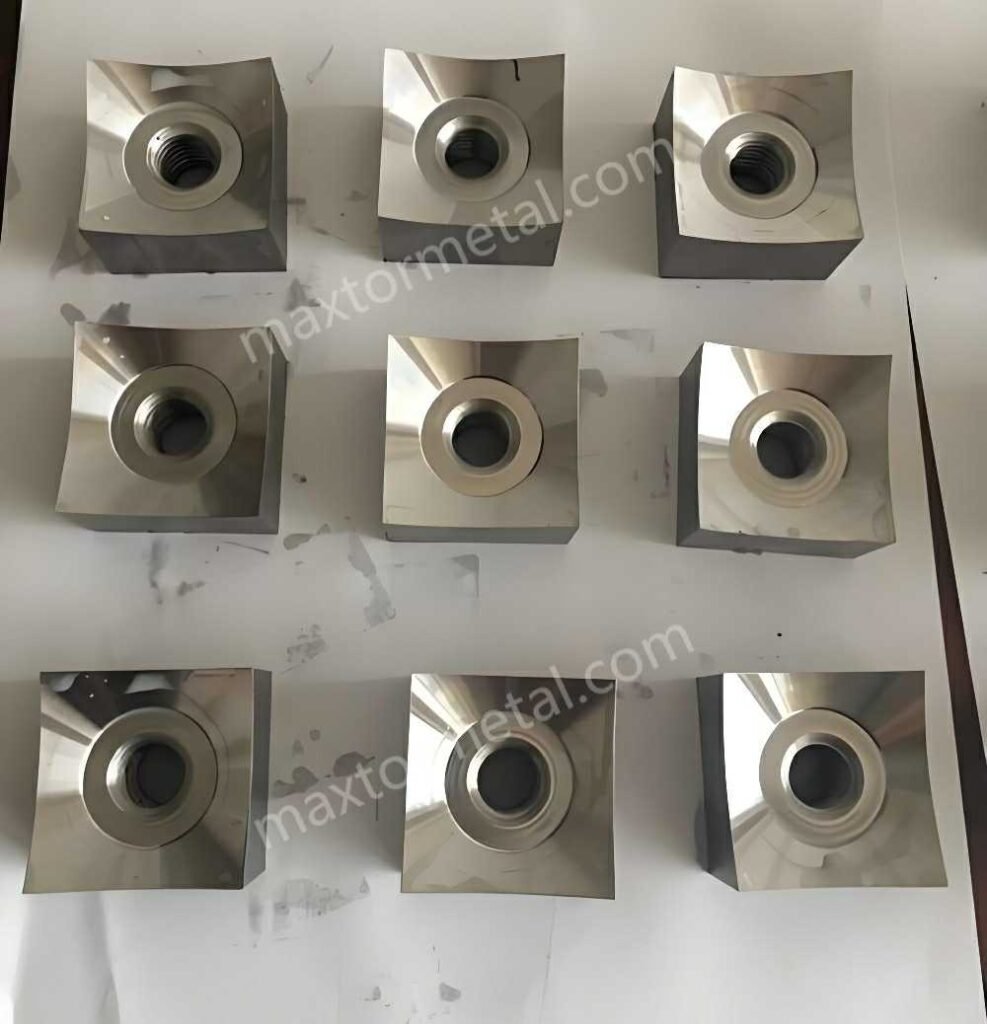
Input: damaged knives and a stopped machine.
Action: record the minimum evidence set below.
Output: a short “failure snapshot” you can compare over time.
- Photos of the chipped edges (close-up + full knife)
- Which knife position failed (rotor location, counter/bed knife location)
- Feed material mix for the last 24–48 hours (and any changes)
- Any notable events: jams, overload trips, abnormal vibration, sudden noise change
- Throughput, screen size, and target output size (if applicable)
- Last maintenance actions: knife flip/rotation, counter knife adjustment, bearing work
Done when: you can describe the failure in one sentence, e.g., “Outer rotor knives chipped at the corners after a jam on mixed WEEE + aluminium.”
Profi-Tipp: If chipping is repeatable, create a simple log sheet. Trend matters more than one-off anecdotes.
Copy/paste templates (for repeatability and traceability)
Failure snapshot (one row per event)
| Date/time | Machine/line | Knife position | Feed mix (last 24–48h) | Notable event (jam/overload/noise) | Pattern observed | Photos link | Hinweise |
|---|---|---|---|---|---|---|---|
Counter knife clearance record (one row per measurement point)
| Datum | Counter knife ID | Point/location | Measured clearance | OEM spec | Pass/Fail | Adjusted? | Technician |
|---|---|---|---|---|---|---|---|
Bolt torque / clamp check (one row per fastener group)
| Datum | Knife/clamp area | Bolt type/size | OEM torque spec | Applied torque | Sequence followed (Y/N) | Re-torque done (Y/N) | Hinweise |
|---|---|---|---|---|---|---|---|
Step 1: Make the machine safe to inspect (general safety context)
This post isn’t legal advice. Always follow your site safety procedures and the machine OEM’s safety instructions before any knife work.
Input: machine ready for inspection.
Action: isolate, lock out/tag out, and verify zero energy.
- Isolate electrical supply; lock off and tag
- Verify zero speed and no stored energy (run-down time is often longer than expected)
- Confirm hydraulic/pneumatic systems are de-energised and depressurised (if present)
- Use appropriate PPE for sharp edges and pinch points
Reference note (standards + OEM manuals): lockout/tagout (LOTO) practices are commonly governed by site procedures and applicable safety standards. For machine-specific steps, always refer to your OEM documentation. For brands such as VECOPLAN, WEIMA, Und Forrec, look for sections titled:
- Safety instructions / General safety
- Lockout-Tagout (LOTO) / Energy isolation / Hazardous energy
- Servicing / Wartung / Knife change / Clearing jams
If you cannot access the manual, request the correct revision from the OEM using your machine model + serial number.
Output: safe access for measurement and inspection.
Done when: you have a verified, documented safe state before any clearance checks.
⚠️ Warnung: “Stopped” isn’t the same as “safe.” Stored energy and unexpected movement are a common injury pathway during knife work.
Stop-and-escalate (do not proceed) if any of the following are true:
- You cannot verify zero energy (electrical, hydraulic, pneumatic, gravity, or spring-loaded)
- Guards/interlocks are missing, bypassed, or cannot be reinstalled correctly
- There is abnormal vibration/noise history suggesting a mechanical fault beyond normal wear
- You suspect structural damage (cracks, loose housings, deformed mounting faces) or severe bearing issues
In these cases, keep the machine isolated and escalate to a qualified maintenance lead or the OEM service team.
Step 2: Read the chipping pattern like a failure code
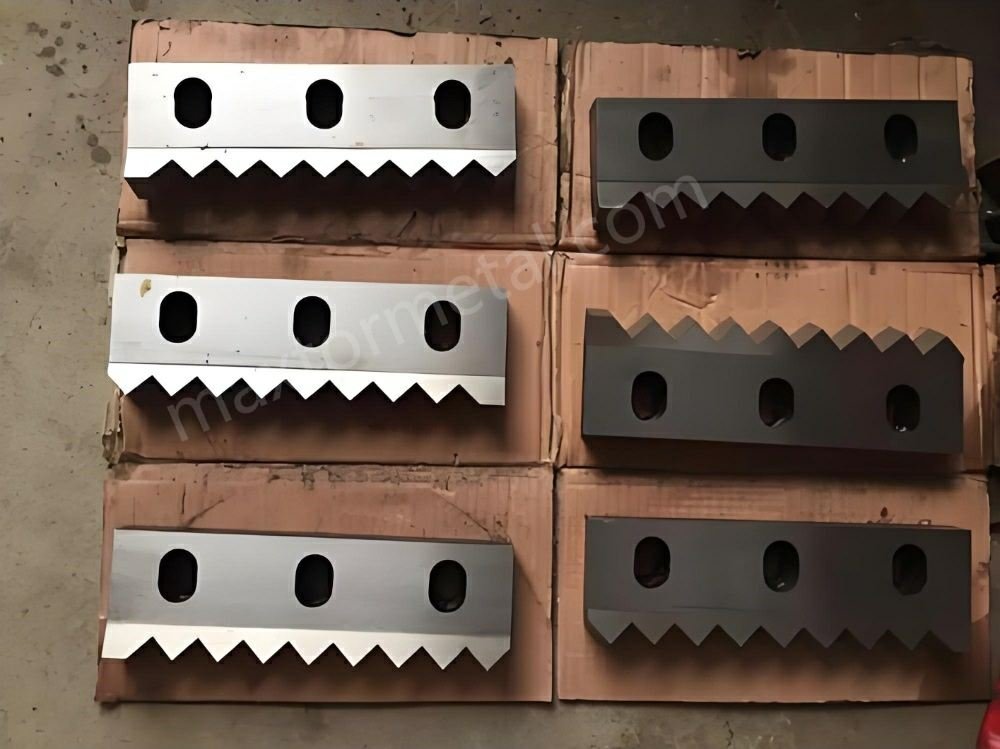
This is where most teams waste time. Instead of debating opinions, treat the damage as data and work through the most likely shredder knife chipping causes in a repeatable order.
Before you adjust anything, interpret the pattern. It helps you avoid “fixes” that just move the problem.
Chipping on knife corners (small chunks missing at the tip)
Common signals:
- Impact with hard contaminants
- Excessive local load due to incorrect clearance or a high spot
- Knife seating issues (debris behind knife, uneven clamp pressure)
Random chipping across multiple knives in one event
Common signals:
- A single severe impact/jam (metal block, thick WEEE cluster)
- Incorrect operating setup (screen/ram settings or too aggressive feed for the material)
Chipping concentrated near one side of the rotor
Common signals:
- Misalignment (rotor to counter knife)
- Bearing wear, rotor runout, or uneven housing wear
- Localised clearance deviation (one end tight)
Step 3: Verify Single Shaft Shredder Blade Chipping risk at the counter knife clearance (don’t guess)
If you only do one thing after a chipping event, do this.
Input: machine isolated and accessible.
Action: measure and adjust counter knife clearance to the OEM spec.
What to check:
- Clearance along the full knife length (not just one point)
- Parallelism: the rotor knife path should be consistent relative to the counter/bed knife
- Counter knife spacer condition (wear, deformation)
- Evidence of rubbing/contact marks (polishing, heat tint, smeared metal)
Output: clearance restored to spec and consistent end-to-end.
Done when: you can document clearance readings and confirm there are no high spots.
Wichtigste Erkenntnis: A “slightly tight” setting can turn normal cutting loads into brittle edge failure. A “slightly wide” setting can increase tearing and impact loading. Both can contribute to shredder blade premature failure.
Step 4: Check knife seating, clamping, and shredder knife installation torque
Chipping is often preceded by micro-movement: the knife shifts, the load becomes uneven, and the edge fails.
Input: knives accessible.
Action: inspect interfaces and confirm bolt torque per OEM.
Inspect:
- Debris, burrs, or dents behind knives and clamp bars
- Clamp bar flatness and contact pattern
- Bolt condition (stretching, thread damage, galling)
- Seating faces for fretting (fine black dust), which indicates movement
Torque discipline (installation torque):
- Use a calibrated torque wrench (not an impact gun)
- Follow the tightening sequence and re-torque protocol from the machine OEM
- If your site standard allows it, mark bolts after tightening so you can spot loosening at a glance
Output: knives are seated flat, clamping is even, and bolts are torqued correctly.
Done when: contact faces are clean and uniform, and torque is verified—not estimated.
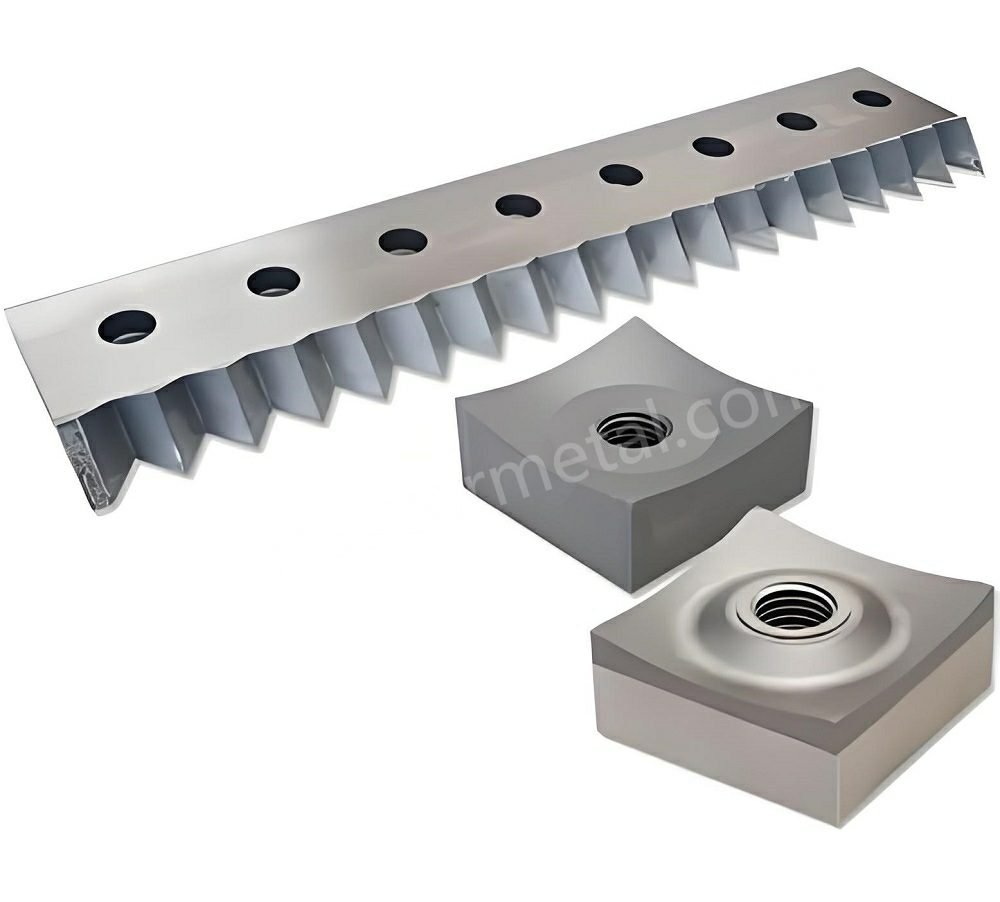
If chipping keeps returning on the same side/zone, stop treating it as a consumable issue.
Input: repeated failures or side-biased chipping.
Action: validate alignment and mechanical health.
Checkliste:
- Bearing condition (play, noise history, temperature trend)
- Rotor runout (dial indicator if available)
- Counter knife mounting faces (wear steps, distortion)
- Rotor knife pocket wear (knife sits differently over time)
Output: a go/no-go decision: is the geometry stable enough to justify new knives?
Done when: you’ve either confirmed geometry is within OEM tolerance or identified the mechanical repair required.
Common mistakes (and what to do instead)
- Don’t set clearance “by feel.” Do measure at multiple points and record readings against the OEM spec.
- Don’t use an impact gun for final tightening. Do use a calibrated torque wrench and the OEM tightening sequence.
- Don’t reuse suspect bolts that show stretching/galling. Do replace fasteners per OEM guidance and track replacements.
- Don’t ignore repeat failures on one side of the rotor. Do check alignment, runout, and mounting-face wear before fitting new knives.
- Don’t keep running after a severe jam/impact event. Do stop, inspect, and re-verify seating/clearance before restart.
- Don’t copy torque/clearance/hardness numbers from another machine. Do use the correct OEM spec for your exact model/revision.
Step 6: Separate process problems from knife problems (feed, settings, and contaminants)
If the knives are failing early, ask: did the job change?
Input: recent change in throughput, material mix, or output spec.
Action: look for load spikes and impact events.
- Mixed feed with hard inclusions (metal, stone, dense WEEE fragments) increases impact risk
- Aggressive push ram settings can drive shock loads into the edge
- Pushing throughput beyond stable cutting increases heat and edge stress
Output: a practical process adjustment list.
Done when: you can name the top 1–2 process variables likely driving shock load.
Step 7: Shredder blade material selection—when to change steel vs fix the system
Material selection matters, but it’s rarely the first lever to pull. Change material only after geometry and installation checks are clean.
Input: repeated chipping after clearance + installation verification.
Action: match blade material/heat treatment to your feed risk profile.
A practical way to think about it:
- High impact / contamination risk → prioritise toughness and chipping resistance
- High abrasion (filled plastics, grit, fibre) → prioritise wear resistance, but don’t ignore brittleness risk
From the MAXTOR METAL shredder blade range, commonly specified materials include SKD-11/D2 and DC53 (selection should follow your application and OEM constraints).
If you’re switching materials, require:
- material certification for each batch
- heat-treatment traceability (process control evidence)
- incoming + in-process + final inspection records where available
To make material trials more reliable, align on what gets measured and which test methods are used (your OEM/spec may require different standards):
- Chemical composition / material certificate (heat number traceability)
- Hardness testing (e.g., Rockwell hardness testing per ISO 6508 series)
- Impact toughness when chipping is the dominant failure (e.g., Charpy impact testing per ISO 148-1)
- Microstructure/metallographic checks if heat-treatment consistency is in doubt
- Dimensional and edge-prep inspection (drawing revision + tolerance + edge prep definition)
Wichtig: do not copy hardness/torque/clearance numbers from other machines. Use OEM specs and validate results in a controlled trial (hours to first chip, tonnes processed, changeover frequency).
Output: a controlled material trial plan.
Done when: you can state what changed, why it should help, and what metric will prove success (hours to first chip, tonnes processed, changeover frequency).
Step 8: Build a prevention plan that reduces unplanned downtime
Use this as a weekly/monthly routine.
Operational controls
- Define “do not shred” contaminants and enforce upstream screening where possible
- Treat jam events as root-cause triggers, not normal production noise
Maintenance controls
- Standardise your clearance verification method and recording
- Standardise bolt replacement intervals if bolt stretch/fretting is observed
- Keep a set of known-good spacers/clamp components for quick swaps
Procurement controls (how to stop repeat failures from supplier variance)
- Lock the specification: drawing revision, tolerances, edge prep, and material standard
- Require traceability: material certs and inspection evidence
- Keep a safety stock sized to your real lead time and failure rate
Where MAXTOR METAL fits (optional)
If your failure snapshot points to fit/compatibility issues, material mismatch, or inconsistent batch quality, it can help to work with a supplier that supports custom manufacturing from drawings/sketches/photos and provides documented QC checkpoints.
MAXTOR METAL provides custom industrial blades and shredder knife sets with OEM/ODM support and structured inspection steps (first-article, incoming material inspection, in-process, and final). See their product pages for:
- MAXTOR METAL shredder blades
- Single shaft shredder rotary/motorized blades
- Single shaft shredder fixed/counter/bed knives
Häufig gestellte Fragen
What’s the fastest way to reduce single shaft shredder blade chipping?
Start with repeatable basics: document the failure pattern, then verify counter knife clearance and knife seating/torque to OEM spec. If those are inconsistent, changing material usually won’t fix the root cause.
Can incorrect counter knife clearance really cause chipping?
Yes. Clearance that’s too tight can create local overload and edge contact. Clearance that’s too wide can increase tearing and impact loading. In both cases, the edge sees abnormal stress that can trigger chipping.
Is chipping always caused by hard contaminants?
Not always. Contaminants are a common trigger, but repeated chipping on the same side/zone often points to misalignment, runout, or inconsistent seating/clamping.
Should we switch to a harder steel to stop chipping?
Hardness can improve wear resistance, but chipping is often a toughness problem—especially in mixed feed with impact events. Treat material changes as a controlled trial after mechanical checks are confirmed.
What should we ask a supplier for to avoid premature failure?
Ask for traceability and repeatability: material certification, heat-treatment evidence, inspection steps, and clear drawing/tolerance control. Procurement control is a downtime control.
Next steps
If you want a faster root-cause diagnosis, share (1) photos of the chipped edge, (2) your feedstock mix, and (3) the knife drawing or key dimensions. We can suggest a practical check sequence and a material option shortlist focused on reducing unplanned downtime.
References (standards mentioned)
- ISO 6508-1 — Metallic materials — Rockwell hardness test — Part 1: Test method (ISO standard page): https://www.iso.org/standard/70460.html
- ISO 148-1 — Metallic materials — Charpy pendulum impact test — Part 1: Test method (ISO standard page): https://www.iso.org/standard/63802.html
Note: Your OEM specification or customer drawing may require additional parts (machine verification, reference blocks, specimen preparation) or alternative standards. Always align the acceptance criteria with the controlling specification.
Autor
Tommy Tang — Senior Sales Engineer, Nanjing METAL Industrial
- 12 years in industrial blade applications and sourcing support
- Zertifizierungen: CSE, CME, Six Sigma Green Belt, PMP
- Webseite: https://maxtormetal.com/

 English
  Spanish
  Italian
  French
  Portuguese
  Russian
  German
  Arabic
  Hindi
Hindi  Vietnamese
  Indonesian
  Japanese
  Korean