

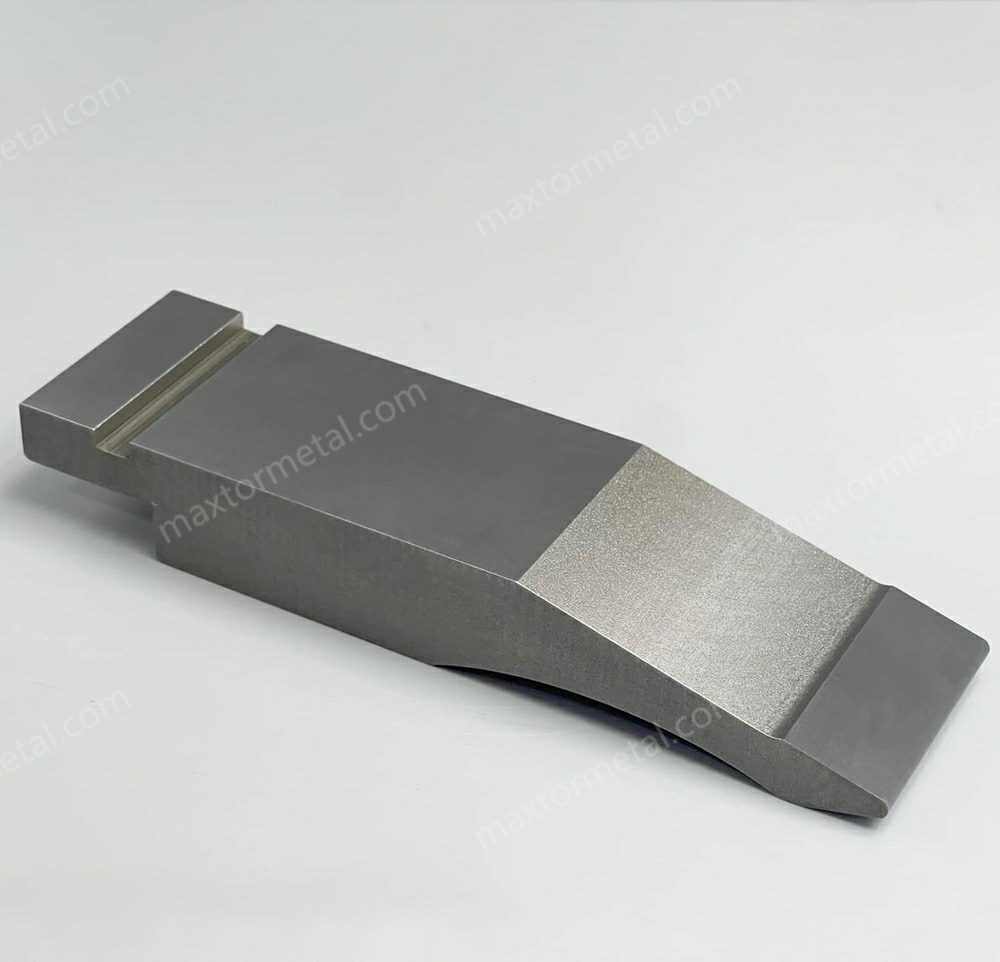
Choosing the right V-die opening starts with knowing your material thickness. You can refer to our Guide de l'outillage de presse plieuse pour débutants to help you with this process. This guide assists in keeping your bends correct and your shop safe. Picking the right V-die lowers the chance of accidents and provides you with better results. A wider V-die helps bridge the die safely, reducing the risk when bending. The easy chart included in the guide helps you feel confident at every step.
- Picking the right V-die lowers accident risks and makes bends better.
- Wider V-dies make bridging safer for brittle materials.
Principaux points à retenir
- Know how thick your material is. Measure it carefully so you can pick the right V-die opening.
- Use the Rule of Eight. Multiply your material thickness by eight to get the best V-die size.
- Pick the correct V-die type. Different materials need different die openings for safe and good bending.
- Check your press brake’s tonnage capacity. Make sure it can handle the force for your V-die and material.
- Test with scrap material first. Always do a test bend to make sure your setup works before starting your real project.
- Watch out for common mistakes. Do not ignore material properties or skip math, or you might get bad results.
- Put safety first. Always wear PPE and follow machine safety rules to keep yourself and others safe.
- Take care of your tools often. Check and clean your dies and punches so they work well and last longer.
V-Die Basics
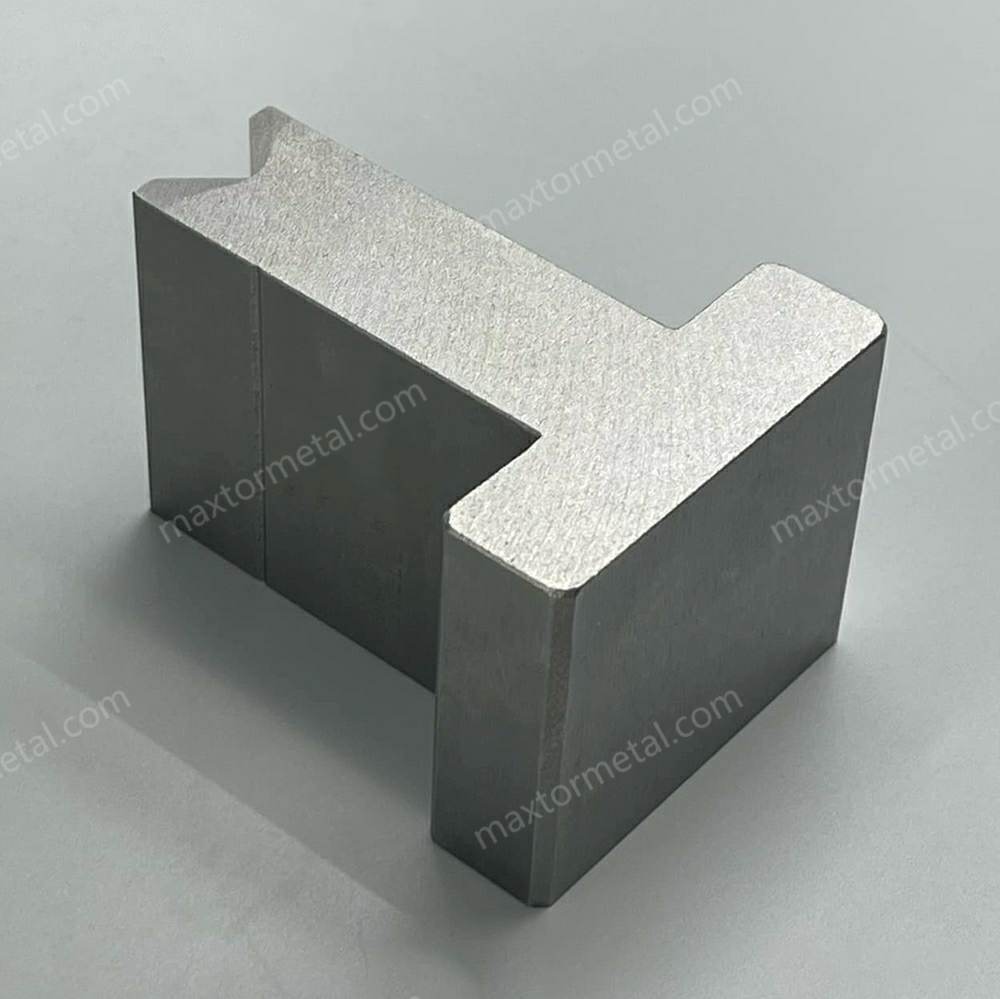
What Is a V-Die
You might wonder what a V-die is when you first hear about press brake tool types. A V-die looks like a block of metal with a V-shaped groove cut into it. This groove is where the magic happens. When you place your sheet metal over the V-die and press down with the punch, the metal bends right along the groove. V-dies come in different shapes and sizes, so you can bend all kinds of materials. Here are some common V-die types you’ll see in shops:
- Single V Die – One groove for basic bends.
- Double V Die – Two grooves, so you can switch sizes without changing tools.
- Multi-V Die – Several grooves for more options and faster work.
| V-Die Type | Description |
|---|---|
| Matrice en V simple | One groove, great for simple bends. |
| Double V Die | Two grooves, lets you switch between sizes quickly. |
| Multi-V Die | Many grooves, perfect for different jobs and saving time. |
You’ll find V-dies in almost every metal shop. They help you bend steel, aluminum, and other metals. If you need a special blade or shape, you can check out custom options like Lames Sur Mesure.
Why V-Die Size Matters
Choosing the right V-die size is super important. The size of the opening affects how your metal bends. If you use a wider V-die, you get a bigger bend radius. That means your bend will be smoother and less likely to crack. If you use a narrow V-die, you get a tighter bend, but you risk breaking the metal if it’s too thick or hard.
Tip: The sweet spot for most bends is using a V-die opening that’s about 8 times the thickness of your material. This helps you get a clean bend without damaging your metal.
When you use the right V-die size, your bends look better and your parts fit together the way you want. If you use the wrong size, you might see cracks, rough edges, or bends that don’t match your plans.
Punch and Die Overview
Let’s talk about how the punch and V-die work together. The punch is the top part of the press brake. It pushes down on your metal, forcing it into the V-die below. The V-die supports the metal and shapes the bend. You need both parts to make a good bend.
There are many press brake tool types, but the punch and V-die are the most common. You can choose different punches for different shapes, like gooseneck punches for deep bends or flat punches for simple angles. Nanjing Metal uses strong materials like 42CrMo alloy steel for their punches and dies. This means you get tools that last longer and work well in tough jobs. You’ll see these tools used in car factories, airplane parts, furniture, and even farm equipment.
When you pick the right punch and V-die, you make your press brake tooling work better. You get cleaner bends, safer operations, and parts that fit your needs.
Facteurs clés de sélection
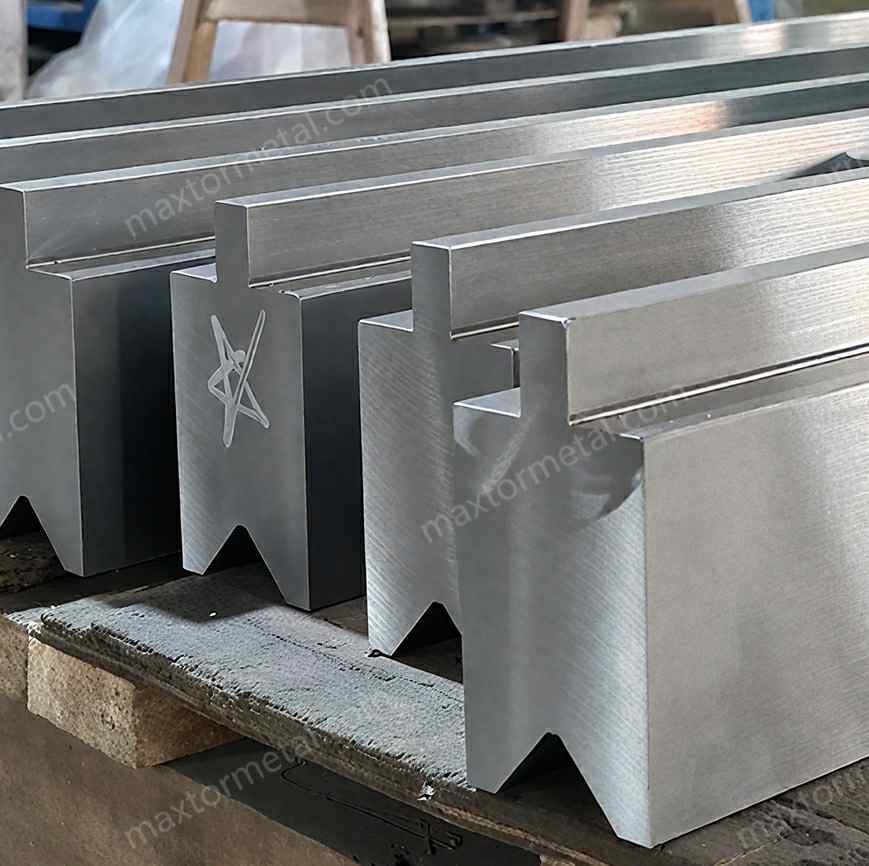
When you start working with press brake tooling, you need to think about a few key things before you pick your V-die. The right choice helps you get clean bends, keeps your press brake safe, and makes your bending process much smoother. Let’s break down the main factors you should consider.
Type de matériau
Définition
Material type means what kind of metal you plan to bend. Common choices include mild steel, stainless steel, and aluminum. Each metal acts differently during the bending process.
| Propriété | Description | Impact on V-die Selection |
|---|---|---|
| Type de matériau | Steel, aluminum, and other metals have unique properties. | Changes the V-die size you need for safe, clean bending. |
| Résistance à la traction | How much force the metal can take before breaking. | Higher strength needs a bigger V-die to avoid cracking. |
| Ductilité | La capacité d'allongement du métal sans rupture. | Les métaux plus ductiles peuvent supporter des plis plus serrés. |
Critères de sélection
Vous devez adapter votre matrice en V à votre matériau. Les métaux plus doux comme l'aluminium se plient facilement, vous pouvez donc utiliser une ouverture de matrice en V plus petite. Les métaux plus durs, tels que l'acier inoxydable, nécessitent une ouverture plus grande. Cela permet d'éviter les fissures et de maintenir votre outillage de presse plieuse en bon état. Vérifiez toujours la ductilité et la résistance à la traction du métal avant de commencer.
Exemple pratique
Si vous souhaitez plier une pièce d'acier inoxydable, vous devez choisir une matrice en V légèrement plus grande que celle que vous utiliseriez pour de l'acier doux de même épaisseur. Cela vous évite de rompre le métal pendant le processus de pliage.
Épaisseur
Définition
L'épaisseur correspond à l'épaisseur de votre tôle. Elle est généralement mesurée en millimètres ou en pouces. L'épaisseur détermine la force requise et la taille de la matrice en V à utiliser.
| Épaisseur du matériau (mm) | Ouverture de matrice en V recommandée (mm) |
|---|---|
| 2 | 16 |
| 3 | 24 |
| 5 | 40 |
Critères de sélection
Plus votre métal est épais, plus l'ouverture de votre matrice en V doit être large. Si vous utilisez une matrice en V trop petite, vous aurez besoin de plus de force, ce qui peut endommager votre presse plieuse ou l'outillage. Par exemple, une tôle d'acier de 5 mm fonctionne de manière optimale avec une ouverture de matrice en V comprise entre 25 mm et 60 mm, 40 mm constituant un bon compromis. Assurez-vous toujours que l'ouverture de votre matrice est au moins égale à deux fois l'épaisseur de votre tôle.
Conseil : Une mauvaise qualité de pliage, des fissures sur la tôle ou des besoins en force élevés signifient souvent que votre matrice en V est trop petite pour l'application.
Exemple pratique
Prenons l'exemple d'une tôle d'acier doux de 3 mm d'épaisseur. Vous devriez utiliser une ouverture de matrice en V d'environ 24 mm. Cette dimension vous garantit un pliage propre et préserve votre outillage de presse plieuse.
Angle de courbure
Définition
L'angle de pliage est l'angle que vous souhaitez former dans votre métal. Vous pouvez avoir besoin d'un angle aigu ou d'un angle ouvert, selon votre projet.
Critères de sélection
L'ouverture de la matrice en V influe sur votre angle de pliage. Pour les matériaux fins (jusqu'à 4 mm), une matrice en V d'environ six fois l'épaisseur convient parfaitement. Pour les matériaux plus épais, utilisez une matrice en V de huit fois l'épaisseur. Si votre matrice en V est trop grande, votre angle de pliage risque d'être incorrect et le métal pourrait ne pas se plier comme souhaité. Si elle est trop petite, vous risquez un surpliage ou même une rupture de la tôle.
Exemple pratique
Si vous souhaitez un pli à 90° sur une tôle de 2 mm, utilisez une ouverture de matrice en V de 16 mm. Pour un angle plus aigu, vous pourriez avoir besoin d'une matrice légèrement plus petite, mais vérifiez toujours que vous ne surchargez pas votre presse plieuse.
Tonnage
Définition
Le tonnage désigne la quantité de force dont votre presse plieuse a besoin pour plier le métal. Cette force est mesurée en tonnes. À chaque opération de pliage, vous devez connaître le tonnage que votre machine peut supporter. Si vous appliquez trop de force, vous risquez d'endommager votre presse plieuse ou votre outillage. Si vous en appliquez trop peu, votre métal risque de ne pas se plier du tout.
| Terme | Ce que cela signifie |
|---|---|
| Tonnage | Force requise pour le pliage |
| Capacité | Force maximale que votre machine peut appliquer |
Critères de sélection
Vous devez adapter votre tonnage à votre opération de pliage. Commencez par vérifier l'épaisseur et le type de votre matériau. Les métaux plus épais ou plus durs nécessitent plus de force. Les métaux plus doux ou plus fins en nécessitent moins. La taille de votre matrice en V modifie également le tonnage. Une matrice en V plus large réduit la force requise, tandis qu'une matrice en V étroite l'augmente.
Conseil : Vérifiez toujours la capacité de tonnage nominale de votre presse plieuse avant de commencer. Si vous poussez votre machine au-delà de ses limites, vous risquez de casser des pièces ou de vous blesser.
Voici quelques éléments à garder à l'esprit :
- Utilisez une ouverture de matrice en V adaptée à l'épaisseur de votre matériau. La règle des huit vous aide à choisir la bonne taille.
- Si vous choisissez une matrice en V trop petite, vous aurez besoin d'un tonnage plus élevé. Cela peut user votre presse plieuse plus rapidement.
- Si vous choisissez une matrice en V trop grande, votre pli risque de ne pas être assez net.
Exemple pratique
Supposons que vous souhaitiez plier une tôle d'acier inoxydable de 4 mm d'épaisseur. L'acier inoxydable est résistant, vous avez donc besoin de plus de force que pour de l'acier doux. Si vous utilisez une ouverture de matrice en V de 32 mm (en suivant la règle des huit), votre presse plieuse aura besoin d'environ 40 tonnes de force pour un pliage standard de 1 mètre. Si votre machine ne peut supporter que 30 tonnes, vous devez utiliser une matrice en V plus large ou plier une pièce plus courte.
Voici un moyen rapide de vérifier si votre configuration convient :
- Mesurez l'épaisseur de votre matériau.
- Multipliez par huit pour obtenir l'ouverture de votre matrice en V.
- Utilisez un tableau ou un calculateur de tonnage pour vérifier si votre presse plieuse peut effectuer le travail.
En cas de doute, effectuez un essai de pliage sur une chute de métal. Cela vous évite des erreurs et préserve votre presse plieuse.
Erreurs courantes de débutant
De nombreux débutants commettent des erreurs simples concernant le tonnage. En voici quelques-unes à éviter :
- Ignorer le tonnage maximal de la presse plieuse. Cela peut casser votre machine.
- Utiliser la même matrice en V pour chaque opération de pliage. Différents matériaux nécessitent des configurations différentes.
- Oublier de vérifier le tableau de tonnage avant de commencer.
- Essayer de plier des métaux épais ou durs sans ajuster la taille de la matrice en V.
Remarque : Double-contrôlez toujours vos chiffres et utilisez des tableaux de référence. La sécurité passe avant tout lors de l'utilisation de presses plieuses.
Guide de l'outillage de presse plieuse pour débutants
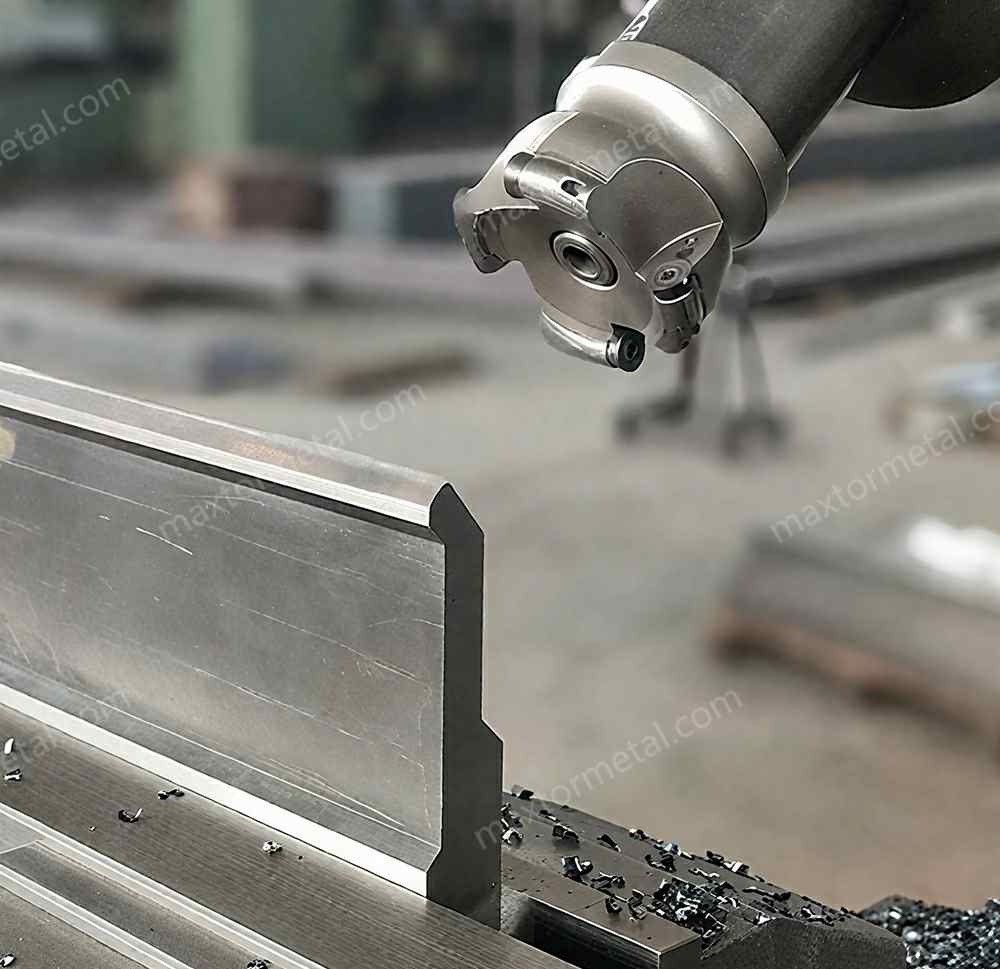
La règle des huit
Vous entendrez peut-être parler de la règle des huit lorsque vous commencerez à travailler avec l'outillage de presse plieuse. Cette règle facilite grandement le choix de l'ouverture de votre vé. La règle des huit stipule que vous devez choisir une ouverture de vé égale à huit fois l'épaisseur de votre matériau. Par exemple, si votre tôle fait 3 mm d'épaisseur, il vous faut une ouverture de vé de 24 mm. Cette formule simple vous permet d'obtenir des plis nets et de préserver la sécurité de votre presse plieuse.
Conseil: La règle des huit est très populaire dans les ateliers du monde entier. Elle vous aide à suivre les meilleures pratiques et garantit la fluidité de votre processus de pliage. Vous pouvez utiliser cette règle pour la plupart des matériaux, mais vérifiez toujours si votre projet nécessite un ajustement particulier.
Voici un aperçu rapide du fonctionnement de la règle des huit :
Ouverture du vé = 8 × épaisseur du matériau
Pour vous le représenter visuellement, imaginez une flèche pointant de l'épaisseur de votre matériau vers l'ouverture du vé. Cette formule vous aide à choisir le bon outil à chaque fois.
Sélection étape par étape
Passons en revue les étapes à suivre pour choisir un vé pour votre outillage de presse plieuse. Ces étapes simplifient le processus et vous évitent les erreurs courantes.
Étape 1 : Identifiez le type de matériau
Tout d'abord, déterminez le type de métal avec lequel vous travaillez. Pliez-vous de l'acier doux, de l'acier inoxydable ou de l'aluminium ? Chaque matériau se comporte différemment lors du pliage. L'acier doux est plus mou, l'acier inoxydable est plus résistant et l'aluminium se plie facilement.
Note: Connaître votre type de matériau vous aide à choisir la bonne ouverture de vé. Certains métaux nécessitent des ouvertures plus grandes ou plus petites pour éviter les fissures ou les plis irréguliers.
Step 2: Measure Material Thickness
Next, measure the thickness of your sheet metal. Use a caliper or a thickness gauge for the best results. Even a small mistake in measuring can change your bend quality.
Conseil: Always double-check your measurement. Accurate thickness means better bends and safer press brake tooling.
Step 3: Apply the Rule of Eight
Now, use the Rule of Eight. Multiply your material thickness by eight to find your recommended V-die opening. For example, if your metal is 2 mm thick:
2 mm × 8 = 16 mm V-die opening
This step helps you match your die to your material. Most shops use this rule because it works well for many jobs.
Step 4: Check Press Brake Capacity
Before you start bending, make sure your press brake can handle the force needed for your chosen V-die and material. If you use too much force, you can damage your machine or your tooling.
Note: Always check your press brake’s tonnage rating. Overloading your machine can lead to costly repairs and unsafe working conditions.
Step 5: Test and Adjust
Do a test bend with a scrap piece of your material. Look at the bend quality. If the bend isn’t right, adjust your V-die size or check your measurements. Sometimes you need a slightly bigger or smaller die to get the perfect bend.
Conseil: Testing helps you catch mistakes early. It saves you time and keeps your press brake tooling in good shape.
Adjusting for Special Cases
Sometimes, you need to adjust the Rule of Eight for special materials or tight bends. Not all metals bend the same way. Stainless steel is harder than mild steel, so you might need a bigger V-die opening. Aluminum is softer, so you can use a smaller opening.
Here’s a quick guide for special cases:
| Matériau | Multiplier for V-die Opening | Example for 2mm Thickness |
|---|---|---|
| Acier doux | 8 × thickness | 16 mm |
| Acier inoxydable | 10–12 × thickness | 20–24 mm |
| Aluminium | 6 × thickness | 12 mm |
- For stainless steel, try a V-die opening of 18 mm or 20 mm for a 2 mm sheet. This helps prevent cracking.
- For aluminum, you can use a smaller opening, like 12 mm for a 2 mm sheet.
Note: Always check material charts or manufacturer guidelines for best results. If you need a custom solution for a tricky job, you can explore Lames Sur Mesure designed for special bends.
If you work with unique materials or need a special bend radius, you might want to talk to a tooling expert.
Choosing the right V-die opening is easy when you follow these steps. You keep your bends clean, your shop safe, and your press brake tooling working for years.
V-Die Size Impact

Choosing the right press brake tooling is more than just picking a die that fits. The V-die size you select changes how your bends look, how much force you need, and even how your metal acts after bending. Let’s break down why this matters for every beginner following a press brake tooling guide for beginners.
Bend Quality
When you use the right press brake tooling, your bends come out clean and accurate. The V-die opening controls the bend radius and the surface finish. If you pick a die that’s too small, you might see cracks or rough edges. If you go too big, your bend could look sloppy or not match your plans.
Here’s a quick table to show how different bending methods affect the bend radius:
| Méthode de pliage | Description | Bend Radius Relation |
|---|---|---|
| Flexion de l'air | The punch doesn’t press all the way into the die. | Depends on V-die size, offers flexibility but less precision. |
| Toucher le fond | The punch nearly touches the die bottom. | Bend radius is closer to punch tip, more consistent. |
| frappe de monnaie | The punch fully presses the metal into the die. | Radius equals punch tip, most accurate and smallest bend radius. |
You want to avoid these common bend quality problems:
- Cracks from over-tight bends
- Deformed edges or wrinkles
- Misaligned holes or features near the bend
- Increased springback that changes the final shape
A good press brake tooling guide for beginners always reminds you to set your bend radius to at least one times your material thickness. Keep holes and cutouts away from the bend line, and use consistent bend directions. These tips help you get the most out of your right press brake tooling.
Tonnage Load
The size of your V-die has a big effect on how much force your press brake needs. If you use a small V-die opening, the force gets focused on a tiny area. This means you need more tonnage to make the bend. If you use a wider V-die, the force spreads out, and your press brake doesn’t have to work as hard.
For example, if you’re bending thin metal, a die opening about six times the thickness works well. For thicker metal, you might need a die opening ten or even twelve times the thickness. This helps you manage the tonnage and keeps your machine safe.
Conseil: Never push your press brake past its tonnage limit. Too much force can damage your tooling, ruin your parts, or even hurt you.
Here’s what can happen if you pick the wrong V-die size:
- Tool damage
- Inaccurate bending
- Not enough force to finish the bend
A press brake tooling guide for beginners always tells you to check your machine’s tonnage rating before you start. Use the right press brake tooling for your job, and you’ll avoid costly mistakes.
retour au ressort
Springback happens when your metal tries to return to its original shape after bending. The V-die size you choose changes how much springback you get. Thicker materials and larger bend angles usually mean more springback. If you use a die that’s too small, you might see even more springback, which can mess up your final part.
You can control springback by:
- Overbending: Bend the metal a little more than you need, so it springs back to the right angle.
- Using the right punch angle: For example, use an 88-degree punch if you expect 2 degrees of springback.
- Picking the right press brake tooling: A punch with a larger nose radius can help reduce stress and springback.
Note: Always do a test bend and check your results. If you see too much springback, adjust your V-die size or try a different punch.
If you ignore springback, you might end up with parts that don’t fit or meet your specs. A good press brake tooling guide for beginners will always remind you to check for springback and make adjustments as needed.
Why V-Die Size Matters for Safety and Efficiency
Using the right press brake tooling keeps your shop safe and your work efficient. If you use a V-die that’s too small, you risk:
- Excessive tonnage that can damage your press brake or tooling
- Material cracking or incomplete bends
- Operator injury
If your V-die is too large, you might see:
- Poor bend accuracy
- Excessive bend radius
- Parts that don’t meet your specifications
Always check your V-die size with reference charts and do a test bend before starting a big job. This simple step, found in every press brake tooling guide for beginners, saves you time and keeps your projects on track.
Erreurs courantes
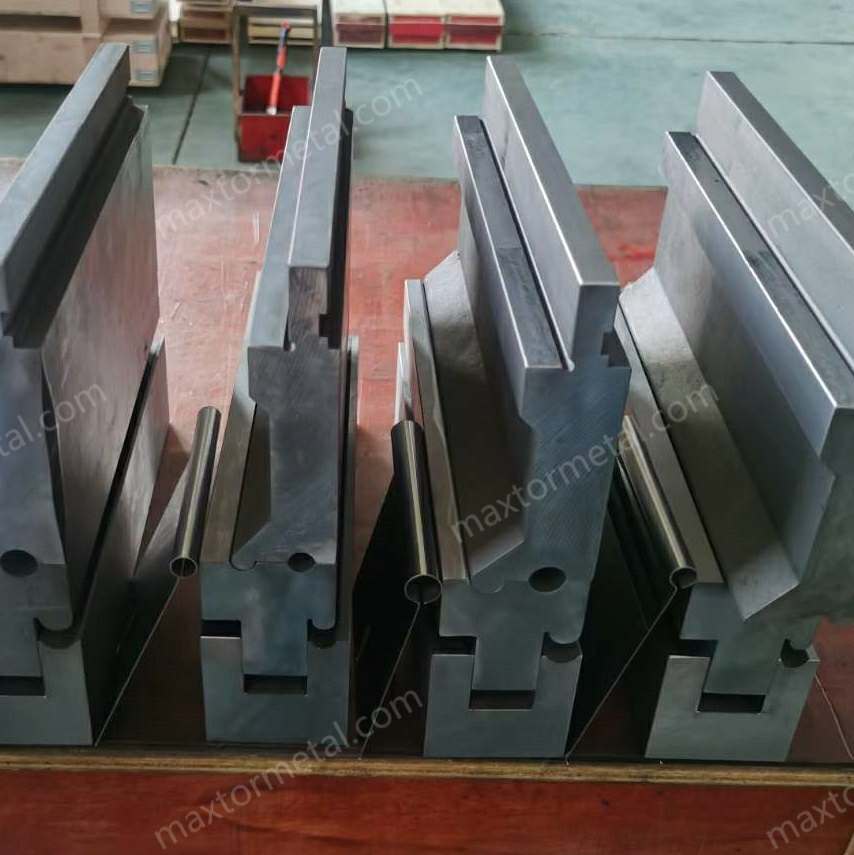
Wrong Die Size
Common Signs
You might notice a few things when you use the wrong die size with your press brake tools:
- The bend does not match your drawing or plan.
- The corners look too sharp or too rounded.
- Cracks appear along the bend line.
- The metal does not sit flat after bending.
- You hear odd noises or feel extra resistance during the bending process.
Many beginners underestimate how important die width is for the material thickness. Sometimes, you might pick a die that is too narrow or too wide, thinking it will work for every job.
Conséquences
Using the wrong die size can cause several problems:
- Your parts may not fit together as planned.
- The metal can crack or break, especially if the die is too small.
- You might damage your press brake tools or even the press brake itself.
- Improper alignment can lead to equipment damage.
- You may see tool wear or even risk injury if the material slips or breaks.
A die that is too wide can give you a bend radius that is too large, which may not look good or meet your needs.
Comment éviter
You can avoid these mistakes by:
- Always matching the die width to your material thickness.
- Using a reference chart or the Rule of Eight to pick the right die.
- Checking your press brake tools before each job.
- Doing a test bend with scrap material to see if the bend looks right.
- Remembering that wider dies can help with larger corner radii, which sometimes look better for certain projects.
Surcharge
Common Signs
Overloading your press brake is dangerous. Here are some signs you might notice:
- You hear loud bangs or strange noises during bending.
- You see cracks or even pieces breaking off your tooling.
- The press brake ram looks bent or out of place.
- Broken pieces may fall from the tooling, which is a big safety risk.
Conséquences
If you overload your press brake, you could face:
- Permanent damage to your press brake, like ram upset or deflection.
- Tooling that cracks, explodes, or wears out quickly.
- Material that cracks or does not bend at all.
- Serious injuries to you or others in the shop.
Inadequate support for the material can also cause excessive force on the dies or the press brake, leading to more problems.
Comment éviter
You can prevent overloading by following these steps:
| Preventive Measure | Description |
|---|---|
| Proper Tool Selection | Make sure your tooling matches the material type and thickness. |
| Match Tooling to Specs | Use tooling that fits your press brake’s tonnage capacity. |
| Select Appropriate Dies | Choose dies based on material and thickness for correct tonnage. |
| V-die Width Selection | Pick a V-die opening 6 to 12 times the sheet thickness. |
| Pratiques d'entretien | Keep your tools in good shape with regular checks and maintenance. |
Also, always check that your press brake tools match the machine’s specs, like tonnage and bed length. Never guess—use charts and guides.
Ignoring Material Properties
Common Signs
If you ignore material properties, you might see:
- Cracks along the bend, especially in hard or brittle metals.
- The bend angle is not what you expected.
- The metal springs back too much after bending.
- You need more force than usual to make the bend.
Conséquences
Ignoring the properties of your material can lead to:
- More force needed for high-tensile materials, which can damage your press brake tools.
- Parts that do not meet your specs because of unexpected springback.
- Cracking, especially if you bend against the grain in metals like aluminum.
- Wasted material and time from failed bends.
Material properties like tensile strength and ductility play a big role in the bending process. Thicker or harder metals need larger bend radii and more tonnage.
Comment éviter
To avoid these issues:
- Always check the material’s tensile strength and ductility before bending.
- Use a larger V-die opening for tougher metals.
- Try to bend perpendicular to the grain direction to reduce cracking.
- Adjust your die selection based on the type and thickness of the metal.
- Use reference charts and manufacturer guidelines for best results.
Tip: Knowing your material helps you choose the right press brake tools and keeps your bending jobs safe and accurate.
Skipping Calculations
Common Signs
You might skip calculations when you feel rushed or think you know the answer. Here are some signs that you missed this step:
- You guess the V-die opening instead of measuring.
- You use the same die for every job.
- You notice bends that look wrong or don’t match your plans.
- You see cracks or uneven bends in your metal.
Conséquences
Skipping calculations can cause big problems. Your bends might not fit together. You could damage your press brake or your tooling. Sometimes, you waste material because the bend is off. You might even risk safety if the metal slips or breaks.
Comment éviter
You can avoid these mistakes by using simple calculation methods. Always measure your material thickness. Use the Rule of Eight or check a reference chart. Try these methods for better results:
| Méthode | Description | Formula/Calculation Example |
|---|---|---|
| Air Forming | Inside bend radius is a percentage of the die opening. | Inside radius = Die opening × 20% |
| Perfect Die Opening | Establishes the radius regardless of forming method. | Die opening = (Outside radius × 0.7071) × 4 |
| Springback Adjustment | Adjusts die opening based on material thickness to account for springback. | For <0.125 in: (Outside radius × 0.7071) × 4.85 |
Tip: Always double-check your numbers before you start. A quick calculation saves you time and keeps your press brake safe.
Safety Reminders
Always Wear PPE
You should always wear personal protective equipment (PPE) when working with metal. Safety glasses, gloves, and steel-toed boots protect you from sharp edges and flying debris. Even a small mistake can cause injury, so gear up every time.
Follow Machine Safety Protocols
Press brake machines have safety rules for a reason. Make sure you know how to use the emergency stop. Keep your hands away from moving parts. Never reach into the machine while it’s running. If you follow these protocols, you keep yourself and others safe.
Keep Work Area Clear
A clean work area helps you avoid accidents. Remove scrap pieces and tools from the floor. Make sure you have enough space to move around. If you keep your area tidy, you lower the risk of trips and falls.
Note: Safety is everyone’s job. Remind your coworkers to follow these steps, too.
Tool Inspection and Maintenance
Regularly Inspect Dies and Punches
You should check your dies and punches before each job. Look for cracks, chips, or worn edges. If you spot damage early, you prevent bigger problems later.
Replace Worn or Damaged Tooling
Don’t use tooling that looks worn out or broken. Replace it right away. Fresh tooling gives you better bends and keeps your press brake working longer.
Keep Tooling Clean and Properly Stored
Clean your tooling after each use. Store it in a dry place where it won’t get bumped or scratched. Good storage habits help your tools last longer and work better.
Tip: Regular maintenance saves you money and keeps your shop running smoothly.
Reference Chart & Example
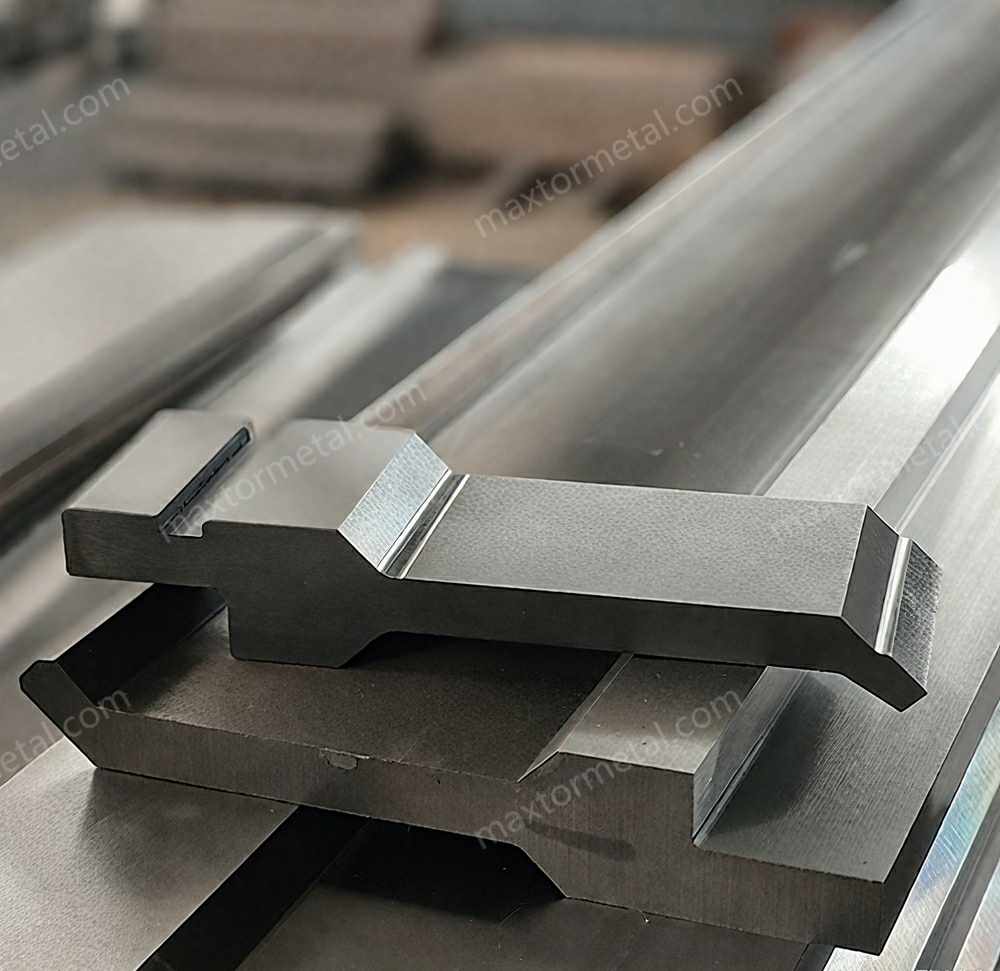
V-Die Opening Chart
You might wonder how to pick the right V-die size for your press brake tooling. The easiest way is to use a reference chart. This chart shows you the standard V-die openings for different material thicknesses. You can check your material thickness and find the matching V-die width.
| Die Type | V-Opening Width (mm) | Minimum Material Thickness (mm) | Maximum Material Thickness (mm) |
|---|---|---|---|
| V-10 | 10 | 0.5 | 3.0 |
| V-16 | 16 | 0.8 | 5.0 |
| V-20 | 20 | 1.0 | 8.0 |
| V-25 | 25 | 1.2 | 10.0 |
| V-30 | 30 | 1.5 | 12.0 |
| V-40 | 40 | 2.0 | 20.0 |
| V-50 | 50 | 2.5 | 30.0 |
| V-60 | 60 | 3.0 | 40.0 |
| V-80 | 80 | 4.0 | 60.0 |
| V-100 | 100 | 5.0 | 80.0 |
You can also look at this chart to see how the minimum and maximum thicknesses change with each V-die opening:
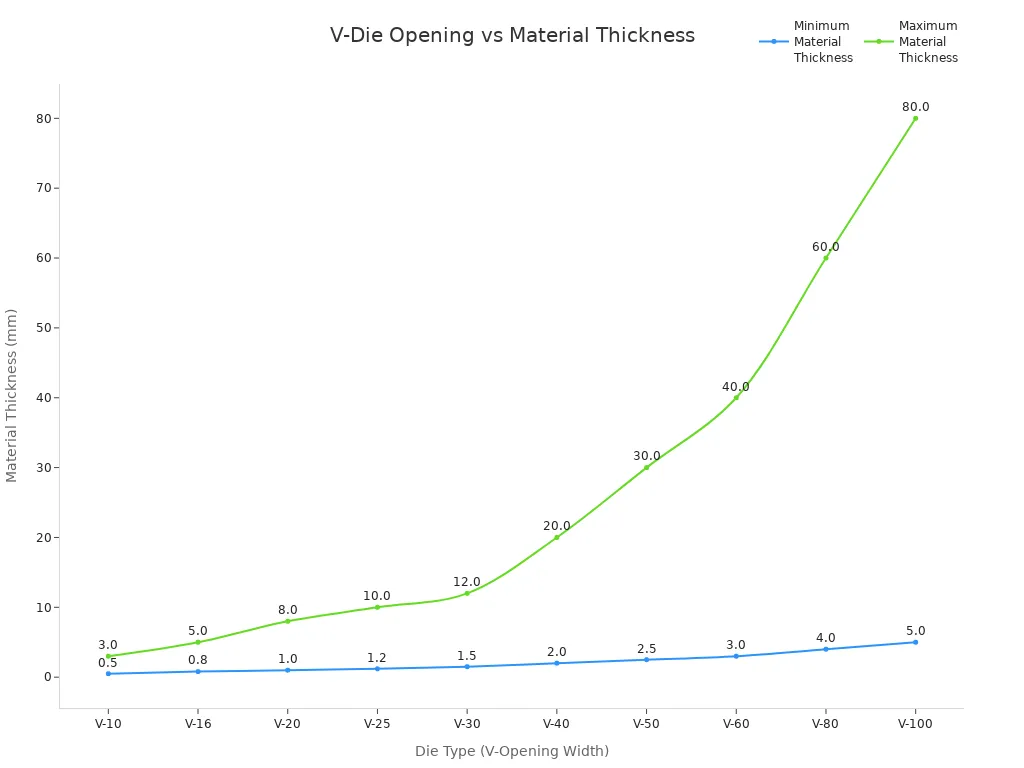
Conseil: Always use a chart like this before you start bending. It helps you avoid mistakes and keeps your press brake tooling in good shape.
Sample Calculation
Let’s walk through a quick example using the Rule of Eight. This rule makes V-die selection easy for most jobs.
- Measure your material thickness. Let’s say you have a steel sheet that is 3 mm thick.
- Multiply the thickness by 8.
3 mm × 8 = 24 mm - Choose a V-die with an opening close to 24 mm. You can use a V-25 die, which has a 25 mm opening.
If your material is thicker than 12 mm, you might want to use a multiplier of 10 instead. For example, a 15 mm thick plate would need a V-die opening of 150 mm.
Note: The Rule of Eight works best for cold-rolled steel and most standard jobs. For thicker or harder materials, use a larger V-die to prevent cracking.
Online Tools
You can make your press brake tooling choices even easier with online calculators. These tools help you find the right V-die size based on your material thickness and type.
- PRESS BRAKE CALC. | RMT – Revolution Machine Tools™: This calculator works for materials from 26 gauge up to 1 inch thick. You just enter your material thickness, and it suggests the best V-die opening.
- Air bending tonnage charts: These charts show you the force needed for different V-die sizes and materials. You can use them to check if your press brake can handle the job.
Conseil: Online tools save you time and help you avoid costly mistakes. Try a calculator before you start your next project.
With these charts, sample calculations, and online tools, you can pick the right V-die for your press brake tooling every time. You get better bends, safer work, and less stress in your shop.
Conseils pour réussir

Consultez des experts
You might feel unsure when you start with press brake tooling. That’s normal. You can always reach out to tooling experts if you need help. These professionals know how to match the right V-die to your material and project. They can answer your questions about custom bends or unusual materials. If you run into a tricky job, an expert can save you time and prevent mistakes.
Nanjing Metal offers support for custom press brake tooling. You can ask about special shapes, sizes, or materials. Tooling experts help you avoid common errors and keep your bending process smooth. You get advice that fits your needs, not just general tips.
Conseil: Don’t guess if you’re unsure. Ask an expert. You’ll get better results and feel more confident with every project.
La sécurité avant tout
Safety matters every time you use press brake tooling. You need to protect yourself and others in the shop. Always wear personal protective equipment (PPE) like safety glasses, gloves, and sturdy shoes. These items shield you from sharp edges and flying debris.
Follow the safety rules for your press brake machine. Know where the emergency stop is. Keep your hands away from moving parts. Never reach into the machine while it’s running. A clean work area helps you avoid trips and falls. Remove scrap pieces and keep tools organized.
| Étape de sécurité | Pourquoi c'est important |
|---|---|
| Wear PPE | Prevents injuries from sharp metal |
| Follow machine rules | Reduces risk of accidents |
| Keep area clean | Avoids slips and falls |
Note: Safety is everyone’s job. Remind your coworkers to follow these steps, too.
Entretien des outils
You want your press brake tooling to last and work well. Regular maintenance keeps your tools in top shape. You should inspect dies and punches for wear or damage before each job. Look for cracks, chips, or worn edges. Replace any tooling that looks worn out or broken.
Routine maintenance helps you bend metal with precision. You avoid mistakes that can ruin your parts. You also keep your shop safe by catching problems early. Proper alignment and calibration of your press brake prevent errors in bending. Clean your tooling after each use and store it in a dry place.
- Regular maintenance ensures precision and consistency in bending operations. You avoid inaccuracies that can lead to quality control issues.
- Safety improves with routine inspections. You lower the risk of accidents caused by worn or malfunctioning parts.
- Cost efficiency increases. You extend the lifespan of your press brake and reduce downtime.
Conseil: Make maintenance a habit. You save money, avoid delays, and keep your press brake tooling working for years.
You now have a clear press brake tooling guide for beginners. Here’s what you need to remember:
- Mesurez l'épaisseur de votre matériau.
- Use the Rule of Eight for V-die opening.
- Check reference charts before bending.
- Test and adjust for best results.
Keep learning and ask questions if you face tricky jobs. If you want expert advice, reach out to a sales engineer using the page de contact. You’ll get help for your next project!
FAQ
What is the Rule of Eight in press brake tooling?
The Rule of Eight helps you pick the right V-die opening. You multiply your material thickness by eight. This gives you a good starting point for most bending jobs.
Can I use the same V-die for all materials?
No, you should not. Different materials need different V-die openings. Harder metals like stainless steel need a bigger opening. Softer metals like aluminum can use a smaller one.
How do I know if my V-die is too small?
You might see cracks, rough bends, or need too much force. If your press brake makes loud noises or the metal does not bend right, your V-die could be too small.
Why does my metal spring back after bending?
Springback happens because the metal wants to return to its original shape. Thicker or harder materials show more springback. You can fix this by overbending or adjusting your V-die size.
What happens if I overload my press brake?
Overloading can damage your press brake tooling or the machine itself. You might also hurt yourself. Always check your machine’s tonnage limit before you start bending.
How often should I inspect my press brake tooling?
Check your tooling before every job. Look for cracks, chips, or worn edges. Clean and store your tools properly to make them last longer.
Do I need special tools for tight bend angles?
Yes, you do. Tight bends often need a smaller V-die and a special punch. Always test with scrap material first to make sure you get the bend you want.
Where can I find a V-die reference chart?
You can find V-die charts in press brake tooling guides, online calculators, or from tooling suppliers. These charts help you match material thickness to the right V-die opening.
Voir aussi
Comment Fonctionne un Poinçon de Presse Plieuse dans le Pliage de la Tôle
Conseils d'entretien des outils de presse plieuse pour des outils durables
Comment l'outillage de presse plieuse personnalisé améliore votre efficacité de fabrication

 English
  Spanish
  Italian
  French
  Portuguese
  Russian
  German
  Arabic
  Hindi
Hindi  Vietnamese
  Indonesian
  Japanese
  Korean
Une réponse
Your point of view caught my eye and was very interesting. Thanks.