

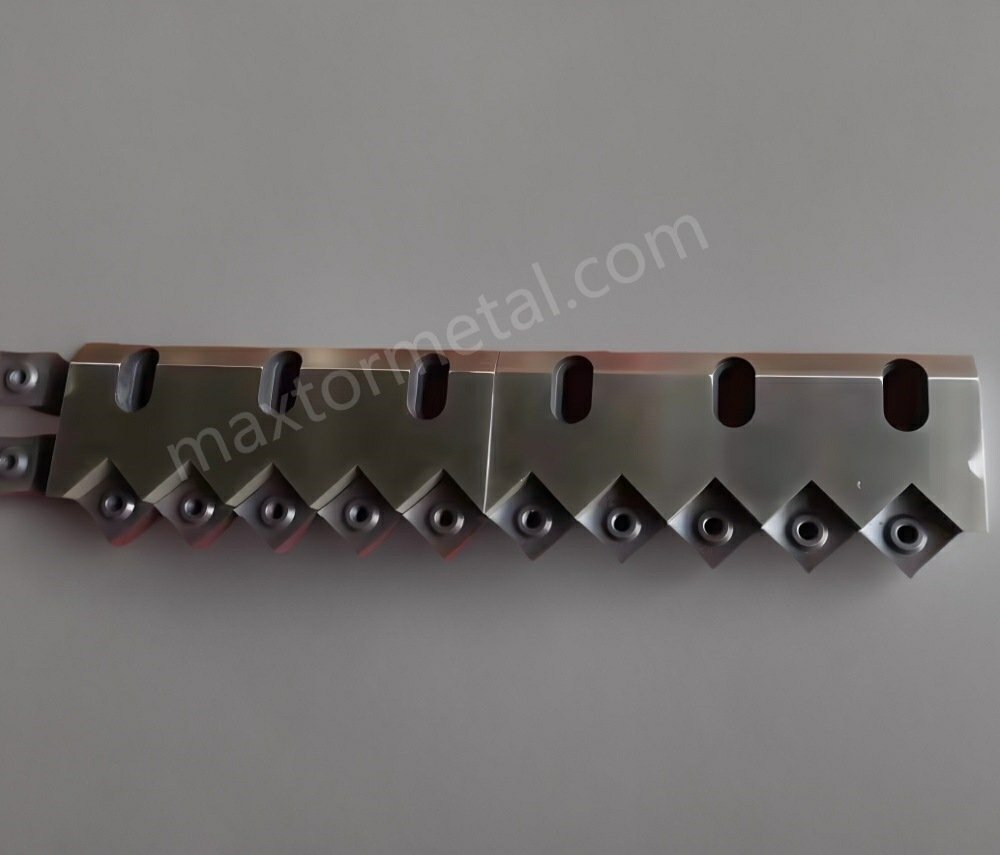
Blade geometry is one of the few levers you can pull on a single-shaft shredder that changes throughput, particle size consistency, energy per ton, wear life, and total cost of ownership (TCO)—without buying a new machine.
But it only works if you treat geometry as a system: square cutters + fixed counter-knife + screen + cutting gap + feed behavior. Change one item blindly and you usually pay for it in amps, heat, noise, and chipping.
- Why blade geometry drives throughput, particle size, energy use, wear life, and TCO
Geometry determines whether the material gets a clean shear (efficient), a smear/tear (hot and power-hungry), or a jam-and-reverse cycle (throughput killer). It also determines where wear concentrates: on the cutting edge, the seating faces, or the counter-knife.
Practical outcomes you’ll see on the floor:
- Higher bite / more aggressive edge can raise throughput on easy materials, but increases the risk of edge damage when contaminants show up.
- Tighter size control (usually smaller screen) improves downstream consistency, but raises residence time, motor load, and knife exposure.
- Better clearance and seating reduces rubbing heat, stabilizes amps, and extends usable edge life.
- How to apply this guide on single-shaft shredders with fixed and square cutters safely and with OEM checks
Treat any geometry change as a controlled engineering change:
- Lock out and verify zero energy before inspection or setup changes. Don’t rely on “stopped” as “safe.”
- Confirm OEM limits for: knife pocket design, bolt grade/torque, allowed cutter thickness, and counter-knife adjustment range.
- Make one change at a time (e.g., screen first, then gap; or thickness first, then rake).
- Run a short, instrumented trial and document the baseline vs. trial metrics.
⚠️ Cảnh báo: If you change cutter thickness, pocket stack-up height, or seating geometry, you can create bolt bending, uneven face loading, and fast chipping. Verify fit and contact pattern before production runs.
- What to baseline and monitor before changes: feed, screen size, power load, and cutting gap
Before you touch geometry, record a baseline. This is how you avoid “it feels better” decisions.
Baseline checklist:
- Feed behavior: bridging, self-feeding, pusher pressure, and whether material wraps.
- Screen size / open area: installed aperture and screen condition.
- Power load: average amps, peak amps, and % time near overload.
- Cắt khoảng cách: measured gap uniformity across the full knife length (not just one point).
Also log:
- knives installed (material, hardness if known)
- hours since last rotation/indexing
- contamination rate (metal, stones, glass, sand)
Baseline & trial log sheet (copy/paste)
| Item to record | Đơn vị | Cách đo lường | Tính thường xuyên | Ghi chú |
|---|---|---|---|---|
| Thông lượng | t/h | Weigh-out over a timed run | Each trial | Use same feed presentation as baseline |
| Energy | kWh/tấn | Line power meter + throughput | Each trial | Compare to baseline at same screen |
| Motor load | A (avg/peak) | Drive readout / clamp meter | Each trial | Note % time near overload |
| Auto-reverse events | count/hr | PLC log / operator log | Each trial | Spike usually indicates gap/feed/contaminant issue |
| Cutting gap uniformity | mm | Feeler gauges across full knife length | Each setup + after warm-up | Record min/max, not a single point |
| Tình trạng dao đối diện | n/a | Visual + edge nick check | Each setup | Photograph the edge if possible |
| Seating face condition | n/a | Cleanliness + burr check | Each setup | One trapped chip can tilt a knife |
| Screen condition | n/a | Visual + open area check | Each trial | Note blinding or damage |
| Product size distribution | mm (qual/quant) | Sieve check or photo reference | Each trial | Use the same sampling method |
| Knife edge condition | n/a | Visual + corner micro-chip check | Each trial | Document before/after indexing |
If any reading drifts materially from baseline, stop and inspect seating, fasteners/torque, and gap before pushing production.
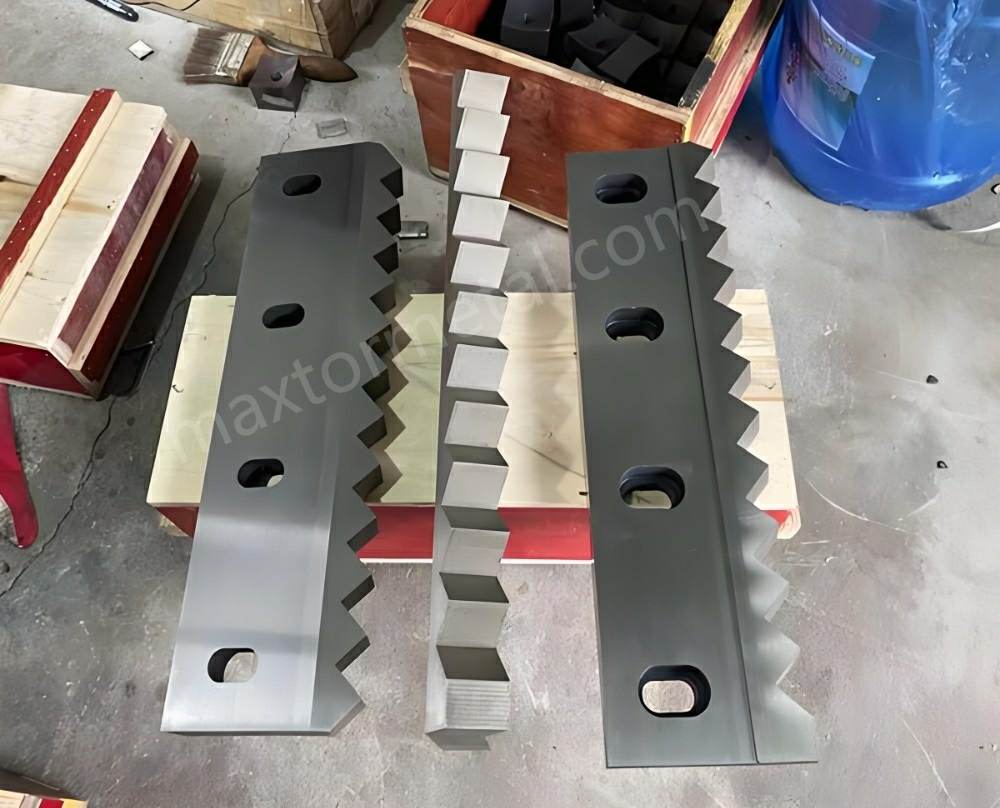
Geometry fundamentals (plastic recycling blades geometry)
Hook and rake angles
In shredding conversations, “hook angle” and “rake angle” often get used interchangeably: they describe how the cutting face is oriented relative to the direction of cut.
What the angle does in practice:
- More positive / more “hook”: the edge wants to pull material into the nip. That usually improves bite and reduces the force needed—great for many plastics and wood-like feed. It can also increase the chance of grabbing and shock-loading when hard contaminants appear.
- More neutral / less hook: the edge is less self-feeding and generally more robust. It’s often more forgiving in mixed streams and abrasive conditions, but may require more torque and can reduce throughput on easy feed.
Two practical rules that keep teams out of trouble:
- If you’re fighting wrap, smearing, or heat, geometry that cuts earlier (better bite and correct clearance) usually helps more than “more power.”
- If you’re fighting mẻ dao, hãy giả định rằng bạn đang gặp phải vấn đề quá tải đột ngột (khe hở, vị trí lắp đặt, tạp chất, hoặc logic quá tải) trước khi bạn cho rằng “thép kém chất lượng”. Để xem sơ đồ cây lỗi có cấu trúc, hãy tham khảo hướng dẫn của MAXTOR METAL về khắc phục sự cố mẻ dao máy băm một trục và phần tổng quan rộng hơn trong hướng dẫn thiết kế dao máy băm một trục.
Khe hở và độ dày dao cắt
Hai khái niệm riêng biệt thường bị nhầm lẫn:
- Khe hở (góc thoát) tại cạnh cắt: góc thoát đủ lớn sẽ ngăn mặt sau của dao ma sát với phôi. Sự ma sát tạo ra nhiệt, làm dao động dòng điện và khiến dao nhanh cùn.
- Độ dày dao cắt: độ dày ảnh hưởng đến độ cứng vững và khả năng hấp thụ nhiệt. Dao cắt dày hơn chống biến dạng và chịu lực va đập tốt hơn, nhưng chúng cũng có thể đẩy nhiều vật liệu hơn (lực cắt lớn hơn) và có thể làm thay đổi cách hình thành điểm kẹp với dao tĩnh.
Logic bắt đầu thực tế:
- Dao cắt mỏng hơn thường phù hợp với các vật liệu dễ cắt hơn, nơi ưu tiên hàng đầu là vết cắt ngọt và tiêu hao năng lượng thấp.
- Dao cắt dày hơn thường phù hợp với các dòng vật liệu có tính mài mòn cao hoặc chịu tải trọng va đập, nơi độ ổn định của cạnh cắt là quan trọng nhất.
Bạn không thể lựa chọn độ dày một cách độc lập. Dung sai tích lũy của hốc dao, độ ngậm ren của bu-lông và độ phẳng của bề mặt lắp đặt đều phải tương thích để hỗ trợ nó.
Số răng và kích thước lưới sàng
Số răng (hoặc số cạnh cắt hiệu dụng trên mỗi vòng quay) quyết định số “cơ hội” mà rotor có để bắt và cắt vật liệu nạp vào.
Sau đó, lưới sàng đóng vai trò như một cánh cổng: nó quyết định khi nào các hạt vật liệu được phép thoát ra ngoài.
- MỘT lưới sàng nhỏ hơn thường buộc vật liệu phải cắt lại nhiều lần hơn: vật liệu lưu lại trong buồng băm lâu hơn, điều này có xu hướng giảm năng suất và tăng điện năng tiêu thụ trên mỗi tấn.
- MỘT lưới sàng lớn hơn thường làm tăng tốc độ xả, điều này có xu hướng tăng năng suất và giảm điện năng tiêu thụ trên mỗi tấn.
Nguyên lý này xuất hiện trên tất cả các thiết bị giảm kích thước: kích thước thành phẩm là hàm số của lưới sàng/vỉ cộng với tốc độ và dụng cụ cắt, chứ không chỉ riêng dụng cụ cắt (xem tài liệu PDF “Giới thiệu về Giảm Kích thước” của Schutte Hammermill).
Sổ tay vật liệu

Use these as starting points, không phải là các thông số kỹ thuật chung. Đặc tính vật liệu, thiết kế rotor và các giới hạn của nhà sản xuất thiết bị gốc (OEM) luôn là yếu tố quyết định.
Gỗ và dệt may
Gỗ và dệt may là những loại vật liệu “đầy đánh lừa”. Chúng có thể dễ cắt nhưng lại khó xả vì chúng có thể:
- tạo ra các dải dài
- lẫn đá dăm/cát
- quấn quanh rotor
Hướng hình học dao:
- Ưu tiên khả năng ăn phôi chắc chắn để dao cắt thực hiện việc cắt đứt thay vì chỉ chà xát làm bóng vật liệu.
- Tránh các thiết lập tạo ra các dải dài, dạng sợi— chúng làm tăng nguy cơ quấn trục.
Chiến lược chọn lưới sàng:
- Bắt đầu với kích thước lưới sàng trung bình và kiểm tra khả năng xả. Lưới quá nhỏ có thể biến vật liệu dệt may thành một sợi dây thừng tuần hoàn liên tục.
Các dạng hư hỏng cần lưu ý:
- quấn trục ở các đầu rotor
- tăng nhiệt độ đi kèm hiệu quả giảm kích thước kém (do ma sát)
- screen blinding from fibers
If film-like textiles or woven bags are in the stream, anti-wrap rotor concepts that cut before material wraps fully can matter more than “sharper knives.” Plastics Technology describes why film shredding often requires film-optimized cutting action rather than conventional geometry in “Shredding Thin Film: How to Do It Right”.
Rigid plastics
Rigid plastics are where square cutters and fixed counter-knives shine—if the shear line is stable.
Hướng hình học dao:
- Many rigid plastics respond well to a moderately aggressive bite (enough hook/rake to enter cleanly) paired with correct clearance.
- If you process abrasive regrind (glass-filled, mineral-filled), prioritize edge robustness and contamination controls over maximum bite.
Chiến lược chọn lưới sàng:
- Select screen size backwards from downstream needs (washing, float/sink, extrusion feeding). A smaller screen tightens size distribution but increases recuts and load.
Các dạng hư hỏng cần lưu ý:
- smear and melt (especially with dull edges + tight screen)
- amp spikes at the start of each push (pusher pressure too high or gap uneven)
- edge micro-chipping from hard inclusions
For a practical overview of shredder selection variables (including sizing and screens), JWCE’s guidance in “How to Select the Right Industrial Plastic Shredder” is a useful cross-check when aligning process expectations to machine constraints.
Tires and rubber
Rubber behaves differently: it absorbs energy, rebounds, and can drag rather than fracture.
Hướng hình học dao:
- Ưu tiên durability and stable shearing over ultra-fine sizing in one pass.
- If steel or textile reinforcement is present, treat the stream as contaminated by design.
Chiến lược chọn lưới sàng:
- Bắt đầu với larger screens to avoid unnecessary recuts that turn into heat and wear.
Các dạng hư hỏng cần lưu ý:
- heat buildup
- rapid edge rounding
- screen damage from wire/rebar-like contaminants
Implementation and setup
Counter-knives and cutting gap
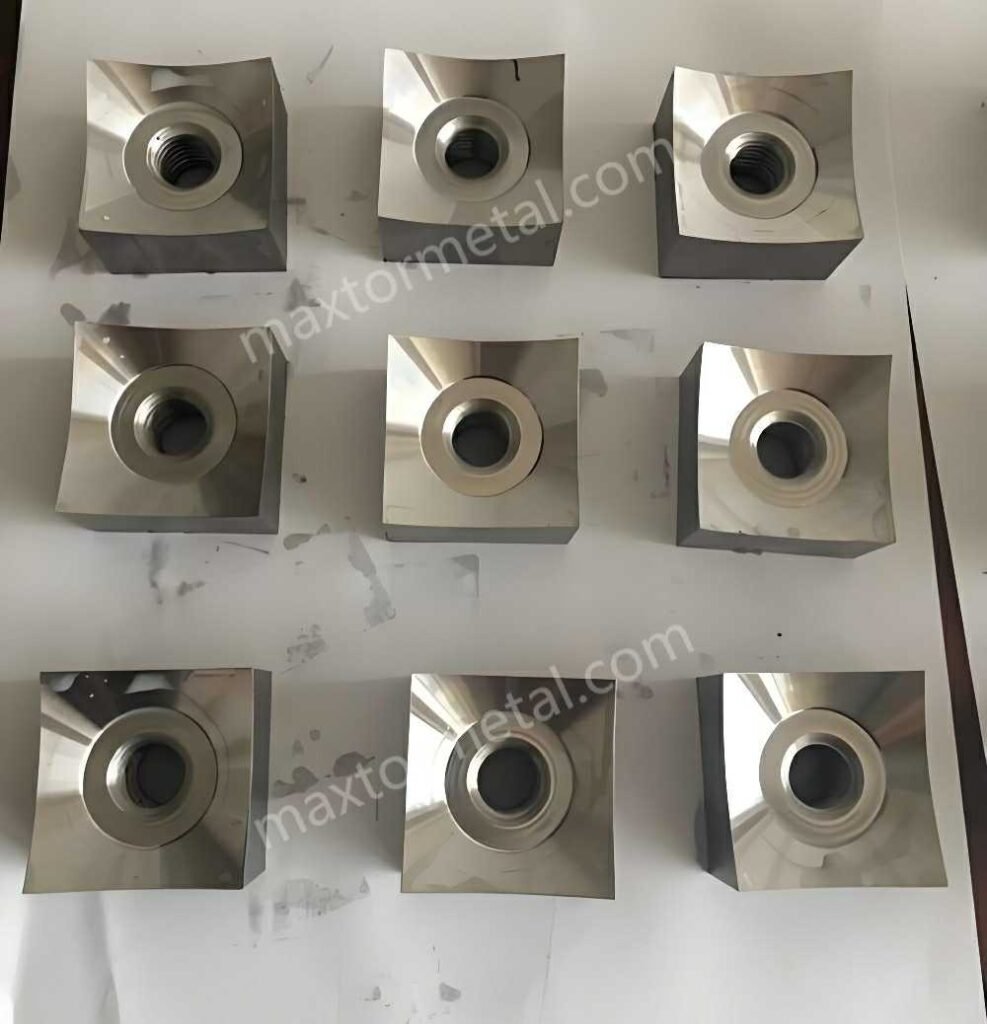
The cutting gap between the rotating square cutters and the fixed counter-knife is where “good geometry” becomes real output.
Best-practice setup:
- Clean and inspect seating faces (cutter pocket, bolts, counter-knife bed). One trapped chip can tilt a knife and concentrate load.
- Set and verify a uniform gap across the full knife length.
- Re-check after the first trial run—thermal growth and seating settling can change the gap.
What gap should you run?
- There is no universal number because rotor size, cutter design, and material stiffness vary.
- Public guidance and example machine specs often land in the sub-millimeter to low-millimeter range for plastics. For example, one single-shaft plastic shredder spec references a 1–1.5 mm gap as its stated setup target (see KITECH’s single shaft plastic shredder product page).
Use those ranges only as a rationality check. That example value is not a target and should not be copied across machines—your OEM manual, knife pocket geometry, and a verified contact pattern define the safe operating window.
Anti-wrap and contamination
Anti-wrap is not one trick; it’s a stack of choices.
Geometry and setup moves that often help:
- Ensure cutters have enough bite to cut early rather than drag.
- Avoid “stringing” conditions: dull edges + small screen + high pusher pressure.
- Use screen and pusher settings that keep the chamber from becoming a rope-making machine.
Contamination controls that protect cutters:
- Magnetic separation upstream where feasible.
- Defined “stop rules” for unusual noise, vibration, or repeated auto-reverse.
- Routine checks for cutter bolts backing off and for counter-knife nicks.
Overload and control logic
Overload logic is part of TCO.
If the shredder spends its life hitting overload and reversing, you’ll see:
- lower throughput
- higher energy per ton
- more shock loading on edges, bolts, and bearings
Control best practices:
- Tune pusher force and feed rate to avoid repeated stall cycles.
- Use auto-reverse as a protection feature, not as a normal operating mode.
- Treat repeated overloads as a diagnostic: gap, screen, contamination, or geometry mismatch.
Maintenance and TCO

Indexing and rotation schedules
Square cutters are often indexed to present a fresh edge. The fastest way to shorten life is to run “just a little longer” after the edge is already rounding.
A practical schedule is built from signals, not the calendar:
- Nếu như amps drift upward at constant feed, the edge is rounding or clearance is rubbing.
- If particle size distribution widens at constant screen, the effective cutting edge has changed.
Log the hours and the condition when you index. Over time you get an evidence-based interval for each feedstock.
Energy, wear, and throughput
Three shop-floor observations hold up across plants:
- Smaller screen = more recuts → typically higher kWh/ton and more wear exposure.
- Uneven gap = uneven wear → the “high corner” does most of the work, then chips.
- Wrap and repeated reverse cycles are a silent energy tax.
If you need finer output, consider whether pre-sizing or staged size reduction can beat forcing everything through a very small screen in one pass.
Mixed-material operations
Mixed streams (e.g., rigid plastic plus occasional wood, plus contamination) demand compromise.
Best-practice compromise strategy:
- Choose geometry that survives the worst credible contaminant, not the easiest material.
- Use operating discipline to protect the edge: separation, inspection, and stop rules.
- Keep a second geometry set (and documented setup sheet) for when the feed becomes cleaner and you can chase higher throughput.
Quality and compatibility

Materials and heat treat
For single-shaft shredder cutters, material and heat treat must match the failure mode you actually have:
- Abrasive wear (glass-filled plastics, grit): prioritize wear resistance and stable hardness.
- Impact / contamination (metal pieces, stones): prioritize toughness and edge support.
Whatever steel grade you use, insist on traceability. It’s hard to run a TCO program when blade batches are effectively anonymous.
Tolerances and inspection
Compatibility failures look like “random” chipping, but they’re often geometric:
- seating faces not flat
- bore/fit mismatch creating runout
- pocket stack-up changing the effective gap
Inspection checkpoints that pay back quickly:
- Xác minh seating face contact (clean, flat, no burrs).
- Xác minh bolt condition and torque discipline (and replace fasteners that have stretched).
- Xác minh gap uniformity after any indexing or counter-knife adjustment.
Engineering support
If you’re changing geometry to solve throughput or wear problems, don’t do it blind.
MAXTOR METAL can support engineering-led trials with:
- custom cutter geometry tuning to match your feedstock and shredder architecture,
- chứng chỉ vật liệu for traceability,
- heat‑treat reports (and related QC documentation) to reduce batch-to-batch uncertainty.
For product context, MAXTOR METAL publishes baseline specs and blade options on its single shaft shredding motorized blades trang.
When you request support, include: material photos, contamination description, screen size, baseline amps/kWh per ton (if available), and measured cutting gap.
Key takeaways and scope limits
Key takeaways:
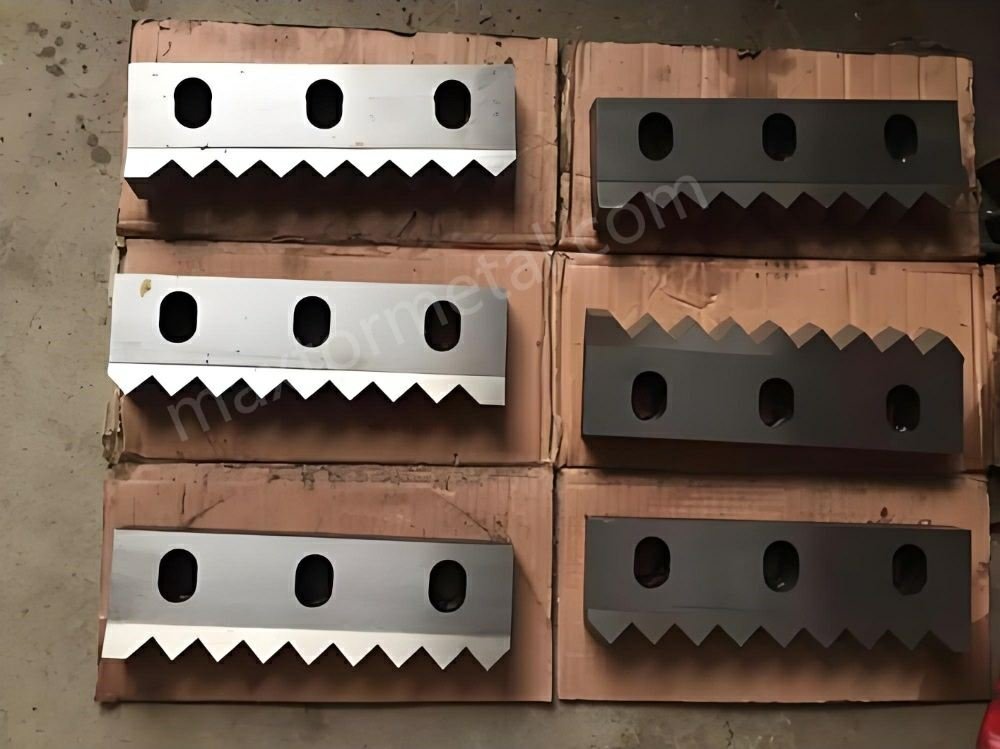
- Treat geometry as a system: cutters + counter-knife + screen + cutting gap + feed behavior.
- Change one variable at a time and run short, instrumented trials—don’t tune by feel.
- Most chipping is a load-spike problem first (gap, seating, contamination, or overload logic), not “bad steel.”
- Gap uniformity and seating cleanliness usually matter more than chasing an aggressive edge.
- Use public numbers only as rationality checks; OEM limits and contact-pattern verification decide what’s safe.
Scope limits (to reduce misuse):
- This guide targets single-shaft shredders with square cutters and a fixed counter-knife.
- Do not apply settings directly to twin-shaft shredders, different knife styles, or grinders without OEM review.
- Any change that affects cutter thickness, pocket stack-up height, seating geometry, bolt engagement, or torque procedure must be approved and verified against OEM specifications.
- If your feedstream has frequent metal/stone contamination, prioritize separation and stop rules before pushing for higher bite or smaller screens.
Kết luận
- Key geometry choices and expected trade-offs by material
If you want predictable improvements, treat geometry as a controlled set of trade-offs:
- Wood/textiles: prioritize early cutting and anti-wrap behavior; don’t force ultra-small screens.
- Rigid plastics: stable shear line (gap + seating) matters as much as edge aggressiveness.
- Tires/rubber: prioritize durability and heat management; start coarse and step down intentionally.
- Next steps: validate with OEM specs, trial changes, document results
- Baseline feed behavior, screen, amps/kWh per ton, and measured gap.
- Validate any geometry change against OEM pocket and counter-knife specs.
- Run a short trial, change one variable at a time, and document results (throughput, energy, wear).
- If you want to shorten the iteration cycle, have your cutter supplier review drawings and propose a controlled geometry change—with certs and heat-treat documentation attached.
Standards and safety references
This guide is not a substitute for your OEM manual or your facility’s EHS procedures. For widely accepted safety frameworks, see:
- OSHA, 29 CFR 1910.147 — The control of hazardous energy (Lockout/Tagout)
- ISO, ISO 14118:2017 — Safety of machinery — Prevention of unexpected start-up
- ISO, ISO 12100:2010 — Safety of machinery — General principles for design (risk assessment and risk reduction)
For quality-traceability expectations on industrial blades, MAXTOR METAL typically supports projects with material certificates and multi-stage inspections (incoming, in-process, and final).
Tác giả
Tommy Tang — Kỹ sư bán hàng cấp cao, Công nghiệp kim loại Nam Kinh
- Industry experience: 12 năm
- Chứng nhận: CSE, CME, Six Sigma Green Belt, PMP

 English
 Spanish
 Italian
 French
 Portuguese
 Russian
 German
 Arabic
 Hindi
 Vietnamese
 Indonesian
 Japanese
 Korean