


Hình học cạnh cắt không phải là một lựa chọn mang tính thẩm mỹ. Trong quy trình cắt lát sản lượng lớn, hình dạng cạnh cắt quyết định cách lưỡi dao đi vào vỏ bánh, cách nó cắt lát ruột bánh và độ ổn định của nó khi vận hành ở tốc độ cao. Đó là lý do tại sao cùng một máy cắt có thể hoạt động “không đồng đều một cách bí ẩn” trên các mã hàng (SKU) khác nhau — ngay cả khi vật liệu và độ dày của lưỡi dao không hề thay đổi.
Nói một cách đơn giản: bạn đang tinh chỉnh hình học lưỡi dao cắt bánh mì để kiểm soát ba chỉ số KPI của nhà máy — lượng vụn bánh hao hụt, độ đồng đều của độ dày lát cắt và độ ổn định của dây chuyền.
Bài viết này so sánh ba dạng hình học phổ biến —dạng sóng (scallop), Răng chữ V, Và ABT (răng vát xen kẽ)— dưới góc nhìn mà các nhà máy bánh mì công nghiệp và các nhà sản xuất thiết bị gốc (OEM) máy cắt thực sự quan tâm:
- Những thay đổi đối với các dạng hình học scallop, răng chữ V và ABT
- Cách cạnh lưỡi dao ảnh hưởng đến lượng vụn bánh hao hụt, độ dày lát cắt và tốc độ
- Những gì bạn sẽ rút ra được: ma trận lựa chọn và kế hoạch thử nghiệm
Cơ bản về hình học lưỡi dao

Dạng sóng (Scallop): biên dạng sóng và các tùy chọn bước răng (pitch)
Cạnh cắt dạng sóng (scallop) sử dụng biên dạng sóng lặp đi lặp lại. Hãy hình dung nó như các “điểm tiếp xúc” và các khoảng thoát dao xen kẽ dọc theo cạnh cắt. Trong thực tế, hình dạng sóng đó thay đổi hai yếu tố:
- Phân bổ áp lực tiếp xúc: ít điểm tiếp xúc với ổ bánh hơn tại bất kỳ thời điểm nào, giúp giảm thiểu tình trạng bết dính/nén chặt trên các sản phẩm mềm hơn.
- Kiểm soát vụn bánh: các khoảng thoát dao tạo không gian cho vụn bánh và cặn bám thoát ra ngoài thay vì tích tụ lại ở thành bên của lưỡi dao.
Cạnh cắt dạng sóng (scallop) thường được thảo luận dựa trên bước răng (pitch) (khoảng cách giữa các đặc tính lặp lại). Các tài liệu hướng dẫn ứng dụng từ các nhà cung cấp lưỡi dao thường phân loại các dải bước răng theo độ cứng của sản phẩm — bước răng mịn hơn cho vỏ bánh dai hơn, bước răng thô hơn cho các ổ bánh mềm hơn — bởi vì bước răng ảnh hưởng đến mức độ “mạnh mẽ” của đường cắt ở một tốc độ dây chuyền nhất định. Simcut (Simmons) minh họa cách định vị dựa trên bước răng trong “Lưỡi dao cắt bánh mì Simmons dành cho các lò bánh mì công nghiệp’ (2025).
MAXTOR METAL tóm tắt những ưu điểm thực tế là cắt mượt mà hơn, ít ma sát hơn và tạo ra ít vụn bánh hơn trong môi trường nhà máy trong “Lưỡi dao cắt bánh mì: so sánh thực tế tại nhà máy cho mục đích sử dụng công nghiệp“.
Răng chữ V (V-Tooth): cấu hình TPI và góc vát (bevel)
Lưỡi dao răng chữ V sử dụng các răng hình chữ V lặp đi lặp lại. Hai yếu tố quan trọng nhất là:
- TPI (số răng trên mỗi inch): TPI cao hơn thường đồng nghĩa với việc có nhiều răng tiếp xúc cùng lúc hơn, xu hướng tạo ra đường cắt mịn hơn (ít bị rách hơn) nhưng có thể kém hiệu quả hơn đối với các sản phẩm dính, nóng hoặc có nhiều cặn bám.
- Kiểu vát / mài: các lựa chọn góc vát sẽ thay đổi cách răng dao hoạt động, thiên về dạng “đâm xuyên” (ưu tiên đâm xuyên trước) hay thiên về dạng “cắt lát” (ưu tiên cắt trượt trước).
Trong các tài liệu ứng dụng chuyên ngành bánh mì, răng chữ V thường được định vị là một lựa chọn “đâm xuyên sạch” cho các sản phẩm mềm ở điều kiện ổn định.
ABT: tác động cắt trượt vát xen kẽ
ABT là viết tắt của răng vát xen kẽ (alternating bevel tooth) (bạn cũng sẽ thấy thuật ngữ này được thảo luận dưới dạng lưỡi dao cắt bánh mì cạnh ABT trong tài liệu của nhà cung cấp). Thay vì mọi răng dao đều có cùng một mặt cắt, góc vát sẽ xen kẽ trái/phải, tạo ra nhiều tác động cắt trượt qua vỏ và ruột bánh.
Một mô tả cụ thể, chuyên biệt cho ngành bánh mì đến từ dòng lưỡi dao ABT artisan của Kasco, mô tả cạnh cắt này có dạng sóng/ba chữ V đặc trưng dành cho các sản phẩm bánh mì thủ công (artisan) (xem mô tả cạnh cắt ABT artisan của Kasco). Bất kể hoa văn chính xác của nhà sản xuất là gì, cơ chế cốt lõi vẫn nhất quán: các góc vát xen kẽ giúp hướng đường cắt theo dạng cắt trượt chứ không phải ép nát, đó là lý do tại sao ABT thường được lựa chọn khi bạn muốn khắc phục tình trạng rách trên cấu trúc ruột bánh xốp hoặc dễ vỡ.
Hiệu suất vận hành ở tốc độ cao

Trước khi so sánh các cạnh cắt, hãy thống nhất về định nghĩa thế nào là “tốt nhất” trên dây chuyền của bạn: crumb loss control, slice thickness stability, and whether quality holds as you ramp throughput.
Crumb control and slice uniformity
Crumb loss is typically created by one of three failure modes:
- Xé rách (the edge “grabs” and rips)
- Nén (the loaf deforms, then springs back ragged)
- Rubbing/drag (residue builds, friction rises, and the cut gets dirty)
A useful mental model is that slicing quality is a system property—pitch, edge, and tension interact. Baking Business makes the same point in “The three core properties of bread slicing blades” (2019)—not just “sharpness.”
How that plays out by geometry:
- Scallop often performs well when you need a forgiving cut that doesn’t punish minor loaf variability. The wave profile can reduce continuous rubbing and help keep the cut cleaner over a run.
- Răng chữ V can deliver very clean surfaces on stable, soft products—especially when tooth density matches the crumb and the loaf is fully cooled. Too aggressive a tooth pattern can increase tearing.
- ABT usually earns its keep when the crumb structure is fragile (open crumb, inclusions, very moist products) because the alternating bevel tends to shear fibers rather than pull them.
Throughput, vibration, and thickness drift
When you push speed, inconsistency is rarely “just the blade.” BakingBusiness’ troubleshooting coverage is blunt: uneven slice thickness often comes from setup and machine factors beyond the blade itself.
At 600–1200 loaves/hour, three drift drivers dominate:
- Tension imbalance: small variations across the blade set become visible as thickness drift and ragged slices.
- Guide alignment and wear: guide shift or wear increases lateral movement and friction.
- Vibration sources: belts, bearings, and even floor leveling can induce oscillation that looks like “random” slice variation.
Geometry choice can’t compensate for a slicer that’s vibrating or incorrectly guided, but it can change how sensitive you are to those issues:
- A geometry that cuts with less drag (often scallop/ABT) tends to be more tolerant when conditions aren’t perfect.
- A geometry that relies on crisp tooth engagement (often V-tooth) can look great—until residue or vibration changes tooth behavior.
Hot bread, hydration, and coatings impact
Hot and high-hydration products raise the probability of sticking, residue buildup, and jams. BakingBusiness notes moist products and process conditions can trigger jamming and inconsistent results at the blades.
In practice, you’re managing friction and residue, not just sharpness.
- If you slice hot: expect more adhesion. Coatings are commonly used in the industry to reduce sticking and drag (for an example of coating availability in bakery blades, see Abtek’s note on Teflon-coated bread slicer blades).
- If you slice high-hydration/open crumb: prioritize a geometry that shears cleanly with less tearing (ABT is often selected for this reason).
- If residue builds quickly: a geometry that minimizes rubbing plus a disciplined cleaning cadence beats “more aggressive teeth.”
Mẹo chuyên nghiệp: If slice quality degrades across a shift, track it alongside cleaning intervals. A step-change after cleaning usually points to residue/drag—not “mysterious dulling.”
Phân loại bánh mì và sơ đồ tốc độ

Soft sandwich and buns: scallop vs ABT
Soft sandwich loaves and buns usually fail by compression + tearing, not by “can’t cut the crust.” That means you’re optimizing for gentle entry, low drag, and stable thickness.
A practical rule set:
- Chọn dạng sóng (scallop) when your main KPI is consistent cosmetic quality with forgiving behavior across minor loaf variability.
- Chọn ABT when your main KPI is preventing tearing on delicate structures or when you’re seeing defects that look like “pulling” rather than “crushing.”
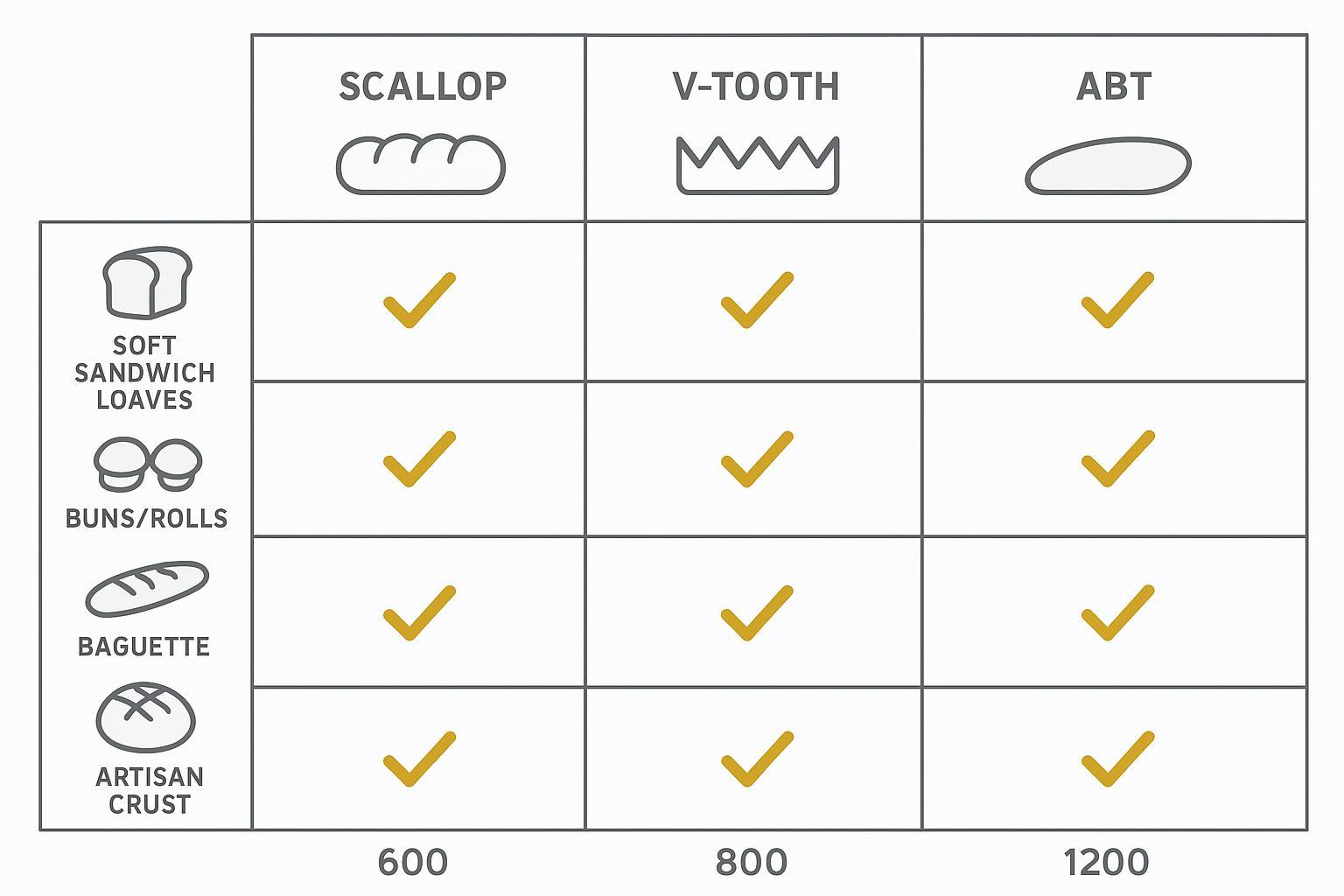
Baguette and artisan crusts: V-tooth vs ABT
Crusty products shift the problem: you need reliable crust entry without shattering the crumb underneath.
- Răng chữ V can perform well when the tooth pattern is matched to the crust thickness and the loaf is sufficiently cooled, because the teeth “bite” predictably.
- ABT tends to win when crust variability is high or when you want the cut to behave more like a shear than a tear—especially if the interior crumb is open or fragile.
If your baguette slices show micro-tears under the crust, that’s often a sign the edge is pulling fibers as it exits. ABT’s alternating bevel is specifically designed to bias toward a shearing exit.
High-hydration/open crumb: why ABT often wins
High-hydration and open-crumb loaves have less structural support. The blade edge has to separate the crumb without collapsing it.
ABT often wins because the alternating bevel pattern encourages a left-right shearing action instead of a single-direction “rake.”
MAXTOR METAL can retrofit Oliver/Berkel slicers with compatible band or reciprocating blades, manufacturing replacements from drawings, samples, or photos to match guides, pitch, and edge geometry—without forcing a full slicer redesign.
Triển khai, TCO và thử nghiệm

Slicers, guides, and tension (Oliver/Berkel)
If you’re comparing edges but your slice thickness drifts, start with setup. BakingBusiness emphasizes that many slicing errors come from machine factors and product handling—not just blades.
A practical checklist for Oliver/Berkel-class slicers:
- Verify the machine is level and mechanically stable (vibration shows up as thickness drift fast).
- Check guide condition and alignment; worn guides increase lateral movement and friction.
- Verify tension is consistent across the set; tension imbalance creates uneven cut behavior.
- Confirm loaf feed is centered and consistent; back-pressure and skew amplify tearing.
If you’re troubleshooting thickness drift at speed, start with the system basics—BakingBusiness calls out that uneven thickness often isn’t a blade-only issue.
Sharpening, materials, and sanitation compliance
In industrial bakeries, sanitation is a performance variable. Residue increases friction, friction increases tearing and drift, and drift creates waste.
Về mặt vận hành:
- Set a cleaning cadence tied to your product: higher hydration and hot slicing usually require more frequent wipe-downs.
- Choose materials/coatings with your hygiene program in mind. MAXTOR METAL’s overview “Blade material pros and cons for bread slicing machine blades“ is a good starting point for stainless vs. carbon steel trade-offs.
⚠️ Cảnh báo: If you change edge geometry without re-validating tension and guides, you can “prove” the new blade is worse when the real issue is setup sensitivity.
On-line A/B testing and ROI calculation
A geometry decision is only controversial when it isn’t measured. Here’s a factory-friendly test plan that doesn’t require lab equipment:
1) Define success metrics (choose 2–3, not ten):
- Crumb loss rate (% by weight, pre/post slicing)
- Slice thickness variation (e.g., standard deviation across sampled slices)
- Defect rate (tears, compressed slices, end-slice rejects)
- Unplanned stops (count/shift) and cleaning downtime (minutes/shift)
2) Run an on-line A/B:
- A = current blade geometry; B = candidate geometry.
- Hold constant: loaf temp window, conveyor speed, guide setting, tension target.
- Sample: every 30 minutes, pull 10 slices, record thickness and defects.
3) Translate to ROI (keep it simple):
- Savings from crumb reduction = (baseline crumb % − new crumb %) × total loaf mass × product value.
- Savings from downtime reduction = (baseline downtime − new downtime) × labor + lost throughput value.
- Cost delta = blade cost + changeover + sharpening/maintenance delta.
If you can show the new edge reduces waste or stops by even a small amount at 600–1200 loaves/hour, it usually beats unit price debates.
Evidence-based troubleshooting case
When a line reports “random” thickness drift or rising crumb across a shift, the fastest way to avoid chasing the wrong variable is to verify the system before you blame a single geometry.
Problem (symptoms you can observe):
- Uneven thickness (thick + thin slices in the same loaf or across loaves)
- Wavy slices at higher throughput
- Crumb and residue building on blade sidewalls, followed by a step-change after cleaning
Action (what to do first, in order):
- Confirm pitch/edge is appropriate for the product class. Baking Business notes pitch, edge type, and tension are the three core properties that drive slicing behavior; for example, traditional white bread often slices well around a 1/2-inch pitch, while crusty/dense breads may need a tighter pitch to maintain control at speed. See Baking Business’ “The three core properties of bread slicing blades” (2019).
- Check tension and guides before changing blades. Baking Business’ troubleshooting coverage emphasizes that thick/thin slices in the same loaf often point to tensioning or guide/lattice issues rather than “mysterious dulling.” See “Pyler says: Troubleshooting slicing issues” (2019).
- Validate guide alignment with the OEM procedure (example: Berkel MB). The Berkel MB service manual documents an adjustment method to level the gauge plate to the knife and verify contact points—exactly the kind of alignment check that prevents lateral movement and friction from masquerading as a blade problem. See Berkel Equipment’s Model MB Bread Slicer Service Manual (PDF).
Result (what you should see if the root cause was system-related):
- Thickness variation stabilizes without changing edge geometry
- Crumb rate becomes more consistent over the run (especially when residue control is improved)
- A/B tests become more meaningful because you’ve removed machine-induced noise
Once those checks are clean, then switching between scallop, V-tooth, and ABT becomes a true geometry comparison instead of a setup sensitivity test.
Kết luận
- Key takeaways on scallop vs V-tooth vs ABT
- Next steps: run the matrix, set tension, validate with data
Những điểm chính cần ghi nhớ
- Scallop is a strong default when you need stable, low-drag cutting across soft products and minor loaf variability.
- Răng chữ V can deliver very clean slices when TPI and setup are well matched, but it can be less forgiving when residue, vibration, or loaf condition changes.
- ABT often performs best on artisan, crusty, and especially high-hydration/open-crumb products because the alternating bevel biases toward shearing rather than pulling.
Các bước tiếp theo
- Use the matrix above to pick a candidate geometry for each SKU and speed band.
- Re-validate guides and tension before judging the new edge.
- Run a two-shift A/B test and decide with crumb, thickness, and downtime data.
If you want a quick compatibility check, start with MAXTOR METAL bread slicer blades and share your slicer model (Oliver/Berkel), slice thickness target, bread types, and line speed range.
Ghi chú và đánh giá bài viết
Written by: MAXTOR METAL Engineering Team
Reviewed by: Tommy Tang, Senior Sales Engineer, Nanjing METAL Industrial (12 years; CSE, CME, Six Sigma Green Belt, PMP)
Relationship note: MAXTOR METAL is the brand name of Nanjing Metal Industry Company.
Tài liệu tham khảo
- Baking Business (2019-09-23), “The three core properties of bread slicing blades“.
- Baking Business (2019-10-21), “Slaying bread slicing errors“.
- Baking Business (2019-01-28), “Pyler says: Troubleshooting slicing issues”.
- Berkel Equipment, Model MB Bread Slicer Owner/Operator Manual (PDF).
- Berkel Equipment, Model MB Bread Slicer Service Manual (PDF).
- Simcut (Simmons) (2025-07-24), “Simmons’ Bread Slicing Blades for Industrial Bakeries“.
- MAXTOR METAL, “Bread cutting blades: factory comparison for industrial use”.
- MAXTOR METAL, “Blade material pros and cons for bread slicing machine blades”.

 English
  Spanish
  Italian
  French
  Portuguese
  Russian
  German
  Arabic
  Hindi
Hindi  Vietnamese
  Indonesian
  Japanese
  Korean