


La geometría de los bordes no es una elección estética. En el corte de alto volumen, la forma del borde determina cómo la cuchilla penetra en la corteza, cómo corta la miga y cuán estable se mantiene a velocidadPor eso, la misma rebanadora puede parecer "misteriosamente inconsistente" en diferentes versiones, incluso cuando el material y el grosor de la cuchilla nunca cambian.
En pocas palabras: estás sintonizando geometría de la cuchilla de la rebanadora de pan controlar tres indicadores clave de rendimiento (KPI) de la fábrica: pérdida de migas, uniformidad del grosor de las rebanadas y estabilidad de la línea de producción.
Este artículo compara tres geometrías comunes—Vieira, Diente en V, y ABT (diente biselado alterno)—desde la perspectiva que realmente les importa a las panaderías industriales y a los fabricantes de rebanadoras:
- ¿Qué cambia con las geometrías de vieira, diente en V y ABT?
- Cómo los bordes de las cuchillas influyen en la pérdida de miga, el grosor y la velocidad.
- Lo que te llevarás: una matriz de selección y un plan de pruebas.
Conceptos básicos de geometría

Vieira: opciones de perfil y paso de ola
Un borde festoneado utiliza un perfil de onda repetitivo. Imagínelo como una alternancia de “puntos de contacto” y cavidades de alivio a lo largo del borde. En la práctica, esa forma de onda cambia dos cosas:
- Distribución de la presión de contacto: Menos puntos entran en contacto con el pan en cualquier instante, lo que puede reducir la deformación/compresión en productos más blandos.
- Gestión de escombros: Los huecos de alivio permiten que las migas y los residuos se acumulen en lugar de pegarse a la pared lateral de la cuchilla.
Los bordes festoneados se suelen analizar en términos de paso (distancia entre características repetitivas). Las notas de aplicación de los proveedores de cuchillas a menudo relacionan las bandas de paso con la firmeza del producto: paso más fino para cortezas más duras, paso más grueso para panes más blandos, porque el paso afecta la sensación de "agresividad" del corte a una velocidad de línea determinada. Simcut (Simmons) ilustra el posicionamiento basado en el paso en “Cuchillas para cortar pan de Simmons para panaderías industriales” (2025).
MAXTOR METAL resume la ventaja práctica como un corte más suave con menos fricción y menos generación de migas en entornos de fábrica. "Cuchillas para cortar pan: comparación de fábrica para uso industrial".
Diente en V: Configuraciones de TPI y bisel
Las cuchillas con dientes en V utilizan dientes en forma de V repetitivos. Los dos pomos más importantes son:
- TPI (dientes por pulgada): un TPI más alto generalmente significa más dientes enganchados a la vez, lo que tiende a producir un corte más fino (menos tendencia al desgarro), pero puede ser menos tolerante a productos pegajosos, calientes o con muchos residuos.
- Estilo de bisel/afilado: la elección del bisel cambia si el diente se comporta más como un "palillo" (penetración primero) o más como una "rebanada" (corte primero).
En las notas de aplicación centradas en la panadería, la tecnología V-tooth suele presentarse como una opción de "penetración limpia" para productos blandos en condiciones estables.
ABT: acción de corte de bisel alternante
ABT significa diente biselado alterno (también verá que se habla de esto como Cuchillas para cortar pan ABT Edge en la literatura del proveedor). En lugar de que cada diente presente la misma cara, el bisel alterna izquierda/derecha, creando más una acción de corte a través de la corteza y la miga.
Una descripción concreta y específica para panadería proviene de las cuchillas artesanales ABT de Kasco, que describen el filo como un distintivo patrón festoneado/triple en V diseñado para productos artesanales (véase la descripción del filo artesanal ABT de Kasco). Independientemente del patrón exacto del fabricante, el mecanismo básico es el mismo: Los biseles alternos favorecen el corte por cizallamiento, no por aplastamiento., por eso ABT se suele elegir cuando se lucha contra el desgarro en estructuras frágiles o con miga abierta.
Rendimiento a alta velocidad

Antes de comparar los bordes, pónganse de acuerdo sobre qué significa "mejor" en su línea: control de pérdida de migas, la estabilidad del grosor de las rebanadas y si la calidad se mantiene a medida que aumenta la producción.
Control de la desmenuz y uniformidad de las rebanadas
La pérdida de partículas generalmente se produce por uno de tres modos de falla:
- Desgarro (el borde “agarra” y desgarra)
- Compresión (El pan se deforma y luego recupera su forma irregular)
- Frotamiento/arrastre (Se acumulan residuos, aumenta la fricción y el corte se ensucia)
Un modelo mental útil es que la calidad del corte es una propiedad del sistema.tono, borde y tensión interactuar. Baking Business hace el mismo punto en "Las tres propiedades principales de las cuchillas para cortar pan” (2019)—no solo “agudeza”.
Cómo se manifiesta eso geométricamente:
- Vieira Suele funcionar bien cuando se necesita un corte indulgente que no penalice las pequeñas variaciones en la forma del pan. El perfil ondulado puede reducir el roce continuo y ayudar a mantener un corte más limpio durante la cocción.
- Diente en V Puede proporcionar superficies muy limpias en productos estables y blandos, especialmente cuando la densidad de los dientes coincide con la miga y el pan está completamente frío. Un patrón de dientes demasiado agresivo puede aumentar el desgarro.
- ABT Suele demostrar su eficacia cuando la estructura de la miga es frágil (miga abierta, inclusiones, productos muy húmedos) porque el bisel alterno tiende a cortar las fibras en lugar de tirar de ellas.
Rendimiento, vibración y deriva de espesor
Cuando se aumenta la velocidad, la inconsistencia rara vez se debe simplemente a la cuchilla. La guía de solución de problemas de BakingBusiness es poco clara: el grosor desigual de las rebanadas suele deberse a la configuración y a factores de la máquina que van más allá de la propia cuchilla.
Con una producción de entre 600 y 1200 panes por hora, predominan tres factores que influyen en la deriva:
- Desequilibrio de tensión: pequeñas variaciones en el juego de cuchillas se hacen visibles como cambios en el grosor y rebanadas irregulares.
- Alineación y desgaste de la guía: El desplazamiento o desgaste de la guía aumenta el movimiento lateral y la fricción.
- Fuentes de vibraciónLas correas, los cojinetes e incluso la nivelación del suelo pueden inducir oscilaciones que parecen variaciones de corte "aleatorias".
La elección de la geometría no puede compensar una herramienta de corte que vibra o está mal guiada, pero sí puede cambiar el grado de sensibilidad a esos problemas:
- Una geometría que corta con menos resistencia (a menudo de tipo vieira/ABT) tiende a ser más tolerante cuando las condiciones no son perfectas.
- Una geometría que se basa en un acoplamiento preciso de los dientes (a menudo en forma de V) puede tener un aspecto estupendo, hasta que los residuos o las vibraciones alteran el comportamiento de los dientes.
El pan caliente, la hidratación y los recubrimientos tienen un impacto
Los productos calientes y con alto contenido de agua aumentan la probabilidad de que se peguen, se acumulen residuos y se formen atascos. BakingBusiness señala que los productos húmedos y las condiciones del proceso pueden provocar atascos y resultados inconsistentes en las cuchillas.
En la práctica, lo que se gestiona es la fricción y los residuos, no solo el filo.
- Si cortas calienteSe espera una mayor adherencia. Los recubrimientos se utilizan comúnmente en la industria para reducir la adherencia y la fricción (para ver un ejemplo de la disponibilidad de recubrimientos en cuchillas para panadería, consulte la nota de Abtek sobre cuchillas para rebanadoras de pan con recubrimiento de teflón).
- Si cortas una miga de alta hidratación/abierta: priorizar una geometría que se corte limpiamente con menos desgarro (ABT se suele elegir por este motivo).
- Si se acumulan residuos rápidamenteUna geometría que minimiza la fricción, sumada a una cadencia de limpieza disciplinada, supera a unos dientes más agresivos.
Consejo profesionalSi la calidad de corte disminuye durante un turno, registre la variación junto con los intervalos de limpieza. Un cambio brusco después de la limpieza suele indicar la presencia de residuos o fricción, no un desgaste inexplicable.
Tipos de pan y mapeo de velocidad

Sándwich blando y panecillos: vieira vs ABT
Los panes y bollos blandos para sándwiches suelen fallar compresión + desgarro, no por “no se puede cortar la corteza”. Eso significa que estás optimizando para una entrada suave, baja resistencia y espesor estable.
Un conjunto de reglas prácticas:
- Elegir Vieira cuando su principal KPI es una calidad cosmética constante con un comportamiento tolerante a pequeñas variaciones en el pan.
- Elegir ABT cuando su principal KPI es evitar desgarros en estructuras delicadas o cuando observa defectos que parecen "tirar" en lugar de "aplastar".
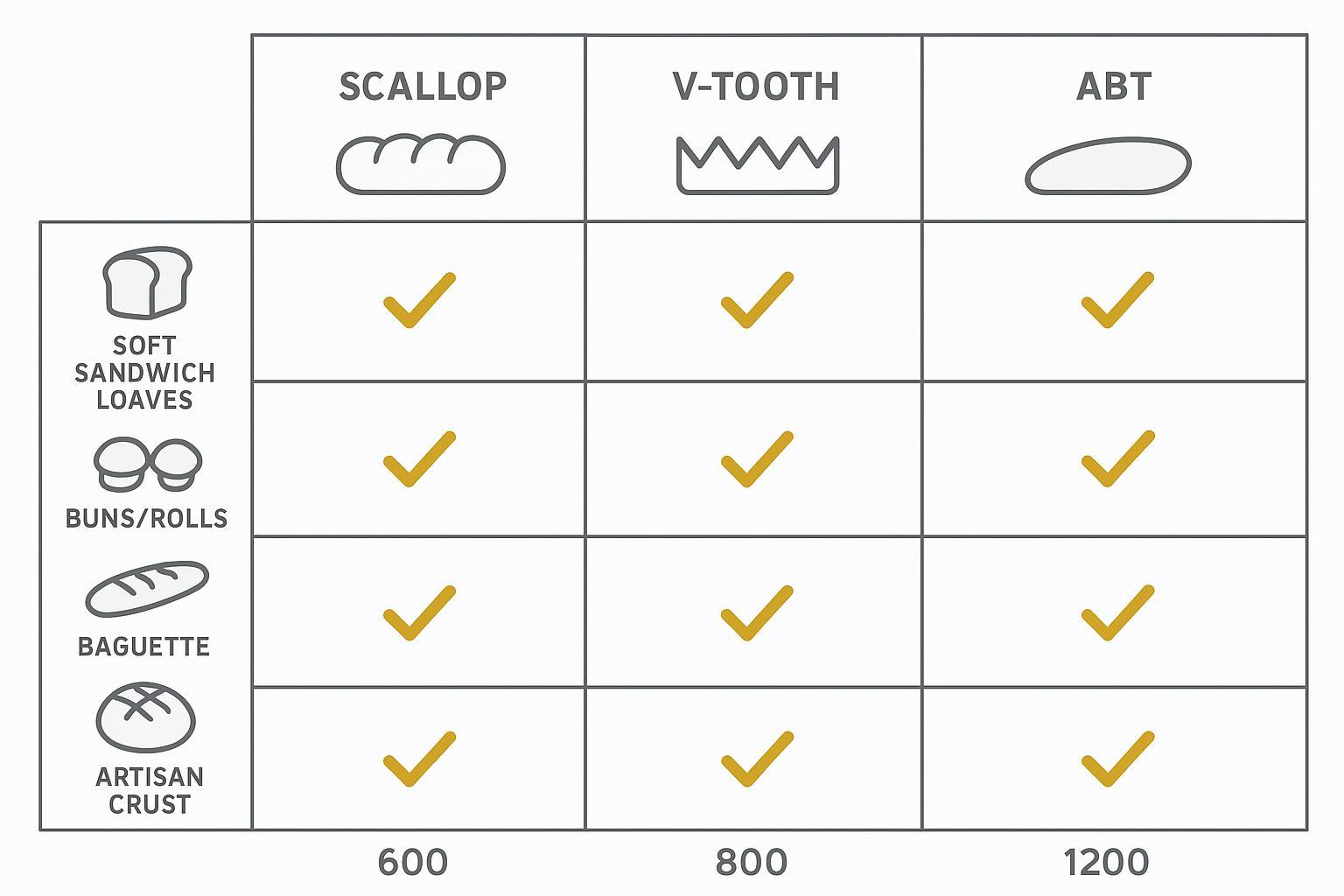
Baguette y cortezas artesanales: V-tooth vs ABT
Los productos con corteza crujiente cambian el problema: se necesita una corteza que penetre bien sin que se rompa la miga que hay debajo.
- Diente en V Pueden funcionar bien cuando el patrón de los dientes coincide con el grosor de la corteza y el pan se enfría lo suficiente, porque los dientes "muerden" de forma predecible.
- ABT Suele ser la mejor opción cuando la variabilidad de la corteza es alta o cuando se desea que el corte se comporte más como una cizalla que como un desgarro, especialmente si la miga interior es abierta o frágil.
Si las rebanadas de baguette presentan microdesgarros bajo la corteza, suele ser señal de que el borde está arrancando fibras al cortarlas. El bisel alterno de ABT está diseñado específicamente para favorecer un corte más limpio.
Hidratación intensa/miga abierta: por qué ABT suele ser la mejor opción
Los panes con alto contenido de agua y miga abierta tienen menos soporte estructural. El filo de la cuchilla debe separar la miga sin que se derrumbe.
ABT suele ganar porque el patrón de bisel alterno fomenta una acción de corte de izquierda a derecha en lugar de un "rastrillo" unidireccional.
MAXTOR METAL puede adaptar las rebanadoras Oliver/Berkel con cuchillas de banda o recíprocas compatibles, fabricando repuestos a partir de planos, muestras o fotografías para que coincidan con las guías, el paso y la geometría del filo, sin necesidad de rediseñar completamente la rebanadora.
Implementación, costo total de propiedad y pruebas

Cortadores, guías y tensión (Oliver/Berkel)
Si al comparar los bordes el grosor de las rebanadas varía, comience por la configuración. BakingBusiness destaca que muchos errores al cortar se deben a factores de la máquina y al manejo del producto, no solo a las cuchillas.
Una lista de verificación práctica para cortadoras de la clase Oliver/Berkel:
- Verifique que la máquina esté nivelada y mecánicamente estable (la vibración se manifiesta rápidamente como una variación del espesor).
- Compruebe el estado y la alineación de las guías; las guías desgastadas aumentan el movimiento lateral y la fricción.
- Verifique que la tensión sea uniforme en todo el conjunto; un desequilibrio en la tensión provoca un comportamiento de corte irregular.
- Asegúrese de que la alimentación del pan esté centrada y sea uniforme; la contrapresión y la inclinación aumentan el riesgo de desgarro.
Si está solucionando problemas de variación del grosor a alta velocidad, comience con los aspectos básicos del sistema: BakingBusiness señala que el grosor desigual a menudo no es un problema exclusivo de la cuchilla.
Cumplimiento en materia de afilado, materiales y saneamiento
En las panaderías industriales, la higiene es un factor clave para el rendimiento. Los residuos aumentan la fricción, la fricción incrementa el desgarro y la dispersión, y la dispersión genera desperdicio.
Operacionalmente:
- Establezca una frecuencia de limpieza acorde con su producto: una mayor hidratación y el corte en caliente generalmente requieren limpiezas más frecuentes.
- Elija los materiales/recubrimientos teniendo en cuenta su programa de higiene. Descripción general de MAXTOR METAL "Ventajas e inconvenientes del material de las cuchillas para máquinas rebanadoras de pan." Es un buen punto de partida para comparar las ventajas y desventajas del acero inoxidable con las del acero al carbono.
⚠️ AdvertenciaSi cambias la geometría del borde sin volver a validar la tensión y las guías, puedes "demostrar" que la nueva hoja es peor cuando el verdadero problema es la sensibilidad de la configuración.
Pruebas A/B en línea y cálculo del ROI
Una decisión geométrica solo es controvertida cuando no se mide. Aquí tienes un plan de pruebas práctico para la fábrica que no requiere equipo de laboratorio:
1) Define success metrics (choose 2–3, not ten):
- Crumb loss rate (% by weight, pre/post slicing)
- Slice thickness variation (e.g., standard deviation across sampled slices)
- Defect rate (tears, compressed slices, end-slice rejects)
- Unplanned stops (count/shift) and cleaning downtime (minutes/shift)
2) Run an on-line A/B:
- A = current blade geometry; B = candidate geometry.
- Hold constant: loaf temp window, conveyor speed, guide setting, tension target.
- Sample: every 30 minutes, pull 10 slices, record thickness and defects.
3) Translate to ROI (keep it simple):
- Savings from crumb reduction = (baseline crumb % − new crumb %) × total loaf mass × product value.
- Savings from downtime reduction = (baseline downtime − new downtime) × labor + lost throughput value.
- Cost delta = blade cost + changeover + sharpening/maintenance delta.
If you can show the new edge reduces waste or stops by even a small amount at 600–1200 loaves/hour, it usually beats unit price debates.
Evidence-based troubleshooting case
When a line reports “random” thickness drift or rising crumb across a shift, the fastest way to avoid chasing the wrong variable is to verify the sistema before you blame a single geometry.
Problem (symptoms you can observe):
- Uneven thickness (thick + thin slices in the same loaf or across loaves)
- Wavy slices at higher throughput
- Crumb and residue building on blade sidewalls, followed by a step-change after cleaning
Action (what to do first, in order):
- Confirm pitch/edge is appropriate for the product class. Baking Business notes pitch, edge type, and tension are the three core properties that drive slicing behavior; for example, traditional white bread often slices well around a 1/2-inch pitch, while crusty/dense breads may need a tighter pitch to maintain control at speed. See Baking Business’ "Las tres propiedades principales de las cuchillas para cortar pan” (2019).
- Check tension and guides before changing blades. Baking Business’ troubleshooting coverage emphasizes that thick/thin slices in the same loaf often point to tensioning or guide/lattice issues rather than “mysterious dulling.” See "Pyler says: Troubleshooting slicing issues” (2019).
- Validate guide alignment with the OEM procedure (example: Berkel MB). The Berkel MB service manual documents an adjustment method to level the gauge plate to the knife and verify contact points—exactly the kind of alignment check that prevents lateral movement and friction from masquerading as a blade problem. See Berkel Equipment’s Model MB Bread Slicer Service Manual (PDF).
Result (what you should see if the root cause was system-related):
- Thickness variation stabilizes without changing edge geometry
- Crumb rate becomes more consistent over the run (especially when residue control is improved)
- A/B tests become more meaningful because you’ve removed machine-induced noise
Once those checks are clean, then switching between scallop, V-tooth, and ABT becomes a true geometry comparison instead of a setup sensitivity test.
Conclusión
- Key takeaways on scallop vs V-tooth vs ABT
- Next steps: run the matrix, set tension, validate with data
Conclusiones clave
- Vieira is a strong default when you need stable, low-drag cutting across soft products and minor loaf variability.
- Diente en V can deliver very clean slices when TPI and setup are well matched, but it can be less forgiving when residue, vibration, or loaf condition changes.
- ABT often performs best on artisan, crusty, and especially high-hydration/open-crumb products because the alternating bevel biases toward shearing rather than pulling.
Próximos pasos
- Use the matrix above to pick a candidate geometry for each SKU and speed band.
- Re-validate guides and tension before judging the new edge.
- Run a two-shift A/B test and decide with crumb, thickness, and downtime data.
If you want a quick compatibility check, start with cuchillas para rebanadoras de pan MAXTOR METAL and share your slicer model (Oliver/Berkel), slice thickness target, bread types, and line speed range.
Notas y reseña del artículo
Written by: MAXTOR METAL Engineering Team
Reviewed by: Tommy Tang, Senior Sales Engineer, Nanjing METAL Industrial (12 years; CSE, CME, Six Sigma Green Belt, PMP)
Relationship note: MAXTOR METAL is the brand name of Nanjing Metal Industry Company.
Referencias
- Baking Business (2019-09-23), "The three core properties of bread slicing blades".
- Baking Business (2019-10-21), "Slaying bread slicing errors".
- Baking Business (2019-01-28), "Pyler says: Troubleshooting slicing issues”.
- Berkel Equipment, Model MB Bread Slicer Owner/Operator Manual (PDF).
- Berkel Equipment, Model MB Bread Slicer Service Manual (PDF).
- Simcut (Simmons) (2025-07-24), "Simmons’ Bread Slicing Blades for Industrial Bakeries".
- MAXTOR METAL, "Bread cutting blades: factory comparison for industrial use”.
- MAXTOR METAL, “Blade material pros and cons for bread slicing machine blades”.

 English
  Spanish
  Italian
  French
  Portuguese
  Russian
  German
  Arabic
  Hindi
Hindi  Vietnamese
  Indonesian
  Japanese
  Korean