

Quick Answer: Balance hardness (wear resistance) against Charpy impact toughness rather than maximizing HRC alone—DC53 at 58–60 HRC delivers roughly double D2’s impact toughness for contaminated tire/ELV streams, while a documented real-world case shows that fracture at mounting-hole geometry, not material hardness, is often the true root cause.
Scope: This guide focuses primarily on primary and pre-shredding applications for whole scrap tires and mixed ELV feedstocks, where steel reinforcement, tramp metal, impact loading, and abrasive contamination are significant. Secondary rubber granulation and clean wire-free crumb processing require a different wear-versus-toughness balance.
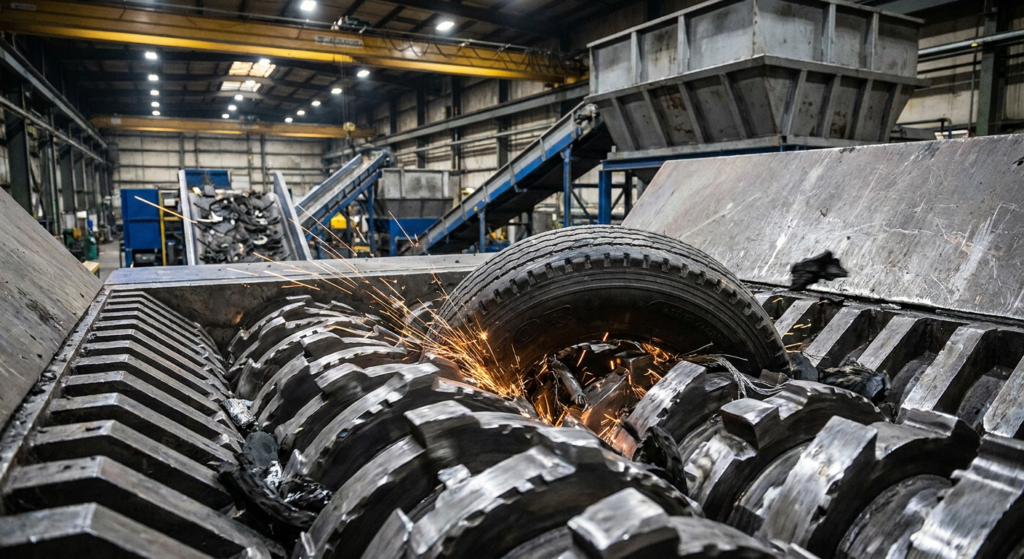
Scrap tire recycling and end-of-life vehicle (ELV) size reduction represent two of the most mechanically demanding environments in industrial waste processing. Unlike homogeneous plastic granulating or clean sheet-metal shearing, processing whole radial tires and automotive scrap forces shredder knives to confront a violent combination of heavy mechanical shock, high-friction heat, and relentless abrasive wear in a single continuous operation. Steel-belted passenger and commercial truck tires embed high-tensile spring steel plies and thick bead wire bundles directly inside elastic vulcanized rubber.
When an operator selects knives for a primary dual-shaft or single-shaft shredder, the instinct is often to specify the hardest tool steel available to maximize wear life. However, field experience across high-throughput recycling plants proves that maximizing hardness alone leads to early edge chipping, catastrophic body fractures, and costly unexpected mill shutdowns. Operational success relies on a deliberate balance between wear-resistant hardness and impact-resistant fracture toughness. Engineering teams that transition from off-the-shelf blade purchasing to metallurgical material selection evaluate performance through total cost per ton processed rather than initial Rockwell hardness readings. Custom knife manufacturers like Maxtor Metal engineer precision-ground shredder blades and shredding knives to maintain structural integrity under these multi-axial shock loads.
The engineering guidance that follows draws on Maxtor Metal’s internal metallurgical and materials team — a certified ISO 9001 quality-management environment with more than 15 years of experience in precision-grinding hardened industrial blades across steel recycling, waste processing, and size-reduction machinery. The selection and failure-analysis recommendations below reflect this hands-on tool-steel remanufacturing experience rather than manufacturer datasheet theory alone.
Why Tire and ELV Feed Destroys Knives
Shredding whole tires and ELV auto scrap exposes cutting edges to severe impact and abrasion dynamics that far exceed standard solid-waste or plastic recycling stresses.
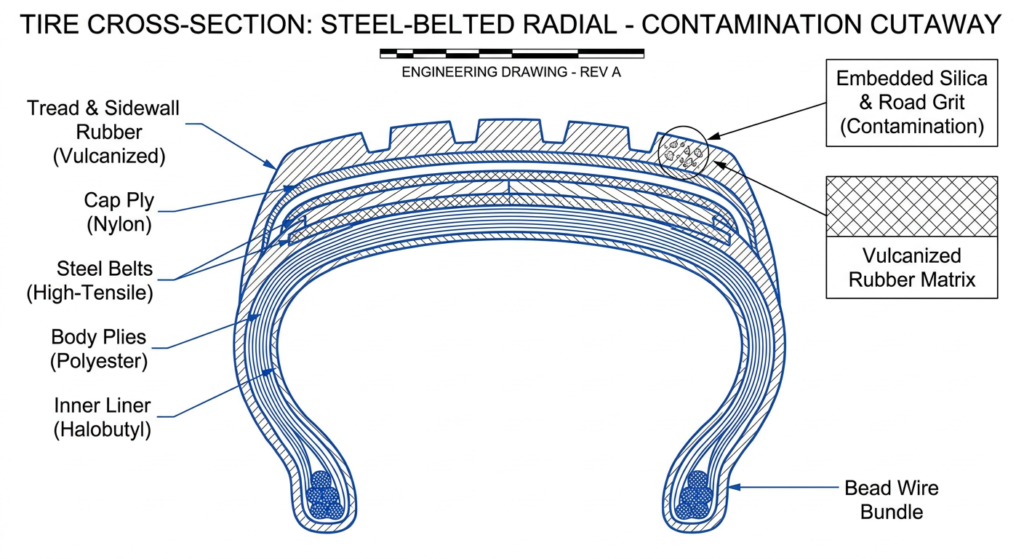
- Extreme Impact Shock: High-tensile steel bead wire bundles (boasting tensile strengths between 1,500 MPa and 2,100 MPa) and heavy automobile structural framing create sudden peak shock loads that exceed the yield strength of conventional cold-work tool steels.
- Elastic Energy Loss: The elasticity of thick vulcanized rubber absorbs mechanical energy before shearing occurs. This forces shredder knives to maintain an extremely aggressive bite while squeezing the feedstock against counter-knives, generating intense friction.
- Compound Abrasive Degradation: Embedded road grit, quartz silica, brake dust, and unseparated tramp iron act as grinding compounds against knife flanks, accelerating abrasive rounding while shock loads simultaneously encourage micro-chipping along the cutting edge.
Key Takeaway: Tire shredding is not a pure cutting operation; it is a violent combination of high-energy impact, metal shearing, and severe rubber abrasion. Knives designed solely for wear resistance fail rapidly through fatigue fracturing.
The Unique Stress Profile of Steel-Belted Rubber
Ferrous steel construction accounts for 65% to 70% of an ELV’s total weight. When whole tires or vehicle assemblies enter a primary shredder, every revolution of the rotor forces the knife hook to shear through elastic synthetic rubber and high-strength steel wire simultaneously.
Because rubber acts as a thermal insulator, friction heat generated during the shear cycle cannot dissipate quickly. Local frictional heating can become significant when clearance deteriorates, the edge becomes dull, or abrasive contamination increases. The actual edge temperature depends strongly on rotor speed, knife clearance, feed composition, contact time, and cooling conditions; therefore, a fixed 200–300°C value should not be treated as a universal operating temperature.
In lower-grade tool steels tempered at low temperatures, this operational heat triggers unwanted secondary tempering, lowering localized surface hardness, relaxing compressive residual stresses, and accelerating flank wear.
In short: tire and ELV feed combines high-tensile bead-wire shock, insulated friction heat, and abrasive contamination in one continuous cycle—no single property (hardness or toughness alone) survives all three.
The Hardness vs Toughness Trade-Off
In tool steel metallurgy, hardness and impact toughness sit on opposite sides of a balance beam. Hardness, measured on the Rockwell C scale (HRC), quantifies a material’s resistance to localized plastic deformation, surface penetration, and abrasive wear. Impact toughness, quantified in Joules (J) or Joules per square centimeter (J/cm²) via Charpy V-notch testing, measures a steel’s ability to absorb energy and deform plastically without fracturing when subjected to high-velocity shock.
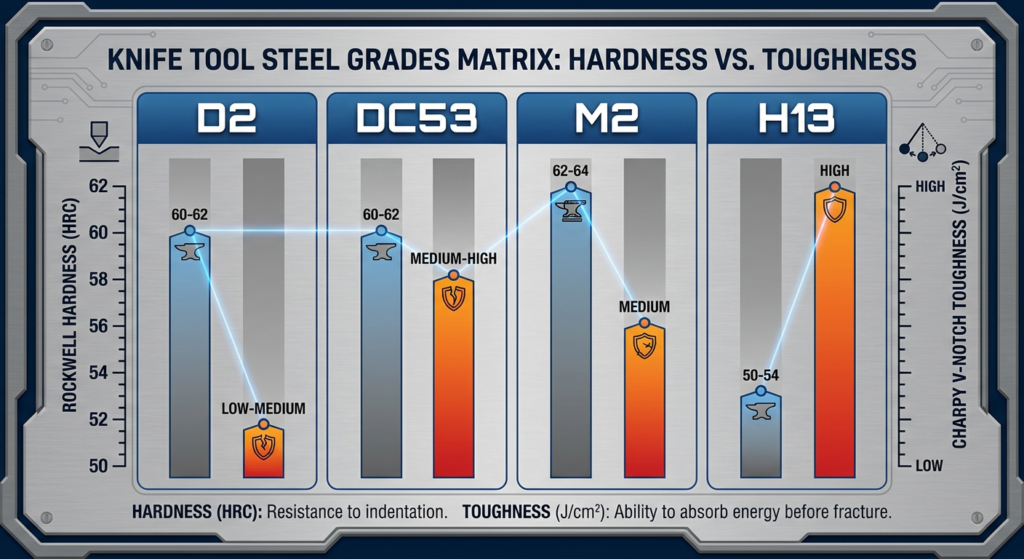
Raising HRC by increasing carbon content or altering quenching parameters increases abrasive wear resistance and edge sharpness retention. However, higher hardness shrinks the material’s fracture toughness, leaving the cutting hook vulnerable to catastrophic cracking when striking tramp metal. Conversely, lowering HRC improves impact absorption and eliminates blade breakage, but the knife edge rounds prematurely under abrasive silica and steel belt scrubbing.
The optimal alloy selection depends entirely on feed contamination levels and primary rotor speed rather than chasing the highest achievable HRC rating.
Reading HRC Ranges for Tire and ELV Duty
To match knife metallurgy to specific processing steps, engineering standards such as ASTM A681 tool steel specifications classify tool steels into specialized hardness and toughness windows:
| Tool Steel Grade | Typical Hardness Range | Unnotched Charpy Impact Energy | Dominant Failure Resistance | Recommended Processing Application |
|---|---|---|---|---|
| AISI D2 / SKD11 | ~58–62 HRC | 15–25 J/cm² | High Abrasive Wear | Clean, pre-sorted rubber or secondary granulating |
| DC53 (Modified D2) | ~58–60 HRC depending on tempering condition | 40–60 J/cm² | Balanced Wear & Impact | Primary tire shredding & contaminated ELV streams |
| AISI M2 / SKH51 | ~62–64 HRC | 10–18 J/cm² | Extreme Wear & Hot Hardness | Clean high-speed shearing without tramp metal |
| AISI H13 / SKD61 | ~50–54 HRC in tough-duty applications | 80–120 J/cm² | High Impact & Thermal Shock | Heavy primary ELV auto-scrap & high-tramp feeds |
Why DC53 Is a Benchmark for Contaminated Streams
DC53 is an upgraded cold-work tool steel developed by Japan’s Daido Steel as a higher-toughness alternative to standard AISI D2 (JIS SKD11) — a positioning Daido states plainly in its official DC53 cold-work tool steel brochure, which describes the grade as overcoming SKD11’s shortcomings in hardness and toughness. By contrast, standard D2 steel contains large, coarse primary chromium carbides (M₇C₃) that form network boundaries during solidification. These coarse carbides act as internal stress risers where micro-cracks originate under impact.
DC53 is registered as an 8% chromium, 8Cr-2Mo cold-work grade — a composition ASM International catalogs in its independent DC53 materials digest — and trims carbon to roughly 0.95% while adding molybdenum (~2.0%) and vanadium (~0.35%). When subjected to high-temperature double tempering at 520°C to 530°C, DC53 undergoes secondary precipitation hardening. This process precipitates sub-micron M₂C carbides uniformly throughout a tempered martensitic matrix.
The resulting microstructure delivers a working hardness of 58–60 HRC while yielding a Charpy impact toughness roughly double that of standard D2 steel. This extra toughness allows DC53 shredder knives to withstand direct impacts against high-tensile bead wires and stray bolts without spalling or shattering.
Heat Treatment as the Hidden Lever
A tool steel’s chemical composition represents only half of its final performance potential. Advanced heat treatment procedures serve as the critical lever to unlock maximum fatigue life:
- Vacuum Hardening: Eliminates surface decarburization and scale, ensuring uniform hardness from the knife skin to its inner core.
- Deep Cryogenic Treatment: Subjecting quenched knives to liquid nitrogen temperatures (-196°C) converts residual retained austenite (RA) into hard, stable martensite, preventing dimensional growth and micro-cracking during service.
- Dual-Hardness Profiles: Differential hardness should be treated as an application-specific design option rather than a default heat-treatment route. Where a blade architecture requires a wear-resistant working zone and a tougher structural region, the manufacturer should validate the hardness gradient, transition zone, dimensional stability, and crack resistance on the actual cross-section..
Diagnose the Failure Mode Before Choosing a Grade
DC53 is often described — and sometimes oversold — as a universal upgrade for D2. From a metallurgist’s standpoint, that framing is too simple. A grade is only as good as the failure mode it is asked to defeat. If the dominant problem is pure abrasive edge rounding on a clean, pre-sorted feed, a well-refined D2 at high hardness can remain the more economical choice, because its heavier carbide fraction buys the most wear life for the lowest cost. A move to DC53 only earns its premium when the dominant mode is impact, or a genuine impact-plus-abrasion duty — and even then, removing a stress-concentration point in the blade geometry is frequently just as important as the choice of steel.
That is why Maxtor Metal’s engineers frame shredder procurement as a failure-mode diagnosis first and a D2-versus-DC53 decision second. The matrix below is a practical first screen:
| Observed Field Symptom | Primary Suspect | What to Measure First | Is a D2 → DC53 Swap Justified? |
|---|---|---|---|
| Edge chipping | Toughness shortfall | Fracture microscopy, HRC, edge condition | Usually worth evaluating |
| Large or body fracture | Stress concentration + impact | Crack origin, hole and keyway geometry, dimensions | Not by material alone — redesign first |
| Rapid flank wear | Insufficient wear resistance | Edge radius, wear-depth profile | May help |
| Cracking from the mounting hole | Stress concentration | Hole-edge radius, surface defects, SEM | Redesign geometry first, then grade |
| Normal hardness but early failure | Toughness, microstructure, or design | Metallography + fracture analysis | Hardness alone cannot pass judgment |
| Edge spalling | Impact combined with high hardness | Edge microscopy + HRC | DC53 / tougher grades worth comparing |
| Uniform wear with no fracture | Abrasive wear | Wear profile under steady load | D2 may remain the more economical choice |
The verified D2 blade-base case later in this guide is a textbook illustration of why this sequence matters. There, hardness measured within the expected range and heat treatment was not the root cause; the crack initiated at the mounting-hole stress concentration and propagated rearward. Read through the matrix, no grade swap — D2 to DC53 or otherwise — would have solved that failure on its own, because the geometry, not the steel, was the controlling defect.
In short: diagnose the failure mode first—chipping points toward toughness, flank wear points toward hardness, and fracture from a mounting hole points toward geometry, not steel grade at all.
Selecting Knife Geometry for Tire and ELV Service
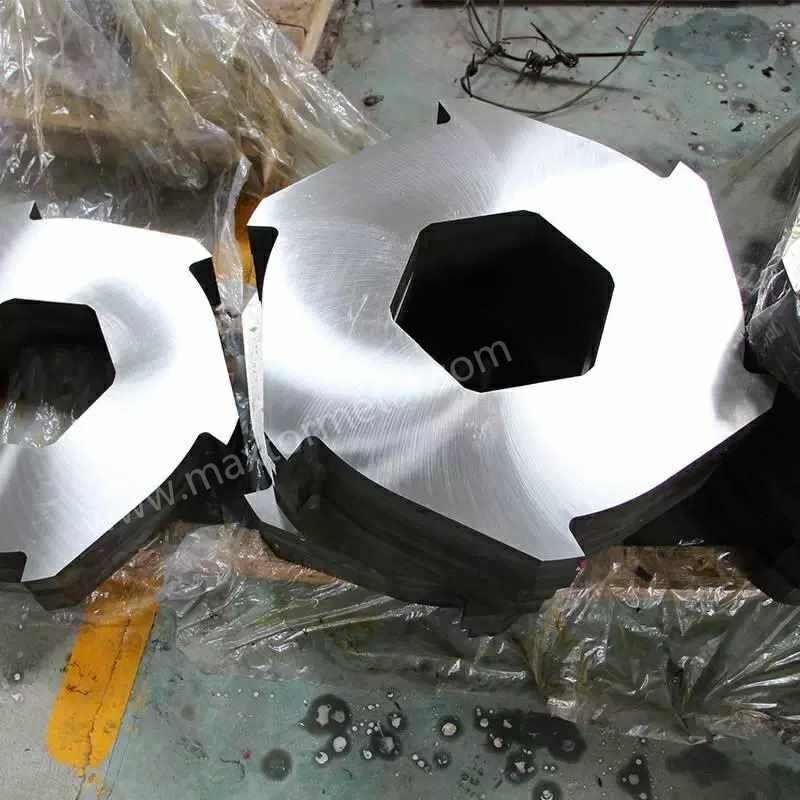
Material properties must work in harmony with mechanical blade design. Even the toughest steel grade will fail if structural stress points are built into the knife geometry.
Aggressive Hook Angle → Higher Rubber Bite → Greater Edge Stress
Generous Fillet Radii → Smooth Stress Flow → Eliminates Corner Cracks
Broad Cross-Section → High Flexural Rigidity → Prevents Blade Deflection
- Hook Profile Optimization: Extremely steep, sharp hook angles maximize bite on slippery elastic tires, but thin knife tips suffer extreme bending stresses when shearing steel bead wire. Truncating hook tips slightly increases structural support behind the cutting edge without sacrificing throughput.
- Section Thickness and Stiffness: Primary tire shredders apply tens of thousands of Newton-meters of torque. Knives must feature sufficient cross-sectional thickness to prevent lateral deflection, which alters blade-to-counter-knife clearances and causes binding.
- Stress Concentration Management: Internal keyways, bore corners, and mounting bolt holes are classic failure sites. Machining generous fillet radii (minimum 3–5 mm) at all internal corners redistributes internal tensile stresses, preventing fatigue cracks from propagating through the blade body.
In short: hook angle, fillet radius, and section thickness determine whether a tough steel grade actually gets to use that toughness—geometry and material selection have to be solved together.
The Real Economics: Cost Per Ton Beats Initial Hardness
In industrial recycling management, purchasing decisions driven solely by the initial price tag of replacement knives often result in higher overall operating expenses.
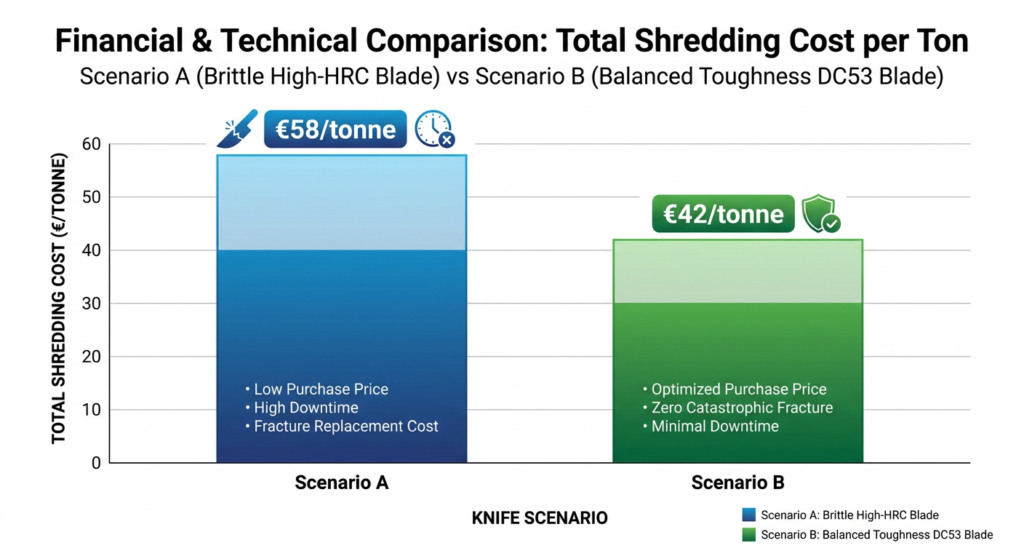
When a brittle, low-cost blade shatters after 300 operating hours, the true expense includes not just the purchase price of a replacement knife set, but also four to eight hours of unscheduled plant downtime, crane rental, maintenance labor, and lost production capacity. Primary tire shredding operational costs typically range between €40 and €60 per tonne. In high-capacity processing plants, unexpected downtime directly erodes profitability.
Pro Tip: Well-engineered shredder knives crafted from balanced DC53 or refined D2 steel routinely operate for 10,000 to 15,000 tonnes of whole tire processing before requiring edge resharpening or hard-facing maintenance.
Building a Cost-Per-Ton Comparison Model
To calculate true tooling economics, maintenance directors utilize a Total Cost of Ownership (TCO) formula:
Cost Per Ton = Knife Set Cost + Installation Labor + Downtime Lost Revenue + Resharpening Costs/Total Processed Tonnage Over Blade Lifetime
The scenarios below are illustrative TCO calculations built around typical published cost ranges, not a specific customer’s invoiced figures—use them as a modeling template with your own site’s downtime and labor rates.
Scenario A: High-HRC Low-Toughness Blade (Standard D2 at 61 HRC)
- Initial Knife Set Cost: €12,000
- Lifespan Before Failure: 350 Hours (1,750 Tonnes) due to catastrophic edge spalling from tramp metal.
- Downtime & Replacement Labor: €9,500 (2 unscheduled shutdowns).
- Total Operational Cost: €21,500 / 1,750 Tonnes = €12.28 per tonne in knife overhead.
Scenario B: Balanced Toughness Blade (DC53 at 59 HRC)
- Initial Knife Set Cost: €15,500
- Lifespan Before Maintenance: 2,200 Hours (11,000 Tonnes) with uniform flank wear and zero cracking.
- Scheduled Maintenance Labor: €3,000 (1 planned overhaul).
- Total Operational Cost: €18,500 / 11,000 Tonnes = €1.68 per tonne in knife overhead.
Failure Mode Diagnosis: Reading the Knife
Inspecting worn shredder blades provides direct diagnostic feedback regarding rotor alignment and metallurgical fit:
- Uniform Abrasive Flank Rounding: Indicates that the blade material possesses adequate toughness, but wear resistance can be improved by stepping up HRC slightly or selecting a grade with higher vanadium content (such as M2 or DC53).
- Chipping, Spalling, or Corner Cracking: Signals that the blade is excessively brittle for the feedstock contamination level. The operator should immediately reduce HRC or transition to a tougher steel grade like DC53 or H13.
- Galling and Thermal Cracking: Indicates severe friction buildup caused by improper knife clearance, dull edges, or inadequate high-temperature tempering resistance.
For failures that don’t fit a clean wear-vs-chipping pattern — or when you need lab-confirmed root cause rather than a field read — see our guide on catastrophic blade shattering: metallurgical root causes and prevention for the fractography sequence (macro mapping → SEM/EDS → metallography → XRD) that separates heat-treatment, material, and overload causes.
In short: a cheaper, harder blade that fractures early can cost 7x more per tonne than a tougher blade with a higher sticker price, once downtime and unscheduled labor are counted.
Verified Field Case: A Cracked D2 Blade-Base at Three Months

To ground the hardness-versus-toughness discussion in real field evidence rather than only in brand experience, we reference an independently published failure-analysis case study in the peer-reviewed journal Engineering Failure Analysis. The study documents a steel blade-base cutting tool used on a two-rotor, low-speed shear machine pre-shredding end-of-life passenger and truck tires that contain steel-belt reinforcement.
The component was manufactured from AISI D2 tool steel, and the failure was a complete fracture, not a worn edge: it cracked through approximately three months into service, despite a predicted working life of roughly one year. Because this study is publicly indexed and independently verifiable, operators and engineers can use it as a neutral reference point when assessing their own knife metallurgy.
Evidence classification: Independent published failure-analysis case; not a Maxtor Metal customer case.
| Verified Case Data | Value |
|---|---|
| Material | AISI D2 tool steel |
| Application | End-of-life tire (ELT) pre-shredding |
| Machine principle | Two-rotor, low-speed shear between counter-rotating rotors |
| Expected working life | ~12 months |
| Actual time to failure | ~3 months |
| Life achieved vs. prediction | ~25% |
| Failure mode | Cracking / complete fracture |
| Hardness | Within expected range |
| Heat treatment | Not identified as the primary cause |
The fracture did not begin as uniform abrasive wear. Crack initiation occurred at the connection-hole region and then propagated rearward through the blade body, producing visibly distinct regions across the fracture face. Read as a system, the failure was an interaction between impact loading, stress concentration at the mounting geometry, and material/design fit — not a simple case of “the edge went dull.” Diagnosing this correctly matters, because a premature edge-rounding problem and a catastrophic fracture problem demand opposite engineering responses.
A Field-Verifiable Five-Step Failure Diagnosis
The most reliable way to separate a genuine material deficiency from a geometry- or impact-driven failure is a disciplined, evidence-based inspection sequence rather than a quick visual check:
- Operating History: Record actual service hours, processed tire type, unexpected shutdowns, blade or base replacement frequency, and any operator-reported abnormal vibration or impact events.
- Hardness Verification: Measure Rockwell hardness on the failed component. The goal is not to prove “harder is better” but to confirm whether the part was genuinely under- or over-hardened. In this case, hardness measured within the expected range, ruling out a simple hardness anomaly as the primary cause.
- Chemical Analysis: Verify that the actual steel chemistry matches the specified grade (here, AISI D2). An off-spec heat silently invalidates every subsequent conclusion.
- Macroscopic Fracture Inspection: Examine crack origin, crack direction, connection-hole geometry, and overall fracture morphology on the as-received part.
- Metallography and SEM: Use optical microscopy, scanning electron microscopy, and cross-sectional examination to confirm the crack-initiation site and map the propagation path.
Only after these steps can an engineer conclude whether the corrective action belongs in chemistry, heat treatment, geometry, or operator/application management.
In this instance, the correct response was a design-and-material requalification rather than a one-line “switch to a harder grade and the problem disappears.” Because the fracture originated at the mounting-hole geometry under impact, upgrading toughness around unchanged stress-concentration points would still concentrate load at the same location. A balanced evaluation starts with DC53, an 8% chromium cold-work tool steel that Daido’s tool-steel catalog lists as an 8Cr-2Mo grade combining high hardness with high toughness — which is what gives it its higher-impact-toughness advantage over SKD11 (D2-class) at comparable hardness, working around 58–60 HRC rather than chasing 62–63 HRC. Here fracture resistance matters more than maximum attainable hardness, and the chosen range must ultimately be validated against the actual hook geometry, section thickness, and heat-treatment result — not assumed from a datasheet.
Source: “Failure Analysis of an AISI D2 Blade-Base Used in Tire Waste Recycling Machine,” Engineering Failure Analysis, 2013 (Elsevier ScienceDirect). Figures in the case table above report the published study’s documented findings; the surrounding engineering-response discussion contextualizes them for blade procurement and requalification.
In short: in the published case, hardness was within spec and heat treatment wasn’t the cause—the crack started at the mounting-hole stress concentration, meaning a harder or tougher grade alone would not have fixed it.
Sourcing Non-OEM Knives Without Risk

To reduce replacement tool budgets, many recycling operators procure non-OEM shredder blades. However, sourcing non-OEM components requires strict quality verification to prevent installation fitment issues and premature mechanical failure.
For the full incoming-inspection workflow this section summarizes—spec control, CMM sampling plans, and MTR documentation review—see Aftermarket Shredder Knives Procurement: Spec Control, CMM Plan, MTR Validation, and Functional Fit Verification.
- Precision Dimensional Tolerances: Verify that mounting bores, hex shafts, and thickness dimensions conform to H7/f7 fits. A thickness variance of just +0.05 mm across a 20-blade rotor stack creates cumulative stack-up errors that destroy precise counter-knife clearance. The GD&T controls and selective-fit spacer strategy that prevent this kind of stack-up error on multi-shaft rotors are covered in Fix Uneven Wear: Multi-shaft Blade Tolerance Stacking Guide.
- Metallurgical Certification: Demand official Material Test Certificates conforming to EN 10204 MTC 3.1. The certificate must document complete heat-lot chemical spectro-analysis and mechanical hardness testing.
- Ultrasonic Inspection: For heavy-section blades where internal soundness is a specified requirement, define the ultrasonic inspection method, acceptance class, and sampling plan separately in the purchase specification. ISO 4957 can be used to specify the tool-steel grade and material requirements, but it should not be presented as the ultrasonic inspection acceptance standard.
What a Responsible Custom Knife Maker Should Be Able to Evidence
Asking for certificates on paper is one thing; being able to explain how those numbers were produced is another. Because procurement risk lives in the batch-to-batch gap between a datasheet and a delivered knife, Maxtor Metal runs every custom heavy-duty blade through a five-stage qualification protocol. This keeps a requested material change directed, documented, and traceable rather than assumed:
- Stage 1 — Incoming Material (traceability): For each heat, the steel grade, heat number, and mill certificate are recorded, with chemical composition and material thickness confirmed, and ultrasonic inspection performed on any heavy sections the drawing requires to be internally sound. Off-spec chemistry is stopped before it reaches a machine.
- Stage 2 — Heat-Treatment Verification: Each batch carries batch and furnace identifiers plus hardness mapping, quenching and tempering records, and dimensional-change readings, confirming that the delivered hardness profile matches the drawing rather than the invoice.
- Stage 3 — Blade Geometry: Critical dimensions — OD, ID, thickness, flatness, parallelism, mounting-hole position, edge radius, and edge runout — are measured on finished parts. This is where the ±0.05 mm stack-up errors that destroy counter-knife clearance are caught before a rotor set is assembled.
- Stage 4 — Failure Inspection on Returned Knives: When a customer returns a failed knife, the part is investigated rather than silently replaced: photography, macroscopic inspection, hardness mapping, chemical verification, crack-origin inspection and, when necessary, metallography and SEM to pin down the actual failure mode.
- Stage 5 — Material Decision and Re-qualification: Only after Stages 1–4 can an engineer answer the question that really drives replacement cost — not “D2 or DC53?” but “is this duty wear-dominated, impact-dominated, or stress-concentration-dominated?” — and then select and re-qualify the grade, hardness, and geometry accordingly.
This is offered as a method rather than as any single customer’s proprietary figures. The independently verifiable anchors for it remain the published D2 blade-base failure above and Daido’s own microstructural and impact data for DC53, so operators can check Maxtor Metal’s approach against their own evidence instead of taking a vendor’s word alone.
Frequently Asked Questions
What is the best tool steel for shredding steel-belted scrap tires?
For primary tire shredding where high-tensile steel wire and occasional tramp metal are present, DC53 tool steel tempered to 58–60 HRC is widely considered the industry benchmark. It delivers twice the impact toughness of standard AISI D2 steel while maintaining high wear resistance.
Why do standard D2 shredder blades chip when processing ELV auto scrap?
Standard AISI D2 steel contains coarse primary chromium carbides in its microstructure. When a D2 knife strikes high-tensile bead wires or structural automobile steel, these large carbides act as stress concentration points, initiating micro-cracks that rapidly lead to edge spalling and chipping.
How does DC53 compare to D2 for primary shredder knives?
DC53 is an upgraded modification of D2 steel. By reducing carbon content and utilizing high-temperature double tempering (520–530°C), DC53 forms a finer carbide structure. This grants DC53 approximately double the Charpy impact toughness of D2 at equal hardness levels (58–60 HRC), preventing catastrophic blade breakage under heavy shock loads.
What Rockwell hardness (HRC) should scrap tire shredder blades have?
For primary tire and ELV shredders, the recommended hardness range is 56–60 HRC. Secondary granulators processing clean, wire-free rubber crumb can utilize higher hardness ranges (60–62 HRC) to maximize abrasive wear life.
How many tons can a set of primary tire shredder knives process before resharpening?
When using high-grade, metallurgically balanced tool steel like DC53 or refined D2, a primary tire shredder knife set typically processes between 10,000 and 15,000 tonnes of scrap tires before requiring resharpening or hard-facing maintenance.
How do cumulative thickness tolerances affect non-OEM shredder blade performance?
On multi-blade shredder shafts, small thickness variances accumulate across the entire rotor length. If individual blades exceed tolerance by even ±0.03 mm, a 30-blade stack-up creates nearly 1 mm of total lateral error, leading to blade-to-counter-knife interference, excessive friction, and rotor jamming.
What quality documents should I require when purchasing non-OEM replacement knives?
You should always request an EN 10204 MTC 3.1 Material Test Certificate verifying chemical composition and heat treatment batch hardness, an ultrasonic flaw inspection report confirming internal soundness, and a CNC dimensional inspection sheet verifying bore fit and thickness parallelism.
Conclusion
Maximizing profitability in scrap tire and ELV size reduction demands a deliberate metallurgical strategy rather than a blind search for the hardest available blade. While extreme HRC levels offer theoretical wear resistance, real-world recycling streams impose severe shock loads that demand high impact toughness and structural fatigue resistance. By balancing Rockwell hardness against Charpy impact energy—specifically through advanced tool steels like DC53, precision heat treatment, and stress-relieved blade geometry—operators eliminate catastrophic blade failures and drastically lower total operational costs per ton.
Leading recycling operations pair metallurgical rigor with disciplined non-OEM procurement protocols to control tooling budgets without risking machinery health.
Disclosure: The material-science guidance in this article is provided as objective, field-oriented technical information for engineering evaluation. Maxtor Metal is a manufacturer of custom precision-ground industrial blades and may supply knife products referenced in this text; any mention of equipment or process performance reflects verified case data and responsibly published tool-steel specifications rather than a guarantee of specific results. Equipment operators should validate material, geometry, and heat-treatment choices against their own machinery and application conditions.
To explore custom blade geometries, material test certifications, and long-life replacement options for your machinery, consult with the engineering specialists at Maxtor Metal for custom industrial shredder blade replacement solutions.
About the Author
Nancy Wu — Senior Manufacturing Engineer, PE (Production Engineering), Maxtor Metal
Nancy Wu brings 12 years of hands-on manufacturing-engineering experience to industrial blade design and production. Her expertise spans the machining, material, and coating characteristics of the most common industrial blade grades — including SKD11, D2, M2, H13, powder-metallurgy steels, and tungsten carbide — along with advanced high-precision CNC grinding programming capability.
She holds the SME Certified Manufacturing Engineer (CMfgE), PMP, Six Sigma Black Belt, and ASM International certifications, applying disciplined process control and quality methodology to the tool-steel solutions discussed throughout this guide.

 English
  Spanish
  Italian
  French
  Portuguese
  Russian
  German
  Arabic
  Hindi
Hindi  Vietnamese
  Indonesian
  Japanese
  Korean