

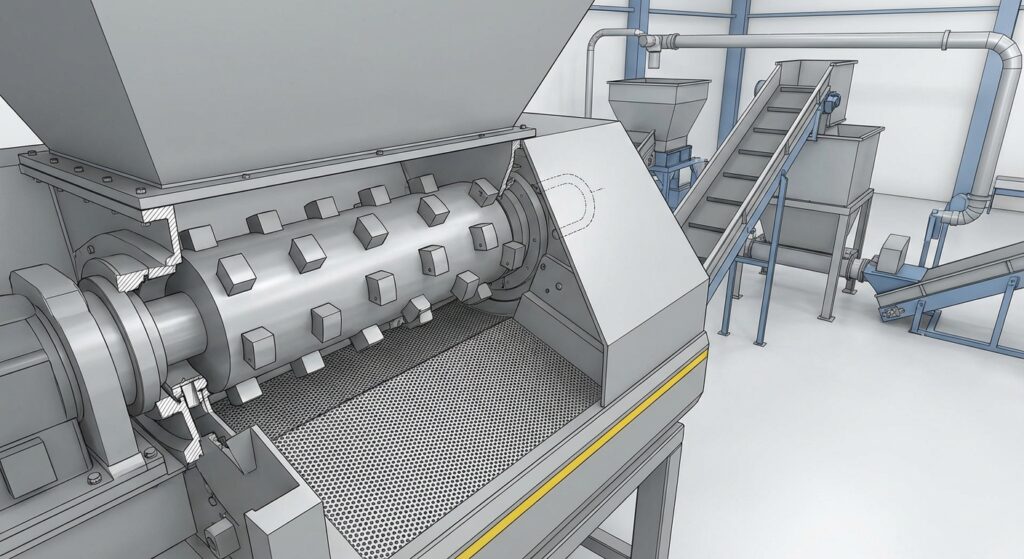
In abrasive plastic streams—glass-filled regrind, mineral-filled compounds, or bales that carry sand and grit—blade wear is rarely “just a materials problem.” In a single-shaft shredder, setup choices decide whether knives stay in steady cutting or spend their life heating, rubbing, and reverse-cycling.
You control more levers than most plants document: feed rate uniformity, the speed/torque regime, and how the screen and cutting gap force material to re-circulate in the cutting chamber.
Knife engineering still matters—steel choice, heat treatment quality, coatings, and edge geometry are the last line of defense for abrasive plastic recycling blades—but it works best when the process isn’t fighting the knives.
Finally, the most reliable maintenance trigger isn’t “it feels dull.” Track kWh/ton, vibration trend, and reverse cycles. Those signals show wear well before you reach the point of chipped corners, cracked edges, or a jam that takes the line down.
النقاط الرئيسية: Stabilize feed before touching RPM. Run the lowest speed that still cuts cleanly at your target throughput. Keep the cutting gap tight and verified, and use kWh/ton + reverse cycles to time sharpening.
مقدمة
Abrasive plastics don’t fail blades in one dramatic moment—they grind them down by forcing more sliding contact, more heat, and more recirculation inside the chamber. When that happens, you see the same pattern: rising motor load, more reverse cycles, hotter cutting edges, and eventually micro-chipping or rolled edges.
That’s why setup decisions typically drive blade life and uptime more than the steel grade alone. If your feed surges, or your screen is too tight for the material condition, the shredder will “work” but it will do it by rubbing and reversing—both of which accelerate edge wear.
The controllable levers are straightforward:
- Feed rate (and how uniform it is)
- Rotor speed/torque (the regime you operate in)
- Screen and cutting gap (how hard you force size reduction per pass)
Engineering the knives closes the loop: steel family, heat treatment, coatings/hardfacing, and edge geometry for abrasive plastic recycling blades. Those choices determine how much abuse the edge can take before it chips, rounds, or loses bite.
On the monitoring side, don’t wait for catastrophic symptoms. Use kWh/ton, vibration/noise trend, and reverse cycles as measurable triggers to schedule maintenance before failures.
Process setup
Feed rate control
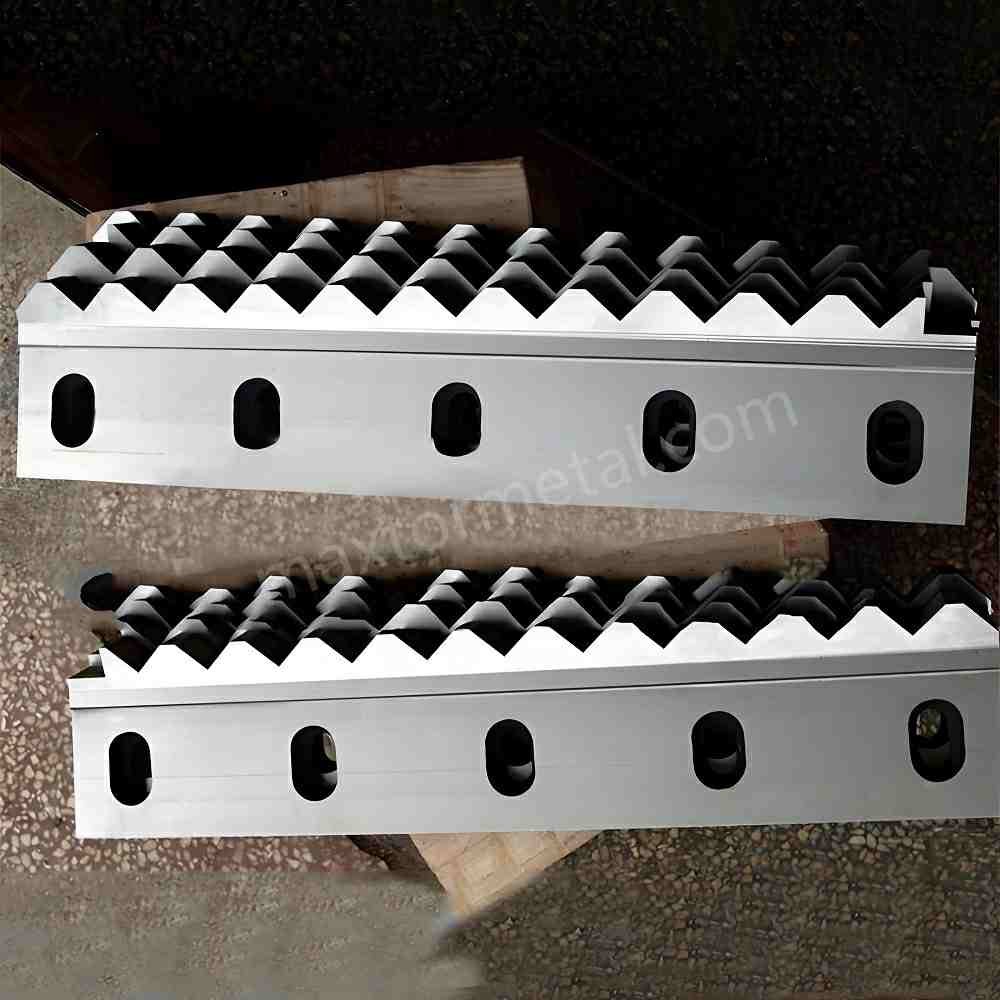
Abrasive feedstock punishes inconsistency. A steady, metered feed keeps the rotor in a predictable cutting mode; surges push the machine into overload behavior (high current/torque spikes, reverses, and heat).
Control points that usually pay back fastest:
- Prevent surges: avoid “dump feeding” where a slug of material hits the rotor, then the chamber runs half-empty.
- Meter the feed: a controlled conveyor/ram reduces jams and dulling; a 2025 technical note emphasizes that overfeeding increases jams and accelerates dulling/overload events in plastics processing (matching rotor speed, screen size, and knife gap (2025)).
- Treat contamination as a process variable: if bales carry grit or fines, upstream screening and wash steps reduce abrasive load before it hits the knives.
What failure looks like when feed rate isn’t controlled: more reverse cycles per hour, “spiky” motor current, and knives that come off the rotor with polished, rounded edges rather than a clean wear land.
Rotor speed and torque
For abrasive plastics, faster isn’t automatically better. Higher RPM can increase sliding contact and heat if the screen and gap force the material to circulate. A slower, higher-torque regime often reduces edge temperature and helps the knives “bite” rather than rub—provided feed is stable.
Practical decision logic:
- إذا رأيت frequent reverses, first reduce peak loading (feed surges) before changing RPM.
- If the machine cuts cleanly but kWh/ton rises over time, check whether you’re in a high-RPM “rubbing” regime created by a restrictive screen/gap.
- Match speed to your discharge requirement: MAXTOR METAL notes that slow rotor speed pairs better with smaller screen openings, ، بينما higher speed typically needs larger openings to avoid excessive recirculation and heat (as discussed in MAXTOR METAL’s 2025 note on matching rotor speed, screen size, and knife gap).
What failure looks like when RPM/torque regime is wrong: hotter cutting chamber, smeared/softened plastic buildup, and edges that “lose bite” quickly even when the steel is sound.
Screen and cutting gap
Screen and gap settings decide how hard you’re forcing size reduction per pass—and how long material stays in the cutting chamber. In abrasive plastics, too-restrictive settings can turn cutting into grinding.
Safety note: Before you change screens, adjust the cutting gap, or enter the cutting chamber, follow your site’s lockout/tagout procedure, confirm the rotor can’t move, and use the shredder OEM’s service instructions. Mechanical work on rotating equipment should only be done by trained personnel. For baseline safety requirements, see OSHA’s The Control of Hazardous Energy Lockout Tagout OSHA Standard 29 CFR 1910.147, and the risk-control principles in ISO 12100 Safety of Machinery General Principles for Design Risk Assessment and Risk Reduction و ISO 14118 Safety of Machinery Prevention of Unexpected Start-up (Europe: EN 1037). Key setup principles:
- Screen size is a wear lever: smaller openings improve size control, but they increase residence time and abrasive contact.
- Cutting gap is a wear multiplier: a tight, verified gap supports clean shearing; a gap that opens up unevenly can increase rubbing, noise, and vibration.
- Verify gap uniformly across the full knife length. One “wide corner” is enough to start uneven loading and edge chipping.
Practical boundary conditions (keep it safe and reproducible):
- Use OEM definitions for “gap”: document where you measure (e.g., near both ends + the middle) and كيف you lock the rotor before measuring.
- Uniformity matters more than the absolute number: a slightly-off nominal gap that’s consistent end-to-end often cuts more predictably than a “perfect” nominal gap with one wide spot.
- Treat any change as a new baseline: after you change the screen, gap, or knife set, expect kWh/ton and reverses/hour to shift—then re-establish your baseline rather than comparing to last month’s numbers.
A useful rule for troubleshooting is sequencing: if you need fewer reverses and less heat, fix feed uniformity first, then set a reasonable RPM/torque regime, then adjust screen and gap to hit size.
Blade engineering (abrasive plastic recycling blades)
Steel and hardness targets
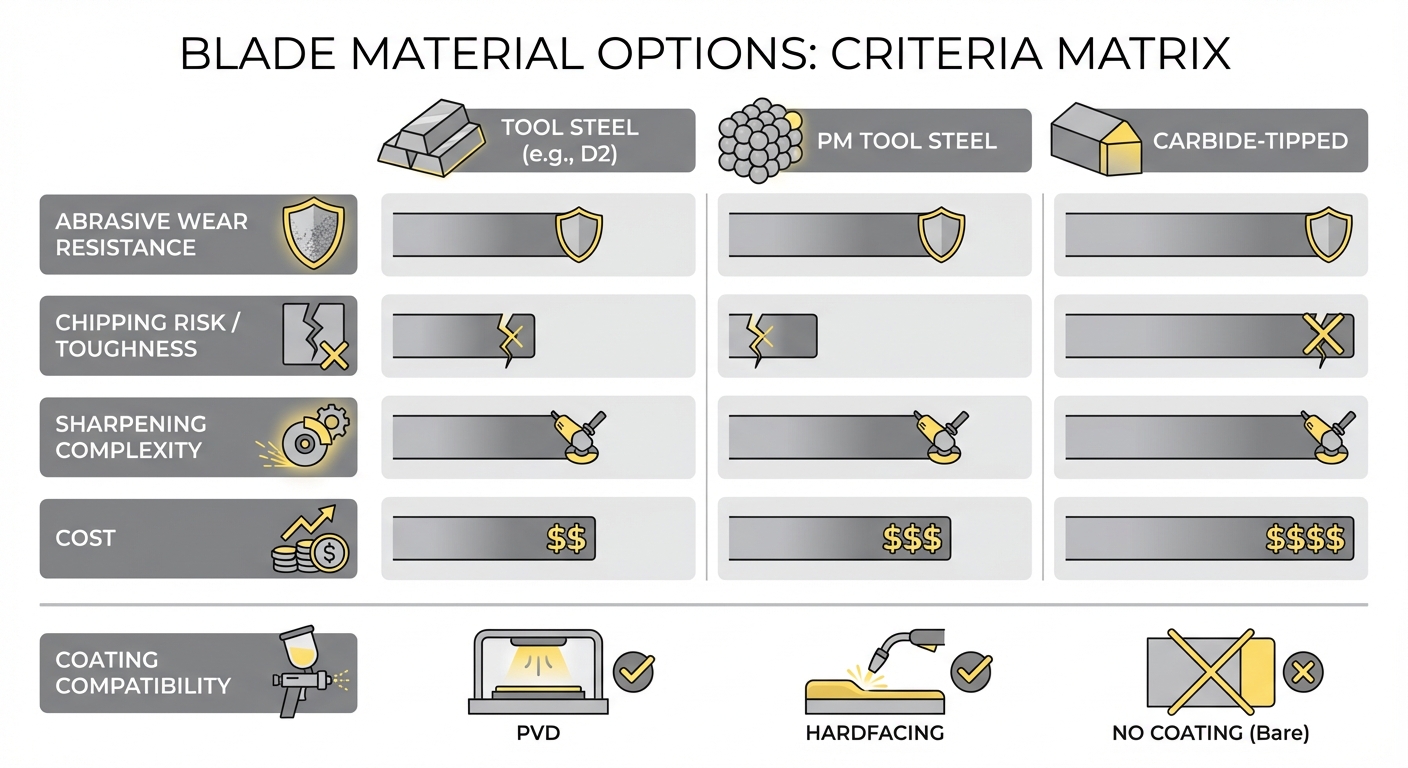
In abrasive plastic recycling blades, you’re always balancing two failure modes:
- التآكل الكاشط (edge rounds over; kWh/ton rises; cut quality drifts)
- Impact-driven chipping (corners break; vibration spikes; sudden jams)
That tradeoff is why “hardest possible” isn’t a universal answer. Contaminated streams and tramp metal demand toughness; glass-filled regrind demands wear resistance.
A practical selection approach:
- Start from your dominant damage mode (rounding vs chipping).
- Specify the steel family and the target hardness range appropriate to your machine’s cutting geometry and the expected contamination level.
- Require documentation that makes hardness repeatable across batches.
When you’re sourcing knives, this is also where supplier QA matters. For example, MAXTOR METAL lists incoming material certification and multi-stage inspection (first-article, in-process, final) on its single-shaft shredder fixed blade material options and QC steps. In abrasive service, that kind of traceability reduces the risk of “mystery batches” that chip early or wear unpredictably.
Coatings and hardfacing
Coatings and hardfacing can extend wear life in abrasive plastics—but only when they match the wear mechanism and the sharpening plan.
Use them when:
- You have a stable process window (feed/speed/screen/gap are controlled), and abrasive wear is the dominant limiter.
- You can maintain edge geometry consistently during regrinds (coatings are not magic if the edge is overheated or rounded during sharpening).
Avoid forcing coatings when:
- Your stream includes frequent hard contaminants that cause impact chipping (a very hard surface can fail abruptly if the edge support and toughness aren’t there).
- Your maintenance process can’t preserve the intended edge geometry (coating benefit disappears if you grind it off unpredictably).
Your decision shouldn’t be “coated vs uncoated,” but “what failure mode am I buying time against?”
Edge geometry and sharpening
Edge geometry is the fastest way to change how the knife experiences abrasive plastics. Two edges made of the same steel can wear very differently if one is too thin at the edge or if the included angle drives sliding contact.
Engineering choices that usually reduce chipping without giving up all wear life:
- Micro-chamfer or controlled edge radius to support the edge in contaminated abrasive streams.
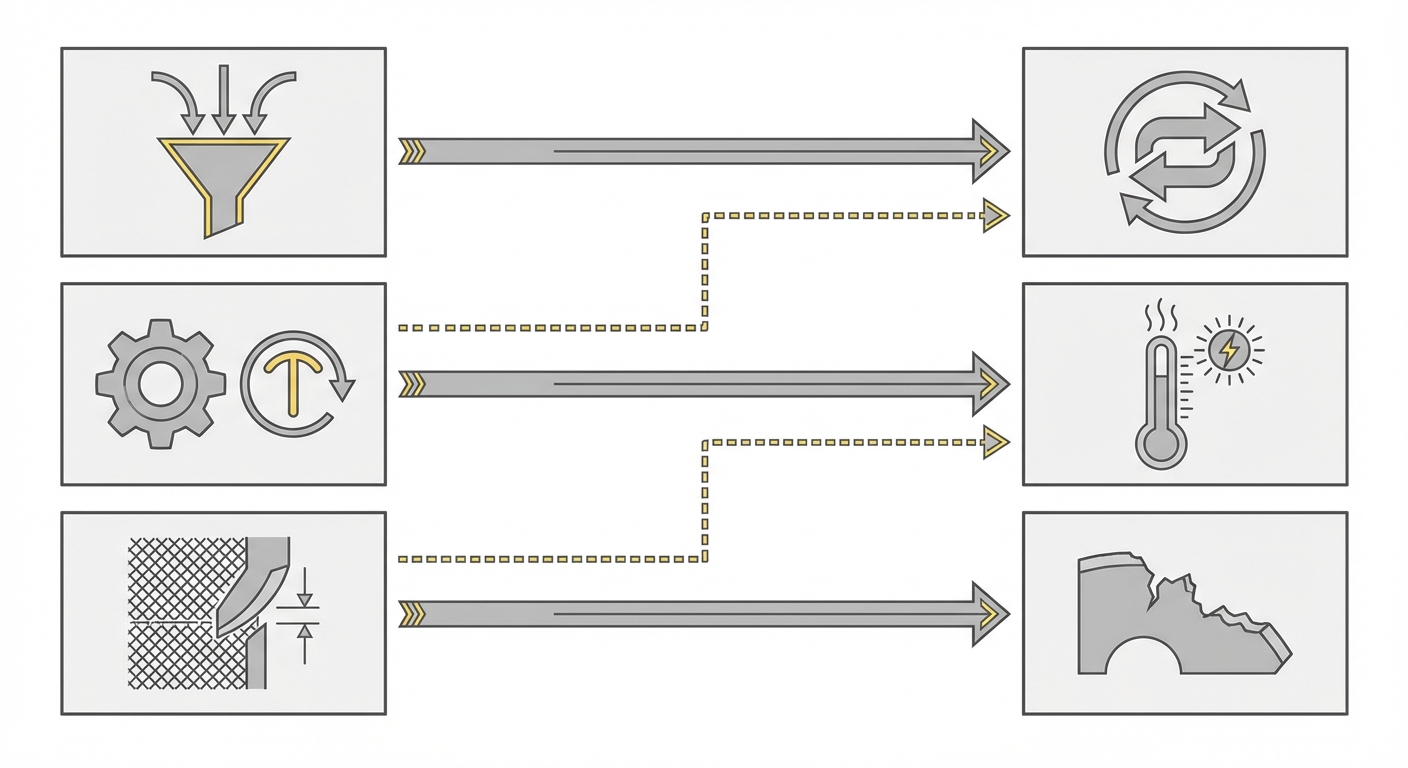
- Geometry matched to feedstock: straight vs serrated vs hook/R-shaped edges affect how material is gripped and how load is distributed. For a practical overview of edge styles and where they fit, see MAXTOR METAL’s blade design/edge-style guide (2025).
- انضباط عملية الشحذ: حافظ على تدفق سائل التبريد وتجنب السخونة المفرطة؛ إذ يمكن للتلف الحراري عند الحافة أن يعطي انطباعًا مضللًا بوجود “صلب رديء” لأنه يسرع من التشظي الدقيق.
حدد محفزات الشحذ بناءً على الانحراف المقاس، وليس على أساس العادة:
- اتجاه تصاعدي لمعدل kWh/ton عند إنتاجية مستقرة
- زيادة دورات العكس عند نفس مزيج التغذية
- اتساع نطاق توزيع حجم القطع (المزيد من المواد الناعمة + المزيد من المواد الزائدة عن الحجم في آن واحد)
نصيحة احترافية: إذا قمت بتغيير حجم الغربال أو الفجوة، فأعد ضبط “الخط المرجعي” لمعدل kWh/ton ودورات العكس. وإلا، فستلقي باللوم على السكاكين بسبب تغيير في الإعدادات.
Monitoring and ROI
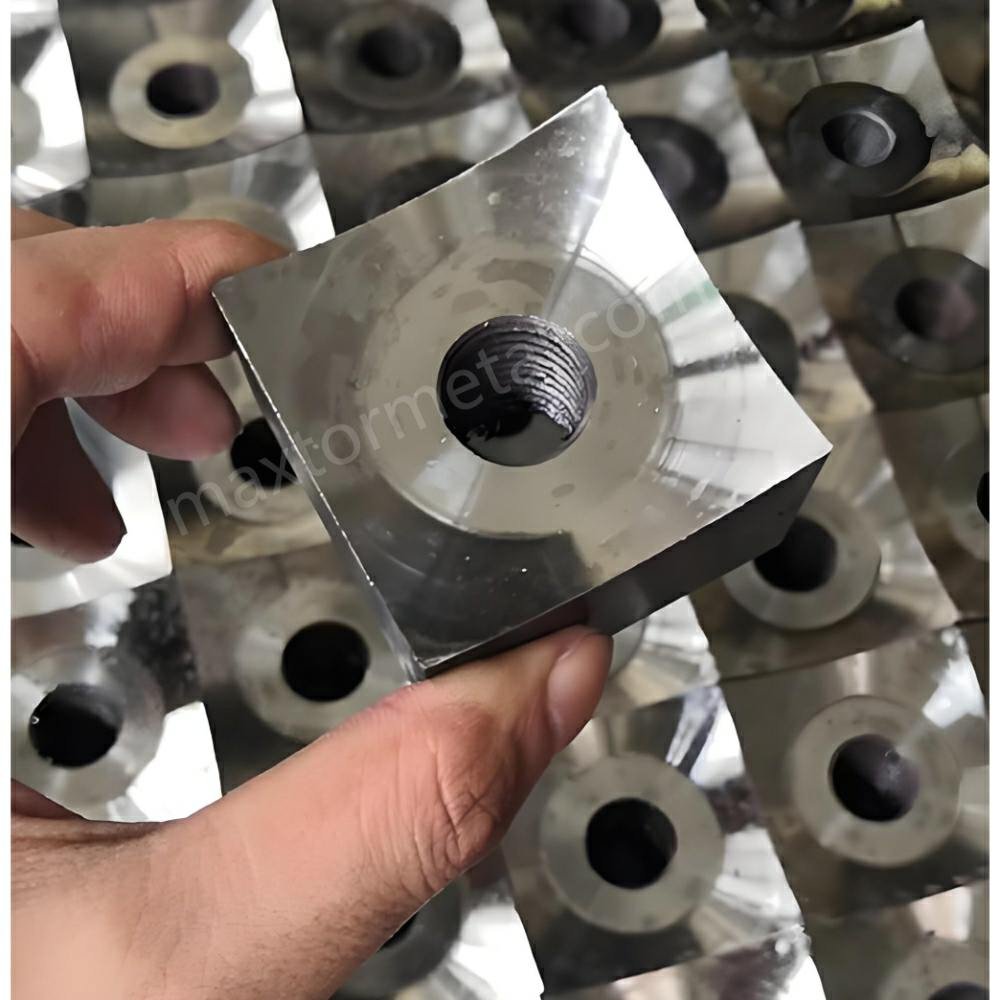
إشارات مراقبة الحالة
لا يلزم أن تكون مراقبة الحالة معقدة. اختر مجموعة صغيرة من الإشارات التي ترتبط بالتآكل والتلف، ثم تتبع اتجاهها مقارنة بالإنتاجية الإجمالية بالطن.
الإشارات التي تتغير أولاً عادةً:
- الطاقة لكل طن (kWh/ton): يعد ارتفاع معدل kWh/ton عند نفس الإنتاجية مؤشرًا واضحًا على تآكل واستدارة الحواف، أو انحراف الفجوة، أو الغربلة المقيدة.
- دورات العكس: غالبًا ما تشير زيادة دورات العكس في الساعة إلى وجود حمل زائد، أو تغذية غير منتظمة، أو توليفة غربال/فجوة تؤدي إلى استمرار دوران المواد.
- اتجاه الاهتزاز والضوضاء غير الطبيعية: يمكن أن يشير الاهتزاز المتزايد إلى تآكل غير متساوٍ للسكاكين، أو زوايا مشظاة، أو أدوات تثبيت مرتخية، أو تصادمات داخل الغرفة؛ وتشير MAXTOR METAL إلى الاهتزاز/الضوضاء غير الطبيعية وانخفاض كفاءة القطع كمحفزات للصيانة في قائمة مراجعة إشارات الصيانة (2024).
مقارنة مرجعية سريعة “نمط التآكل ← الإشارة ← السبب المحتمل”:
- استدارة الحواف / فقدان قدرة القطع ← ارتفاع تدريجي في معدل kWh/ton عند إنتاجية مستقرة؛ وانحراف توزيع حجم القطع ← غالبًا ما يرتبط بالتآكل الاحتكاكي الطبيعي، أو اتساع الفجوة بمرور الوقت، أو الغربلة المقيدة للغاية.
- التشظي الدقيق عند الزوايا ← تغير مفاجئ في الاهتزاز/الضوضاء؛ عمليات عكس/انحشار مفاجئة ← غالبًا ما يرتبط بوجود شوائب مسببة للتصادم، أو فجوة غير متساوية (نقطة واحدة واسعة)، أو هندسة حافة رقيقة جدًا بالنسبة لتدفق المواد.
- منطقة تآكل مصقولة / التصلد الحراري اللامع ← ارتفاع حرارة الغرفة، تراكم المواد الملتصقة، زيادة دورات العكس ← غالبًا ما يرتبط بنمط الاحتكاك الناتج عن سرعة الدوران العالية RPM + إعادة الدوران، أو انسداد الغربال، أو التغذية الاندفاعية المفاجئة.
استخدم هذا بمثابة مؤشر تشخيصي, ، ثم تأكد من خلال الفحص—ولا تفترض أن مقياسًا واحدًا يوضح الصورة الكاملة.
طريقة بسيطة لتفعيل هذه الإشارات عمليًا (دون تعقيد زائد):
- حدد خطًا مرجعيًا بعد عملية تجليخ جديدة أو تغيير السكاكين: سجل معدل kWh/ton، ودورات العكس/الساعة، ومستوى الاهتزاز لأول دورة إنتاج مستقرة.
- سجل البيانات بوتيرة منتظمة: عادةً ما يكفي التسجيل لكل نوبة عمل (أو لكل دفعة)، طالما أنك تسجل دائمًا ملاحظات الإنتاجية ومزيج التغذية.
- استخدم “الانحراف” كمحفز للإجراء: عندما يظل معدل kWh/ton و/أو دورات العكس/الساعة مرتفعًا مقارنة بالخط المرجعي لفترة مستمرة، قم بجدولة عملية فحص.
- اقرن البيانات بفحوصات سريعة: تحقق من اتساق فجوة القطع، وافحص حالة الغربال/الانسداد، وتأكد من عزم ربط أدوات التثبيت.
تختلف حدود العتبات القياسية حسب الآلة والمادة،, ولكن تبدأ العديد من المصانع بالتحقيق عندما يرتفع معدل kWh/ton بنسبة تقارب 10–20% عند نفس معدل الإنتاجية ومزيج التغذية, ، أو عندما تظهر دورات العكس/الساعة تغيرًا مفاجئًا وواضحًا على مدار عدة دورات تشغيل.
تعامل مع هذه الإشارات على أنها مؤشرات لـ “حان وقت الفحص”، وليس “التشغيل حتى التلف”.
ملاحظات تسجيل البيانات (لتكون اتجاهاتك قابلة للمقارنة)
- كيلوواط ساعة/طن: إجمالي الطاقة (kWh) لدورة التشغيل ÷ الأطنان المعالجة في نفس الدورة.
- الأطنان المعالجة: استخدم مصدرًا واحدًا ثابتًا (ميزان السير، أو ميزان البسكول، أو حمولة المحاسبة) ولا تخلط بين الطرق في نفس منحنى الاتجاه.
- Sampling cadence: عادةً ما يكفي التسجيل لكل نوبة عمل أو لكل دفعة؛ وسجل نفس الحقول في كل مرة.
- دورات العكس: استخرج العدد من سجل أحداث PLC/VFD إذا كان متاحًا (غالبًا ما تكون عمليات الإحصاء اليدوية من قبل المشغلين غير دقيقة ومربكة).
- سجل دائمًا سياق التشغيل: مزيج التغذية (الحشو الزجاجي/المعدني، الرطوبة)، فتحة الغربال، سرعة دوران الدوار RPM، وأي حالات تلوث معروفة.
إذا تغيرت حقول السياق هذه بشكل جوهري، فتعامل مع ظروف التشغيل الجديدة كخط مرجعي جديد بدلاً من اعتبارها “تآكل الشفرة”.”
Preventive maintenance windows
A practical PM window is one you can schedule without guessing.
Build it around tonnage and signal drift:
- After a knife change or fresh grind, record baseline kWh/ton, reverses/hour, and vibration level.
- Set an inspection trigger when any one metric drifts materially above baseline (plant-defined threshold) for a sustained period.
- Combine inspection with a fast mechanical verification: cutting gap check, screen inspection, and bolt/fastener torque verification.
What this prevents: the classic cycle where blades are kept in service until they chip badly, then the plant blames “bad steel” when the real root cause was gap drift or feed surges.
TCO metrics and documentation
To prove ROI to procurement and management, document in the same units your plant already uses:
- Blades per 1,000 tons (or knives per 1,000 tons)
- Downtime hours per 1,000 tons attributed to knife changes, jams, or chamber cleanouts
- كيلوواط ساعة/طن at stable throughput
- Screen life and screen change labor (if screen wear is a meaningful cost)
Keep the documentation simple:
- Material spec + hardness range + edge geometry drawing
- Heat-treat and inspection records (where available)
- A before/after trend chart for kWh/ton and reverse cycles after a setup or blade change
When you can show that a setup change reduced reverses and lowered kWh/ton, the ROI discussion becomes evidence-based rather than anecdotal.
الخاتمة
Lock in stable feed, moderated speed, and a tight cutting gap before upgrading materials. If the process is surge-feeding or forcing constant recirculation through a restrictive screen, even premium steels will wear like commodity knives.
Specify steel, hardness, and edge geometry deliberately; sharpen by tonnage or energy/ton, not by feel. For abrasive plastics, edge support (micro-chamfer/controlled radius) is often what prevents early chipping.
Track vibration, reverse cycles, and blades per 1,000 tons to prove ROI. Once those metrics are stable, material upgrades and coatings become easier to justify because you can measure the delta.
Next step: Put your knife spec in writing—material, hardness range, edge geometry, and required QA documents—so every reorder is repeatable, not a new experiment.
المراجع
- Occupational Safety and Health Administration (OSHA): The Control of Hazardous Energy (Lockout/Tagout) – OSHA Standard 29 CFR 1910.147
- International Organization for Standardization (ISO): ISO 12100: Safety of Machinery — General Principles for Design — Risk Assessment and Risk Reduction
- International Organization for Standardization (ISO): ISO 14118: Safety of Machinery — Prevention of Unexpected Start-up (Europe: EN 1037)
نبذة عن الكاتب: Written by Tommy Tang, Senior Sales Engineer (Nanjing METAL Industrial). 12 years in industrial blade applications. Certifications: CSE, CME, Six Sigma Green Belt, PMP. Email: [email protected]
مراجعة فنية: Internally reviewed by the MAXTOR METAL engineering/QA team for manufacturing feasibility and common failure modes observed in abrasive plastic service.
Last reviewed: 2026-04-08

 English
  Spanish
  Italian
  French
  Portuguese
  Russian
  German
  Arabic
  Hindi
Hindi  Vietnamese
  Indonesian
  Japanese
  Korean
استجابة واحدة