

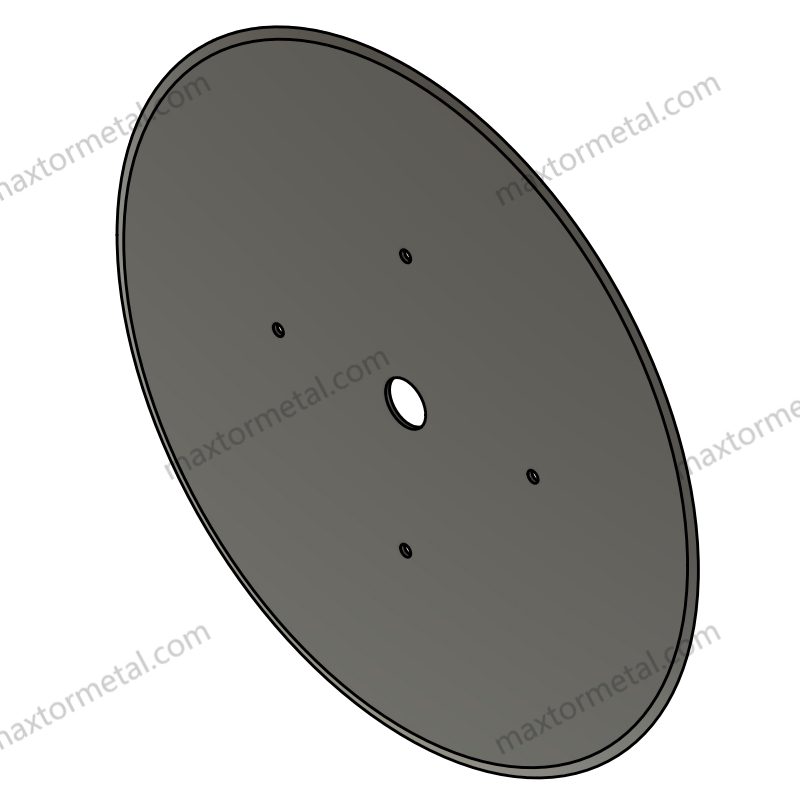
Choisir le meilleur matériau et la configuration optimale pour Couteaux Circulaires Industriels permet d'assurer un fonctionnement optimal dans n'importe quelle usine. Le matériau de la lame, le profil du tranchant et les revêtements spéciaux doivent être adaptés au matériau à couper et aux exigences de chaque industrie. L'acier rapide, le carbure de tungstène, la céramique et les revêtements spéciaux présentent tous des avantages spécifiques. Choisir la bonne configuration garantit des coupes plus nettes, prolonge la durée de vie des lames et améliore la productivité.
Principaux points à retenir
- Choisir le bon matériau de lame, tel que l'acier rapide, le carbure de tungstène, la céramique ou l'acier inoxydable, permet d'optimiser la qualité de coupe et de prolonger la durée de vie des lames.
- Les profils de tranchant, tels que le simple biseau, le double biseau ou la denture, doivent être adaptés au matériau. Cela permet d'obtenir des coupes nettes et de réduire les déchets.
- Les revêtements tels que le TiN, le DLC et le TiCN augmentent la dureté des lames. Ils réduisent également le frottement, préviennent la corrosion et prolongent la durée de vie des outils.
- Les lames rotatives coupent plus rapidement et s'usent de manière uniforme. Elles sont particulièrement adaptées aux matériaux fins et aux cadences de production élevées.
- Les lames sur mesure, conçues pour des matériaux et des applications spécifiques, peuvent réduire les temps d'arrêt jusqu'à 75%. Elles permettent également de réduire considérablement les taux de rebut.
- L'entretien des lames par le nettoyage, l'affûtage et un stockage adéquat garantit leur bon fonctionnement et permet de réaliser des économies.
- Adapter le matériau de la lame, le type de tranchant et le revêtement à l'application permet d'accélérer la production et de réduire les coûts.
- Consulter des experts ou des entreprises comme Nanjing Metal peut vous aider à choisir ou à concevoir la lame la mieux adaptée à vos besoins.
Principales conclusions
Meilleurs matériaux
Le choix du matériau de la lame est crucial pour chaque application. L'acier rapide (HSS) offre une dureté élevée et conserve son tranchant même à des vitesses de coupe élevées. Le carbure de tungstène est extrêmement résistant à l'usure et durable, ce qui le rend idéal pour les applications à haute cadence. Les lames en céramique conservent leur tranchant très longtemps et sont insensibles à la corrosion, ce qui convient parfaitement aux coupes de précision en environnement propre ou médical. L'acier à outils D2 et les aciers à haute teneur en carbone comme le 1095 et le 52100 sont robustes et durables, parfaits pour la coupe du caoutchouc et des plastiques. L'acier inoxydable est privilégié pour l'agroalimentaire, le médical et les non-tissés en raison de sa résistance à la corrosion et de sa facilité de nettoyage.
La fabrication de lames avec une concentricité élevée permet d'améliorer la qualité de coupe et de prolonger leur durée de vie. Les lames présentant un faux-rond minimal vibrent moins, durent plus longtemps et réduisent les pertes de matière. Cela est particulièrement avantageux dans les secteurs de l'emballage et de l'agroalimentaire.
Configurations optimales
la conception des Couteaux Circulaires Industriels influe directement sur leurs performances et sur la fréquence de maintenance. Les lames fines et tranchantes à simple biseau sont idéales pour la coupe de films plastiques. Elles garantissent des coupes nettes et minimisent les pertes de matière. Les profils à double biseau ou à bords émoussés sont plus robustes et adaptés au caoutchouc et aux plastiques, car ils résistent mieux aux impacts et s'ébrèchent moins facilement. Les dentures ou profils ondulés conviennent aux matériaux tenaces ou extensibles, facilitant le travail de la machine et assurant des coupes plus régulières. Les lames à mise en carbure et celles avec revêtement céramique offrent une durée de vie accrue et réduisent la fréquence de remplacement dans les usines à forte cadence.
- Les types de lames recommandés comprennent :
- Lames de rasoir pour le refendage de films fins et de feuilles métalliques
- Lames de refendage par écrasement pour le caoutchouc et la mousse
- Lames de refendage par cisaillement pour le papier et le carton
- Lames de perforation pour emballage
- Lames dentées pour les matériaux épais ou fibreux
Un nettoyage, un affûtage et un stockage appropriés des lames prolongent leur durée de vie et garantissent des performances optimales.
Matrice d'application
Le tableau ci-dessous présente les meilleurs matériaux de lames et profils de tranchant pour différentes applications :
| Domaine d'application | Matériaux de lames courants | Types et configurations de bords typiques | Critères de performance |
|---|---|---|---|
| Film | HSS, carbure de tungstène | Tranchant fin et acéré, simple biseau | Coupes de haute précision, cadences élevées, peu de déchets |
| Caoutchouc et plastiques | Acier à outils D2, HSS, carbure | Double biseau, bord émoussé | Très grande ténacité, longue durée de vie, haute résistance aux chocs |
| Non-tissés (Hygiène) | Acier inoxydable, céramique | Tranchant net et précis, biseau simple | Coupes nettes, sans corrosion, conforme aux exigences d'hygiène |
| Papier et aluminium | HSS, acier à outils, carbure | Arête vive, biseau simple ou double | Coupes régulières, réduction de la poussière, durée de vie accrue des lames |
| Transformation des aliments | Acier inoxydable, céramique | Tranchant, biseau simple | Qualité alimentaire, sans corrosion, facile à nettoyer |
Remarque : Les revêtements tels que le TiN, le CrN et le DLC augmentent la dureté des lames et améliorent leurs performances de coupe dans toutes les applications.
FAQ
Quel matériau de lame circulaire est le plus adapté pour couper les films multicouches ?
Le carbure de tungstène ou l' HSS Les lames dotées d'un tranchant fin et affûté sont les plus performantes pour les films multicouches. Elles garantissent des coupes nettes et limitent la perte de matière.
Le revêtement TiCN peut-il surpasser le TiN lors du refendage à grande vitesse ?
Les revêtements TiCN sont plus durs et durent plus longtemps que le TiN. Ils sont parfaits pour la coupe rapide lorsque vous souhaitez prolonger la durée de vie des lames.
Aperçu des couteaux circulaires industriels
Définition
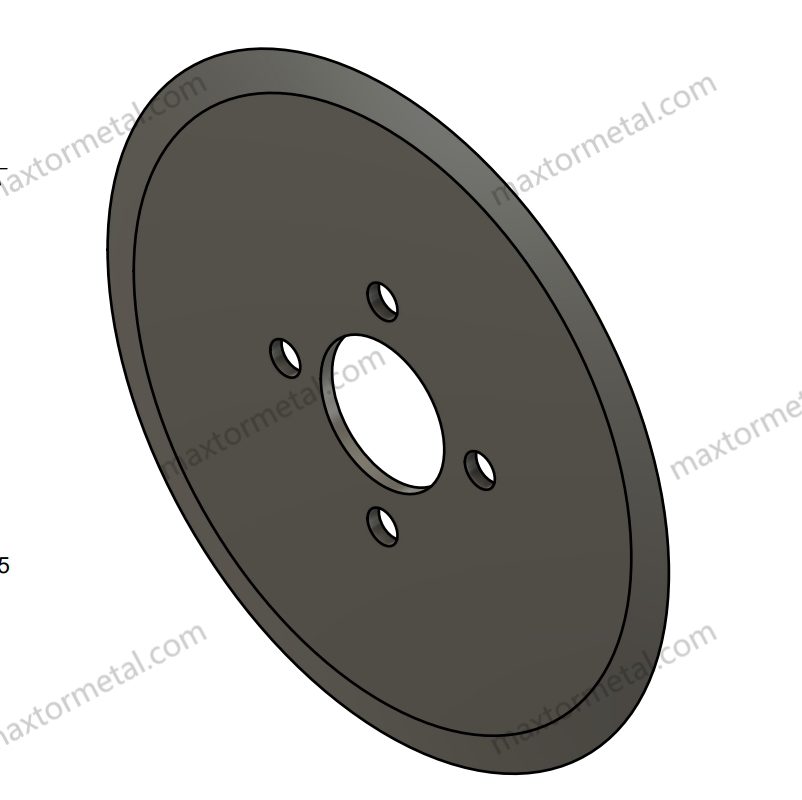
Les couteaux circulaires industriels sont des outils ronds dotés de tranchants affûtés. Ils tournent pour couper, refendre ou rainurer de nombreux matériaux en usine. Leur rotation les rend particulièrement adaptés aux cadences élevées des lignes de production. La géométrie du tranchant permet d'obtenir des coupes nettes et précises. Les fabricants utilisent de l'acier au carbone, de l'acier rapide, de l'acier à outils allié, du carbure de tungstène, de la céramique et de l'acier inoxydable selon les applications. Des revêtements comme le nitrure de titane (TiN) et le nitrure de chrome (CrN) augmentent la dureté des couteaux et prolongent leur durée de vie. Ces revêtements préviennent également la rouille et réduisent la friction. Il existe de nombreux types de couteaux circulaires : disques monoblocs, couteaux à segments rapportés, couteaux de rainurage, de coupe par cisaillement, de perforation, de refendage, coupelles ou couteaux dentés. Chaque type est conçu pour un mode de coupe ou un matériau spécifique.
Le mouvement rotatif, les conceptions spécifiques et les formes de tranchant distinguent les couteaux circulaires industriels des autres outils de coupe. Ils sont très performants dans les usines à cadence élevée et s'avèrent indispensables pour la fabrication moderne.
Styles de bordure
Le profil du tranchant influe sur la qualité de coupe du couteau circulaire. Il détermine également les matériaux qu'il peut couper. Choisir la bonne forme de tranchant permet d'obtenir des coupes nettes et de réduire les déchets. Le tableau ci-dessous présente les profils de tranchant courants et leurs fonctions :
| Profil du tranchant | Description et impact sur les performances de coupe | Adéquation de l'application |
|---|---|---|
| Profil en V | La forme en V standard assure une force uniforme. Certains profils en V répartissent la force et contrôlent la pression. | Idéal pour la coupe générale avec une force uniforme |
| Festonné | Présente des dents arrondies comme une scie. Coupe les matériaux souples ou épais en douceur. | Utilisé pour les mousses, certains produits alimentaires et les matériaux souples |
| Profil en L | Non expliqué | Non expliqué |
| Style Peg | Non expliqué | Non expliqué |
| Dent oblique | Non expliqué | Non expliqué |
Il est essentiel de choisir le profil de tranchant adapté à la dureté et à l'épaisseur du matériau. Par exemple, le profil en V convient à la plupart des applications. Les tranchants ondulés sont plus performants pour les matériaux souples ou épais.
Lames rotatives vs Lames droites
Les lames rotatives et les lames droites remplissent des fonctions différentes dans les usines. Les lames rotatives sont rondes et tournent lors de leur utilisation, ce qui leur permet de couper rapidement et en continu. Elles sont idéales pour les feuilles fines, les bobines et les applications nécessitant beaucoup de refendage. Les lames droites possèdent un tranchant plat et fixe. Elles sont utilisées sur des machines telles que les guillotines pour couper des matériaux épais, comme des tôles métalliques ou des fers à béton, en une seule passe.
Les lames rotatives subissent des traitements thermiques spécifiques pour augmenter leur dureté et leur longévité. Ces traitements comprennent le revenu, la cémentation et la nitruration. Ainsi, les lames rotatives s'usent plus lentement et nécessitent moins d'entretien. Par exemple, les lames rotatives traitées thermiquement peuvent durer jusqu'à 40% plus long de plus que celles sans traitement. Les lames droites peuvent s'user de manière irrégulière et nécessitent un affûtage ou un remplacement plus fréquent.
| Fonctionnalité | Lames droites | Lames rotatives |
|---|---|---|
| Conception de la lame | Tranchant plat ; utilisé pour les matériaux épais | Ronde, rotative ; coupe les matériaux fins en continu |
| Mécanisme de coupe | Coupe en un seul mouvement droit | Tourne pour une coupe rapide et répétée |
| Vitesse et efficacité de coupe | Plus lente, idéale pour les travaux épais ou de petite envergure | Plus rapide, idéale pour les cadences de production élevées |
| Application | Tôles métalliques, fers à béton, plaques épaisses | Métaux fins, feuilles métalliques, bandes, films, papier |
| Usure et entretien | Usure irrégulière ; nécessite des affûtages fréquents | Usure régulière ; nécessite moins d'entretien |
| Durabilité et longévité | Dépend du matériau coupé | Durée de vie prolongée grâce à un traitement thermique spécial |
| Coût et complexité | Simple, généralement plus économique | Plus de composants, coût plus élevé en raison du système rotatif |
Les lames rotatives s'usent de manière uniforme et durent plus longtemps, en particulier dans les usines à cadence élevée. Les lames droites sont optimales pour les matériaux épais nécessitant une seule coupe puissante.
Nanjing Metal est un fabricant de premier plan de couteaux circulaires industriels. L'entreprise produit des lames depuis plus de 20 ans et conçoit des lames spéciales adaptées aux différents besoins industriels. Son équipe contrôle chaque lame pour en garantir la qualité supérieure. Si une entreprise a besoin d'une lame spécifique, Nanjing Metal propose des services de fabrication de lames sur mesure pour y répondre.
Impact du matériau et du revêtement de la lame sur le coût et l'efficacité
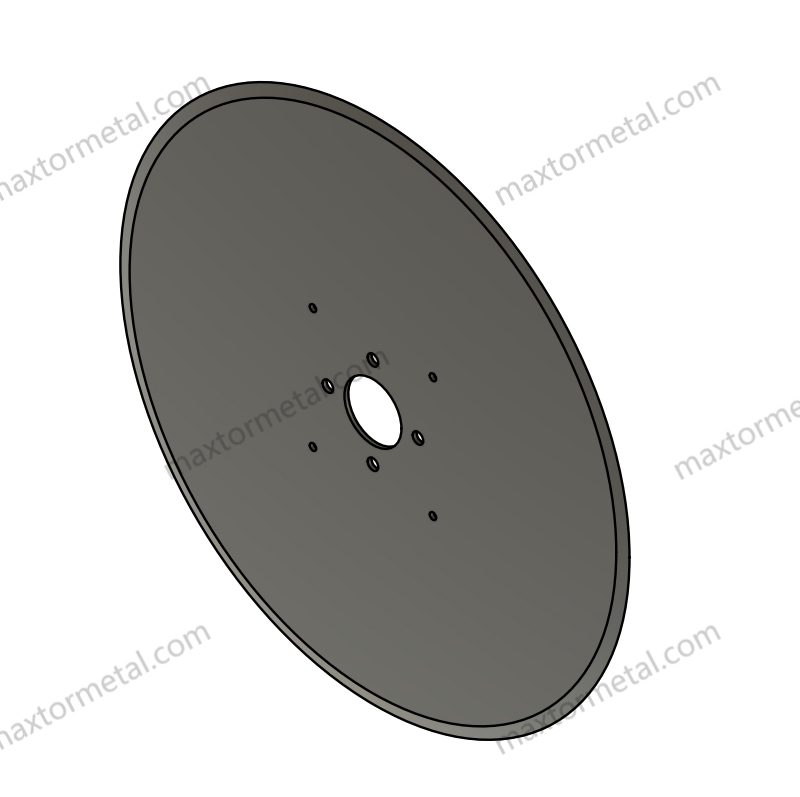
Le choix du matériau et du revêtement de la lame influe directement sur les coûts et les temps de production d'une usine. Chaque matériau est optimal pour des applications spécifiques. Les revêtements améliorent les performances des lames en prolongeant leur durée de vie et en assurant une coupe plus fluide.
Comment le matériau de la lame influe sur le coût et l'efficacité
Choisir le bon matériau de lame permet de réaliser des économies et d'améliorer la qualité de coupe. Les matériaux plus durs, comme le carbure de tungstène et la céramique, durent plus longtemps et réduisent la fréquence des remplacements. L'acier inoxydable et HSS sont moins durs, mais ils sont plus économiques tout en offrant une durée de vie satisfaisante. Le tableau ci-dessous montre l'impact des différents matériaux de lame sur le coût et les performances :
| Matériau de la lame | Dureté (HRC) | Applications idéales | Impact sur le coût et l'efficacité |
|---|---|---|---|
| Acier inoxydable | 55–60 | Alimentation, médical, travaux légers | Durabilité moyenne, résistance à la corrosion, durée de vie modérée |
| Acier à haute vitesse | 60–64 | Papier, bois, plastique | Compatible avec différentes épaisseurs de tranchant, excellent rapport coût/durée de vie |
| Carbure de tungstène | 75–85 | Metal, caoutchouc, composites | Dureté élevée, durée de vie accrue, réduction des changements de lames et des temps d'arrêt |
| Céramique | 80–90 | Feuilles, microfilms, optiques | Ultra-thin edges but brittle, risk of breakage if misused |
Tungsten carbide and ceramic blades can cut tough things for a long time. This means you do not have to stop and change blades as much. For example, HSS blades for film cutting stay sharp and last long. This is why many factories use them for packaging.
The Role of Coatings in Blade Performance
Coatings like titanium nitride (Étain), diamond-like carbon (DLC), and titanium carbonitride (TiCN) make blades work better. These coatings make blades harder and smoother. They also stop things from sticking to the blade. The table below shows what each coating does:
| Type de revêtement | Avantage clé | Application Areas | Effect on Ownership Cost & Efficiency |
|---|---|---|---|
| TiN (nitrure de titane) | Reduces friction, increases hardness | Alimentation, emballage, textiles | Extends blade life, reduces friction-related wear |
| DLC (carbone de type diamant) | Empêche le collage, dissipe la chaleur | Film, plastique, caoutchouc | Increases blade change intervals by 53%, eliminates adhesive buildup |
| TiCN (carbonitrure de titane) | Améliore la résistance à l'usure dans des conditions difficiles | Metal, composites | Enhances durability under tough conditions, lowers scrap and downtime |
Tungsten carbide rotary knives with DLC coating can cut sticky or rough things without needing to be cleaned or changed a lot. Ceramic blades for nonwovens stay sharp and do not rust, so they are good for medical and clean jobs.
Real-World Impact: Cost and Efficiency Gains
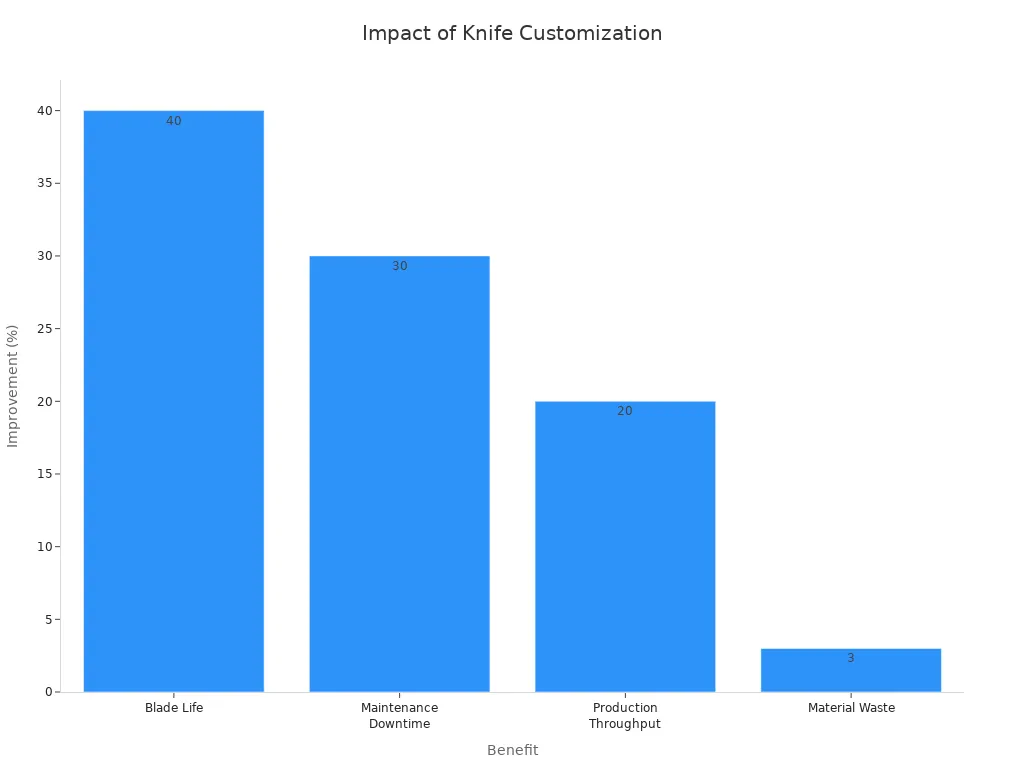
When factories use the best blade material and coating, they work better. The chart below shows how custom blades help factories:
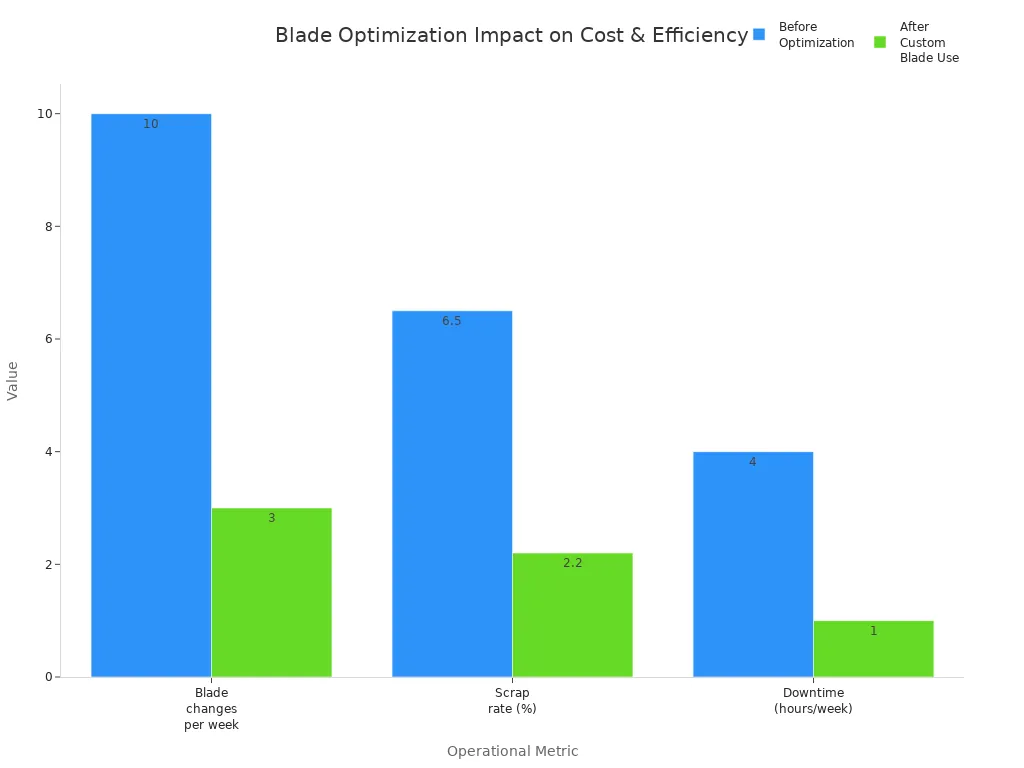
- Blade changes each week went down by 70%.
- Scrap rates dropped by 66%.
- Downtime was cut by 75%.
A food company used custom serrated blades and cut faster by 22%. Their blades lasted from 2 weeks to 6 weeks. Their cuts were also more exact, with less than 0.5 mm difference.
Material and Coating Influence on Blade Stability and Lifespan
Les tests montrent que martensitic stainless steel, like X39Cr13, is very hard and strong. This helps blades last longer and cut better. Coatings put on by PVD, like AlCrN and DLC, make blades last even longer. But if there are hard things like sand in the material, blades can wear out faster. Picking the right blade and coating keeps cutting steady and stops machines from breaking down.
Pourquoi la personnalisation est importante
Every factory has its own cutting problems. Custom blades made for special jobs help save money and time. Nanjing Metal is a top maker of industrial circular knives. They have made custom blades for over 20 years. Their team offers custom blade services to fit what each customer needs.
Tip: Always pick blade material and coating that match what you are cutting. This helps you save money, work faster, and make blades last longer.
FAQ
How do coatings like DLC and TiN affect blade replacement frequency?
DLC et Étain coatings make blades harder and smoother. This means blades last longer and need to be replaced less often.
What is the best blade for slitting abrasive rubber?
Tungsten carbide rotary knives with a DLC coating work best for cutting rough rubber. They last the longest and wear out the slowest.
Can custom blades really reduce downtime?
Yes. Custom blades made for special jobs can cut downtime by up to 75% and lower scrap rates.
Want to make your cutting better? Contact Nanjing Metal’s sales engineers for help and advice.
Comparaison complète des matériaux de couteaux circulaires industriels et de leurs performances
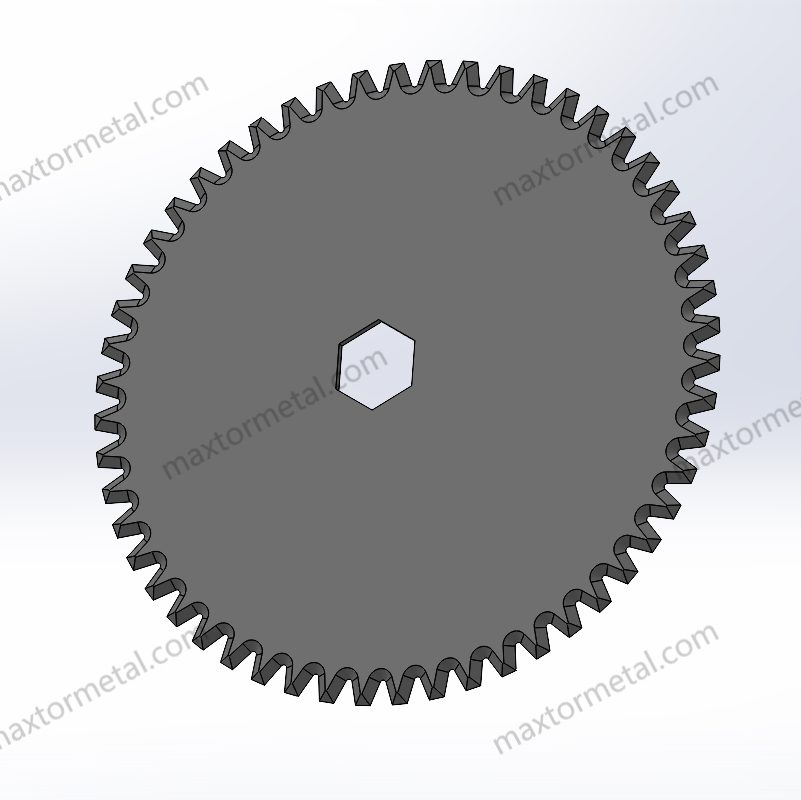
Acier à outils
Caractéristiques matérielles
Tool steel is used a lot because it is hard, tough, and not too expensive. It is made from carbon and alloy steels. These blades are good for places where things do not wear out too fast. Tool steel blades are easy to shape and sharpen. They do not last as long as some other blade materials. But they are a smart pick when you want to save money and do not need the blade to last forever.
The table below shows the main tool steel types, what they are good at, and where they are used:
| Tool Steel Type | Key Performance Characteristics | Applications courantes |
|---|---|---|
| Water-hardening steels | Gets hard in water, stands up to stress and wear | Used for wood and paper cutting |
| Shock-resistant steels | Does not crack or break when hit hard | Used for chisels, punches, and tools that get hit |
| High-speed steels | Stays hard and strong even when hot | Used for fast cutting and drilling |
| Cold-work steels | Tough and does not wear out fast at room temperature | Used for tools that cut or shape things for a long time |
| Hot-work steels | Stays hard and tough when hot | Used for forging, die casting, and hot tools |
D2 steel is a kind of tool steel with lots of carbon and chromium. It is very hard and keeps its edge well after heat treatment. It can get up to 60-62 HRC. Tool steel knives are used in paper, packaging, food, plastics, and metalworking. The type of steel you pick depends on how hard, tough, or easy to sharpen you need it to be, and how much you want to spend.
Tool steel blades are best when you care more about saving money than making the blade last the longest.
Lames HSS
Caractéristiques matérielles
High-Speed Steel (HSS) blades work better than regular tool steel. HSS blades stay hard and sharp even when they get hot. This makes them great for fast and busy cutting jobs. They last longer and do not need to be changed as much. This helps workers get more done.
The table below compares HSS blades and lames en carbure de tungstène:
| Paramètre | Lames en acier rapide (HSS) | Lames en Carbure de Tungstène |
|---|---|---|
| Dureté (Vickers) | 700 – 900 HV | 1600 – 2200 HV |
| Vitesse de coupe | About 70 m/min (steel) | About 160 m/min (alloy steel) |
| Durée de vie de l'outil | Good, but not as long | Lasts 5–10 times longer |
| Résistance à la chaleur | Jusqu'à 500°C | Jusqu'à 1000°C |
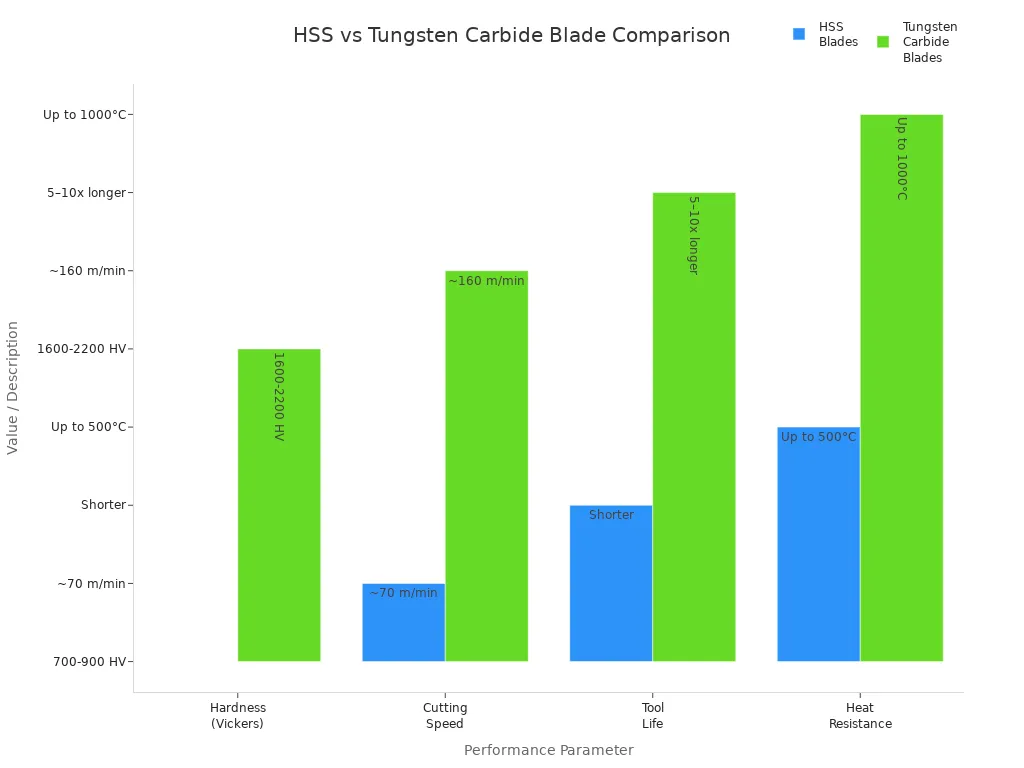
HSS blades are tough and can take hits without breaking. They are easier to sharpen and cost less than tungsten carbide blades. This makes them good for softer things and jobs that are not too rough. In paper factories, HSS blades are used a lot for cutting and slitting. They need to be sharpened more often than carbide blades.
HSS blades are a good mix of lasting long, not costing too much, and being easy to fix. That is why many people use them for industrial circular knives.
Lames en Carbure de Tungstène
Caractéristiques matérielles
Tungsten carbide blades are the hardest and last the longest. They keep their sharp edge much longer than tool steel or HSS. This is true when cutting hard or rough things. Because they are so hard, they can cut faster and last longer. This is very helpful in busy places that need exact cuts.
The table below shows how tungsten carbide blades are different from HSS and tool steel blades:
| Attribut | Lames en Carbure de Tungstène | HSS and Tool Steel Blades |
|---|---|---|
| Dureté | Much harder, the hardest | Not as hard as carbide |
| Conservation des bords | Stays sharp much longer, even with rough stuff | Needs sharpening more often |
| Abrasive Wear Resistance | Best at not wearing out, great for rough things | Wears out faster, gets dull quicker |
| Dureté | More likely to chip if hit | Tougher, can take hits and shakes |
| Résistance à la chaleur | Handles more heat, can cut faster | Cannot take as much heat, gets soft above 600°C |
| Coût | Costs more at first but saves money later | Cheaper at first, easier and cheaper to sharpen |
| Applications appropriées | Best for lots of cutting and tough jobs | Good for normal jobs and softer things |
- Tungsten carbide tips keep their edge and last longer, even with tough or thick things.
- Carbide blades stay hard at very high heat (over 1100°C), so they can cut faster and last longer.
- Carbide is harder but can break easier than HSS if hit or shaken.
- Carbide blades are best for fast, exact, and rough cutting. HSS blades are better for normal jobs and when the blade might get hit.
Tungsten carbide blades need to be handled with care because they can chip. But they work so well in tough jobs that many people think they are worth the price. Factories that cut rubber, composites, or layered films often pick tungsten carbide for its sharpness and long life.
If you want your blades to last the longest and stop work less, tungsten carbide blades are the best.
Nanjing Metal is a top maker of industrial circular knives. They have made custom blades for over 20 years. Their team can make special blades for many jobs. If you need a special blade, you can look at services de fabrication de lames sur mesure to help your work.
FAQ
Which circular blade material is best for cutting abrasive composites?
Tungsten carbide blades are best for cutting rough composites because they are very hard and do not wear out fast.
Are HSS blades suitable for high-speed slitting of paper and film?
Yes, HSS blades stay sharp at high speeds and work well for cutting paper and film. But they need to be sharpened more often than carbide blades.
Want to make your cutting better? You can ask Nanjing Metal’s sales engineers pour obtenir de l'aide.
Lames en Céramique
Caractéristiques matérielles
Ceramic blades are very hard and keep their sharp edge for a long time. They are made from special ceramic materials like zirconia or alumina. These blades have a Mohs hardness of 8.2, which is much harder than steel. Because of this, ceramic blades can stay sharp up to ten times longer than steel blades. Workers like that ceramic blades do not rust or corrode. This makes them great for clean places like food factories, medical plants, and hygiene product lines.
Ceramic blades are light, so workers do not get tired as fast. Since they are not metal, they do not react with sensitive things. But, because they are so hard, ceramic blades can break or chip if hit from the side. That is why factories use ceramic blades mostly for careful cutting of soft or gentle materials like films, nonwovens, and special papers.
| Propriété | Lames en Céramique | Lames en acier |
|---|---|---|
| Dureté (Mohs) | 8.2 (very hard) | 5–6 |
| Conservation des bords | Stays sharp up to 10 times longer | Needs sharpening often |
| Fragilité | High (can chip or crack easily) | Low (more bendy and strong) |
| Durabilité | Hard but can break | Tough and bends more |
Note: You need diamond tools to sharpen ceramic blades. They cost more at first, but you do not have to change or fix them as much.
Comparative Summary: Lifespan and Wear Resistance
Ceramic blades are the best at staying sharp and not wearing out. Their hardness lets them keep a sharp edge for a long time, even when cutting soft or rough things. Compared to tool steel, HSS, and tungsten carbide, ceramic blades do not rust and are not hurt by chemicals.
Le table below shows how the main blade materials compare:
| Matériau | Dureté (HRC) | Résistance à l'usure | Résistance à la corrosion | Stabilité thermique | Applications typiques |
|---|---|---|---|---|---|
| Acier à haute teneur en carbone | 55–62 | Modéré | Faible | Modéré | General cutting, saves money |
| Acier à outils D2 | 58–62 | Haut | Modéré | Haut | Exact cutting, tough jobs |
| Acier rapide M2 | 60–65 | Très élevé | Modéré | Très élevé | Fast, hot cutting work |
| Carbure de tungstène | 75–80 | Extrêmement élevé | Haut | Très élevé | Les travaux difficiles durent longtemps |
| Céramique | 85+ | Haut | Très élevé | Faible | Travaux ultra-précis, sans métal |
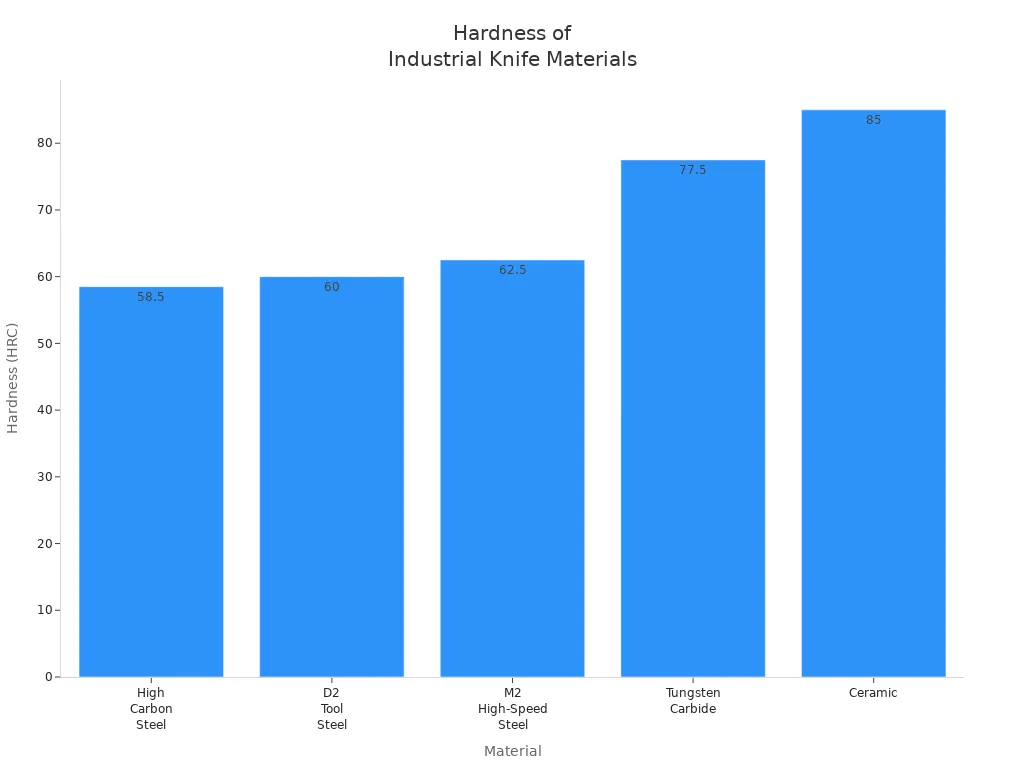
- Ceramic blades stay sharp much longer than steel or carbide blades.
- They are good for jobs where you do not want to change blades a lot.
- But, they do not handle heat well, so they are not good for hot cutting.
- Because they can break, they are not used for heavy or rough jobs.
Summary: Ceramic blades are great for careful, long-lasting cuts on soft or rough things, but you must be careful not to chip them.
FAQ
Are ceramic blades suitable for cutting abrasive nonwovens or hygiene products?
Yes. Ceramic blades stay sharp and make clean cuts in nonwovens and hygiene materials. This means you do not have to change blades as often.
Can ceramic blades be used for high-speed slitting of films?
Ceramic blades can cut thin films quickly, but you must be careful not to hit them from the side or they might chip.
What is the main limitation of ceramic blades in industrial use?
The biggest problem is that they can chip or crack if they get hit from the side or dropped.
Analyse complète des revêtements de lames et de leur impact sur les performances des couteaux circulaires industriels
Common Coating Types
Blade coatings help cutting tools work better and last longer. Makers use special coatings to solve problems like wear, friction, and rust. Here are some common coatings:
- Diamond Coating: Keeps blades sharp longer and stops wear. This means less time spent changing blades.
- Nitrure de chrome (CrN): Sticks well to blades, fights rust, and lowers friction. This keeps blades cool.
- Zirconium Nitride (ZrN): Makes blades very hard and stops rust. It helps blades make cleaner cuts.
- Chrome Coating: Makes blades harder and helps them last longer. It protects against rust and wear.
- Teflon (PTFE) Coating: Stops things from sticking to blades. It also helps with heat and friction.
- Nitrure de titane (TiN): This hard ceramic coating is put on by PVD. It makes blades harder, tougher, and smoother.
- Teflon Black Nonstick: This FDA-approved coating stops sticky stuff from building up. It also fights rust and wear, which is good for food jobs.
- Titanium Carbon Nitride (TiCN): Has titanium, carbon, and nitrogen. It makes blades harder and stops rust. It is good for fast cutting.
- Chrome dur: Helps steel blades fight rust and wear. It also makes them last longer.
- Carbone de type diamant (DLC): Makes blades very hard and smooth. It also helps blades handle heat and tough jobs.
- PolyTetraFluoroEthylene (PTFE): This coating bends easily, does not react with chemicals, and has a high melting point.
- Electroless Nickel Plating: Makes blades smoother and fights rust and wear. But it does not make blades harder.
Coatings make blades harder, lower friction, stop rust, and help blades last longer.
TiN (Titanium Nitride) Coating
TiN coating is gold and very hard. Makers use PVD to put it on blades. TiN makes blades about 25% harder. It also lowers friction and helps blades last longer. TiN stops blades from rusting. It is used for cutting soft metals like aluminum and copper. Blades with TiN last 20–30% longer than blades without it.
TiAlN (Titanium Aluminum Nitride) Coating
TiAlN is even harder than TiN and can take more heat. This makes it good for fast, hot cutting jobs, like cutting hard metals. TiAlN can help blades last up to 35% longer. It looks dark gray or black and protects blades from heat and wear.
DLC (Diamond-Like Carbon) Coating
DLC coating is very hard and super smooth. It stops things from sticking to blades. It helps blades work better, especially when cutting fast or sticky things. DLC-coated blades are great for soft metals and sticky jobs. They can last up to 50% longer, so they are good for tough places.
Performance Enhancements from Coatings
Wear Resistance and Friction Reduction
Blade coatings help blades fight wear and lower friction. TiN, TiAlN, and DLC each have special strengths:
| Type de revêtement | Dureté (HV) | Principaux avantages | Applications typiques | Amélioration de la durée de vie des lames |
|---|---|---|---|---|
| TiN (nitrure de titane) | ~2200-2400 HV | Makes blades harder, lowers friction, stops rust | Soft metals like aluminum and copper | 20-30% longer |
| TiAlN (nitrure de titane et d'aluminium) | Up to 3200 HV | Even harder, takes more heat, good for fast cutting | Hard metals, metal coil slitting | Up to 35% longer |
| DLC (carbone de type diamant) | 1000-2400 HV | Very hard, super smooth, stops sticking | Soft metals, fast cutting | Up to 50% longer |
These coatings help blades stay sharp, keep cool, and cut smoothly. For example, DLC makes blades less sticky and gives cleaner cuts. TiAlN can take more heat, so it is good for fast, hot jobs.
Coated blades last longer, cut better, and need to be changed less often.
Protection contre la corrosion
Many coatings also keep blades from rusting. Chromium Nitride (CrN), Hard Chrome, and PTFE protect blades from water and chemicals. This is important in food, hygiene, and medical jobs where blades must stay clean. Teflon and Teflon Black Nonstick also stop sticky stuff from building up and make cleaning easier.
Comparative Table: Wear Resistance and Cost
Coated blades cost more at first, but save money later. They need less fixing and last longer. Here is a table that shows how coatings compare:
| Type de revêtement | Résistance à l'usure | Protection contre la corrosion | Réduction de la friction | Coût initial | Prolongation de la durée de vie de la lame |
|---|---|---|---|---|---|
| Étain | Haut | Modéré | Modéré | Modéré | 20-30% |
| TiAlN | Très élevé | Modéré | Modéré | Haut | Jusqu'à 35% |
| DLC | Exceptionnel | Haut | Très élevé | Haut | Jusqu'à 50% |
| CrN | Haut | Haut | Haut | Modéré | 20-30% |
| PTFE/Téflon | Modéré | Haut | Très élevé | Modéré | 10-20% |
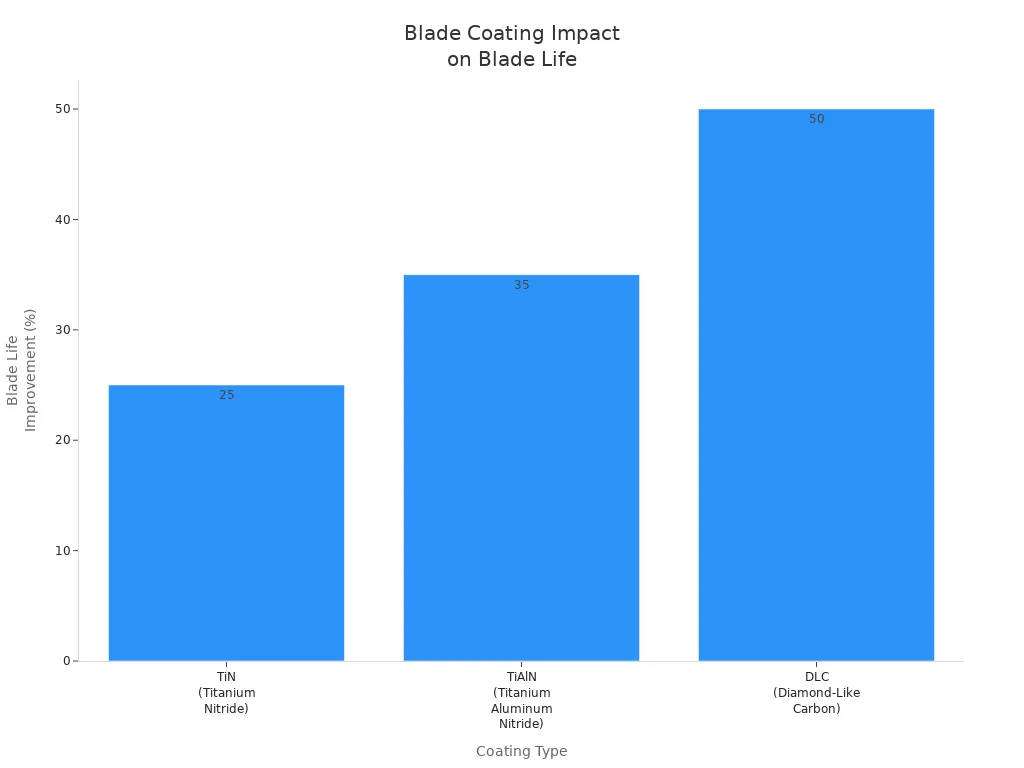
Top coatings like TiN and TiCN can make blades last up to 40% longer. They also cut fixing time by 30%. DLC coatings give the best wear resistance and smoothness. They are good for tough or sticky jobs. Even though coated blades cost more at first, they save money over time by lasting longer and working better.
Better coatings help blades last longer and make products better by cutting faster and making fewer mistakes.
A textile factory switched from carbon steel to stainless steel blades with coatings. They changed blades 30% less often and made 12% more products. Coated blades also wasted less fabric and cut faster.
FAQ
Which coating is best for cutting sticky or adhesive materials?
DLC and PTFE coatings are best for sticky things. They stop stuff from sticking and keep blades clean.
How do TiN and TiAlN coatings compare for high-speed metal slitting?
TiAlN is harder and takes more heat than TiN. It is better for fast, hot cutting of hard metals.
Do coated blades really save money in the long run?
Yes. Coated blades last longer, need less fixing, and cut better. This saves money over time.
Applications des couteaux circulaires industriels dans les secteurs clés
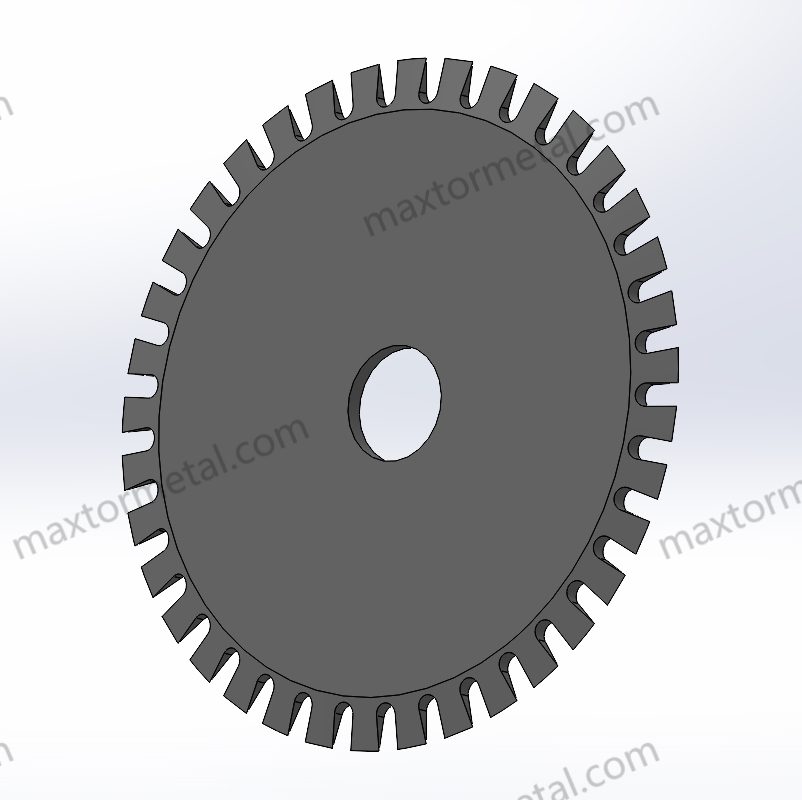
Découpe de film
Film slitting needs blades that make smooth, clean cuts fast. Factories cut thin plastic films and packaging. The blade must stay sharp and not wear out quickly. It should also not build up static. Picking the right material and coating is very important.
Recommended Material and Coating Combinations
The best materials for film slitting are tungsten carbide, high-speed steel, and hardened steel. These materials are hard and tough. They do not wear out fast. Factories use coatings like Titanium Nitride (TiN), Titanium Aluminum Nitride (TiAlN), and Diamond-Like Carbon (DLC). These coatings help blades last longer and cut smoother.
| Performance Requirement | Description |
|---|---|
| Dureté | Keeps the blade sharp for clean film cuts |
| Dureté | Stops the blade from chipping or breaking |
| Résistance à l'usure | Makes the blade last longer in busy work |
| Ductilité | Lets the blade bend a bit without breaking |
| Pureté | Makes sure the blade works the same every time |
| Matériau | Application and Benefits |
|---|---|
| Carbure de tungstène | Very strong, cuts tough films, lasts long |
| Acier à haute vitesse | Good mix of hard and tough, works well |
| Acier trempé | Heat-treated to be strong and last longer |
| Type de revêtement | Principaux avantages | Amélioration quantifiée |
|---|---|---|
| Nitrure de titane (TiN) | Rend les lames plus dures, réduit la friction | Jusqu'à 45% usure en moins |
| Nitrure de titane et d'aluminium (TiAlN) | Handles heat, fights rust, lasts longer | Fonctionne bien à grande vitesse |
| Carbone de type diamant (DLC) | Cuts smoother, stops sticking | Peut réduire la force de plus de 50% |
| Revêtements céramiques | Hard, non-metal, fights rust and wear | Good for wet or rough jobs |
| Revêtements nano multicouches | Many thin layers, less friction | Makes blades last longer and cut better |
Changing blade shape and edge can make blades last up to 40% longer. It can also cut maintenance time by 30%. Factories can make 15-25% more products and waste less material, dropping waste from 5% to 2%.
Top Recommendations:
- HSS with TiN coating: Great for fast film cutting, less friction and sticking.
- Tungsten carbide with DLC coating: Best for tough or layered films, lasts longest.
- Multi-layer nano coatings: Helps with special films, makes blades more exact and last longer.
Tip: Factories should match blade height and speed to the film. A 5 mm blade height and 370 rpm speed often work best.
Découpe du caoutchouc
Rubber slitting is hard on blades. Rubber is thick and stretchy. It can stick to the blade and cause problems. Blades must not gum up, must stay sharp, and must handle lots of rubbing. The right material and coating help blades last and cut better.
Recommended Material and Coating Combinations
Tungsten carbide and high-speed steel are best for rubber slitting. These materials are tough and keep their edge. Coatings like DLC and TiAlN help blades not stick and last longer.
| Matériau | Benefits for Rubber Slitting |
|---|---|
| Carbure de tungstène | Cuts rough rubber, stays sharp, does not wear out fast |
| Acier rapide (HSS) | Tough and not too costly, good for most rubber jobs |
| Acier à outils D2 | Very hard, good for less rough rubber |
| Revêtement | Avantage clé |
|---|---|
| DLC | Stops sticking, lowers friction, makes blades last longer |
| TiAlN | Handles heat, helps blades last in tough jobs |
| Étain | Good for normal rubber jobs, balances cost and work |
Top Recommendations:
- Tungsten carbide with TiAlN coating: Best for cutting rough, tough rubber.
- HSS with TiN coating: Good for most rubber jobs, saves money and lasts.
- Tungsten carbide with DLC coating: Great for sticky or high-friction rubber.
Note: The right blade and coating mean fewer blade changes and smoother work.
Nonwovens and Textiles
Cutting nonwovens and textiles needs blades that stop fraying and make neat cuts. These materials can be soft, fake, or layered. The blade must stay sharp and not pull at the fibers.
Recommended Material and Coating Combinations
Factories use D2 tool steel, M2 high-speed steel, tungsten carbide, and ceramic for these jobs. These materials are very hard and keep their edge. Coatings like TiN, TiCN, TiAlN, and DLC help blades last longer and cut better.
| Matériau / Revêtement | Propriétés clés | Benefits for Nonwoven/Textile Cutting |
|---|---|---|
| Acier à outils D2 | Very hard, fights wear | Blades last long and stay sharp |
| Acier rapide M2 (HSS) | Hard and tough | Good for tough textile jobs |
| Carbure de tungstène | Super hard, fights wear | Lasts longer, cuts rough materials cleanly |
| Céramique | Very hard, low friction | Makes neat cuts, less heat and wear |
| Nitrure de titane (TiN) | Harder, fights wear | Les lames durent plus longtemps, les coupes restent nettes. |
| Carbonitrure de titane (TiCN) | Fights wear very well | Blades last longer in tough jobs |
| Nitrure de titane et d'aluminium (TiAlN) | Supporte bien la chaleur | Stays hard in fast cutting |
| Carbone de type diamant (DLC) | Very hard, low friction | Less friction and wear, blades last longer |
| Chromage | Fights rust, smooth finish | Protects blade, less friction |
- Use strong steel and carbide for blades that last.
- Blades are made sharp and smooth to stop fraying.
- Factories can get custom blades for special jobs.
- Careful making of blades means neat, even cuts.
- Special knives are made for nonwovens and textiles, like straight, round, or toothed shapes.
- Blade edge shape and tight rules help stop fraying and make good cuts.
Top Recommendations:
- Ceramic blades: Stay sharp and make clean cuts, great for soft or fake fibers.
- HSS with TiN coating: Lasts longer and stops fiber pulling, good for fast textile work.
- Tungsten carbide with DLC coating: Best for rough nonwovens and long jobs.
FAQ
Quel matériau de lame circulaire est le plus adapté pour couper les films multicouches ?
Tungsten carbide or HSS blades with a thin, sharp edge are best for multilayer film. They make clean cuts and waste less.
Can TiCN coating outperform TiN in high-speed slitting?
TiCN coatings are harder and last longer than TiN. They are great for fast and tough cutting.
How do custom blades help in textile and nonwoven cutting?
Custom blades make better cuts, stop fraying, and lower downtime. Factories get better results and save on fixing costs.
Paper and Foil
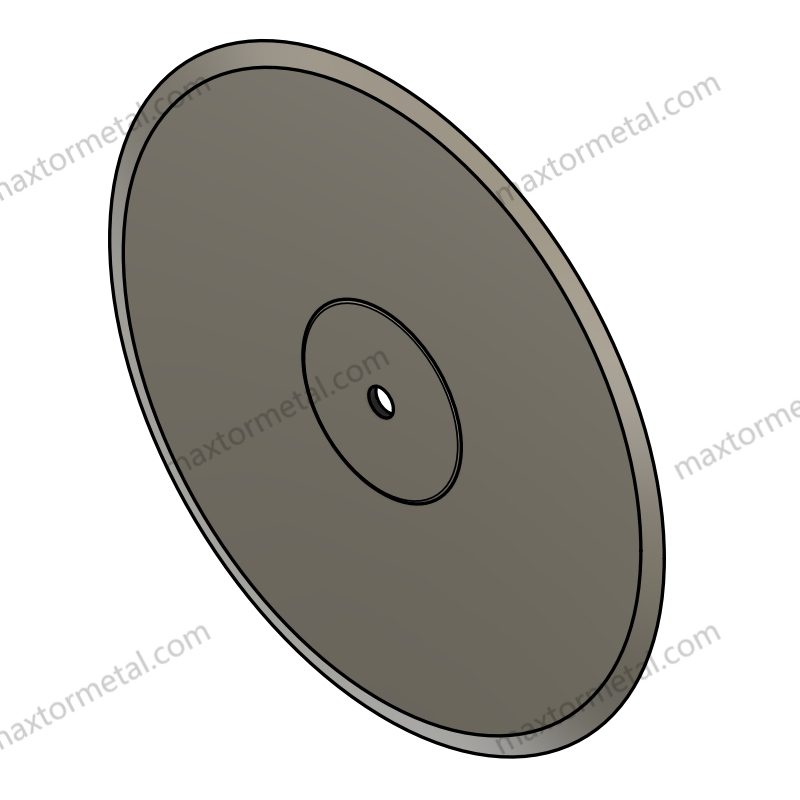
Recommended Material and Coating Combinations
Cutting paper and foil is tricky. Workers need to stop dust, keep blades sharp, and make clean cuts for a long time. Picking the right blade material and coating helps blades work better and saves money.
- D2 steel blades are good for many jobs and do not cost much. They are easy to sharpen and last a long time when cutting paper or plastic.
- M2 steel blades are even tougher. They work well with rough paper and last longer, so workers do not have to stop as much.
- CPM 10V steel is super tough and does not wear out fast. It is best for cutting many layers or rough materials and can be used for a long time.
- Carbide inlay blades stay sharp all day and night. They are great for rough paper and foil and help workers change blades less often.
- Split bottom knives let workers change blades quickly. This means they do not have to take out the whole set, so work does not stop for long.
- Making the blade edge between 10 and 20 micrometers keeps it sharp and strong. This helps make less dust and makes blades last longer.
- Coatings like Titanium Nitride (TiN) and Diamond-Like Carbon (DLC) make blades harder and smoother. These coatings help blades last longer and cut better.
- Setting the nip point right and using strong blade holders is important. This stops blades from wearing out too fast and keeps them sharp.
A paper company used a blade with a 20 micrometer edge and saw blades last 25% longer. Their cuts got 15% better. Other reports show 20% fewer blade changes and 18% less dust with a 15–20 micrometer edge.
Best Practices for Paper and Foil Slitting:
- Pick D2 or M2 steel for most paper and foil jobs.
- Use CPM 10V or carbide inlay blades for rough or layered materials.
- Put TiN or DLC coatings on blades to help them last and cut better.
- Keep blades sharp to stop dust and avoid losing products.
- Teach workers how to set up and care for blades to get the best results.
| Matériau de la lame | Avantage clé | Typical Use Case |
|---|---|---|
| Acier D2 | Good for many jobs, easy to sharpen | Cutting paper or plastic |
| Acier M2 | Tough, lasts longer | Rough paper, coated paper |
| CPM 10V | Super tough, lasts longest | Many layers, rough materials |
| Incrustation en carbure | Stays sharp, works all day | Rough paper or foil |
| Revêtement | Avantage |
|---|---|
| Étain | Makes blades harder, less friction |
| DLC | Blades last longer, cleaner cuts |
Tip: Always check if blade holders are tight and set right. This keeps blades sharp and makes less dust.
FAQ
- Which blade material is best for long paper slitting runs?
CPM 10V or carbide inlay blades last the longest and work best for long jobs. - How can operators reduce dust during foil slitting?
Use blades with a 15–20 micrometer edge and put on TiN or DLC coatings to make less dust and get better cuts.
Autres industries
Recommended Material and Coating Combinations
Many jobs need special blades and coatings. Picking the right one helps machines work better, keeps people safe, and makes good products.
- Lames en acier inoxydable are best for food jobs. They do not rust and are safe to use with food.
- Tool steel blades are strong and tough. They are good for cars and metal work because they stay sharp even when used a lot.
- Carbon steel blades are hard and keep their edge. They are used for cutting metal, paper, and plastic.
- Special materials like solid carbide, ceramic, CPM 10V, 52100, M-2, and D-2 steels are very hard and can take heat. They are good for tough jobs like cutting fiberglass, composites, or medical things.
- Coatings like TiN, DLC, and PTFE help blades stay sharp and last longer. These coatings are great for sticky or rough materials.
- Different edge shapes, like Standard V, Vari-Depth V, Hi/Low V, Scalloped, Peg Style, and Slant Tooth, help blades cut better and make machines work easier.
- Custom blades and picking the right material help with special jobs and tough cuts.
| Industrie | Recommended Blade Material/Coating | Avantage clé |
|---|---|---|
| Transformation des aliments | Stainless Steel, PTFE Coating | Does not rust, safe for food |
| Automotive/Metal | Tool Steel, DLC/TiN Coating | Tough, does not wear out fast |
| Plastics/Composites | Solid Carbide, Ceramic, DLC Coating | Very hard, makes clean cuts |
| Medical/Hygiene | Ceramic, Stainless Steel | Safe, does not react with chemicals |
| Fiberglass/Advanced | CPM 10V, Carbide, Protective Coating | Lasts long, stays sharp, takes heat |
Note: Custom blades help factories do their jobs better, save time, and stop machines from breaking down.
Nanjing Metal is a top maker of industrial circular knives with over 20 years of experience. The company is known for its skilled team and good designs. Nanjing Metal makes custom blades for many different jobs. People can look at custom blade choices with this services de fabrication de lames sur mesure link.
FAQ
- Which blade material is best for food processing?
Stainless steel with a PTFE coating is best because it is safe and does not rust. - What is the best option for cutting fiberglass or composites?
CPM 10V or solid carbide blades with coatings last long and stay sharp. - How do custom blades help in specialized industries?
Custom blades fit each job, make better cuts, and help machines run longer.
Guide de sélection
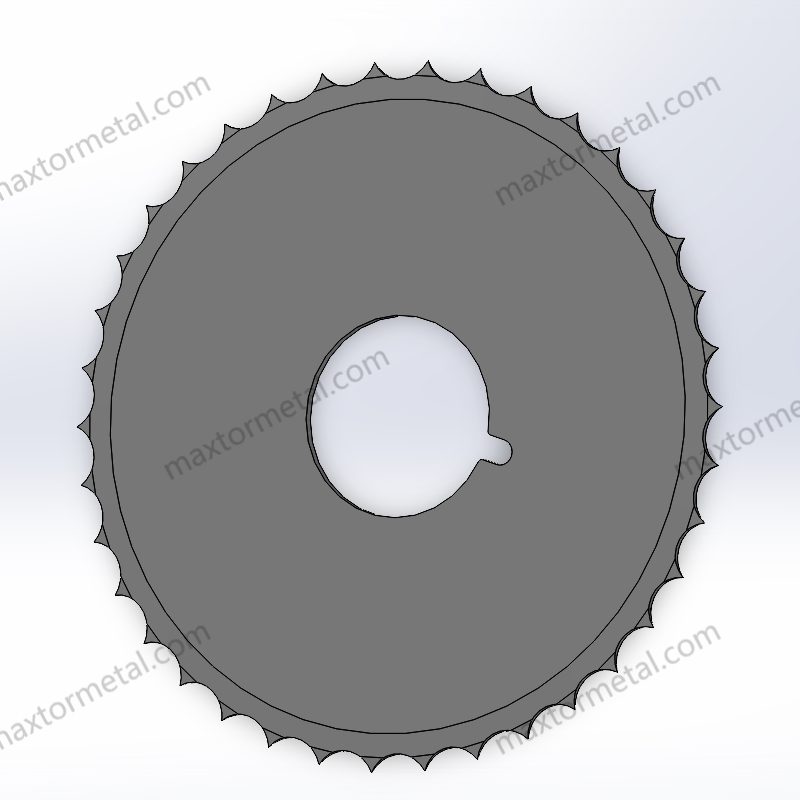
Material Matching
To pick the right blade material, you first need to know what you are cutting. Every material is different and changes how the blade works. Here is a simple way to match the blade to the job:
- Assess the Material to Be Cut
Find out what you are cutting. Check if it is thick, thin, soft, or hard. Soft plastics, rough composites, and sticky rubber all need different blades. - Define the Application Requirements
Decide what the blade will do. Will it slit, score, slice, or make holes? Each job needs a different kind of blade. - Select the Blade Material
- Pick high-carbon steel if you need a strong blade for lots of use.
- Use stainless steel if the blade will get wet or touch food, because it does not rust.
- Choose solid carbide for very hard jobs, like cutting rough or layered films.
- Go with ceramic if you want a blade that does not need to be changed much, or if you cut things for medical or clean jobs.
- Choose the Edge and Tooth Geometry
Match the edge shape to what you are cutting. A square edge is good for most jobs. Scalloped or slant tooth edges work better for soft or stringy things. - Consult with Experts or Manufacturers
Talk to engineers or the blade maker if you are not sure. They can help you pick or design a special blade. - Reverse Engineer When Replacing Blades
If you are changing an old blade, look at how it wore out. This helps you pick a better blade next time.
Tip: Always think about where the blade will be used. Heat, water, and chemicals can change how long a blade lasts.
Edge Type Choice
The edge type decides how the blade cuts. Picking the right edge makes cuts cleaner, wastes less, and helps the blade last longer. Here are some common edge types and what they are best for:
| Type de bord | Description | Idéal pour |
|---|---|---|
| Bord carré | Plat et pointu | Découpe, papier, film |
| Biseau simple | Un côté incliné, un côté plat | Careful cuts, thin things |
| Double biseau | Les deux côtés inclinés | Tough stuff, rubber, foam |
| Dentelé/dentelé | Dents en forme de scie | Textiles, non-tissés, emplois pénibles |
| Festonné | Dents arrondies, coupe lisse | Objets mous, nourriture, mousse |
| Dent oblique | Des dents angulaires pour les travaux difficiles | Des choses épaisses ou filandreuses |
- Use square or single-bevel edges for neat, straight cuts in films and foils.
- Pick double-bevel or toothed edges for thick or rough things.
- Choose scalloped or slant tooth edges for soft, stretchy, or stringy stuff.
Note: The wrong edge can make cuts messy or cause dust. Always match the edge to what you are cutting.
Coating Selection
Blade coatings help blades last longer and cut better. The right coating makes blades smoother, harder, and keeps them from rusting. Here is how to pick the best coating:
- Identify the Main Cutting Challenge
Figure out what is hardest about the job. Is it wear, sticking, heat, or rust? - Select a Coating Based on Need
- Use Titanium Nitride (TiN) to make blades last longer and cut smoother, especially for fast or tough jobs.
- Pick Diamond-Like Carbon (DLC) for extra hardness and to stop sticky stuff from building up.
- Try nano-coatings if the blade gets hot and cold a lot, because these coatings protect against heat changes.
- Match Coating to Blade Material
Put DLC on tungsten carbide for hard jobs. Use TiN on High-Speed Steel for softer things. - Maintain Blades Properly
Clean, oil, and store blades the right way to keep coatings working well. - Consider Custom Solutions
If you have a special job, ask the blade maker for custom coatings or blade shapes.
Picking the right coating and making blades carefully keeps them sharp and working well, even in tough places.
FAQ
- What is the most important factor when matching blade material to the application?
The most important thing is what you are cutting, like how hard, rough, or wet it is. - How does edge type affect blade life?
The right edge shape helps the blade last longer and makes better cuts, so you do not have to fix it as much. - Can coatings really make a difference in blade performance?
Yes. The right coating can make blades last up to half again as long, cut smoother, and stop sticking or rust.
Rapport coût/performance
Picking the right blade is about more than price. You have to think about what you pay now and what you save later. Some people only look at the price tag. But the real cost comes from how often you change blades, how much time machines stop, and how much fixing is needed. The best blade depends on the job, what you are cutting, and where you work.
Comparing Material Investments
Each blade material has its own cost and how well it works:
- Acier à haute teneur en carbone: This blade costs less at first. But it wears out fast. You will need to buy new blades a lot, which costs more over time.
- Acier inoxydable: This blade costs more when you buy it. It does not rust and works well in wet or chemical places. It lasts longer, so you save money later.
- Acier allié: These blades cost more at the start. They last longer and help machines run without stopping. They are good for busy factories.
- Lames en Céramique: These blades cost the most at first. They almost never need fixing and last a long time. If you need careful and fast work, they are the best value in the long run.
Material Cost-Benefit Table
| Matériau de la lame | Coût initial | Fréquence de remplacement | Besoins d'entretien | Valeur à long terme |
|---|---|---|---|---|
| Acier à haute teneur en carbone | Faible | Haut | Haut | Faible |
| Acier inoxydable | Moyen | Moyen | Faible | Moyen-élevé |
| Acier allié | Haut | Faible | Faible | Haut |
| Céramique | Très élevé | Très faible | Très faible | Le plus élevé |
Tip: Spending more at first can mean fewer blade changes, less machine stopping, and lower total costs later.
The Impact of Advanced Treatments
Special blade treatments can change cost and how long blades last. Cryogenic treatment is one example. It makes blades last longer and wear out slower. The table below shows the difference:
| Aspect | Traitement thermique régulier | Cryogenically Treated |
|---|---|---|
| Résistance à l'usure (cycles) | 1,000 | 2,500 |
| Durée de vie moyenne (mois) | 6 | 12 |
| Taux d'usure (mm³/heure) | 0.15 | 0.05 |
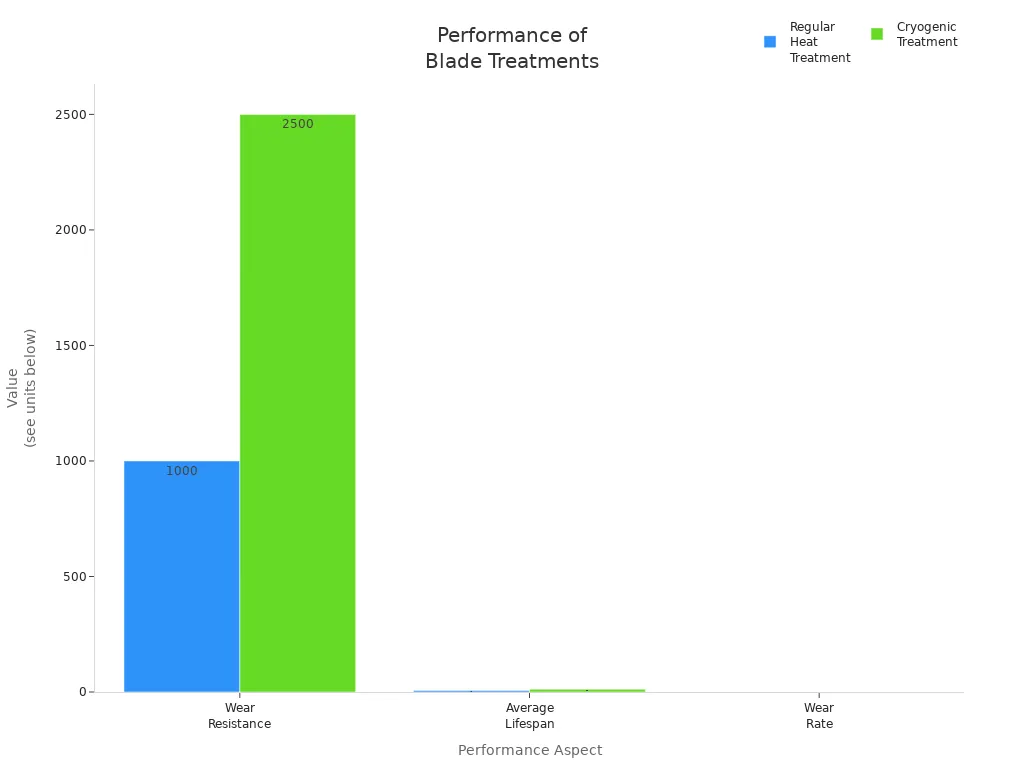
Cryogenic treatment can make blades last twice as long. It also makes them wear out slower. This can lower total costs by up to 30%. You will need fewer new blades and less fixing, so you can make more products and waste less.
Erreurs à éviter
- Only looking at the lowest price can cost more later.
- Not thinking about the work area (like wet, chemicals, or sand) can make blades wear out fast.
- Not using special coatings or treatments can mean more downtime and more waste.
Tips for Maximizing Value
- Pick the blade material that fits your job and work area.
- Buy coatings or treatments that help your factory.
- Keep track of how long blades last and when you change them. This helps you find ways to save money.
Why Manufacturer Expertise Matters
A good blade maker can help you pick the best blade. Nanjing Metal is a top maker with 20 years of experience. Their team makes custom blades for many jobs. They offer custom blade services to help you get the most for your money.
For advice or to talk about your needs, contact Nanjing Metal’s sales engineers with this contact link.
FAQ
How does blade material affect total cost of ownership?
Blade material changes how often you need new blades and how much time machines stop. Harder blades cost more at first but save money later.
Is cryogenic treatment worth the extra cost?
Yes. Cryogenic treatment can make blades last twice as long and wear out less, so you spend less on new blades and fixing.
When should a company choose ceramic blades?
Ceramic blades are best for careful, fast jobs where you want blades to last a long time and not need much fixing.
Picking the right material, edge style, and coating changes how well industrial circular knives work. When companies match blade hardness and edge type to what they are cutting, blades last longer and work better. This means fewer blade changes and more work done.
| Facteur | How It Helps the Blade |
|---|---|
| Matériau | Makes blades last and stops rust |
| Profil du tranchant | Helps make clean cuts and fits the job |
| Revêtement | Blades last longer, need less fixing |
To get the best results, people should:
- Tell suppliers all about what they need and any cutting problems.
- Try out sample blades before buying a lot.
- Ask experts for help making special blades for tricky jobs.
FAQ
What is the best industrial circular knife material for slitting multilayer film?
Tungsten carbide or high-speed steel blades with a sharp, thin edge make the cleanest cuts in multilayer film. These materials do not wear out fast and keep their sharp edge even when cutting quickly.
Can TiCN coating last longer than TiN in high-speed cutting?
Yes. TiCN coatings are harder and fight wear better than TiN. This means they are great for fast cutting jobs where you want blades to last longer.
How does edge style affect cutting performance?
Edge style changes how well a blade cuts and how neat the cut is. A single-bevel edge makes very clean cuts in thin things. Serrated or toothed edges work better for tough or stringy things. They help the blade move easier and make cuts more even.
When should a company choose ceramic blades?
Ceramic blades are best when you need blades to stay sharp for a long time and not react with chemicals. They are great for hygiene, medical, and food jobs where changing blades often is hard.
What are the main benefits of using coated circular knives?
Coated blades last longer, slide smoother, and do not rust. Coatings like DLC or TiN stop sticky stuff from building up and help blades last longer between changes. This saves money and helps workers get more done.
How can custom industrial knives improve production efficiency?
Custom blades are made for special jobs and materials. They help make better cuts and stop machines from stopping as much.
Voir aussi
Trouvez les Couteaux de Granulation Parfaits pour Vos Besoins de Traitement du Plastique
Les 10 Meilleurs Conseils pour Prolonger la Durée de Vie de Vos Lames de Rasoir Circulaires
Que sont les couteaux à écrasement et comment fonctionnent-ils dans l'industrie ?
Comment choisir les lames de refendeuse circulaire adaptées pour des performances durables

 English
  Spanish
  Italian
  French
  Portuguese
  Russian
  German
  Arabic
  Hindi
Hindi  Vietnamese
  Indonesian
  Japanese
  Korean
Une réponse