

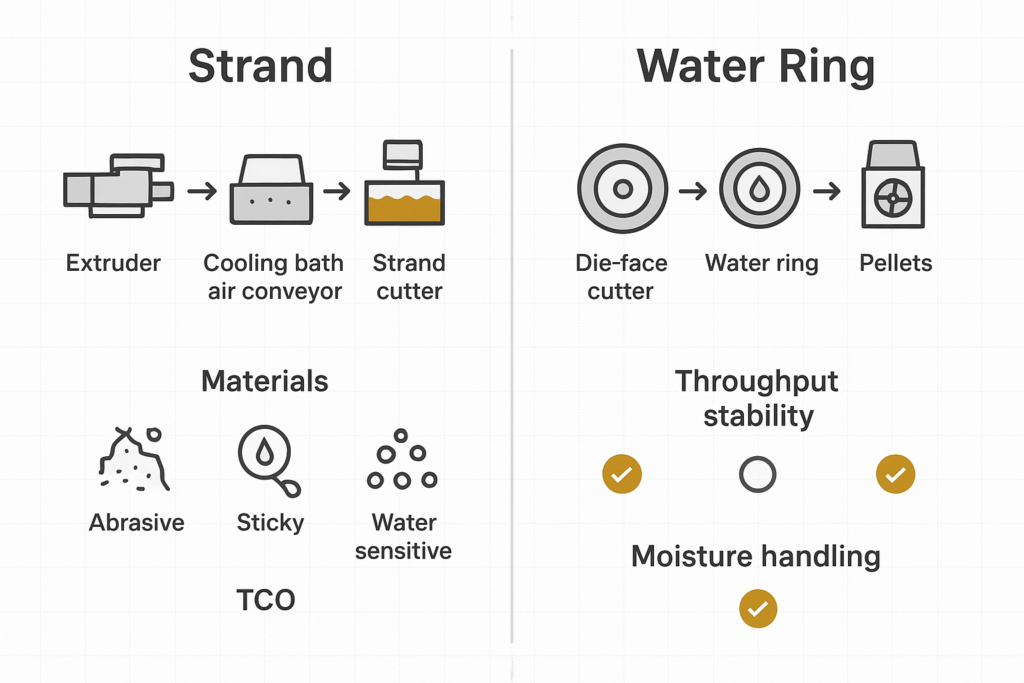
Memilih antara strand pelletising dan water ring pelletising bukan sekadar preferensi pemotongan “basah” atau “kering”. Hal ini mengubah apa yang mengontrol kualitas pelet, apa yang gagal terlebih dahulu saat terjadi gangguan, dan di mana letak biaya per ton yang sebenarnya (suku cadang aus, pengeringan, pergantian, dan scrap).
Dalam proses compounding dan daur ulang di UK—terutama saat Anda menjalankan aliran high-fill, serat kaca (glass fibre), bermuatan mineral, atau konten daur ulang tinggi—pemilihan yang salah dapat muncul dalam bentuk fines, ekor pelet (tails), throughput yang tidak stabil, dan rencana pemeliharaan yang tidak pernah sesuai dengan kenyataan.
Dalam panduan ini, Anda akan mempelajari bagaimana perilaku material dipetakan ke setiap proses, apa arti sebenarnya dari “throughput yang stabil” sehari-hari, bagaimana tuas kualitas pelet bekerja (pemasangan die–pisau, kontrol celah, pengeringan), dan model TCO praktis yang dapat langsung Anda masukkan ke dalam spreadsheet.
Ini ditulis untuk pimpinan peralatan, produksi, proses, dan pengadaan yang membutuhkan cara jelas untuk membandingkan opsi tanpa terikat pada merek OEM tertentu.
Kesesuaian material secara sekilas
Kesesuaian material adalah tempat di mana sebagian besar kesalahan pemilihan dimulai. Lini yang sama dapat terlihat “baik-baik saja” pada lembar data tetapi berperilaku sangat berbeda setelah Anda menambahkan pengisi (filler), kontaminasi, atau jendela proses yang lebih sempit.
Rapuh, abrasif, high-fill
Kompon yang abrasif, rapuh, dan high-fill cenderung merusak apa pun yang paling dekat dengan pemotongan.
- Peletisasi untai sering kali memberi Anda lebih banyak cara untuk mengelola keausan tersebut secara progresif: Anda dapat mengubah cara mendinginkan strand, cara menopangnya ke dalam pemotong, dan cara menjaga ketajaman pisau tanpa memaparkan area pemotongan ke air yang bersirkulasi di permukaan die (die face).
- Peletisasi cincin air dapat berjalan dengan baik pada banyak material umum, tetapi campuran abrasif dapat mempercepat keausan tepi pisau dan mengubah perilaku pemotongan lebih cepat dari yang diperkirakan operator—terutama jika filtrasi lelehan (melt filtration) meloloskan kontaminasi keras.
Yang perlu diperhatikan pada material abrasif/high-fill:
- micro-chipping pada tepi pisau
- pembentukan alur dan “tanda seret” (drag marks) pada permukaan die
- meningkatnya tingkat fines selama pengoperasian, meskipun panjang pelet terlihat “OK” pada pandangan pertama
Lelehan lengket atau elastomerik
Lelehan yang lengket dan campuran elastomerik kurang toleran ketika Anda mencoba memotong terlalu dini atau mendinginkan terlalu agresif.
- Peletisasi untai biasanya lebih mudah distabilkan untuk material yang lengket karena Anda dapat menyesuaikan kondisi permukaan dan kekakuan strand sebelum mencapai pemotong. Jika strand masih lengket, Anda akan melihat adhesi antar-strand dan pengumpanan yang tidak merata, yang lebih mudah dideteksi dan diperbaiki di hulu (upstream).
- Peletisasi cincin air dapat mengalami kesulitan jika pelet menempel di water ring, melumuri permukaan die (smear), atau menumpuk pada pemotong. Ketika itu terjadi, Anda dapat mengalami perubahan bentuk pelet yang cepat dan frekuensi pembersihan yang lebih tinggi.
Pemeriksaan praktis: jika operator Anda sering menghadapi masalah “stringing”, smearing, atau penumpukan pada permukaan die, material Anda mungkin menunjukkan bahwa ia memerlukan pemadatan yang lebih terkontrol sebelum dipotong.
Polimer sensitif air
Beberapa polimer (dan banyak campuran daur ulang) sangat sensitif terhadap kelembapan—baik karena mereka menyerapnya, terdegradasi karenanya, atau mengalami masalah pemrosesan hilir (downstream) ketika pelet membawa kelembapan.
- Peletisasi untai dapat dikonfigurasi untuk meminimalkan paparan air (atau mengelola kontak air dalam bak terkontrol dengan pengeringan yang kuat). Hal ini dapat mengurangi risiko terbawanya kelembapan ke dalam penyimpanan dan transportasi.
- Peletisasi cincin air secara inheren memasukkan air pada saat pemotongan, sehingga tahap dewatering dan pengeringan Anda menjadi langkah kontrol kualitas utama, bukan sekadar pelengkap.
Jika masalah kualitas di pabrik Anda mencakup splay, gelembung, atau perilaku lelehan yang tidak konsisten di hilir, manajemen kelembapan dalam proses pelletising sering kali menjadi bagian dari akar masalahnya—bahkan ketika pelletiser itu sendiri terlihat “baik-baik saja” secara mekanis.
Jendela throughput dan stabilitas
Throughput jarang sekali hanya dibatasi oleh kapasitas output ekstruder nominal saja. Ini dibatasi oleh bagian paling sensitif dari rantai pelletising: penanganan strand, kondisi permukaan die, kapasitas dewatering/pengeringan, atau seberapa cepat Anda dapat pulih setelah terjadi gangguan.
Perilaku start-up dan gangguan
Start-up dan gangguan adalah saat di mana perbedaan menjadi sangat jelas.
Menurut Panduan pemilihan Plastics Technology (2019), strand pelletising dapat lebih padat karya saat start-up (termasuk penanganan strand), sementara sistem die-face dapat menawarkan perilaku start/stop yang lebih otomatis—dengan konsekuensi ketergantungan yang lebih ketat pada kondisi lelehan yang stabil.
Dalam praktiknya:
- Sistem strand sering kali gagal secara “terlihat” terlebih dahulu: strand putus/jatuh, pendinginan tidak merata, atau pergeseran panjang pelet.
- Sistem water ring dapat gagal “pada permukaan die” terlebih dahulu: penumpukan, ketidakkonsistenan pemotongan, atau kelebihan beban dewatering, terkadang dengan lebih sedikit peringatan hingga terjadi penurunan kualitas.
Kiat Profesional: Jika lini Anda rentan terhadap gangguan (pergantian screen, sering ganti grade, bahan baku yang bervariasi), pertimbangkan “waktu untuk pulih” secara lebih mendalam daripada throughput puncak teoretis.
Target pendinginan, pengeringan, dan kelembapan
Kedua sistem bergantung pada pendinginan dan pengeringan, tetapi menempatkan risiko di tempat yang berbeda.
Cara mencatat data uji coba (agar kelembapan dan atrisi dapat dibandingkan):
- Define your sampling point(s): at pelletiser discharge, after dewatering/drying, and after a fixed storage time (e.g., 24 h) if storage performance matters.
- Moisture method: document the method and lab conditions. ASTM D6869 describes determining moisture content in plastics using Karl Fischer techniques (coulometric/volumetric). If you use a different method (loss-on-drying, in-line sensors), note it explicitly and keep it consistent across both options.
- Handling/attrition notes: log conveying distance, bends, blower settings, and any observed clumping; a “fines event” may come from handling damage, not the cutter.
- Report results as a small table per trial run: material family, throughput, drying capacity setting, moisture at each sampling point, and any downstream defects observed.
This turns “moisture targets” into auditable numbers that can be compared across strand vs water ring configurations.
- Di dalam strand pelletising, you’re stabilising the strand before cutting. Cooling issues show up as strand deformation, poor cutting behaviour, and pellet geometry drift.
- Di dalam water ring pelletising, you’re cutting immediately and then relying on separation and drying to hit your moisture targets. If separation/drying falls behind, the pellets can leave the system “looking right” but carrying enough water to create storage, conveying, or downstream quality problems.
From a cost perspective, drying isn’t just utilities. It’s also:
- filter cleaning and water quality management
- time spent chasing moisture-related defects
- the scrap and rework that follows a “wet pellet” event
Capacity envelopes by polymer family
The chart below is intentionally illustrative. It’s meant to help you ask better OEM questions and size the rest of the system (especially drying and filtration), not to replace trials.
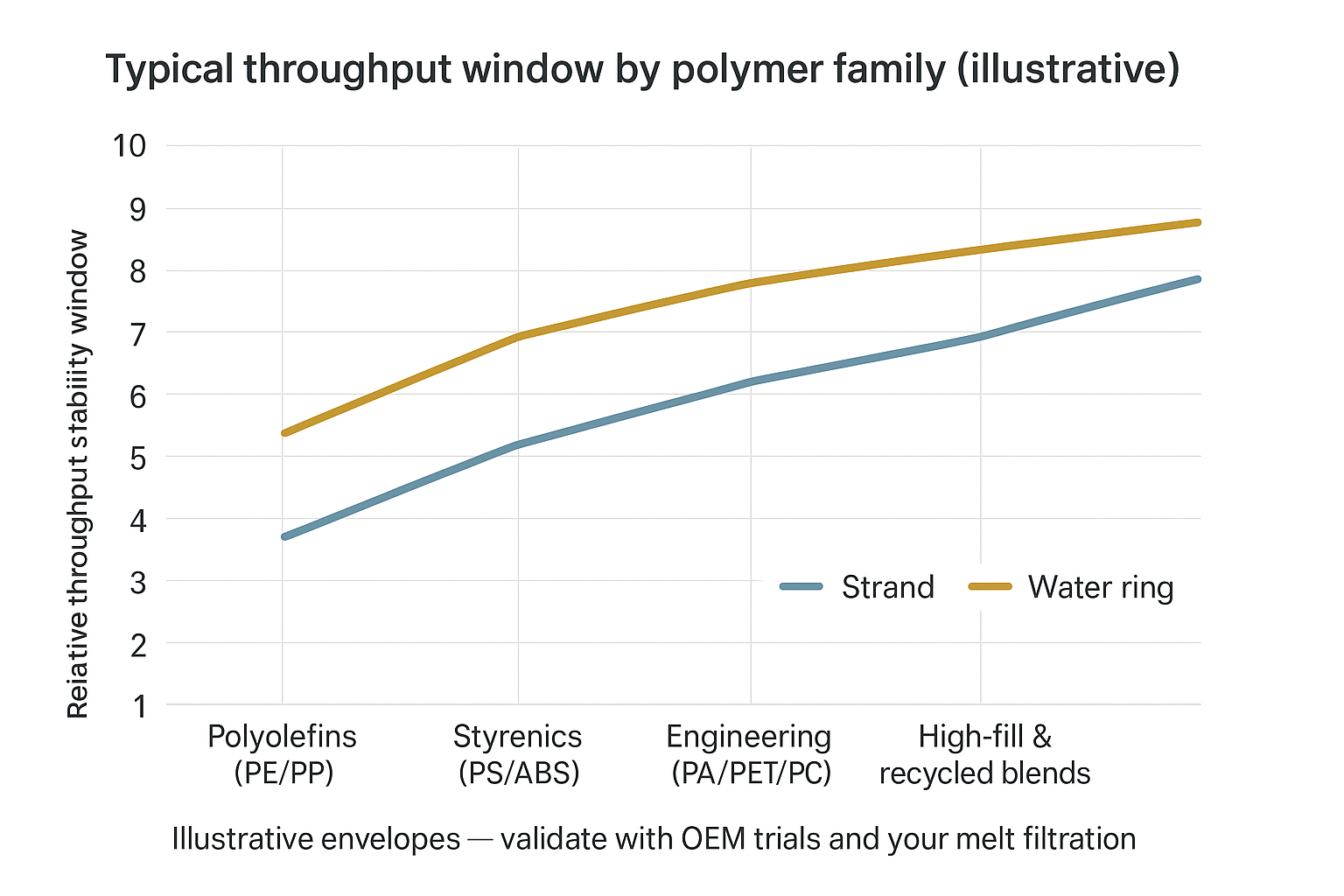
Illustrative only: use your own trials to define the real envelope for each material family. Record at minimum the material family, screen pack/filtration setup, die temperature stability, drying capacity setting, and the moisture/fines test method used.
A useful way to interpret “envelopes”:
- Wider window means you can tolerate more variation in melt temperature/pressure, filler fluctuations, and minor upsets without quality collapse.
- Narrower window means you’ll run fine—until you don’t—then the recovery time and scrap cost dominate.
Kualitas pelet dan kontrol fines
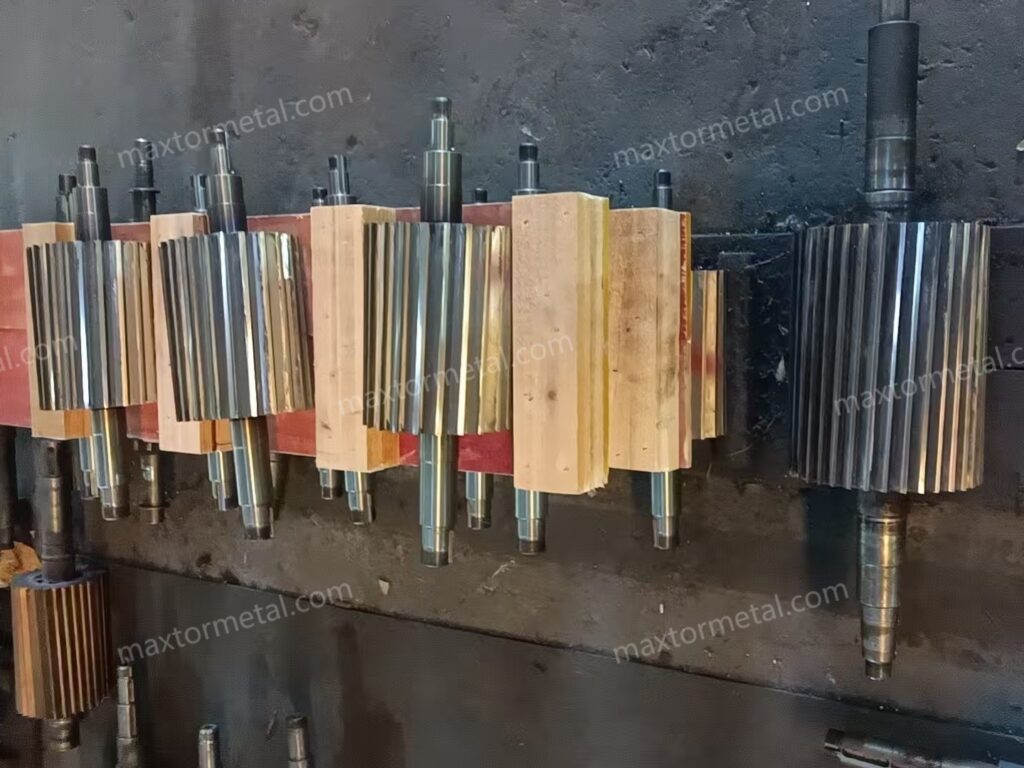
Most pellet quality complaints can be traced back to three levers: the condition of the die face, the condition of the knife edge, and how consistently the cut is executed (gap/pressure, alignment, and temperature stability).
Die–knife pairing and hardness
The die face and knife edge operate as a pair. If the pairing is wrong for the material (abrasive filler, contamination, or very tough polymer), wear accelerates in a way that changes the cut geometry.
Typical symptoms of an unhappy pairing:
- rising fines and “pepper” over time
- tails and angel hair increasing after regrind cycles
- pellet size spread widening even when RPM looks stable
A practical approach is to treat die condition dan knife condition as one maintenance KPI. Don’t only log knife changes; log die resurfacing and its effect on pellet defects.
Gap control and regrind cadence
Gap (or effective cutting pressure) is where good pelletising becomes repeatable—or not.
QC method note (fines): If fines are a key KPI in your trials, document Bagaimana you measure it. For example, ASTM D7486 describes a lab method for quantifying fines and dust adhered to plastic pellets/granules (wet wash + filtration) for particle fractions below 500 μm. Using a consistent method prevents “better pelletiser” decisions that are actually just “different measurement” decisions.
For pellet size distribution, ASTM D1921 covers particle size (sieve analysis) of plastic materials in powdered, granular, or pelleted forms. Its abbreviated approach is noted as useful for materials like pellets/cubes that may not follow a normal distribution—helpful when you need a simple “% retained / % passing” spec for procurement and trial acceptance.
Also keep your charts and envelopes honest: if you publish throughput “windows” as illustrative, add a short line on what data you captured during trials (material family, screen pack, die temperature stability, drying capacity, and fines/moisture checks).
- Too tight, and you can drive heat, chatter, and accelerated wear.
- Too loose, and you’ll see incomplete cutting, tails, and a sharp rise in fines.
For abrasive and recycled blends, the best “gap” is often not a single number—it’s a range plus a verification method (pellet inspection frequency, fines measurement method, and a trigger point for regrind/change).
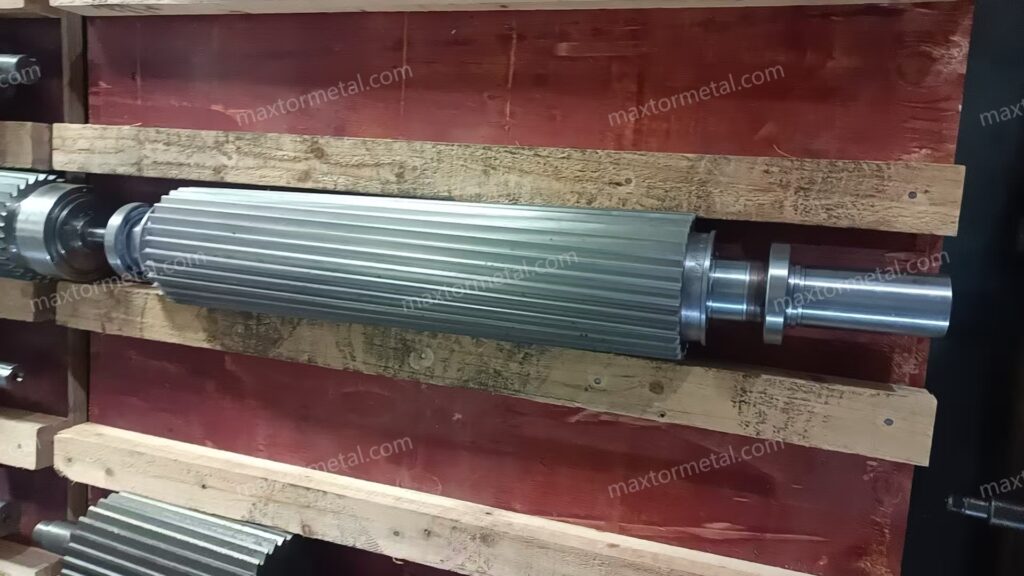
If you’re running a strand cutter, MAXTOR METAL’s own guide on rotary cutter setup for water‑strand pelletising is a useful checklist-style reference for what to log and verify during set-up.
Drying quality and fines generation
Drying doesn’t just control moisture. It can also influence fines in two indirect ways:
- Handling stress: wet pellets can clump, then break apart in conveying—creating fines that look like “cutting dust” but are actually downstream handling damage.
- Kondisi permukaan: inconsistent drying can leave pellets with a tacky surface (or variable friction), which affects flow and attrition.
- MAXTOR METAL note (verifiable, non-promotional): When you’re sourcing pelletiser knives, it’s reasonable to request QC evidence such as first article inspection, incoming material inspection, materials certification, in-process inspection, and final inspection—as described in the MAXTOR METAL pelletizer knife overview.
Suku cadang aus, pemeliharaan, dan uptime
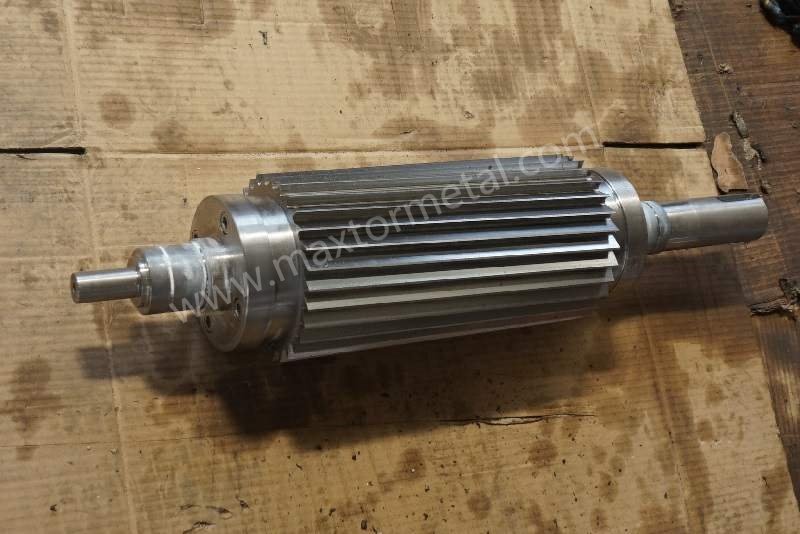
A pelletising line rarely loses money because of one catastrophic failure. It loses money because of repeated small stops: blade changes, die touch-ups, cleaning events, and quality-driven slow-downs.
Knife life, regrinds, and changeovers
Knife life is not just “hours until blunt”. It’s the time until your pellet quality KPIs drift outside spec.
To make knife life a procurement-grade KPI:
- log regrinds as a count dan as a reason (fines up, tails up, pellet length drift)
- record changeover minutes (lock-off to restart) and any quality recovery scrap
- track which materials accelerate edge damage (high-fill, glass fibre, contaminated regrind)
For readers who want a deeper primer on knife material choice and maintenance logic, MAXTOR METAL’s article on how to select pelletizer knives is a helpful neutral reference.
Die plate wear and resurfacing
Die plate condition is often the hidden driver of pellet size spread and fines.
If you only react when quality complaints appear, you’ll likely resurface too late. A more stable approach is to tie resurfacing to:
- total tonnes processed on abrasive blends
- observed groove formation and die-face marks
- fines trend line (not just absolute fines)
Planned vs unplanned stops
UK plants often underestimate how much “stop behaviour” affects compliance as well as cost.
The Health and Safety Executive’s PUWER guidance emphasises maintaining work equipment in efficient working order and good repair, alongside inspection, guarding, and operator competence. In practice, planned maintenance is usually the safer and cheaper option than repeated unplanned interventions.
Model TCO dan matriks pemilihan
TCO only works if it’s specific enough to capture your real losses, but simple enough that someone can actually maintain it.
Cost drivers and assumptions
A practical cost-per-tonne model for pelletising can be built from seven input blocks:
To make this model spreadsheet-ready, use the fields below (keep units consistent across both options):
- Wear parts: knife set cost (£/set), expected life (tonnes/set), regrind cost (£/regrind), regrinds per set (count), die plate resurfacing cost (£/event), resurfacing interval (tonnes/event)
- Labour: operator time for start-up (min/run), grade changeover (min/change), knife change (min/event), cleaning (min/event), hourly labour rate (£/hour)
- Waktu senggang: planned downtime (min/week), unplanned downtime (min/week), lost margin or contribution (£/tonne) atau opportunity cost (£/hour)
- Utilities: electricity (kWh/tonne), water (m³/tonne), compressed air (Nm³/tonne), drying energy (kWh/tonne), unit prices (e.g., £/kWh)
- Scrap & rework: scrap rate (%), rework rate (%), scrap value (£/tonne), quality hold events (count/month)
- Water system consumables (if applicable): filtration media (£/month), water treatment chemicals (£/month), separator maintenance (£/month)
- Inventory & lead-time risk: knife safety stock (sets), die plate safety stock (count), lead time (weeks), expedited freight probability (%/year), expedited cost (£/event)
A minimal structure is:
- Cost/tonne = wear parts + labour + downtime + utilities + scrap/rework + consumables + inventory risk
The key is consistency: define how you measure “fines”, define what counts as downtime, and keep the same method across both options.
Decision matrix by material and goals
Use this as a directional matrix—not a substitute for trials.
- If your priority is maximum flexibility across materials and frequent changes, strand pelletising often gives you more controllable levers and simpler failure visibility.
- If your priority is compact layout and more automated operation on compatible materials, water ring pelletising can be attractive—but only if drying and water management are sized as part of the core system.
Selection at scale: strand vs water ring pelletising
The most common scaling mistake is to scale only the pelletiser, not the system around it.
- Untuk strand systems, scaling demands stable strand cooling/handling and a cutter maintenance plan that prevents drift.
- Untuk water ring systems, scaling demands robust separation/drying and water quality control so the cut remains consistent and pellets leave at target moisture.
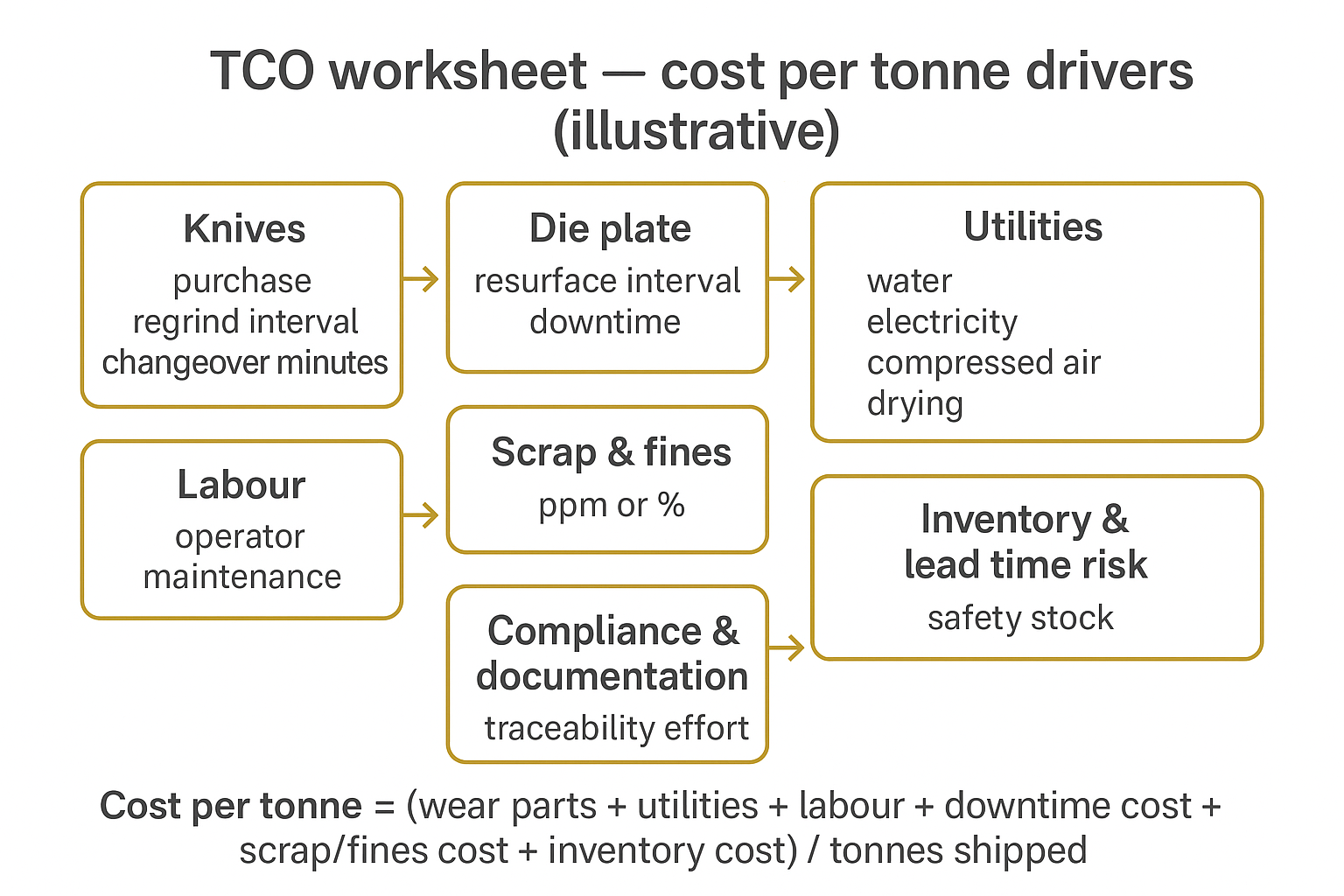
Illustrative only: treat this as a checklist of cost drivers. Populate it with your measured trial data (downtime minutes, kWh/tonne, scrap kg, fines results and test method) before comparing options.
Pengadaan dan kepatuhan UK
Even at Awareness stage, procurement and compliance are worth addressing early—because the “right” process on paper can still be the wrong choice if documentation, lead times, or compatibility risk aren’t controlled.
Import duty, VAT, and cash flow
For UK buyers, landed cost is often shaped as much by cash flow timing as by unit price.
A practical approach is to model:
- VAT timing and reclaim cycle (your finance team will know the real working-capital effect)
- safety stock levels required to protect uptime
- the cost of expediting (air freight, short-notice changeovers)
Documentation and traceability
For wear parts that can affect quality and safety, “documentation” is not bureaucracy—it’s risk control.
Common documents UK teams ask for include:
- material certification
- inspection records (first article + final inspection)
- traceability identifiers (batch/lot, revision control)
Keep this aligned with how you manage process change control internally (material changes, coating changes, geometry revisions).
Lead times, compatibility, and risk
Compatibility risk shows up in two places:
- fit and geometry risk (will it mount correctly and hold the intended gap?)
- process risk (will it behave the same under your material and contamination profile?)
For pelletising, risk reduction often looks like:
- one controlled pilot run per material family
- pre-defined acceptance checks (pellet size spread, fines measurement method, moisture check)
- clear escalation triggers (what defect rate forces a stop?)
Alur kerja pemilihan praktis (siap uji coba)
Use this 5-step flow to turn the comparison into a procurement-grade decision:
A simple way to keep trials comparable is to use one run log template and fill it out for both options.
| Bidang | Unit / format | Catatan |
|---|---|---|
| Run ID | text | One ID per start-up → steady state → interruption → recovery sequence |
| Keluarga material | text | e.g., glass-filled, mineral-filled, elastomeric, recycled with contamination risk |
| Throughput (steady state) | kg/h | Record the stable range, not only peak |
| Pelletiser type | text | Strand / water ring |
| Die temperature stability | °C or qualitative | e.g., ±2 °C band, or “stable/unstable” with notes |
| Screen pack / filtration | mesh / description | Include screen change timing |
| Knife RPM / cut setting | rpm / text | Note gap/pressure setting method |
| Drying / separation setting | text | Dewatering/drying capacity setting used |
| Moisture @ discharge | % or ppm | Define sampling point |
| Moisture @ post-drying | % or ppm | Define sampling point |
| Moisture @ 24 h storage (optional) | % or ppm | Only if storage matters |
| Fines method | text | e.g., ASTM D7486 (or your internal method) |
| Fines result | ppm or % | Keep method consistent |
| Interruption type | text | e.g., screen change, controlled stop, feed variation |
| Time to recover | min | From stop to stable-in-spec again |
| Scrap / rework generated | kg or % | Include recovery scrap |
If you keep these fields consistent, you can compare strand vs water ring on evidence—not anecdotes.
- Classify the material family (brittle/abrasive high-fill, sticky/elastomeric, moisture-sensitive, recycled with contamination risk).
- Define the primary instability risk (strand handling/cooling vs die-face build-up vs drying bottleneck vs filtration/screen change interruptions).
- Design a trial that includes disruptions (start-up, one controlled interruption, one grade change) rather than only steady-state output.
- Agree acceptance metrics upfront:
- pellet size spread / shape consistency
- fines measurement method and limit
- pellet moisture target at discharge and after storage
- time to recover after interruption (minutes) and scrap generated (kg)
- stable throughput range (kg/h) without quality drift
- Translate results into the TCO sheet (use the same definitions and measurement method for both options).
Kesimpulan
Strand vs water ring pelletising isn’t a “better vs worse” debate. Each wins under different material behaviours and different definitions of stability.
Penulis & catatan editorial
Pengarang: Tommy Tang — Senior Sales Engineer, Nanjing METAL Industrial. 12 years in polymer compounding and recycling applications.
Kredensial: CSE, CME, Six Sigma Green Belt, PMP.
Editorial note (transparency): This guide is written to help compare pelletising options using practical operations and total cost of ownership (TCO) considerations. It does not endorse any specific OEM brand. Always validate short-listed configurations with trials under your own material and contamination profile.
Test methods referenced (for consistent trial acceptance)
- ASTM D7486 — Measurement of fines and dust adhered to plastic pellets/granules (wet wash + filtration; useful for particle fractions below 500 μm).
- ASTM D1921 — Particle size (sieve analysis) for plastic materials in powdered, granular, or pelleted forms (useful for “% retained / % passing” acceptance checks).
- ASTM D6869 — Moisture content determination in plastics using Karl Fischer techniques (coulometric/volumetric), to document moisture method consistency across trials.
If you’re running abrasive, high-fill, or variable recycled blends, strand systems often give you more controllable levers and clearer early-warning failure modes. If you’re running compatible polymers and you can size and maintain the water and drying system properly, water ring pelletising can deliver a compact, automated route—but it shifts quality risk into die-face condition and dewatering performance.
Next steps are straightforward: build your site-specific TCO worksheet (minutes, kWh, kg scrap, fines trend), then validate your short-listed configuration with a pilot run that includes start-up, an interruption, and a controlled changeover. That’s where the real cost-per-tonne story shows up.

 English
  Spanish
  Italian
  French
  Portuguese
  Russian
  German
  Arabic
  Hindi
Hindi  Vietnamese
  Indonesian
  Japanese
  Korean