


Avez-vous déjà essayé de couper du caoutchouc pour vous retrouver avec des bords rugueux ou des pièces gâchées ? Vous n'êtes pas seul ! Choisir la bonne lame de coupe pour caoutchouc est crucial pour obtenir une coupe nette. Avant de commencer, tenez compte du type et de l'épaisseur de votre caoutchouc. Pensez également à vos besoins de coupe spécifiques. Même de petites variations dans votre caoutchouc peuvent affecter la façon dont vous devez le couper et impacter vos résultats. Par exemple, jetez un œil à ce tableau:
| Force normale appliquée | Structure du noir de carbone | Comportement du mélange | Effet sur la coupe et l'usure par écaillage |
|---|---|---|---|
| Force faible | Structure élevée | Mélange plus rigide, moins de déflexion | Minimise l'usure en rigidifiant le mélange |
| Force élevée | Structure faible | Mélange plus souple, permet la cristallisation sous tension | Minimise l'usure en permettant la cristallisation |
Sélectionner la bonne combinaison de lame et de caoutchouc peut améliorer la qualité de votre travail et réduire les erreurs.
Principaux points à retenir
- Tout d'abord, connaissez votre type de caoutchouc, sa dureté, sa flexibilité et son épaisseur avant de choisir une lame. Cela vous aide à obtenir des coupes nettes et lisses.
- Choisissez le bon type de lame. Elle peut être droite, dentelée, circulaire ou sur mesure. Choisissez en fonction de votre caoutchouc et de la façon dont vous devez le couper. Cela vous donnera de meilleurs résultats.
- Trouvez un bon équilibre entre précision et rapidité. Choisissez des lames et des réglages qui correspondent aux objectifs de votre projet et à votre volume de travail.
- Examinez les caractéristiques importantes de la lame telles que le nombre de dents, l'angle de coupe, la largeur du trait de coupe et la taille. Celles-ci vous aident à mieux couper et prolongent la durée de vie de votre lame.
- Utilisez toujours des lames bien affûtées. Respectez les consignes de sécurité, comme le port d'équipements de protection. Cela vous aide à couper le caoutchouc en toute sécurité et vous évite de vous blesser.

Connaître votre matériau en caoutchouc
Types de caoutchouc
Avant de choisir une lame, vous devez savoir quel type de caoutchouc vous utilisez. Le caoutchouc se présente sous de nombreuses formes. Vous travaillez peut-être avec du caoutchouc naturel, qui est doux et extensible. Certains projets utilisent du caoutchouc synthétique, comme le néoprène ou l'EPDM. Ces types de caoutchouc résistent mieux à la chaleur, à l'huile ou aux intempéries que le caoutchouc naturel. Le caoutchouc de silicone est une autre option. Il reste flexible même à des températures extrêmes. Chaque type réagit différemment lors de la coupe. Si vous utilisez la mauvaise lame, vous risquez d'obtenir des bords irréguliers ou de gaspiller du matériau.
Conseil: Vérifiez l'étiquette ou demandez à votre fournisseur le type de caoutchouc. Cela vous aidera à choisir le meilleur outil de coupe.
Dureté et flexibilité
La dureté et la flexibilité du caoutchouc jouent un rôle majeur lors de la coupe. La dureté désigne la fermeté du caoutchouc au toucher. La flexibilité indique sa capacité à se plier. Les recherches montrent que le caoutchouc plus souple permet de réaliser des empreintes et des formes plus profondes, mais qu'il peut se déchirer plus facilement. Le caoutchouc plus dur permet d'obtenir des coupes plus nettes et moins profondes, et conserve mieux sa forme. La façon dont le caoutchouc s'étire (son élasticité) modifie également le comportement d'une lame. Deux caoutchoucs de même dureté peuvent se comporter différemment si l'un est plus flexible. Si vous recherchez un équilibre, certains produits utilisent une conception double couche : un intérieur souple et un extérieur dur. Ce mélange vous permet d'obtenir à la fois de la résistance et de la flexibilité dans vos coupes.
Épaisseur
L'épaisseur du caoutchouc change tout. Les feuilles minces se coupent facilement avec une lame bien affûtée. Le caoutchouc épais ou renforcé nécessite un outil plus robuste et plus tranchant. Si vous essayez d'utiliser une petite lame sur du caoutchouc épais, vous risquez d'obtenir des bords rugueux ou même d'endommager votre lame. Mesurez toujours votre caoutchouc avant de commencer. Pour les matériaux très épais ou résistants, vous pouvez avoir besoin d'une lame spéciale ou même d'une solution sur mesure.
Rappel : Connaître le type, la dureté, la flexibilité et l'épaisseur de votre caoutchouc vous aide à obtenir des coupes lisses et nettes à chaque fois.
Types de lames de coupe pour caoutchouc
Choisir la bonne lame de coupe pour caoutchouc peut grandement faciliter votre projet. Vous trouverez plusieurs types de lames, chacun ayant ses propres atouts. Examinons les principales options et voyons comment elles fonctionnent pour différents matériaux en caoutchouc et travaux.
Lames droites
Matériaux courants
- Acier à haute teneur en carbone : ce matériau offre un tranchant exceptionnel et dure longtemps. Il convient parfaitement pour des coupes droites et nettes.
- Acier inoxydable : si vous devez couper du caoutchouc dans des environnements humides ou difficiles, l'acier inoxydable résiste à la rouille et reste tranchant.
- Carbure de tungstène : ce matériau est très dur et conserve son tranchant même lorsque vous coupez du caoutchouc résistant ou épais.
Applications typiques
Vous utiliserez des lames droites lorsque vous souhaitez obtenir une coupe nette et droite dans des feuilles de caoutchouc souples ou de dureté moyenne. Ces lames s'adaptent aussi bien aux outils à main qu'aux machines. Si vous devez couper du caoutchouc pour des joints, des revêtements de sol ou des étanchéités, une lame droite est un excellent choix.
Des chercheurs ont testé des lames droites en mesurant l'impact de l'affûtage et de la forme de la lame sur la coupe. Ils ont découvert qu'une pointe plus tranchante et un angle de biseau approprié permettent d'obtenir une coupe plus nette. Les tests ont également montré que la façon dont le caoutchouc s'étire et adhère à la lame modifie la force requise. Ainsi, si vous souhaitez des coupes fiables et lisses, portez une attention particulière à la forme et au tranchant de la lame.
Conseil: Vérifiez toujours le tranchant de votre lame avant de commencer. Une lame émoussée peut déchirer le caoutchouc et laisser des bords rugueux.
Lames dentelées
Matériaux courants
- Acier à haute teneur en carbone : les lames dentelées fabriquées dans ce matériau possèdent des dents solides et tranchantes. Elles coupent facilement le caoutchouc résistant ou fibreux.
- Acier inoxydable : ce matériau aide à prévenir la rouille, ce qui est utile si vous travaillez dans des environnements humides ou industriels.
- Carbure de tungstène : les lames dentelées avec des dents en carbure de tungstène conservent leur tranchant plus longtemps, même lors de la coupe de caoutchouc abrasif ou renforcé.
Applications typiques
Les lames dentelées excellent lorsqu'il s'agit de couper du caoutchouc épais, texturé ou renforcé. Les dents agrippent le matériau et aident à réduire le glissement. Vous pouvez utiliser ces lames pour couper des bandes transporteuses, des tapis en caoutchouc ou des pneus. Les différences de comportement entre les lames droites et les lames dentelées résident dans leur façon de traiter les matériaux difficiles. Les lames dentelées mordent dans le caoutchouc, ce qui facilite la coupe à travers les couches ou les fibres.
Si vous constatez que le caoutchouc glisse ou s'accumule, essayez une lame dentelée pour un meilleur contrôle.
Lames circulaires
Matériaux courants
- Acier à haute teneur en carbone : ce matériau offre un équilibre idéal entre coût et performance, ce qui en fait un choix populaire pour les applications de coupe générale.
- Acier inoxydable : utilisez ce matériau si vous devez couper du caoutchouc dans des environnements humides ou de qualité alimentaire.
- Tungsten carbide: Circular blades with this material handle high-speed, nonstop cutting and resist wear.
Applications typiques
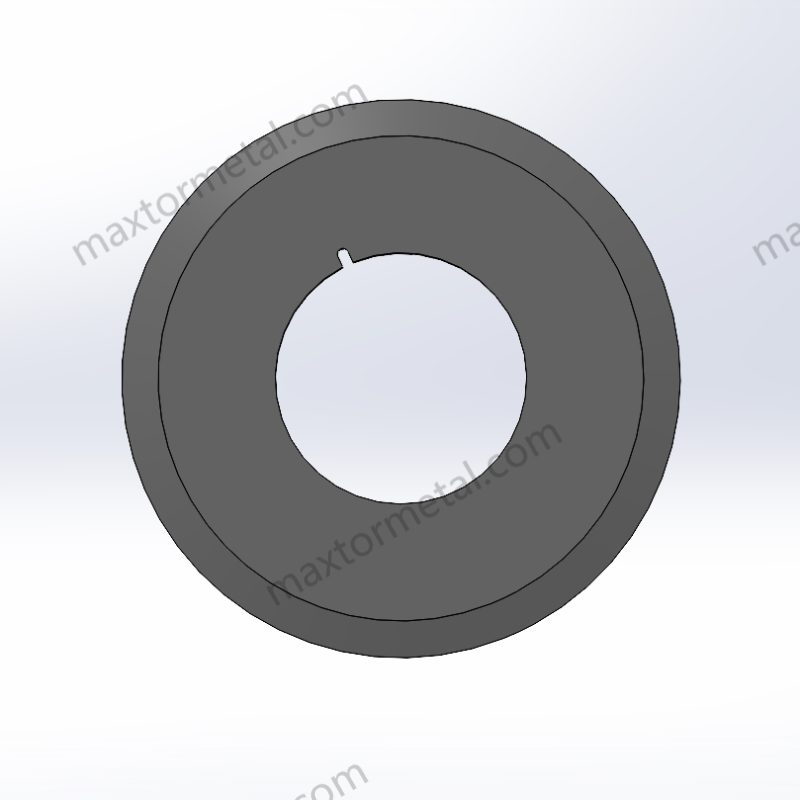
You will often see circular blades in machines that cut large rolls or sheets of rubber. These blades work best for continuous or high-volume jobs. Factories use them to make products like rubber flooring, seals, or strips.
Technical studies show that circular blades work well for nonstop cutting. When you pair them with a flexible rubber backing roll, the blade can cut fibers cleanly and last through thousands of cuts. The backing roll supports the rubber and absorbs some of the cutting force. This setup keeps the blade sharp and helps you get smooth, even cuts every time.
Note: If you need to cut a lot of rubber quickly, a circular blade in a machine will save you time and effort.
Specialty and Custom Blades
Matériaux courants
- High-carbon steel, stainless steel, tungsten carbide, and other special alloys: Custom blades use the best material for your job. You can choose what fits your needs.
Benefits and Necessity of Custom Blades
Sometimes, your project needs more than a standard rubber cutting blade. Maybe you work with a special type of rubber, or you need to cut a unique shape or thickness. Custom blades let you pick the right size, shape, and material. This helps you cut faster, safer, and with more accuracy. Industries like automotive, aerospace, or food processing often need custom blades to meet strict rules or handle tough jobs.
Custom blades can solve problems that standard blades cannot. If you keep running into trouble, a custom solution might be the answer.
Nanjing Metal as a Custom Blade Provider
If you need a custom rubber cutting blade, you want a manufacturer you can trust. Nanjing Metal stands out as a leading rubber cutting blade manufacturer with over 20 years of experience. Their team designs and makes blades for all kinds of industries. They use advanced tools and strict quality checks to make sure every blade meets your needs. Many customers around the world trust Nanjing Metal for their custom blade projects.
Want to learn more or get a quote? Just contact a Nanjing Metal sales engineer. They can help you find the perfect blade for your project.
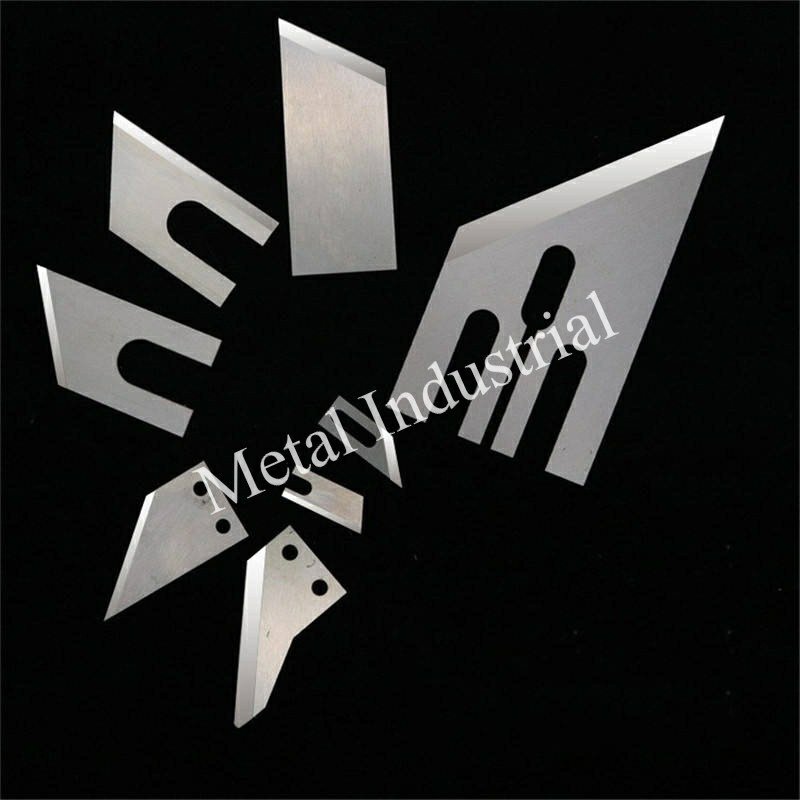
Choisir la lame parfaite
Precision vs. Speed
When you start choosing the perfect blade, you need to think about what matters most for your project: precision or speed. If you want smooth, clean edges, you should focus on precision. If you need to finish a lot of work quickly, speed becomes more important.
When to Prioritize Precision
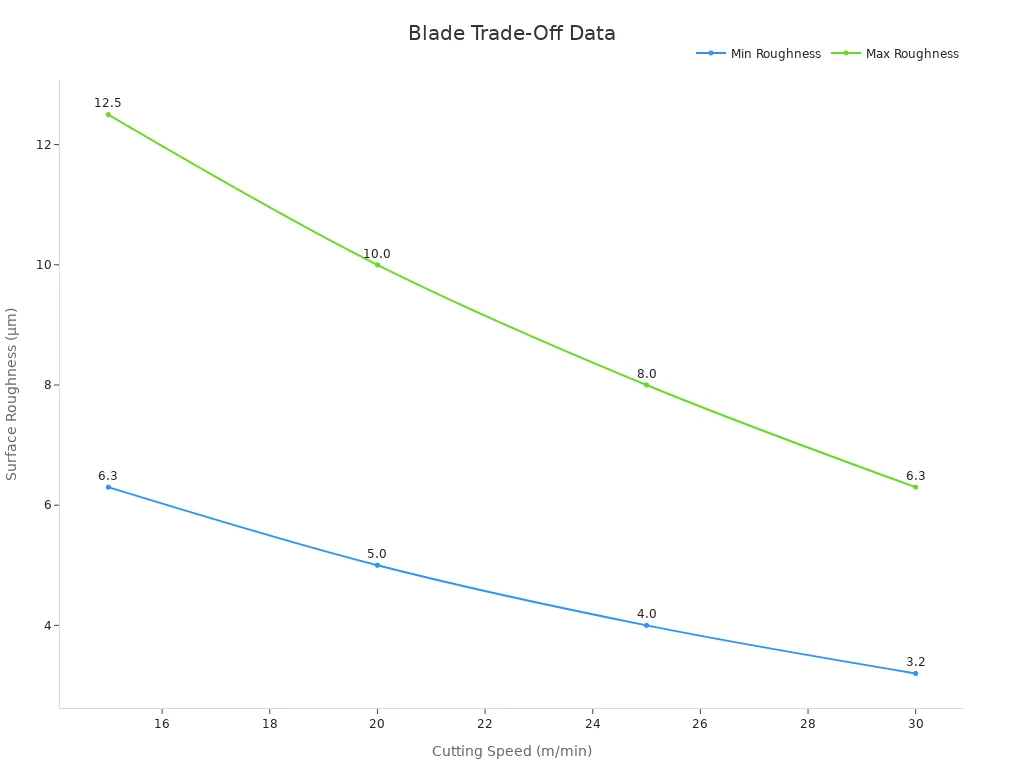
You should choose precision when your project needs tight tolerances or a perfect finish. For example, if you cut rubber gaskets for engines, a rough edge can cause leaks. Take a look at this table to see how different cutting speeds affect surface quality:
| Steel Grade | Surface Roughness (μm) | Vitesse de coupe (m/min) | Saw Type | Feed (mm/tooth) |
|---|---|---|---|---|
| Low Carbon Steel | 3.2 – 6.3 | 30 | Band saw | 0.2 |
| Medium Carbon Steel | 4.0 – 8.0 | 25 | Circular saw | 0.15 |
| Acier allié | 5.0 – 10.0 | 20 | Band saw | 0.1 |
| Acier à outils | 6.3 – 12.5 | 15 | Circular saw | 0.08 |
Higher speed can mean rougher cuts, especially with harder materials.
When to Prioritize Speed
Speed matters when you have a lot of material to cut and less need for perfect edges. For example, if you cut rubber mats for playgrounds, you might want to finish quickly. Just remember, faster cutting can wear out your blade faster and lower the quality of your cuts.
Balancing Both for Your Project
You can balance speed and precision by testing different blades and settings. Sometimes, using a hybrid blade or adjusting your machine helps you get both good speed and decent quality.
Manual vs. Machine Cutting
Blade Selection for Manual Cutting
Manual cutting works best for small jobs or when you need to make custom shapes. You should pick a blade that feels comfortable and stays sharp. Straight or serrated blades are common choices.
Blade Selection for Machine Cutting
Machines can cut faster and more accurately. They use circular or specialty blades for high-volume work. A sealing gasket company found that switching to machine cutting cut their production time in half and gave them smoother edges.
| Gasket Type | Épaisseur | Machine Speed (mm/s) | Manual Speed (mm/s) | Labor (people) |
|---|---|---|---|---|
| Rubber Gasket | 3 mm | 200 | 50 | 3 |
| Rubber Gasket | 10 mm | 50 | ≤10 | 4 |
Safety and Efficiency Considerations
Machine cutting is safer and more efficient for big jobs. Manual cutting needs more skill and can be tiring. Always wear safety gear and keep your blades sharp.
Volume of Work
Low-Volume Projects
If you only cut rubber once in a while, your blade will last longer. You will not need to sharpen or replace it often.
High-Volume or Industrial Projects
Cutting rubber every day wears out blades faster. In factories, blades may need replacing every few months. The table below shows how work volume affects blade life:
| Contexte d'utilisation | Durée de vie prévue | Besoins d'entretien |
|---|---|---|
| Home Kitchen | 12 to 24 months | Less frequent maintenance |
| Industrial Use | 6 à 18 mois | Frequent sharpening and replacement |
Cost and Maintenance Implications
More cutting means higher costs for new blades and more time spent on maintenance. You can save money by storing blades properly and using the right blade for your job.
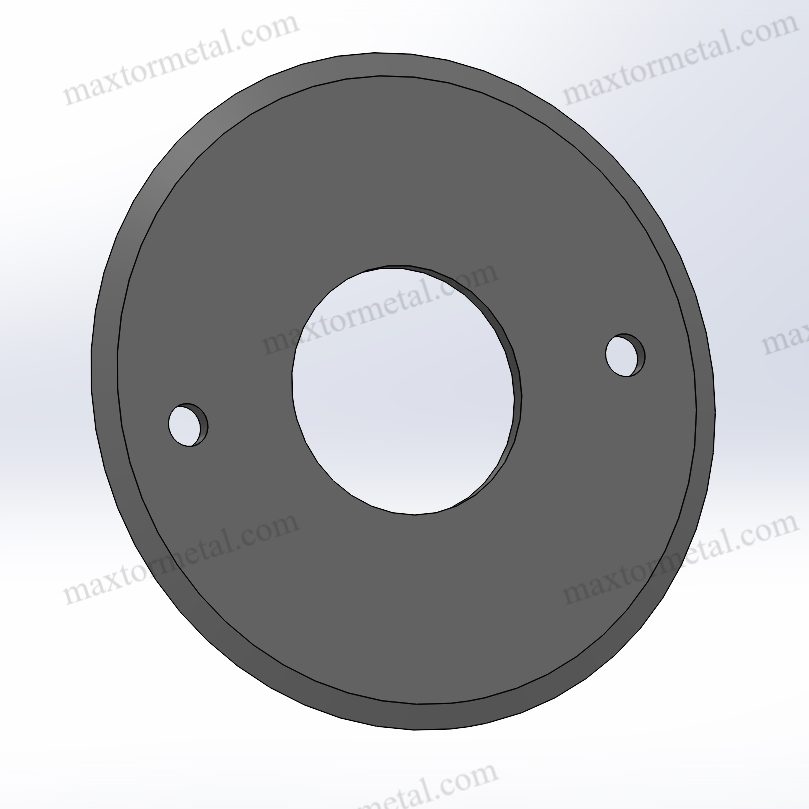
Caractéristiques clés des lames
When you pick a rubber cutting blade, you want to look at more than just the shape. Each feature changes how your blade performs and how clean your cuts turn out. Let’s break down the most important features you should know.
Tooth Configuration
Tooth configuration means the way the teeth are arranged on your blade. The tooth count, spacing, and shape all matter. A higher tooth count gives you smoother cuts, but it can slow you down. Fewer teeth cut faster, but you might see rougher edges. The tooth geometry, or the shape of each tooth, also affects how the blade slices through rubber. If you work with thick or tough rubber, you might want a blade with fewer, larger teeth. For thin or soft rubber, a higher tooth count helps you get a cleaner edge.
Material Removal Rate (MRR) shows how fast you can cut. It depends on feed rate, tooth count, and how deep you cut. If you want to balance speed and quality, try different tooth counts to see what works best for your project.
Hook Angle
The hook angle is the tilt of the blade’s teeth. A positive hook angle pulls the rubber into the blade, making cutting easier and faster. A negative hook angle pushes the material away, which can help you get more control and a smoother finish. Some wood blades with a negative hook angle actually work well for certain rubber types, especially if you want to avoid tearing or slipping. Always check the hook angle before you start, because it changes how the blade grabs the rubber.
Kerf Width
Kerf width is the thickness of the cut your blade makes. A narrow kerf means less material wasted and more precise cuts. A wider kerf can handle thicker or tougher rubber but may leave a bigger gap. Studies show that smaller kerf widths lead to less heat damage and smoother edges, especially when cutting soft or flexible rubber. If you need tight tolerances, always measure the kerf width before you begin.
Blade Size and Diameter
Blade size and diameter decide how deep and wide you can cut. Bigger blades cut deeper, but they need more power. Smaller blades work well for thin sheets or detailed work. Always match your blade size to your rubber’s thickness and your cutting tool.
Durabilité et entretien
A durable blade saves you time and money. Look for blades made from strong materials like high-carbon steel or tungsten carbide. Sharpness matters, too. Tests like the BESS Score and CATRA metrics measure how sharp a blade is and how long it stays sharp. You can use high-tech tools like SEM or AFM to check for tiny defects or dull spots. Keep your blade clean and sharpen it often. Regular maintenance helps your blade last longer and keeps your cuts smooth.
Tip: If you notice your blade getting dull or your cuts looking rough, it’s time for some maintenance. A well-cared-for blade makes every project easier.
Comment couper le caoutchouc en toute sécurité
Best Tool to Cut Rubber
You want clean, easy cuts when you work with rubber. Picking the best tool to cut rubber makes a huge difference. Many users say anvil pruners, like the Craftsman Edge, and the Ronan Multi-Cut tool give the best results. These tools help you avoid rough edges and wasted material. People who switched from scrapers or scissors to these tools noticed they stopped ruining cuts. The Ronan Multi-Cut tool stands out as the best tool to cut rubber for most jobs, even though it costs more. It gives you smooth, straight cuts every time.
If you need to cut thick or tough rubber, you might want to try waterjet cutting. This method works well for big projects and gives you high precision. Here’s a quick look at how different cutting methods compare:
| Fonctionnalité | Waterjet Cutting | Découpe à l'emporte-pièce | Découpe laser | Knife Cutting |
|---|---|---|---|---|
| Précision | ±0.005 in | ±0.010 in | ±0.003 in | ±0.020 in |
| Max Thickness | Up to 12 in | Up to 2 in | Up to 1 in | Up to 4 in |
| Vitesse | Medium-Fast | Very Fast | Rapide | Lent |
| Coût | Haut | Moyen | Haut | Faible |
You can see that waterjet and laser cutting give you the best accuracy, but hand tools like the Ronan Multi-Cut are perfect for smaller jobs.
Conseils de sécurité
When you learn how to cut rubber, safety should always come first. Many accidents happen because people skip safety steps or use the wrong tools. Always wear cut-resistant gloves, safety glasses, and sturdy boots. If you use power tools, check that everything works before you start. Keep your work area clean and free of clutter.
Tip: The Logger Safety Initiative recommends using sharp, well-maintained tools and wearing proper protective gear. They also suggest having a first aid kit nearby and working with others when possible.
UN study in rubber sawmills found that most injuries happen to hands and feet. You can avoid these by using the right tools and following safe cutting techniques.
Erreurs courantes
You might wonder how to cut rubber without making mistakes. Many people run into trouble because they rush or skip steps. Here are some common mistakes:
- Using dull blades or the wrong tool for the job.
- Not measuring or marking the rubber before cutting.
- Skipping safety gear like gloves or goggles.
- Ignoring tool maintenance, which leads to accidents.
- Applying uneven pressure, causing jagged or uneven cuts.
- Overheating the rubber or using too much force.
- Not checking for defects in the rubber before starting.
Incident analysis shows that fixing these mistakes can reduce defects by over 80%. If you want to cut rubber properly, take your time, use the best tool to cut rubber, and always follow safety steps.
Choosing the right rubber cutting blade starts with knowing your material and project goals. You should look at blade materials, shapes, and coatings to match your needs.
- Different blades work best for different types of rubber and cutting jobs.
- Coatings like Titanium Nitride help blades last longer.
- Custom blades give you the best results for tricky projects.
If you want to master how to cut rubber, always check your blade and stay safe. For unique jobs, custom blades from a trusted manufacturer like Nanjing Metal can make how to cut rubber easier and more precise. Don’t forget to keep your tools sharp and Contact their sales engineer if you need expert help.
FAQ
What is the best blade for cutting thick rubber?
You should use a heavy-duty blade, like a tungsten carbide or serrated blade. These blades stay sharp and handle tough, thick rubber without tearing.
Can I use a wood blade to cut rubber?
Some wood blades with a negative hook angle work for certain rubber types. Always check the blade’s sharpness and test on a scrap piece first.
How do I keep my cutting blade sharp?
Clean your blade after each use. Store it in a dry place. Sharpen it regularly with the right tool. A sharp blade gives you smoother cuts and lasts longer.
Do I need a custom blade for my project?
If you work with unique rubber materials or need special shapes, a custom blade helps you get better results. Custom options fit your exact needs and improve efficiency.
Where can I get expert help with custom blades?
You can contact a Nanjing Metal sales engineer for advice. They have years of experience as a leading industrial blade manufacturer and can help you find the perfect solution for your project.
Voir aussi
Le guide ultime pour choisir une lame de refendage en caoutchouc
Que sont les lames rondes et comment sont-elles utilisées dans les industries
Comment choisir les lames de refendeuse circulaire adaptées pour des performances durables

 English
  Spanish
  Italian
  French
  Portuguese
  Russian
  German
  Arabic
  Hindi
Hindi  Vietnamese
  Indonesian
  Japanese
  Korean