

टॉमी टैंग, वरिष्ठ बिक्री इंजीनियर, Nanjing METAL Industrial द्वारा (औद्योगिक कटिंग टूल्स और रीफर्बिशमेंट आपूर्ति कार्यक्रमों में 12 वर्ष; प्रमाणपत्र: CSE, CME, सिक्स सिग्मा ग्रीन बेल्ट, PMP)।.
अंतिम अद्यतन: 2026-04-02।.
संशोधन इतिहास
- 2026-03-29: पहली बार प्रकाशित। ISO 21940 भाग संदर्भ, सुरक्षा/अनुपालन नोट्स और एक ऑडिट योग्य QA + बैलेंसिंग पैक टेम्प्लेट जोड़ा गया।.
इस गाइड पर भरोसा क्यों करें
यह सर्वोत्तम प्रथाओं की चेकलिस्ट पेलेटाइजिंग और औद्योगिक कटिंग अनुप्रयोगों में उपयोग किए जाने वाले सामान्य विफलता मोड और QA नियंत्रणों पर आधारित है। MAXTOR METAL ISO 9001 गुणवत्ता प्रबंधन के तहत काम करता है, कैलिब्रेटेड/ट्रेस करने योग्य मापने वाले उपकरणों (जहां लागू हो तीसरे पक्ष के अंशांकन सहित) का उपयोग करता है, और महत्वपूर्ण कटिंग घटकों में परिवर्तनशीलता को कम करने के लिए इनकमिंग, इन-प्रोसेस और अंतिम निरीक्षण द्वारों को लागू करता है।.
चाबी छीनना
- रीफर्बिशमेंट की गुणवत्ता लाइन पर पेलेट की लंबाई के फैलाव, टेल्स, फाइन्स और कंपन के रूप में दिखाई देती है—न कि केवल “यह कितना तेज दिखता है”।.
- रीफर्बिशमेंट को परिभाषित द्वारों के साथ एक नियंत्रित प्रक्रिया के रूप में मानें: मेट्रोलॉजी बेसलाइन, मरम्मत विधि, फिनिश ग्राइंडिंग और एक बैलेंसिंग रिपोर्ट।.
- स्वीकृति को POs में लिखा जाना चाहिए: ज्यामिति जांच, सतह फिनिश, कोटिंग सत्यापन, और ISO 21940 डायनेमिक बैलेंसिंग साक्ष्य।.
- रखरखाव और गार्डिंग अभ्यास को अपने स्थानीय मशीनरी-सुरक्षा ढांचे और साइट जोखिम मूल्यांकन के साथ संरेखित करें—विशेष रूप से जहां घूर्णन भागों तक पहुंच मौजूद है। (यूके साइटों के लिए, PUWER एक उपयोगी संदर्भ है: HSE का PUWER अवलोकन.)
दायरा और सीमाएं
यह गाइड स्ट्रैंड पेलेटाइज़र रोटर्स के लिए लिखी गई है जहाँ रीफर्बिशमेंट के परिणाम नियंत्रित ज्यामिति, फिट्स और संतुलन पर निर्भर करते हैं। यह निरीक्षण द्वारों, दस्तावेज़ीकरण और स्वीकृति डिलिवरेबल्स पर ध्यान केंद्रित करता है।.
It does नहीं यह गाइड OEM मैनुअल, साइट-विशिष्ट जोखिम मूल्यांकनों, या अधिकार क्षेत्र-विशिष्ट कानूनी आवश्यकताओं का स्थान नहीं लेती है। यदि कोई OEM किसी मरम्मत विधि को प्रतिबंधित करता है, यदि तनावग्रस्त क्षेत्रों में दरार का पता चलता है, या यदि क्षति पुनर्प्राप्ति योग्य सीमाओं से अधिक है (जैसे, अपर्याप्त शेष टूथ फॉर्म या असुरक्षित ताप-प्रभावित क्षेत्र), तो रीफर्बिशमेंट के दायरे को एक इंजीनियरिंग निर्णय के रूप में मानें और OEM या किसी योग्य मरम्मत प्राधिकरण को बढ़ाएं।.
त्वरित परिभाषाएं (निरीक्षण रिपोर्ट के लिए)
- TIR (टोटल इंडिकेटेड रनआउट): घटक को घुमाते समय देखा गया पीक-टू-पीक संकेतक रीडिंग, जिसका उपयोग माप स्थान पर रनआउट को परिमाणित करने के लिए किया जाता है।.
- Ra (सतह की खुरदरापन): बेयरिंग जर्नल और सीट फिनिश को निर्दिष्ट/सत्यापित करने के लिए उपयोग किया जाने वाला एक मापा गया औसत खुरदरापन मान।.
- रिजिड बनाम फ्लेक्सिबल रोटर (बैलेंसिंग संदर्भ): अधिकांश पेलेटाइज़र रोटर रिजिड के रूप में व्यवहार करते हैं सामान्य सेवा गतियों पर, लेकिन उच्च-गति या लंबे रोटर्स के लिए लचीली-रोटर (flexible-rotor) विधियों की आवश्यकता हो सकती है। ISO 21940 निर्दिष्ट करते समय, उस भाग का हवाला दें जो आपके रोटर व्यवहार और सेवा गति से मेल खाता है।.
सुरक्षा और अनुपालन नोट (पहले पढ़ें): घूर्णन मशीनरी पर काम में OEM मैनुअल और आपकी साइट के जोखिम मूल्यांकन और खतरनाक-ऊर्जा पृथक्करण प्रक्रियाओं का पालन किया जाना चाहिए। उपयुक्त गार्डिंग/इंटरलॉक का उपयोग करें, पहुंच से पहले शून्य ऊर्जा सत्यापित करें, और सुनिश्चित करें कि केवल प्रशिक्षित कर्मचारी ही सेटअप और निरीक्षण करें। वैश्विक संदर्भ के लिए, ISO 12100 में जोखिम-मूल्यांकन दृष्टिकोण और ISO 14120 में गार्ड डिज़ाइन सिद्धांतों का व्यापक रूप से उपयोग किया जाता है; अमेरिका में, OSHA 29 CFR 1910.212 सामान्य मशीन-गार्डिंग आवश्यकताओं की रूपरेखा तैयार करता है। यूके के पाठक PUWER नियम 11 (मशीनरी के खतरनाक भाग) के विरुद्ध गार्डिंग अभ्यास का बेंचमार्क कर सकते हैं, लेकिन अन्य क्षेत्राधिकारों में भी इसके समकक्ष आवश्यकताएं मौजूद हैं।.
स्ट्रैंड पेलेटाइजिंग लाइनों पर, पेलेटाइज़र रोटर में छोटी यांत्रिक त्रुटियां शायद ही कभी छोटी रहती हैं। वे पेलेट की लंबाई में भिन्नता, टेल्स, फाइन्स और इस तरह के उपद्रव रुकावटों के रूप में दिखाई देते हैं जो चुपचाप OEE को नुकसान पहुंचाते हैं।.
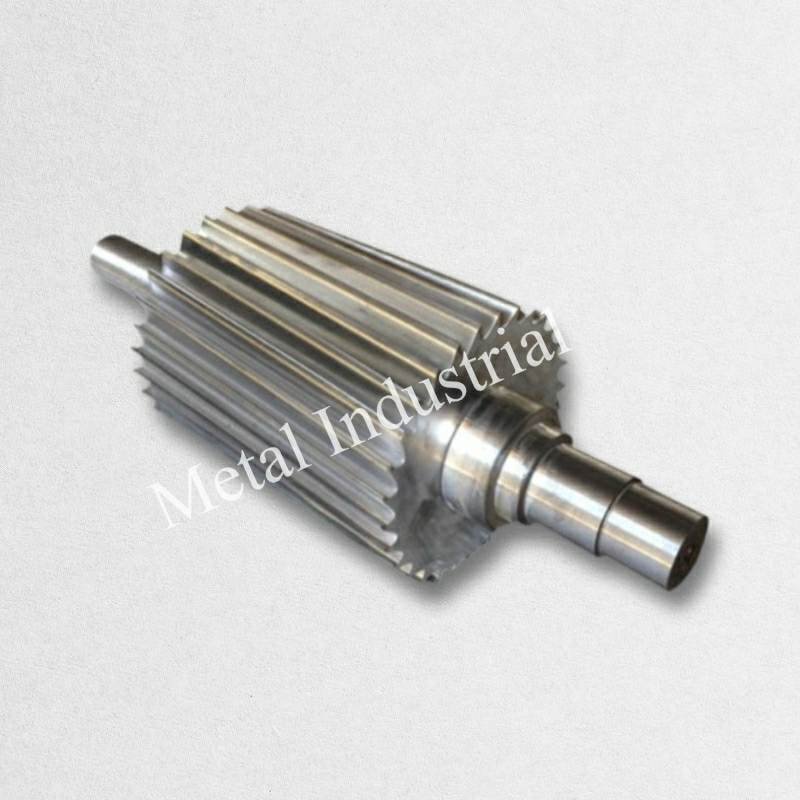
यह गाइड अत्यधिक घिसाव के मामलों में रीफर्बिशमेंट पर केंद्रित है: ज्यामिति बहाली, जर्नल और बेयरिंग सीट की मरम्मत, कोटिंग मार्ग, ISO 21940 डायनेमिक बैलेंसिंग, और QA दस्तावेज़ीकरण जो यूके के प्रोसेसर को मांगना चाहिए। यह आपको निर्दिष्ट करने में मदद करने के लिए लिखा गया है स्ट्रैंड पेलेटाइज़र रोटर मरम्मत कार्य ताकि परिणाम दोहराने योग्य हो, न कि विक्रेता पर निर्भर।.
इसे चरण-दर-चरण संदर्भ और एक स्वीकृति जांच सूची के रूप में उपयोग करें जिसे आप ऑडिट और खरीद आदेशों में शामिल कर सकते हैं।.
विफलता के प्रकार और निदान
घिसाव के पैटर्न और मूल कारण
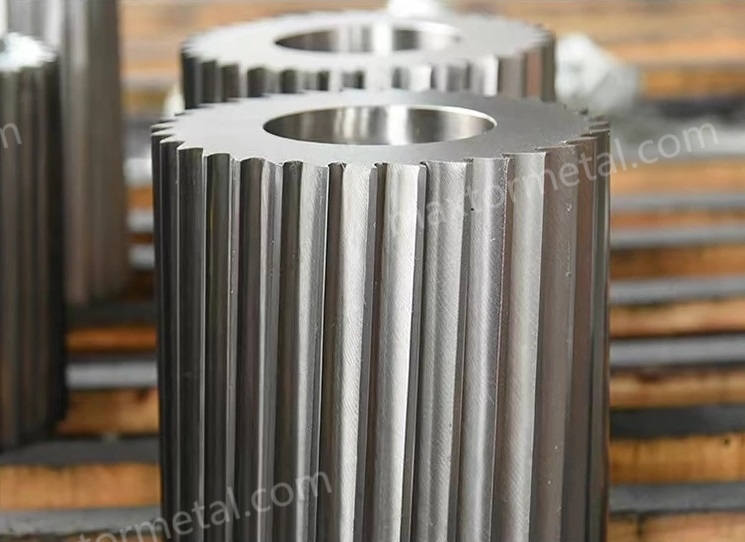
अधिकांश रोटर समस्याएं सबसे पहले कट-गुणवत्ता के लक्षणों के रूप में दिखाई देती हैं, न कि दृश्यमान “टूटे हुए हिस्से” के रूप में। प्लास्टिक्स टेक्नोलॉजी की समस्या निवारण गाइड टेल्स और फाइन्स को कटिंग समायोजन, अलाइनमेंट और घटक घिसाव से जोड़ती है जो चाकू के सामने स्ट्रैंड प्रस्तुत करने के तरीके को बदल देती है (प्लास्टिक्स टेक्नोलॉजी, “सॉल्व सेवन कॉमन पेलेटाइजिंग प्रॉब्लम्स” (2012)).
रीफर्बिशमेंट के संदर्भ में, सामान्य मूल कारण हैं:
- धार और प्रोफ़ाइल का घिसाव: टूथ फ्लैंक का गोल होना, किनारों का टूटना, और हेलिक्स/प्रोफ़ाइल विकृति; रोटर अब पूरी चौड़ाई में लगातार कतरन नहीं कर सकता है।.
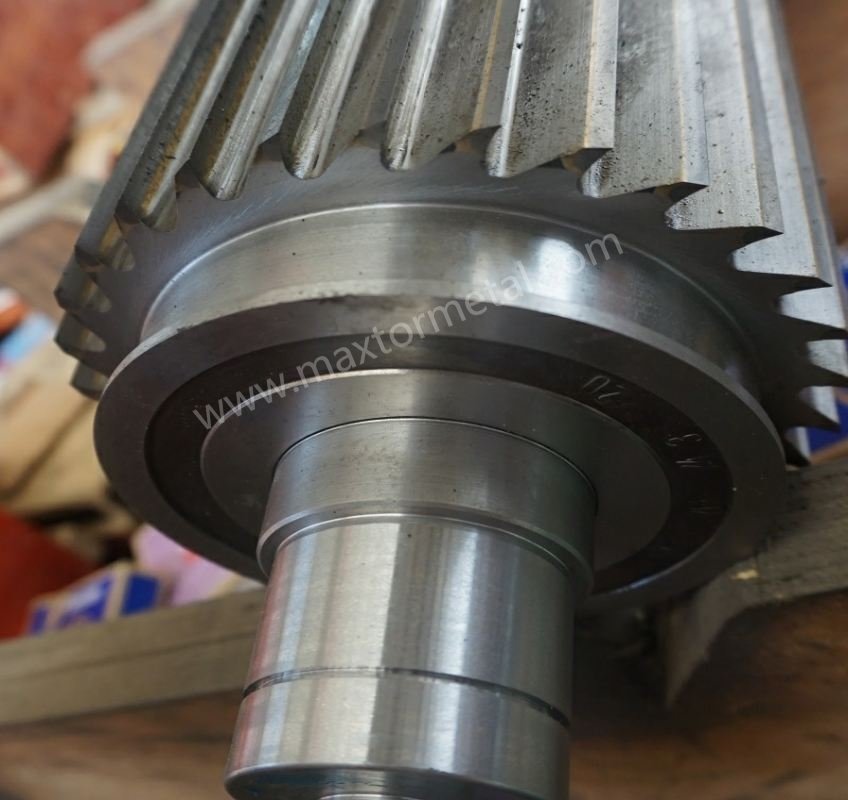
- जर्नल की क्षति: बेयरिंग फिट्स पर फ्रेटिंग, स्कोरिंग, और अंडाकारता; यह गर्मी, कंपन और अस्थिर नाइफ गैप का कारण बनता है।.
- रनआउट वृद्धि: शाफ्ट का मुड़ना, सीट की क्षति, या असेंबली त्रुटियां जो घूर्णन के माध्यम से एक बदलते प्रभावी अंतर को उत्पन्न करती हैं।.
- घर्षक कार्य त्वरण: हाई-फिल, ग्लास-फाइबर और रीसायकल की गई सामग्री घिसाव दर को बढ़ाती है और मार्जिनल फिनिश को जल्दी विफल कर देती है।.
मेट्रोलॉजी बेसलाइन और NDT
किसी भी धातु को हटाने से पहले, आपको एक ऐसी बेसलाइन की आवश्यकता होती है जो आपको “ऐसे घिसाव जिसे ग्राइंड करके निकाला जा सकता है” को “ऐसे नुकसान जिसके लिए मरम्मत की आवश्यकता है” से अलग करने में मदद करे। एक अच्छे इनकमिंग निरीक्षण में निम्नलिखित शामिल होना चाहिए:
- Dimensional baseline: critical diameters, shoulder locations, keyways, and any rotor-specific features.
- Runout checks: measure total indicated runout (TIR) at key journals and reference faces with a dial test indicator (DTI), recorded at multiple clock positions.
- Surface condition capture: photographs plus written notes for scoring, pitting, corrosion, and fretting.
For severe wear or abnormal vibration history, add NDT where appropriate:
- Magnetic particle inspection (MPI) for ferromagnetic rotors to find surface-connected cracks.
- Dye penetrant inspection (DPI) where MPI isn’t applicable.
The goal is simple: if the rotor has cracking or heat-checking in stressed areas, a “regrind only” job is the wrong scope.
Impact on pellet quality and uptime
Mechanically, the rotor affects cut quality through two levers:
- ज्यामिति: tooth profile and edge condition determine whether strands are sheared cleanly or smeared/teased.
- स्थिरता: journals, seats, and balance determine whether the set knife gap stays consistent under load.
When these drift, you typically see:
- rising tails and fines at constant throughput,
- more frequent gap resets,
- bearing temperature rise and vibration alarms,
- unplanned stoppages for cleaning fines, swapping knives, or investigating noise.
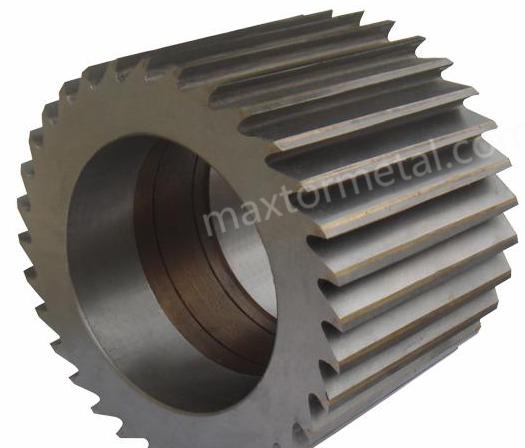
पेलेटाइज़र रोटर रीफर्बिशमेंट

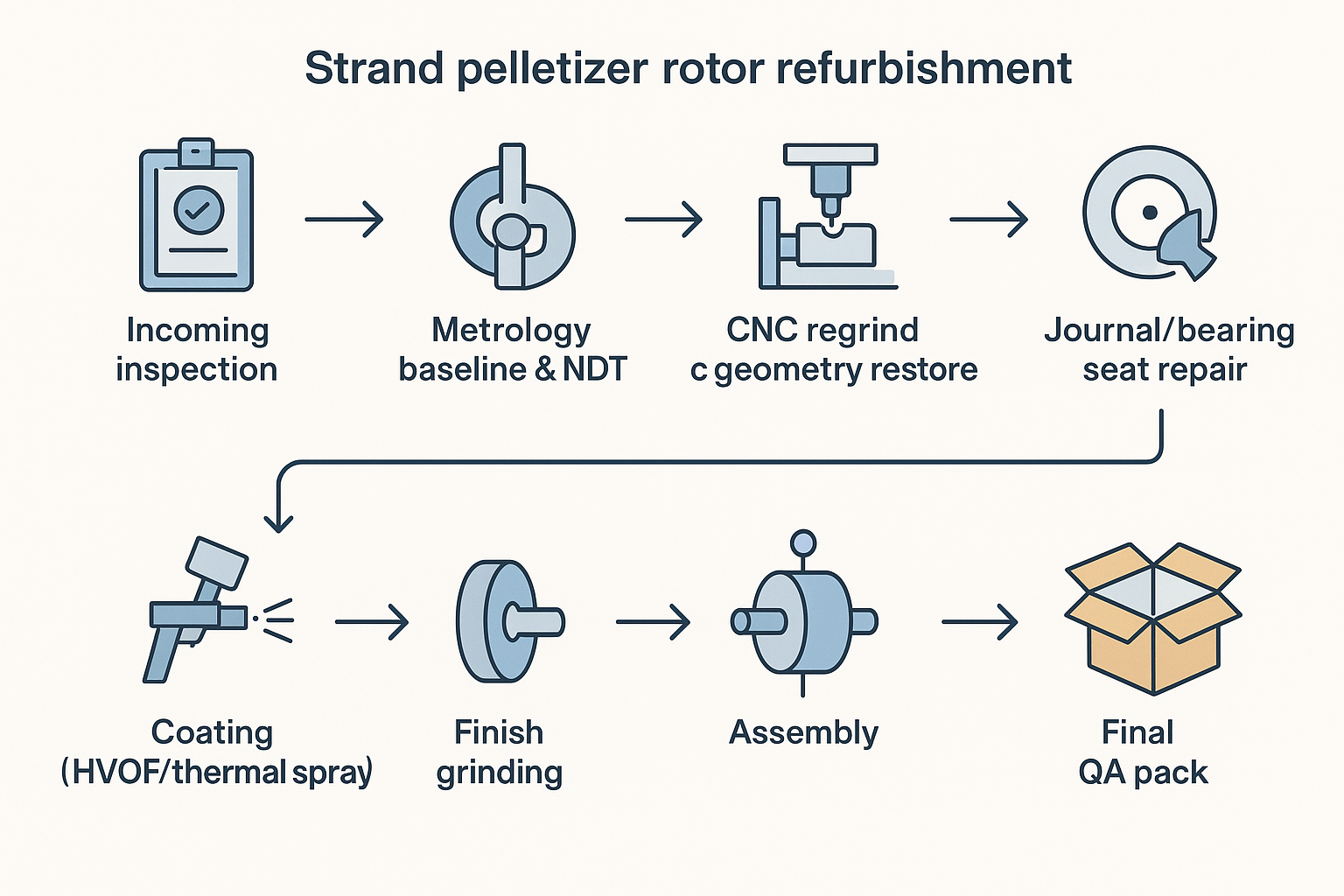
CNC regrind and geometry restore
A controlled regrind is about restoring geometry, not just “making it sharp”. Best practice is to treat tooth profile, helix angle (where relevant), and relief geometry as controlled characteristics.
Process controls that reduce rework:
- Confirm the reference datums used to set the rotor for grinding (and keep them consistent across future regrinds).
- Restore the intended cutting geometry (primary/secondary reliefs where used) so the edge shears rather than rubs.
- Define regrind limits upfront so you don’t drift into an under-strength tooth form over multiple cycles.
Journal and bearing seat repair
If journals or bearing seats show scoring, ovality, fretting, or loss of fit, grinding alone may not recover the functional condition.
Typical controlled options include:
- Build-up and regrind: apply a suitable build-up process, then grind back to dimension.
- Sleeving: where design allows, recover a damaged seat with a sleeve solution, then finish-grind.
Whichever method is chosen, the acceptance requirement should be written as verifiable measurements:
- diameters and form checks at multiple axial positions,
- runout at the journals relative to the rotor’s functional datum,
- surface finish verified by a measured Ra value, not “looks smooth”.
Coatings, finish grinding, assembly
Coatings can extend life in abrasive duty, but only when they’re treated as an engineered layer with controlled prep, thickness, and post-grind condition.
A robust sequence typically looks like:
- prep and mask critical fits,
- apply the specified coating (where used),
- finish grind to final geometry and finish,
- assemble with controlled torque and cleanliness, then balance.
स्वीकृति सहनशीलता और QA
Example: what a “good” QA + balancing pack looks like
To make refurbishment repeatable across vendors, ask for a pack that is auditable (what was measured, with what instrument, and against which standard). Below is an example structure you can adapt—values are illustrative fields only and should be filled with your OEM targets.
A) Incoming (as-found) inspection report
- Rotor ID/serial, date received, photos (damage and contact patterns)
- Datum scheme used for setup (named reference faces/centres)
- Key dimensions and fits (diameter, roundness, cylindricity if specified)
- Runout/TIR results by location (DTI setup described; readings by clock position)
- NDT record where used (MPI/DPI method, acceptance criteria, inspector/contractor)
B) Repair route statement
- Scope: regrind-only vs repair + regrind vs coating route
- Areas repaired (journals, seats, tooth form), method used (build-up, sleeve, etc.)
- Heat-treatment/coating details if applicable (process name, thickness target, masking)
C) Final (as-left) dimensional & finish report
- Dimensions and tolerance status vs OEM drawing or agreed control plan
- Runout/TIR results after final grind
- Surface finish (Ra) readings at bearing journals/seats and reference faces
- Measuring instruments used + calibration ID/expiry (traceability)
D) Dynamic balancing record
- Standard referenced: ISO 21940 (specify the relevant part, e.g., ISO 21940-11 for rigid rotors)
- Service speed (rpm) used for tolerance calculation
- Acceptance target/grade agreed for your machine duty
- Correction method and plane(s)
- Before/after readings and final residual unbalance
- Balancing machine ID + calibration/verification evidence
E) Packaging and transport protection
- Journal/edge protection method (caps, corrosion inhibitor, handling notes)
- Shipping orientation and lift points
Geometry and surface finish
The safest way to specify pelletizer rotor tolerances—without pretending there is one universal number—is to:
- Require OEM drawing compliance where you have drawings, and
- Define a measurement method and report format where you don’t.
At minimum, the QA pack should include:
- critical diameters and positions (with instrument type and calibration status),
- runout results at specified locations (DTI setup described),
- tooth geometry verification (what was measured and how),
- surface finish readings for bearing journals/seats and any ground faces.
प्रो टिप: If your site regularly regrinds the same rotor family, standardise a single inspection sheet with named datums and measurement points. It makes supplier comparisons meaningful.
Hardness and coating verification
For refurbished components, hardness and coating checks are less about marketing and more about risk control.
Specify what “verification” means:
- कठोरता: method (e.g., Rockwell), test locations, and reporting format.
- कलई करना (if used): thickness measurement method, post-grind finish requirement, and any adhesion or porosity test evidence the supplier can provide.
If you cannot justify a coating spec with your duty conditions, keep the requirement simple: correct geometry, stable fit, and documented inspection.
Dynamic balancing (ISO 21940)
After repair and finish grinding, balancing is a functional requirement—not a nice-to-have. Any mass change, build-up repair, or coating can shift unbalance.
Write the acceptance as deliverables:
- a balancing report that references ISO 21940 (rigid-rotor balancing) and records:
- service speed (rpm) used for tolerance calculation,
- balance grade or acceptance target agreed for your machine duty,
- correction method and final residual unbalance,
- before/after readings and instrument traceability.
If a supplier can’t provide a coherent balancing record, you’re effectively guessing whether vibration issues are “on the rotor” or “on the line”.
खरीद और अनुपालन
Documentation and traceability pack
For UK processors, procurement is often where refurbishment quality is won or lost. If you can’t audit what was done, you can’t repeat it.
Ask for a traceability pack that includes:
- incoming inspection report (as-found condition),
- repair route statement (what was done, which areas, and why),
- final dimensional and runout report,
- hardness and coating verification (where applicable),
- dynamic balancing record,
- serialisation/ID so the pack clearly maps to आपका rotor.
Where maintenance activities involve access to rotating hazards, align your own procedures with PUWER Regulation 11 (dangerous parts) and your site’s guarding/isolation controls.
PO specs and first-article acceptance
Copy/paste: refurbishment service PO clauses (example)
Use the clauses below as a starting point and replace placeholders with your OEM drawing and site requirements.
- दायरा: Supplier shall perform rotor refurbishment per agreed route: (a) regrind-only / (b) repair + regrind / (c) coating route + finish grind. Any deviation requires written approval.
- Datums & repeatability: Supplier shall state the setup datum scheme used for grinding and inspection and keep it consistent for future cycles.
- As-found + as-left reporting (mandatory): Provide incoming (as-found) and final (as-left) inspection reports covering all critical diameters/locations, plus runout/TIR at specified journals and reference faces.
- Surface finish: Provide measured Ra values at bearing journals/seats and any specified ground faces, including instrument type and calibration traceability.
- NDT (when required): If severe wear, abnormal vibration history, or visual indications exist, perform MPI (or DPI where applicable) and report method, acceptance criteria, and inspector/contractor.
- Balancing record: Provide a dynamic balancing report referencing ISO 21940 and citing the relevant part (e.g., ISO 21940-11 for rigid-rotor procedures/tolerances). Report shall include service speed (rpm), acceptance target/grade, correction plane(s)/method, before/after readings, final residual unbalance, and balancing machine ID with calibration/verification evidence.
- Traceability: Rotor ID/serialisation must appear on all reports. Report pack must map unambiguously to the shipped rotor.
- Protection & packaging: Journals and cutting edges shall be protected (caps/guards + corrosion control) and packaged to prevent impact damage in transit.
- Nonconformance handling: Any out-of-tolerance characteristic must be highlighted with proposed corrective action and a disposition request before shipment.
- Deliverables: Supplier shall provide a single PDF “QA pack” containing all reports, photos, and certificates; shipment is not considered complete without the QA pack.
A practical PO spec should be short, measurable, and hard to misread. Include:
- scope (regrind only vs repair + regrind vs coating route),
- required inspection gates (as-found + as-left),
- report deliverables (dimensions, runout, hardness/coating, balancing),
- packaging and protection requirements for journals and edges.
For first-article acceptance (new vendor or new repair route), define a test plan:
- baseline vibration and cut-quality data before change,
- controlled run-in after install,
- pass/fail criteria for pellet length spread and fines (using आपका sampling method).
If you need a broader reference on how knife gap and QA packs affect water‑strand cut quality, MAXTOR METAL’s रोटरी कटर: वाटर-स्ट्रैंड पेलेटाइजिंग के लिए अल्टीमेट गाइड is useful background reading.
Vendor selection checklist
Use this as a due-diligence checklist when comparing vendors:
- Can they explain and document their datum strategy for grinding (repeatability across regrinds)?
- Do they provide an as-found और as-left measurement report (not just a delivery note)?
- Do they have an NDT option for severe wear cases (and can they show when they use it)?
- Can they supply a balancing report that references ISO 21940 and shows before/after results?
- Do they protect journals and edges in transit (caps, corrosion control, handling instructions)?
- Do they define regrind limits and communicate remaining life?
- Can they support a first-article acceptance run with a clear sign-off pack?
MAXTOR METAL offers fit‑to‑drawing blades and QC traceability documentation.
संचालन और रखरखाव
Setup, gap setting, run-in
Even a perfect refurbishment can be undone by a poor restart. Treat setup as a controlled change, and protect knife gap consistency as a controlled characteristic:
- Isolate and verify zero energy before any manual checks; use your site’s PUWER-aligned procedures.
- Set knife gap using your OEM method; verify at multiple points across the width and through a full rotation.
- Run in at conservative conditions first, then ramp while monitoring vibration and cut quality.
Monitoring wear and powder rate
Wear monitoring should be KPI-led:
- Track fines/powder rate and tails as an early warning.
- Record vibration and bearing temperature trends; step changes often correlate with fit loss or balance shift.
- Correlate quality changes to time since last regrind, not just calendar time.
Regrind limits and service intervals
Define limits so decisions are made before quality collapses:
- maximum allowed regrinds before geometry drift becomes unacceptable,
- minimum remaining tooth form (or a go/no-go gauge approach),
- journal condition thresholds that trigger repair rather than “another light grind”.
A simple rule helps: if you’re compensating with tighter and tighter gap settings to hold pellet quality, you’re already consuming safety margin.
निष्कर्ष
संदर्भ और मानक जांच
- आईएसओ. ISO 21940-11:2016 Mechanical vibration — Rotor balancing — Part 11: Procedures and tolerances for rotors with rigid behaviour. https://www.iso.org/standard/54074.html
- आईएसओ. ISO 21940-12:2016 Mechanical vibration — Rotor balancing — Part 12: Procedures and tolerances for rotors with flexible behaviour. https://www.iso.org/standard/50429.html
- HSE (UK). PUWER overview. https://www.hse.gov.uk/work-equipment-machinery/puwer-overview.htm
- UK Legislation. PUWER Regulation 11: Dangerous parts of machinery. https://www.legislation.gov.uk/uksi/1998/2306/regulation/11
- Plastics Technology. Solve Seven Common Pelletizing Problems (2012). https://www.ptonline.com/articles/solve-seven-common-pelletizing-problems
- ASTM. ASTM D1921: Standard Test Methods for Particle Size (Sieve Analysis) of Plastic Materials. https://www.astm.org/d1921-18.html
- आईएसओ. ISO 12100:2010 Safety of machinery — General principles for design — Risk assessment and risk reduction. https://www.iso.org/standard/51528.html
- आईएसओ. ISO 14120:2015 Safety of machinery — Guards — General requirements for the design and construction of fixed and movable guards. https://www.iso.org/obp/ui/
- OSHA. 29 CFR 1910.212 General requirements for all machines (machine guarding). http://www.osha.gov/laws-regs/regulations/standardnumber/1910/1910.212
Standards checked on: 2026-03-29.
The quickest way to stabilise cut quality and reduce cost/tonne is to stop treating rotor refurbishment as a black box. Lock down a small set of acceptance numbers and records: geometry and runout checks, surface finish evidence at functional fits, coating verification where used, and a balancing report that makes ISO 21940 more than a name on an invoice.
Next steps: formalise your PO tolerances, standardise the data pack you require, and run a controlled first-article trial with sign-off criteria you can repeat.

 English
  Spanish
  Italian
  French
  Portuguese
  Russian
  German
  Arabic
  Hindi
Hindi  Vietnamese
  Indonesian
  Japanese
  Korean