

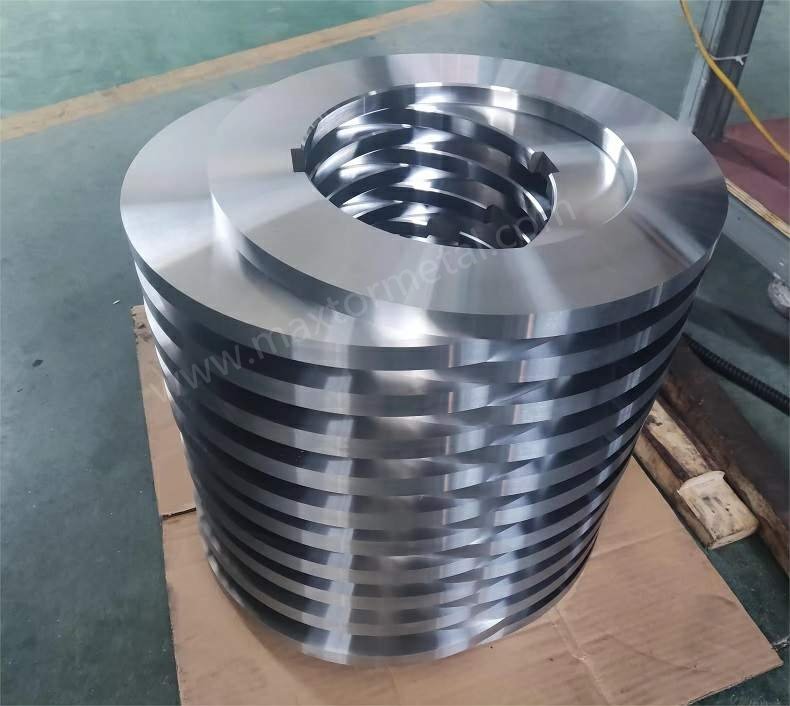
Dalam pemrosesan kumparan logam secara kontinu, mencapai tepi potongan yang bersih, siku, dan bebas dari geram (burr-free) adalah tolok ukur utama dari lini slitting yang terkalibrasi dengan baik. Di balik setiap proses slitting ber-yield tinggi terdapat dua parameter geometris kritis yang mengatur kualitas pemotongan geser: celah samping horizontal (horizontal side clearance) dan overlap pisau rotari vertikal. Sementara celah horizontal menentukan konsentrasi tegangan di seluruh lebar strip, overlap pisau vertikal menentukan kedalaman penetrasi pisau yang tepat yang diperlukan untuk memindahkan logam secara bersih dari deformasi plastis ke fraktur yang terkontrol.
Signifikansi operasional dari overlap pisau rotari sangatlah vital. Mengatur overlap vertikal yang tepat akan meminimalkan tinggi geram (burr), menjaga geometri tepi potongan, dan memperpanjang masa pakai pisau secara drastis. Sebaliknya, pengaturan overlap yang salah menyebabkan tepi koyak, pembentukan geram berlebih, pisau gompal (chipping) prematur, timbulnya skrap, และ downtime lini produksi yang mahal.
Bagi supervisor lini slitting kumparan, insinyur proses, dan manajer pabrik, menguasai kalibrasi overlap sangat penting untuk mempertahankan toleransi tepi yang ketat. Operator peralatan dapat mengeliminasi spekulasi, melindungi stok kumparan bernilai tinggi, และ mencapai kualitas tepi yang konsisten serta dapat diulang di berbagai grade material dengan menerapkan protokol penyesuaian dinamis berbasis material bersama dengan perkakas gerinda presisi.
Maxtor Metal designs and manufactures rotary slitting knives and arbor spacers to the dimensional tolerances this guide describes — including OD concentricity, face flatness, and hardness consistency across a full knife set — so that overlap settings made on paper translate directly to stable cut behavior on the line.
What this guide covers
Referensi teknis dan pengaturan untuk overlap pisau rotari vertikal pada lini slitting kumparan: mengapa kedalaman penetrasi mengontrol inisiasi fraktur, bagaimana overlap berinteraksi dengan celah horizontal untuk menentukan rasio zona kilap/patah (burnish/break ratio), jendela awal khusus material untuk baja karbon, AHSS, aluminium, dan stainless steel, serta bagaimana sistem pemosisian arbor otomatis mempertahankan — atau kehilangan — pengaturan overlap yang stabil selama proses produksi.
Untuk siapa buku panduan ini ditujukan
Insinyur proses yang mengatur atau mengaudit overlap untuk grade atau ketebalan material baru; tim pemeliharaan (maintenance) yang memecahkan masalah geram tepi dan keausan pisau yang terkait dengan kesalahan penetrasi; operator peralatan yang mengkalibrasi sistem pemosisian arbor otomatis setelah proses gerinda ulang (regrind); serta tim pengadaan kỹ thuật yang mengevaluasi spesifikasi dimensi pisau yang memengaruhi stabilitas overlap.
Cara menggunakannya pada lini produksi yang sedang berjalan: Mulai dengan tabel overlap khusus material sebagai acuan dasar → Verifikasi penjajaran arbor dan diameter luar (OD) pisau sebelum menyesuaikan penetrasi → Lakukan satu perubahan pada satu waktu dan jalankan strip verifikasi pendek → Catat hasilnya terhadap batas toleransi geram (burr) sebelum ditingkatkan ke kecepatan produksi.
Metrik utama yang harus dipantau
Tinggi gerigi as % of strip thickness at steady-state production speed · Burnish/break ratio on the cut face (target ~1:2 to 1:3 for standard carbon steel) · Knife OD after each regrind (to recalculate required arbor height correction) · Edge condition at 30–50× after changeover and after speed ramp
Poin Penting: Pergeseran overlap hampir selalu merupakan masalah dimensi — perubahan OD pisau setelah gerinda ulang (regrind), keausan spacer, atau lenturan arbor — bukan kegagalan sistem kontrol. Perbaiki dimensinya, bukan kenopnya.
Sains di Balik Overlap Pisau Rotari

Rotary knife overlap (frequently termed penetration or vertical entry) is defined as the vertical distance that the outer periphery of the upper circular slitting blade extends below the top tangent line of the lower circular slitting blade. It represents the physical vertical engagement between opposing knife edges on the slitting arbor.
It is vital to distinguish vertical overlap from horizontal side clearance:
- Vertical Overlap: Controls the depth of initial knife entry into the strip and influences the point along the cut line where internal tensile stress exceeds the material’s ultimate shear strength.
- Horizontal Side Clearance: Refers to the lateral gap between the cutting faces of the upper and lower blades, which directs the angle and propagation path of the shear fracture.
Poin Penting: Vertical overlap controls how deeply the rotary knives penetrate the metal strip before fracture occurs, while horizontal side clearance directs the angle of propagation. Both parameters must work in tandem to establish a clean edge.
The fundamental governing principle for setting vertical overlap is the minimum overlap for a stable cut rule. The optimal vertical overlap is the smallest penetration depth that produces a complete, continuous fracture across the full length and width of the coil without leaving uncut strands or slivers.
As a baseline reference across standard light-to-medium gauge carbon steels, vertical overlap typically falls within a window equal to 5% to 15% of the strip thickness. However, this baseline must be dynamically adjusted depending on material ductiled tensile strength, strip gauge, and arbor rigidity.
The Consequences of Incorrect Overlap
Deviating from the optimal overlap window compromises edge geometry and accelerates mechanical wear on slitting arbors and tooling.
1. Under-Overlap (Insufficient Penetration)
When the upper knife does not penetrate deeply enough below the lower knife tangent plane:
- Incomplete Separation: The metal strip fails to fracture completely, leading to uncut sections or persistent web strands that jam downstream coiling equipment.
- Ragged and Torn Edges: Instead of a clean fracture, the metal undergoes excessive tensile stretching, resulting in torn, jagged edge profiles with heavy hanging burrs.
- Slivers and Debris: Incomplete shearing creates fine metallic slivers and wire-like burrs that contaminate strip surfaces and damage tension stand rolls.
For a complete root-cause diagnostic framework — covering clearance, knife condition, alignment, and tension as the full variable set — see the Pengurangan Burr Slitting: Matriks Akar Penyebab, Jendela Setup & Protokol Inspeksi.
2. Over-Overlap (Excessive Penetration)
When the upper knife penetrates too deeply into the lower knife plane:
- Increased Friction and Heat: Excessive blade engagement creates severe friction along the knife side faces, causing thermal expansion, localized overheating, and loss of edge hardness.
- Edge Galling and Chipping: Heavy vertical loading forces metal against the blade side walls, causing material pickup (galling) on aluminum or stainless coils and micro-chipping along the knife cutting edge.
- Metal Dust Formation: Deep penetration grinds the sheared edge, creating fine iron powder or metal dust that accumulates in arbor bearings and optical line sensors.
- Accelerated Tool Wear: Excessive overlap forces the knives to perform unnecessary sliding work, shortening regrind intervals by up to 50%.
Coordinating Overlap with Horizontal Clearance
Vertical overlap cannot be adjusted in isolation. Shear cutting relies on a balanced two-stage fracture mechanism:
- Plastic Deformation (Burnish/Shear Band): The knives penetrate the upper and lower surfaces of the strip, creating a smooth, shiny burnished band that typically accounts for the upper 20% to 35% of strip thickness.
- Brittle Fracture (Break Band): As vertical penetration reaches the critical strain threshold, cracks initiate from opposing knife tips and meet in the middle, creating a matte fracture zone that covers the remaining 65% to 80% of strip thickness.
To maintain a clean edge profile (with a burnish-to-fracture ratio of roughly 1:2 or 1:3), vertical overlap and horizontal clearance must be balanced simultaneously. If horizontal clearance is widened for a harder material, vertical overlap must often be reduced slightly to prevent excessive bending moments across the shear zone.
That burnish-to-fracture split is not a universal constant—it shifts sharply with material behavior, and reading it correctly is one of the fastest ways to judge whether a cut is running properly. In Advanced High-Strength Steel (AHSS), high yield strength drives crack initiation almost the moment the blade engages, so the burnish zone can collapse to under 10% of strip thickness and the edge is dominated by a brittle break band. Mild carbon steel sits in the middle, producing the familiar burnish band of roughly 20% to 35%. Soft aluminum alloys, with their high elongation and ductility, resist fracture far longer, yielding a noticeably thicker burnish band and a smaller fracture zone. This matters for edge specifications: a thick, shiny burnish zone points to excessive plastic deformation (deep penetration, or too-tight clearance), while a nearly absent burnish band suggests the material is fracturing almost instantly—expected in AHSS, but a red flag if it appears on a ductile grade.
This balance is echoed in published tooling practice. The setup method described in U.S. Patent US4680851A, for example, states that knife clearance should approximate 10% of strip gauge for hard temper dan 5% for soft temper—a direct illustration of how clearance must track material condition rather than follow a single fixed figure. Industry process references such as IspatGuru similarly note that knife horizontal clearance and vertical overlap are both critical to slit quality, warning that a large horizontal clearance can cause excessive edge roll-over and burr, while an excessively tight clearance risks premature knife wear or damage.
Furthermore, knife calibration is not a one-time setup. Both vertical overlap and horizontal clearance must be re-calculated and verified whenever:
- Knives are reground or replaced (accounting for blade outer diameter reduction).
- Stripper rings or arbor spacers are changed.
- The processing line shifts to a new coil thickness, temper, or material grade.
Panduan Overlap Khusus Berdasarkan Material
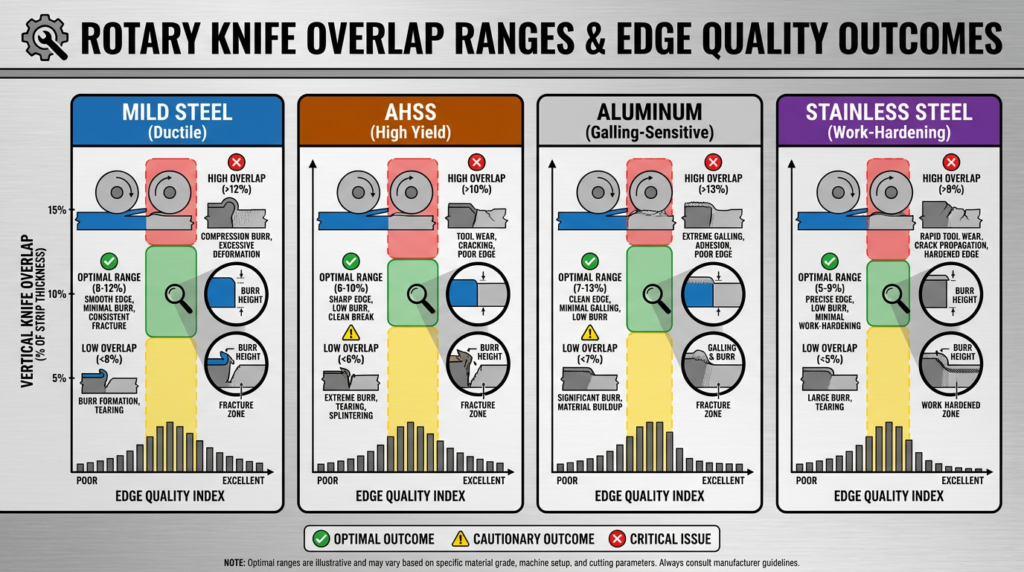
A common pitfall in coil slitting operations is applying a fixed percentage rule across all metal grades. Material behavior during shear cutting varies dramatically based on yield strength, tensile strength, strain hardening exponent, ductility, and surface coating.
Advanced materials demand tighter operational windows:
- Advanced High-Strength Steels (AHSS): High yield strength means crack initiation occurs almost immediately upon blade entry. Excessive overlap causes severe shock loading and knife edge breakdown.
- Coating-Sensitive Aluminum: Soft, ductile aluminum alloys possess high elongation properties and stickiness, making them prone to edge rollover and side-face galling if vertical entry is even slightly excessive.
Recommended Overlap Ranges by Material
The table below outlines baseline vertical overlap parameters, horizontal clearances, and characteristic edge outcomes across primary industrial coil alloys:
| Material Family | Typical Yield Strength | Recommended Vertical Overlap (% of Strip Thickness) | Recommended Horizontal Clearance (% per side) | Edge Quality & Process Behavior |
|---|---|---|---|---|
| Mild Carbon Steel (CR4, DD11, A36) | 180 – 350 MPa | 10% – 15% (Light gauge)5% – 10% (Heavy gauge) | 8% – 10% | Broad processing window; smooth shear band; low sensitivity to minor setting drift. |
| Advanced High-Strength Steel (DP600, DP1000, TRIP) | 600 – 1200+ MPa | 3% – 8% | 12% – 18% | Extremely narrow window; brittle fracture occurs rapidly; requires reduced overlap to prevent blade micro-chipping. |
| Aluminum Alloys (3000, 5000, 6000 Series) | 100 – 300 MPa | 5% – 10% | 5% – 7% | High risk of edge burrs and pickup; minimal overlap required; demands highly polished knife faces. |
| Stainless Steel (304, 316, 430 Series) | 250 – 600 MPa | 8% – 12% | 10% – 15% | High work-hardening rate; requires precise penetration to snap the edge cleanly without dragging or work-hardening burrs. |
A general rule of thumb applies to strip thickness: thinner, ductile metals require a higher percentage of vertical overlap to initiate crack propagation, whereas thicker, high-strength metals require significantly less vertical overlap because the material fractures under lighter entry depths.
These process margins are framed by internationally recognized product standards. Slit width tolerances and edge classifications are governed by specifications such as ASTM A568/A568M dan ASTM A109/A109M (which define edge conditions including No. 3 slit edge), while ASTM A480/A480M covers edge conditions for stainless steel and ISO 9445-2 sets dimensional and form tolerances for slit cold-rolled stainless strip. Note that the term “burr” is formally defined in ASTM A623 as metal displaced beyond the surface plane by slitting or shearing. Clearance and overlap values themselves are not fixed by a single mandatory standard; they remain process-setting recommendations that must be tuned within the dimensional windows those standards define.
Precision Tooling for Stable Overlap
Holding vertical overlap tolerances across a multi-knife arbor—sometimes carrying 20 to 50 individual slitting heads—requires sub-micron mechanical accuracy. If individual rotary knives vary in outer diameter, or if spacers suffer from axial thickness variation, vertical overlap will wobble across the arbor width. A variation of just 0.01 mm in knife radius translates directly to a 0.01 mm error in vertical penetration.
To eliminate overlap drift across the arbor:
- Rotary slitting knives must be manufactured from high-purity alloy steels refined through Electroslag Remelting (ESR), such as AISI D2 (1.2379), H13 (1.2344), High-Speed Steel (M2/1.3343), or Powder Metallurgy (PM) steels. ESR processing eliminates primary eutectic carbide segregation (M₇C₃ and VC monocarbides), ensuring uniform toughness and edge wear resistance.
- Outer diameters and bore concentricity must be precision-ground to within ±0.001 mm tolerances.
- Precision arbor spacers must maintain strict parallelism to prevent cumulative axial runout and angular deflection under shear load.
For spacer tolerance specifications, face flatness targets, and rubber ring compression standards that directly affect axial runout and overlap stability, see the precision slitting spacers and rubber rings guide. For the stack-up arithmetic showing how knife OD variation and spacer thickness errors accumulate into width deviation across a full arbor — including TIR target bands and worst-case vs RSS models — see Runout Aksial Slitter Rotari: Kalkulasi Stack-Up, Target TIR & Kontrol Lebar.
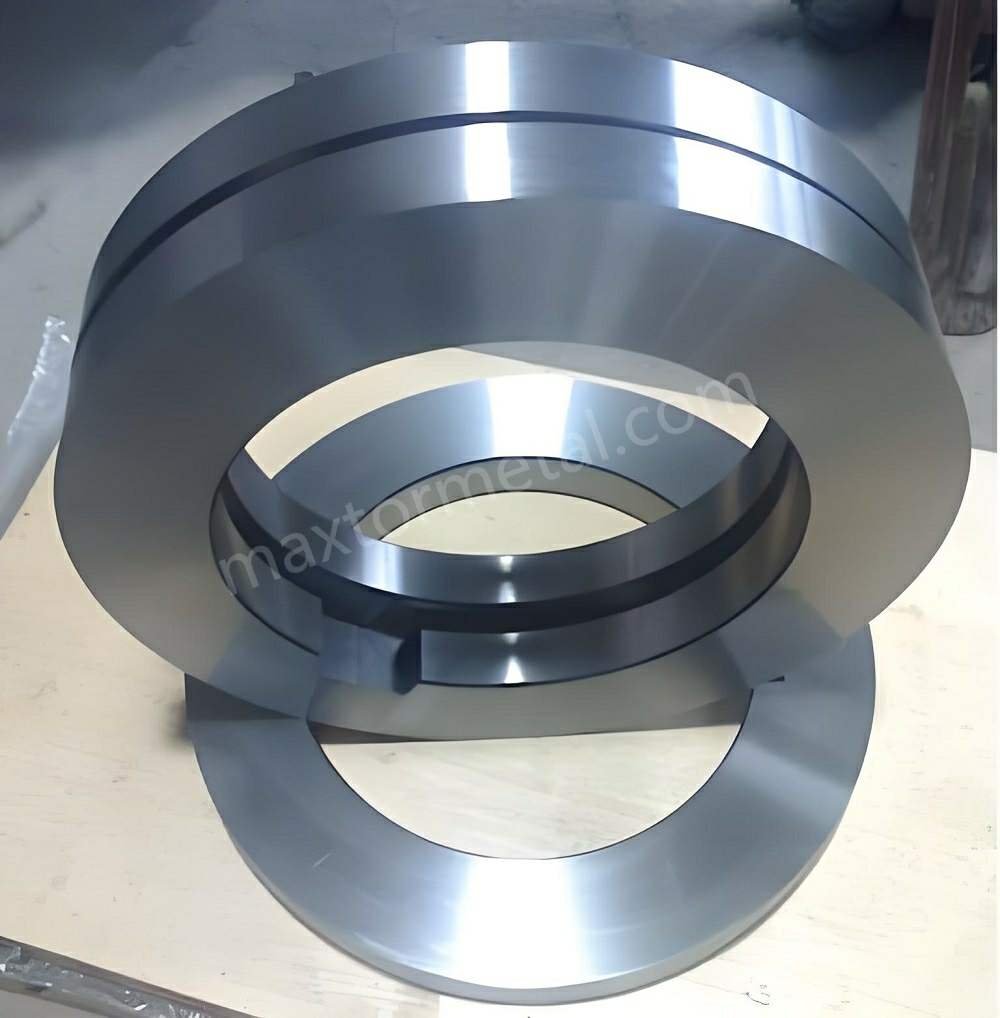
High-precision tooling solutions manufactured by Maxtor Metal, including custom-ground rotary slitting knives and hardened spacers, ensure uniform vertical overlap settings across every cut pocket. Their material selection expertise and strict thermal treatment controls help extend blade working life, maintain consistent edge burr standards, and minimize planned line stops.
Maxtor Metal’s approach to overlap stability rests on four levers that buyers can specify and verify during procurement:
- Material grade matched to the cut, not the catalog. Blade steel is selected against the target coil—carbon steel, AHSS, aluminum, or stainless—so that hardness and wear resistance suit the actual shear load rather than a generic default.
- Controlled heat treatment for uniform hardness. Consistent austenitizing, quenching, and tempering cycles reduce soft spots and patchy hardness that would otherwise make one knife wear faster than its neighbors on the same arbor.
- Precision grinding of OD, bore, and faces. Holding outer diameter, bore concentricity, and side-face flatness to tight tolerances keeps every knife in a multi-head arbor contributing the same effective penetration.
- Dimensional verification as a deliverable. Because overlap drift is ultimately caused by dimensional variation, inspection of critical dimensions before shipment lets the customer confirm that a new knife set will interface with their existing spacers and arbors without introducing overlap error.
This is the practical link between tooling quality and edge quality: because a variation of just 0.01 mm in knife radius becomes a 0.01 mm error in vertical penetration, controlling knife and spacer dimensions upstream is what allows the downstream overlap setting to remain stable.
Penyesuaian Overlap Dinamis pada Lini Slitting Modern
Traditional slitting lines relied on manual handwheel adjustments and mechanical feeler gauges to set upper arbor heights. On modern, high-speed automated slitting lines, manual adjustments have been replaced by motorized upper arbor actuators integrated with digital recipe controls.
Automated upper arbor positioning systems dynamically reposition the upper slitting arbor relative to the fixed lower arbor based on pre-programmed material recipes. Key features of dynamic overlap control include:
- Closed-Loop Linear Encoder Feedback: Optical or magnetic encoders continuously monitor the vertical position of the arbor bearing blocks with positioning accuracy down to 0.002 mm.
- HMI Recipe Control: Equipment operators select the material grade, thickness, coil width, and knife outer diameter on the Human-Machine Interface (HMI). The control system automatically calculates and sets the required vertical penetration.
- Kompensasi Defleksi: Advanced controls automatically increase vertical penetration slightly toward the center of wide arbors to offset mechanical arbor flexing under heavy shear loads.
Kiat Profesional: Always log reground knife outer diameters into your HMI control system. Failing to update the blade radius parameter after regrinding will cause automated positioning systems to under-penetrate the coil, resulting in severe edge burrs.
A practical note on tooling compatibility with automated systems: closed-loop positioning accuracy is only as good as the dimensional consistency of the knives and spacers it is positioning. If knife OD varies across a set, or if spacer face thickness is not held to a tight tolerance, the encoder will report the commanded position accurately — but the actual penetration at each cut pocket will still drift. Maxtor Metal‘s dimensional inspection protocol includes OD verification of every knife in a set and face parallelism checks on spacers before shipment, so that the physical stack matches the recipe input your HMI is working from.
Setup Best Practices for Consistent Edge Quality
To achieve consistent, burr-free edge quality run after run, slitting line crews should adhere to a structured setup protocol:
- Establish the Baseline Minimal Overlap: Begin setup with the conservative minimum overlap recommended for the material gauge. Increase penetration only until a complete, clean shear is achieved across all strip mults. In practice, “complete, continuous fracture” is a judgment you make from several signals together, not from the dial alone:
- No uncut strands. The most immediate check: run a short length and confirm the strip has fully separated across every mult, with no web strands or connected slivers bridging the cut. Even one surviving strand means penetration is still short of the minimum.
- Break-band meets mid-thickness. Examine the cut face: a correct cut shows opposing crack fronts from the top and bottom meeting near the strip’s mid-plane. Cracks that stall and leave a rough ridge low on the edge point to under-penetration.
- Confirm with a test strip. Untuk pemeriksaan fisik cepat, masukkan strip uji tipis atau gunakan feeler gauge untuk memverifikasi bahwa pisau benar-benar tumpang tindih (overlap), karena nilai pembacaan sistem dan keterlibatan pisau yang sebenarnya akan berbeda seiring menyusutnya OD pisau.
- Perhatikan rasio burnish-to-break. Pita burnish yang jauh di atas sekitar 35% dari ketebalan menandakan Anda telah melewati batas minimum; pita yang tetap tebal setelah peningkatan penetrasi berarti overlap tambahan tidak menghasilkan patahan (fracture).
- Verifikasi Penyelarasan dan Kesejajaran Arbor: Gunakan dial indicator untuk memverifikasi bahwa arbor atas dan bawah tetap sejajar sempurna di bawah beban penjepitan. Ketidakselarasan sudut (angular misalignment) menyebabkan overlap berlebih di satu sisi garis dan kurang overlap di sisi lainnya. Untuk prosedur verifikasi TIR yang terstruktur — mencakup pengaturan dial indicator, pemilihan kelas fit ISO, dan protokol penerimaan blue-check — lihat OCetak Biru Pisau Slitting EM: Audit Spindle Fit, Toleransi ISO & TIR Gates.
- Periksa Kembali Pengaturan Setelah Setiap Pergantian (Changeover): Jangan pernah mengasumsikan pengaturan sebelumnya berlaku untuk master coil baru. Bahkan variasi kecil dalam ketebalan koil (misalnya, dari 1.0 mm ke 1.15 mm) atau yield strength memerlukan evaluasi ulang pengaturan overlap dan clearance.
- Periksa Stripper Ring dan Bantalan Arbor: Pastikan kekerasan shore (shore hardness) dan diameter luar stripper ring karet sesuai dengan pengaturan pisau. Bantalan pendukung arbor yang aus memungkinkan pergerakan arbor selama akselerasi, menyebabkan overlap vertikal bergeser selama pengoperasian kecepatan tinggi.
- Lacak Tren Kualitas Hasil Potongan: Ukur tinggi burr secara teratur menggunakan komparator optik atau micrometer burr gauge. Peningkatan tinggi burr yang tiba-tiba menunjukkan tumpulnya tepi pisau atau pergeseran overlap vertikal yang disebabkan oleh ekspansi termal.
Catatan Lapangan: Urutan Pemecahan Masalah Langsung
Berdasarkan pengalaman selama 10 tahun dalam pemecahan masalah slitting koil di berbagai lini pemrosesan baja karbon, AHSS, stainless steel, dan aluminium, Jerry Chu, Spesialis Dukungan Teknis di Maxtor Metal, menawarkan urutan diagnostik yang telah teruji di lapangan berikut ini. Ketika operator melaporkan perubahan mendadak pada kualitas hasil potongan, jalur tercepat untuk menemukan akar masalah adalah dengan memeriksa variabel-variabel ini secara berurutan — alih-alih langsung menyetel handwheel overlap:
- Pisahkan gejala dari penyebabnya. Burr yang hanya muncul di satu sisi strip biasanya menunjukkan ketidakselarasan arbor (arbor misalignment) atau penumpukan spacer yang tidak rata, bukan kesalahan overlap global. Burr yang muncul di setiap mult menunjukkan adanya pergeseran pada parameter pengaturan bersama.
- Periksa kondisi pisau sebelum geometri. Tepi pisau yang tumpul atau mengalami micro-chipping meniru kondisi kurang overlap (under-overlap) dengan cara merobek alih-alih memotong (shearing) logam. Pastikan tepi pemotong dalam kondisi baik sebelum menyesuaikan penetrasi, jika tidak, Anda berisiko mengompensasi pisau yang aus dengan memaksakan overlap secara berlebihan.
- Verifikasi overlap yang sebenarnya, bukan pembacaan dial. Encoder dan handwheel melaporkan posisi yang diperintahkan, bukan keterlibatan pisau yang sebenarnya. Setelah setiap pengasahan ulang (regrind), konfirmasikan penetrasi nyata dengan feeler gauge atau strip uji tipis, karena nilai pembacaan dan realitas akan berbeda seiring menyusutnya OD pisau.
- Perhatikan debu dan serpihan logam, bukan hanya bagian tepi potongan. Debu logam dan serbuk besi halus yang menumpuk di sekitar bantalan arbor atau pada sensor lini adalah tanda nyata dari penetrasi berlebih (over-penetration) — pisau mengikis tepi potongan alih-alih mematahkannya dengan bersih. Serpihan logam atau burr seperti kawat yang menjuntai dari tepi strip menunjukkan hal sebaliknya: penetrasi yang tidak memadai membuat patahan tidak sempurna. Sisa pemotongan ini memberi tahu Anda ke arah mana pengaturan telah bergeser sebelum pengukuran tepi mendeteksinya.
- Lakukan kalibrasi ulang (re-baseline) setelah setiap perubahan material. Karena setiap kombinasi paduan (alloy), temper, dan ketebalan (gauge) menggeser ambang batas inisiasi retakan (crack-initiation threshold), overlap yang menghasilkan tepi bersih pada satu koil mungkin salah untuk koil berikutnya. Anggap pengaturan baik terakhir sebagai hipotesis awal, bukan jaminan.
Dampak Bisnis dari Overlap yang Dioptimalkan
Mengontrol overlap pisau putar (rotary knife) bukan sekadar latihan teknis—ini secara langsung mendorong indikator kinerja utama (KPI) dan profitabilitas operasional untuk pusat servis baja dan fabrikator logam.
Angka-angka di bawah ini mencerminkan hasil yang biasa diamati di area produksi, dipisahkan berdasarkan pendorong utama: kalibrasi overlap saja (berlaku untuk lini apa pun dengan pengaturan manual atau otomatis), dan sistem pemosisian otomatis (hanya berlaku untuk lini dengan kontrol arbor bermotor dan manajemen resep HMI). Peningkatan dari kedua pendorong ini akan berlipat ganda jika diterapkan bersama-sama.
Dari disiplin kalibrasi overlap (lini manual atau otomatis)
- Pengurangan Scrap Hingga 25%: Menghilangkan serpihan tepi, burr yang tebal, dan lebar potongan yang tidak sesuai spesifikasi mencegah seluruh mult koil ditolak di pabrik stamping pelanggan.
- Masa Pakai Perkakas yang Lebih Lama: Menghindari penetrasi berlebih mengurangi gesekan dan tekanan termal, memungkinkan pisau slitting berkualitas tinggi mencapai tonase hingga 40% lebih banyak di antara pengasahan ulang (regrind).
Dari sistem pemosisian arbor otomatis (lini bermotor dengan kontrol resep)
- Waktu Pergantian (Changeover) yang Lebih Singkat: Pemosisian overlap otomatis berbasis resep mengurangi waktu pengaturan dari 30 menit menjadi kurang dari 5 menit per pergantian koil.
- Yield First-Pass yang Lebih Tinggi: Overlap yang presisi mengeliminasi pemotongan uji coba trial-and-error, memungkinkan lini produksi langsung melaju ke kecepatan operasi penuh (hingga 300 m/min) dengan keyakinan penuh pada kualitas tepi potong.
Jika Anda sedang mengevaluasi apakah peningkatan material pisau dapat memperpanjang interval regrind dan meningkatkan stabilitas overlap, rotary slitter knife ROI guide menyediakan model biaya per ton untuk PM-HSS vs tool steel pada AHSS, stainless, dan aluminium.
Dalam model total cost of ownership (TCO) yang komprehensif, pengurangan tingkat scrap, downtime perawatan yang lebih rendah, dan masa pakai tooling yang lebih lama bekerja sama untuk menurunkan total biaya tooling per ton koil logam yang diproses.
Pertanyaan yang Sering Diajukan (FAQ)
T: Apa perbedaan antara overlap pisau dan celah horizontal (horizontal clearance) pada proses slitting?
J: Overlap pisau vertikal (atau penetrasi) adalah kedalaman vertikal pisau rotari atas yang melewati tepi atas pisau bawah. Celah horizontal adalah jarak samping antara permukaan pemotong pisau atas dan bawah. Overlap mengontrol kedalaman penetrasi awal bilah pisau, sedangkan celah horizontal menentukan sudut garis patahan (fracture line) pada logam.
T: Bagaimana cara menghitung overlap pisau rotari yang benar untuk slitting baja?
For standard carbon steels, a starting baseline for vertical overlap is 5% to 15% of the strip thickness. For thin gauges (under 1.0 mm), use 10% to 15% of strip thickness; for thicker gauges (over 3.0 mm), reduce overlap to 3% to 8%. Consistent with the minimum overlap for a stable cut rule defined in the Science section above, always use the smallest vertical overlap that still delivers a complete, continuous fracture across the full strip width — no uncut strands or slivers left behind.
T: Apa yang menyebabkan timbulnya geram (heavy burrs) yang parah pada tepi kumparan logam hasil slitting?
Heavy burrs are typically caused by either insufficient vertical overlap (which tears the metal rather than shearing it cleanly), excessive horizontal clearance, or dull knife cutting edges. If vertical penetration is too shallow, crack propagation fails to meet in the middle, leaving a raised metal ridge along the bottom edge.
T: Mengapa baja tahan regang tinggi (AHSS) memerlukan overlap yang lebih sedikit dibandingkan baja lunak (mild steel)?
J: AHSS memiliki kekuatan luluh (yield) dan tarik yang tinggi, yang berarti tegangan internal mencapai ambang batas patah hampir seketika saat pisau mulai memotong. Menerapkan overlap yang besar pada AHSS menyebabkan beban kejutan berlebihan, gumpil/gerpis (chipping) pada tepi pisau, dan pembentukan geram yang parah. AHSS membutuhkan overlap vertikal kecil yang dikombinasikan dengan celah horizontal yang lebih lebar.
T: Bagaimana proses gerinda ulang (regrinding) pisau memengaruhi pengaturan overlap vertikal?
J: Gerinda ulang mengurangi diameter luar (OD) pisau rotari slitting. Jika ketinggian arbor atas tidak disesuaikan ke bawah untuk mengompensasi radius pisau yang lebih kecil, penetrasi vertikal aktual ke dalam strip akan lebih sedikit dari yang diperkirakan. Operator peralatan harus memasukkan diameter pisau yang tepat setelah gerinda ulang ke dalam perangkat lunak pengaturan lini produksi atau menyesuaikan posisi arbor secara manual untuk mengembalikan overlap yang tepat.
T: Apakah overlap yang tidak tepat dapat menyebabkan pisau slitting gumpil (chip) atau patah?
J: Ya. Pengaturan overlap vertikal yang berlebihan memaksa permukaan samping pisau atas dan bawah saling bergesekan atau menjepit kuat strip logam. Ini menciptakan beban aksial yang tinggi dan tegangan termal, yang menyebabkan aus gesek (galling), micro-chipping pada tepi pisau, atau kerusakan pisau secara total — terutama saat memproses paduan keras atau baja tahan karat (stainless steel).
T: Apakah kecepatan lini slitting mengubah overlap pisau yang diperlukan?
J: Ya — kecepatan lini secara tidak langsung memengaruhi perilaku overlap. Seiring meningkatnya kecepatan, panas yang dihasilkan oleh gesekan di area pemotongan juga meningkat. Ekspansi termal tersebut mengubah hubungan efektif antara arbor atas dan bawah, sehingga pengaturan yang menghasilkan tepi bersih pada kecepatan rendah dapat bergeser ke arah penetrasi yang kurang atau berlebihan pada kecepatan tinggi. Inilah mengapa overlap harus diverifikasi pada atau mendekati kecepatan produksi aktual, bukan hanya saat pergerakan lambat (jog) atau pemasangan awal. Lini yang dilengkapi dengan kompensasi lenturan dan termal dapat mempertahankan overlap secara lebih konsisten di seluruh rentang kecepatan, tetapi lini manual harus memeriksa ulang kualitas tepi setelah mencapai kecepatan operasi stabil.
Kesimpulan
Overlap pisau rotari merupakan variabel mendasar dalam operasi slitting kumparan presisi. Jauh dari sekadar pengaturan statis, overlap vertikal adalah parameter dinamis yang memengaruhi secara langsung tinggi geram tepi pemotongan, geometri zona geser (shear band), tingkat keausan bilah pisau, dan hasil produksi secara keseluruhan.
Dengan beralih dari pengaturan manual berbasis pengalaman ke kalibrasi overlap berbasis data yang disesuaikan dengan material —dan memadukan pemosisian arbor otomatis dengan perkakas slitting asah presisi (precision-ground)— pemroses kumparan dapat secara konsisten menghilangkan geram tepi dan menekan biaya operasional.
Meningkatkan performa lini slitting Anda dimulai dengan tooling yang dimensinya disesuaikan untuk memenuhi target overlap Anda — bukan stok katalog generik. Maxtor Metal‘tim teknis ‘s dapat meninjau geometri pisau Anda saat ini, riwayat regrind, dan konfigurasi arbor, lalu merekomendasikan grade baja pisau, coating, dan spesifikasi dimensi yang mempertahankan window overlap Anda di seluruh siklus produksi penuh. Hubungi kami untuk mendiskusikan pisau slitting rotary custom-ground, spacer arbor presisi, dan paket inspeksi dimensi yang disesuaikan dengan konfigurasi lini dan kombinasi material Anda.
Referensi dan Standar
- ASTM A568/A568M – Spesifikasi Standar untuk Baja, Lembaran, Karbon, Struktural, dan Kekuatan Tinggi, Paduan Rendah, Hot-Rolled dan Cold-Rolled, Persyaratan Umum untuk (toleransi lebar slit dan kondisi tepi).
- ASTM A109/A109M – Spesifikasi Standar untuk Baja, Strip, Karbon (Maksimum 0,25 Persen), Cold-Rolled (penomoran tepi, termasuk tepi slit No. 3).
- ASTM A480/A480M – Spesifikasi Standar untuk Persyaratan Umum Pelat, Lembaran, dan Strip Baja Tahan Karat (Stainless) dan Tahan Panas Flat-Rolled (kondisi tepi stainless).
- ASTM A623 – Spesifikasi Standar untuk Produk Tin Mill, Persyaratan Umum (definisi formal burr).
- ISO 9445-2 – Baja tahan karat cold-rolled terus-menerus – Toleransi dimensi dan bentuk – Bagian 2: Strip lebar dan pelat/lembaran, termasuk strip lebar cold-rolled slit di bawah lebar 600 mm.
- US4680851A – “Method of setting up rotary slitter tooling” (paten AS yang menjelaskan pemilihan clearance sebagai fungsi dari ketebalan strip dan temper).
- IspatGuru – “Flattening, Levelling, Slitting, and Shearing of Coiled Flat Steel Product” (referensi proses industri yang mencakup clearance horizontal pisau dan overlap vertikal).
Rentang proses kuantitatif yang disajikan dalam panduan ini dimaksudkan sebagai titik awal engineering. Nilai overlap dan clearance akhir harus selalu divalidasi terhadap standar produk yang berlaku dan dikonfirmasi pada konfigurasi lini slitting spesifik Anda.
Tentang penulis
Jerry Chu adalah Spesialis Dukungan Teknis di Maxtor Metal, dengan 10 tahun pengalaman lapangan dalam aplikasi slitting koil dan pemotongan presisi di lini pemrosesan baja karbon, AHSS, stainless, dan aluminium.
Fokus teknisnya dalam panduan ini adalah kalibrasi overlap dan mekanika geser: memahami mengapa kedalaman penetrasi tertentu menghasilkan patahan yang bersih pada satu material dan kerusakan tepi pada material lain, bagaimana siklus regrind mengubah overlap efektif, dan bagaimana sistem pemosisian arbor otomatis dapat mempertahankan—atau kehilangan—jendela pemotongan yang stabil selama proses produksi. Jendela overlap spesifik material, panduan rasio burnish/break, dan urutan troubleshooting dalam artikel ini mencerminkan pendekatan diagnostik yang diterapkan Jerry dalam layanan dukungan purna jual Maxtor Metal.
Ia memegang PMP (Project Management Professional) dan CMRP sertifikasi (Certified Maintenance & Reliability Professional), mendukung pendekatan terstruktur yang berpusat pada keandalan untuk keputusan perkakas dan proses.

 English
 Spanish
 Italian
 French
 Portuguese
 Russian
 German
 Arabic
 Hindi
 Vietnamese
 Indonesian
 Japanese
 Korean