

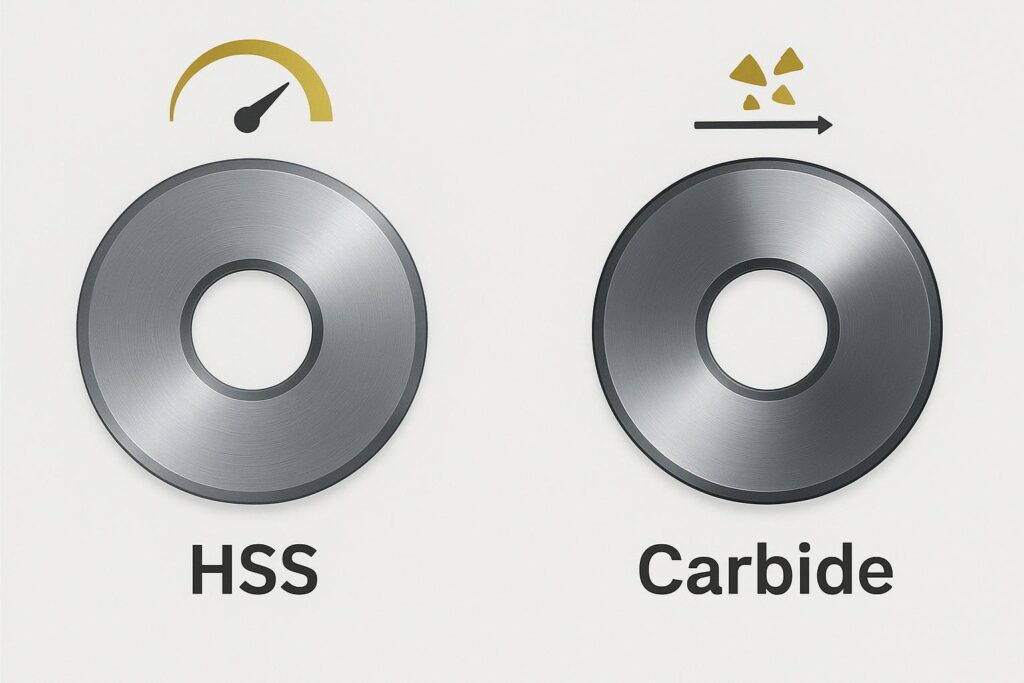
主なポイント
- HSSと超硬(カーバイド)は「優劣」の選択ではありません。それは 摩耗対衝撃 の問題であり、以下に直結しています: ライン速度、摩耗性、および安定性.
- もし 摩耗/刃先の丸み, が見られる場合、通常は摩耗が制限要因です(摩耗性ウェブ、フィラー、高負荷サイクル)。もし 微小チッピング, が見られる場合、通常は衝撃が制限要因です(振れ、振動、過剰なオーバーラップ/サイドロード)。.
- 公差の累積(平面度、TIR/振れ、オーバーラップ)と再研磨の管理基準は、高速運用時の刃先寿命において、基材の選定と同等に重要です。.
なぜHSS対超硬が刃先寿命、OEE、TCOに影響するのか
刃先寿命は、ナイフ交換のための停止頻度、スリット断面の安定性、そして切断面のズレに気づくまでに発生するスクラップの量に影響します。.
コンバーティングラインでは、これが3つのビジネス指標へと直結します:
- Edge life:刃先更新(再研磨または交換)までの時間(分)または距離(メートル)。.
- OEE:段取り替え、セットアップ時間、品質による一時停止が、稼働率および歩留まりの損失として現れます。.
- TCO:ダウンタイム、再研磨の手間、スクラップを考慮すると、購入価格は通常最も小さな影響要因です。.
選定前に記録すべき重要変数
再現性のある判断を行うには、まず作業ごとに以下の5つの変数を記録することから始めてください:
- ライン速度と負荷サイクル (断続 vs 連続)
- Material abrasiveness (フィラー、リサイクル材、繊維構造)
- 負荷安定性 (テンション変動、ニップ変動、ウェブのばたつき)
- 振動 / 振れ感度 (ホルダーの状態、アーバー、累積公差)
- 再研磨計画 (研磨担当業者/部門、刃付け後の振れ/平面度の検証方法)
本ガイドが提供するもの
- あ 材料–速度適合マップ (HSS vs 超硬用)
- の 損傷モード (セッティングの問題を「悪質な鋼材」と誤診断しないための注意点)“
- の 公差および再研磨チェックポイント (刃付け後も安定した性能を維持するため)
次のステップとしてナイフの仕様選定や交換を行う場合、MAXTOR METALの circular knives and blades ページは準備事項(図面、外径/内径、板厚、用途ノート)の具体的な参照先となります。.
材料–速度の適合性
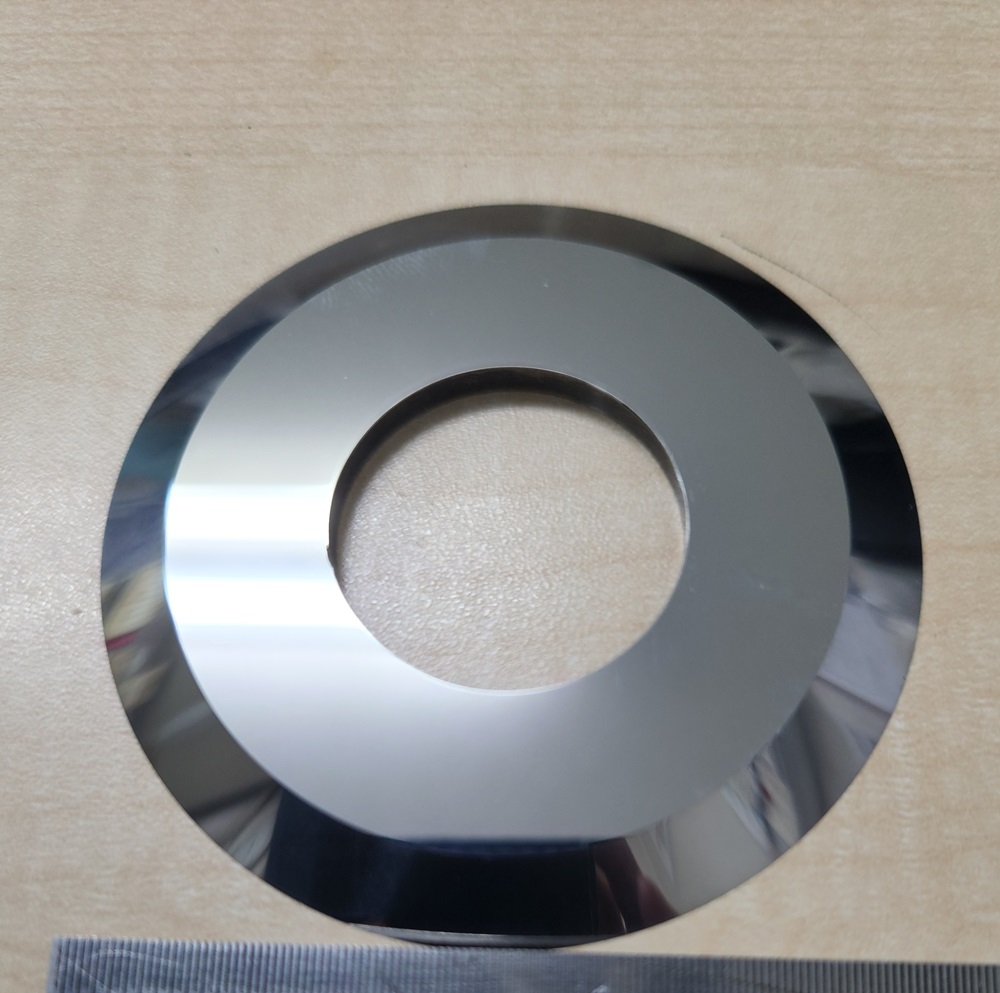
プロのヒント:オーバーラップ、サイドロード、振れを安定して維持できない場合は、チッピングリスクを低減するためにまずHSSから開始してください。ラインの機械的安定性が確認され、再研磨の検証手順が確立された後に超硬へ移行します。.
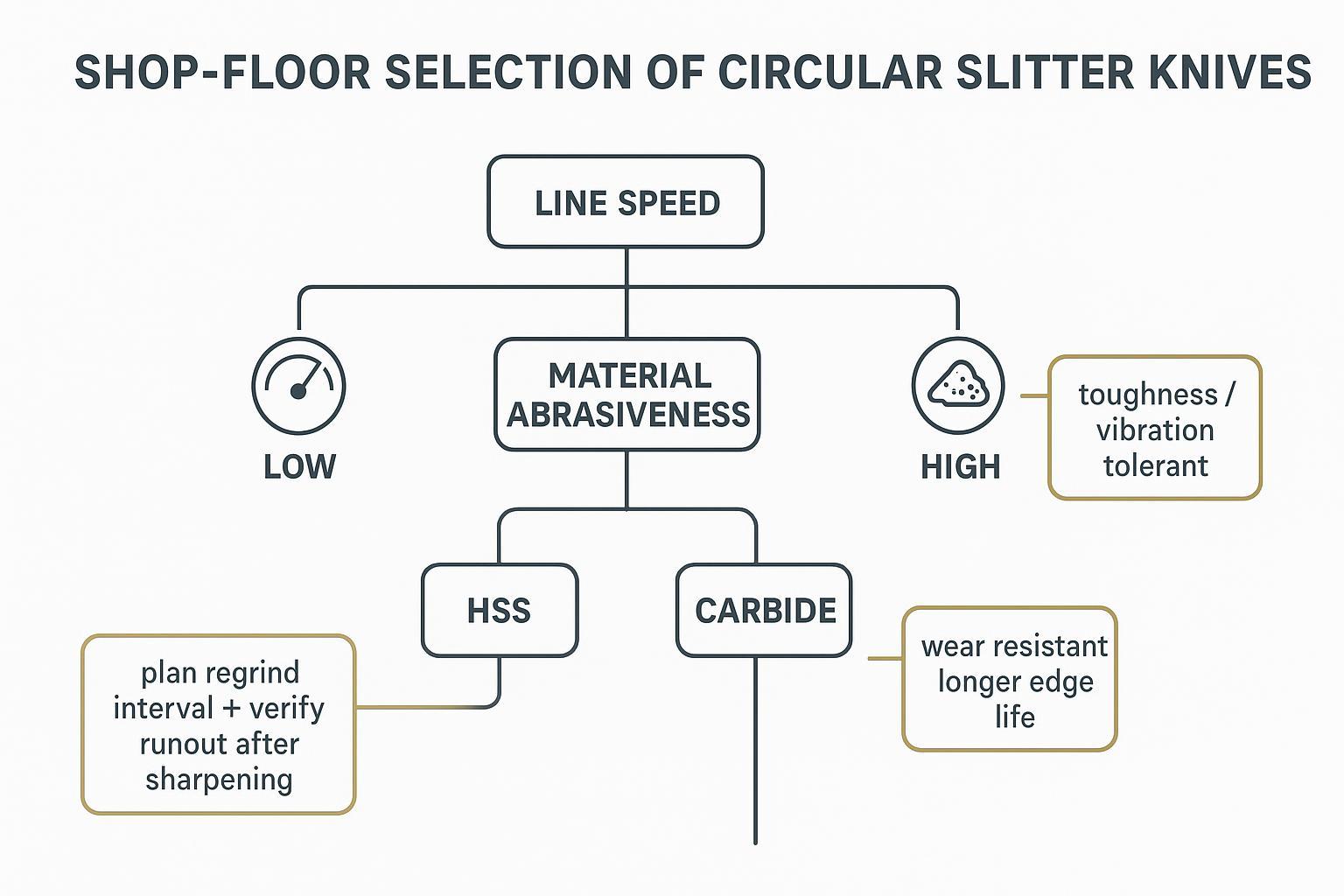
実務上、本セクションは スリッターナイフ材質選定 ワークシートとして機能します。どの損傷モードが主要因かを判断し、速度と摩耗性に最も適した基材を選択してください。.
ライン速度と負荷サイクル
速度と負荷サイクルは、消費している「熱と摩耗の許容枠」とお考えください。.
- 低速 + 断続運用 では、通常 HSS が有利になります。これは、純粋な耐摩耗性よりも靭性と負荷変動に対する耐性が重視されるためです。.
- 高速化 + 連続運転 では、通常 carbide アブレシブ摩耗と刃先の丸みが寿命の限界要因となるためです。.
現場で役立つ判断基準は、まず何が原因で刃先を損傷させているかを突き止めることです:
- 刃先が徐々に劣化する場合(バリが大きくなる、スリット端面に毛羽立ちが生じるなど)は、摩耗が制限要因です。.
- 刃先が突然破損する場合(微小な欠け、チッピング、筋が入るなど)は、衝撃が制限要因です。.
重要なポイント:超硬は作業条件が安定しており摩耗が主因となる場合に費用対効果を発揮します。ハイス(HSS)は作業条件が変動しやすく衝撃が主因となる場合に効果を発揮します。.
材質の詳細な背景については、MAXTOR METALの社内 HSS 対 超硬 切削比較.
被削材の摩耗性とフィラー
“コンバーティング加工における「摩耗性」とは、単に硬度だけの問題ではありません。刃先が何時間も何に擦れ合っているかが重要です。.
超硬の採用が推奨される主な事例:
- 以下の要素を含むウェブ: 無機フィラー または摩耗性顔料
- リサイクル材 異物混入リスクが高いもの
- 繊維質不織布 微細な研磨ブラシのように作用するもの
ハイス(HSS)が優位性を保ちやすい事例:
- 清浄でフィラー含有量が少ないフィルム
- 刃物交換のコストが許容できる小ロット生産
- ラインの条件調整中である工程(張力/ホルダー/面振れが完全に安定していない)
被削材の変更後に(同一速度・同一刃形状で)刃先寿命が急激に低下した場合は、サプライヤーの品質問題ではなく、まず摩耗性の変化によるシグナルとして捉えてください。.
注意すべき損傷モード(摩耗による鈍化 vs 微小チッピング)
Two failure modes create very different actions.
鈍化/刃先の丸み(摩耗主因)
典型的な症状:
- バリが徐々に増加し、スリット端面の品質が低下する
- 刃先の熱変色や研磨状の摩耗ランド
- 突発的な問題なしに時間の経過とともにダスト(粉塵)が増加する“
最初に確認すべき推奨項目:
- ウェブの摩耗性が想定より高くありませんか?
- 再研磨計画の想定を超える高負荷・長時間運転を行っていませんか?
- 粘着剤の付着や熱による貼り付きは発生していませんか?
微小チッピング(衝撃主因)
典型的な症状:
- 突発的な筋、刃こぼれ、チャタリングマーク(びびり傷)
- 拡大時に刃先が「破壊」して見られる
- 性能が不安定:短時間は良好だが急激に悪化する
最初に確認すべき推奨項目:
- アーバおよび刃物の面振れ/TIR
- 過度なオーバーラップ(重ね合わせ)またはサイドロード(側圧)
- 振動源(ホルダー、ベアリング、スタックの剛性)
オーバーラップ、サイドロード、および面振れに起因する一般的なシャー加工のトラブルに関するDienesのトラブルシューティングノートは、材質変更前に設置上の原因と症状を照合する優れたリファレンスです。.
公差、幾何形状、再研磨
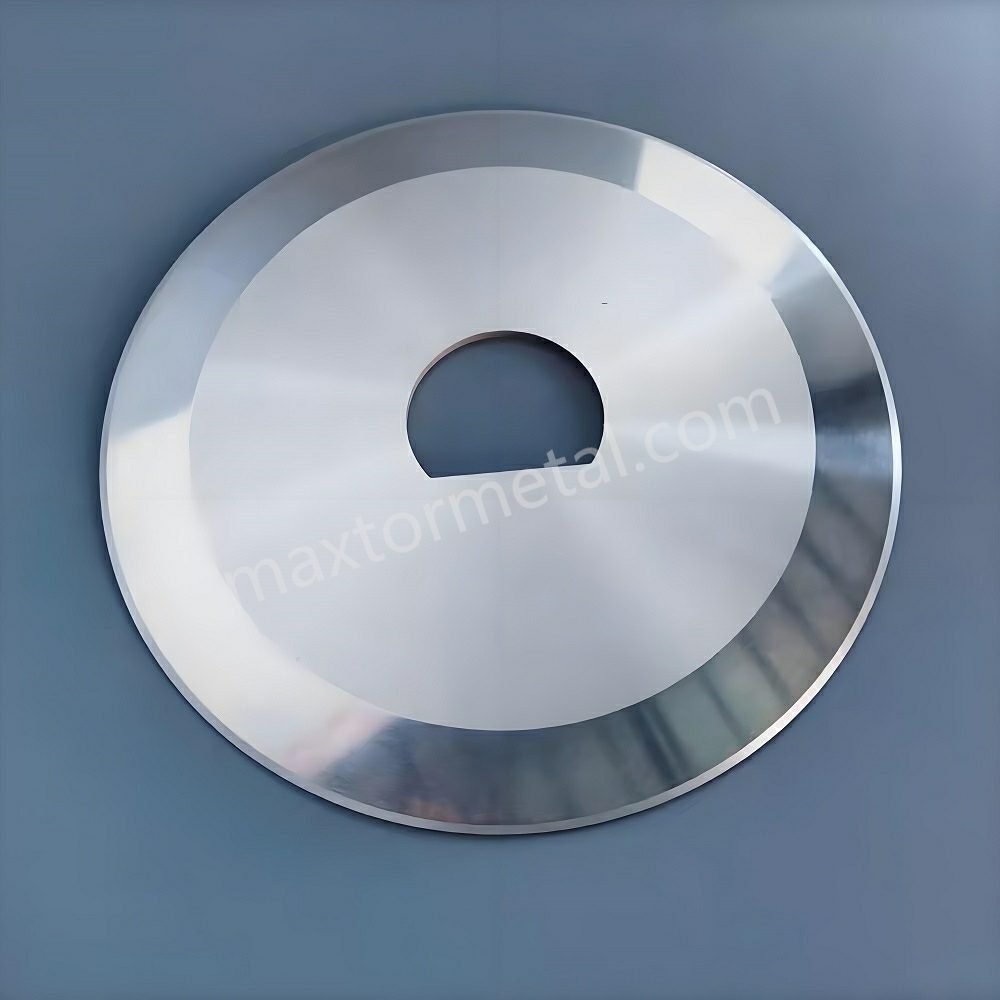
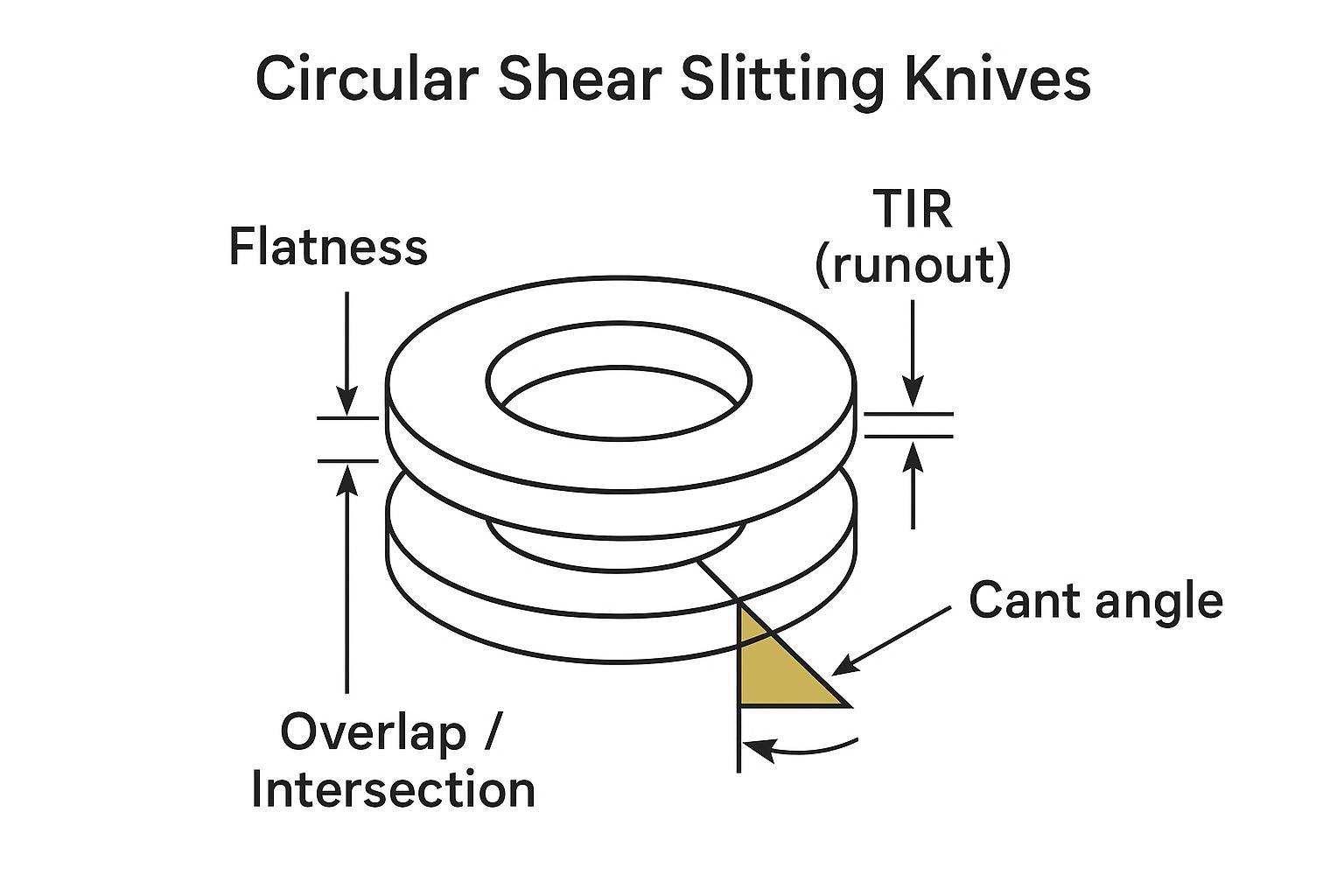
重要な公差(平面度、TIR、オーバーラップ)
刃物の回転・走行精度が低い場合、高品質な被削材であっても早期摩耗や破損が発生します。バリやチッピングのトラブルシューティングを行う際は、これを以下の基本基準として扱ってください: シャー加工用スリッターナイフの公差 TIR オーバーラップ.
高速運転時の安定性を左右する主な公差/パラメータは3つあります(これらは、 超硬 vs ハイス 丸ナイフ が予測通りの性能を発揮するかどうかを決定づける要素でもあります):
- 平坦性:ナイフ端面の接触面の一貫性および荷重の均一分散を制御します。.
- TIR(全測定振れ)/ランアウト: Controls vibration and shock loading at the edge.
- Overlap / intersection: Controls whether you are shearing cleanly or rubbing/plowing.
Sollex publishes practical overlap ranges for tangential shear slitting—see their guidance on recommended overlap ranges for film, fabrics, and nonwovens (film/foil often ~0.50–0.75 mm; nonwovens higher). Treat this as a starting range only: actual optimum depends on knife diameter, web thickness, holder stiffness, and measured runout.
⚠️警告: If you try to “fix” edge quality by increasing overlap or side pressure, you can shorten knife life fast and raise chipping risk—especially on carbide.
Safety & validation note: Always follow your machine OEM’s setup limits and local safety procedures (guards, lockout/tagout). When changing overlap/side load, validate with a small trial run and confirm bearing load and edge quality before ramping speed.
Edge geometry by substrate
Geometry is where you tailor the edge to the dominant failure mode.
- シフトの途中で運転を継続するために wear-limited (dulling): you typically want a geometry that supports edge stability under abrasion.
- シフトの途中で運転を継続するために shock-limited (micro-chipping): you typically want a geometry that reduces edge fragility and lowers peak stress.
Practical notes to align the team:
- Don’t change material and geometry at the same time unless you’re running controlled trials.
- Record what “good” looks like (edge under magnification, slit edge appearance, dust level) so you can compare apples to apples.
For setup fundamentals that interact with geometry (cant angle, overlap approach, knife profiles), MAXTOR METAL’s shear slitting setup guide is a useful internal reference.
Regrind cycles and methods
Regrinding is where many “carbide vs HSS” debates get distorted—and it’s also where circular knife regrind cycles can either protect edge life or quietly destroy it.
A few practical rules:
- Decide whether you want to optimize for maximum number of regrinds または most stable performance per regrind. These aren’t always the same.
- Treat sharpening as a controlled process: consistent wheel selection, cooling, and edge finish.
- After regrind, verify what matters to performance: runout/TIR, flatness, 、そして edge condition under magnification.
If you’re using spacers and stack-ups that influence runout, review how components interact. MAXTOR METAL’s guide on slitting knives and spacers provides a clear reminder that the “knife system” is not only the knife.
OEEおよびTCOガイド
Cost drivers beyond purchase price
To compare HSS vs carbide honestly, separate cost into four buckets:
- Downtime costs: changeover time, setup verification, and re-threading losses
- Quality losses: scrap, rework, and customer claims due to edge quality drift
- Regrind logistics: grinding cost, transport, queue time, spare inventory
- Risk costs: web breaks, sudden edge failure, and operator time troubleshooting
If carbide reduces changes but increases chipping events (because runout/overlap isn’t controlled), your TCO can get worse, not better.
ROI thresholds by speed and abrasiveness
Instead of chasing a universal “carbide lasts X times longer” number, use ROI signals you can measure in your plant:
- Edge-life multiplier needed to break even:
- If a knife change costs you more than the price difference in lost time and scrap, carbide is easier to justify.
- Stability premium:
- If the line is speed-limited by edge quality drift, the right substrate/geometry is often worth more than the knife cost.
- Abrasive-job flag:
- If a filler/recycled/fibrous job forces frequent edge refresh, carbide usually becomes the default—provided vibration/runout is controlled.
Coatings and cryo that shift the balance
Treat coatings and cryogenic treatment as “second levers” that can move the decision when you’re close to the boundary.
- もし sticking, heat, or buildup, a low-friction coating option (often positioned as DLC-type coatings in industry tool discussions) can be worth a controlled trial.
- もし abrasive wear but can’t change substrate for cost or brittleness reasons, a wear-focused PVD coating family is often a practical next step.
- のために HSS, cryogenic treatment is commonly used to improve wear behavior in tool steels; position it as an option to test on wear-limited jobs.
MAXTOR METAL case note (what to ask for when you want repeatability):
MAXTOR METAL supplies both PM HSS そして fine-grain carbide circular knives with documented tolerances (flatness/runout targets aligned to your application), plus PVD/DLC coating options when wear or sticking is the dominant limit. For plant and procurement confidence, they support QA traceability (inspection records and batch tracking) and a one-stop import process for US/EU customers.
If you want a fast, apples-to-apples comparison, prepare three inputs for your supplier: your line speed range, web/material description (including fillers/recycled content), and your observed failure mode (dulling vs micro-chipping).
ミニケーススタディ(匿名化済み)
Job: Calcium carbonate–filled PE film (shear slitting) at 250–450 m/min
| パラメータ | Before (HSS) | After (Carbide + setup control) |
|---|---|---|
| Knife material | Standard HSS circular knives | Carbide circular knives |
| Dominant failure mode | Wear-dominated (abrasive wear, edge rounding) | Wear-dominated, controlled |
| 症状 | Rapid dulling, rising dust, unstable slit edge after several rolls | Improved edge stability, fewer unplanned stops |
| Radial TIR (runout) | ~0.03 mm | < 0.015 mm |
| Overlap / intersection | ~1.0 mm | ~0.6–0.7 mm |
| Regrind approach | Reactive replacement | Scheduled, inspection-based grinding |
| 結果 | ベースライン | ~3–5× knife life; unplanned knife-change stoppages reduced significantly |
Measurement note: TIR values above refer to radial runout measured on the knife/arbor setup with a dial indicator; overlap values are tangential shear slitting intersection settings and should be tuned for your geometry and web.
結論
- Choose HSS for resilience at lower speeds, variable loads, and tighter budgets
- Choose Carbide for continuous, abrasive, high-speed runs seeking maximum edge life
- Confirm with tolerance specs, regrind plan, and tracked OEE/TCO metrics
FAQs:
1) HSS vs carbide slitter knives: which lasts longer for plastic film?
Carbide usually lasts longer when the film job is wear-dominated (high speed, continuous duty, abrasive contamination). HSS can still be the better choice for short runs or unstable conditions where shock and vibration drive micro-chipping.
2) What causes carbide slitter knives to chip?
Micro-chipping is typically driven by shock loading: excessive runout/TIR, vibration, too much overlap, or too much side load. Dienes’ notes on 一般的なシェアスリッティングの問題 link these setup variables directly to chipping symptoms.
3) What overlap/intersection should I use for shear slitting film?
A common starting range is about 0.50–0.75 mm for film/foil in tangential shear slitting. Sollex summarizes these recommended ranges in their shear slitting guide, and you should tune from there based on thickness, tension stability, and knife geometry.
4) Is HSS better than carbide for vibration or interrupted contact?
Often, yes. HSS is generally more forgiving when the system has vibration, runout, or variable loading because toughness reduces edge breakout. If you want carbide in these conditions, you typically need tighter tolerance control and geometry tuned to reduce edge fragility.
5) How do I decide if carbide is worth the extra cost?
Treat it like an OEE decision: estimate what one changeover costs in lost time and scrap, then compare that to the price difference. Carbide makes sense when longer runs and abrasive webs make changeovers the dominant cost driver.
6) Should I regrind carbide circular knives the same way as HSS?
The principle is the same (restore geometry and edge finish), but the process control and inspection discipline often need to be tighter. After any regrind, verify runout/TIR and flatness—if runout increases, carbide can start chipping even if the edge looks sharp.
7) Do coatings help slitter knife life on sticky films or abrasive webs?
They can. Low-friction coatings are often trialed when sticking and heat are limiting edge life, while wear-focused coatings are often trialed for abrasive webs. The key is to run controlled trials and track edge life and quality drift, rather than relying on generic multipliers.
8) What specs should I send a circular knife supplier to get the right recommendation?
Send: OD/ID/thickness and drawing, slitting method (shear/crush), line speed range, web description (including fillers/recycled content), target edge quality, and current failure mode (dulling vs chipping). If you have them, include your runout/TIR measurement approach and your current overlap/side load settings.
規格参照(図面および検証用)
If you need a standards-backed language for drawings and inspection reports, these ISO documents are widely used:
- Geometrical tolerancing (flatness, run-out) — ISO 1101:2017, Geometrical product specifications (GPS) — Geometrical tolerancing. See the run-out definitions in Clause 16 (including circular run-out and total run-out) and the general rules for specification/interpretation throughout the standard: ISO 1101:2017 on ISO.
- Datum systems used for run-out inspection setups — ISO 5459:2011, Datums and datum systems for geometrical tolerances, for defining datum references when you specify/measure run-out relative to an arbor axis: ISO 5459:2011 on ISO.
- Dial indicator / dial test indicator characteristics — ISO 9493:2010, Dial gauges — Design and metrological characteristics, as a reference for the metrological characteristics of lever-type dial indicators often used in TIR checks: ISO 9493:2010 on ISO.
- Prevention of unexpected start-up during setup/maintenance — ISO 14118:2017, Prevention of unexpected start-up (commonly referenced when implementing safe setup and energy isolation controls): ISO 14118:2017 on ISO.
- Safety distances for guarding — ISO 13857:2019, Safety distances to prevent hazard zones being reached by upper and lower limbs. See the main requirements and tables in Clauses 4–6: ISO 13857:2019 on ISO.
本手法について(MAXTOR METAL)
This guide is based on MAXTOR METAL’s shop-floor troubleshooting patterns and QA checkpoints built over 15+ years of custom, precision-ground industrial blade manufacturing. For repeatability, we recommend documenting (and, where possible, providing) inspection records for:
- Flatness inspection for knife faces (to prevent intermittent contact and load spikes)
- Hardness / material certificate traceability to confirm substrate consistency
- Regrind process control and post-grind checks (edge condition + runout verification)
- QA traceability (batch tracking and inspection reports)
Update note: If you want us to review your setup and recommend substrate/geometry, please share your measured TIR/flatness method, overlap/side load settings, and a small set of slit-edge photos under magnification.

 English
 Spanish
 Italian
 French
 Portuguese
 Russian
 German
 Arabic
 Hindi
 Vietnamese
 Indonesian
 Japanese
 Korean