

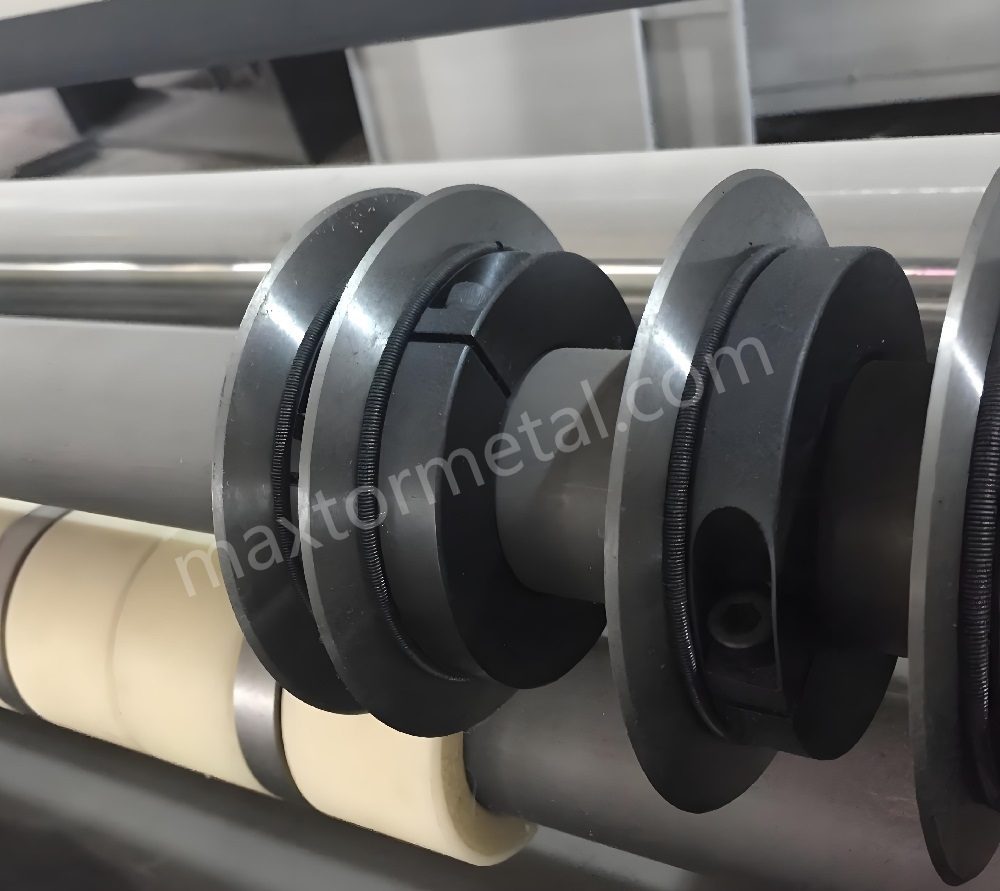
O corte (slitting) de alta velocidade é implacável: se uma faca circular não gira perfeitamente, a qualidade da aresta de corte degrada-se antes mesmo de a lâmina estar "cega". Neste artigo, a Maxtor Metal relaciona a tolerância e o batimento do furo central (como o tamanho e a geometria do furo se manifestam como TIR da aresta em alta velocidade) com os números que você pode especificar — e as verificações que pode repetir.
Nota de Engenharia: Para especificações detalhadas da lâmina, incluindo padrões de excentricidade axial e classes de materiais, consulte Facas de corte circular de precisão da Maxtor Metal.
- Why dynamic runout ruins edge quality and OEE on high-speed slitters: it creates uneven engagement, heat, burrs, and early edge failure—plus extra setup time and scrap.
- How central bore tolerance runout control and fit choice drive stability at the cutting edge: the bore is the first locator; its size and geometry affect centering repeatability and how the stack behaves at speed.
- What readers will take away: numeric targets, fit selection, assembly checks: runout target bands, ISO 286 fit windows (50 mm example), and a verification routine that prevents drift over time.
Runout amplification
Geometry to dynamics
At rest, runout looks like a simple geometric error: the blade’s cutting circle isn’t perfectly concentric with the arbor axis. At speed, that error turns into a force problem.
A small eccentricity at the bore creates a larger effect at the edge because the cutting radius is the longest lever arm in the system. And because runout is a stack-up, the assembled Total Indicated Runout (TIR) reflects the combined effects of arbor TIR, bore/OD coaxiality, spacer parallelism, shoulder squareness, and clamping faces—classic tolerance stack-up behavior across multiple locating surfaces.
In other words, arbor bore fit runout stack-up is the normal failure mode: a few small contributors add up to one visible edge problem.
So what: if your runout “moves around” between blade changes, it’s usually not the blade OD. It’s repeatability of location—bore fit, faces, spacers, and the seating condition.
In multi-knife setups, stack repeatability also depends on how thickness variation accumulates across knives and spacers; for practical troubleshooting, see controlling cumulative thickness tolerance in multi-knife slitting.
Thin disc flexibility
Slitter knives are often thin relative to diameter. That matters because clamping force and imperfect contact can elastically distort the disc.
Two common failure modes:
- You clamp hard to “fix” runout and you actually bend the blade or tilt it on a high spot.
- A slight face error (burr, dent, trapped debris) creates a tilt that becomes measurable edge TIR, even if the bore size is correct.
If you want to go deeper on how face wobble shows up on the slit edge, see our guide to axial runout and edge quality in slitting.
So what: a tighter bore size tolerance won’t save a stack that isn’t flat, clean, and square. Bore control is necessary, but it’s not sufficient.
Balance and resonance
Runout and balance aren’t the same thing. Runout is geometric/assembly alignment; balance is mass distribution. You can have low TIR and still excite vibration if the assembly is unbalanced.
For high-speed slitting, practical guidance often starts with a precision arbor and low runout targets.
In many production environments, teams use an internal “do‑not‑exceed” gate for assembled runout based on product tolerance and line speed. If your assembled edge TIR drifts into the 0.02–0.04 mm range, it’s typically a strong signal to investigate the full stack (arbor, faces, spacers, seating, and clamp conditions) rather than trying to compensate with overlap or side load alone.
If overlap and side clearance are part of your stabilization strategy, you may also find this companion article useful: optimizing overlap depth and side clearance for stable slitting.
If you’re fighting chatter that appears only above a certain line speed, treat it like a system problem: runout + balance + stiffness + damping can cross a resonance threshold.
So what: set two acceptance gates—(1) assembled edge TIR and (2) vibration/balance at speed.
Fit selection for central bore tolerance runout (ISO 286)
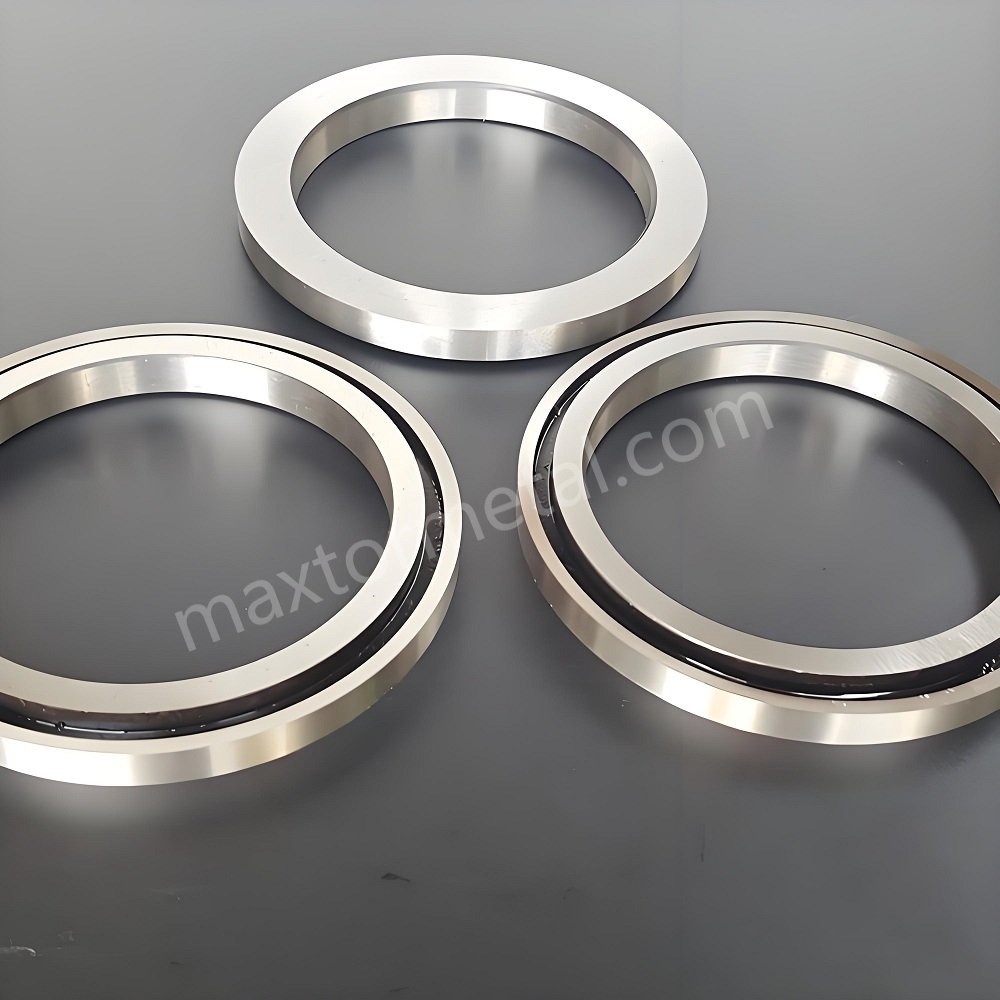
For readers specifying knife geometry alongside runout targets, bevel design can change how sensitive the cut is to small alignment errors; see bevels for circular slitter knives for a practical overview.
If you’re searching for ISO 286 H7 h6 g6 k6 p6 fit selection, treat it as a practical question: “Which fit window gives repeatable centering without assembly pain or distortion for my line speed and tolerance?”
Central bore tolerance windows at 50 mm
Fit language matters because it translates into a predictable clearance/interference window.
For a 50 mm nominal example, published fit tables show H7 as a hole‑basis tolerance and several typical shaft zones as examples.
Because the ISO system is defined in paid standards, use the official catalog pages below for the authoritative scope and edition details:
- ISO 286‑1: ISO code system for tolerances on linear sizes — Part 1: Basis of tolerances, deviations and fits (official catalog page): https://www.iso.org/standard/52912.html
- ISO 286‑2: ISO code system for tolerances on linear sizes — Part 2: Tables of standard tolerance grades and limit deviations for holes and shafts (official catalog page): https://www.iso.org/standard/52913.html
Use any numeric values you apply here as a practical starting point, but treat your own metrology, functional requirements, and the latest purchased edition of the standard as final—especially if you’re controlling edge TIR in the 10–20 µm range.
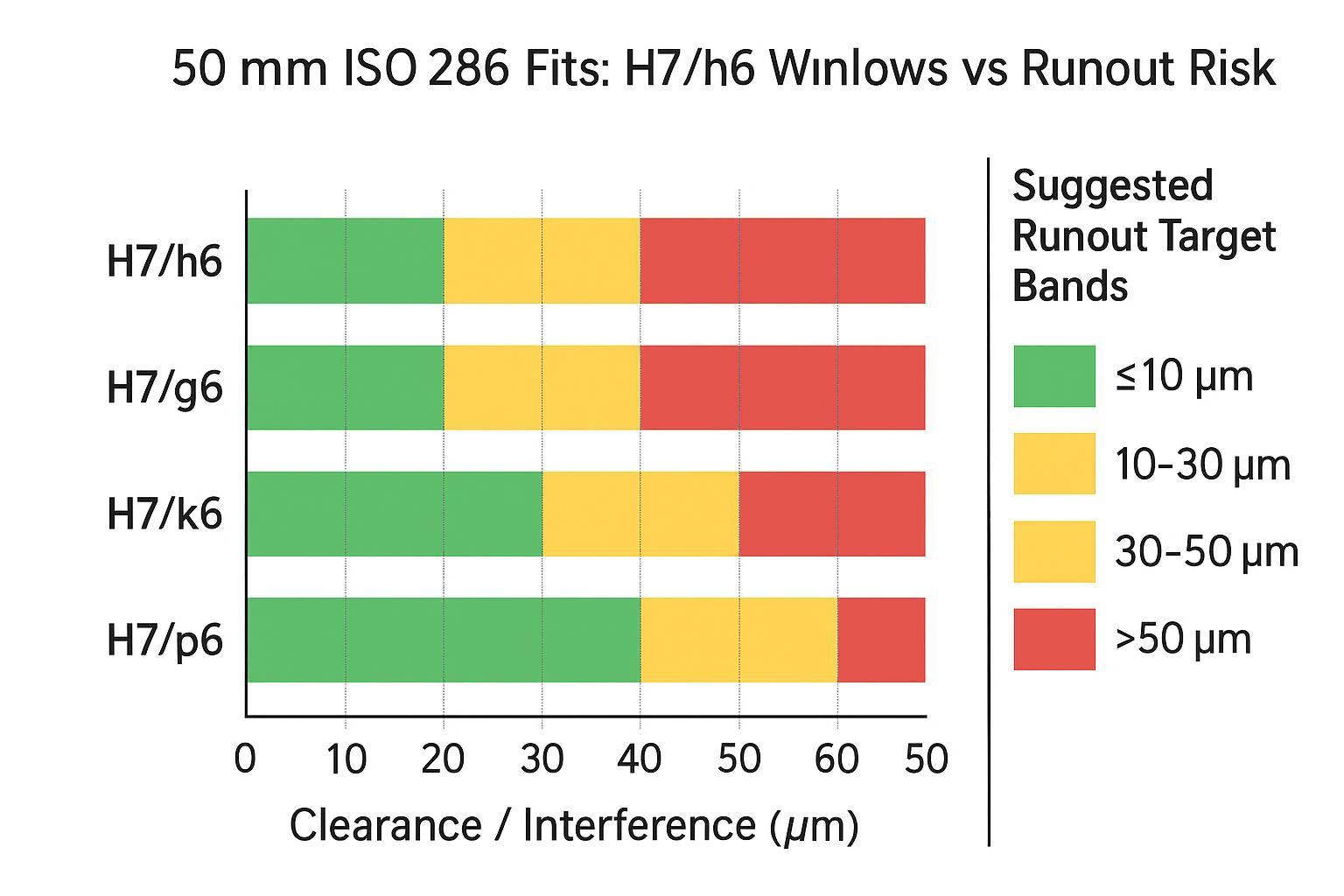
Choosing H7/h6, H7/g6, H7/k6, H7/p6
Below is the core decision logic for a 50 mm class bore/shaft interface on a slitter knife (hole basis H7; shaft tolerance class ·6). The goal is predictable centering without distortion or unstable micro-slip.
- H7/h6 (very close running / near line-to-line)
- Use when you want high centering repeatability with straightforward assembly.
- Risk to manage: fretting or pickup if surfaces are rough or contaminated.
- H7/g6 (clearance fit)
- Use when you need reliable assembly and controlled free fit, especially with frequent changes.
- Risk to manage: too much clearance can increase positional variability unless faces/pilots control location.
- H7/k6 (transition fit)
- Use when you need more location security than g6 but don’t want a true press fit.
- Risk to manage: the same parts can assemble as “easy” one day and “tight” the next; clamp distortion can also increase.
- H7/p6 (interference / press fit)
- Use only when the design intent is a press-mounted component, not a blade that must be swapped routinely.
- If you need press‑fit limits for your nominal size, calculate them using your purchased ISO 286 tables (or your company’s controlled fit calculator derived from the standard) to ensure the edition and rounding rules match your print requirements.
A practical way to connect fit choice to cutting performance is to treat fit selection as a risk control for assembled edge TIR. If your process needs ≤10 µm edge TIR, you typically can’t rely on “clearance somewhere in the stack” to self-center.
GD&T and surface finish targets
Size limits alone don’t guarantee low runout. To stop runout at the edge, you also need geometric control.
Targets to specify (typical, adjust to your product tolerance):
- Bore to OD (cutting circle) runout / coaxiality: control as a runout requirement to the bore datum; this is often more practical than trying to verify true concentricity in production metrology. For authoritative definitions and symbol rules, refer to standards catalog pages such as:
- ISO 1101:2017 — GPS — Geometrical tolerancing — Tolerances of form, orientation, location and run-out (official catalog page): https://www.iso.org/standard/66777.html
- ASME Y14.5 (GD&T) — Dimensioning and Tolerancing (official ASME catalog listing PDF): https://files.asme.org/Catalog/Codes/PrintBook/35976.pdf
- Clamping faces parallelism / flatness: keep faces flat and parallel so clamping doesn’t tilt the disc.
- Surface finish at the bore and clamping faces: smoother seating surfaces reduce high-spot tilt and improve repeatability.
Conclusão principal: A “correct” ISO fit can still produce bad edge runout if bore geometry, faces, and stack flatness aren’t controlled to the same order of magnitude as your edge TIR target.
Assembly and verification
Quick acceptance spec (targets + what to measure)
| What to control | Practical target band | Where to indicate (minimum) | If you’re out of spec, check first |
|---|---|---|---|
| Assembled edge TIR (near cutting edge) | ≤10 µm (high‑precision) / 10–30 µm (general) | Near cutting edge on the assembled stack | Seating cleanliness, spacer damage/parallelism, clamp face high spots, torque sequence |
| Arbor TIR | As low as practical (verify before blaming the knife) | Arbor OD / reference surface | Bent/damaged arbor, bearing condition, shoulder squareness |
| Face wobble / axial runout | Keep to the same order as edge TIR | One knife face on the assembled stack | Burrs/dents on faces, trapped debris, spacer flatness, clamp-face parallelism |
| Bore‑to‑OD runout (knife qualification) | Align with your edge‑TIR goal (often single‑digit µm for tight processes) | Indicate OD while locating from bore datum | Bore geometry, bore finish, datum setup, grinding sequence |
| Bore fit intent (ISO 286) | H7/h6 when centering repeatability is critical; H7/g6 when changeovers dominate | Fit is a design/print requirement, not a measurement point | If runout “moves” between changes, suspect clearance + seating repeatability, not OD |
Use this table as a working baseline. Final limits should match your product tolerance, knife diameter/thickness, line speed, holder stiffness, and your measurement resolution.
Boundary conditions and common pitfalls
These recommendations are most reliable when the system is mechanically stable and your measurement method can resolve the targets.
Boundary conditions (make them explicit in your spec):
- Knife diameter vs. thickness: thinner discs are more sensitive to clamp-face errors and over-torque.
- Speed regime: higher line speed increases sensitivity to micro-slip, vibration, and resonance.
- Holder stiffness and loading: pneumatically loaded holders and worn pivots can amplify wobble.
- Process type: wrap shear slitting behaves differently from score slitting; don’t copy overlap rules across processes.
- Measurement capability: if your indicator resolution and setup repeatability are worse than the tolerance you’re chasing, you will “tune noise.”
Common pitfalls (and what to do instead):
- Only tightening bore size tolerance while ignoring faces/spacers.
- Do instead: control face flatness/parallelism and spacer condition, then verify assembled edge TIR.
- Using torque to force runout to disappear (bending the knife).
- Do instead: find the seating high spot (burr/dent/debris), correct it, and use a consistent torque sequence.
- Chasing overlap/side load first when burr appears.
- Do instead: measure arbor TIR and assembled edge TIR first; adjust overlap only after the stack is repeatable.
- Measuring only OD TIR and assuming the edge is fine.
- Do instead: indicate near the cutting edge and one face to catch wobble and tilt.
- Skipping re-seat verification and accepting a one-time reading.
- Do instead: re-seat once (clean → reassemble → remeasure). If TIR shifts materially, fix repeatability before changing knife geometry.
Arbor, spacers, cleanliness, torque
If you want runout to stay low over weeks—not just on a fresh setup—treat assembly as a controlled process.
Checklist (field-practical):
- Verify arbor seat and shoulder are clean, burr-free, and undamaged.
- Clean blade bore and clamping faces; remove adhesive, oil film, and embedded particles.
- Inspect spacers for flatness/parallelism; reject visibly dented or galled spacers.
- Use consistent torque and clamping sequence; avoid “over-tightening to fix runout.”
- Mark orientation for repeatability if you disassemble and reassemble frequently.
Measuring edge runout and concentricity
For slitter knives, measurement method matters as much as the number.
A solid routine (how to measure TIR slitter knife repeatably):
- Measure arbor TIR first (so you don’t blame the blade for a bent or damaged arbor).
- Then measure assembled TIR at:
- OD
- near the cutting edge (function-driving)
- one face (to detect wobble)
- Repeat the check after re-seating once. If TIR changes materially, the problem is seating repeatability, not “randomness.”
Many shops use edge TIR target bands that align with product tolerance and speed:
- High-precision slitting: aim around ≤0.01 mm (10 µm) edge TIR
- General industrial slitting: often 0,01–0,03 mm
- Investigate aggressively if you approach the 0.02–0.04 mm band described in broader setup guidance, because edge quality and tool life typically degrade quickly beyond that.
- Maxtor Metal supplies inspection traceability records — including runout measurement, material certification, and heat-treat documentation — to support incoming quality verification and assembly repeatability.
If you’re also evaluating knife manufacturing controls and verification capability, see Maxtor Metal circular slitter knives and blades for materials options and typical runout verification practices.
Balance grades and spin checks
Once geometry and assembly are under control, balance keeps vibration from reintroducing dynamic runout.
Practical steps:
- Balance the assembly you actually spin (knife + clamp + spacers) when possible.
- Select a balance grade appropriate to your speed and sensitivity (common starting points are G 6.3 for general rotating assemblies and tighter grades like G 2.5 for higher-precision/high-speed needs).
- If you need to formalize acceptance, use the purchased standard edition for the calculation and verification method. Official catalog pages:
- ISO 1940‑1:2003 — Mechanical vibration — Balance quality requirements for rotors in a constant (rigid) state — Part 1: Specification and verification of balance tolerances: https://www.iso.org/standard/27092.html
Case study: PET film slitting runout stabilization (anonymized)
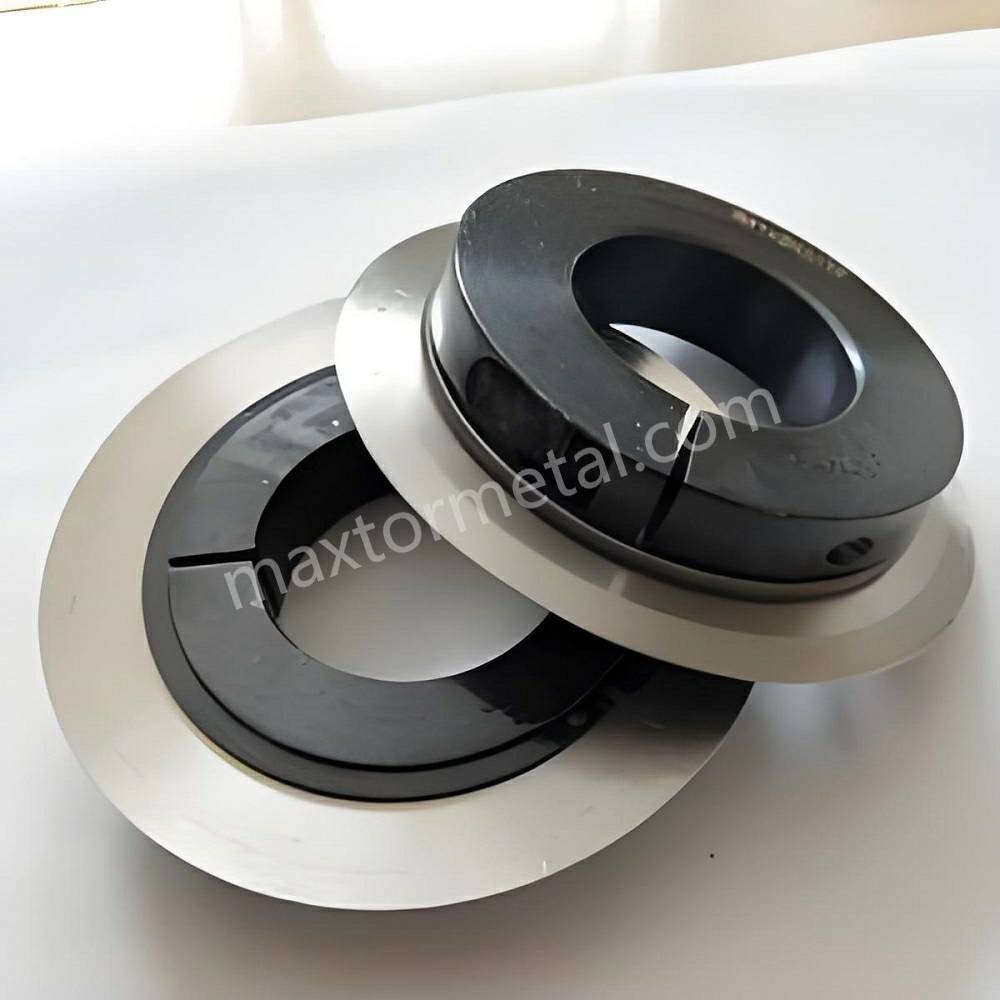
Application / industry: Flexible packaging PET film slitting (web converting).
Setup snapshot: circular shear slitter knives, M2 high speed steel with mirror‑polished edge finish; OD 130 mm, thickness 1,0 mm, bore ID 75 mm; line speed 250–580 m/min; wrap shear slitting with pneumatically loaded top knife holders; 16 slit lanes; web thickness 23–50 µm PET used for laminated packaging structures.
The problem: “unpredictable edge drift” at high speed
Above ~500 m/min (especially on narrow slit widths below 80 mm), the line showed intermittent burr, fine PET dust, slight edge cracking during acceleration, and unstable narrow trim behavior. Operators reported that one shift could run stable for hours, while the next shift produced burr immediately using the “same settings.” The converter ultimately stopped changing knife geometry and investigated assembled edge TIR and stack repeatability.
Quantified results (before vs after)
Note: The data below comes from Maxtor Metal’s project support for a film converter; the customer name has been anonymized.
| Parâmetro | Antes | Depois |
|---|---|---|
| Assembled edge TIR (near cutting edge) | 18–24 µm | 6–9 µm |
| OD TIR | 12–16 µm | 4–6 µm |
| Face wobble / axial runout | 15–20 µm | 5–8 µm |
| Burr / edge defect rate | 4.5–6% | 0.8–1.5% |
| Vida de faca | 38–45 operating hours | 62–78 operating hours |
| Slitting setup adjustment time | 25–40 min | 8–15 min |
The converter considered the largest improvement not just the lower defect rate, but the reduction in between‑shift variability.
What didn’t work (and why)
Attempt 1 — Increasing overlap (≈0.45 → 0.90 mm): incomplete cuts disappeared initially, but PET dust increased sharply, edge temperature rose, burr became more aggressive, and knife wear accelerated.
Attempt 2 — Increasing side load: short‑term slit stability improved, but holder vibration increased, top knife heating became visible, face wobble sensitivity worsened, and knife life dropped below 35 hours.
Root cause: stack-up + repeatability, not one “bad knife”
The team found multiple small contributors:
- bore fit inconsistency between knife batches
- spacer parallelism variation
- residual contamination during assembly
- repeat‑clamping variation
- aggressive overlap amplifying small runout errors
A key finding was that assembled edge TIR shifted significantly after re‑clamping, even when knife OD TIR alone looked acceptable.
Controls implemented (the fixes that held)
- Bore fit optimization: moved from a loose H7/g6‑style condition to a tighter controlled H7/h6 range to reduce micro‑movement and improve reassembly repeatability.
- Bore‑to‑OD runout tightening (qualification): previous acceptance ≤15 µm; new acceptance ≤5–6 µm relative to the bore datum to reduce accumulated stack‑up error in multi‑knife assemblies.
- Spacer & face parallelism control: tightened spacer flatness inspection, removed damaged spacers, and checked end‑face parallelism during PM intervals; the converter found spacer inconsistency drove assembled wobble more than knife OD alone.
- Standardized assembly procedure: arbor cleaned before every setup (lint‑free wipe mandatory), torque sequence standardized, and re‑seat + remeasure required after first clamp. Operators were not allowed to adjust overlap before TIR verification.
- Overlap & side clearance optimization: stable window: overlap 0.50–0.65 mm, light‑to‑medium side load only, cant angle ~0.6°. Reducing overlap slightly improved edge quality because the web stayed supported longer inside the wrap zone.
Measurement method (what made it repeatable)
- Indicator resolution: 0.001 mm (1 µm) dial indicator
- Measurement points: knife OD near cutting edge, knife face / axial surface
- What was measured: individual knife TIR, assembled stack TIR, post‑clamping repeatability
- Re‑seat verification: Sim (assemble → measure → disassemble/clean → reassemble → remeasure)
If assembled edge TIR shifted by more than ~3–4 µm after re‑seat, the team investigated spacers, arbor surface condition, and bore condition before touching overlap settings.
Takeaway from the project: Overlap depth alone was not the root cause. Instability came from overlap interacting with assembly variation and side load—so controlling the bore datum, faces/spacers, and re‑seat repeatability stabilized the process at speed.
Jesse Xu — Senior Quality Engineer, QA (Quality Assurance), Maxtor Metal. Jesse has 15 years of experience in custom industrial blades and slitting applications, with hands-on Failure Analysis capability to diagnose whether chipping and abnormal wear are driven by heat-treatment processes or by material segregation. Certifications: ASQ – CQE, ISO 9001 Lead Auditor, ASNT Level II.
Conclusão
Stable high‑speed slitting is less about one “magic tolerance” and more about repeatable location. Treat the bore as a functional datum, control the stack, and verify what matters at the cutting edge.
Action checklist (use as an SOP starting point):
- Define acceptance gates: assembled edge TIR, face wobble, and (if needed) balance/vibration at speed.
- Verify the arbor first, then verify the assembled stack at the edge and on a face.
- Control what actually moves the number: seating cleanliness, spacer condition, clamp faces, and a consistent torque sequence.
- Use fit intent (e.g., H7/h6 vs H7/g6) to manage repeatability risk, not to “fix” a dirty stack.
- Build re-seat repeatability into your routine; if the number shifts after re-seat, fix repeatability before tuning overlap.
When TIR is confirmed within spec but snake cuts persist, the root cause typically shifts to tension, alignment, or air dynamics. For a diagnostic sequence that covers all four subsystem categories in film slitting, see Stopping Snake Cuts in Film Slitting: A Systems Checklist.
Maxtor Metal supports build-to-print circular slitter knives with standards-based specifications and documentation (e.g., inspection reports for runout/TIR and related geometric checks) to help teams keep performance repeatable across changeovers.
- ISO 286‑1 / ISO 286‑2 (fits & tolerances): official ISO catalog pages — https://www.iso.org/standard/52912.html e https://www.iso.org/standard/52913.html
- ISO 1101:2017 (GPS geometrical tolerancing incl. run-out): official ISO catalog page — https://www.iso.org/standard/66777.html
- ASME Y14.5 (GD&T): official ASME catalog listing — https://files.asme.org/Catalog/Codes/PrintBook/35976.pdf
- ISO 1940‑1:2003 (balance quality requirements, rigid rotors): official ISO catalog page — https://www.iso.org/standard/27092.html
- ISO 21940‑11:2016 (successor series for rotor balancing procedures/tolerances): official ISO catalog page — https://www.iso.org/standard/54074.html
- ISO 9001:2015 (quality management systems): official ISO catalog page — https://www.iso.org/standard/62085.html
Observação: Many standards are paywalled. This article links only to official catalog/purchase pages and does not reproduce copyrighted tables. Always use the latest purchased edition and your internal specifications as the controlling documents.
FAQ
Pergunta: Qual é uma tolerância de batimento (runout) aceitável para uma faca de corte no gume?
For many lines, a practical starting band is ≤0.01 mm (10 µm) edge TIR for high-precision slitting and 0.01–0.03 mm for general industrial slitting, with tighter targets for thinner materials and smaller knives.
Pergunta: Um ajuste de furo mais justo reduz sempre o batimento (runout)?
Respuesta: Não. Um ajuste mais justo pode melhorar a repetibilidade da centralização, mas também pode aumentar o risco de distorção e tornar o assentamento mais sensível à contaminação ou a erros nas faces. O batimento geralmente é um empilhamento de erros através do eixo, faces, espaçadores e aperto.
Pergunta: Como escolho entre H7/h6 e H7/g6 para um eixo (arbor) de 50 mm?
Use H7/h6 when centering repeatability is critical and assembly conditions are controlled. Use H7/g6 when frequent changeovers require reliable assembly and you can control runout via faces/pilots and clean, square stack components.
Pergunta: O que devo medir primeiro se o batimento (runout) aumentar repentinamente?
Respuesta: Comece pelo TIR do eixo, depois meça o TIR da aresta montada e o balanço das faces (face wobble). Se as leituras mudarem após o reposicionamento das peças, suspeite de rebarbas, detritos, danos nos espaçadores ou problemas nas faces de fixação.
Pergunta: Qual é a diferença entre batimento (runout) e concentricidade para facas de corte (slitter knives)?
Respuesta: A concentricidade é um controle geométrico mais complexo; na prática, as oficinas costumam usar o batimento (TIR) porque ele é diretamente mensurável com indicadores e reflete a condição funcional do conjunto montado.
Pergunta: Por que o batimento (runout) piora em velocidades mais altas, mesmo que o TIR estático pareça estar bom?
Respuesta: Em alta velocidade, pequenos erros geométricos podem provocar vibração, flexibilidade do disco fino e ressonância. É por isso que as verificações de balanceamento/giro e a rigidez/amortecimento são importantes, além do TIR estático.
Pergunta: Qual grau de balanceamento devemos buscar para corte (slitting) de alta velocidade?
Respuesta: Comece com um grau industrial comum (geralmente G 6.3) e aperfeiçoe (por exemplo, G 2.5) quando a velocidade, os requisitos de qualidade ou a sensibilidade à vibração exigirem. Use a massa do rotor e o RPM para calcular o desequilíbrio residual permitido de acordo com as diretrizes da ISO.

 English
  Spanish
  Italian
  French
  Portuguese
  Russian
  German
  Arabic
  Hindi
Hindi  Vietnamese
  Indonesian
  Japanese
  Korean