

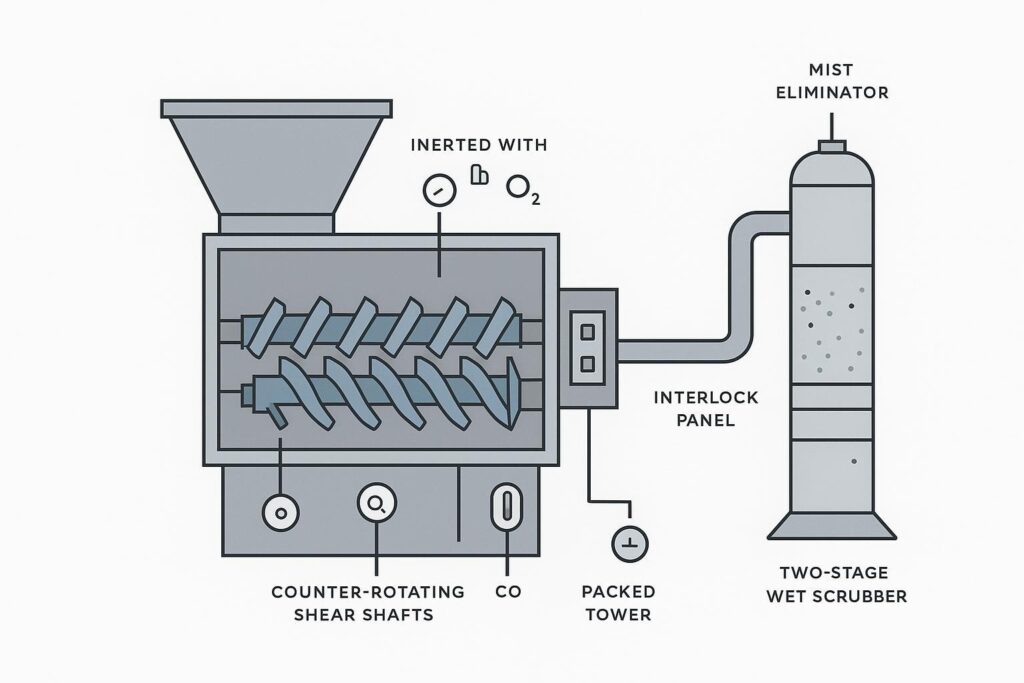
Измельчение литий-ионных аккумуляторов (LIB) — это одна из тех операций, где “механический” и “химический” миры сталкиваются наихудшим образом: высокая накопленная электрическая энергия, легковоспламеняющиеся пары электролита, электропроводящая пыль и коррозионно-активные отходящие газы.
В данном руководстве рассматривается концепция безопасного проектирования (safety-by-design), к которой приходят многие предприятия: низкоскоростной сдвиг встречно вращающимися ножами в контролируемой атмосфере (часто инертной, иногда в жидкой среде), поддерживаемый блокировками, мониторингом и нейтрализацией HF. Оно написано в том же строгом техническом стиле, ориентированном на документацию, который Maxtor Metal использует при обсуждении качества ножей для шредеров и методов их проверки, поскольку детали, обеспечивающие непрерывную работу линии, обычно являются теми же деталями, которые обеспечивают ее безопасность.
На ранних этапах пусконаладочных работ специалисты часто обнаруживают, что те же самые “скучные” переменные, которые определяют время безотказной работы — геометрия ножей, соблюдение зазоров и документация по контролю качества — также влияют на риски возникновения аварийных ситуаций. Если вам нужен ориентир для понимания того, как обычно формулируются требования к прецизионному контролю и допускам для ножей шредеров, страница ножей для шредеров / измельчителей Maxtor Metal служит одним из практических примеров.
Краткий ответ:
- Почему низкоскоростной сдвиг снижает энергию зажигания и образование пыли Низкоскоростной сдвиг ограничивает энергию удара, снижает фрикционный нагрев по сравнению с высокоскоростным дроблением и обеспечивает более крупный и контролируемый рез. На практике это означает меньшее количество локальных зон перегрева и меньшую концентрацию взвешенной в воздухе электропроводящей пыли — оба этих фактора критически важны, когда поврежденные ячейки могут выделять горючие газы. В типичном низкоскоростном шредере со сдвиговым принципом работы цель состоит в предсказуемой резке, а не в измельчении в порошок.
- Профиль рисков: тепловой разгон, коррозия под воздействием HF, время безотказной работы и соответствие требованиям Последствия тяжелых аварий не ограничиваются только пожарами. Тепловой разгон может распространяться; фтороводород (HF) может травмировать персонал и вызывать коррозию оборудования; а любой инцидент способен остановить производство, повлечь за собой обязательства по отчетности и поставить под угрозу действие разрешительной документации.
- Что охватывает данное руководство (методы контроля, материалы, мониторинг) и чего оно избегает (закрытые настройки) Вы получите многоуровневое представление о мерах предотвращения, обнаружения и нейтрализации, а также о выборе материалов для работы в условиях воздействия HF. Чего вы здесь не найдете, так это запатентованных уставок, специфических рецептур производителей или “магических чисел”, которые должны определяться вашим уполномоченным органом (AHJ), анализом опасностей технологического процесса (PHA) и валидационными испытаниями.
Ключевые требования к комплаенсу (соответствию стандартам)
Измельчение только на специализированных предприятиях утилизации
Если вы осуществляете обращение с батареями в рамках федеральной системы регулирования универсальных отходов (universal waste), EPA (Агентство по охране окружающей среды США) четко разъяснило, что измельчение не является допустимым видом деятельности для операторов по обращению с универсальными отходами— это деятельность, осуществляемая исключительно на конечных объектах утилизации. По заявлению самого EPA, батареи могут измельчаться для вторичной переработки на конечном объекте (например, предприятии по переработке опасных отходов или объекте TSDF, имеющем лицензию RCRA), и после доставки туда батареи больше не регулируются как универсальные отходы в прежнем порядке.Часто задаваемые вопросы EPA о нормативном статусе переработки литиевых батарей (PDF)
Ключевой вывод: Если вы составляете стандартные операционные процедуры (СОП) для измельчения литиевых батарей, классифицируемых как универсальные отходы, рассматривайте измельчение как операцию, выполняемую на конечном объекте утилизации, и соответствующим образом документируйте критерии передачи и приемки.
Лимиты и роли при обращении с универсальными отходами
Категория универсальных отходов создана для упрощения сбора и обращения с распространенными опасными отходами (включая батареи), при этом по-прежнему требуя обращения, исключающего их утечку или выброс. Стандарты обращения с универсальными отходами 40 CFR Part 273. Поскольку программы отдельных штатов могут быть более строгими, рассматривайте Part 273 как федеральный базовый уровень, а затем проверяйте требования, принятые (или расширенные) в вашем штате.
Руководство OSHA/NIOSH по воздействию HF
Фтороводород (HF) представляет собой технологическую опасность, поскольку он может выделяться при повреждении, перегреве или возгорании батарей, а также потому, что он создает как риск получения острых травм, так и долгосрочные проблемы с коррозией.
С точки зрения защиты работников:
| Источник | Метрическая | Значение / Ссылка |
|---|---|---|
| OSHA | Предельно допустимый уровень воздействия (потолочный) | 3 ppm фтороводорода (потолочное значение) — см. пределы воздействия фтороводорода OSHA |
| НИОШ | Карта аварийного реагирования | Влияние на здоровье и рекомендуемые пределы — см. карту аварийного реагирования NIOSH для фтороводорода |
| НИОШ | IDLH (немедленная угроза жизни или здоровью) | Значение концентрации, представляющей непосредственную угрозу для жизни или здоровья — см. значение IDLH NIOSH для фтороводорода |
⚠️ Предупреждение: Поражение HF может быть тяжелым и иногда проявляться с задержкой. Рассматривайте мониторинг, выбор СИЗ, готовность аварийных фонтанов для глаз/душей и планирование медицинской помощи как неотъемлемую часть проектирования технологического процесса, а не как “дополнения по охране труда и технике безопасности”.”
Суммируя: измельчение батарей является деятельностью, осуществляемой на конечном объекте утилизации в соответствии с правилами обращения с универсальными отходами, а пределы воздействия HF по стандартам OSHA/NIOSH должны рассматриваться как ключевые исходные данные для проектирования процесса, а не просто как формальные документы по охране труда.
Опасности при измельчении (шредировании) литий-ионных батарей

Факторы запуска и распространение теплового разгона
Тепловой разгон может быть инициирован внутренними короткими замыканиями, механическим повреждением, перегревом или дефектами. В условиях измельчения наиболее актуальными триггерами обычно являются механические и электрические факторы: раздавливание или сдвиг, приводящие к замыканию электродов, повреждение сепараторов и остаточный уровень заряда. Как только начинается выделение газов, горючие газы могут воспламениться при наличии кислорода и источника зажигания.
Публичные руководства NFPA по литий-ионным аккумуляторам ориентированы на широкую аудиторию, однако их ключевой посыл напрямую применим к процессам переработки: аккумуляторы могут воспламеняться и приводить к серьезным пожарам, поэтому они требуют специализированного обращения, а не классификации как “стандартные отходы”. Руководство NFPA по пожарной опасности литий-ионных аккумуляторов.
Гидролиз LiPF6 с выделением HF и коррозия
В электролитах многих литий-ионных аккумуляторов (LIB) используется LiPF6. При наличии влаги (влажность воздуха, вода для промывки, вода для пожаротушения или влажное сырье) LiPF6 может гидролизоваться с выделением HF. Для предприятий это представляет угрозу как для здоровья персонала, так и для целостности оборудования: HF разрушает стекло, многие эластомеры, а также может ускорять коррозию и питтингообразование в чувствительных сплавах.
Механические и электрические опасности при измельчении
Даже при “низкоскоростном” измельчении шредирование создает классические промышленные риски:
- Механические зоны защемления и риски выброса материала в зонах загрузки
- Опасность высвобождения накопленной энергии из застрявших модулей, которые могут спружинить или сместиться
- Риски поражения электрическим током и возникновения дуги из-за остаточного напряжения и токопроводящих осколков
- Dust explosibility/flash hazards when fine conductive particles accumulate in the wrong place
A useful way to manage this is to treat the shredder cell as a controlled process unit—not a “machine”—with defined boundaries, sensors, and interlocks.
Суммируя: LIB shredding hazards span thermal runaway, HF-forming corrosion, and standard mechanical/electrical risks—treating the shredder cell as a controlled process unit is what ties them together.
Инженерно-технические меры предотвращения возгорания
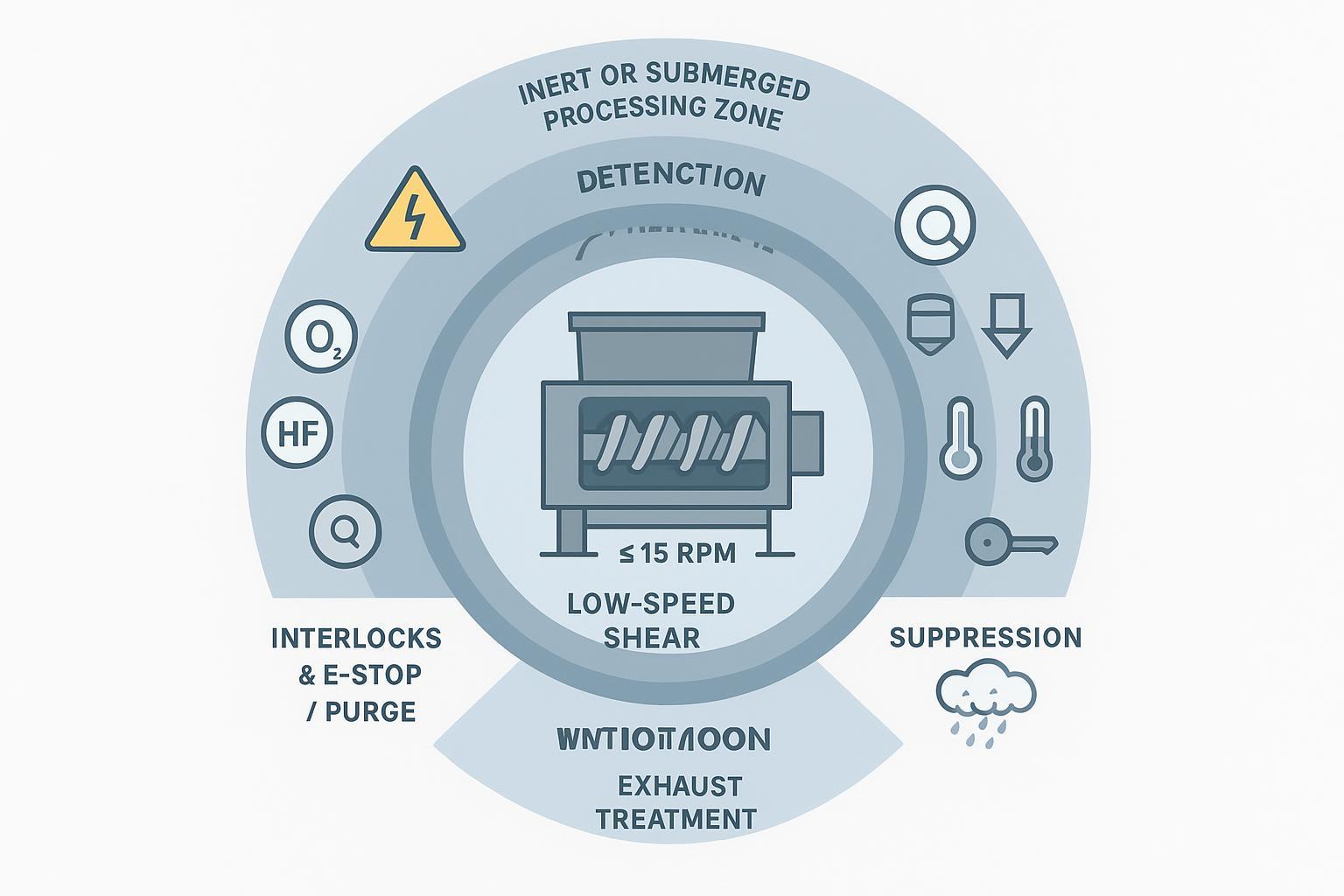
Atmosphere control: inert or submerged
If you take one design lesson from battery incidents, it’s that oxygen management is strategy, not tactic.
Two common architectures are:
- Inerted enclosure: The shredding chamber and immediate transfer volumes are sealed and inerted (often with nitrogen) so that vented electrolyte vapors are less likely to find an ignitable mix.
- Submerged / wet processing: Some lines keep the cut zone submerged or flooded to absorb heat, limit airborne dust, and reduce vapor-phase ignition potential.
Neither approach is “set and forget.” The practical requirement is verification: demonstrate that atmosphere control is actually maintained during transient events (feed changes, jams, door openings, maintenance states).
≤15 RPM counter-rotating shear and clearance
Why the outline’s ≤15 RPM emphasis matters: low shaft speed limits kinetic energy transfer and reduces the likelihood that you turn the process into impact milling. But the more subtle control is clearance discipline.
Low-speed shear works when:
- The process favors controlled cutting rather than violent rupture
- The shredder doesn’t “hammer” intact cells repeatedly
- Knife-to-knife and knife-to-counterknife clearances are consistent, verified, and maintained
The tolerance chain behind that clearance consistency—including GD&T callouts, spacer selective fit, and post-assembly TIR verification—is covered in Multi-shaft Blade Tolerance Stacking: GD&T Controls, Spacer Selective Fit, and Post-assembly TIR Verification.
Ключевой вывод: For LIBs, “slow” is not a safety control by itself; slow + controlled shear geometry + controlled clearances + atmosphere control is the package.
Detection, interlocks, and water/mist suppression
Detection is what turns a hazardous process into a managed process.
A practical monitoring/interlock stack often includes:
- O2 monitoring (to verify inerting and detect air ingress)
- CO monitoring (early combustion indicator)
- HF monitoring (to protect people and to confirm scrubbing performance where installed)
- Температура at key points (chamber, bearings, exhaust, downstream transfer)
- Motor current / torque trend (jam and abnormal friction indicator)
Interlocks should be designed around outcomes, not alarms:
- Alarm → controlled stop or feed inhibit
- Alarm → inert purge / isolation sequence
- Alarm → activation of water/mist or deluge (where the facility’s fire strategy supports it)
Maxtor Metal’s shredder knife documentation follows a similar trend-based logic: wear and clearance data are tracked across each maintenance cycle rather than verified only once at commissioning.
EPA’s guidance for used lithium-ion batteries emphasizes a practical reality: lithium batteries can cause fires during handling and transport, so prevention and separation are central.EPA guidance on used lithium‑ion batteries.
Response playbook (non-numeric)
To keep this guide actionable без publishing unsafe “magic numbers,” use trend- and state-based triggers tied to clear operator actions.
If O₂ trends up / chamber pressure shifts (possible air ingress)
- Inhibit feed; hold the line in a controlled state
- Verify door seals, inspection ports, and sampling-line integrity
- Restore inerting and confirm stability before resuming
If CO appears or rises (early combustion indicator)
- Stop feed and upstream conveying
- Follow the site’s escalation path (operator → EHS → incident response)
- Execute the predefined isolation / purge / suppression sequence for the shredder cell
If HF alarms or acid mist is suspected (exposure + corrosion risk)
- Stop feed; keep personnel out of the cell boundary until conditions are verified
- Confirm scrubber + mist eliminator function; inspect sample conditioning (filters, moisture separators)
- Resume only after the cause is identified and controls are restored
If chamber temperature rises abnormally (process upset)
- Stop feed; verify no mechanical binding or repeated “hammering” of intact cells
- Check bearing temperatures and exhaust temperature trends; inspect for abnormal friction sources
If motor current / torque becomes unstable (jam / abnormal friction)
- Stop feed; execute the jam-recovery procedure (do not force restart)
- Require post-event inspection and supervisor authorization before resuming
Примечание: Treat transient states—door opening/closing, restart, material transition, and blockage recovery—as the highest-risk scenarios for drift, air ingress, and control-logic gaps. Validate interlocks specifically in these states during FAT/SAT and recurring EHS drills.
Суммируя: no single control is sufficient—low-speed shear, clearance discipline, atmosphere control, and outcome-based interlocks function together as one layered system.
Выбор материалов и промышленных ножей
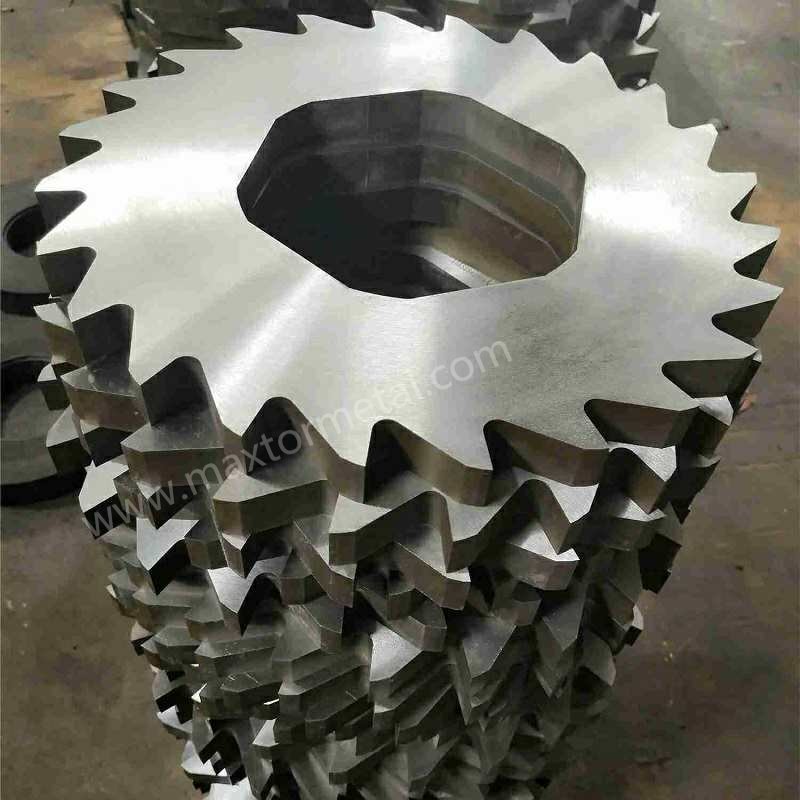
AISI 440C: wear benefits, HF limits, mitigations
AISI 440C is often chosen where wear resistance and edge retention matter, and it performs well in many abrasive, mixed-feed shredding environments. But HF changes the conversation.
Practical limitations in HF-exposed service:
- HF can accelerate corrosion and pitting at vulnerable sites (crevices, threads, under deposits)
- Corrosion can undercut the edge and degrade predictable wear patterns
Mitigations to consider:
- Keep HF in the gas path controlled with upstream scrubbing and mist elimination (don’t let acid mist become “ambient”)
- Favor designs that minimize crevices and trapped condensate
- Use inspection intervals and replacement criteria tied to measured corrosion, not calendar time
In programs Maxtor Metal has supported for corrosive-feed applications, knife deliveries included CMM dimensional reports and heat-treatment certifications — giving maintenance teams traceable baseline records for wear inspection and audit-ready commissioning.
Wetted components, seals, and coatings for HF
For wetted and condensate-prone areas (scrubber inlets, mist eliminators, drains, and any “cold spots” that condense acids), prioritize materials compatibility.
At a high level:
- Select elastomers and plastics based on verified HF compatibility in your concentration/temperature range
- Avoid mixed-metal galvanic couples in wet acidic zones
- Treat coatings as systems: surface prep, thickness control, holiday testing, and repair procedures matter as much as the nominal coating name
Maxtor Metal specifies wetted-component material compatibility at the design-review stage for corrosive-feed projects, rather than leaving it to field substitution after installation.
Installation tolerances and quick-change strategy
The fastest way to turn a safety design into an incident is to let installation drift.
A robust approach includes:
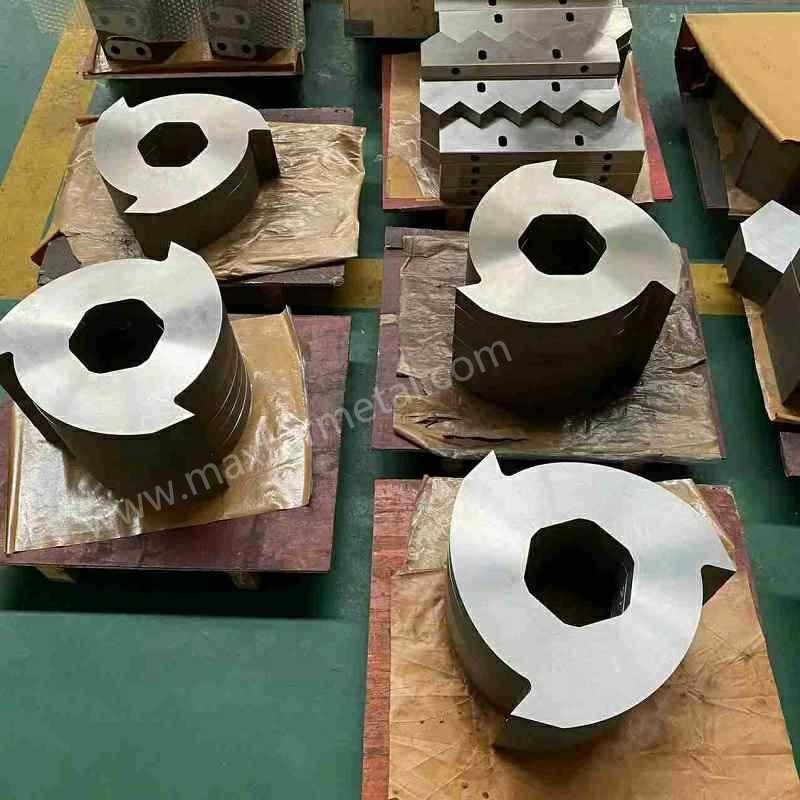
- Documented tolerances for knife seating, parallelism, and runout
- A repeatable quick-change procedure that preserves the critical geometry
- A verification step after every knife change (not just after “major” maintenance)
This is also where technical procurement and maintenance meet: if your replacement knives do not reliably meet the required tolerances, you inherit both uptime risk and hazard risk.
Maxtor Metal’s shredder knife line documents seating, parallelism, and runout tolerances as part of standard delivery, so this verification step doesn’t depend on the buyer reverse-engineering acceptance criteria.
For a complete incoming-inspection workflow covering GD&T spec control, CMM sampling plans, and MTR documentation for shredder knives, see Закупка ножей для измельчителей (послепродажное обслуживание): Контроль спецификаций, план CMM, проверка MTR и верификация функциональной посадки..
Суммируя: 440C remains a strong wear-resistance choice for HF-exposed shredding, provided corrosion is managed through upstream scrubbing, crevice-minimizing design, and condition-based (not calendar-based) replacement.
Очистка воздуха и сточных вод от HF (фтористоводородной кислоты)
Two-stage wet scrubbing: venturi + packed tower
When HF and acid mists are credible byproducts, off-gas treatment is part of the process boundary.
A common high-level architecture is:
- Venturi scrubber (high-energy contact to capture fine droplets/particles and knock down soluble gases)
- Packed tower (additional contact time for mass transfer and neutralization)
The exact chemistry and operating targets are site-specific, but the design intent is universal: keep corrosive and toxic species out of occupied areas and out of downstream equipment.
Mist elimination and continuous HF monitoring
Mist elimination is easy to under-budget and expensive to ignore.
If acid mist leaves the scrubber:
- It corrodes ductwork and fans
- It creates exposure risk in maintenance tasks
- It contaminates sensors and causes false confidence
Where HF monitoring is deployed, treat it like an instrumented safety function: calibration discipline, sample conditioning, and defined responses to sensor fault states.
Fluoride precipitation and sludge handling
Scrubbing and neutralization often convert gaseous HF into fluoride-containing wastewater streams.
At a conceptual level, facilities commonly plan for:
- Fluoride precipitation/neutralization steps (chemistry chosen to meet discharge requirements)
- Solid-liquid separation
- Managed handling and disposal of fluoride-bearing sludge under applicable waste rules
Do not treat this as a “utilities” afterthought. If wastewater handling is capacity-limited, it becomes a throughput constraint.
Суммируя: HF treatment doesn’t end at the scrubber outlet—mist elimination and fluoride-bearing sludge handling are equally load-bearing parts of the system.
FAQ
В: Каковы основные опасности при измельчении (шредировании) литий-ионных батарей?
Тепловой разгон и возгорание являются главными рисками, однако при измельчении предприятия также сталкиваются с опасностями выделения токсичных/коррозионных газов (включая фтороводород HF), рисками образования токопроводящей пыли, а также с электрическими и механическими опасностями.
В: Почему низкоскоростное сдвиговое измельчение безопаснее для шредирования литий-ионных батарей?
Низкоскоростной сдвиг снижает энергию удара и фрикционный нагрев по сравнению с высокоскоростным дроблением, а также минимизирует образование летучей мелкодисперсной пыли — особенно при оптимизированных зазорах между ножами и контроле защитной атмосферы.
В: Можно ли измельчать литий-ионные батареи в рамках правил обращения с универсальными отходами (Universal Waste Rules)?
Агентство по охране окружающей среды США (EPA) разъяснило, что операторы по обращению с универсальными отходами не могут измельчать батареи в рамках текущей деятельности; шредирование для последующей переработки должно выполняться только на специализированном целевом предприятии (destination facility).
В: Какие датчики обычно используются в инертной камере для шредирования батарей?
На предприятиях обычно контролируют уровень кислорода (для проверки инертности среды), оксид углерода (индикатор горения), температуру, а также показатели тока/крутящего момента двигателя. В местах, где существует реальная опасность выделения HF, может быть добавлен мониторинг HF для контроля воздействия на персонал и проверки выхлопных газов.
В: Каковы нормы OSHA и NIOSH по воздействию фтороводорода (HF)?
OSHA устанавливает предельно допустимый уровень воздействия (PEL) для фтороводорода на уровне 3 ppm (максимальная/потолочная концентрация). NIOSH предоставляет рекомендуемые лимиты (REL) и плановые значения для острых опасностей.
В: Как образуется фтороводород (HF) в процессе шредирования или переработки литий-ионных батарей?
HF может образовываться, когда соли электролита, такие как LiPF6, вступают в реакцию с влагой (влажность воздуха, вода для промывки или пожаротушения), а также может выделяться при перегреве и возгорании.
В: Каков практический способ контроля выбросов HF при шредировании батарей?
Рассматривать шредер как герметичную технологическую установку и направлять отходящие газы на мокрую очистку (wet scrubbing) с эффективным каплеуловителем (mist eliminator) при поддержке процедур мониторинга и техобслуживания, предотвращающих попадание кислотного тумана в рабочие зоны.
В: Какие ключевые показатели эффективности (KPI) следует отслеживать для раннего обнаружения сбоев при шредировании батарей?
Следите за стабильностью пропускной способности (производительности), отклонением гранулометрического состава (особенно фракции мелкой пыли), тенденцией тока/крутящего момента двигателя, ключевыми температурами (камеры, выхлопных газов, подшипников) и уровнем HF в ppm (при наличии мониторинга).
Заключение
- Recap: controls to cut ignition, HF exposure, and downtime/ton The safest LIB shredding lines don’t rely on a single control. They stack low-speed shear, controlled atmosphere (inert or submerged), gas/temperature/current monitoring with interlocks, и suppression + scrubbing so that a bad cell becomes a managed upset, not an incident.
- KPIs: throughput stability, particle size control, current draw, temp, HF ppm Track a small set of “truth” signals:
| KPI | Цель |
|---|---|
| Throughput stability | Detect unexplained process drift |
| Particle size distribution stability | Catch sudden fines spikes |
| Motor current trend | Proxy for friction/jam risk |
| Temperature (chamber/exhaust/bearings) | Early process-upset indicator |
| HF ppm (where measured) | Workplace exposure & exhaust verification |
The same documentation discipline that supports commissioning—traceable knife records, lot-level QC packs, and CMM reports—is standard practice in Maxtor Metal’s shredder knife supply; see the audit-ready procurement guide for a compatible receiving-dossier structure.
- Next steps: AHJ coordination, validation tests, SOP updates Coordinate early with your AHJ and permitting contacts, then validate controls with controlled tests: loss-of-inerting scenarios, jam recovery, shutdown and door-open states, and sensor/interlock proof testing. Update SOPs so maintenance and knife changes preserve the same verified clearances and safety functions.When you’re tightening up commissioning documentation, it can help to benchmark how knife tolerances and inspection are specified in practice; the shredder knife tolerance and inspection specifications provide concrete examples of tolerance language and inspection methods.
Джерри Чу — Technical Support Specialist, After-sales Service, Maxtor Metal. Jerry has 10 лет of cross-industry field experience (papermaking, plastics recycling/shredding, metal slitting, woodworking) helping resolve practical cutting issues such as burrs, excessive dust, and unstable cut quality.
Сертификаты: PMP, CMRP.
Обзор, область применения и версия документа
- Область применения: Information-only best-practices guidance for engineering/EHS planning. It does not replace site-specific hazard analysis, OEM instructions, or requirements from your Authority Having Jurisdiction (AHJ).
- How to use: Validate controls, interlocks, and operating procedures through PHA/HAZOP and commissioning tests (FAT/SAT) before production.
- Версия: v1.1
- Последнее обновление: 2026-07-12
Обзор валидации (анонимизированный): Логика блокировок и многопараметрического мониторинга
The following anonymized commissioning snapshot illustrates как facilities commonly verify interlocks and multi-parameter monitoring logic without disclosing sensitive setpoints or control code.
Цель
Verify that the interlock stack can detect abnormal conditions and maintain the intended safety boundary during transient states—not merely that individual sensors function in isolation.
Covered signals (trend-based)
- O₂ trend
- CO trend
- HF monitoring effectiveness (sampling integrity + conditioning)
- Shredder chamber temperature
- Main motor current/torque trend
- Conveyor synchronization status
Method (as part of SAT)
Validation ran across multiple shifts and included typical operating states:
- Normal continuous feeding
- Simulated high-SOC battery mix-in scenario
- Blockage recovery
- Restart after shutdown
- Maintenance door open/close confirmation
- N₂ system switching drill
- Sensor inspection and alarm-function checks
All alarms and responses were compared using PLC event logs and SCADA historical trends, with emphasis on Sequence of Events (SoE) correctness rather than chasing fixed numeric targets.
Observed learnings (trend-level)
- Door open/close produced the clearest transient response: O₂ exhibited brief fluctuations and chamber pressure shifted slightly after door closure—highlighting that seal recovery speed can be more critical than machine response time.
- Blockage recovery showed higher process variability: after clearing a jam, motor current fluctuations increased, chamber temperature rose temporarily, and gas-trend stability degraded for a short period—making recovery phases a priority target for interlock protection.
- Acid mist influenced sampling maintenance intervals: after continuous operation, HF sampling remained functional, but sampling filters accumulated deposits and moisture separators required earlier maintenance; maintenance intervals were adjusted accordingly.
- Operator behavior changed alarm frequency: gradual feed reintroduction reduced nuisance current alarms compared with “full-load immediately” restart behavior; SOPs were updated and operator simulation training was added.
Automatic actions on interlock activation (generic)
- Stop material feeding and upstream conveying
- Maintain shredder rotation per the programmed safe sequence
- Activate suppression and/or inerting support where applicable
- Notify operator and EHS
- Require alarm acknowledgment before restart
- Record complete event history for investigation
Post-validation improvements (examples)
- Door seal inspection strengthened; gasket replacement checklist added
- Sampling-line cleaning frequency increased; routine sensor-response verification added
- Restart confirmation logic added to prevent immediate full-feed after an alarm clears
- Training expanded for blockage recovery, maintenance restart, and alarm acknowledgment
Суммируя: transient states—door openings, restarts, and blockage recovery—produced the largest deviations in this SAT validation, making them the priority target for interlock testing.
Public-information limits
Public summaries typically avoid disclosing: numeric setpoints (O₂/CO/HF), control code, SIS configuration, N₂ flow strategy, suppression start conditions, SOC ratios, customer throughput, equipment models, and detailed time-stamped event timelines.
Ссылки и стандарты (избранные)
Government / official guidance
- EPA — Lithium Battery Recycling Regulatory Status (FAQ PDF). https://rcrapublic.epa.gov/files/14957.pdf
- eCFR — 40 CFR Part 273: Standards for Universal Waste Management. https://www.ecfr.gov/current/title-40/chapter-I/subchapter-I/part-273
- OSHA — Hydrogen Fluoride: Exposure Limits. http://www.osha.gov/chemicaldata/622
- NIOSH — Emergency Response Card: Hydrogen Fluoride. https://www.cdc.gov/niosh/ershdb/emergencyresponsecard_29750030.html
- NIOSH — IDLH: Hydrogen fluoride. https://www.cdc.gov/niosh/idlh/7664393.html
- NFPA — Lithium‑ion battery fire risk (public guidance). https://www.nfpa.org/education-and-research/energy-transition/lithium-ion-batteries
- EPA — Used lithium‑ion batteries (handling and fire-prevention guidance). https://www.epa.gov/recycle/used-lithium-ion-batteries
Standards bodies (for further reading and project-specific compliance mapping)
- NFPA — Codes & standards catalog (includes fire protection and related standards). https://www.nfpa.org/codes-and-standards
- UL Standards — Standards catalog (includes battery safety standards; confirm the exact applicable standard(s) for your products and process). https://www.ulstandards.com/
- IEC — Standards catalog (international electrotechnical standards; confirm applicability). https://www.iec.ch/standards
- ANSI — Standards catalog (U.S. national standards portal). https://www.ansi.org/standards

 English
  Spanish
  Italian
  French
  Portuguese
  Russian
  German
  Arabic
  Hindi
Hindi  Vietnamese
  Indonesian
  Japanese
  Korean