

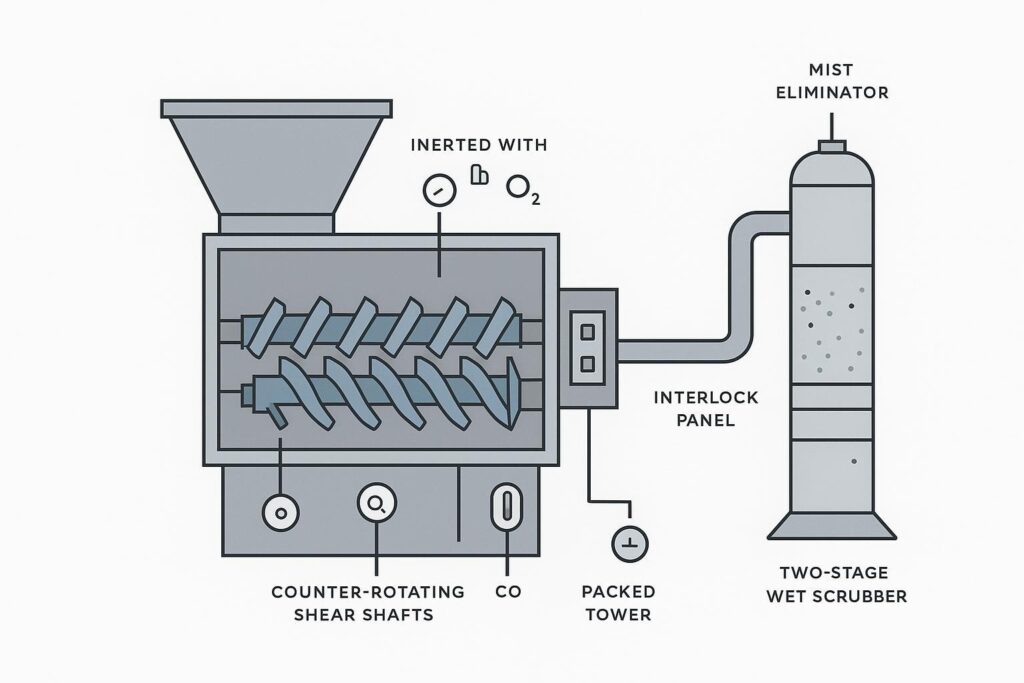
リチウムイオン電池(LIB)の破砕(減容化)は、「機械的」世界と「化学的」世界が最悪の形で衝突するプロセスのひとつです。そこには、高い蓄電エネルギー、可燃性の電解液蒸気、導電性粉塵、そして腐食性のオフガスが潜んでいます。.
本ガイドでは、多くの施設が採用しつつある「本質安全設計(safety-by-design)」アプローチに焦点を当てています。 低速・対向回転式シャー(剪断) 制御された雰囲気下(多くは不活性化、時には液中)で行われ、インターロック、モニタリング、およびHF(フッ化水素)処理によって裏付けられています。本書は、Maxtor Metalがシュレッダー刃の品質や検証プロセスを議論する際と同様に、「文書化(エビデンス)重視」の視点で執筆されています。なぜなら、ラインの稼働を維持するための細部こそが、安全性を維持するための細部でもあるからです。.
試運転の初期段階において、稼働率を左右する「退屈な」変数(刃の形状、クリアランス管理、品質保証文書など)が、そのままハザード(危険)の発生結果をも左右することに、多くのチームが気づかされます。シュレッダー刃の精密検査や公差の仕様が通常どのように規定されているか、参考基準が必要な場合は、 Maxtor Metalのシュレッダー刃/破砕刃のページ が実用的な一例となります。.
クイックサマリー:
- なぜ低速剪断が着火エネルギーと粉塵を低減するのか 低速剪断は衝撃エネルギーを制限し、高速破砕と比較して摩擦熱を抑え、より粗く制御された切断を行う傾向があります。実際、これによりホットスポットの発生が減り、空気中の導電性微粉末も減少します。これらは、損傷したセルから可燃性ガスが放出される可能性がある場合に極めて重要です。一般的な低速剪断式シュレッダーにおいて、目的は「予測可能な切断」であり、「粉砕(微細化)」ではありません。.
- リスクプロファイル:熱暴走、HF腐食、稼働率、およびコンプライアンス 重大な結果をもたらす事象は、単なる火災にとどまりません。熱暴走は連鎖(伝播)する可能性があり、HF(フッ化水素)は人体に危害を及ぼし設備を腐食させます。また、事故が発生すれば生産が停止し、報告義務が生じ、操業許可が脅かされることになります。.
- 本ガイドがカバーする内容(管理、材質、モニタリング)と、カバーしない内容(独自の独自設定) 本書では、予防、検知、処理に関する多層的な管理策に加え、HF暴露に対する材質の選択肢について解説します。一方で、管轄官庁(AHJ)、プロセス危険性分析(PHA)、および検証テストによって決定されるべき、独自の基準値、メーカー固有のレシピ、あるいは「魔法の数字」は提供しません。.
コンプライアンスの必須要件(規制適合基準)
処分施設(Destination Facilities)のみでの破砕
連邦ユニバーサル廃棄物(Universal Waste)の枠組みの下でバッテリーを管理している場合、EPA(環境保護庁)は以下を明確に規定しています。 破砕はユニバーサル廃棄物取扱者(Handlers)に認められた管理活動ではない――これは処分施設(Destination Facility)の活動です。EPAの言葉を借りれば、バッテリーは処分施設(有害廃棄物リサイクル業者やRCRA許可を受けたTSDFなど)においてリサイクルのために破砕することができ、到着後は同様のユニバーサル廃棄物としては規制されなくなります。.EPAのリチウム電池リサイクル規制状況に関するFAQ(PDF)
重要なポイント:もし、以下の標準作業手順書(SOP)を作成している場合は、 ユニバーサル廃棄物としてのリチウム電池の破砕, 、破砕を処分施設の業務として扱い、それに応じた引き渡し基準および受入基準を文書化してください。.
ユニバーサル廃棄物の制限と役割
ユニバーサル廃棄物は、一般的な有害廃棄物(バッテリーを含む)の回収と管理を合理化すると同時に、放出を防止する取り扱いを義務付けるように設計されています。その規制構造と定義は、以下に規定されています。 40 CFR Part 273 ユニバーサル廃棄物基準. 。州のプログラムはより厳格である可能性があるため、Part 273を連邦政府の基準(ベースライン)として扱い、その上で各州が採用(または拡張)している要件を確認してください。.
HF(フッ化水素)暴露に関するOSHA/NIOSHのガイダンス
フッ化水素(HF)は、バッテリーの損傷、過熱、または火災の際に発生する可能性があり、急性傷害のリスクと長期的な腐食の問題を同時にもたらすため、プロセス上のハザードとなります。.
労働者保護の観点から:
| ソース | メトリック | 基準値 / 参照先 |
|---|---|---|
| OSHA(労働安全衛生局) | 許容暴露限界(天井値) | フッ化水素 3 ppm(天井値) ―― OSHAのフッ化水素暴露限界を参照 |
| NIOSH(国立労働安全衛生研究所) | 緊急対応カード(Emergency Response Card) | 健康への影響と推奨限界値 ―― NIOSHのフッ化水素緊急対応カードを参照 |
| NIOSH(国立労働安全衛生研究所) | IDLH(生命または健康に対する即時の危険) | 生命または健康に直ちに危険を及ぼす濃度(IDLH値) ―― NIOSHのフッ化水素IDLH値を参照 |
⚠️警告:HFによる傷害は深刻であり、症状が遅れて現れることもあります。モニタリング、個人用保護具(PPE)の選定、緊急用洗眼器・シャワーの整備、および医療対応計画は、単なる「EHS(環境・健康・安全)の追加要素」ではなく、プロセス設計の一部として扱ってください。“
要するに: バッテリーの破砕はユニバーサル廃棄物規則における処分施設の活動であり、OSHA/NIOSHのHF暴露限界は、単なるEHSの事務手続きではなく、コアとなるプロセス設計のインプットとして扱われるべきです。.
リチウムイオン電池破砕における危険性(火災・爆発リスク)

熱暴走のトリガーと伝播
熱暴走は、内部短絡、機械的虐待(衝撃)、過熱、または欠陥によって引き起こされる可能性があります。破砕(減容化)環境において、関連するトリガーは通常、機械的および電気的なものです。すなわち、電極間を橋渡しする圧壊や剪断、セパレータの損傷、および残留充電状態(SOC)です。一度ガス放出(ベント)が始まると、酸素が存在し、かつ着火源がある場合、可燃性ガスが引火するおそれがあります。.
NFPAのリチウムイオンバッテリーに関する一般向けガイダンスは、より幅広い層を対象に書かれていますが、その要点はリサイクル作業に直接当てはまります。バッテリーは発火して重大な火災を引き起こす可能性があり、「一般廃棄物」としての前提ではなく、専用の取り扱いが必要であるということです。. リチウムイオンバッテリーの火災リスクに関するNFPAガイダンス.
LiPF6の加水分解によるHFの発生と腐食
多くのLIB電解液にはLiPF6が使用されています。水分(湿度、洗浄水、消火用水、または湿った原料)が存在すると、LiPF6が加水分解してHFを生成します。工場設備にとって、これは人体への曝露問題であると同時に、設備の健全性の問題でもあります。HFはガラスや多くのエラストマーを侵食し、影響を受けやすい合金の腐食やピッチング(孔食)を加速させる可能性があります。.
破砕・細粒化プロセスにおける機械的および電気的ハザード
「低速」であっても、シュレッダー処理は典型的な産業ハザードを引き起こします。
- 投入口における機械的な挟み込み(ピンチポイント)および飛散リスク
- 噛み込んだモジュールが跳ね返ったりずれたりすることによる、蓄積エネルギーのハザード
- Electrical shock/arc risks from residual voltage and conductive debris
- Dust explosibility/flash hazards when fine conductive particles accumulate in the wrong place
A useful way to manage this is to treat the shredder cell as a controlled process unit—not a “machine”—with defined boundaries, sensors, and interlocks.
要するに: LIB shredding hazards span thermal runaway, HF-forming corrosion, and standard mechanical/electrical risks—treating the shredder cell as a controlled process unit is what ties them together.
発火・着火を防止するエンジニアリングコントロール(設備的制御)
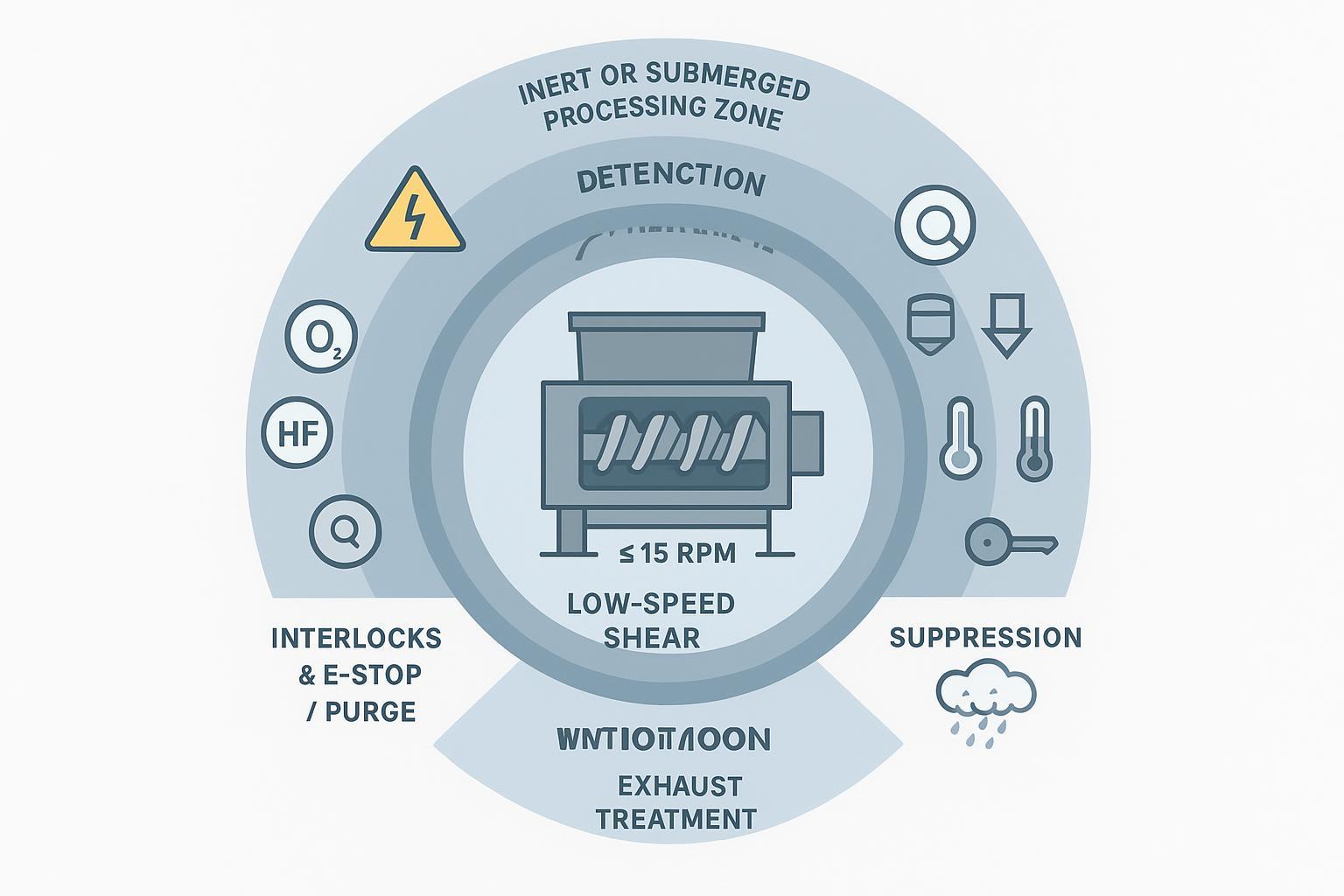
Atmosphere control: inert or submerged
If you take one design lesson from battery incidents, it’s that oxygen management is strategy, not tactic.
Two common architectures are:
- Inerted enclosure: The shredding chamber and immediate transfer volumes are sealed and inerted (often with nitrogen) so that vented electrolyte vapors are less likely to find an ignitable mix.
- Submerged / wet processing: Some lines keep the cut zone submerged or flooded to absorb heat, limit airborne dust, and reduce vapor-phase ignition potential.
Neither approach is “set and forget.” The practical requirement is verification: demonstrate that atmosphere control is actually maintained during transient events (feed changes, jams, door openings, maintenance states).
≤15 RPM counter-rotating shear and clearance
Why the outline’s ≤15 RPM emphasis matters: low shaft speed limits kinetic energy transfer and reduces the likelihood that you turn the process into impact milling. But the more subtle control is clearance discipline.
Low-speed shear works when:
- The process favors controlled cutting rather than violent rupture
- The shredder doesn’t “hammer” intact cells repeatedly
- Knife-to-knife and knife-to-counterknife clearances are consistent, verified, and maintained
The tolerance chain behind that clearance consistency—including GD&T callouts, spacer selective fit, and post-assembly TIR verification—is covered in マルチシャフトブレードの公差スタッキング:GD&T制御、スペーサー選択嵌合、および組立後のTIR検証.
重要なポイント: For LIBs, “slow” is not a safety control by itself; slow + controlled shear geometry + controlled clearances + atmosphere control is the package.
Detection, interlocks, and water/mist suppression
Detection is what turns a hazardous process into a managed process.
A practical monitoring/interlock stack often includes:
- O2 monitoring (to verify inerting and detect air ingress)
- CO monitoring (early combustion indicator)
- HF monitoring (to protect people and to confirm scrubbing performance where installed)
- 温度 at key points (chamber, bearings, exhaust, downstream transfer)
- Motor current / torque trend (jam and abnormal friction indicator)
Interlocks should be designed around outcomes, not alarms:
- Alarm → controlled stop or feed inhibit
- Alarm → inert purge / isolation sequence
- Alarm → activation of water/mist or deluge (where the facility’s fire strategy supports it)
Maxtor Metal’s shredder knife documentation follows a similar trend-based logic: wear and clearance data are tracked across each maintenance cycle rather than verified only once at commissioning.
EPA’s guidance for used lithium-ion batteries emphasizes a practical reality: lithium batteries can cause fires during handling and transport, so prevention and separation are central.EPA guidance on used lithium‑ion batteries.
Response playbook (non-numeric)
To keep this guide actionable それなし publishing unsafe “magic numbers,” use trend- and state-based triggers tied to clear operator actions.
If O₂ trends up / chamber pressure shifts (possible air ingress)
- Inhibit feed; hold the line in a controlled state
- Verify door seals, inspection ports, and sampling-line integrity
- Restore inerting and confirm stability before resuming
If CO appears or rises (early combustion indicator)
- Stop feed and upstream conveying
- Follow the site’s escalation path (operator → EHS → incident response)
- Execute the predefined isolation / purge / suppression sequence for the shredder cell
If HF alarms or acid mist is suspected (exposure + corrosion risk)
- Stop feed; keep personnel out of the cell boundary until conditions are verified
- Confirm scrubber + mist eliminator function; inspect sample conditioning (filters, moisture separators)
- Resume only after the cause is identified and controls are restored
If chamber temperature rises abnormally (process upset)
- Stop feed; verify no mechanical binding or repeated “hammering” of intact cells
- Check bearing temperatures and exhaust temperature trends; inspect for abnormal friction sources
If motor current / torque becomes unstable (jam / abnormal friction)
- Stop feed; execute the jam-recovery procedure (do not force restart)
- Require post-event inspection and supervisor authorization before resuming
注記: Treat transient states—door opening/closing, restart, material transition, and blockage recovery—as the highest-risk scenarios for drift, air ingress, and control-logic gaps. Validate interlocks specifically in these states during FAT/SAT and recurring EHS drills.
要するに: no single control is sufficient—low-speed shear, clearance discipline, atmosphere control, and outcome-based interlocks function together as one layered system.
刃物材質およびシュレッダー刃・ナイフの選定
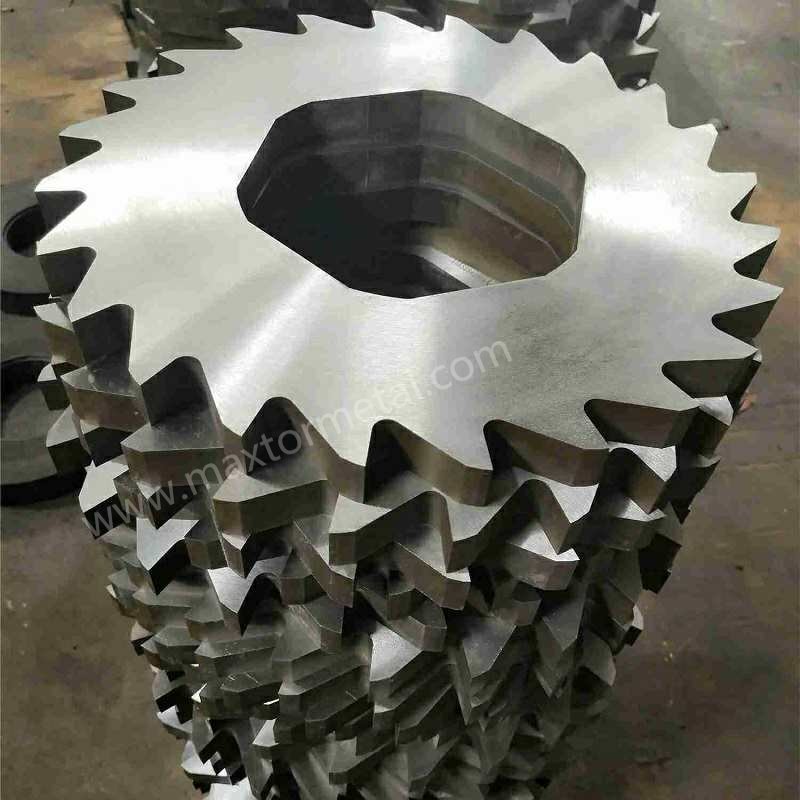
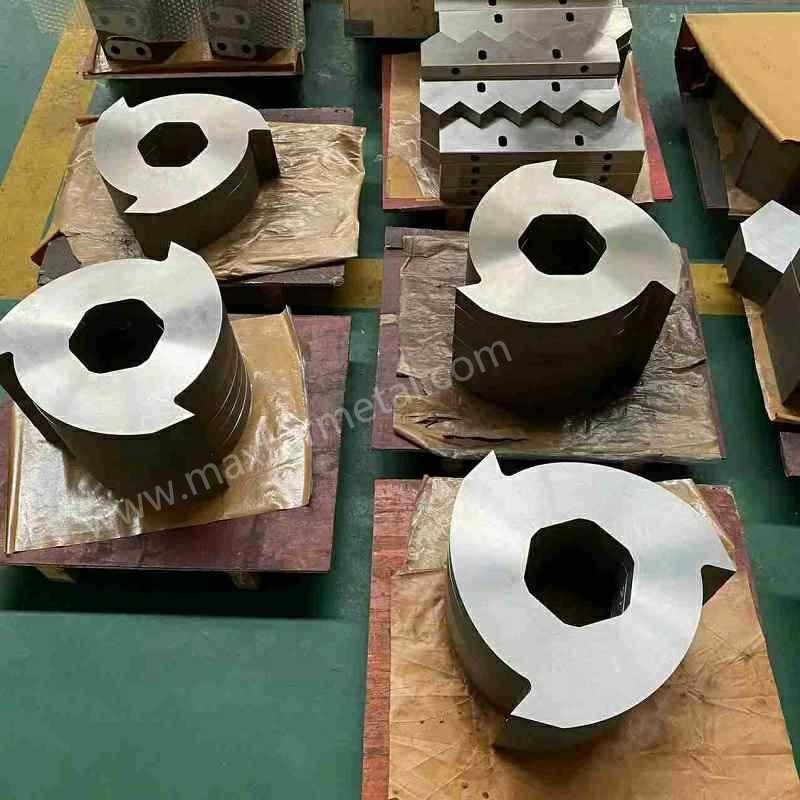
AISI 440C: wear benefits, HF limits, mitigations
AISI 440C is often chosen where wear resistance and edge retention matter, and it performs well in many abrasive, mixed-feed shredding environments. But HF changes the conversation.
Practical limitations in HF-exposed service:
- HF can accelerate corrosion and pitting at vulnerable sites (crevices, threads, under deposits)
- Corrosion can undercut the edge and degrade predictable wear patterns
Mitigations to consider:
- Keep HF in the gas path controlled with upstream scrubbing and mist elimination (don’t let acid mist become “ambient”)
- Favor designs that minimize crevices and trapped condensate
- Use inspection intervals and replacement criteria tied to measured corrosion, not calendar time
In programs Maxtor Metal has supported for corrosive-feed applications, knife deliveries included CMM dimensional reports and heat-treatment certifications — giving maintenance teams traceable baseline records for wear inspection and audit-ready commissioning.
Wetted components, seals, and coatings for HF
For wetted and condensate-prone areas (scrubber inlets, mist eliminators, drains, and any “cold spots” that condense acids), prioritize materials compatibility.
At a high level:
- Select elastomers and plastics based on verified HF compatibility in your concentration/temperature range
- Avoid mixed-metal galvanic couples in wet acidic zones
- Treat coatings as systems: surface prep, thickness control, holiday testing, and repair procedures matter as much as the nominal coating name
Maxtor Metal specifies wetted-component material compatibility at the design-review stage for corrosive-feed projects, rather than leaving it to field substitution after installation.
Installation tolerances and quick-change strategy
The fastest way to turn a safety design into an incident is to let installation drift.
A robust approach includes:
- Documented tolerances for knife seating, parallelism, and runout
- A repeatable quick-change procedure that preserves the critical geometry
- A verification step after every knife change (not just after “major” maintenance)
This is also where technical procurement and maintenance meet: if your replacement knives do not reliably meet the required tolerances, you inherit both uptime risk and hazard risk.
Maxtor Metal’s shredder knife line documents seating, parallelism, and runout tolerances as part of standard delivery, so this verification step doesn’t depend on the buyer reverse-engineering acceptance criteria.
For a complete incoming-inspection workflow covering GD&T spec control, CMM sampling plans, and MTR documentation for shredder knives, see アフターマーケット向けシュレッダーナイフ調達:仕様管理、CMMプラン、MTRバリデーション、および機能適合性検証。.
要するに: 440C remains a strong wear-resistance choice for HF-exposed shredding, provided corrosion is managed through upstream scrubbing, crevice-minimizing design, and condition-based (not calendar-based) replacement.
HF(フッ化水素)の排気ガスおよび排水処理対策
Two-stage wet scrubbing: venturi + packed tower
When HF and acid mists are credible byproducts, off-gas treatment is part of the process boundary.
A common high-level architecture is:
- Venturi scrubber (high-energy contact to capture fine droplets/particles and knock down soluble gases)
- Packed tower (additional contact time for mass transfer and neutralization)
The exact chemistry and operating targets are site-specific, but the design intent is universal: keep corrosive and toxic species out of occupied areas and out of downstream equipment.
Mist elimination and continuous HF monitoring
Mist elimination is easy to under-budget and expensive to ignore.
If acid mist leaves the scrubber:
- It corrodes ductwork and fans
- It creates exposure risk in maintenance tasks
- It contaminates sensors and causes false confidence
Where HF monitoring is deployed, treat it like an instrumented safety function: calibration discipline, sample conditioning, and defined responses to sensor fault states.
Fluoride precipitation and sludge handling
Scrubbing and neutralization often convert gaseous HF into fluoride-containing wastewater streams.
At a conceptual level, facilities commonly plan for:
- Fluoride precipitation/neutralization steps (chemistry chosen to meet discharge requirements)
- Solid-liquid separation
- Managed handling and disposal of fluoride-bearing sludge under applicable waste rules
Do not treat this as a “utilities” afterthought. If wastewater handling is capacity-limited, it becomes a throughput constraint.
要するに: HF treatment doesn’t end at the scrubber outlet—mist elimination and fluoride-bearing sludge handling are equally load-bearing parts of the system.
FAQ
Q: リチウムイオン電池の破砕加工における主な危険性は何ですか?
熱暴走(サーマルランナウェイ)と火災が最大の頭痛の種となるリスクですが、減容・破砕プロセス(サイズリダクション)中には、HF(フッ化水素)を含む毒性・腐食性ガスの発生、導電性粉塵による短絡、および電気的・機械的なトラブルのリスクにも直面します。
Q: リチウムイオン電池の破砕において、なぜ低速せん断(二軸式)の方が安全なのですか?
低速せん断式破砕は、高速回転による衝撃粉砕(ハンマークラッシャー等)と比較して、衝突エネルギーと摩擦熱の発生を大幅に抑制できます。さらに、適正な刃先隙間(クリアランス)管理や雰囲気制御と組み合わせることで、火災源となる空気中への導電性微粉塵の飛散を抑えることが可能です。
Q: ユニバーサル・ウェイスト規則(汎用有害廃棄物管理基準)の下で、リチウムイオン電池の破砕加工を行うことは可能ですか?
米国環境保護庁(EPA)は、ユニバーサル・ウェイストの取扱業者が通常の管理活動として電池を破砕することは認められないと明示しています。リサイクル目的の破砕処理は、最終処分・再資源化施設(Destination Facility)として認可された設備でのみ行うことができます。
Q: 不活性雰囲気(窒素パージ等)のバッテリー破砕室(セル)では、一般的にどのようなセンサーが使用されますか?
リサイクルプラントでは通常、酸素濃度(不活性化の検証用)、一酸化炭素(燃焼・異常発熱の指標)、温度、およびモーターの電流値・トルク変動トレンドを監視します。HF(フッ化水素)の発生リスクが想定されるラインでは、作業環境ばく露防止および排気検証のためにHFモニター・センサーが追加導入されます。
Q: フッ化水素(HF)のばく露に対するOSHA(米国労働安全卫生局)およびNIOSH(米国労働安全卫生研究所)の許容限界値(基準値)は?
OSHAはフッ化水素の許容ばく露限界(PEL)を3 ppm(天井値/Ceiling)と定めています。NIOSHは推奨ばく露限界(REL)および急性有害性計画値を提供しています。
Q: リチウムイオン電池の破砕やリサイクルプロセスの過程で、どのようにしてHF(フッ化水素)が発生するのですか?
HFは、LiPF6(六フッ化リン酸リチウム)などの電解質塩が水分(空気中の湿度、洗浄水、または消火用水)と反応することで生成されます。また、セルの異常発熱や火災発生時にも熱分解によってガスとして発生します。
Q: バッテリー破砕時のHF(フッ化水素)排出を抑制する実用的な方法は何ですか?
破砕機(シュレッダー)を完全密閉型のプロセスユニットとして設計し、発生した排ガスを強力なデミスター(気液分離ミストエリミネーター)を備えた湿式スクラバー(排ガス洗浄塔)に導入します。さらに、酸性ミストを作業エリアへ漏洩させないための厳格なモニタリングと定期メンテナンス手順を確立することが不可欠です。
Q: バッテリー破砕工段における初期の運転異常(アプセットコンディション)を検知するために、どのKPI(重要業績評価指標)を監視すべきですか?
処理能力(スループット)の安定性、粒度分布のズレ(特に微粉の発生比率)、モーターの電流値・トルクの変動トレンド、各部重要温度(破砕室/排気/ベアリング・軸受)、およびセンサーが設置されている場合はHF(フッ化水素)のppm濃度を監視してください。
結論
- Recap: controls to cut ignition, HF exposure, and downtime/ton The safest LIB shredding lines don’t rely on a single control. They stack low-speed shear, controlled atmosphere (inert or submerged), gas/temperature/current monitoring with interlocks、 そして suppression + scrubbing so that a bad cell becomes a managed upset, not an incident.
- KPIs: throughput stability, particle size control, current draw, temp, HF ppm Track a small set of “truth” signals:
| KPI | 目的 |
|---|---|
| Throughput stability | Detect unexplained process drift |
| Particle size distribution stability | Catch sudden fines spikes |
| Motor current trend | Proxy for friction/jam risk |
| Temperature (chamber/exhaust/bearings) | Early process-upset indicator |
| HF ppm (where measured) | Workplace exposure & exhaust verification |
The same documentation discipline that supports commissioning—traceable knife records, lot-level QC packs, and CMM reports—is standard practice in Maxtor Metal’s shredder knife supply; see the audit-ready procurement guide for a compatible receiving-dossier structure.
- Next steps: AHJ coordination, validation tests, SOP updates Coordinate early with your AHJ and permitting contacts, then validate controls with controlled tests: loss-of-inerting scenarios, jam recovery, shutdown and door-open states, and sensor/interlock proof testing. Update SOPs so maintenance and knife changes preserve the same verified clearances and safety functions.When you’re tightening up commissioning documentation, it can help to benchmark how knife tolerances and inspection are specified in practice; the shredder knife tolerance and inspection specifications provide concrete examples of tolerance language and inspection methods.
ジェリー・チュウ — Technical Support Specialist, After-sales Service, Maxtor Metal. Jerry has 10年 of cross-industry field experience (papermaking, plastics recycling/shredding, metal slitting, woodworking) helping resolve practical cutting issues such as burrs, excessive dust, and unstable cut quality.
認定資格: PMP, CMRP.
レビュー、適用範囲、および改订バージョン
- 範囲: Information-only best-practices guidance for engineering/EHS planning. It does not replace site-specific hazard analysis, OEM instructions, or requirements from your Authority Having Jurisdiction (AHJ).
- How to use: Validate controls, interlocks, and operating procedures through PHA/HAZOP and commissioning tests (FAT/SAT) before production.
- Version: v1.1
- 最終更新日: 2026-07-12
SATバリデーション事例(匿名化):インターロックおよびマルチパラメータ(多変量)監視ロジック
The following anonymized commissioning snapshot illustrates どうやって facilities commonly verify interlocks and multi-parameter monitoring logic without disclosing sensitive setpoints or control code.
客観的
Verify that the interlock stack can detect abnormal conditions and maintain the intended safety boundary during transient states—not merely that individual sensors function in isolation.
Covered signals (trend-based)
- O₂ trend
- CO trend
- HF monitoring effectiveness (sampling integrity + conditioning)
- Shredder chamber temperature
- Main motor current/torque trend
- Conveyor synchronization status
Method (as part of SAT)
Validation ran across multiple shifts and included typical operating states:
- Normal continuous feeding
- Simulated high-SOC battery mix-in scenario
- Blockage recovery
- Restart after shutdown
- Maintenance door open/close confirmation
- N₂ system switching drill
- Sensor inspection and alarm-function checks
All alarms and responses were compared using PLC event logs and SCADA historical trends, with emphasis on Sequence of Events (SoE) correctness rather than chasing fixed numeric targets.
Observed learnings (trend-level)
- Door open/close produced the clearest transient response: O₂ exhibited brief fluctuations and chamber pressure shifted slightly after door closure—highlighting that seal recovery speed can be more critical than machine response time.
- Blockage recovery showed higher process variability: after clearing a jam, motor current fluctuations increased, chamber temperature rose temporarily, and gas-trend stability degraded for a short period—making recovery phases a priority target for interlock protection.
- Acid mist influenced sampling maintenance intervals: after continuous operation, HF sampling remained functional, but sampling filters accumulated deposits and moisture separators required earlier maintenance; maintenance intervals were adjusted accordingly.
- Operator behavior changed alarm frequency: gradual feed reintroduction reduced nuisance current alarms compared with “full-load immediately” restart behavior; SOPs were updated and operator simulation training was added.
Automatic actions on interlock activation (generic)
- Stop material feeding and upstream conveying
- Maintain shredder rotation per the programmed safe sequence
- Activate suppression and/or inerting support where applicable
- Notify operator and EHS
- Require alarm acknowledgment before restart
- Record complete event history for investigation
Post-validation improvements (examples)
- Door seal inspection strengthened; gasket replacement checklist added
- Sampling-line cleaning frequency increased; routine sensor-response verification added
- Restart confirmation logic added to prevent immediate full-feed after an alarm clears
- Training expanded for blockage recovery, maintenance restart, and alarm acknowledgment
要するに: transient states—door openings, restarts, and blockage recovery—produced the largest deviations in this SAT validation, making them the priority target for interlock testing.
Public-information limits
Public summaries typically avoid disclosing: numeric setpoints (O₂/CO/HF), control code, SIS configuration, N₂ flow strategy, suppression start conditions, SOC ratios, customer throughput, equipment models, and detailed time-stamped event timelines.
参考文献および適用規格・主要標準(抜粋)
Government / official guidance
- EPA — Lithium Battery Recycling Regulatory Status (FAQ PDF). https://rcrapublic.epa.gov/files/14957.pdf
- eCFR — 40 CFR Part 273: Standards for Universal Waste Management. https://www.ecfr.gov/current/title-40/chapter-I/subchapter-I/part-273
- OSHA(労働安全衛生局)— Hydrogen Fluoride: Exposure Limits. http://www.osha.gov/chemicaldata/622
- NIOSH — Emergency Response Card: Hydrogen Fluoride. https://www.cdc.gov/niosh/ershdb/emergencyresponsecard_29750030.html
- NIOSH — IDLH: Hydrogen fluoride. https://www.cdc.gov/niosh/idlh/7664393.html
- NFPA — Lithium‑ion battery fire risk (public guidance). https://www.nfpa.org/education-and-research/energy-transition/lithium-ion-batteries
- EPA — Used lithium‑ion batteries (handling and fire-prevention guidance). https://www.epa.gov/recycle/used-lithium-ion-batteries
Standards bodies (for further reading and project-specific compliance mapping)
- NFPA — Codes & standards catalog (includes fire protection and related standards). https://www.nfpa.org/codes-and-standards
- UL Standards — Standards catalog (includes battery safety standards; confirm the exact applicable standard(s) for your products and process). https://www.ulstandards.com/
- IEC — Standards catalog (international electrotechnical standards; confirm applicability). https://www.iec.ch/standards
- ANSI — Standards catalog (U.S. national standards portal). https://www.ansi.org/standards

 English
  Spanish
  Italian
  French
  Portuguese
  Russian
  German
  Arabic
  Hindi
Hindi  Vietnamese
  Indonesian
  Japanese
  Korean