

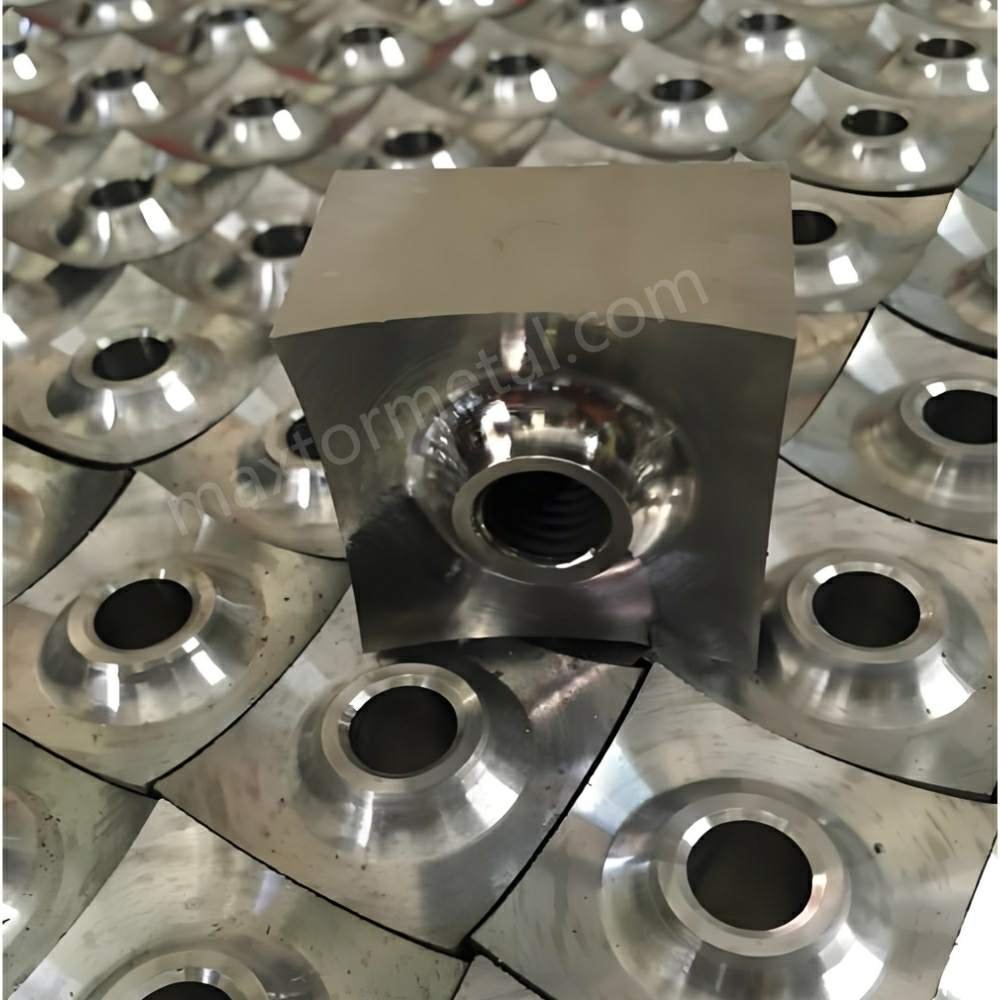
- Warum hartgepanzerte Shredder-Messer bei mineralstoff- und sandhaltigen Materialströmen entscheidend sind
Mineralischer Abrieb verschleißt ein Messer nicht so wie sauberer Kunststoff. Er verwandelt Ihre Schneidzone in eine Schleifzone: mehr Gleitkontakt, höhere Hitzeentwicklung und schnellere Kantenverrundung.
Sobald sich die Schneidkante verrundet, setzt meist die gleiche Kaskade ein: höhere Drehmomentschwankungen, stärkere Vibrationen, eine breitere Streuung der Partikelgröße und häufigere Stillstände. Aus diesem Grund führt abrasiver Betrieb oft dazu, dass selbst eine gute Auswahl des Grundstahls wirkungslos bleibt, wenn die Arbeitsflächen nicht zusätzlich geschützt werden.
- Gewünschte Ergebnisse: Betriebszeit, konstante Partikelgröße, weniger Messerwechsel, niedrigere TCO
Wenn Sie einen Einwellen-Shredder betreiben, ist das Ziel selten nur eine isolierte “längere Standzeit des Messers”. Sie streben nach Stabilität auf Systemebene:
- Betriebszeit: weniger ungeplante Messerwechsel und weniger materialstaubedingte Stillstände.
- Gleichmäßige Partikelgröße: präzisere nachgeschaltete Siebung und berechenbarere Ballen-/Flake-Qualität.
- Weniger Messerwechsel: geringerer Arbeitsaufwand, weniger Einstellfehler, selteneres Nachjustieren des Schnittspalts.
- Niedrigere Gesamtbetriebskosten (TCO): niedrigere Kosten pro Tonne, sobald Ausfallzeiten eingerechnet werden.
- Inhalte dieses Leitfadens: Materialien, Anwendung, QC-Metriken, Wartungsindikatoren
Wie Sie die Kosten pro Tonne richtig kalkulieren
Beim Zerkleinern von abrasivem Material schadet Ihnen der Messerverschleiß doppelt: Sie müssen häufiger Messer kaufen und verlieren während der Wechselzeiten an Durchsatz. Eine einfache Methode für einen direkten Vergleich ist die Kosten pro Tonne ($/t).
Für eine umfassendere Betrachtung der “Kosten pro Tonne” und deren Bestandteile bietet die Erklärung dieser Kennzahl von Komatsu eine nützliche Grundlage (Komatsu: Wie man Kosten berechnet pro Tonne). Für die Berechnung der Ausfallkosten können Sie die Ausfallkosten pro Stunde schätzen und diese durch Division durch den Durchsatz in $/t umrechnen; FourJaw beschreibt die typischen Komponenten von Ausfallkosten (FourJaw: Die Kosten von Ausfallzeiten in der Fertigung).
Formel zum Ausfüllen (Kosten pro Tonne).
Praktisch gesehen beeinflusst die Hartpanzerung folgende Kosten am direktesten:
- Messersatz- und Aufarbeitungskosten
- Umrüstarbeit
- Ausfallzeit pro Ereignis und Ereignisse pro Monat/Quartal
Dieser Leitfaden bleibt praxisnah:
- Wann eine Hartpanzerung sinnvoll ist (und wann nicht)
- Gängige Werkstoffe für die Auftragsschweißung und wie Sie diese auf Ihre Anforderungen abstimmen
- Auftragsverfahren, die bei der Geometrie von Shredder-Messern tatsächlich funktionieren
- QC-Prüfpunkte, die Sie messen und freigeben können
- Wartungsindikatoren für die Aufarbeitung, bevor die Leistung einbricht
Wann sich hartgepanzerte Shredder-Messer lohnen
Materialströme und Beanspruchungsklasse
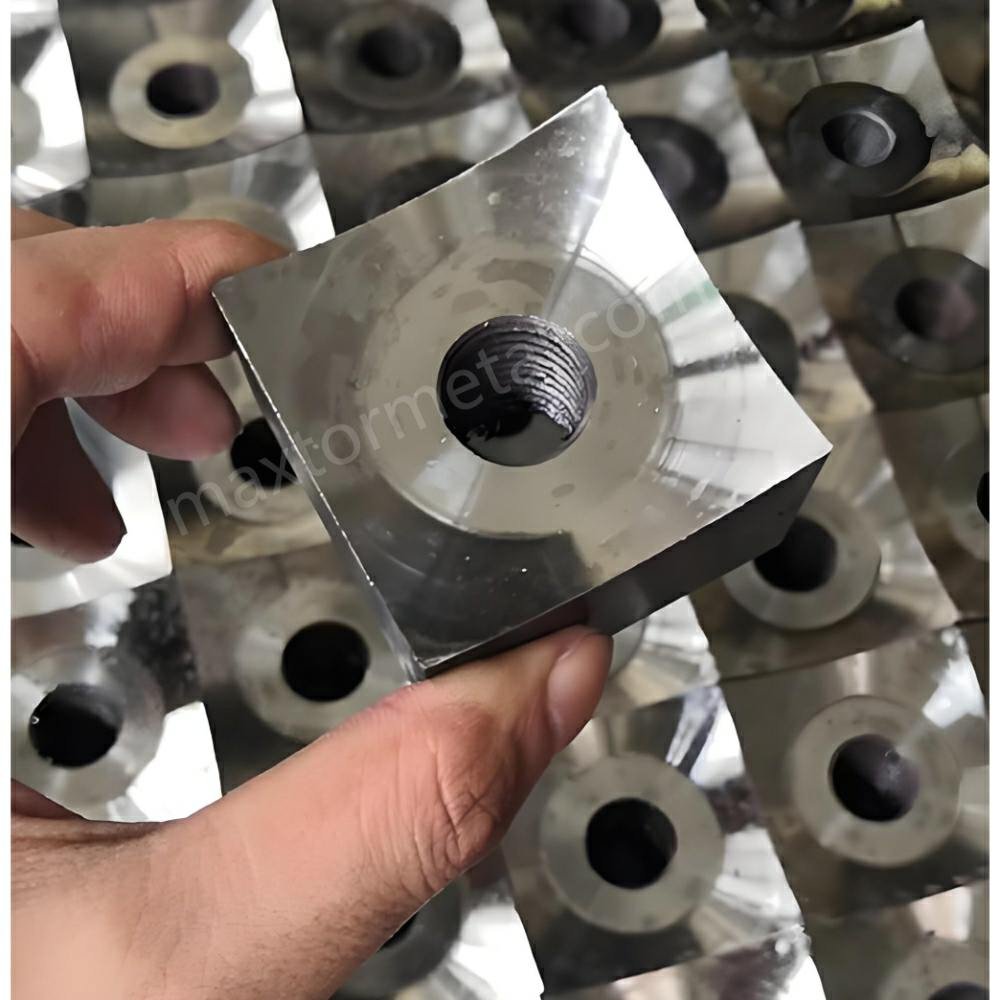
Eine Hartpanzerung ist dann in Betracht zu ziehen, wenn Ihr Materialstrom so abrasiv ist, dass “Schärfen + Schnittspalt nachjustieren” als Instandhaltungsstrategie nicht mehr ausreicht. Das ist das Kernszenario, in dem hartgepanzerte Shredder-Messer die Wirtschaftlichkeit grundlegend verändern.
Typische stark abrasive Materialströme sind:
- Verschmutzte Agrarfolien (Sand-/Siliziumdioxid-Kontamination)
- Mineralstoffhaltige Abfälle, Bauschutt-Feinteile und erdverschmutzter Schrott
- Hochgefüllte Kunststoffe (Glasfaser- oder Mineralfüllstoffe)
Praxisregel: Wenn Abrasion dominiert, geht es bei der Standzeit der Messer weniger um die Schärfe der Schneidkante als vielmehr um den Erhalt der Geometrie. Verschleißtechnisch versuchen Sie, die im ASM-Verschleißversagensmodell beschriebenen Mechanismen zu verlangsamen, bei denen Verschleiß mit Bruch als primäre Versagensart bei technischen Bauteilen konkurriert (ASM Handbook-Kapitel über abrasives Verschleißversagen).
Zu beachtende Versagensmuster
Abrasive Beanspruchung hinterlässt meist ein charakteristisches Bild. Bevor Sie in Panzerungen investieren, sollten Sie sicherstellen, dass es sich um ein verschleißbedingtes Versagen und nicht um ein einmaliges Stoßereignis handelt.
Häufige Muster:
- Kantenverrundung / Abstumpfung: Schneiden wird zu Reiben; die Partikelgröße streut; die Hitzeentwicklung steigt.
- Erosion and “washout”: wear bands develop where feed and counterfaces slide.
- Chipping and micro-cracking: more likely when hard contaminants create shock loading or when clearance drift increases impacts.
Operational triggers show up early:
- Rising jams/misfeeds and rough, irregular output
- Increased noise/vibration and higher torque spikes
- Throughput drop that doesn’t recover after sharpening
TCO break-even cues
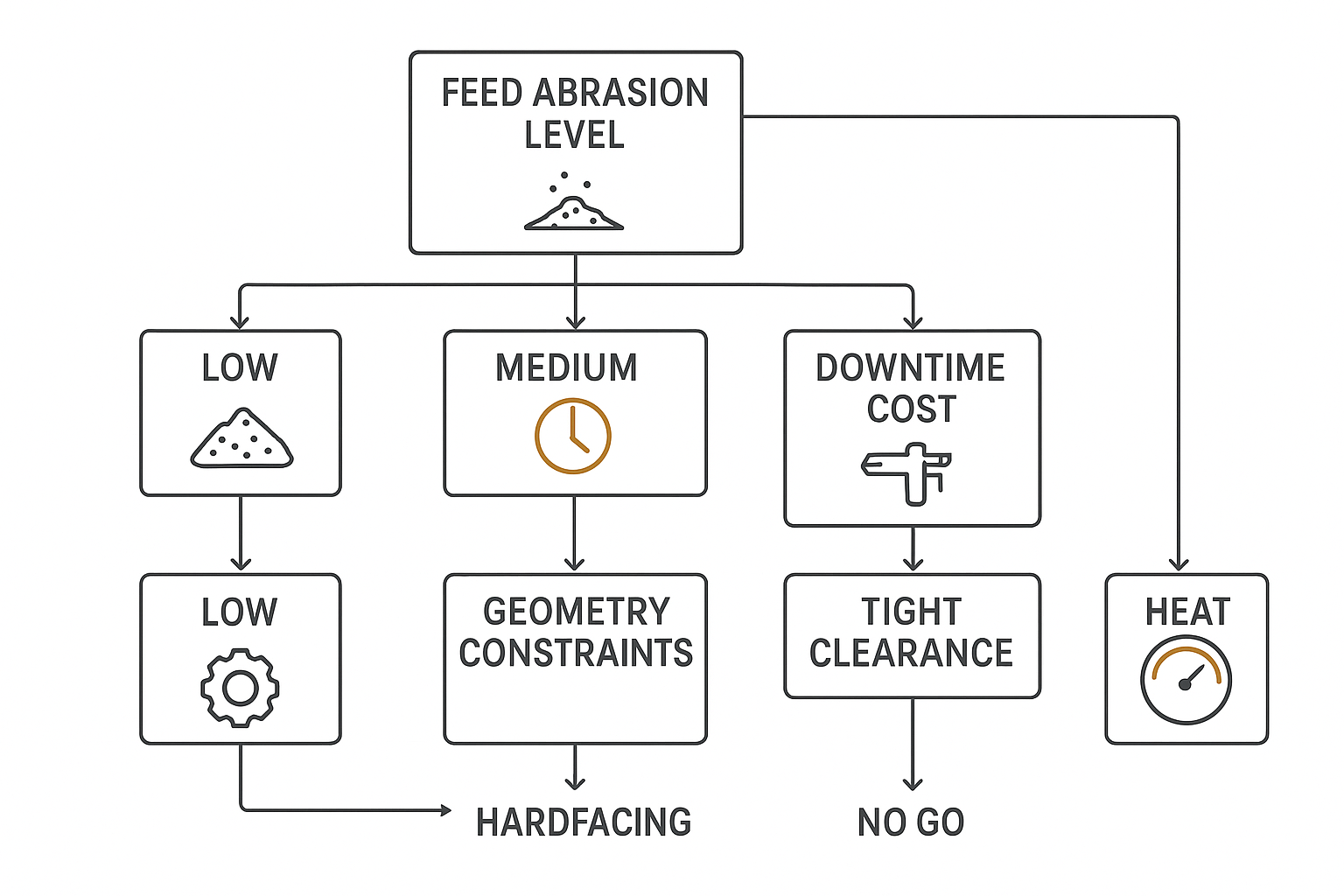
Hard-facing usually increases upfront cost. The break-even is almost always won or lost on downtime.
Use a simple TCO comparison:
- Standard knife set: part cost + labor + downtime per changeover × changeovers per year
- Hard-faced set: higher part/rebuild cost + labor + downtime × fewer changeovers
Two quick cues that you’re close to break-even:
- Changeover downtime is expensive (your line is a bottleneck, or you run overtime to catch up).
- You’re losing multiple shifts per month to knife-related stops.
If you don’t have a number, calculate an hourly downtime cost using a lost-production framework like FourJaw’s downtime cost calculation guide, then roll it into the broader lifecycle view described in Graco’s guide to total cost of ownership.
Materialien und Verfahren
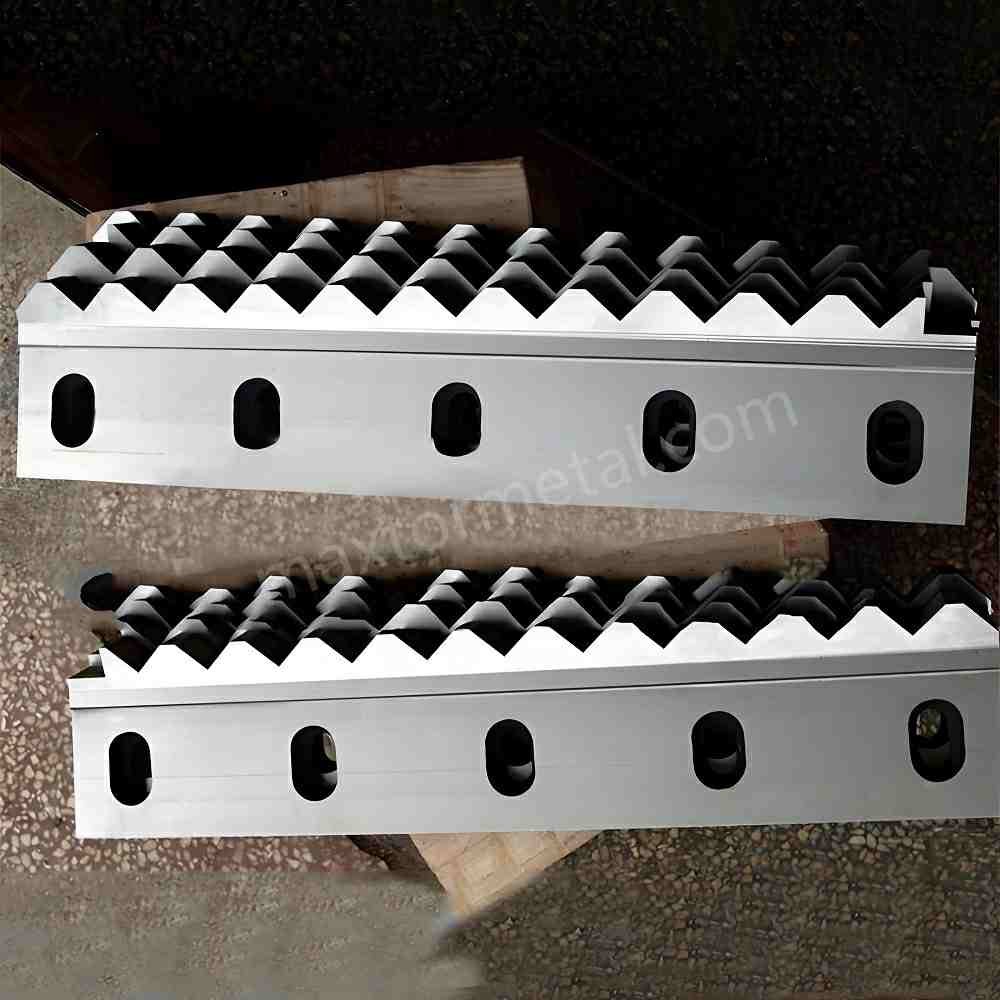
When people talk about hartgepanzerte Shredder-Messer, they usually mean a wear-resistant overlay that preserves cutting geometry longer under abrasion.
Overlay choices and pairing
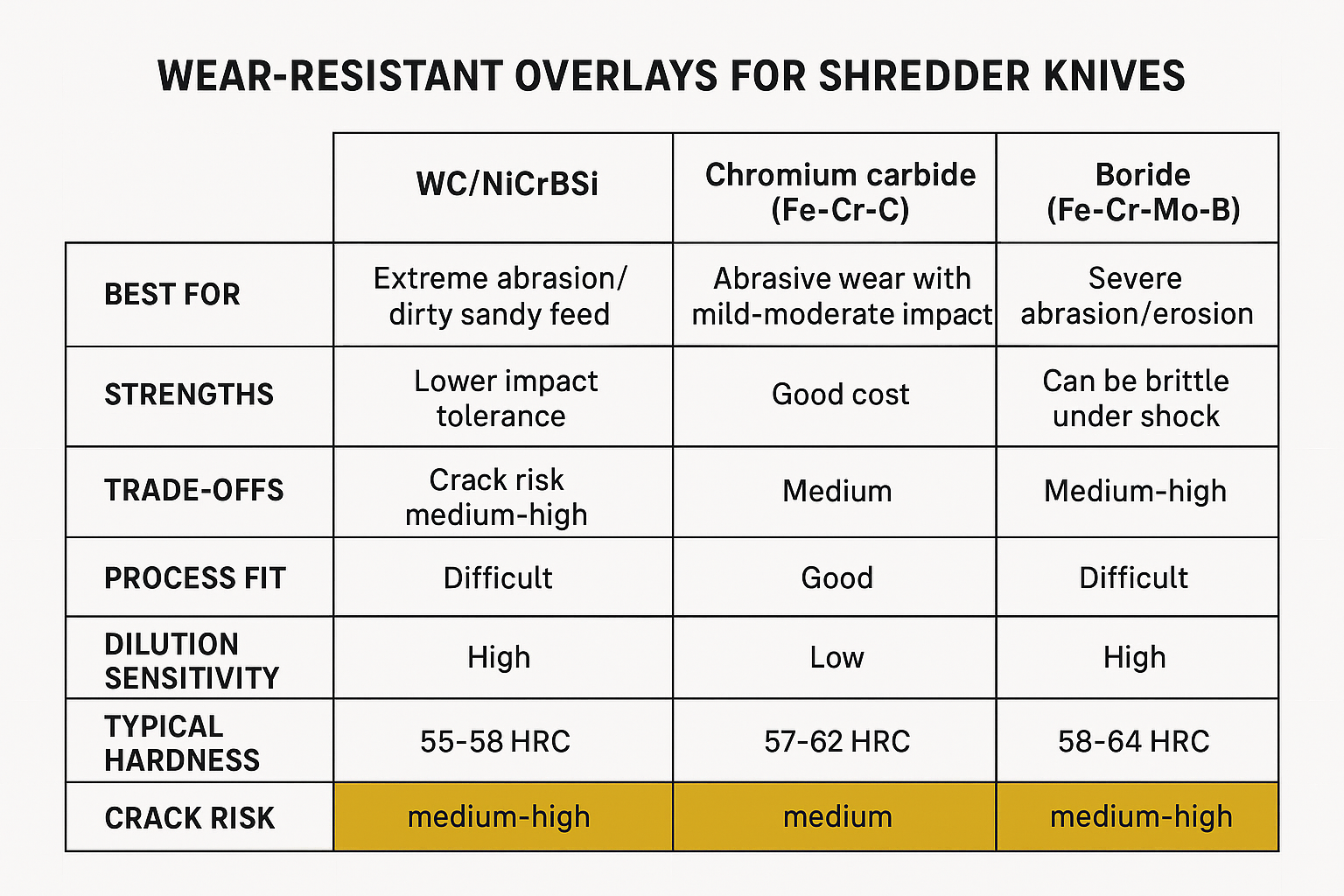
There isn’t one “best overlay” for shredder knives. You’re balancing abrasion resistance against impact tolerance, plus what your geometry can accept.
Three common overlay families:
- WC/NiCrBSi (tungsten carbide in a nickel-based matrix): often selected for extreme abrasion. Carbides are very hard, but the system can be more crack-prone under shock loads or poor process control. For an overview of carbides used in hardfacing (including tungsten and chromium carbides), see SAMaterials’ overview of carbides used in hardfacing.
- Chromium carbide overlays (Fe–Cr–C): a common choice where abrasion is high but impact isn’t “pure abrasion only.” Microstructure and carbide orientation matter; the wrong structure can reduce wear performance, as shown in a 2020 study comparing properties of chromium-rich hardfacing layers.
- Boride hardfacing (Fe–Cr–Mo–B variants): often discussed for severe abrasion/erosion regimes. It can outperform carbide-based overlays in some comparative studies, but it’s process-sensitive and can be brittle under shock.
Selection is more reliable when you state your wear mode clearly:
- Abrasion-dominant with low shock → bias toward harder, more abrasion-focused overlays.
- Mixed abrasion + impact → bias toward overlays and processes that preserve toughness and reduce cracking.
Application methods that work
On shredder knives, application quality matters as much as material choice. The failure mode you’re preventing (wear) can be replaced by a new failure mode (cracking, distortion, geometry drift) if heat input and dilution aren’t controlled.
The main routes you’ll see discussed:
- Laser cladding: generally lower heat input and lower dilution; good for controlling distortion and preserving hard phases. Experimental comparisons such as the 2023 study comparing laser cladding vs PTA welding discuss these tradeoffs.
- PTA (plasma transferred arc): a metallurgical overlay process often used for wear-resistant deposits with reasonable control and deposition rate; it can be a practical choice when you need thicker deposits than laser and can manage heat input.
- FCAW hardfacing: often economical for thicker builds and repairs, but heat input and dilution can be higher. That increases distortion risk and can change the overlay properties if you “wash in” too much base metal.
- HVOF thermal spray (when applicable): low substrate heating and negligible dilution, but bonding differs from weld overlays. Treat it as a different class of solution than welded overlays.
Geometry and thickness control
Shredder knife geometry is unforgiving:
- Edge profile, flatness, and mounting faces dictate clearance and cutting behavior.
- Overlays change thickness and can force you to re-machine or re-grind.
Control points that prevent surprises:
- Define where overlay is allowed (wear bands, non-cutting surfaces) and where it is forbidden (mounting faces, datum surfaces).
- Specify post-overlay grinding steps to restore thickness, flatness, and edge condition.
- If your shredder runs tight clearances, treat distortion control as a first-class requirement (process choice, fixturing, heat management).
Qualitätskontrolle, Wartung und Risiken
Measurable QC checkpoints
Hard-facing should be treated like a qualified process, not a cosmetic add-on. Your QC should prove two things: the overlay is what you specified, Und the knife still matches the geometry your shredder needs.
Measurable checkpoints:
- Materialrückverfolgbarkeit: base steel and consumable certificates; batch IDs tied to each knife set.
- Hardness mapping: defined test points on overlay and base; record results by serial.
- Overlay placement and thickness verification: confirm coverage in the intended wear zones; verify you didn’t build up mounting faces or datums.
- Crack inspection: visual + dye penetrant or magnetic particle as appropriate for your material and overlay; record acceptable crack criteria.
- Flatness/warp: verify against your clearance and fit requirements.
- Edge and clearance verification: confirm profile and setup after install; avoid “it fits” acceptance.
MAXTOR METAL supports qualified hardfacing procedures, material certificates, and one-stop import/logistics support so buyers can standardize specs and documentation across rebuild cycles.
Inspection and rebuild intervals
Abrasive streams reward earlier, shorter inspection loops. Waiting for “the shredder won’t cut” is the expensive path.
Use a two-layer interval approach:
- Short interval (condition checks): quick inspections for edge rounding, cracks, wear bands, bolt looseness, and clearance drift.
- Long interval (rebuild window): planned downtime where you can regrind, re-overlay, and reset geometry without rushing.
Keep the checks measurable. Even basic blade-care guidance emphasizes routine inspection and cleaning as a way to avoid compounding damage (Zellner’s maintenance and care guidance for industrial blades).
Practical triggers to schedule a rebuild:
- Particle size begins drifting outside your acceptable band
- Torque spikes and vibration increase at the same throughput
- Clearance resets become frequent and no longer stabilize output
- Early crack indications show up near high-stress corners
Counterpart wear and compatibility
A harder knife surface can move wear to the counterpart.
Before you commit to hard-facing, confirm compatibility with:
- Counter-knife materials and any wear plates in the cutting chamber
- Rotor/stator alignment and how your machine handles clearance drift
- Your sharpening/regrinding method (some overlays don’t regrind like standard tool steels)
If your overlay is too brittle for your feed shocks, you may trade wear-out for crack-out. That’s why mixed duty (abrasion + impact) often needs a more balanced overlay and tighter crack-control QC rather than the hardest possible deposit.
For a full duty profile, it helps to treat the knife set as a system: base steel, overlay, counterparts, and setup discipline. That’s also where hartgepanzerte Shredder-Messer delivers the most predictable ROI.
Beispielszenarien (illustrativ)
When you can’t share internal case data, you can still build a transparent, decision-ready estimate.
- Translate downtime into $/ton
- Estimate your hourly downtime cost using a standard framework (lost output, labor, restart losses). FourJaw summarizes common cost components and why downtime is often the real TCO driver (FourJaw: Die Kosten von Ausfallzeiten in der Fertigung).
- Convert it to $/ton by dividing by average throughput (tons/hour).
- Convert blade events into $/ton
- (Knife set + rebuild + changeover labor) ÷ tons between events
- Plus: (downtime hours per event × downtime $/hour) ÷ tons between events
- Compare standard vs hardfaced as two cost-per-ton lines
- If hardfacing mainly reduces event frequency (fewer changeovers) and improves stability (fewer jams), you’ll typically see the cost-per-ton gap widen in your favor as downtime gets more expensive.
For a general checklist of what to include in cost per ton, Komatsu’s breakdown is a helpful baseline (Komatsu: how to calculate cost per toN).
Fazit
- Key actions: specify overlays, qualify process, verify QC, plan inspection windows
Treat hard-facing as an engineered change:
- Specify overlay family and where it’s allowed on the knife
- Qualify the process (heat input, dilution control, fixturing)
- Verify QC with measurable checkpoints (hardness, thickness, cracks, flatness)
- Plan inspection windows so you rebuild before throughput and particle size collapse
- Expected gains: often fewer changeovers and steadier throughput, which can reduce cost per ton when downtime and labor are meaningful drivers
In abrasive streams, hard-facing is most valuable when it prevents geometry drift and stabilizes cutting behavior. In practice, performance is best expressed in unit economics: if hardfacing reduces changeovers and unplanned stops, the downtime cost you allocate per ton falls. Reported outcomes vary by feed contamination, impact severity, clearance discipline, and rebuild quality—so treat “2–3× life” as a range seen in abrasion-led duty, not a guarantee. A practical way to quantify the benefit is to estimate an hourly downtime cost and divide by throughput to convert it into $/ton (see FourJaw: Die Kosten von Ausfallzeiten in der Fertigung), then track how fewer blade events change that number over a month or quarter.
For related shredder setup and maintenance guidance, see MAXTOR METAL’s resources on setups that protect abrasive plastic recycling blades und die shredder blade troubleshooting guide.
Tommy Tang ist ein Senior Sales Engineer bei Nanjing METAL Industrie mit 12 Jahre of experience supporting industrial cutting blade selection, specification, and import procurement for abrasive-duty applications. Certifications: CSE, CME, Six Sigma Green Belt, PMP.

 English
  Spanish
  Italian
  French
  Portuguese
  Russian
  German
  Arabic
  Hindi
Hindi  Vietnamese
  Indonesian
  Japanese
  Korean