


When you’re cutting nylon webbing, synthetic rope, or strap material at volume, “a little fray” isn’t cosmetic—it’s a process defect. Frayed ends trigger rework, slow assembly, and create inconsistent downstream quality checks. That adds up fast in yield loss and in OEE.
A synthetic fabric hot knife (often called a thermocutter) solves the root issue by cutting and sealing in one pass—in other words, it can cut and seal synthetic webbing in a single controlled operation. Done right, it turns an edge that would unravel into a fused end that’s stable through handling, sewing, and packaging.
This article explains:
- Why fraying on synthetic rope and webbing hurts yield and OEE
- How a synthetic fabric hot knife cuts and seals in one pass
- What you will learn: selection, safety, setup, and ROI
Stop Fraying, Boost OEE
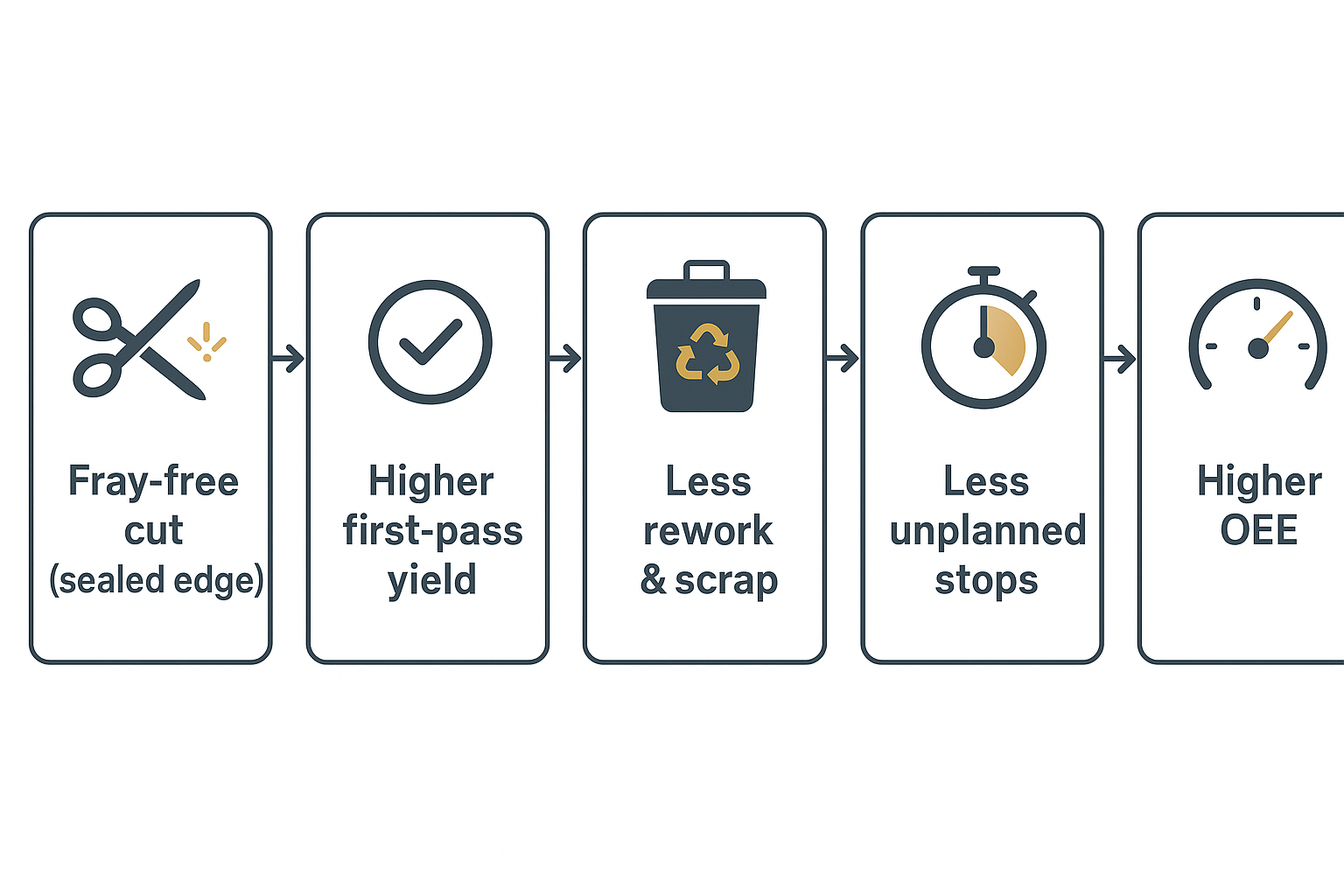
Fraying’s hidden losses
Fraying is rarely “just fraying.” On a line, it usually shows up as one of these loss buckets:
- Scrap: cut ends unravel before they’re stitched or terminated, and parts don’t meet appearance/strength expectations.
- Rielaborazione: operators trim, re-cut, tape, singe, or re-seal ends to pass inspection.
- Speed loss: handling frayed ends is slower (snagging, threading issues, misfeeds).
- Downtime and micro-stops: cutting stations pause for adjustments, blade cleaning, or repeated attempts to get a passable edge.
- Quality holds: inconsistent edges create debate in QA—what passes today may fail tomorrow.
In many synthetic product inspections, frayed fibers are treated as a reject signal—a practical reality that pushes borderline material into rework or scrap. For an example of how fraying is used as an inspection trigger in synthetic products, see Kennedy Wire Rope & Sling’s “Synthetic Slings Inspection Criteria”.
Sealed edges, first-pass yield
A fray-free edge is an upstream “stabilizer.” It protects first-pass yield because it reduces the number of times the material has to be touched, trimmed, or corrected before it becomes a finished SKU.
A hot knife for nylon webbing does two things at once:
- Separates fibers cleanly (the cut)
- Fuses the edge (the seal)
That seal matters because it prevents the first few millimeters of the end from turning into loose filament bundles during normal handling.
Conclusione chiave: If fraying creates rework loops, a consistent melt-seal removes the loop—not by “better inspection,” but by eliminating the defect at the cut.
OEE levers and quick wins
OEE is the product of Availability × Performance × Quality. A hot knife doesn’t magically fix all three—but it can reliably pull two levers:
- Qualità: fewer rejects and fewer borderline edges that fail cosmetic or integrity checks.
- Availability/Performance: fewer micro-stops and less time spent fixing cut ends.
The quick win is standardization: one tool, one setup procedure, one verification check.
Selection and Setup: Synthetic Fabric Hot Knife Criteria
Power, temperature, duty cycle
Think of selection as matching heat delivery to your line reality.
- Power determines whether the blade can maintain temperature when you cut thicker webbing, multiple layers, or higher line speeds.
- Temperature control determines repeatability. “Hot enough” isn’t a setpoint—your ideal temperature depends on polymer type, thickness, and feed rate.
- Duty cycle matters when the tool runs all shift. Underspec’d duty cycle shows up as drifting cut quality (more fray, more blackening) as the system heat-soaks.
Practical selection rule:
- If you cut thick or multi-layer materials, prioritize power headroom and stable temperature control.
- If you cut thin ribbon/webbing, prioritize controllability and a blade geometry that doesn’t over-melt the edge.
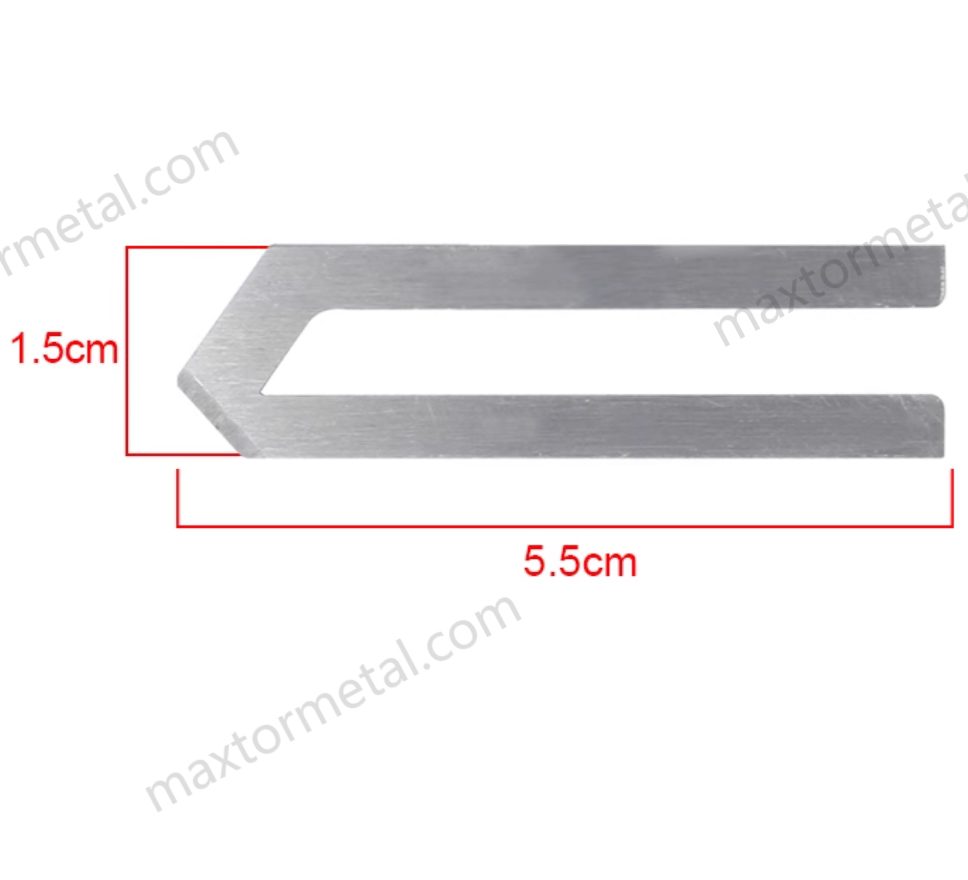
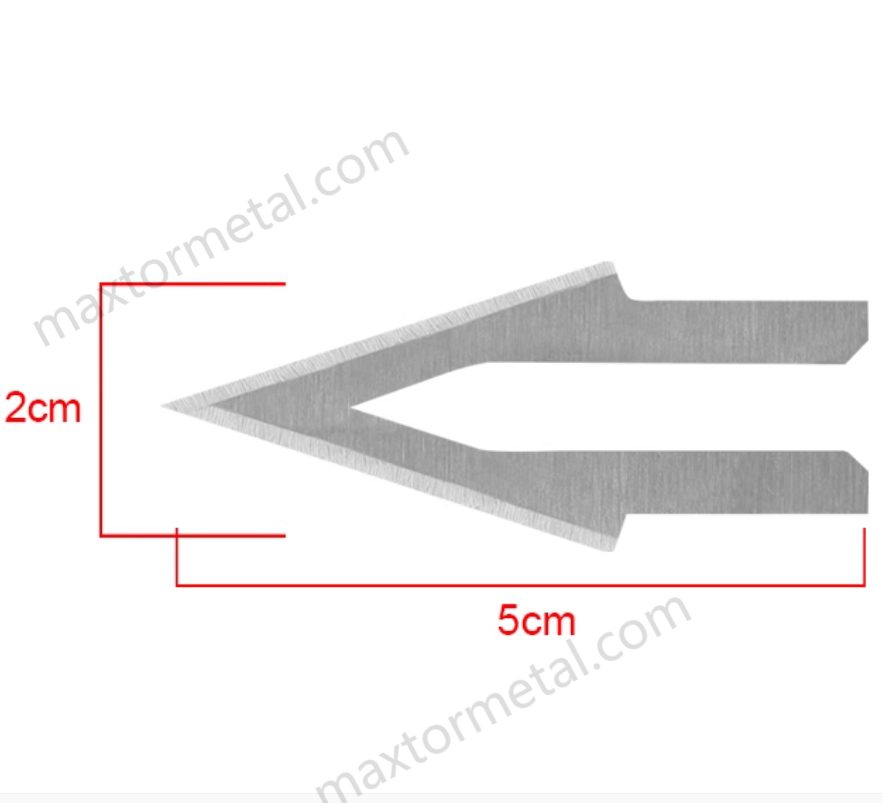
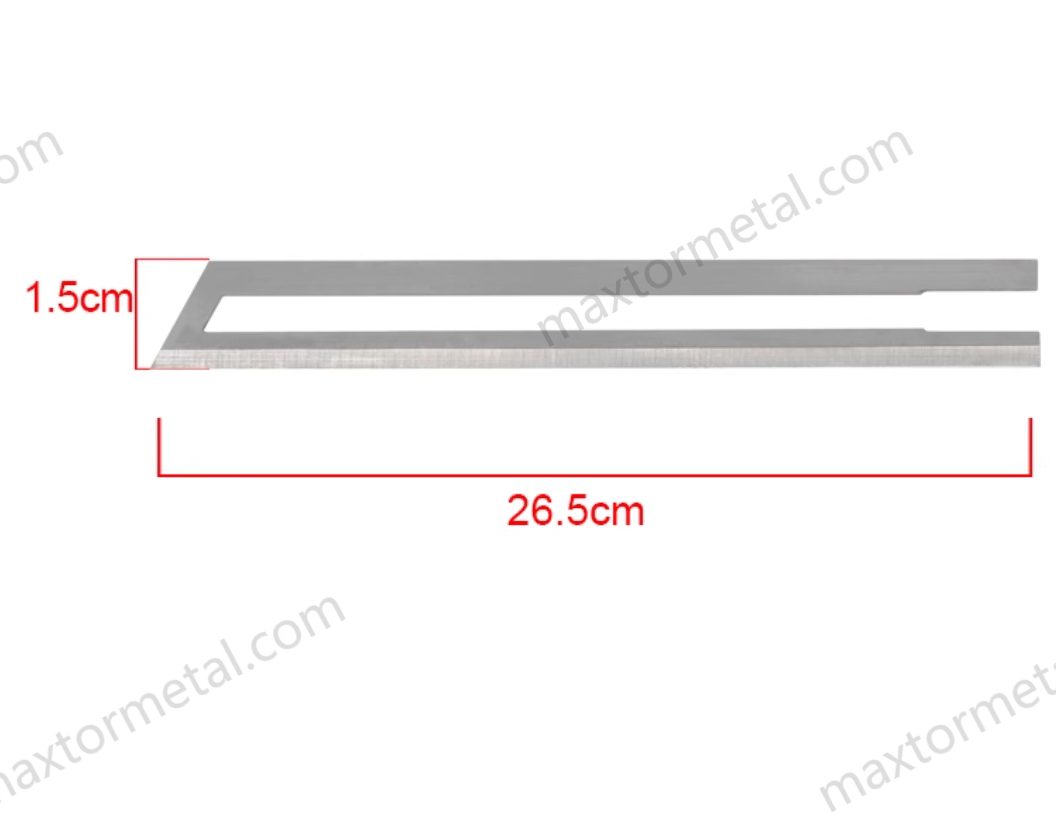
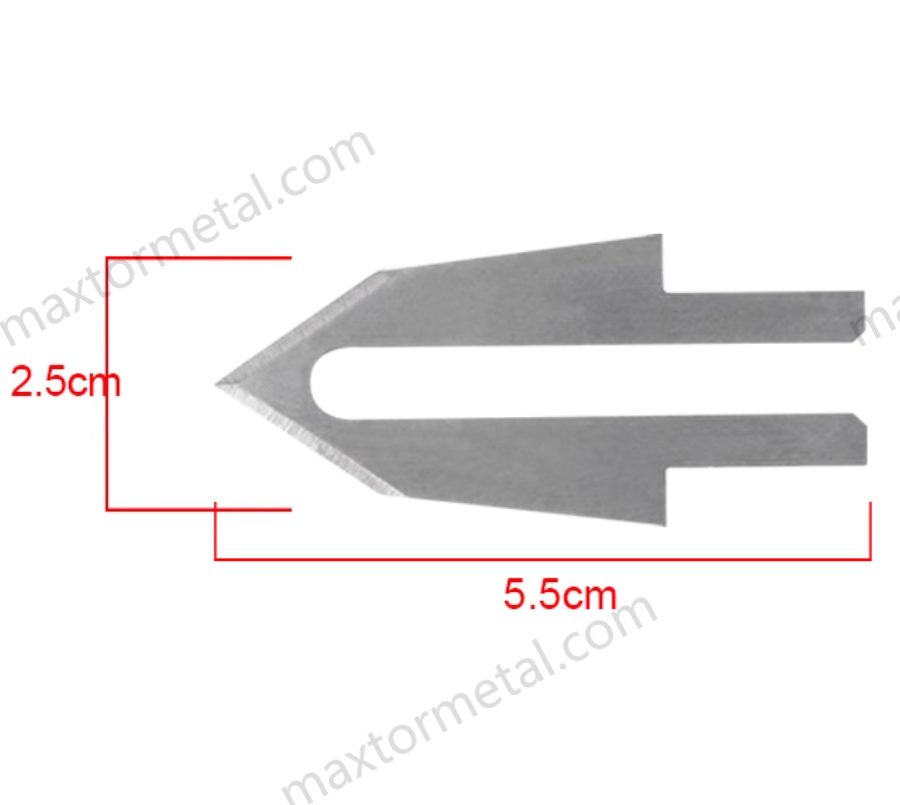
Thermocutter blades and geometry
Blade geometry determines how heat enters the material and how molten polymer is displaced. Choosing the wrong shape is a common reason for uneven edges, excessive melt, or drag marks.
Common thermocutter blade types (and why you’d use them) include straight, curved, rope/webbing notch, beveled/chisel, and specialty groove blades. MAXTOR METAL supports blade material selection, heat-treatment, and QC documentation (material certs, in-process checks) to improve durability and consistency.
For a reference list of hot knife blade profiles and common materials/coatings, see MAXTOR METAL’s Lame per Coltello Caldo Elettrico overview.
Parameter logic to reduce defects:
- If you see fraying (under-seal): increase temperature slightly O slow feed O increase tension stability.
- If you see heavy melt beads or edge distortion (over-melt): reduce temperature O increase feed O switch to a geometry that removes less material.
- If you see blackening/smoke: reduce temperature/dwell and clean residue from the blade—contamination makes scorching worse.
Field notes from production troubleshooting (no-data, experience-based)
If you need a fast, repeatable troubleshooting order on a real line, these checks typically remove the most variation first:
- Confirm tension and feed consistency (many “fray” complaints are really tension fluctuation or inconsistent dwell).
- Stabilize motion before changing temperature (operators pausing at the end of the cut is a common cause of bead/blackening).
- Clean the blade earlier than you think (a thin residue layer changes heat transfer and causes sudden smoke and edge drift).
- Change geometry before chasing setpoints when you have persistent drag marks or distortion (the wrong blade shape will keep forcing bad tradeoffs).
A simple habit that improves shift-to-shift consistency: document “what good looks like” with one photo of a passing edge and one photo of an under-seal defect for each material family.
Corded vs. cordless use
Corded vs. cordless is an operations choice, not a brand preference.
- Corded makes sense when the cutting station is fixed and the tool runs continuously. You typically get stable heat delivery and fewer interruptions.
- Cordless is useful for in-aisle corrections, kitting, or low-duty cutting where mobility beats continuous runtime.
If your goal is OEE stability, pick the option that reduces “small stops”:
- Fixed station + continuous demand → corded
- Distributed work + intermittent cuts → cordless
Safety and Compatibility
Materials: fit and avoid
Hot knives are designed for thermoplastics—materiali che fondono e si risolidificano. I materiali “idonei” tipici includono nylon, poliestere, cinghie/cordoni in polipropilene e molti nastri sintetici.
Evitare o prestare particolare attenzione quando:
- Il materiale è con supporto adesivo (può imbrattare le lame e produrre molto fumo)
- Il materiale contiene rivestimenti sconosciuti (fumo/odore e comportamento del bordo diventano imprevedibili)
- Si tagliano fibre naturali (non si termosaldano allo stesso modo; si rischiano carbonizzazioni anziché una saldatura)
In caso di dubbi, effettuare un breve taglio di prova controllato e valutare l'integrità del bordo e i fumi prima di passare alla produzione su scala.
Ventilazione, DPI, conformità
Il taglio a caldo può generare fumi e odori, specialmente quando la temperatura è troppo elevata, la lama è sporca o sono presenti rivestimenti. Considerare la ventilazione come parte integrante del processo, non come un elemento secondario.
Buone pratiche minime per un ambiente di produzione:
- Aspirazione localizzata o estrazione fumi sul punto di taglio durante il funzionamento continuo
- Protezione per gli occhi e guanti termoresistenti per gli operatori
- Una zona di taglio protetta e un'area di raffreddamento definita per utensili e lame
- Istruzioni di lavoro documentate (intervallo di setpoint, indicazioni sulla velocità, intervallo di pulizia)
Per i programmi di sicurezza, è utile allineare i controlli alle linee guida di ventilazione consolidate per le operazioni di “saldatura, taglio e riscaldamento”, in cui le normative evidenziano la necessità di una sufficiente ventilazione meccanica e/o aspirazione localizzata. Si vedano i requisiti di ventilazione e protezione OSHA: https://www.osha.gov/laws-regs/regulations/standardnumber/1926/1926.353
Molti taglierini a caldo da produzione integrano anche protezioni e dispositivi di sicurezza (ad esempio, uno schermo di protezione e lo spegnimento automatico sono caratteristiche comunemente presenti sulle taglierine industriali a lama calda, come descritto nella pagina del modello Start International TBC50H sulle modalità con cui i taglierini a lama calda tagliano e termosaldano i materiali soggetti a sfilacciamento).
⚠️ Condizioni di arresto del lavoro: Se si riscontrano fumo persistente, forte odore irritante, irritazione a occhi/gola o accumulo visibile di residui che si ripresenta subito dopo la pulizia, interrompere l'operazione. Ridurre la temperatura, verificare che l'aspirazione localizzata sul punto di taglio funzioni correttamente, pulire la lama e riavviare solo dopo che un taglio di prova controllato abbia prodotto fumi minimi e una saldatura stabile.
Superfici, test QA, parametri
La costanza dei risultati deriva dal controllo di tre fattori: superficie, tensione, E tempo a temperatura.
Superficie:
- Utilizzare una superficie di supporto ininfiammabile e resistente al calore.
- Mantenere la superficie pulita per evitare che i residui si trasferiscano sul bordo fuso.
Test QA (semplici, rapidi e verificabili):
- Continuità visiva del bordo: il bordo saldato deve essere continuo, non “fuso a metà”.”
- Verifica dell'integrità del bordo: leggera trazione/abrasione con un dito guantato: se le fibre si sfilano facilmente, la saldatura è insufficiente.
- Controllo dimensionale: misurare la lunghezza/larghezza di taglio su un campionamento dopo il riscaldamento; eventuali scostamenti indicano spesso un'instabilità di temperatura o di avanzamento.
- Controllo dello scolorimento: l'annerimento suggerisce un calore/tempo di stazionamento eccessivo o una contaminazione.
Gestione rigorosa dei parametri:
- Registrare l'intervallo operativo (setpoint, velocità di avanzamento, tipo di lama) per ogni famiglia di materiali.
- Includere una fase di riscaldamento e l'approvazione del primo pezzo prima di avviare un lotto.
Punti di partenza tipici per i parametri (da utilizzare come prova controllata)
Il setpoint esatto dipende dalla progettazione della taglierina, dalla massa della lama, dalla velocità di linea e dalla rapidità con cui il calore viene sottratto alla lama. Utilizzare i valori sottostanti come semplici punti di partenza, quindi convalidare con un breve taglio di prova e con i propri controlli di qualità.
Riferimento materiali (intervalli di fusione):
- Nylon 6/6 (PA66): intervallo di fusione ~225–265 °C; picco di fusione principale ~261 °C (riferimento: database NETZSCH Polymers — PA66)
- PET (polyester, PET): melting point commonly reported ~250–260°C (reference: MakeItFrom materials database — PET)
- Polypropylene (PP): melting peak ~160.9°C (onset ~125.4°C) from DSC testing (reference: FSRI Materials & Products Database — Polypropylene (PP))
Starting-point table (typical shop-floor ranges):
| Material family | Typical trial setpoint logic | Cutting pace guidance | What “too cold” looks like | Come si presenta un calore “eccessivo” |
|---|---|---|---|---|
| Nylon webbing / rope | Start near melt point; increase in small steps until the seal becomes continuous | Keep feed steady; avoid pausing at the end (dwell spikes heat) | Fibers pull out in the edge integrity check; partial seal | Heavy melt bead, edge distortion, smoke/blackening |
| PET webbing / tape | Start near melt range; PET can need slightly more stable heat delivery for a smooth edge | Use a consistent motion; let the blade do the work | Drag marks; “hairy” edge after handling | Glossy over-melt, sticky edge, odor |
| PP webbing | PP melts lower; start lower and prioritize speed to avoid excessive bead | Slightly faster motion often helps reduce bead | Under-seal; end opens under light abrasion | Thick bead, shrink-back, surface bubbling |
Blade cleaning interval (rule of thumb): If residue is visible or you notice a step-change in smoke/odor, stop and clean immediately. Do not “push through” buildup—contamination increases scorching risk and worsens cut repeatability.
Disclaimer: These are generalized starting points. Confirm with your tool manufacturer’s manual and your site’s safety program, and lock parameters only after a first-piece approval and repeatable QA results.
Conclusione
Key actions to stop fraying and stabilize OEE
- Standardize on cut + seal in one pass for synthetic webbing/cord where fraying drives rework.
- Treat temperature/feed/blade geometry as a system: adjust in small steps and lock parameters once stable.
- Add lightweight QA checks (edge continuity, integrity, dimension, discoloration) to protect first-pass yield.
- Don’t ignore fumes—ventilation and blade cleanliness are part of repeatable output.
Quick selection checklist and ROI reminders
Selection checklist (quick, practical):
- Can the tool maintain temperature at your target speed (power headroom)?
- Do you have stable temperature control and a repeatable setpoint?
- Is the duty cycle appropriate for your shift usage?
- Is blade geometry matched to your material and thickness?
- Do you have a documented parameter sheet and first-piece approval?
ROI reminders (use your own numbers):
- Any reduction in scrap E rework minutes raises yield.
- Any reduction in micro-stops improves availability and performance.
- The win compounds when the process becomes repeatable across operators and shifts.
Quick ROI worksheet (copy/paste)
Use this lightweight template to estimate payback with your own numbers.
| Input | Symbol | Esempio | Your value |
|---|---|---|---|
| Units per shift | U | 10,000 | |
| Shifts per month | S | 44 | |
| Current scrap rate (from fray) | r_s | 1.5% | |
| Scrap reduction after hot-knife standardization | Δr_s | 0.7% | |
| Rework minutes per shift (trim/reseal) | M_r | 45 | |
| Rework reduction (%) | Δr_r | 60% | |
| Fully loaded labor cost ($/min) | C_l | 0.60 | |
| Value per scrapped unit ($) | C_u | 0.20 | |
| Tool + setup cost ($) | C_t | 600 |
Output:
- Scrap savings / month = U × S × Δr_s × C_u
- Rework labor savings / month = M_r × S × Δr_r × C_l
- Total savings / month = (scrap savings + rework savings)
- Simple payback (months) = C_t ÷ (total savings / month)
Note: For OEE tracking, also log micro-stops at the cutting station (count per shift and total minutes). Even small reductions typically show up as higher Availability and Performance.
If you want a neutral starting point for blade options and profiles, you can review MAXTOR METAL’s industrial blade catalog and build your internal parameter sheet from there.
Autore e recensione
Author: Tommy Tang — Senior Sales Engineer, Nanjing METAL Industrial
Esperienza: 12 years supporting industrial cutting applications and blade selection for manufacturing lines
Credentials: CSE, CME, Six Sigma Green Belt, PMP
Ultimo aggiornamento: 2026-04-12
Nota informativa: MAXTOR METAL supplies industrial blades. This article is for general process education; always validate parameters with your equipment manual, material datasheets/SDS, and site safety requirements.

 English
 Spanish
 Italian
 French
 Portuguese
 Russian
 German
 Arabic
 Hindi
 Vietnamese
 Indonesian
 Japanese
 Korean