

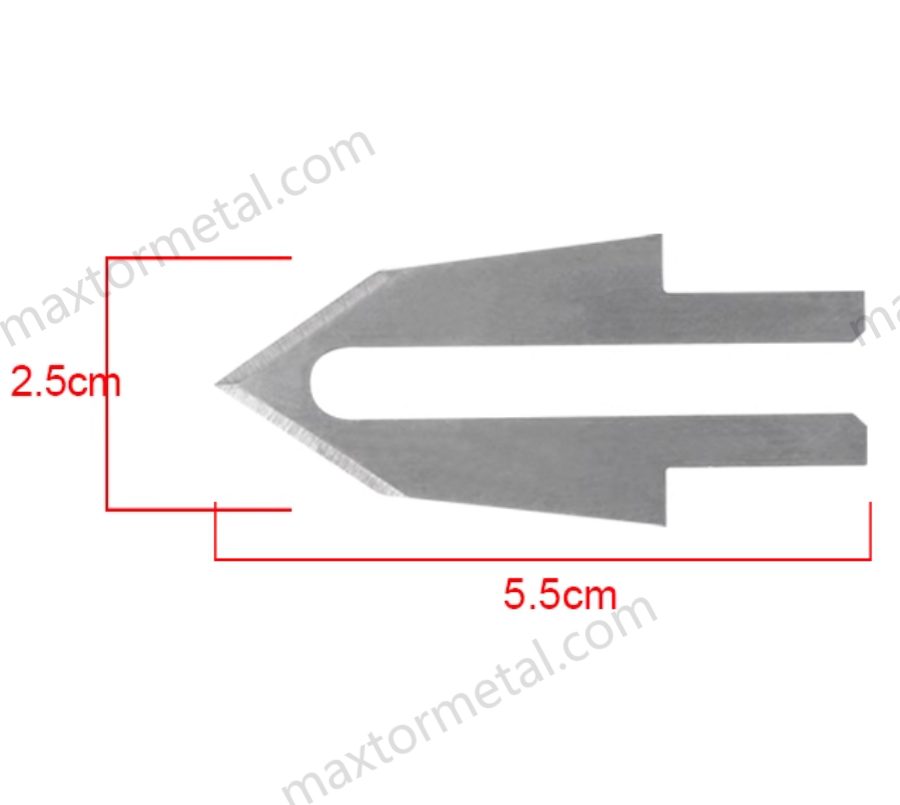
- Why power class drives cut quality, speed, and TCO
- Where 100W vs 400W fits across textiles, webbing, labels, and foams
- How to use this guide to select and validate an industrial hot knife system
Industrial hot knife cutting looks simple until you scale it.
At production volume, the power class you pick determines whether you get a square, sealed edge at line speed—or a constant cycle of slowdown, bead buildup, smoke complaints, and changeovers.
This guide focuses on two common brackets—100W hot knife systems and 400W hot knife systems—and shows how to match them to your material stack-up, duty cycle, and quality targets. Then it gives you a validation approach you can run on your own line before you standardize.
EU-first note (CE/EN/IEC): This guide is written for EU-facing production and machine integration contexts. Always validate against your site-specific risk assessment and the applicable EU directives/EN standards, as well as local requirements in your country.
Safety disclaimer (important): Hot knife cutting can generate hazardous fumes and involves burn and machinery hazards. This article provides general guidance only; it is not legal or safety advice. Implement controls (ventilation, guarding, interlocks, SOPs) based on your process, materials, and measured exposure data.
免責事項: This page may mention suppliers (including MAXTOR METAL) as an example for blade standardization and replacement consistency. You should qualify any supplier based on your own technical and compliance requirements.
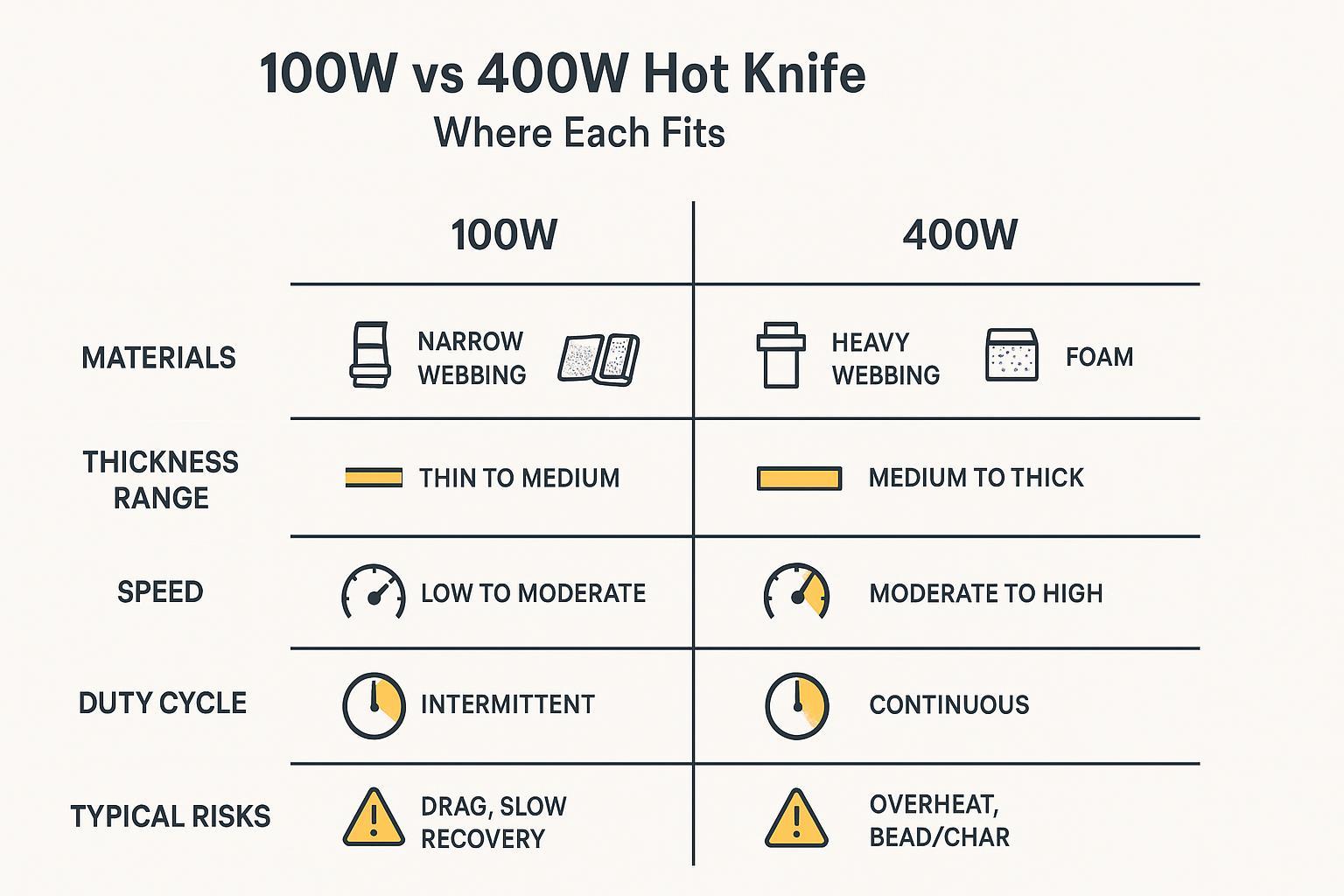
Power classes at a glance
For an industrial hot knife system, the fastest way to narrow options is to match power to heat demand per cut and the recovery you need at steady-state.
100W capabilities and limits
A 100W system typically shines when your process is intermittent and your cut is short:
- Light textiles, narrow webbing, labels, and hot knife cutting webbing applications where the cut length is short and repeatable
- Short heat path (less blade length inside the cut)
- Lower duty cycle where the blade gets time to recover between cuts
Where 100W usually runs out of margin isn’t just “thickness.” It’s thermal recovery.
If your blade cools down faster than it reheats, you’ll see the same pattern: the first few cuts look fine, then the system drifts into dragging, uneven bead, or incomplete sealing unless the operator slows down or turns the temperature up (which often increases smoke and discoloration).
400W capabilities and limits
A 400W class system is usually chosen for higher throughput そして higher heat demand per cut:
- Wider or thicker webbing
- Dense textiles, layered stacks, and tougher synthetics
- Foam where you need consistent penetration without tearing
- Higher duty cycle work where recovery time is limited
The upside is margin: faster heat-up and better recovery under load.
The tradeoff is that with more power, you can reach “too hot” faster. That can show up as edge recession on foams, excessive bead size, discoloration, or smoke if temperature control and airflow aren’t designed for production.
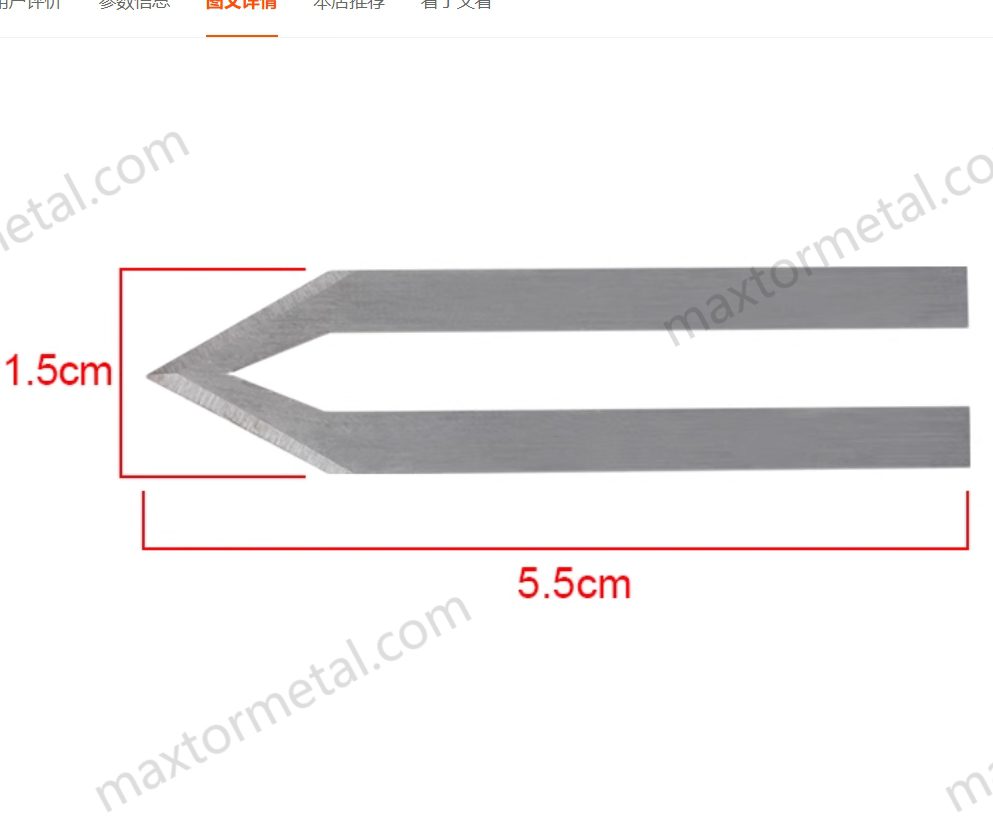
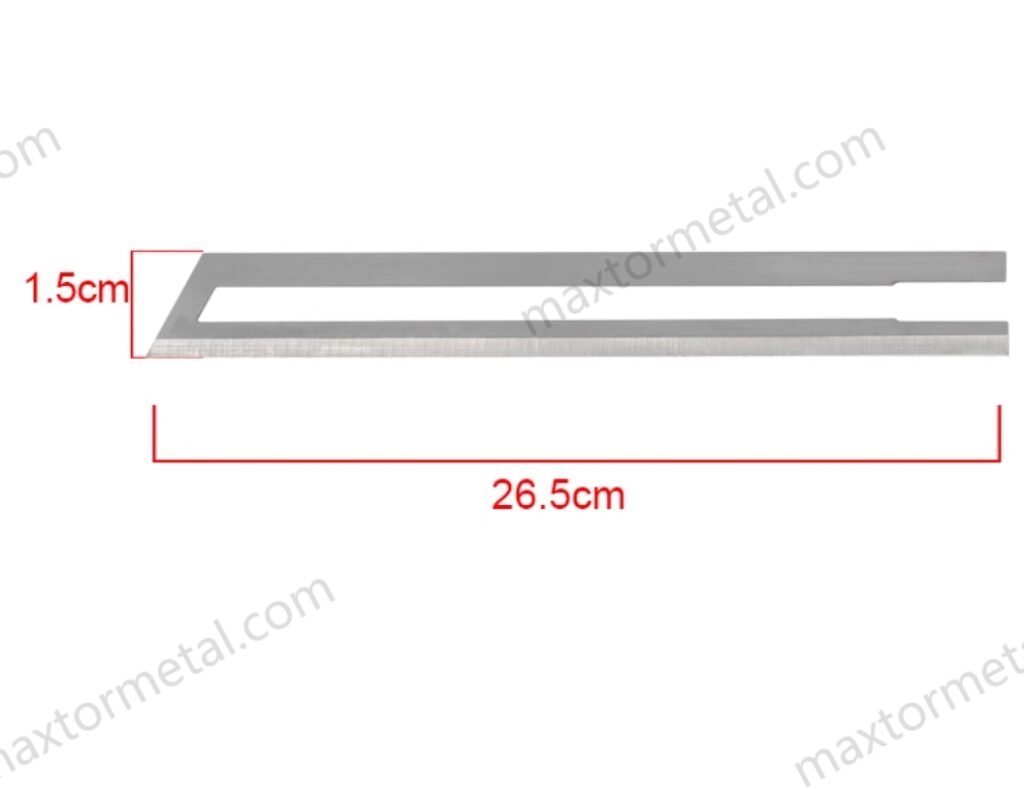
Matching blade mass and geometry to power
Power class and blade choice are inseparable.
Hot knife blades are designed to concentrate heat along the cutting edge, and pre-insertion blade temperatures can vary widely depending on blade type and system; the blade cools as it enters the material, and the material’s thermal properties affect cut speed and temperature behavior (as described in the thermocutter blade design and temperature range guidance).
In practical terms:
- Higher blade mass smooths temperature swings but needs more power to recover quickly.
- Longer cutting edge engagement (more blade inside the cut) increases heat draw.
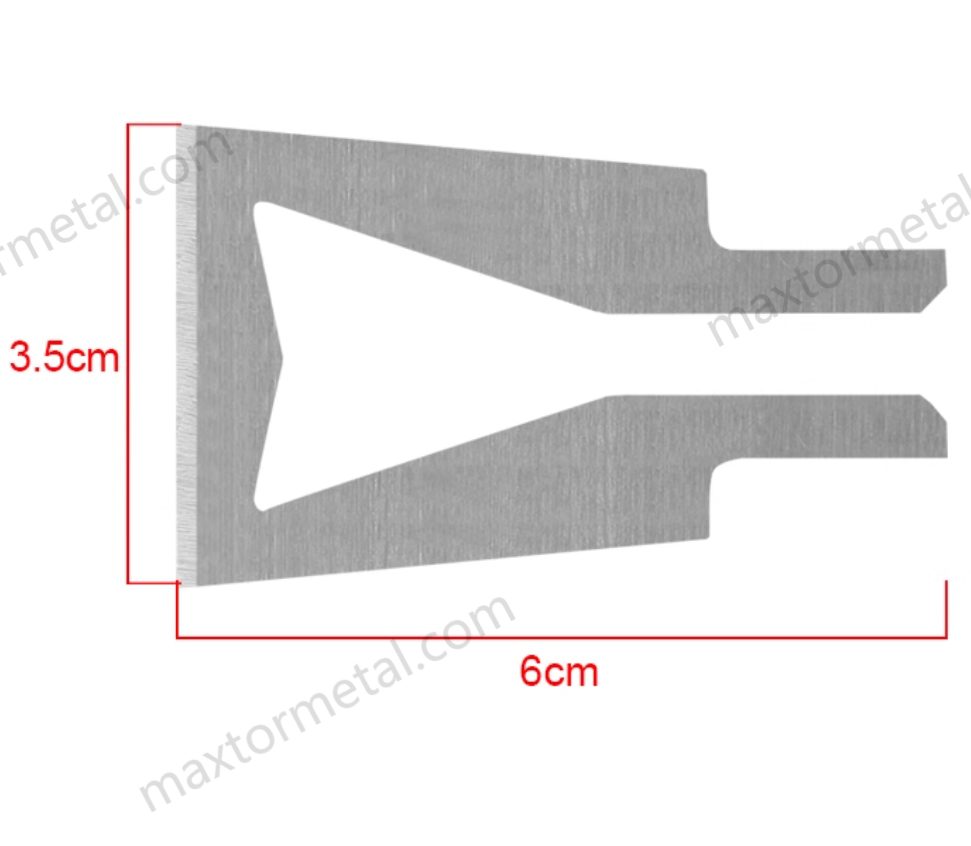
- 幾何学 (hook, bevel, dual-edge, reinforced flange) changes how the material feeds and whether the cut stays square.
If you push a heavy blade on low power, the system tends to “feel stable” at idle but falls behind during continuous cutting. If you run a light blade on high power, you can overshoot temperature quickly and start burning material you meant to seal.
Selection framework
Define material stack-up and thickness/density
Start with your real cut condition—not a single “material name.” Document:
- Material type (textile, webbing, label stock, foam)
- Stack-up (single ply vs multi-layer)
- Thickness and density (especially for foams)
- Additives/coatings (often the real driver behind smoke, odor, and discoloration)
The same nominal thickness can behave very differently if one roll is tighter-woven, has a different resin finish, or traps heat differently.
Decision shortcut: if you regularly cut multi-layer stacks, wide webbing, or dense foam, assume you need more recovery margin and evaluate 400W early. If your work is narrow, thin, and intermittent, 100W may be sufficient—if temperature control is stable.
Set target line speed and duty cycle
Two questions matter more than peak power:
- How many cuts per minute do you need at steady state?
- How long does the blade stay in the material each cut (effective dwell)?
A 100W class system can work well at a modest cut rate when the blade has time to recover. But at higher duty cycles, the process becomes recovery-limited: the blade enters the next cut cooler, forcing either slower feed or higher setpoint.
A 400W class system is often selected when you can’t afford to “wait for heat” between cuts.
重要なポイント: Don’t size power from the first cut. Size it from the 100th cut at your target duty cycle.
Align temperature control and thermal recovery
For production, look beyond a dial.
You want a control loop that can:
- Hold temperature with minimal overshoot (reduces bead growth and discoloration)
- Recover quickly after each cut (reduces drift and operator compensation)
- Stay stable under airflow changes (fume extraction can cool the blade)
Also validate how temperature is measured and where it’s sensed. A controller can be “accurate” at the sensor and still deliver inconsistent edge quality if the blade tip is seeing large swings.
Natural brand note (once): if your line depends on a nonstandard blade shape, mounting interface, or edge geometry, supply stability becomes part of quality control. In practice, teams reduce qualification risk by standardizing drawings/tolerances and working with a supplier such as マックストールメタル that supports custom industrial blades from drawings or sketches so replacement blades remain consistent batch to batch.
Cut quality and process control
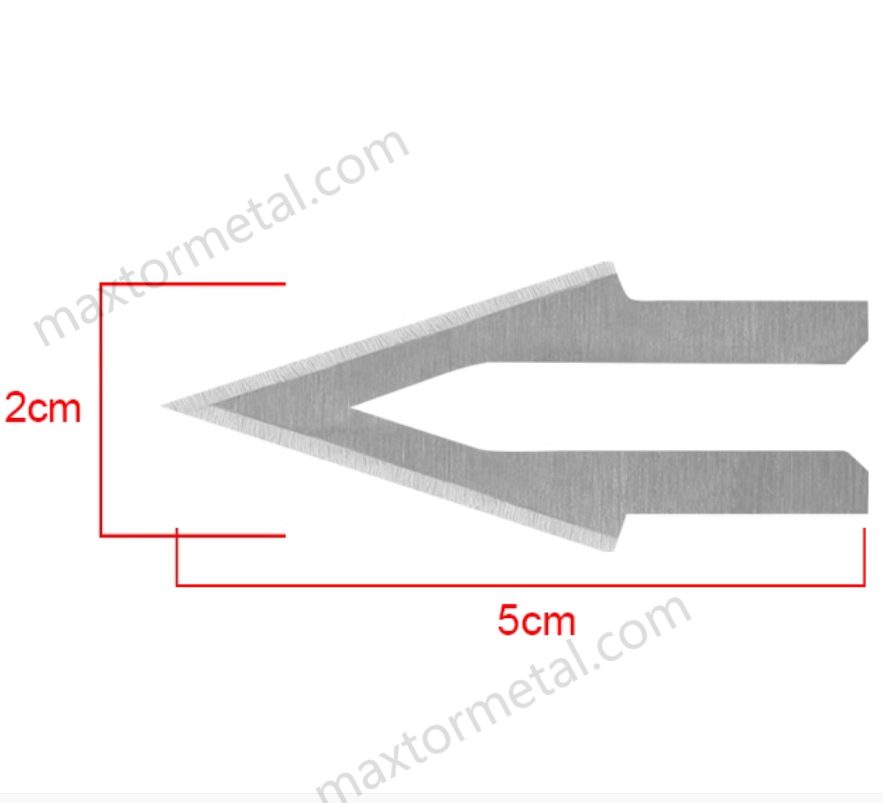
Sealed edge integrity and squareness
“Good cut quality” usually means two things:
- The edge is sealed enough to prevent fray or fiber pull-out (for synthetics and webbing)
- The cut is square enough that downstream operations (sewing, bonding, stacking) don’t drift
Power affects both, but indirectly.
More power gives you recovery and speed headroom. It does not automatically guarantee a better seal. A hot, unstable edge can round corners, distort foam cells, or create a large bead that interferes with fit.
Managing discoloration, smoke, and bead size
If you’re fighting discoloration and smoke, treat it as a heat-input and ventilation problem:
- Lower the setpoint and increase effective dwell (when possible) rather than running maximum temperature.
- Increase feed consistency: inconsistent pressure and feed angle create local overheating.
- Keep the edge clean: residue acts like insulation and changes how heat transfers into the material.
Ventilation matters because hot cutting can generate fumes from polymers, finishes, and adhesives.
A practical benchmark is hot knife fume extraction that captures smoke at the source rather than relying on room dilution. OSHA’s guidance on controlling hazardous fumes emphasizes local exhaust ventilation positioned close to the source—capture is most effective when the hood/nozzle is kept near the plume (see OSHA’s guidance on local exhaust ventilation placement).
For exposure targets, many industrial hygiene programs reference TLVs/BEIs as health-based guidance values (not legal limits) when setting monitoring and control strategy, per ACGIH’s TLV/BEI Guidelines.
Blade wear, changeovers, and uptime impact
Blade wear rarely shows up as a clean failure. It shows up as drift:
- more drag at the cut
- growing bead size
- rising smoke and discoloration
- more frequent operator “touch-ups” to settings
Changeovers are an OEE issue, not a maintenance footnote. Track:
- cuts per blade (or hours) to quality threshold
- changeover time (including heat-up/stabilization)
- scrap rate near end-of-life
If a higher power class reduces changeovers by allowing stable cutting at lower stress (lower overshoot, less operator compensation), it can win on TCO even if energy draw is higher.
Safety and compliance essentials
Ventilation and exposure controls (OSHA/ACGIH)
At minimum, treat hot knife cutting as a fume-generating operation and design controls around source capture.
- Prioritize local exhaust ventilation close to the cut zone; OSHA’s source-capture principle is clearly stated in OSHA’s guidance on local exhaust ventilation placement (see the OSHA fact sheet linked earlier in this article).
- Use exposure evaluation and monitoring practices aligned with your site program; TLVs/BEIs are commonly used guidance values for industrial hygienists, as described in ACGIH’s TLV/BEI Guidelines (linked earlier in this article).
Electrical and guarding (UL/NFPA/CE basics)
For production installations, treat the hot knife station as industrial machinery:
- Electrical design and documentation should align with industrial machinery standards expectations; in North America, NFPA 79 (Electrical Standard for Industrial Machinery) is a common reference point.
- Many machine builders align with IEC/EN principles; IEC 60204-1 electrical equipment of machines provides broad requirements for machine electrical equipment.
If you ship into the EU/EEA, CE marking is a system responsibility (risk assessment, documentation, conformity). A practical starting point is the EU’s overview of CE marking requirements and the European Commission’s machinery compliance overview.
Interlocks, E-stops, and SOP documentation
Power-class decisions are useless if safe operation is inconsistent.
For any station used at speed:
- Guard the hot zone and define safe access points.
- Use interlocks where opening a guard exposes a hot edge or moving feed.
- Provide an E-stop that is reachable from the operator position and the load/unload area.
- Document the SOP: startup, warm-up/stabilization, parameter changes, cleaning, blade change, ventilation checks, and shutdown.
TCO and ROI levers
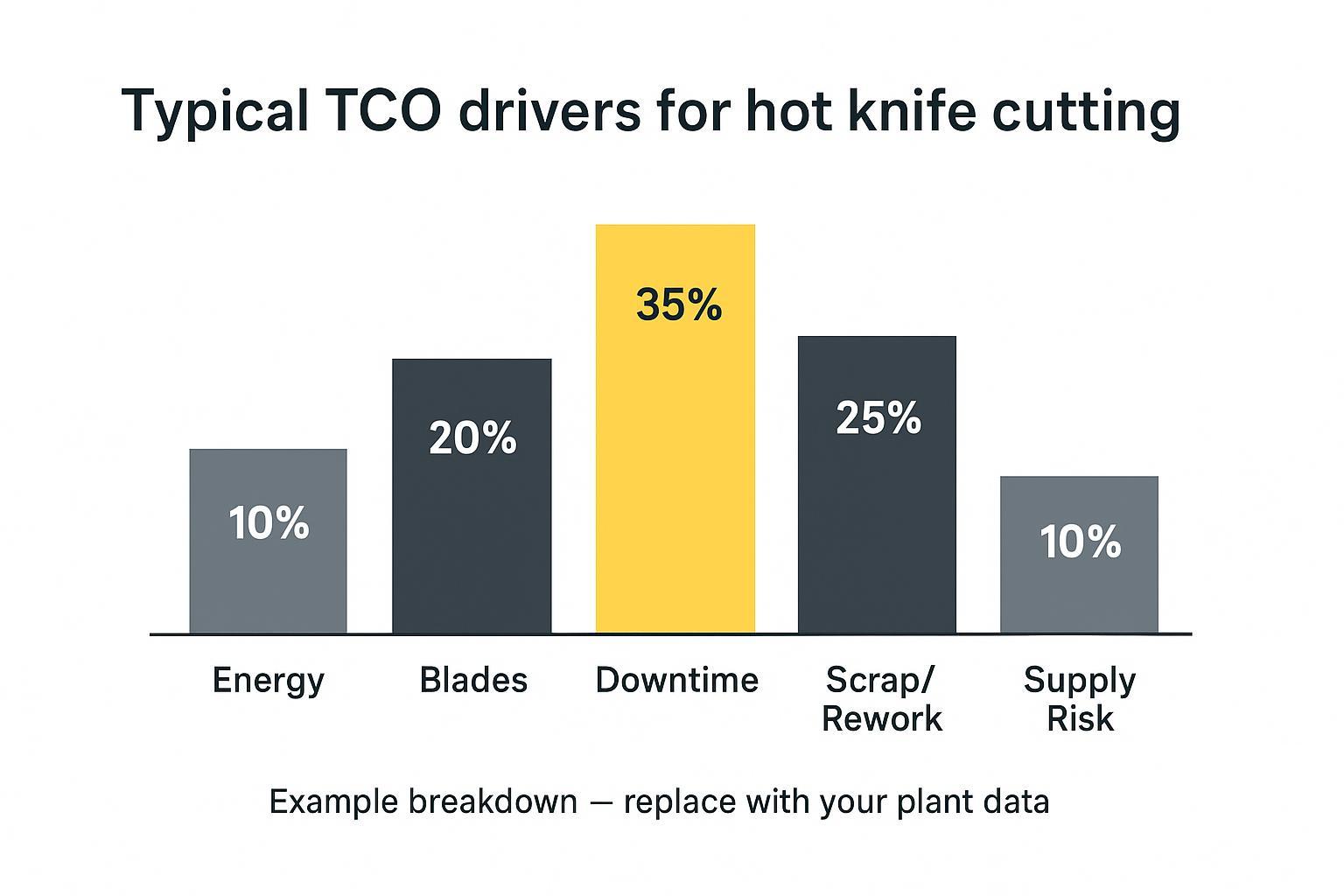
Energy use vs throughput and scrap
Energy is usually not the dominant cost. The dominant cost is what energy enables:
- cycle time
- stability at speed
- scrap and rework reduction
If 400W lets you run at target speed without overheating (stable control, right blade), the kWh increase can be small compared to the value of reduced downtime and scrap.
Blade life, downtime, and inventory costs
Model blade cost as a system cost, not a unit cost:
- blade price × usage rate
- downtime per changeover × line cost
- inventory policy (safety stock vs expedited orders)
A lower-watt system that forces more frequent changes to maintain quality can cost more than a higher-watt system that runs consistently.
Supply risk, lead time, and qualification trials
If your blade is nonstandard, supply risk becomes a production KPI.
Treat qualification like a controlled trial:
- lock the drawing and tolerance stack
- qualify the blade material and heat treatment spec
- validate consistent fit and edge behavior across multiple batches
This is also where lead time matters: if you can’t replenish blades predictably, you’ll either carry excess inventory or accept downtime risk.
Implementation and validation
Run representative material trials and log parameters
Don’t qualify power class on a single “best case” roll.
Build a trial pack that includes:
- worst-case thickness and density
- any coated/adhesive variants
- representative stack-ups
Log:
- setpoint and warm-up time
- cut rate (cuts/min or feed speed)
- duty cycle profile (steady vs burst)
- ventilation setting (airflow changes can alter thermal behavior)
- blade geometry and blade condition
Acceptance metrics: seal, squareness, discoloration, smoke index
Trial log template (copy/paste)
Use a simple table so every shift logs the same fields:
| アイテム | What to record | 例 |
|---|---|---|
| Material & stack-up | material name, layers, thickness/density, coatings | 2-layer webbing, 1.8 mm, PU-coated |
| Power class & blade | 100W/400W, blade geometry, blade mass if known | 400W, hook blade, 2.0 mm edge |
| Setpoint & stabilization | setpoint, warm-up time, stabilization time | 420°C, warm-up 6 min, stabilize 3 min |
| デューティサイクル | cuts/min, dwell time, steady vs burst | 30 cuts/min, 0.6 s dwell, steady |
| 換気 | capture method & setting | LEV nozzle 80 mm from cut zone |
| Quality results | seal grade, squareness tolerance, discoloration grade, smoke index | Seal A, ±1°, ΔE < 2, Smoke 2/5 |
| 注記 | residue, bead buildup, operator adjustments | clean every 30 min |
Quick troubleshooting (most common drift patterns)
- Bead size grows over time: blade temperature overshoot or residue insulating the edge → lower setpoint, improve control tuning, increase cleaning frequency, verify feed consistency.
- Smoke/odor spikes: setpoint too high for coatings/adhesives or capture too far from source → reduce setpoint, bring capture closer, verify airflow is stable during cutting.
- Incomplete sealing / fray appears at speed: recovery-limited (blade enters cut cooler) → increase power class, reduce duty cycle, shorten engagement length, or use a blade geometry that concentrates heat at the edge.
- Foam edge recession / melting back: too much heat input or dwell → lower setpoint, increase feed speed, improve temperature stability, validate blade geometry for foam.
Define acceptance before you run trials. Practical metrics include:
- Seal: fray resistance test and edge pull test suitable for your product
- Squareness: cut angle tolerance and edge straightness over a defined length
- Discoloration: visual standard (A/B samples) or ΔE threshold if you measure color
- Smoke index: simple operator-visible scoring plus ventilation capture effectiveness check
The point is repeatability: the system should hold quality at the target duty cycle without constant operator tuning.
Handover: SOPs, maintenance, and training plan
When you standardize, freeze the process:
- SOP with parameter ranges and “do not exceed” limits
- maintenance schedule (cleaning, inspection, changeover triggers)
- training for normal operation and abnormal conditions (smoke spike, drift, blade damage)
- spare parts list and reorder points
結論
If you need a simple rule: 100W fits intermittent, lighter-duty work where recovery time exists; 400W fits higher duty cycle and higher heat draw where you can’t afford drift. But the correct decision comes from steady-state duty cycle そして acceptance metrics, not the first cut or the nameplate.
Key takeaways (actionable)
- Size power for thermal recovery under load: confirm quality on the 100th cut at target speed.
- Treat the system as a set: power class + blade mass/geometry + temperature control + ventilation.
- Control smoke as an engineered system: source capture first, then verify your site exposure program.
- Standardize only after a representative trial pack and clear pass/fail criteria.
Next steps checklist (run this on your line)
- Define worst-case materials: thickest/densest stack-up, any coatings/adhesives.
- Set a duty-cycle target: cuts/min, dwell time, and shift profile (steady vs burst).
- Run A/B trials (100W vs 400W if unsure) with the same blade geometry where possible.
- Log parameters: setpoint, warm-up time, cut rate, ventilation setting, and blade condition.
- Grade quality: seal, squareness, discoloration, and a simple smoke index.
- Lock the winning configuration: parameter window, cleaning interval, blade change triggers, and drawing/tolerances for supply repeatability.
著者: MAXTOR METAL Process Engineering Team (industrial blade & hot cutting applications), with 15+ years of experience supporting OEMs and end-users on custom, precision-ground blades and replacement blade qualification.
Quality and inspection: MAXTOR METAL operates a documented quality control process covering material inspection, in-process checks, and final inspection. (If you maintain formal certifications such as ISO 9001, list the certificate number and scope here.)
References and standards (starting points)
- OSHA: Local exhaust ventilation placement principle (source-capture guidance): https://www.osha.gov/sites/default/files/publications/OSHA_FS-3647_WELDING.pdf
- ACGIH: TLVs/BEIs guidelines overview: https://www.acgih.org/science/tlv-bei-guidelines/
- NFPA 79 (industrial machinery electrical): https://www.nfpa.org/product/nfpa-79-standard/p0079code
- IEC 60204-1 (electrical equipment of machines): https://webstore.iec.ch/en/publication/26037
- EU CE marking overview: https://europa.eu/youreurope/business/product-requirements/labels-markings/ce-marking/index_en.htm
- European Commission machinery compliance overview: https://single-market-economy.ec.europa.eu/sectors/mechanical-engineering/machinery_en
Revision history
- 2026-04-26: Initial publication.

 English
  Spanish
  Italian
  French
  Portuguese
  Russian
  German
  Arabic
  Hindi
Hindi  Vietnamese
  Indonesian
  Japanese
  Korean