


안전 주의 사항 및 책임 한계: 본 가이드는 산업용 식빵 슬라이서의 일반적인 유지보수 지침을 제공합니다. 항상 장비의 OEM 서비스 매뉴얼, 작업장의 잠금/표지(LOTO) 프로그램 및 관련 지역 규정을 준수하십시오. 어떠한 단계라도 OEM 문서와 상충하는 경우, OEM 요구 사항이 우선합니다.
기술적 검토: 안전 강조 및 절차적 명확성을 위해 MAXTOR METAL의 기술 팀이 검토했습니다(LOTO 및 안전 가드 요구 사항은 여전히 작업장 프로그램 및 지역 규정에 따릅니다).
장착 호환성이나 칼날 형상(blade geometry) 확인에 도움이 필요하십니까? MAXTOR METAL에 문의하십시오: maxtormetal.com/contact.
- 본 가이드의 대상 및 달성할 수 있는 성과본 가이드는 산업용 제과제빵 공장의 유지보수, 생산 및 구매 팀과 현장 고객을 지원하는 식빵 슬라이서 OEM 업체를 대상으로 합니다. 본 가이드를 통해 표준화할 수 있는 교체 절차와 슬라이스 외관을 안정적으로 유지하면서 불필요한 다운타임을 줄이는 검증 방법을 습득할 수 있습니다.
- 식빵 슬라이서 칼날 교체가 품질, OEE 및 TCO에 미치는 영향칼날 상태와 설정은 작업자가 매 교대 근무마다 체감하는 세 가지 결과에 직접적인 영향을 미칩니다:
- 품질: 칼날 마모 및 불균일한 장력은 찢어짐, 압착 및 빵가루 발생으로 나타납니다.
- 설비종합효율(OEE): 느린 교체 작업과 교체 후 “설정 미세 조정” 작업은 가동 시간과 라인 신뢰성을 저하시킵니다.
- 총비용: 칼날 가격이 주요 비용인 경우는 드뭅니다. 불량품, 재작업, 위생 청소 인건비, 계획되지 않은 정지가 대다수의 비용을 차지합니다.
- 준비 사항: 개인보호구(PPE), 공구, 예비 세트 및 다운타임 시간 확보안전 가드를 열기 전에 사용할 도구를 미리 준비하여 장비가 열려 있는 시간을 최소화하십시오:
- 개인보호구(PPE): 베임 방지 장갑, 보안경, 팔 토시 또는 팔뚝 보호대, 헤어넷/수염 커버, 공장에서 사용하는 경우 일회용 앞치마.
- 공구: 제조업체 전용 키/육각 공구, 해당 모델에 사용되는 토크/장력 측정 공구, 손전등, 체결 부품용 깨끗한 보관함.
- 예비 부품: 완벽히 일치하는 칼날 세트(구형과 신형 혼용 금지) 및 해당 모델에 사용되는 클립/핀.
- 다운타임: 다음을 포함하는 시간 확보 테스트 절단 및 초물 포장 검증 (단순히 “교체에만 딱 맞는 시간”으로 잡지 마십시오).
안전, 개인보호구(PPE) 및 준비 작업

재가동 전 신속 점검 목록
- LOTO 완료 및 검증 완료, 에너지 차단이 확인된 후에만 안전 가드 제거.
- 베임 방지 개인보호구(PPE)를 착용하고 칼날 취급, 신형/구형 세트 혼용 금지.
- 최종 장력을 가하기 전에 모든 칼날이 안착되고 체결 부품이 손으로 가볍게 조여졌는지 확인.
- 모든 가이드를 통과하는 칼날 경로 확인(강제로 끼우거나 마찰이 없는지 확인).
- OEM 지정 방법(게이지/설정값/순서)을 사용하여 단계적으로 장력을 높임.
- 안전 가드 재설치, 주변 정리, 제어된 테스트 사이클 수행(해당 모델이 허용하는 경우).
- 테스트 절단 결과가 두께 허용 오차 및 빵가루 발생 기준을 충족하는지 확인.
- 초물 포장 검증 완료 및 서명 승인.
잠금/표지(LOTO) 점검 목록
식빵 슬라이서는 청소 및 유지보수 중 베임 및 절단 위험이 매우 높습니다. OSHA는 위험한 장비를 정비하는 동안 안전 가드를 제거할 때 잠금/표지(LOTO) 프로그램이 필요하다고 명시하고 있습니다(OSHA 가이드 참조: 식품 슬라이서 및 육류 절단기로 인한 베임 및 절단 예방 (OSHA 3794)). 보다 광범위한 에너지 제어 요구 사항은 OSHA의 유해 에너지 제어(락아웃/태그아웃), 29 CFR 1910.147, 및 다음의 합의 지침을 참조하십시오. ASSP의 ANSI/ASSP Z244.1 개요.
반복 가능한 점검 목록을 사용하십시오:
- 관련 직원에게 알리고 “정비 중” 표지판을 게시합니다.
- 모든 에너지원(전기 및 공압/진공 장치가 있는 경우 포함)을 식별합니다.
- 정상 정지 순서에 따라 장비를 종료합니다.
- 에너지를 차단하고 잠금 장치 및 표지(Lock & Tag)를 부착합니다.
- 잔류 에너지를 방출합니다(공기 배출, 구동 부품이 정지 상태인지 확인).
- 에너지 차단을 검증합니다(시동을 시도하여 움직임이 없는지 확인).
⚠️ 경고: 안전 가드가 열린 상태에서 “정렬이 잘 되었는지 확인하기 위해” 장비를 가동해서는 절대 안 됩니다. 검증은 안전 가드가 장착된 상태에서, 제어된 속도로, 안전한 자세를 유지하며 진행되어야 합니다.
베임 방지 취급 및 공구 설정
- 모든 칼날은 항상 날카로운 상태로 취급하십시오. 절단면 내에 손을 넣지 마십시오.
- 날 보호 조치(골판지 또는 전용 트레이)가 되어 있는 깨끗하고 안정적인 거치 공간을 사용하십시오.
- Place tools where you don’t reach across blades.
- Replace one side/section at a time if your frame design allows it—your goal is to prevent the frame from twisting or drifting.
Sanitation boundaries and debris control
Blade change is also a hygiene event. Set clear boundaries:
- Establish a “clean side” for new blades and a “dirty side” for removed blades and crumb debris.
- Control crumbs so they don’t migrate into bearings, guide rails, or electrical enclosures.
- Avoid introducing water into areas that your sanitation SOP defines as no-water zones.
MAXTOR METAL’s own maintenance guidance emphasizes routine cleaning and inspection for blade performance and hygiene (see Maintaining & Replacing Bread Slicing Blades).
Model-aware bread slicer blade replacement steps: Oliver, JAC, Berkel
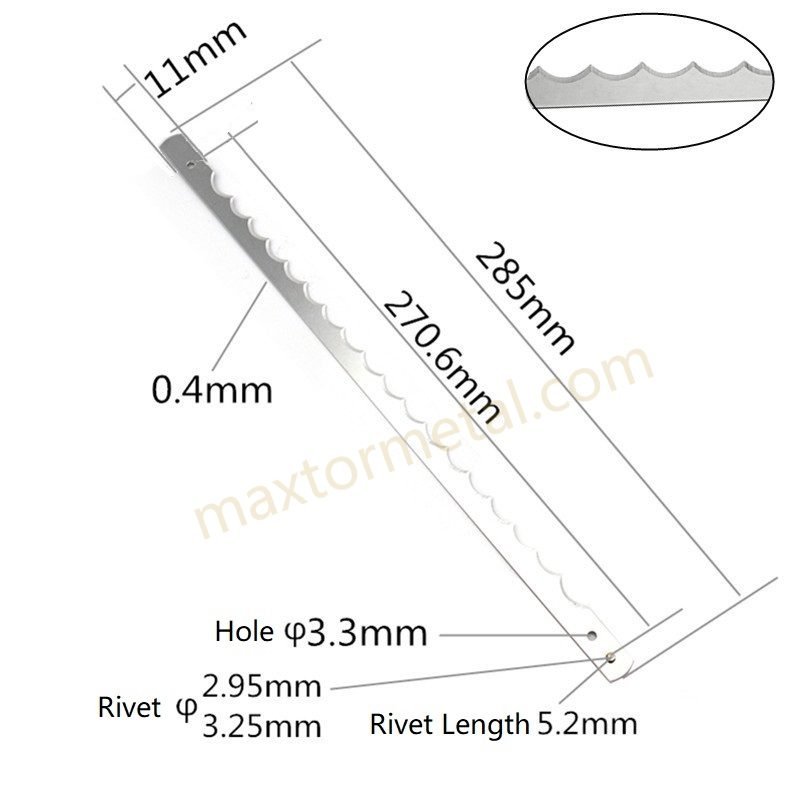
The safe sequence is similar across brands, but the mechanical details that cause trouble differ. The model-aware notes below focus on failure modes: frame distortion, tension inconsistency, and incorrect pathway routing.
Oliver: frame, cams, and tension pins
Oliver-style frames often rely on consistent mechanical indexing. The risk is reassembling with one side “pulled” tighter than the other.
- Relieve tension gradually—alternate adjustments rather than backing one side off fully.
- Photograph or mark the pre-change positions of cams/pins/adjusters.
- Remove blades in a controlled order so the frame doesn’t spring.
- Install the new set with the same order and seating pattern.
완료 시점: all blades are seated, hardware is finger-tight, and the frame sits square without bias.
Fastener types, guide layouts, and tension mechanisms can vary by sub-model—verify details against your OEM parts diagram and service manual before final tensioning.
JAC: progressive swap without distortion
On JAC-style assemblies, the most common mistake is loosening too much at once and introducing distortion that becomes “mystery thickness drift.”
- Work progressively: relieve → remove → seat → lightly secure → move to the next.
- Keep tension low during initial seating so the blade path finds its track.
- Only bring tension up after every blade is installed and the pathway is confirmed.
완료 시점: the blade set is installed with even, repeatable low tension and no obvious pathway rubbing.
Sub-model differences (guide hardware, routing points, and tension devices) are common—confirm the exact pathway and adjustment points in your OEM documentation.
Berkel: service pathway and parts mapping
Berkel slicers often have more explicit service pathways, but teams lose time when parts aren’t mapped before removal.
- Map parts before you start: guards, fasteners, clips, guides.
- Keep removed parts grouped by position (left/right, upstream/downstream).
- Follow the service pathway, and don’t “force” a blade into a guide.
완료 시점: guards and guides return to their original positions and the blade pathway is clean and unobstructed.
If your Berkel variant uses different clips, guide blocks, or guard interlocks, follow the OEM parts diagram/service manual for the correct sequence and reassembly checks.
Tensioning, alignment, and validation (bread slicer blade tensioning and alignment)

Set tension consistently per blade
Your goal isn’t “maximum tight.” Your goal is repeatable tension across the full set. Tension methods and target values vary by brand and model—use your OEM manual’s specified gauge, reading, or adjuster position as the primary reference.
- Bring tension up in stages. Alternate sides and avoid long turns on one adjuster.
- If your model uses a tension gauge/setting, document the reading and keep it consistent per blade.
- If you don’t have a gauge, document the adjuster position and use a fixed pattern (e.g., quarter-turn increments) to reduce variation.
프로 팁: If you’re seeing inconsistent crumb load across lanes or edges, treat tension inconsistency as a prime suspect before you blame bread temperature or packaging.
Align spacing and edge orientation (bread slicer blade alignment)
Alignment errors usually show up as:
- thickness variation that won’t “tune out”
- tearing at the same location repeatedly
- unusual rubbing marks, noise, or heat
Practical checks:
- Confirm every blade is routed through the intended guide pathway.
- Verify spacing is uniform and that blades aren’t twisted in the frame.
- Confirm edge orientation is correct for your blade geometry (serrated/scalloped).
MAXTOR METAL documents bread-blade geometry options and typical tooth pitch ranges—use them as a reference when selecting and verifying blade style (see MAXTOR METAL’s “Essential Guide to Bread Cutting Blades: Optimize Your Bakery…” and MAXTOR METAL’s “How Blade Geometry Impacts Cutting Efficiency”). (Both cited later—only link once per URL.)
Validate with test cuts and SD targets
Do not restart production on “looks okay.” Validate like an OEM would:
- Run a short warm-up cycle at low risk (no product) if your slicer permits.
- Make a controlled set of test cuts.
- Measure and record slice thickness over a small sample.
- Compare to your internal SD/variance target and your packaging tolerance.
- Inspect crumb load and edge finish (tearing vs clean sever).
If results are drifting:
- Re-check pathway routing and blade seating first.
- Adjust tension in small, documented increments.
- Re-test on the same product type and loaf temperature.
Selecting OEM‑alternative blades (OEM alternative bread slicer blades)

Materials, coatings, and edge geometry
For bread slicing, geometry and surface condition matter as much as the base material.
- 재료: MAXTOR METAL’s 빵 슬라이서 블레이드 are offered in stainless steel with serrated/scalloped cutting edge styles suited to bread.
- 에지 기하학: tooth pitch and tooth form influence how the edge “grips” crust vs compressing crumb. MAXTOR METAL’s guidance cites serrated pitch ranges (see How Blade Geometry Impacts Cutting Efficiency) and compares blade types by speed and application (see Essential Guide to Bread Cutting Blades: Optimize Your Bakery…).
- 코팅: if you’re slicing warm or high-sugar product where sticking is a problem, ask your supplier what surface finishes and anti-stick options are available, and validate them with the same crumb + thickness protocol.
Where MAXTOR METAL helps in practice is repeatable manufacturing and controlled geometry for OEM-alternative sets, plus custom build support when the mounting features (holes/tabs) differ between machines.
Match to product mix and throughput
Choose blades to fit your product reality, not a catalog category.
Match by:
- Product mix: sandwich loaves, buns, baguettes, artisan crust—each behaves differently.
- Line rate: higher throughput amplifies small setup errors into scrap.
- Bread condition: loaf temperature and moisture (hot bread sticks; dry crust tears).
When procurement evaluates OEM-alternative blades, push for a short, controlled trial and record three numbers:
- slice thickness variance (your internal tolerance)
- crumb load per unit output (weigh it or at least trend it)
- changeover duration (minutes from stop to first-pack accept)
This turns “OEM vs alternative” into a measurable decision rather than an argument.
Example from industry
A publicly documented example of how slicer design + disciplined upkeep can reduce maintenance burden comes from Bizerba’s case study on the Koch artisan bakery. Bizerba reports the slicer has been “absolutely reliable since start-up,” with “no need for maintenance and no need to change or resharpen the saw blade,” while delivering “up to 200 slices per minute” and a daily cleaning time of “just five minutes” (see Bizerba’s “CSP meets the increased demands of the Koch artisan bakery” case page).
Compliance, documentation, and sourcing
For bakeries and OEMs, “compatible” isn’t just fit—it’s also documentation.
Ask your blade supplier for:
- material grade documentation suitable for food contact use (as required by your market)
- batch traceability and test records
- inspection reports for geometry-critical features
MAXTOR METAL outlines traceability and compliance documentation expectations for food-grade blades—such as traceability papers per batch and supplier certificates—in 더 안전한 칼날을 위한 식품 등급 강철에 대한 5가지 빠른 사실.
Changeovers, maintenance, and records

Rapid swap SOPs and spare staging
Changeovers get faster when the work is staged:
- Keep one complete, labeled spare set sealed on the “clean side.”
- Pre-stage fasteners, clips, and any model-specific pins.
- Use a fixed replacement sequence and a sign-off step for tension/alignment.
MAXTOR METAL’s maintenance guidance also reinforces the operational value of routine inspections and replacement discipline.
Cleaning cadence and no‑water zones
Crumbs are both a quality issue and a sanitation issue.
- Clean crumbs on a cadence that matches output and product type.
- Respect no-water zones to avoid corrosion and contamination risk.
- Keep blades dry after cleaning and before storage.
Traceability, KPIs, and review cadence
Treat blades like a controlled consumable:
- Record blade set ID / batch, install date, and running hours.
- Track: crumb load trend, slice thickness drift, and changeover minutes.
- Review weekly for the first month after a new blade source or geometry change.
TCO note (method, not marketing): If you want an apples-to-apples comparison, model TCO as:
- (blade set cost + changeover labor + sanitation labor + scrap/rework + downtime cost) / total good output
Even when you don’t publish the number, tracking the inputs makes procurement decisions defensible.
Troubleshooting after a blade change
| Symptom you see | 가능성 있는 원인 | First checks to run |
|---|---|---|
| Thickness drift or lane-to-lane variation | Uneven tension, frame distortion, misrouting | Confirm routing through guides; verify even, repeatable tension using the OEM method; check for frame bias |
| Tearing at the same location on every loaf | Blade twist, incorrect edge orientation, damaged guide | Verify blade seating and twist; confirm edge orientation matches blade geometry; inspect guide condition |
| High crumb load vs baseline | Edge wear/incorrect tooth form, inconsistent tension, product condition shift | Recheck tension consistency; confirm blade geometry matches product mix; retest at consistent loaf temperature |
| Unusual noise, rubbing marks, or heat | Pathway rubbing, misaligned guide, debris in rails | Stop and inspect for rub points; clean crumbs/debris; confirm guides return to original positions |
If any symptom persists after checks, pause production and compare your setup to the OEM manual for your specific model before making larger adjustments.
결론
- Key checkpoints before restart and first-pack verificationBefore you return the line to normal output:
- LOTO removed only after guards are back in place and the area is clear.
- Tension is set consistently and documented.
- Blade pathway is confirmed (no rubbing, no misrouting).
- 테스트 절단 결과가 두께 허용 오차 및 빵가루 발생 기준을 충족하는지 확인.
- First-pack verification is completed and signed off.
- What to monitor in week one and when to retension or replaceIn the first week after a change (especially when trialing OEM-alternative blades), monitor:
- thickness drift (trend it by shift)
- crumb load changes vs baseline
- any recurring tear patterns (often alignment or routing)
- changeover time and post-change adjustments
저자 소개
토미 탕 입니다 선임 영업 엔지니어 ~에 난징 금속 산업, 와 함께 12년 of experience supporting industrial blade selection and OEM-alternative replacement projects. Certifications include CSE, CME, Six Sigma Green Belt, and PMP.

 English
  Spanish
  Italian
  French
  Portuguese
  Russian
  German
  Arabic
  Hindi
Hindi  Vietnamese
  Indonesian
  Japanese
  Korean