

آخر تحديث: -2026-0330
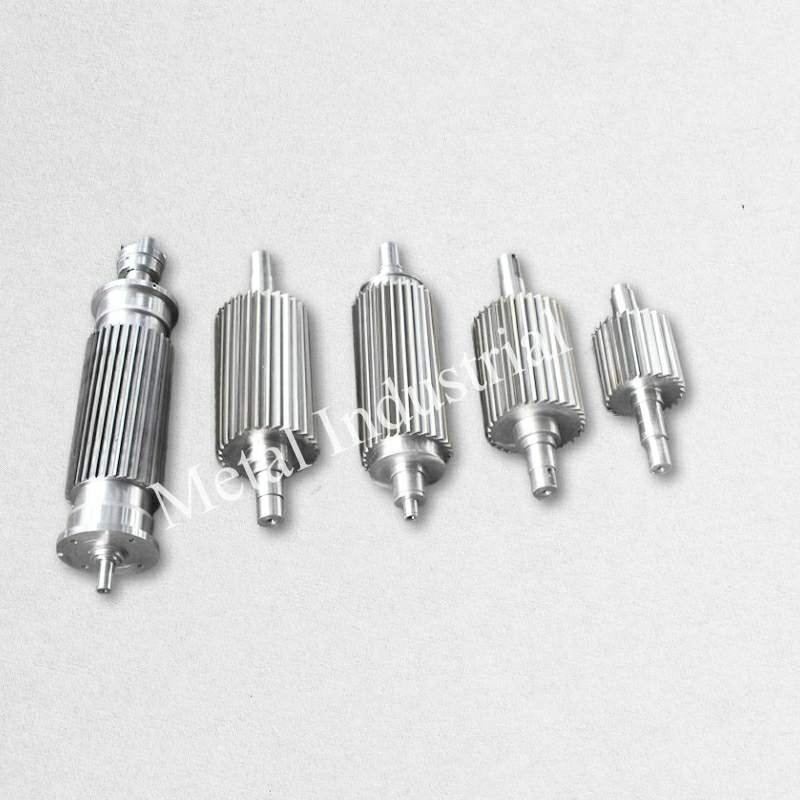
ملاحظة السلامة والامتثال (المملكة المتحدة): يقدم هذا المقال إرشادات عامة لأفضل الممارسات لاستبدال القواطع الدوارة. ولا يغني عن تقييم المخاطر الخاص بموقعك، أو وثائق الشركة المصنعة الأصلية (OEM)، أو التقييم الهندسي المختص. تحقق دائمًا من خلوص الحماية، وحدود الانحراف (runout)، وأنظمة العمل الآمنة بموجب لوائح PUWER قبل إعادة المعدات إلى الخدمة.
إخلاء مسؤولية: يشير هذا المقال إلى منتجات وقدرات MAXTOR METAL. الكاتب تابع لشركة Nanjing METAL Industrial.
النطاق والافتراضات
- يغطي هذا الدليل المطابقة التامة (مثل بمثل) مشاريع استبدال القواطع الدوارة حيث يكون الهدف هو استعادة الوظيفة وتكرار عملية الشراء (المواصفات ← التحقق ← التوثيق).
- إنه لا لا يوفر تقييمًا كاملاً للسلامة. إذا كان الاستبدال يغير خلوص الحماية، أو الاهتزاز/الضوضاء، أو قوى القطع، أو معايير التحكم، أو يسبب مخاطر جديدة، فعامله كتعديل واتبع إجراءات إدارة التغيير والتقييم الهندسي المختص في موقعك.
- أي أمثلة “نموذجية” في هذا المقال هي لغرض المرجعية فقط. حدد معايير القبول (مثل إعداد/حدود الانحراف runout، وطريقة اختبار الصلادة) مع وثائق الشركة المصنعة الأصلية (OEM) والمهندس المسؤول قبل إعادة تشغيل المعدات.
نادرًا ما تفشل خطوط الإنتاج القديمة دفعة واحدة. بل تفشل قطعة استهلاكية تلو الأخرى — حتى تصبح القطعة التي لا يمكنك شراؤها هي القطعة التي توقف الخط بأكمله.
الأسباب المعتادة يمكن التنبؤ بها:
- لم تعد الشركة المصنعة الأصلية (OEM) تدعم الآلة، أو تم إيقاف إنتاج رقم القطعة.
- “قطع الغيار البديلة ”الشبيهة تقريبًا" لا تطابق في الواقع أبعاد التركيب، أو التثبيت، أو هندسة القطع.
- تستمر تكاليف التوقف عن العمل في الارتفاع لأن عمليات التبديل تصبح متكررة وبطيئة وأكثر خطورة.
إذا كنت تشغل خطًا يرتبط فيه وقت التشغيل وجودة الحبيبات مباشرة بالقاطع الدوار، فإن استبدال الآلة بالكامل غالبًا ما يكون الطريقة الأكثر تكلفة لحل مشكلة قطع الغيار.
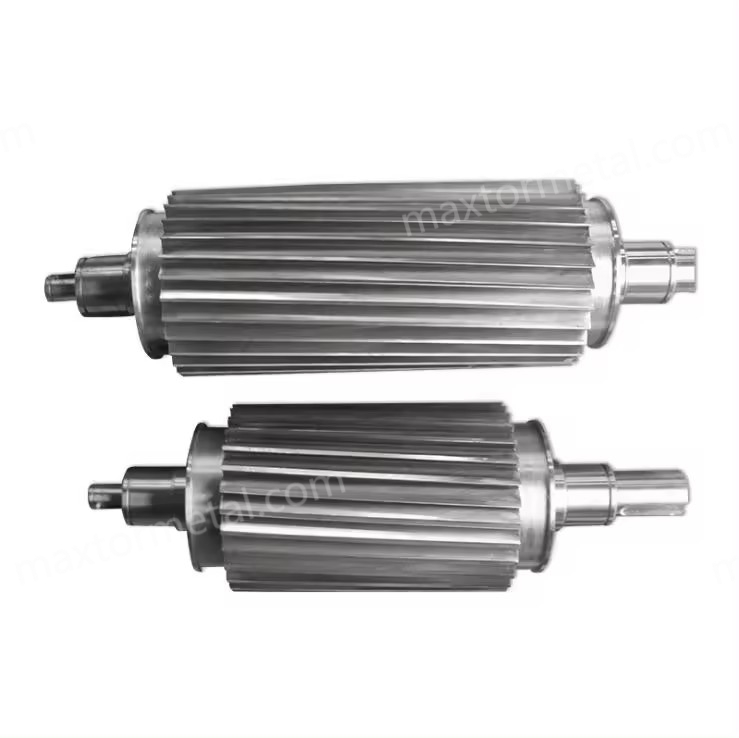
المسار الأكثر أمانًا هو تأهيل بدائل مخصصة للقواطع الدوارة— المصنعة وفقًا للهندسة الوظيفية الخاصة بقاطعك القديم، والتحقق منها من خلال عملية فحص العينة الأولى، وتوثيقها بشكل كافٍ يتيح لقسم المشتريات والصيانة تكرار الطلب دون الحاجة لإعادة هندسته في كل مرة.
ما ستحصل عليه من هذا النهج:
- ضمان ملاءمة التركيب من خلال القياس القائم على المراجع وتخطيط التفاوتات (tolerance mapping)
- عودة أسرع للخدمة مع اعتماد خاضع للرقابة للعينة الأولى
- خفض التكلفة الإجمالية للملكية (TCO) من خلال إطالة وقت التشغيل وتقليل مخاطر التبديل
أهم النقاط الرئيسية: تعامل مع القاطع كمشروع قطع غيار خاضع للرقابة (المواصفات ← التحقق ← التوثيق)، وليس كعملية شراء طارئة.
أساسيات الهندسة العكسية
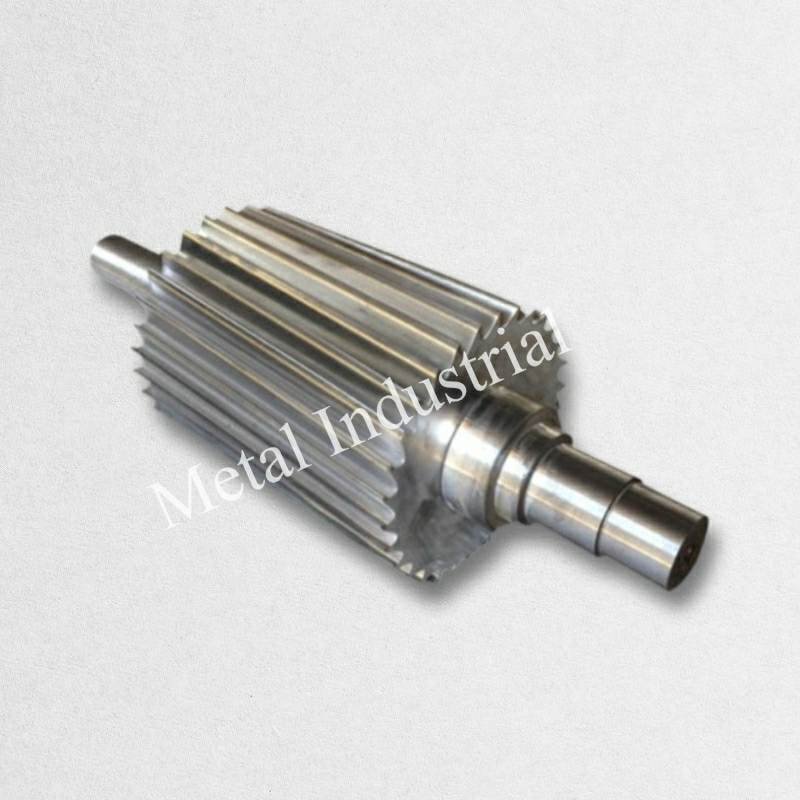
استلام البيانات وجمعها
تعمل الهندسة العكسية بشكل أفضل عندما تتعامل مع الجزء التالف كـ دليل مادي, ، وليس كمخطط نهائي.
ابدأ بعملية استلام تقلل من الغموض:
- تحديد سياق التشغيل: المادة التي يتم قطعها (بكر مقابل معاد تدويره، مركبات مضافة)، ومعدل الإنتاج النموذجي، ونمط الفشل الذي تلاحظه (تثلم سريع، تشقق دقيق، علامات حرارة، زوائد رايش).
- تصوير ووضع ملصقات تعريفية على القطعة قبل تنظيفها (كلا الجانبين، أسطح التثبيت، وأي علامات).
- قياس المراجع “غير المعرضة للتآكل” أولاً: الثقوب، مجاري الخوابير، أسطح التثبيت، ودوائر البراغي — وهي الميزات التي تحدد الموضع على العمود وغالبًا ما تكون أكثر موثوقية من حافة القطع.
لجمع البيانات، يشيع استخدام طريقة هجينة:
- الأبعاد الأساسية باستخدام الفرجار / الميكرومتر
- أبعاد التوافق الحرجة والهندسة باستخدام آلة قياس الإحداثيات (CMM) أو المسح ثلاثي الأبعاد (خاصة عندما يحتوي القاطع على مقاطع معقدة)
ليس الهدف هو جمع “أكبر قدر ممكن من البيانات”، بل هو جمع ما يكفي من البيانات لتحديد المراجع (datums) والتحكم في الخصائص التي تؤثر على التوافق، والتباثر الدائري (runout)، وأداء القطع — حتى تتمكن بدائل مخصصة للقواطع الدوارة من العمل بشكل متوقع عند تركيبها.
تخطيط التفاوتات المسموحة والـ CAD
بمجرد حصولك على القياسات، قم بتخطيطها في نموذج CAD حول هيكل مرجعي (datum structure):
- المرجع الأساسي (Primary datum): عادةً ما يكون وجه التثبيت أو التجويف الذي يحدد الموقع المحوري
- المرجع الثانوي (Secondary datum): خاصية تحدد الدوران أو التمركز الموحد (التجويف، الدليل، واجهة العمود)
- المرجع الثالثي (Tertiary datum): مجرى الخابور/نمط البراغي الذي يثبت الاتجاه
بعد ذلك، قم بتعيين التفاوتات بناءً على سلوك أداة القطع في الآلة:
- حالات التوافق (Fits) التي تتحكم في التمركز الموحد والتباثر الدائري (runout) تحظى بأقصى درجات الاهتمام والدقة.
- يتم التحكم في حواف القطع وزوايا الخلوص (relief angles) للحفاظ على الوظيفة (جودة القطع) بدلاً من نسخ التآكل.
- يمكن أن تكون الخصائص التي لا تؤثر على التجميع أو السلامة أكثر مرونة للحفاظ على معقولية التكلفة.
في إرشادات الهندسة العكسية التي تركز على علم القياس (على سبيل المثال، أفضل ممارسات الهندسة العكسية من Verisurf)، فإن الفكرة المتكررة هي نفسها: حدد المراجع (datums) مبكرًا وأغلق الحلقة بين القياس، والـ CAD، والفحص — وبذلك تقلل من “إعادة العمل” واختلاف تفسيرات الموردين عبر الطلبات المتكررة.
إذا كنت تريد لغة رسمية لهذا، فإن إطار عمل ISO GPS (مواصفات المنتج الهندسية) هو المرجع الشائع في التصنيع. على سبيل المثال،, إيزو 1101 يحدد لغة الرموز والقواعد الخاصة بالتفاوتات الهندسية (الشكل، والاتجاه، والموقع، والتباثر الدائري run-out).
اعتماد العينة الأولى (First-article approval)
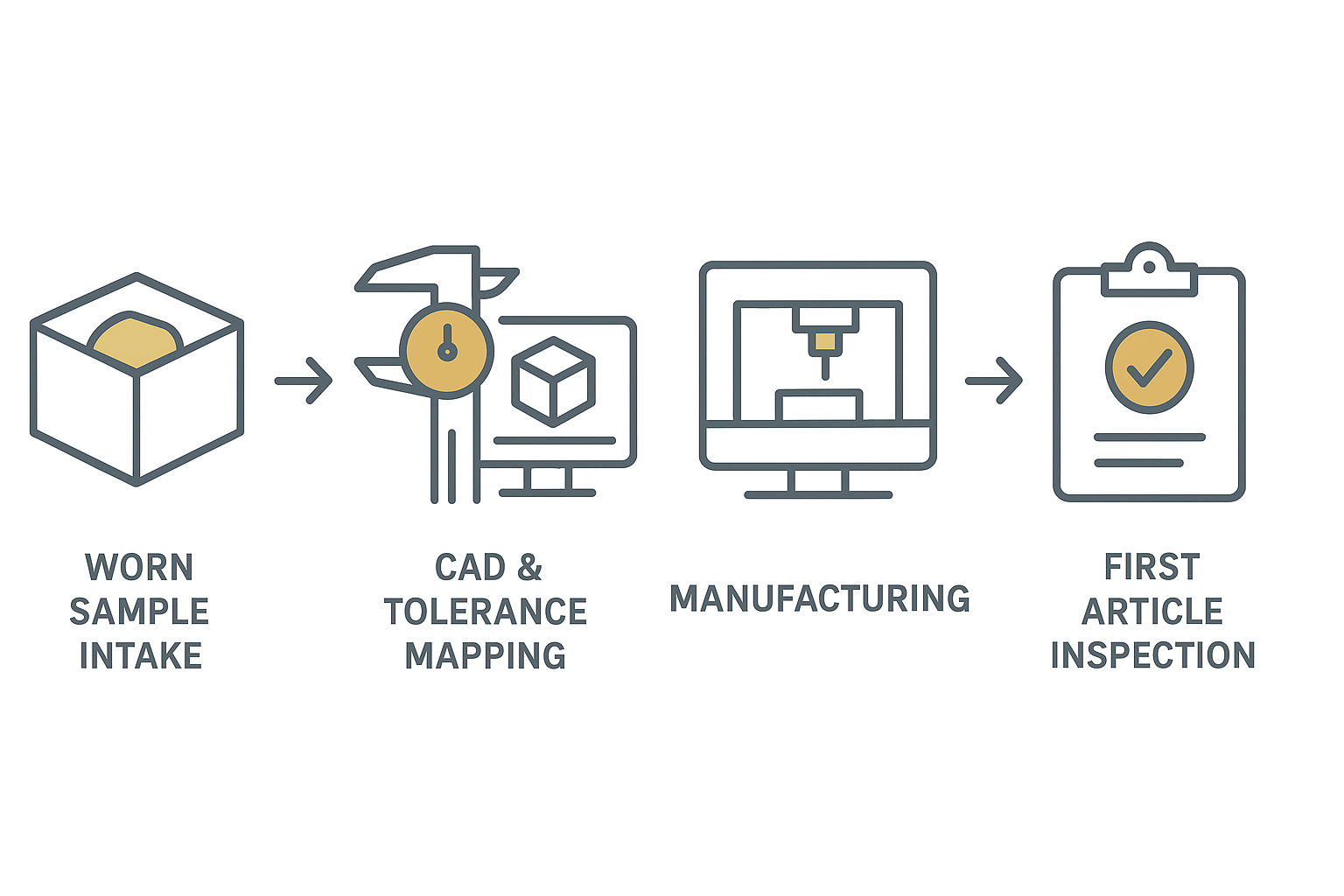
لا ينبغي أن ينتقل الجزء البديل مباشرة من مرحلة “اكتمل الـ CAD” إلى “دفعة الإنتاج”. إن خطوة فحص العينة الأولى الخاضعة للرقابة هي جدار الحماية الخاص بك ضد المخاطر.
يتضمن التدفق العملي لاعتماد العينة الأولى ما يلي:
- تصنيع العينة الأولى وفقًا للتفاوتات المحددة
- الفحص مقارنة برسم الـ CAD / نقاط الفحص المتفق عليها
- حزمة اعتماد (FAI) يمكنك أرشفتها وإعادة استخدامها
نصيحة احترافية: يجب أن تتطابق نقاط فحص FAI الخاصة بك مع الطريقة التي ستقبل بها الدفعات المستقبلية فعليًا — لا تقم بقياس أبعاد “غير ضرورية” لن يقوم أحد بإعادة فحصها تحت ضغط الوقت.
قائمة فحص FAI (نموذج للنسخ/اللصق)
- معرف الجزء، والمراجعة، والكمية (العينة الأولى مقابل الدفعة التجريبية)
- درجة المادة وسجل المعالجة الحرارية
- طريقة اختبار الصلادة والنتائج (على سبيل المثال، Rockwell وفقًا لـ ISO 6508، أو Vickers وفقًا لـ ISO 6507، أو Brinell وفقًا لـ ISO 6506)
- التحقق من الميزات المرجعية أولاً (وجه التثبيت / التجويف / الدليل / مجرى الخابور)
- حجم التجويف والأبعاد الحرجة للتوافق (fit-critical)
- التباثر الدائري/التمركز الموحد عند واجهة التثبيت (تحديد إعداد القياس ومعايير القبول)
- ميزات الموقع المحوري (الفاصلات، الحواف) وملاحظات تراكم التفاوتات (stack-up)
- دائرة البراغي / اتجاه مجرى الخابور (إذا كان ذلك ينطبق)
- نقاط فحص هندسة الحواف (زوايا الخلوص، حالة الحافة، حدود الرايش/الزيادات)
- تشطيب السطح (Surface finish) على وجوه التثبيت / مناطق التلامس
- الفحص البصري (الشظايا، الشقوق، عيوب الطلاء) + حماية التغليف للحواف
نصيحة: استبدل كل سطر بمعايير القبول وطريقة القياس المحددة لموقعك حتى يتم استلام الطلبات المستقبلية بشكل متسق.
للحصول على مثال مستخدم على نطاق واسع لكيفية قيام المؤسسات بهيكلة وتوثيق فحص العينة الأولى، انظر SAE AS9102 (متطلبات فحص العينة الأولى لقطاع الطيران والفضاء). على الرغم من أنه يركز على قطاع الطيران، إلا أن منطق التوثيق (مسؤولية الأجزاء، مسؤولية المواد/العمليات، نتائج الخصائص) يعد مرجعًا مفيدًا عند بناء حزمة FAI/FAIR واضحة لقطع الغيار الصناعية.
المواد، الدقة، وضمان الجودة
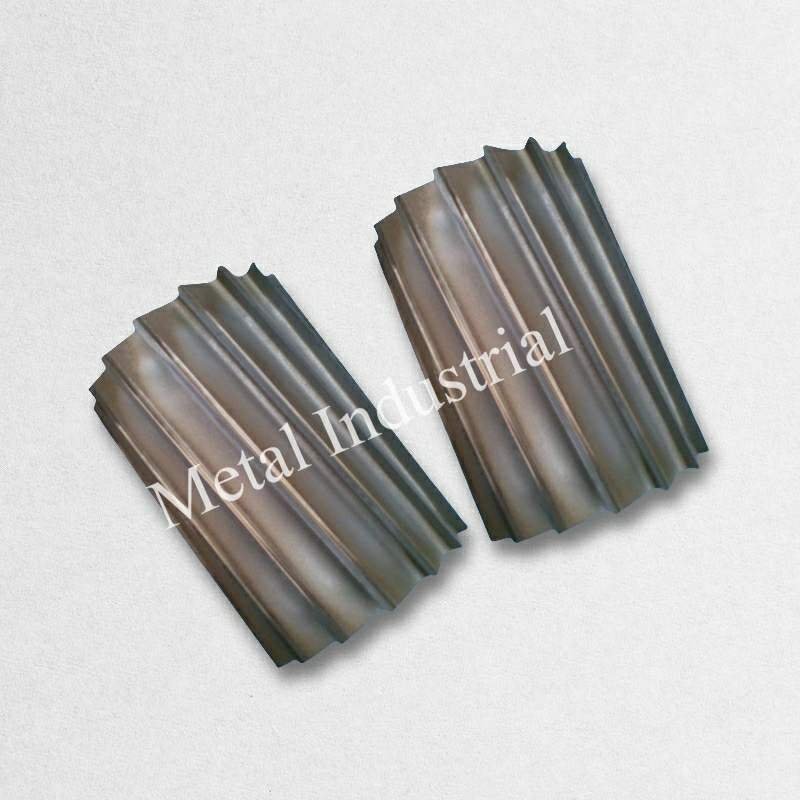
الفولاذ، الكربيد، الطلاءات
Material choices for rotary cutters are usually a trade between مقاومة التآكل و صلابة.
- Tool steels (e.g., D2/SKD-11 class) are common when you need a balanced option with predictable heat treatment.
- الأحرار can improve toughness where intermittent loading or impact is a concern.
- Carbide (tipped or solid) is often used when abrasion dominates (e.g., glass-filled compounds), but brittleness has to be managed through geometry and handling.
Coatings can be a second lever—particularly when you’re fighting friction and abrasive wear. Material selection resources for granulator blades commonly highlight matching the steel/carbide route to the plastic and filler content, rather than defaulting to one “best” material.
Specifying custom rotary cutter replacements
A spec that prevents costly back-and-forth typically includes:
- Cutter type and function (rotary knife, pelletizer cutter, granulator rotor knife)
- Quantity and whether you’re qualifying a single first article or a small pilot batch
- A drawing (preferred) or a controlled reverse-engineering scope (datums + checkpoints)
- Surface finish and edge condition requirements
- Heat treatment expectations (hardness range and where it matters)
If you’re sourcing globally, it also helps to specify what documents are non-negotiable at the quote stage (not after the parts are in transit).
Precision targets and traceability
For legacy machines, precision is less about “tight everywhere” and more about “tight where it prevents downtime.”
Typical high-impact controls include:
- Runout / concentricity control at the mounting interface (define the measurement setup and acceptance criteria with your engineer/OEM; values are equipment-specific)
- Axial positioning so the cutter tracks correctly relative to the bed knife/anvil (verify guarding clearances and safe operation before restart)
- Edge geometry consistency to avoid pellet tails, fines, or quality drift
This is also the point where supplier capability matters—especially for plants that need repeatability over multiple reorder cycles.
على سبيل المثال، ماكستور ميتال manufactures custom industrial blades (including plastic granulator rotary knives و plastic pelletizer knives) and is set up for build-from-drawing/sample workflows. In practice, the useful question to ask any supplier is not “can you copy this part?” but:
- Can you define and agree the datums that control fit?
- Can you provide an inspection pack aligned to those checkpoints?
- Can you maintain traceability (material and process records) batch-to-batch?
Answering those three questions up front is how you avoid tolerance drift and “mystery reworks” on the shop floor.
⚠️ تحذير: If a quote comes back with no mention of inspection/acceptance criteria, you’re likely buying interpretation—not a controlled spare part.
نتائج نموذجية (من مصادر منشورة)
Because results depend heavily on polymer, throughput, cutter design, and maintenance practice, use the examples below as illustrative only, not guaranteed outcomes.
Mini-case A: Fewer changeovers and lower blade-related cost
- مشكلة: Frequent blade changes and rising downtime/labour cost.
- Action (reported): Switching to a better-fit/customized blade approach and tightening maintenance/sharpening practice.
- Outcome (reported): Blade changes reduced from 12 to 3 per month (reported as ~65% less downtime) and monthly blade-related cost lowered from >$800 to ~$450 (including labour).
- When it applies: Plants where changeovers are frequent and knives are treated as consumables without a controlled acceptance/maintenance routine.
Mini-case B: Longer life via process/material treatment (industry example)
- مشكلة: Short knife life and inconsistent performance in pelletizing.
- Action (reported): Evaluating process/material treatment improvements (e.g., cryogenic processing trials) and verifying against a defined acceptance method.
- Outcome (reported): Extended service life and cost savings were reported in a pelletizer blade trial case study; results vary by polymer, throughput, and knife geometry.
- When it applies: High-throughput lines where small improvements in knife life compound into measurable downtime and scrap reduction.
Sources (examples):
- Granulator maintenance/sharpening article with the changeover/cost example: https://maxtormetal.com/maintain-sharpen-granulating-blade-optimal-performance-2025/
- Pelletizer blade cryogenic processing case study: https://ctpcryogenics.com/services/industrial/case-study-rubbermaid/
If you want, we can replace these with your own internal examples later (even anonymized ranges) to make the outcomes more directly relevant to your equipment.
الامتثال في المملكة المتحدة، الاستيراد، والتكلفة الإجمالية للملكية (TCO)
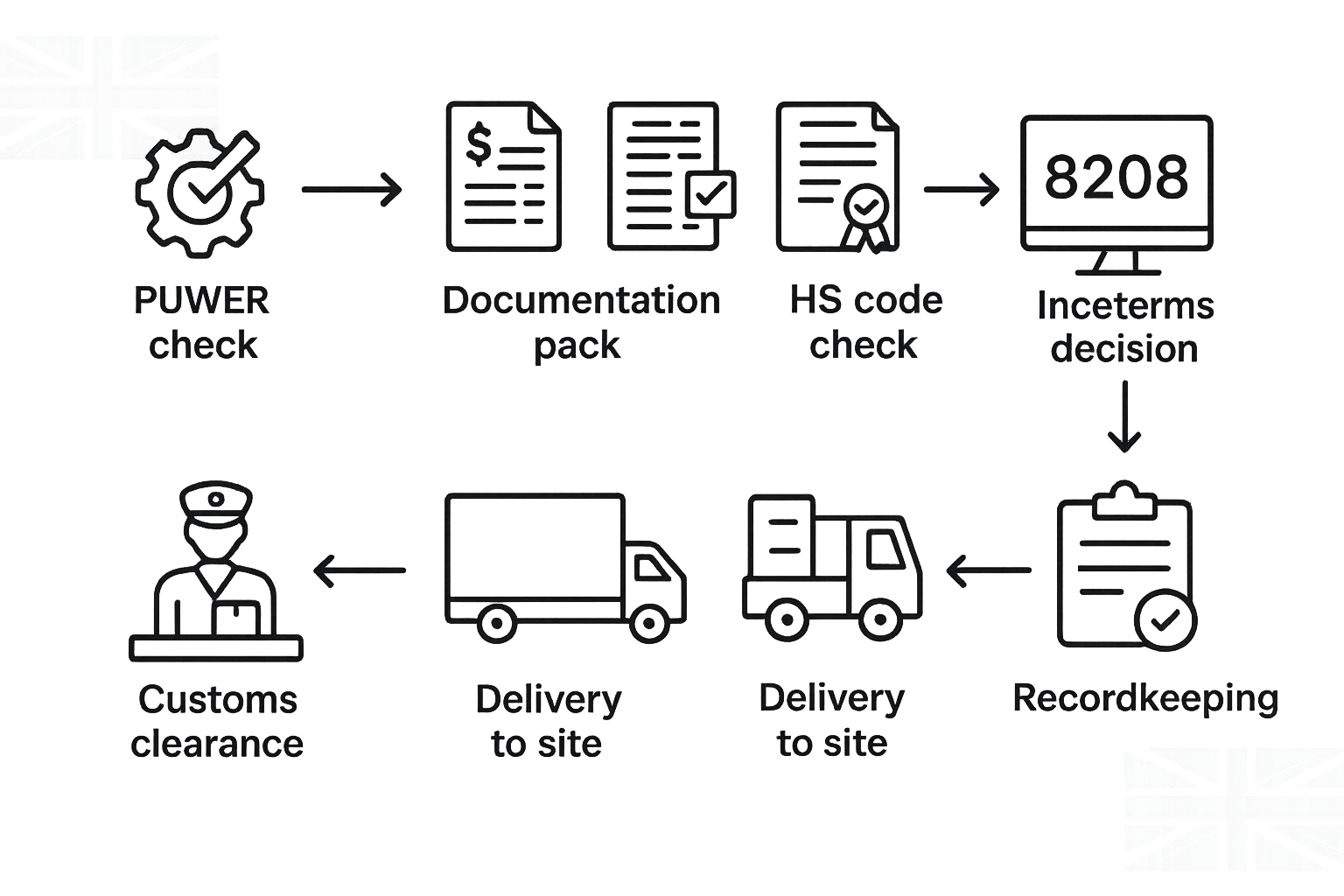
PUWER, UKCA/CE scope
For UK operators, two practical lenses matter:
- Safe use of work equipment (PUWER)
HSE’s overview of PUWER (Provision and Use of Work Equipment Regulations 1998) emphasises that equipment must be suitable for use, maintained, inspected where needed, and supported by appropriate information/instructions and training.
A rotary cutter replacement affects exactly those points—because it can change guarding clearances, cutting forces, vibration, and the operator’s safe system of work.
- When modifications become “substantial”
If the change is like-for-like (same function, no new hazards), you’re typically in a maintenance/refurbishment space. If the change introduces new hazards or materially changes how the machine operates, HSE’s guidance on refurbished and modified machinery explains why the modifier may take on “manufacturer-like” responsibilities.
For context on supply-side obligations, the UK government guidance on the Supply of Machinery (Safety) Regulations 2008 (Great Britain) is the right place to sanity-check whether your change stays a spare-part replacement—or edges into a broader conformity assessment question.
Docs, HS codes, Incoterms
For importing cutters into the UK, smooth procurement is mostly about eliminating paperwork gaps.
A practical documentation pack usually includes:
- Commercial invoice and packing list
- Proof of origin (acceptable formats are explained on GOV.UK’s guidance for Get proof of origin for your goods)
- Material and inspection documents you need for acceptance (e.g., hardness, key dimensions)
On classification, industrial knives and cutter blades often sit under HS heading 8208—confirm the exact commodity code for your specific cutter description using the GOV.UK Trade Tariff tool.
Incoterms decide who does what:
- DDP: supplier typically manages import clearance and delivery duties (lower admin load for the buyer, but verify what’s included).
- DAP: buyer handles import clearance and pays duties/VAT (more control, more responsibility).
If your team has been burned by delays before, align Incoterms with who will provide each document—and who is accountable if customs asks questions.
Life, downtime, payback
TCO is rarely dominated by the cutter’s unit price.
The big levers are:
- Downtime cost per changeover (lost throughput, labour, restart waste)
- Quality cost (fines, tails, off-spec pellets, downstream feeding issues)
- Reorder risk (a replacement that doesn’t fit creates a second downtime event)
A simple way to quantify payback is:
- Estimate how many changeovers you can avoid per month if the replacement holds edge longer.
- Add the cost of one “bad fit” event as a risk cost (even if it’s low probability).
- Compare that against the delta between a standard blade and a verified, documented custom replacement.
الخاتمة
Custom rotary cutter replacements are a practical way to extend the life of legacy machines—لو you treat them as a controlled engineering and procurement process.
That process is straightforward:
- Specify the cutter around datums and functional geometry, not around worn edges
- Qualify the part with mapped tolerances and a first-article inspection pack
- Import with confidence by aligning documentation, HS code checks, and Incoterms responsibilities
الخطوات التالية:
- Share the worn sample and/or drawings
- Agree the critical tolerances (fits, runout, axial location, edge geometry)
- Request an FAI pack that matches how your site will accept repeat orders
المراجع
- HSE: PUWER (Provision and Use of Work Equipment Regulations 1998): https://www.hse.gov.uk/work-equipment-machinery/puwer.htm
- HSE: Refurbished and modified machinery: https://www.hse.gov.uk/work-equipment-machinery/refurbished-modified-machinery.htm
- GOV.UK: Supply of Machinery (Safety) Regulations 2008 (Great Britain): https://www.gov.uk/government/publications/supply-of-machinery-safety-regulations-2008/supply-of-machinery-safety-regulations-2008-great-britain
- GOV.UK: Get proof of origin for your goods: https://www.gov.uk/guidance/get-proof-of-origin-for-your-goods
- GOV.UK: Trade Tariff tool: https://www.gov.uk/trade-tariff
- ISO: ISO 1101 (Geometrical tolerancing): https://www.iso.org/standard/66777.html
- SAE: AS9102 (Aerospace First Article Inspection Requirement): https://www.sae.org/standards/as9102-aerospace-first-article-inspection-requirement
- IAQG: 9102 First Article Inspection Requirement overview: https://iaqg.org/standard/9102-first-article-inspection-requirement/
مؤلف
Written by تومي تانغ, Senior Sales Engineer at نانجينغ ميتال الصناعية (12 years). Certifications: علوم الحاسوب, التعليم الطبي المستمر, حزام سيجما الأخضر, مدير مشاريع معتمد (PMP).

 English
  Spanish
  Italian
  French
  Portuguese
  Russian
  German
  Arabic
  Hindi
Hindi  Vietnamese
  Indonesian
  Japanese
  Korean