

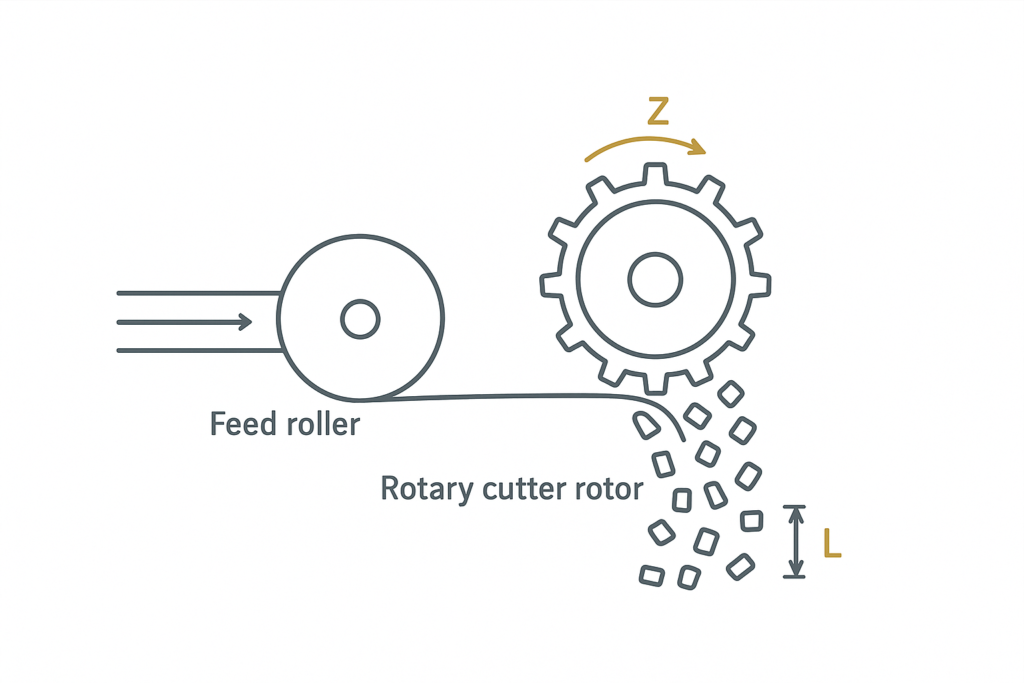
El número de dientes del rotor de corte (cuántas cuchillas/dientes hay en el rotor) es una de las palancas más rápidas de las que dispone para estabilizar la longitud del pellet en un peletizador de cordones, y es la forma más limpia de mantenerse dentro de un límite realista de RPM del rotor. Si se equivoca, lo verá de inmediato: variación de longitud (cortos/largos), colas, más finos y una mayor probabilidad de paradas imprevistas debido a que la estación de corte está trabajando fuera de su ventana de estabilidad.
El vínculo es pura cinemática. La longitud del pellet se define por la distancia que avanza el cordón entre cortes, y la frecuencia de corte se establece mediante las RPM del rotor multiplicadas por el número de dientes. Como resume MAXTOR METAL en su guía de rotores de corte, la longitud del pellet varía proporcionalmente con la relación entre la velocidad de alimentación, las RPM del rotor y el número de cuchillas.
Por lo general, el número de dientes se ajusta cuando el proceso se lleva a los extremos: mayor velocidad de línea, pellets más pequeños o un límite estricto de RPM. Los materiales abrasivos, con alta carga y reciclados también tienden a desplazar la ventana “estable”, ya que se debe equilibrar un corte limpio frente al desgaste, el microastillado y la acumulación de calor en el filo.
La buena noticia es que puede validar rápidamente la elección del número de dientes en la máquina con unas sencillas comprobaciones: mida la longitud real del pellet, observe las tendencias de finos/colas con ajustes constantes y confirme que la holgura y la excentricidad no estén afectando los cálculos teóricos.
Alcance y supuestos (para reproducibilidad): Las relaciones a continuación asumen que la velocidad real del cordón en el rotor de corte (V) es conocida (sin deslizamiento significativo en los rodillos de alimentación), la geometría de la cuchilla/contracuchilla es estable y el objetivo es controlar la distribución de la longitud del pellet (no solo un promedio). Verifique siempre con el manual del fabricante original (OEM) de su peletizadora específica y los procedimientos de seguridad.
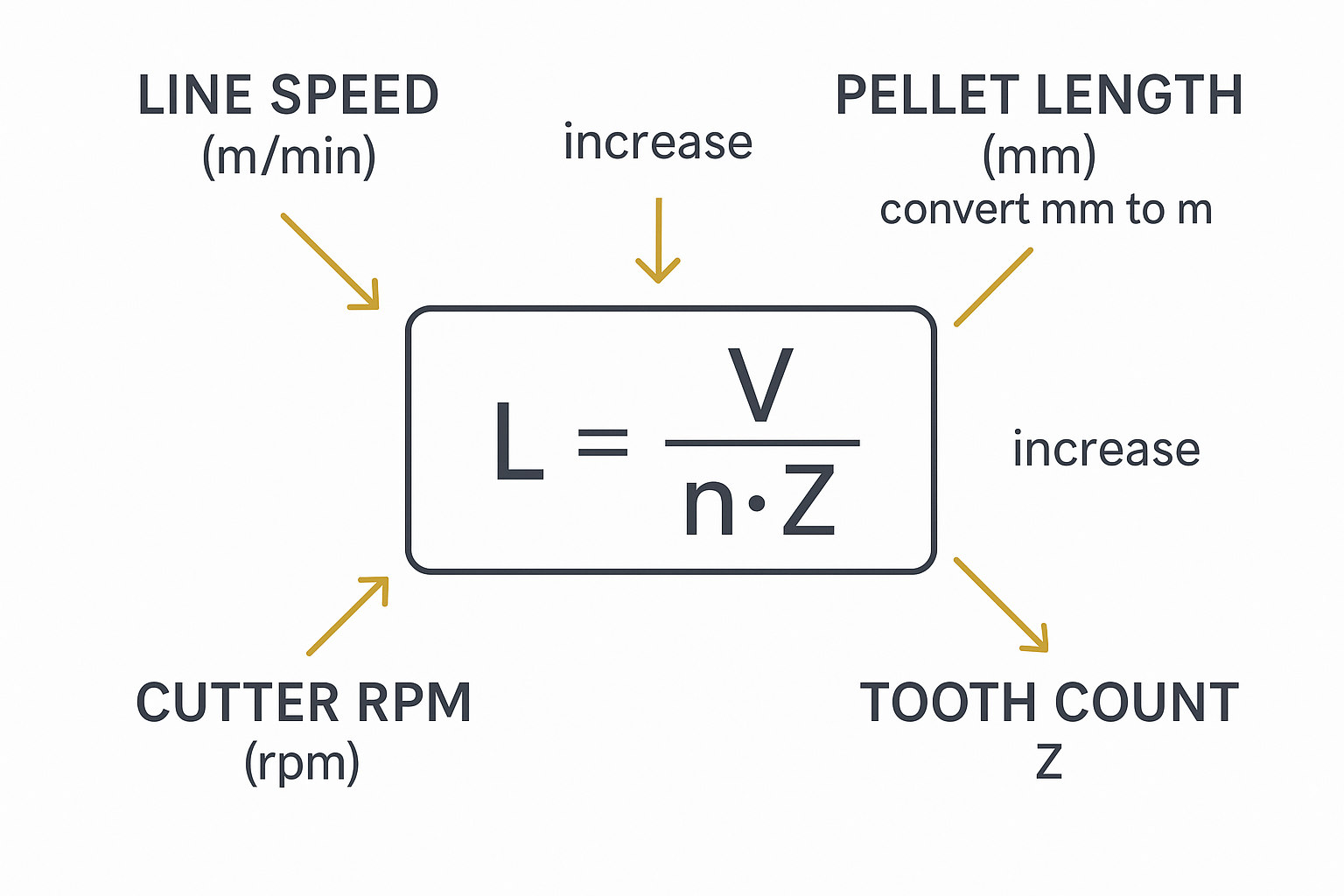
El vínculo cinemático
Fórmula básica y unidades
Definición de variables:
- V = velocidad de línea del cordón en el rotor de corte (m/min)
- L = longitud objetivo del pellet (mm)
- n = velocidad del rotor de corte (rpm)
- Z = número de dientes (dientes/cuchillas en el rotor)
Los cortes por minuto son:
- f = n · Z (cortes/min)
La longitud del pellet es la distancia avanzada por corte:
- L(m) = V / (n · Z)
Para utilizar L en mm, convierta: L(mm) = 1000 · V / (n · Z).
Conclusión clave: Si V es fija, solo puede acortar los pellets aumentando las RPM del rotor (n), aumentando el número de dientes (Z), o ambos.
Interacciones de las variables
Las interacciones son lineales y predecibles:
- Aumentar V → los pellets se vuelven más largos (a menos que aumente n o Z para compensar).
- Aumentar n → los pellets se vuelven más cortos (hasta que se alcancen límites de vibración/ruido, problemas térmicos o el límite de la transmisión).
- Aumentar Z → los pellets se vuelven más cortos con el mismo valor de n (a menudo la forma más limpia de reducir las RPM requeridas).
Dos notas prácticas importantes en líneas reales:
- “V en el rotor de corte” es el valor real. Si los cordones se deslizan en los rodillos de alimentación o son arrastrados por la tensión aguas abajo, la longitud medida del pellet no coincidirá con el cálculo.
- La dispersión mecánica predomina cuando se es demasiado agresivo. Una vez que n es suficientemente alta, cualquier excentricidad, variación de holgura o desviación del cordón se manifiesta como variación de longitud y finos.
Ejemplo práctico
Utilice una configuración de producción común y manténgala en sistema métrico:
- Velocidad de línea V = 40 m/min (dentro del rango comúnmente especificado de 20–80 m/min)
- Longitud objetivo del pellet L = 3 mm (a common default target)
A vendor spec that reflects this typical window is the Techlab Systems “Pelletizing Systems” guide (20–80 m/min; 1–6 mm).
First convert L to meters:
- L = 3 mm = 0.003 m
Compute required cuts per minute:
- f = V / L = 40 / 0.003 ≈ 13,333 cuts/min
Now translate that into RPM for a few common tooth counts:
- If Z = 12 → n = f / Z ≈ 13,333 / 12 ≈ 1,111 rpm
- If Z = 24 → n ≈ 556 rpm
- If Z = 30 → n ≈ 444 rpm
The point isn’t that you “should run” those RPMs; it’s that tooth count is what brings the required RPM back inside your machine’s stable operating window.
Quick sizing table (copy/paste)
Use this as a fast check before you change hardware. Compute:
- n_req (rpm) = 1000 · V(m/min) / (L(mm) · Z)
| V (m/min) | L (mm) | Z (teeth) | n_req (rpm) |
|---|---|---|---|
| 40 | 3 | 12 | 1,111 |
| 40 | 3 | 24 | 556 |
| 40 | 3 | 30 | 444 |
If your n_req is too close to your practical ceiling, increase Z (if available) to regain stability margin before pushing RPM.
Field example (anonymized, qualitative)
In day-to-day support, a common pattern is that pushing line speed without rebalancing cut frequency forces rotor RPM toward the unstable end of the machine’s range. In those cases, moving to a higher tooth count (Z) to bring RPM back down typically improves length consistency (tighter distribution), reduces tails/longs, and lowers fines—provided knife condition, clearance, and strand cooling are kept consistent.
Flujo de trabajo de selección
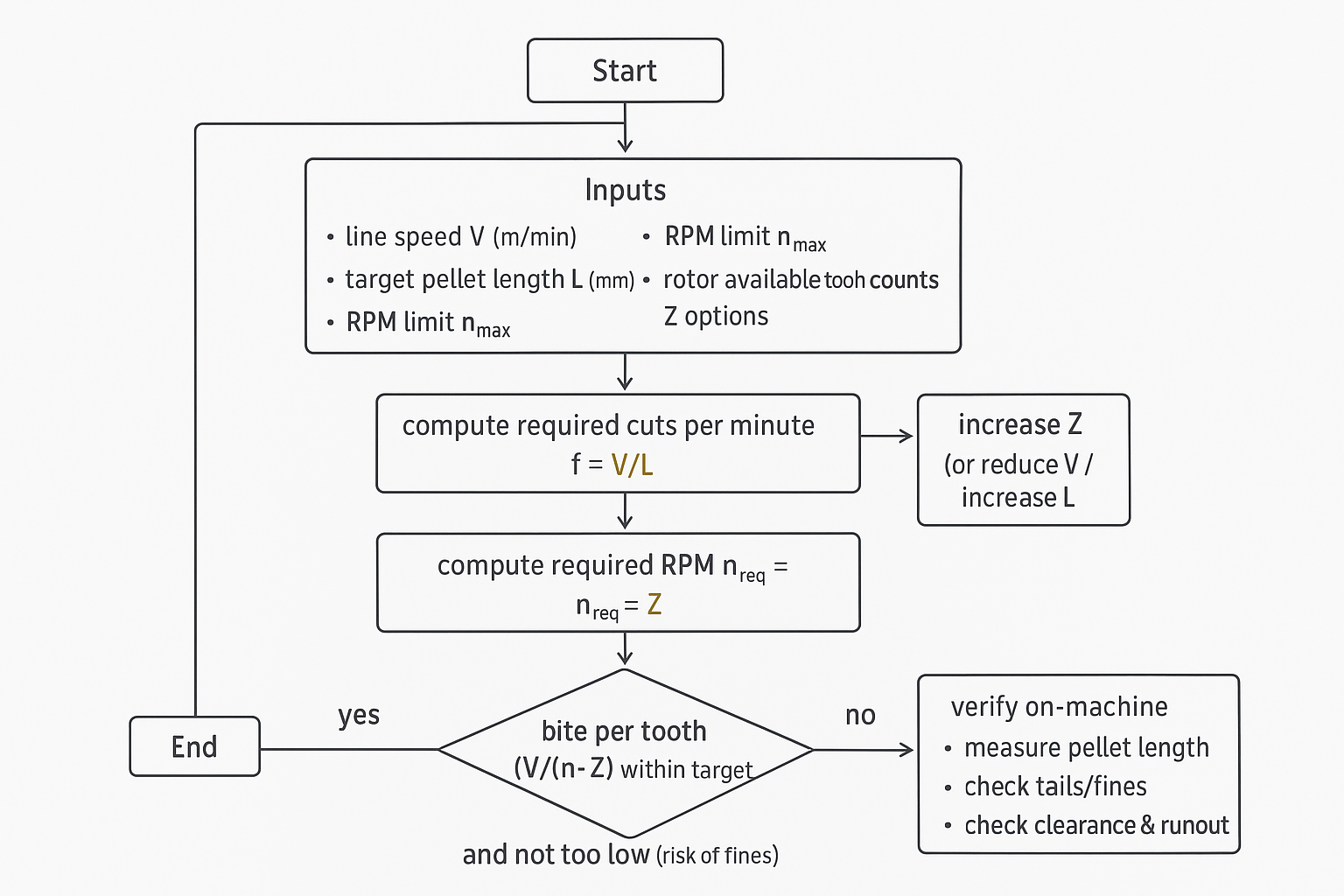
Define inputs
Lock the inputs before you touch hardware:
- V (m/min): measure or confirm actual line speed at the cutter, not just extruder RPM.
- L (mm): define what “pellet length” means for your QA (average length, max length, or distribution).
- n_max (rpm): the practical rotor RPM ceiling for your pelletiser (drive limit and stability limit).
- Available Z: what tooth counts you can actually install (rotor design, inserted blades, knife pockets).
If you’re running recycled or high-fill materials, also treat these as “inputs” because they shrink the stable window:
- Abrasiveness / filler level (wear and micro-chipping risk)
- Strand temperature at entry (smear vs brittle fracture)
- Strand count and strand diameter consistency
Select rotary cutter tooth count
- Compute the required cut frequency:
- f = (V / L(m)) cuts/min
- For each available tooth count Z, compute the required rotor speed:
- n_req = f / Z rpm
- Choose the smallest Z that keeps n_req comfortably below your practical ceiling.
Why “comfortably”? Because you need margin for normal variation: line speed drift, strand swell, and gradual wear that increases cutting force.
If no available Z puts you below the RPM ceiling, you only have three real options:
- reduce V (throughput hit)
- increase L (pellet spec change)
- change rotor hardware (different tooth count range)
Verify RPM and bite per tooth
Even when n_req is acceptable, you still need a rationality check on “bite per tooth” — the strand advance per cut. In this context it’s the same value you are targeting (pellet length), but it’s useful to treat it as a stability variable:
- Very small bite (very high cut frequency) can raise fines and heat if clearance or edge condition isn’t controlled.
- Very large bite (low cut frequency) can raise tails and “squeeze” deformation, especially on soft or warm strands.
Do three on-machine checks before you declare success:
- Length check: collect 50–100 pellets after conditions stabilise. Define your QA statistic (e.g., mean + standard deviation, or P90/P95 length) and measure with a consistent method (calipers or optical measurement).
- Fines/tails check: trend fines as a mass % using a consistent screen/sieve cut (or your plant’s standard) and count tails/longs at constant V, n, Z.
- Mechanics check: confirm knife-to-bed clearance and rotor runout are within your machine’s capability; if you can’t hold them, the calculation won’t hold either.
Neutral references (for further reading): Bay Plastics Machinery explains strand pelletizer setup and the relationship between feed speed, cutter speed, and pellet length in “Basics of Strand Pelletizing” (BPM Training PDF). MAAG Group provides OEM documentation on strand pelletizing systems, strand draw-in, and cutting station fundamentals in “JSG — Automatic Dry Cut strand pelletizing system” (MAAG PDF) y “M-ASG — Strand pelletizing system” (MAAG PDF).
Plantilla de registro de ensayo (copiar/pegar)
Use a simple one-line log per trial so you can compare changes over time.
| Fecha | Material / filler | Strands (count) | V (m/min) | L target (mm) | Z (teeth) | n (rpm) | Clearance setting | Comprobación de agotamiento | Sample size | Length stat (mean+SD or P95) | Fines method | Multas (%) | Tails/longs count | Notas |
|---|---|---|---|---|---|---|---|---|---|---|---|---|---|---|
Tip: keep the sampling point and measurement method identical for every trial; otherwise the “improvement” may just be measurement noise.
Restricciones y materiales
Overlap and clearance
Tooth count can’t compensate for a cutting station that is geometrically unstable.
If clearance varies across the bed knife, you’ll see a “mixed mode” cut: some strands shear cleanly, others tear or smear, so pellet length scatter increases even when the setpoints are steady. In abrasive duty, the problem is amplified because edge wear increases clearance sensitivity.
MAXTOR METAL documents PM tool steel (HRC 60–63), micro‑hone 0.005–0.02 mm, Ra <0.2 µm, and run‑out/parallelism checks ≤0.02–0.05 mm.
See the high‑filler note.
Dynamics and strand count
Tooth count changes the cutting frequency. As frequency rises, dynamic effects matter more:
- More strands means more opportunities for one strand to wander, stick, or arrive hotter/softer than the rest.
- If strand count is high and cooling is uneven, the cutter sees a mix of “easy” and “hard” cuts, which can excite vibration and show up as length variation.
- At higher frequency, any eccentricity/runout becomes a length modulator: every revolution repeats the same error pattern.
Operationally, the fastest way to detect a dynamics problem is to hold V and n constant and watch whether pellet length scatter correlates with rotor position (periodic) or with strand events (random).
Knife materials and tolerances
Abrasive and recycled materials usually force a compromise: you want a robust edge that resists micro-chipping, but you also need tight geometry so the cut stays a shear, not a tear.
For procurement and QC discussions, it’s useful to frame tolerance as “system-appropriate,” not “as tight as possible.” MAXTOR METAL’s Guía de tolerancia de cuchillas industriales gives example tolerance bands and inspection notes that can help you specify what you actually need (and verify it on receipt).
A neutral, practical supplier check is to request: material certificate, heat-treatment report, hardness scan, and a dimensional/flatness report aligned to your machine’s bed-knife and rotor interface.
Conclusión
Choosing rotary cutter tooth count is a controlled trade between kinematics (hit the pellet length) and stability (stay inside your RPM and mechanical limits). Start with the math, then pick the smallest Z that keeps required RPM out of the red zone — and leave margin for drift and wear.
To stabilise pellet size and reduce fines, validate on the machine with simple checks: measure pellet length distribution, trend tails/fines at fixed settings, and confirm clearance/runout are good enough for the calculation to be meaningful.
For abrasive/high-fill and recycled materials, expect the stable window to narrow. You’ll typically bias toward more robust knife materials and tighter, verifiable geometry, then re-tune Z and n to keep the cut clean without pushing RPM into a vibration or heat problem.
If you need a documented reference point for knife materials and measurable geometry targets in abrasive duty, MAXTOR METAL publishes practical notes you can use as a checklist when you’re qualifying any supplier.
Autor: Tommy Tang, Senior Sales Engineer, Nanjing METAL Industrial — 12 years in industrial blades & pelletizing applications. Certifications: CSE, CME, Six Sigma Green Belt, PMP.
Reviewed by: MAXTOR METAL Engineering Team. Learn more: https://maxtormetal.com/about/

 English
  Spanish
  Italian
  French
  Portuguese
  Russian
  German
  Arabic
  Hindi
Hindi  Vietnamese
  Indonesian
  Japanese
  Korean