

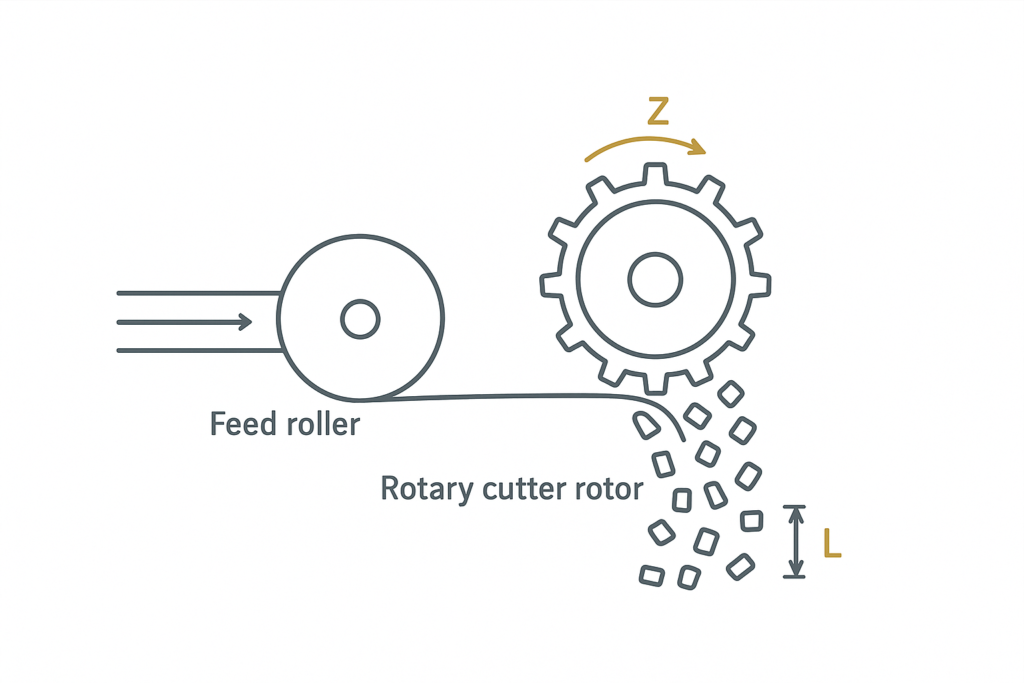
Jumlah gigi rotary cutter (berapa banyak pisau/gigi pada rotor) adalah salah satu tuas tercepat yang Anda miliki untuk menstabilkan panjang pelet pada strand pelletizer — dan ini adalah cara paling bersih untuk tetap berada dalam batas RPM cutter yang realistis. Jika salah, Anda akan langsung melihat dampaknya: variasi panjang/pendek, ekor (tails), lebih banyak fines, dan peluang lebih tinggi terjadinya trip yang mengganggu karena stasiun pemotongan bekerja di luar batas stabilnya.
Hubungan ini murni kinematika. Panjang pelet ditentukan oleh seberapa jauh strand maju di antara pemotongan, dan frekuensi pemotongan ditentukan oleh RPM cutter dikalikan dengan jumlah gigi. Seperti yang dirangkum oleh MAXTOR METAL dalam panduan pemotong putar, panjang pelet sebanding dengan rasio kecepatan umpan terhadap RPM cutter dan jumlah pisau.
Anda biasanya menyesuaikan jumlah gigi ketika proses Anda mendorong ke batas ekstrem: kecepatan lini yang lebih tinggi, pelet yang lebih kecil, atau batas RPM yang ketat. Material abrasif, tinggi pengisi (high-fill), dan daur ulang juga cenderung menggeser batas “stabil” karena Anda harus mengorbankan hasil potong yang bersih demi keausan, micro-chipping, dan penumpukan panas pada bagian tepi pisau.
Kabar baiknya adalah Anda dapat memvalidasi pilihan jumlah gigi dengan cepat pada mesin dengan beberapa pemeriksaan sederhana: ukur panjang pelet aktual, amati tren fines/tails pada pengaturan konstan, dan pastikan bahwa celah (clearance) dan runout tidak merusak perhitungan matematis tersebut.
Ruang lingkup & asumsi (untuk reproduksibilitas): Hubungan di bawah ini mengasumsikan bahwa kecepatan strand sebenarnya pada cutter (V) diketahui (tidak ada slip yang signifikan pada rol umpan), geometri pisau/bed-knife stabil, dan tujuannya adalah untuk mengontrol distribusi panjang pelet (bukan hanya rata-rata). Selalu lakukan verifikasi terhadap manual OEM pelletizer spesifik Anda dan prosedur keselamatan.
Hubungan kinematik
Rumus inti dan satuan
Tentukan variabel:
- V = kecepatan lini strand pada cutter (m/min)
- L = target panjang pelet (mm)
- n = kecepatan rotor cutter (rpm)
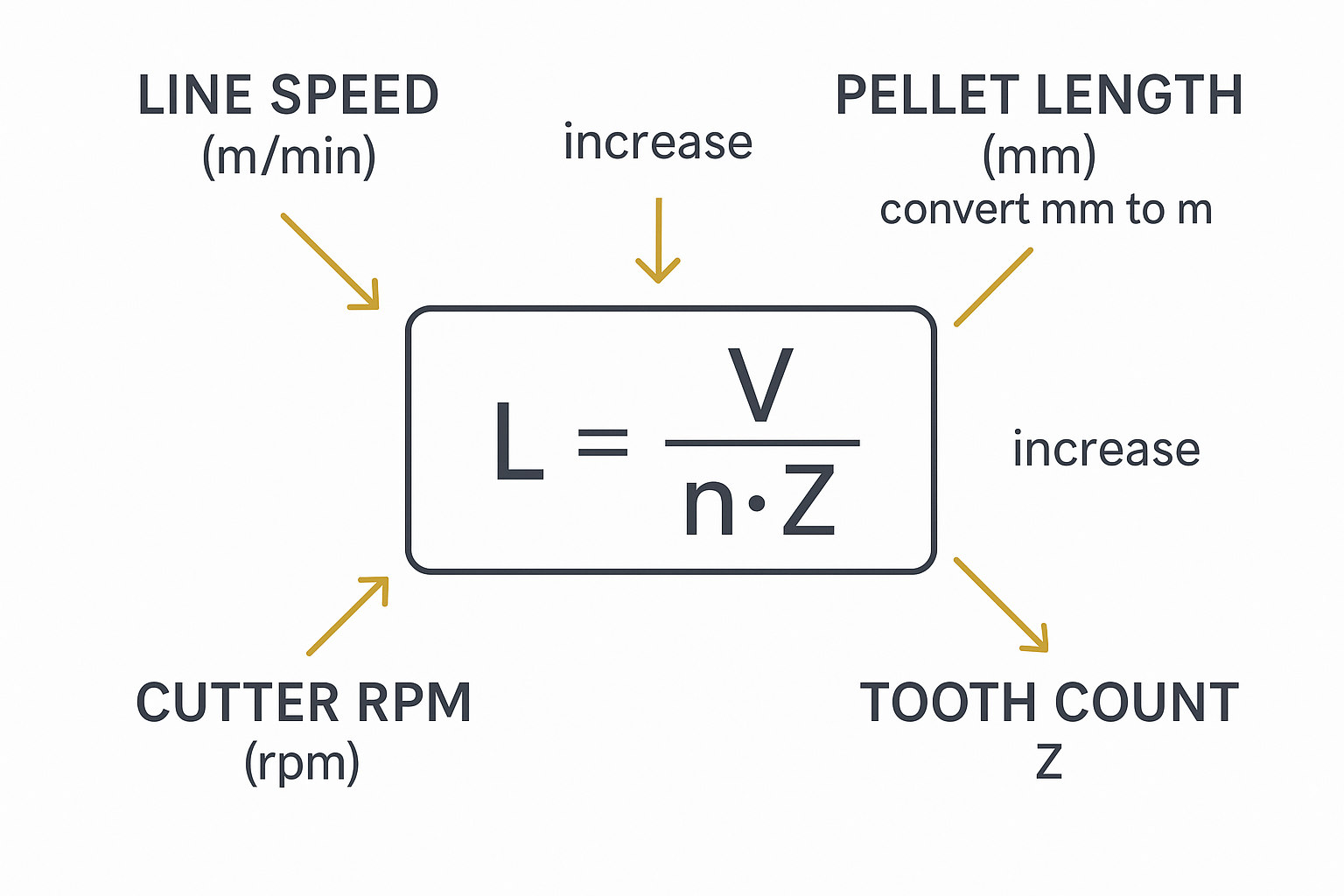
- Z = jumlah gigi (gigi/pisau pada rotor)
Jumlah potongan per menit adalah:
- f = n · Z (potongan/menit)
Panjang pelet adalah jarak maju per pemotongan:
- L(m) = V / (n · Z)
Untuk menggunakan L dalam mm, konversikan: L(mm) = 1000 · V / (n · Z).
Poin Penting: Jika V tetap, Anda hanya dapat membuat pelet lebih pendek dengan meningkatkan RPM cutter (n), meningkatkan jumlah gigi (Z), atau keduanya.
Interaksi variabel
Interaksi tersebut bersifat linier dan dapat diprediksi:
- Increase V → pelet menjadi lebih panjang (kecuali Anda meningkatkan n atau Z untuk mengompensasi).
- Increase n → pelet menjadi lebih pendek (hingga Anda menemui masalah getaran/kebisingan, masalah termal, atau batas penggerak).
- Increase Z → pelet menjadi lebih pendek pada n yang sama (sering kali merupakan cara paling bersih untuk mengurangi RPM yang diperlukan).
Dua catatan praktis yang penting dalam lini produksi nyata:
- “V pada cutter” adalah kondisi yang sebenarnya. Jika strand slip pada rol umpan atau ditarik oleh hambatan di hilir (downstream drag), panjang pelet yang Anda ukur tidak akan sesuai dengan perhitungan.
- Hamburan mekanis mendominasi ketika Anda terlalu agresif. Setelah n cukup tinggi, setiap runout, variasi celah (clearance), atau penyimpangan strand akan muncul sebagai variasi panjang dan fines.
Contoh pengerjaan
Gunakan standar produksi umum dan tetap gunakan satuan metrik:
- Kecepatan lini V = 40 m/menit (dalam rentang 20–80 m/min yang umum ditentukan)
- Target panjang pelet L = 3 mm (target standar yang umum)
A vendor spec that reflects this typical window is the Techlab Systems “Pelletizing Systems” guide (20–80 m/min; 1–6 mm).
First convert L to meters:
- L = 3 mm = 0.003 m
Compute required cuts per minute:
- f = V / L = 40 / 0.003 ≈ 13,333 cuts/min
Now translate that into RPM for a few common tooth counts:
- If Z = 12 → n = f / Z ≈ 13,333 / 12 ≈ 1,111 rpm
- If Z = 24 → n ≈ 556 rpm
- If Z = 30 → n ≈ 444 rpm
The point isn’t that you “should run” those RPMs; it’s that tooth count is what brings the required RPM back inside your machine’s stable operating window.
Quick sizing table (copy/paste)
Use this as a fast check before you change hardware. Compute:
- n_req (rpm) = 1000 · V(m/min) / (L(mm) · Z)
| V (m/min) | L (mm) | Z (teeth) | n_req (rpm) |
|---|---|---|---|
| 40 | 3 | 12 | 1,111 |
| 40 | 3 | 24 | 556 |
| 40 | 3 | 30 | 444 |
If your n_req is too close to your practical ceiling, increase Z (if available) to regain stability margin before pushing RPM.
Field example (anonymized, qualitative)
In day-to-day support, a common pattern is that pushing line speed without rebalancing cut frequency forces rotor RPM toward the unstable end of the machine’s range. In those cases, moving to a higher tooth count (Z) to bring RPM back down typically improves length consistency (tighter distribution), reduces tails/longs, and lowers fines—provided knife condition, clearance, and strand cooling are kept consistent.
Alur kerja pemilihan
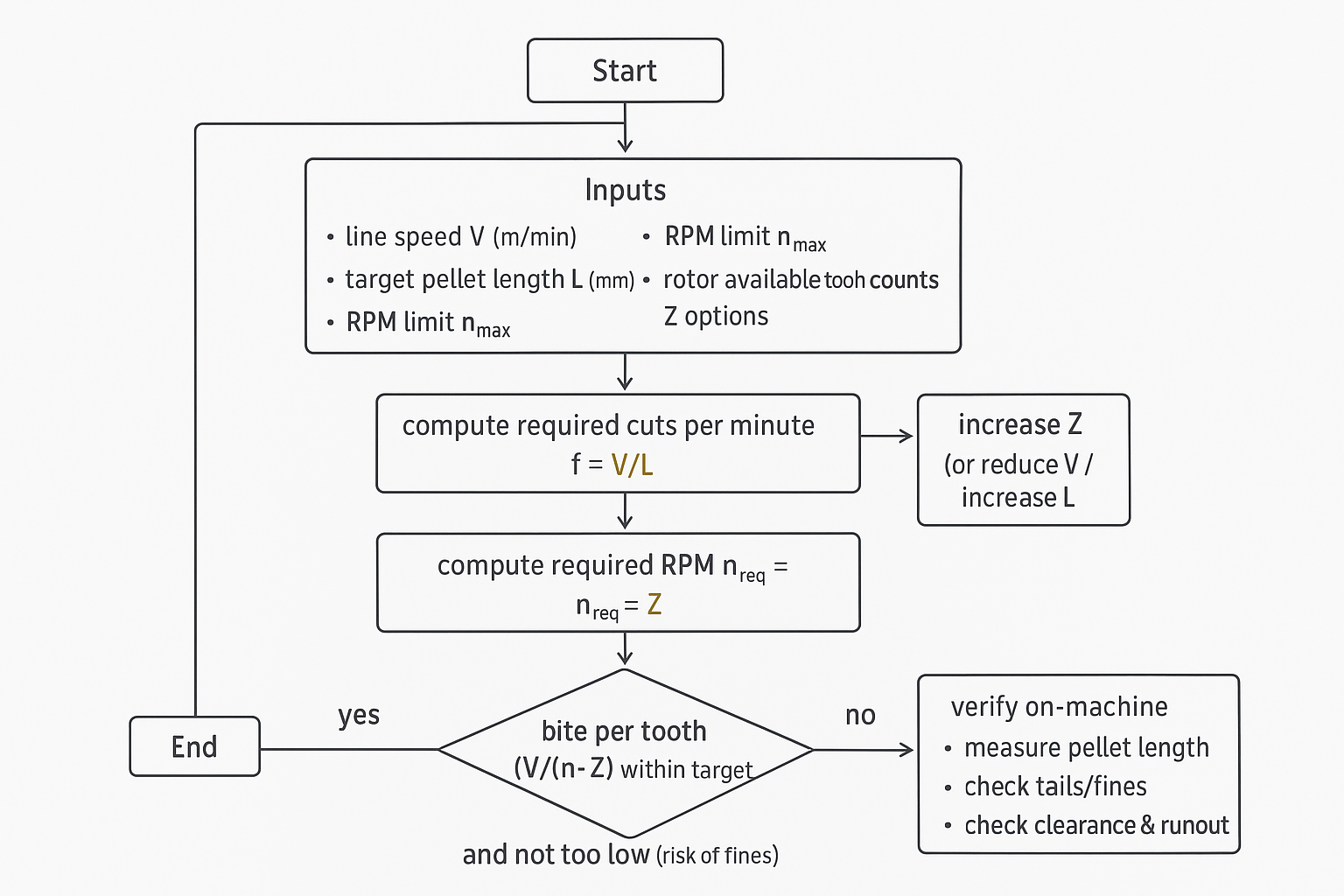
Define inputs
Lock the inputs before you touch hardware:
- V (m/min): measure or confirm actual line speed at the cutter, not just extruder RPM.
- L (mm): define what “pellet length” means for your QA (average length, max length, or distribution).
- n_max (rpm): the practical rotor RPM ceiling for your pelletiser (drive limit and stability limit).
- Available Z: what tooth counts you can actually install (rotor design, inserted blades, knife pockets).
If you’re running recycled or high-fill materials, also treat these as “inputs” because they shrink the stable window:
- Abrasiveness / filler level (wear and micro-chipping risk)
- Strand temperature at entry (smear vs brittle fracture)
- Strand count and strand diameter consistency
Select rotary cutter tooth count
- Compute the required cut frequency:
- f = (V / L(m)) cuts/min
- For each available tooth count Z, compute the required rotor speed:
- n_req = f / Z rpm
- Choose the smallest Z that keeps n_req comfortably below your practical ceiling.
Why “comfortably”? Because you need margin for normal variation: line speed drift, strand swell, and gradual wear that increases cutting force.
If no available Z puts you below the RPM ceiling, you only have three real options:
- reduce V (throughput hit)
- increase L (pellet spec change)
- change rotor hardware (different tooth count range)
Verify RPM and bite per tooth
Even when n_req is acceptable, you still need a rationality check on “bite per tooth” — the strand advance per cut. In this context it’s the same value you are targeting (pellet length), but it’s useful to treat it as a stability variable:
- Very small bite (very high cut frequency) can raise fines and heat if clearance or edge condition isn’t controlled.
- Very large bite (low cut frequency) can raise tails and “squeeze” deformation, especially on soft or warm strands.
Do three on-machine checks before you declare success:
- Length check: collect 50–100 pellets after conditions stabilise. Define your QA statistic (e.g., mean + standard deviation, or P90/P95 length) and measure with a consistent method (calipers or optical measurement).
- Fines/tails check: trend fines as a mass % using a consistent screen/sieve cut (or your plant’s standard) and count tails/longs at constant V, n, Z.
- Mechanics check: confirm knife-to-bed clearance and rotor runout are within your machine’s capability; if you can’t hold them, the calculation won’t hold either.
Neutral references (for further reading): Bay Plastics Machinery explains strand pelletizer setup and the relationship between feed speed, cutter speed, and pellet length in “Basics of Strand Pelletizing” (BPM Training PDF). MAAG Group provides OEM documentation on strand pelletizing systems, strand draw-in, and cutting station fundamentals in “JSG — Automatic Dry Cut strand pelletizing system” (MAAG PDF) dan “M-ASG — Strand pelletizing system” (MAAG PDF).
Trial log template (copy/paste)
Use a simple one-line log per trial so you can compare changes over time.
| Tanggal | Material / filler | Strands (count) | V (m/min) | L target (mm) | Z (teeth) | n (rpm) | Clearance setting | Runout check | Sample size | Length stat (mean+SD or P95) | Fines method | Denda (%) | Tails/longs count | Catatan |
|---|---|---|---|---|---|---|---|---|---|---|---|---|---|---|
Tip: keep the sampling point and measurement method identical for every trial; otherwise the “improvement” may just be measurement noise.
Batasan dan material
Overlap and clearance
Tooth count can’t compensate for a cutting station that is geometrically unstable.
If clearance varies across the bed knife, you’ll see a “mixed mode” cut: some strands shear cleanly, others tear or smear, so pellet length scatter increases even when the setpoints are steady. In abrasive duty, the problem is amplified because edge wear increases clearance sensitivity.
MAXTOR METAL documents PM tool steel (HRC 60–63), micro‑hone 0.005–0.02 mm, Ra <0.2 µm, and run‑out/parallelism checks ≤0.02–0.05 mm.
See the high‑filler note.
Dynamics and strand count
Tooth count changes the cutting frequency. As frequency rises, dynamic effects matter more:
- More strands means more opportunities for one strand to wander, stick, or arrive hotter/softer than the rest.
- If strand count is high and cooling is uneven, the cutter sees a mix of “easy” and “hard” cuts, which can excite vibration and show up as length variation.
- At higher frequency, any eccentricity/runout becomes a length modulator: every revolution repeats the same error pattern.
Operationally, the fastest way to detect a dynamics problem is to hold V and n constant and watch whether pellet length scatter correlates with rotor position (periodic) or with strand events (random).
Knife materials and tolerances
Abrasive and recycled materials usually force a compromise: you want a robust edge that resists micro-chipping, but you also need tight geometry so the cut stays a shear, not a tear.
For procurement and QC discussions, it’s useful to frame tolerance as “system-appropriate,” not “as tight as possible.” MAXTOR METAL’s panduan toleransi pisau industri gives example tolerance bands and inspection notes that can help you specify what you actually need (and verify it on receipt).
A neutral, practical supplier check is to request: material certificate, heat-treatment report, hardness scan, and a dimensional/flatness report aligned to your machine’s bed-knife and rotor interface.
Kesimpulan
Choosing rotary cutter tooth count is a controlled trade between kinematics (hit the pellet length) and stability (stay inside your RPM and mechanical limits). Start with the math, then pick the smallest Z that keeps required RPM out of the red zone — and leave margin for drift and wear.
To stabilise pellet size and reduce fines, validate on the machine with simple checks: measure pellet length distribution, trend tails/fines at fixed settings, and confirm clearance/runout are good enough for the calculation to be meaningful.
For abrasive/high-fill and recycled materials, expect the stable window to narrow. You’ll typically bias toward more robust knife materials and tighter, verifiable geometry, then re-tune Z and n to keep the cut clean without pushing RPM into a vibration or heat problem.
If you need a documented reference point for knife materials and measurable geometry targets in abrasive duty, LOGAM MAXTOR publishes practical notes you can use as a checklist when you’re qualifying any supplier.
Pengarang: Tommy Tang, Senior Sales Engineer, Nanjing METAL Industrial — 12 years in industrial blades & pelletizing applications. Certifications: CSE, CME, Six Sigma Green Belt, PMP.
Ditinjau oleh: MAXTOR METAL Engineering Team. Learn more: https://maxtormetal.com/about/

 English
  Spanish
  Italian
  French
  Portuguese
  Russian
  German
  Arabic
  Hindi
Hindi  Vietnamese
  Indonesian
  Japanese
  Korean