

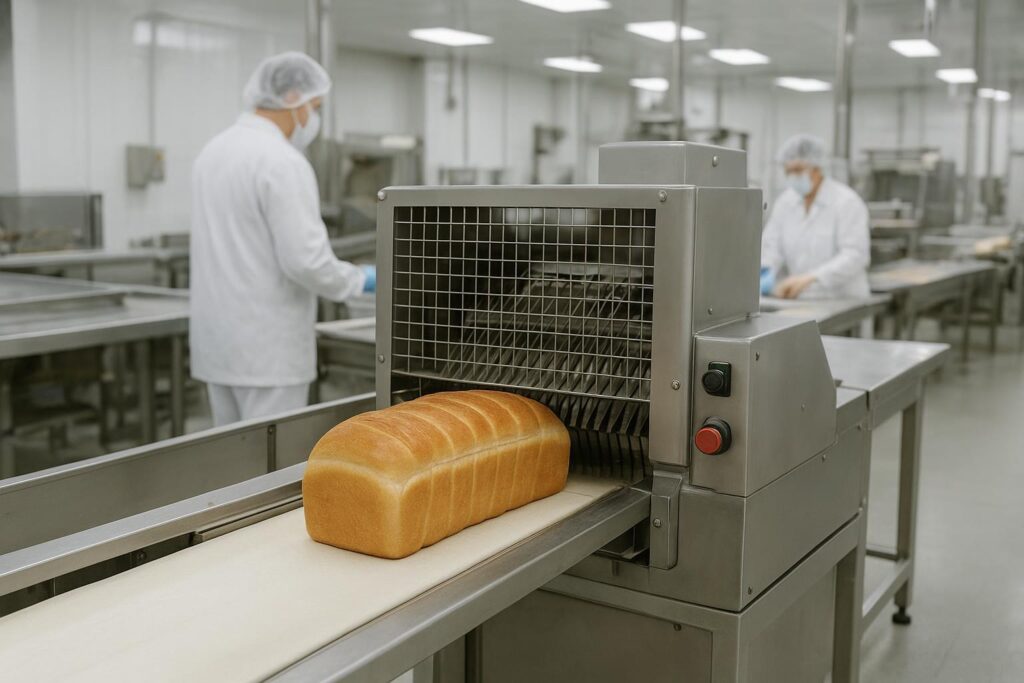
Memilih baja pisau untuk pisau pengiris food grade bukanlah keputusan habis pakai yang sepele. Jika Anda membandingkan baja pisau pengiris roti pilihan di berbagai pemasok, Anda memerlukan spesifikasi yang tahan terhadap sanitasi nyata dan masa pakai operasional yang sebenarnya. Pada lini berkapasitas tinggi (600–1200 roti/jam), material pisau menentukan empat hasil yang terlihat di setiap giliran kerja (shift): tampilan irisan, pembentukan remah, upaya sanitasi, dan penghentian tidak terencana.
Pisau yang mempertahankan ketajamannya dan tahan korosi membantu mengontrol penyimpangan ketebalan, robekan, dan penumpukan remah. Pisau yang cepat tumpul—atau berkarat di bawah rutinitas pencucian Anda—akan menjadi masalah OEE dan memusingkan dalam hal kepatuhan.
Panduan ini ditujukan untuk pabrik roti dan tim OEM pengiris roti yang menentukan atau mengkualifikasi pisau pengiris untuk produksi berkelanjutan. Cakupannya sengaja dibuat spesifik: pisau pengiris kontak makanan yang digunakan pada lini roti industri yang memproduksi sekitar 600–1200 roti/jam, di mana Anda memerlukan kesesuaian desain higienis dan total biaya yang dapat diprediksi.
Kami akan menggunakan kriteria keputusan yang sama dengan yang diperhatikan oleh tim lini dan QA Anda:
- Tingkat remah (seberapa cepat remah menumpuk dan seberapa banyak pengerjaan ulang/pembersihan yang dipicunya)
- Variansi ketebalan (konsistensi antar-irisan seiring ausnya pisau)
- Kesesuaian sanitasi (perilaku korosi di bawah bahan pembersih dan waktu kontak Anda)
- TCO (biaya pisau + tenaga kerja pengasahan/pergantian + risiko waktu henti)
Poin-poin penting
- Bagi sebagian besar pabrik roti, standar stainless martensitik (umumnya seri 420/440) adalah titik awal teraman untuk kesesuaian sanitasi dan pemeliharaan yang dapat diprediksi.
- Kekerasan dan konsistensi perlakuan panas sering kali lebih penting daripada label kelas (grade)—terutama saat Anda mengontrol tingkat remah dan variansi ketebalan dalam jangka panjang.
- Baja karbon tinggi (1095/SK5) dapat memotong dengan agresif, tetapi kurang cocok untuk sanitasi basah kecuali jika Anda memiliki rutinitas anti-karat yang ketat dan paparan yang terkontrol.
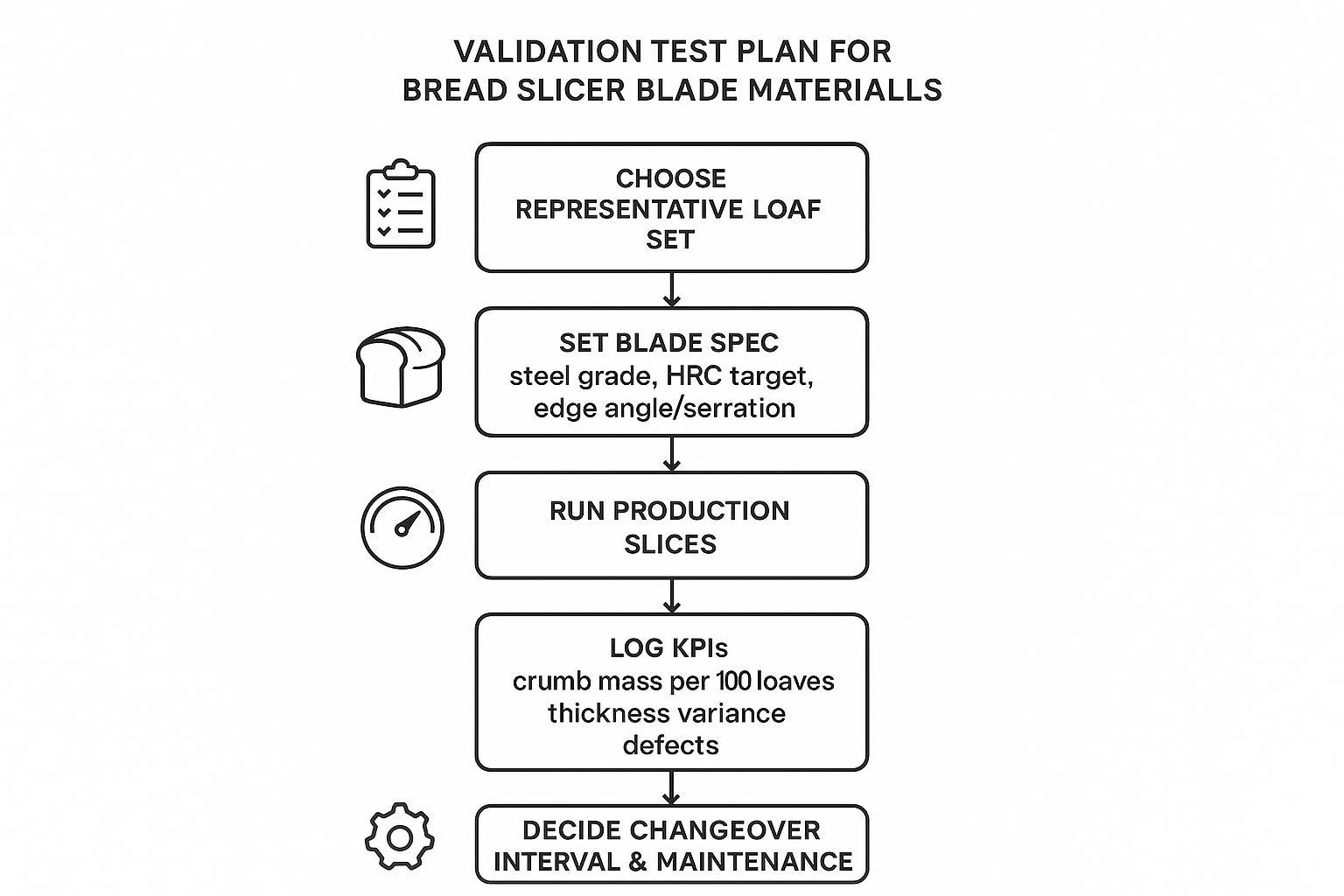
- Validasi pilihan baja dengan uji coba singkat yang terukur: set roti tetap, geometri tepi tetap, catat remah dan variansi ketebalan, lalu tetapkan interval pergantian.
Dasar-dasar material untuk pisau pengiris food grade

Pemilihan material untuk pisau pengiris sebenarnya adalah tiga keputusan yang saling terkait:
- Keluarga baja (stainless martensitik vs karbon tinggi)
- Target perlakuan panas (terutama kekerasan dan stabilitas temper)
- Geometri tepi (pola gerigi, sudut tepi, dan penyelesaian permukaan)
Jika Anda mengubah salah satu dari hal ini, tingkat remah dan stabilitas ketebalan irisan Anda dapat berubah bahkan ketika semua hal lain pada mesin pengiris tidak berubah.
Pilihan stainless martensitik
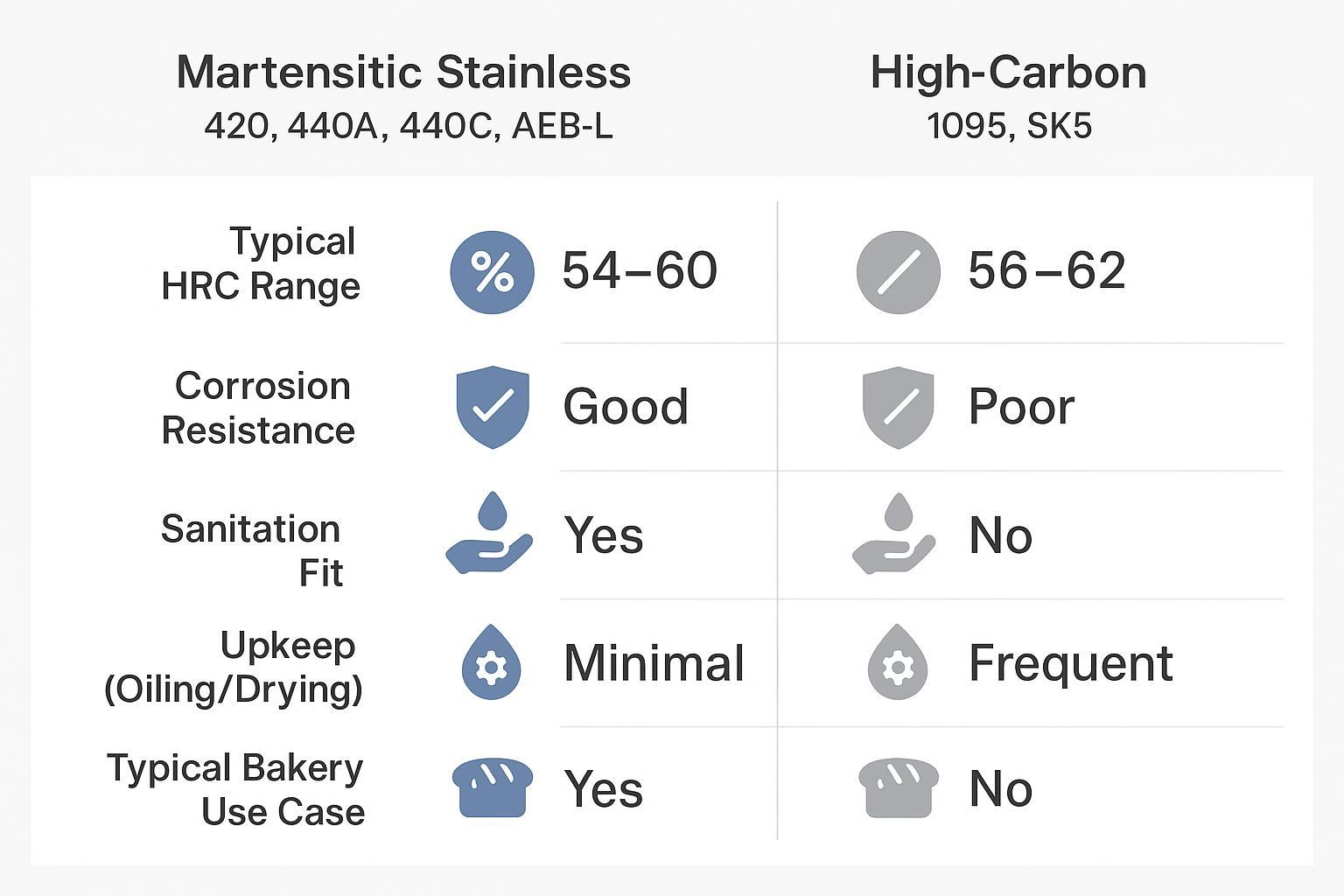
Baja stainless martensitik umum digunakan untuk tepi pemotong. Dalam praktiknya, banyak pabrik menstandardisasi pada pisau pengiris baja stainless martensitik untuk menyederhanakan kontrol higiene dan penyetokan suku cadang karena dapat diberi perlakuan panas hingga kekerasan yang berguna sementara tetap menawarkan ketahanan korosi dibandingkan dengan baja karbon.
Dalam istilah praktis pabrik roti:
- Varian 420 / SUS420 sering digunakan di tempat yang paling mengutamakan ketahanan korosi dan kemudahan sanitasi, dengan masa pakai tepi yang moderat.
- 440A / 440C adalah pilihan “peningkatan” yang umum saat Anda membutuhkan ketahanan tepi yang lebih lama tanpa beralih dari stainless.
- AEB-L is often discussed for fine, stable edges. For OEMs, AEB-L slicer blade steel can be attractive when you need toughness at a fine edge, but only if you can control heat treat and grinding.
Don’t over-index on grade names alone. Two suppliers can ship “440C” blades that behave very differently if the heat treat, cryo (when used), and final grind differ.
A baseline reality that affects procurement: higher-hardness stainless options can improve edge life, but they can also become less forgiving if your slicer setup isn’t stable (alignment, tension, loaf temperature control). That’s why you should tie material changes to a validation plan, not a single “best steel” claim.
High-carbon steel options
High-carbon steels like 1095 dan SK5 can be heat treated to high hardness and often feel “aggressively sharp” in cutting.
In bakery production, the upside is straightforward: high-carbon blades can maintain bite into crusts and seeded skins longer in some conditions. The downside is also straightforward: they have poor corrosion resistance, so they depend on strict drying/oiling discipline and controlled chemical exposure.
If your sanitation program involves wet washdown, standing moisture, or chlorine-containing chemistries, carbon steels are the first to punish you—with rust spots that can escalate from cosmetic to functional (drag increases, debris adheres, and the edge degrades).
As a general reference, materials comparisons such as MWalloys’ discussion of “1095 High Carbon Steel vs. 440/440C Stainless” (2026) highlight this core trade-off: carbon steels can cut well, but corrosion risk is the tax you pay in wet environments. For a bakery-focused discussion of this same trade-off, see MAXTOR METAL’s stainless vs carbon overview.
Catatan: When evaluating any supplier guidance (including ours), use plant trials and third-party hygiene/corrosion references to cross-check assumptions—especially if your sanitation includes chlorine-containing chemistries or frequent wet washdown.
Heat treatment essentials
For slicer blades, heat treatment is not a “nice to have.” It’s what determines whether the steel you specified becomes a repeatable production part.
At a minimum, your heat-treat spec should define:
- Target hardness range (HRC) and acceptable tolerance (your blade hardness HRC window)
- Hardness test method and sampling (per batch, per strip, per blade—whatever matches your risk). For Rockwell hardness, standards commonly referenced include ISO 6508 dan ASTM E18.
- Tempering control (because the same grade at different temper can shift toughness and edge stability)
Typical starting-point note: many bakery teams treat grade selection (e.g., 420 vs 440A/440C) as the first filter, then set the HRC window and validate it against crumb rate and thickness variance targets on their own slicer. Do not treat any “typical” hardness number as a universal requirement—edge geometry, loaf temperature, and alignment can dominate results.
Hardness is not the only variable, but it is a useful control knob: harder edges typically resist wear longer, but may be more prone to chipping or premature micro-damage when the system is misaligned or when loaves are sliced too hot.
From a supplier-qualification standpoint, you also want evidence that the supplier can execute the heat treat consistently. For example, MAXTOR METAL (see Produk MAXTOR METAL for bread slicer blades and related knives) describes material selection support and in-process checks including hardness inspection pada dirinya custom circular knives page, which is the kind of capability you want to verify during onboarding (request hardness reports and traceability for your pilot lots).
Kinerja dan higiene

There are two reasons performance and hygiene have to be handled together:
- A blade that cuts cleanly reduces crumbs and debris, which reduces sanitation load.
- A blade that corrodes or pits can turn into a cleaning validation risk and can also increase drag, accelerating slice defects.
Edge life and slice quality
Your line doesn’t experience “edge retention” as an abstract metallurgy property. It shows up as:
- More crumbs collecting in the slicing lattice and downstream guards
- Tearing or ragged edges (especially on crusty products)
- Thickness drift over a run as cutting resistance changes
Industrial slicing guidance consistently points back to blade condition and setup. For example, troubleshooting advice for industrial bread slicers notes that dull or worn blades increase resistance and contribute to uneven cuts and debris accumulation (see Hanzun’s bread slicer troubleshooting guide (2026)).
Material affects how fast you reach that dullness threshold, but geometry and setup decide how that threshold behaves in your reality:
- A geometry that cuts with lower drag can stay acceptable longer even when conditions aren’t perfect.
- Misalignment, incorrect tension, or slicing bread that’s too hot can mask or amplify material differences.
If you’re comparing steels, keep the rest of the system stable during trials: same serration profile, same edge angle, same loaf temperature window, and the same tension/alignment checks. A practical overview of industrial bread blade types and selection factors is also covered in MAXTOR METAL’s bread cutting blades comparison.
Poin Penting: If your KPI is thickness variance, “steel choice” is never a solo variable. Control edge geometry and setup, then evaluate steel.
Sanitation, corrosion, compliance
Food plants punish metals in two ways: moisture and chemistry.
Even stainless steels can corrode if exposed to the wrong cleaners or if residues sit in dead zones. Food Safety Magazine’s article “In the Food Plant: Danger of Corrosion when Welding Stainless Steel” (2014) is a useful reminder that salts, fabrication quality, and surface condition matter in real plants—not just in lab charts.
For day-to-day prevention, guidance like NAFEM’s “8 Ways to Protect Stainless Steel” (2024) aligns with what bakery teams already know but sometimes can’t fully enforce under production pressure: choose the right cleaners, clean with proper tools, rinse thoroughly, and avoid leaving aggressive chemistries on the surface.
Here’s how this translates into steel selection for slicer blades:
- If your sanitation includes wet washdown, stainless martensitic options are usually the practical baseline.
- If your sanitation includes chlorine-containing chemistries, even stainless can pit if dwell time and rinse/dry discipline aren’t controlled.
- If your sanitation involves standing moisture (drains, enclosures, condensation), high-carbon steels become a high-maintenance risk.
Compliance is rarely about a single certificate on a blade. In audits, HACCP sanitation for slicer blades is judged by whether your cleaning method controls corrosion, residues, and debris buildup consistently. Corrosion that creates rough surfaces, discoloration, or residues is hard to defend—especially if it leads to debris accumulation or frequent corrective maintenance.
Maintenance and TCO
TCO for slicer blades is not the purchase price. It’s:
- Blade price
- Changeover labor
- Sharpening or replacement schedule
- Lost production during setup and cleaning
- Quality losses (crumbs, rejects, customer complaints)
Treat blade changes as a planned interval like any other consumable change, and build that interval from measurable line data.
Slice thickness can drift with multiple variables, not just blade wear. Baking Business reported that factors like product temperature, blade tension, blade temperature, and positioning affect slice thickness on industrial slicers (see “Slaying bread slicing errors” (2019)). If you don’t stabilize those, you’ll blame the steel for a problem caused by setup.
Pemilihan dan validasi
A good steel decision does two things at once:
- It fits your sanitation reality.
- It produces stable slice KPIs at a planned changeover interval.
Baseline vs upgrade choices
Start with a baseline that reduces risk, then upgrade only when the data shows the upgrade pays.
Baseline (most lines): martensitic stainless
- Use a martensitic stainless baseline when the plant runs wet sanitation, has frequent changeovers, or needs a predictable compliance story.
- The baseline is usually a 420/440-family decision depending on how abrasive your products are and how long you need to run between changes. Many teams start with the practical framing: 420 vs 440C slicer blades—then confirm the choice with KPI data and sanitation fit.
Upgrade path: higher edge stability within stainless
- If crumbs increase too fast or thickness variance grows before your planned changeover window, upgrading within stainless (e.g., toward higher edge-life options in the 440 family, or exploring AEB-L where supply and heat-treat control are strong) is typically the next step.
- The point of the upgrade is not “harder is always better.” It’s “longer acceptable KPI window without increasing breakage, sanitation issues, or sharpening complexity.”
Where high-carbon can make sense (with clear constraints)
- High-carbon steels (1095/SK5) can be considered where the sanitation process is dry or tightly controlled, and where the operation is willing and able to prevent corrosion consistently.
- If you can’t guarantee drying and protection after cleaning, carbon steels tend to fail the hygiene fit test even when they cut well.
In practice, many OEM and plant teams also need a supplier that can execute the spec consistently and document it. Without turning this into a sales pitch: capabilities like controlled heat treatment, grade selection support, and in-process hardness checks are relevant selection criteria. If you’re qualifying any supplier, treat documentation (material certs, hardness reports, batch traceability) as part of the blade spec—not an afterthought. For OEM drawings or retrofit patterns, a supplier’s ability to build from prints or samples matters as much as the steel family (see MAXTOR METAL custom blades).
Setup parameters to test
If you want a fair comparison between steels, lock the parameters that can otherwise dominate your results.
Test setup parameters to define before the trial:
- Loaf set: include at least one soft sandwich product and one higher-resistance product (crusty, seeded, or high-inclusion).
- Loaf temperature window: define “slice at” temperature range and enforce it.
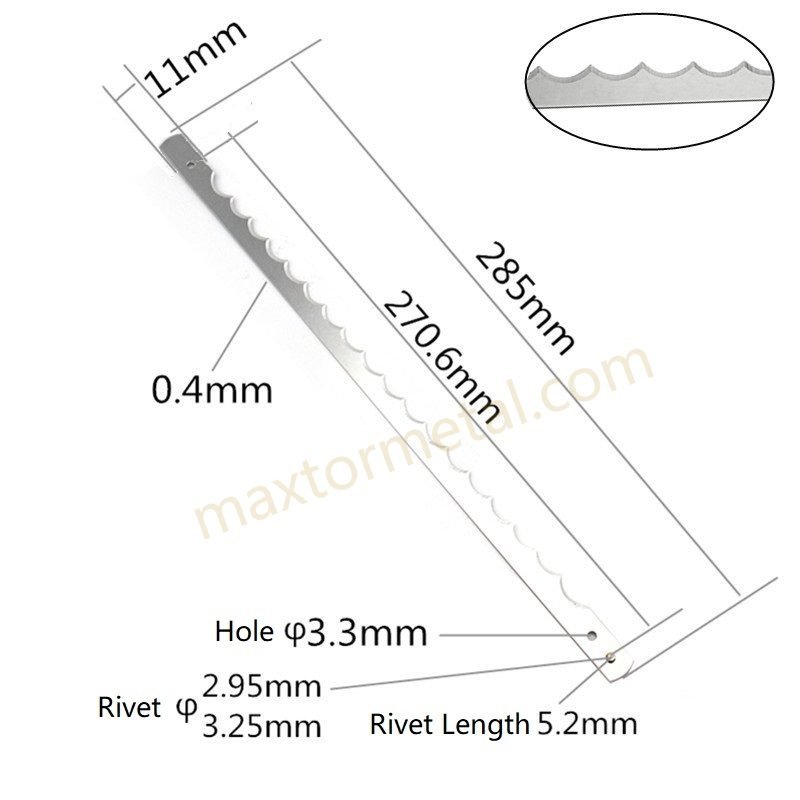
- Geometri bilah: serration type and pitch, edge angle, and surface finish.
- Hardness target (HRC): set a range per steel, not a single value.
- Slicer settings: tension, guides, pressure belts, and alignment checks.
- Cleaning cycle: match your real sanitation SOP (chemistry + dwell time + rinse/dry steps).
This is also where OEMs can align design intent with plant reality: if the guide system is sensitive to certain blade stiffness or thickness tolerance, treat that as a qualification criterion.
KPIs and changeover planning
Choose KPIs that can be measured quickly and that correlate with what your customers complain about.
Common KPI set for slicer-blade validation:
- Crumb mass per 100 loaves (or per shift) under standardized collection method
- Variansi ketebalan (e.g., standard deviation across a defined sample size)
- Defect rate (tearing, ragged edges, compressed slices)
- Cleaning burden (time-to-clean slicer head to acceptable condition)
- Waktu peralihan (blade swap + re-tension/alignment + first-good verification)
Then define the changeover interval based on when KPIs cross your “unacceptable” threshold, not when the blade looks worn.
Kepatuhan Uni Eropa & referensi desain higienis (cara menggunakannya)

This article is a technical best-practices guide, not legal advice. If you’re specifying pisau pengiris kontak makanan for the EU, it helps to map your blade spec and your supplier documentation to a few widely used frameworks:
- EU Framework Regulation (EC) No 1935/2004 (Food Contact Materials): your baseline principle is that materials must not transfer constituents to food in quantities that could endanger health, cause unacceptable changes in food composition, or impair organoleptic characteristics.
- Good Manufacturing Practice: Regulation (EC) No 2023/2006: use this when you audit whether a blade supplier has controlled processes, traceability, and consistent inspection routines.
- Metals & alloys guidance (Council of Europe CM/Res(2020)9 + EDQM Technical Guide: Metals and Alloys used in Food Contact Materials and Articles, 2nd ed., 2024): these references are commonly used for metals/alloys and discuss release testing approaches and Specific Release Limits (SRLs) for metal elements.
- Hygienic design guidance (EHEDG — Hygienic Design Principles): use this to pressure-test whether your blade design, surface condition, and equipment interfaces are compatible with cleanability (for example, minimizing crevices and avoiding surface conditions that make residues harder to remove).
How to apply these references in practice:
- Add a compliance pack to your blade RFQ: request material certificates, batch traceability, hardness inspection records, and a brief statement of intended food-contact use conditions.
- Tie your verification plan to test methods: define hardness testing per ISO 6508 / ASTM E18 (Rockwell), and define corrosion evaluation methods that match your sanitation reality (e.g., salt spray test procedures such as ISO 9227 / ASTM B117 where appropriate).
- Cross-check sanitation chemistry risk: if your cleaners are chlorine-containing or you have standing moisture risk, treat corrosion/pitting behavior as a controlled risk item in HACCP and validate with your actual SOP (chemistry, dwell time, rinse, and dry steps).
These references don’t replace your plant’s validation work, but they help make your material choice and supplier qualification more defensible and more repeatable across sites.
Kesimpulan
A practical, low-risk path for most commercial bakeries is:
- Use a standar stainless martensitik for food-contact slicer blades, then upgrade within stainless when your run-length targets and KPI thresholds demand it.
- Treat high-carbon steels as a niche choice. If your sanitation is wet or chemistry-heavy, they’re usually the wrong fit because corrosion becomes the hidden cost.
Next steps are straightforward and measurable:
- Pilot on representative products (at least one soft loaf and one demanding loaf), using a fixed geometry and a defined HRC target.
- Record the KPIs that matter—crumb rate and thickness variance—then set a changeover interval that protects slice quality and OEE.
- Align the blade spec and documentation package with HACCP expectations and procurement cycles (material certificates, hardness reports, and traceability for pilot lots).
If you want a faster qualification cycle, start by standardizing your test template and supplier documentation checklist, then apply it consistently across baseline and upgrade candidates.
Catatan, cakupan, dan referensi
- Scope: This guide focuses on food-contact slicer blades on industrial bread lines (~600–1200 loaves/hour). Results can change significantly with slicer design, loaf formulation (seeded/crusty), loaf temperature, and sanitation chemistry.
- Not legal advice: For EU deployments, confirm food-contact compliance requirements with your internal QA/regulatory team and the requirements in the destination EU member state.
- About citations: Web references are provided for practical orientation. For audits and supplier qualification, prioritize controlled test methods, documented inspection records, and recognized technical guidance (e.g., EU FCM framework rules, EDQM metals/alloys guidance, and EHEDG hygienic design principles).
About the author & technical review
- Pengarang: Nancy Wu, Senior Manufacturing Engineer, Nanjing METAL Industrial
- Experience: 12 years in industrial blade manufacturing and process control
- Credentials: SME – CMfgE, PMP, Six Sigma Black Belt, ASM International Certifications
- Last technically reviewed: 2026-05-03
Optional: third-party validation package (recommended)
If you need higher defensibility for multi-site deployment or audit readiness, consider commissioning a third-party lab to run a standardized validation package that matches your sanitation SOP. Typical elements include:
- Material verification: chemistry verification vs mill certs + batch traceability review
- Hardness & consistency: Rockwell hardness testing plan (e.g., ISO 6508 / ASTM E18) with sampling rules per lot
- Corrosion screening: test selection aligned to your cleaning chemistry and exposure pattern (for example, salt spray procedures such as ISO 9227 / ASTM B117 where appropriate, plus targeted pitting/crevice risk checks)
- Edge performance: standardized cut trials (fixed loaf set + fixed geometry) with crumb mass and thickness variance tracking
Treat the resulting report as part of your supplier qualification record and keep the test conditions (chemistry, dwell time, rinse/dry) explicitly documented so the results remain reproducible.

 English
 Spanish
 Italian
 French
 Portuguese
 Russian
 German
 Arabic
 Hindi
 Vietnamese
 Indonesian
 Japanese
 Korean