

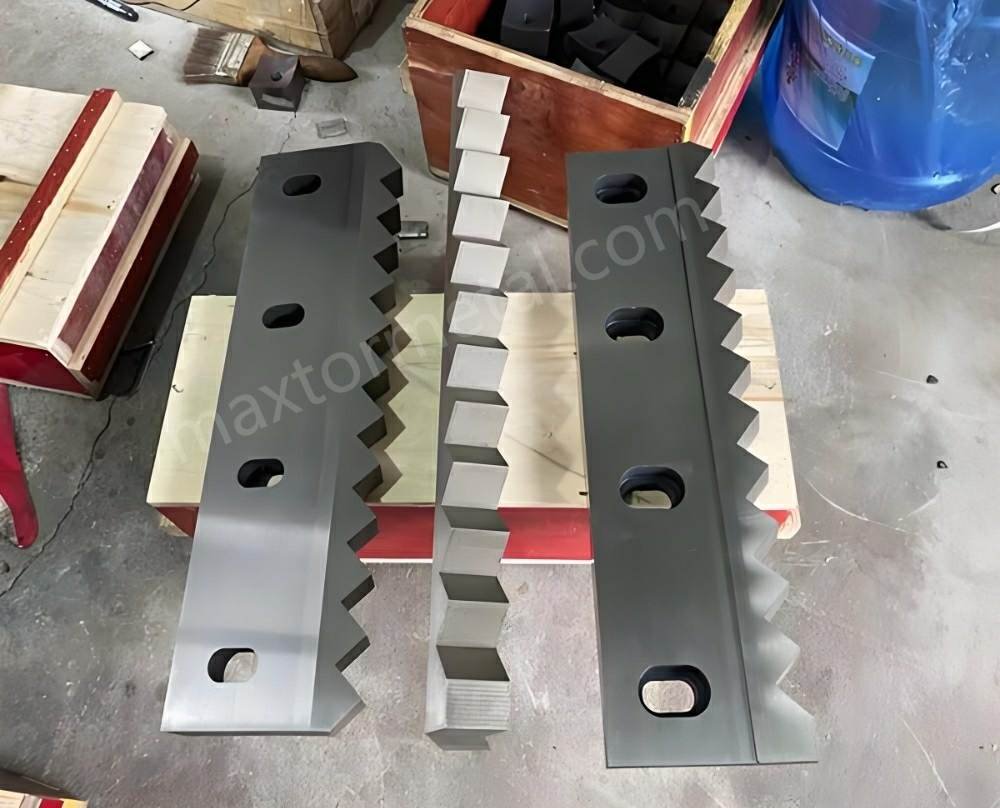
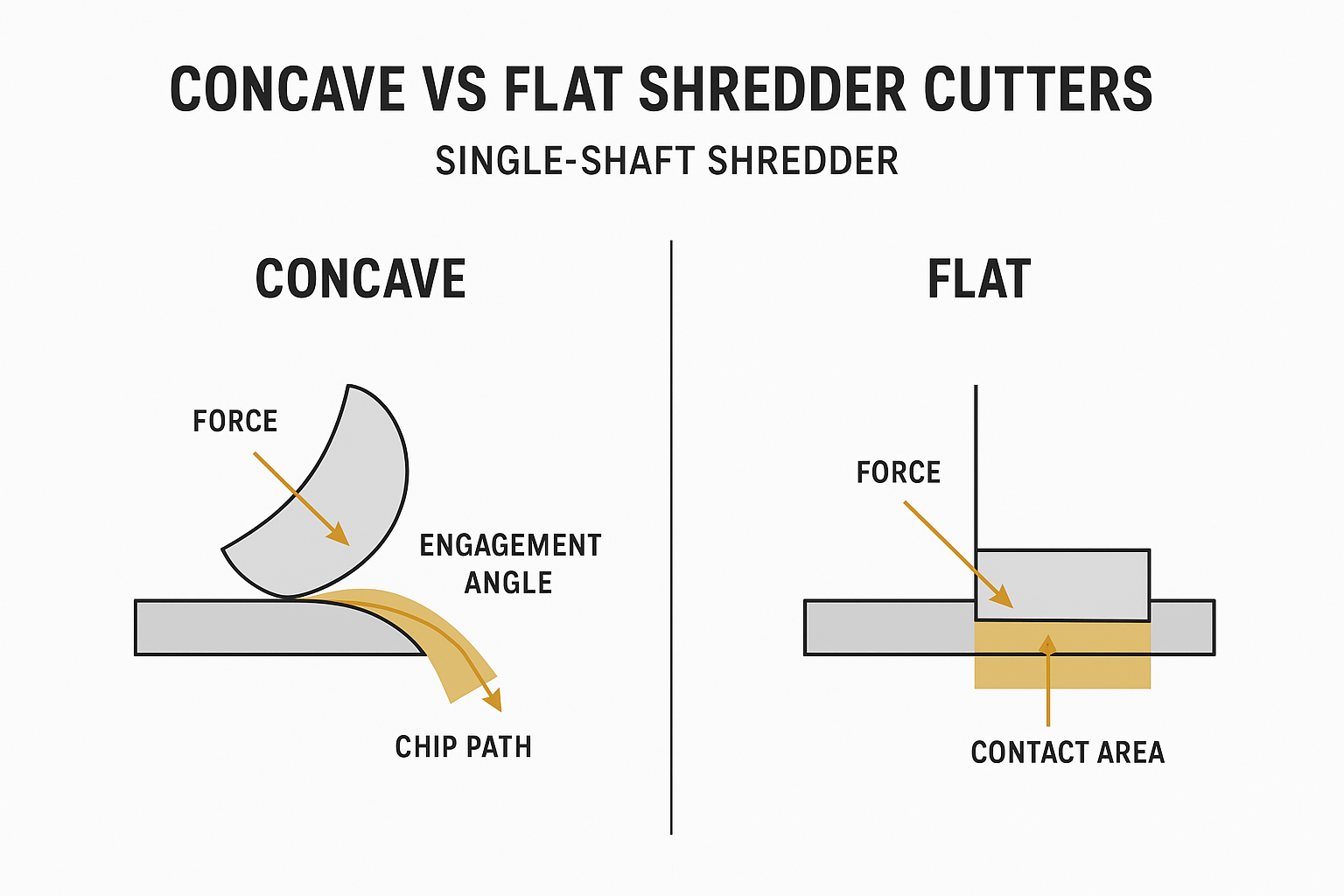
凹面シュレッダー刃は、 最初の接触 一軸シュレッダーにおける材料とローターの間の最初の接触を変化させます。切断を開始するためにプッシャーの力と摩擦に大きく依存するほぼ平らな刃先を提示する代わりに、凹面の刃先は、食い込みと制御された自己供給を促進する、より「引っ掛かる」ような噛み合いを生み出す傾向があります。.
現場では、シュレッダーがすでに機械的に健全であり、プロセスが下流の搬送やスクリーンの目詰まりではなく切断効率によって制限されている場合、トンあたりのエネルギー削減とスループットの向上が現実的になります。そのような条件下では、約5〜15%程度の測定可能な改善が達成されることが多いですが、それは自動的に得られるものではなく、単に刃の形状だけの問題ではありません。.
このガイドでは、そのメカニズム(凹面形状が比エネルギーを削減できる理由)、実際に効果が得られるかどうかを決定するセットアップの調整要素、摩耗とメンテナンスのトレードオフ、およびレトロフィット(後付け)に価値があるかどうかを判断するための実用的なTCOフレームワークについて詳しく説明します。.
主なポイント(メンテナンスおよびプロセスチーム向け):
著者について:このガイドは、実用的なエンジニアリングおよび調達支援の観点から執筆されており、刃の形状、刃の隙間(ギャップ)、カウンターナイフ(固定刃)の状態、スクリーンの
- 凹型シュレッダー刃は、噛み込みが制限要因となっている場合にトルクスパイクや再切断を減少させることができ、多くの場合、処理能力を向上させ、以下を低下させます。 トン当たりのkWh.
- 結果は以下に大きく依存します ナイフギャップ, カウンターナイフの状態, スクリーンの選定、 そして プッシャー/トルク制御ロジック.
- 単なる「見た目の摩耗」ではなく、成果(トン当たりのkWh、時間当たりのトン数、トン当たりの反転回数、スクリーン清掃回数)に基づいて試験を追跡します。.
- 凹型形状は摩耗の集中をシフトさせる可能性があります。鋼材/熱処理の一貫性や、再研磨/インデックスの規律が重要です。.
- レトロフィットが投資回収に見合うかどうかを判断するには、単一変数試験とシンプルなTCOフレームワークを使用します。.
凹面形状がエネルギーを削減する仕組み
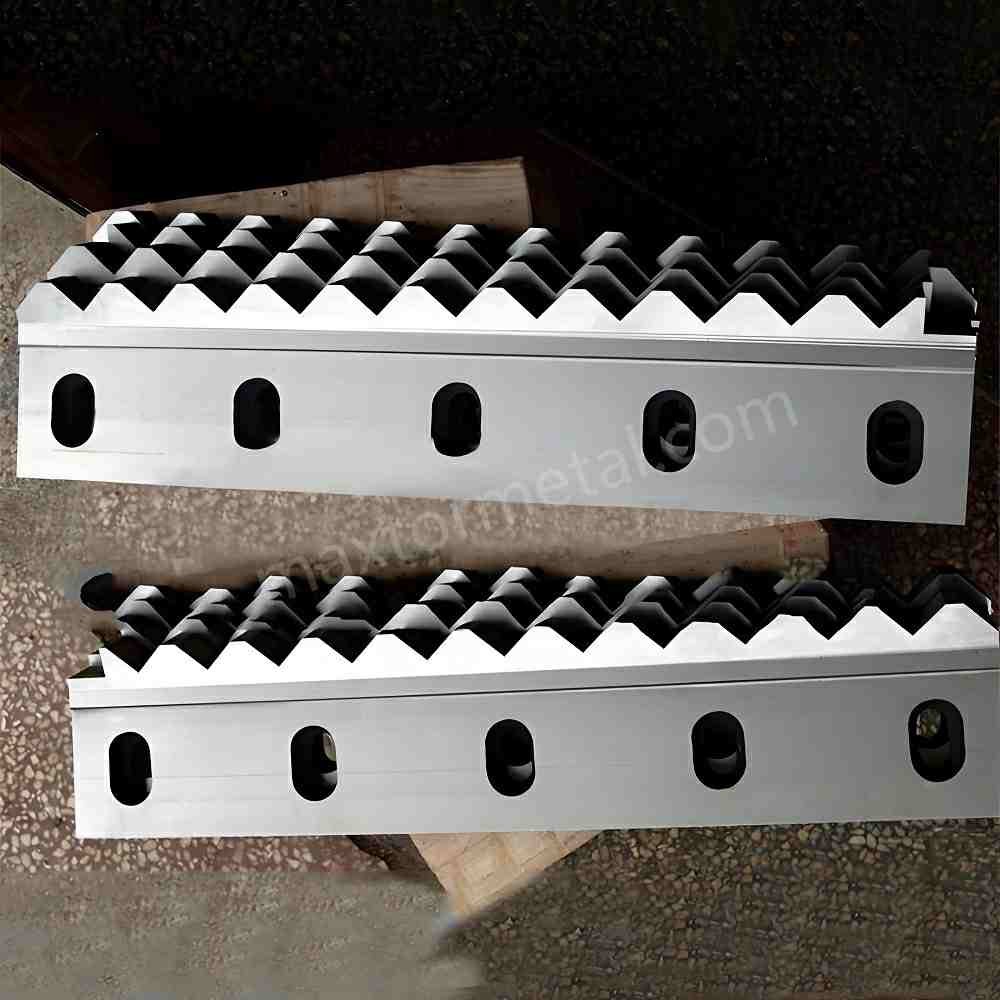
比エネルギー(トン当たりのkWh)は、その背景に多くの要素を持つシンプルなKPIです。一軸シュレッダーの場合、ローターがトルクをいかに効率よく以下に変換できるかによって決まります。 有効なせん断 無駄な熱、摩擦、再切断ではなく、.
噛み込みとセルフフィードのメカニズム
凹型の刃先は、特にプッシャーが作業の大部分を担うような、滑りやすい材料や柔軟な被処理物を処理する際に、最初のきれいな噛み込みの確率を高めることができます。噛み込みが改善されると、2つのことが起こります。
- プッシャーがローターに対して材料を「押し当てる」時間が短縮されます。.
- ローターは、不規則な噛み込みの間の無負荷回転ではなく、回転の多くを生産的なせん断に費やすようになります。.
これが処理能力向上の第一の経路、すなわちデッドサイクルの削減です。.
局所的なせん断と接触面積の縮小
凹型の刃先は、切断開始時のかみ合いをより小さな有効接触領域に集中させることができます。実際には、幅の広い刃先全体を一度にせん断しようとしないため、せん断を開始するのに必要なピーク力が低下することがよくあります。.
ピーク切断力の低下が重要なのは、トルクスパイクの頻度と深刻度を抑えられるためです。トルクスパイクが減少すると、シュレッダーはより安定したローター速度を維持でき、制御介入(減速、反転、一時停止など)に費やす時間を減らすことができます。.
再切断の減少とより安定したチップ形成
刃の形状とセットアップによってより安定したチップ形成が行われれば、材料が「跳ね返り」や擦り潰れを起こし、再び切断領域に引き戻されて何度も部分的に切断される可能性が低くなります。再切断はコストがかかります。新たな処理量を生み出すことなく、エネルギーとローターの時間を消費するためです。.
チップの経路がより予測可能になれば、スクリーンからの排出も安定しやすくなります。ただし、これはスクリーンが適切に組み合わされており、ボトルネックになっていないことを前提とします。.
凹面シュレッダー刃が最も効果を発揮する用途
凹型形状は一つの手段であり、万能なアップグレードではありません。切断効率や供給の安定性が性能のボトルネックになっている場合に、最も優れた効果を発揮する傾向があります。.
材料の分類とスクリーンの組み合わせ
以下のような場合に、より効果を実感しやすくなります:
- 供給物が切断される前に滑ったり、巻き付いたり、変形したりしやすい場合(フィルム、特定の柔軟なポリマー、繊維状の混合物など)。.
- プロセスが安定した排出サイズに敏感であり、スクリーンの選定を調整している場合。.
OEM各社は、スクリーンの選定が排出サイズを直接制御し、材料を押し出すためにローターがどれだけ「激しく」稼働しなければならないかに影響を与えることを強調しています。WEIMA社は、WLKシリーズの製品ページにおいて、交換可能なスクリーンによって排出サイズを調整でき、網目が小さいほどより細かい材料が排出されると指摘しています(これは、スクリーンを制限しすぎると切断負荷が高くなることも意味します)(WEIMA社のWLK 1000シュレッダー製品ページ).
刃の隙間(ギャップ)、カウンターナイフ(固定刃)の鋭さ、およびローター速度
凹型刃を使用しても、機械的なセットアップが不十分であれば解決にはなりません。多くの設備において、刃先形状よりも、隙間(ギャップ)やカウンターナイフの状態の方が結果を大きく左右します。.
主な原則:
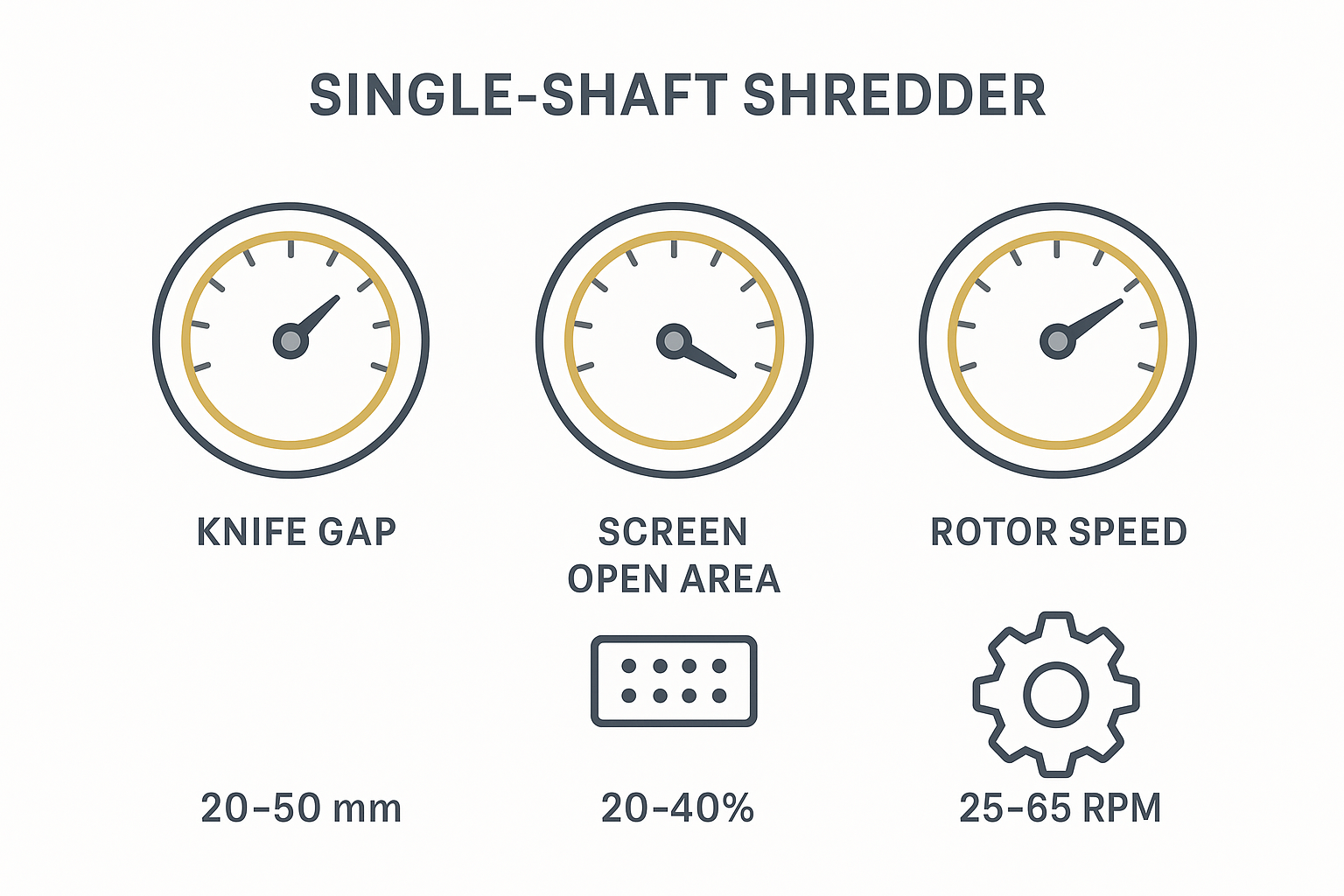
- シュレッダーの刃の隙間(ギャップ)とカウンターナイフ(固定刃)のアライメント: クリアランスが大きすぎると、せん断から引き裂きや摩擦へと移行してしまいます。逆に狭すぎると、発熱や騒音、刃先損傷のリスクが高まります。.
- カウンターナイフの状態: A blunt counter-knife turns clean shear into compress-and-smear behavior. That increases kWh/ton and worsens granulate consistency.
- Rotor speed: Higher speed can help bite on some materials but can also increase heat and wear. Use speed as a controlled variable—don’t “crank it up” to hide a gap problem.
WEIMA explicitly highlights maintaining a consistent cutting gap using adjustable and reversible counter-knives and notes that knife/counter-knife interaction strongly influences throughput and shredding results (WEIMA’s guidance on cutting gap maintenance).
Pusher logic and torque management
If you have control access (or can tune it via OEM settings), treat pusher behavior and torque logic as part of the retrofit—not an afterthought.
実地確認:
- Pusher force vs. pusher timing: Over-aggressive pushing can increase rubbing and heat; under-feeding creates rotor “air time.”
- Torque limit and reversal thresholds: Too sensitive, and you waste time reversing; too lax, and you shock-load the edge.
- Feed consistency: Big, rigid chunks mixed with thin flexible material can negate the advantages of concave engagement.
トレードオフ、摩耗、およびメンテナンス
Concave geometry can shift where wear concentrates. That’s not inherently bad—but it changes how you plan regrinds, indexing, and procurement.
Edge wear concentration and indexing/regrind
Because a concave edge can localize the cut initiation zone, it may also localize abrasive wear—especially in mixed waste with hard contaminants.
To keep performance stable:
- Track wear by tons processed per edge (not calendar time).
- Index or rotate replaceable knives before the edge becomes rounded enough to drive up kWh/ton.
- Regrind based on measured outcomes: rising motor load, more reversals, hotter discharge, or worsening size distribution.
プロのヒント: If you’re trialing concave blades, log kWh/ton, reversals per ton, and screen-cleaning events. Those three signals often tell the story faster than “does it look worn?”
Steel, heat treatment, and coatings selection
If concave knives reduce force spikes but increase localized abrasive wear, steel selection and heat treatment consistency become even more visible in your uptime.
This is where supplier evidence matters. For shredder blades and counter-knives, MAXTOR METAL documents common material options (e.g., 65Mn, 9CrSi, Cr12MoV, SKD-11, plus high-speed steel options) and describes multi-stage inspection practices such as incoming material inspection, in-process checks, and final inspection on its single-shaft shredder blade pages (MAXTOR METAL single-shaft shredding motorized blades そして MAXTOR METAL single-shaft shredder fixed blade).
For maintenance and procurement teams, the practical takeaway is simple:
- Ask for material certificates tied to the batch.
- Request heat-treatment evidence (hardness targets and test method) and keep it with your spare-parts record.
- Make sure the supplier can provide QC/inspection documents that match your tolerance sensitivity—because knife gap performance doesn’t tolerate inconsistent thickness, flatness, or hardness.
Coatings can help in abrasive feeds, but they can also change edge behavior and chip formation. Treat coatings as a controlled trial variable—don’t stack multiple changes at once.
When flat or chamfered geometries are preferable
Flat or chamfered edges can outperform concave in scenarios where:
- Your feed is already easy to bite (rigid, consistent geometry) and you’re limited by screen throughput or downstream capacity.
- You need broader edge support for impact-heavy feeds (large rigid chunks, frequent tramp metal) where edge chipping is the dominant failure mode.
- Your maintenance process requires fast, predictable regrinds and your team is standardized on flat-edge inspection gauges.
Concave isn’t a universal “upgrade.” It’s a geometry choice that should match material behavior and your operational constraints.
動作限界と安全上の注意

- Always follow your shredder OEM’s safety procedures for lockout/tagout and for any changes to knife gap, rotor speed, or control parameters.
- If you see rising discharge temperature, abnormal noise, frequent edge chipping, or rapid motor-load increase, stop the trial and re-check knife gap, counter-knife alignment, and feed consistency.
- Treat coatings, steel grade changes, and geometry changes as separate variables. If you change more than one variable at once, it becomes difficult to attribute improvements (or failures) to the right cause.
TCOと意思決定のガイダンス
Throughput and kWh/ton are only part of the decision. The full cost picture usually includes blade life, changeover labor, and the value of uptime.
Energy, blade life, and downtime math
A practical TCO frame for a retrofit trial:
- Energy cost impact = (baseline kWh/ton − trial kWh/ton) × $/kWh × tons processed
- Blade cost impact = (baseline cost per ton of knives) − (trial cost per ton of knives)
- Downtime impact = (changeovers/year × downtime hours/changeover) × $/hour value of line uptime
If your operation is downtime-driven, the fastest payback often comes from fewer unplanned stops—not from a small reduction in kWh/ton.
Material-dependent selection cues
Use these cues before you commit:
- If output size distribution is unstable, prioritize gap, counter-knife condition, and screen pairing before changing geometry.
- If the shredder reverses frequently with acceptable edge sharpness, look for feed inconsistency, pusher timing, or torque thresholds.
- If edges round quickly without chipping, consider whether concave geometry plus a more wear-resistant steel/heat treatment spec is a better fit.
Implementation checklist after retrofit
Trial log template (copy/paste)
| Category | What to record | Target / notes |
|---|---|---|
| Material & feed | Material type/grade, bulk density (if known), contamination notes, feed consistency | Keep feed mix consistent across baseline vs trial |
| Screen | Screen hole size, open area (if known), screen condition/plugging | Screen restrictions often dominate energy/throughput |
| Knife setup | Knife geometry (concave/flat), knife gap setting method & gauge, counter-knife condition | Use the same measurement method every time |
| Controls | Rotor speed, pusher force/timing, torque limit & reversal thresholds | Freeze settings for the first trial window |
| Trial window | Start/end timestamps, tons processed in the window | Use fixed tonnage windows (e.g., every X tons) |
| Performance KPIs | tons/hour, kWh/ton | Compare like-for-like windows |
| Stability signals | reversals per ton, screen-cleaning events, motor current (avg/peak) | Often explains KPI changes faster than visual wear |
| Wear notes | edge rounding, chipping, wear location on edge, tons per edge | Photograph at consistent intervals |
| Product quality | basic size distribution check (sieve/yield proxy), downstream issues | Ensure throughput gains don’t harm quality |
Keep the trial controlled. Change one main variable at a time.
- Verify counter-knife condition and alignment before installing the new knives.
- Set and record knife gap (and keep the same gauge/process for repeatability).
- Keep rotor speed and torque thresholds unchanged for the first run unless your baseline is unstable.
- Run a fixed-tonnage trial window and log:
- tons/hour
- kWh/ton
- reversals per ton
- screen-cleaning events
- granulate size distribution (basic sieve check or downstream yield proxy)
- Inspect edge wear pattern at the same tonnage interval each run.
参考文献
- WEIMA — WLK 1000 shredder page: https://weima.com/us/shredders/wlk-800-2000/wlk-1000/
- WEIMA — Cutting gap maintenance guidance (WLK 10 page): https://weima.com/us/shredders/wlk-6-s-20/wlk-10/
- MAXTOR METAL — Single-shaft shredding motorized blades: https://maxtormetal.com/product/single-shaft-shredding-motorized-blades/
- MAXTOR METAL — Single-shaft shredder fixed blade: https://maxtormetal.com/product/single-shaft-shredder-fixed-blade/
結論
Concave shredder blades can improve throughput and cut kWh/ton when conditions align—especially when the baseline process is limited by inconsistent bite, high re-cut rates, or unstable chip formation.
But realized results typically depend more on setup discipline (knife gap, counter-knife sharpness, screen pairing, and controls) than geometry alone. OEM guidance also points to the knife/counter-knife interaction and maintaining a stable cutting gap as central to throughput and shredding quality.
Start with controlled trials, verify granulate quality, and track kWh/ton alongside operational signals like reversals and screen cleaning. If you’re sourcing replacement knives, make documentation part of the spec: material certs, heat-treatment evidence, and QC records are what make geometry improvements repeatable—not just anecdotal.

 English
  Spanish
  Italian
  French
  Portuguese
  Russian
  German
  Arabic
  Hindi
Hindi  Vietnamese
  Indonesian
  Japanese
  Korean