

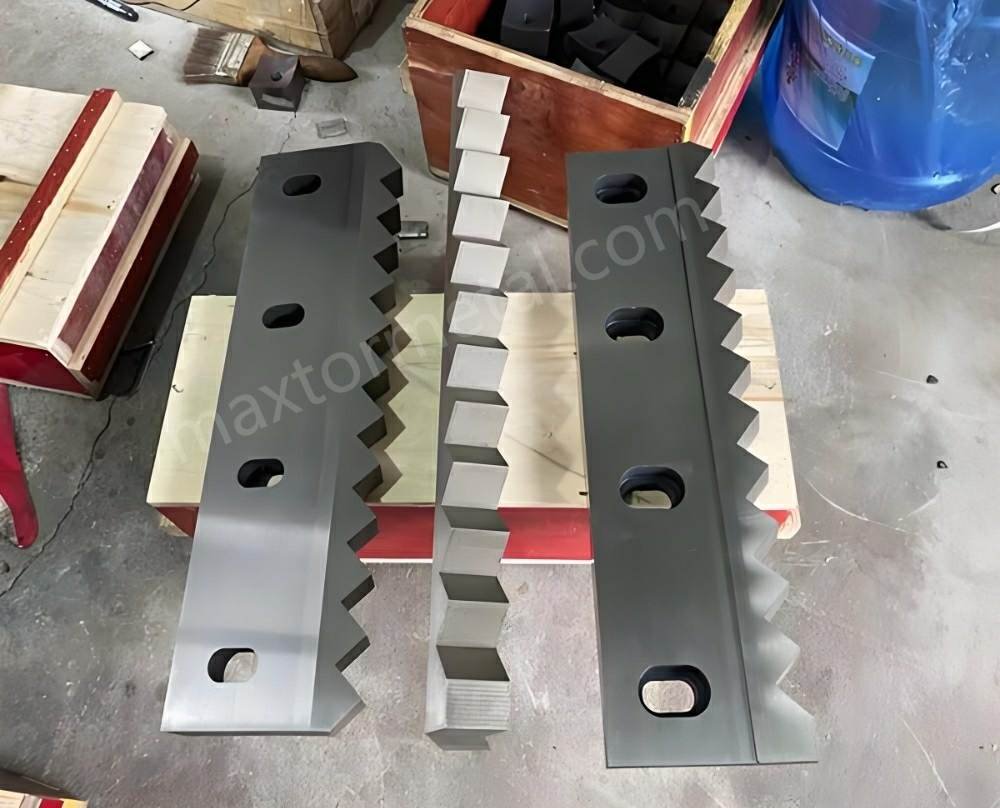
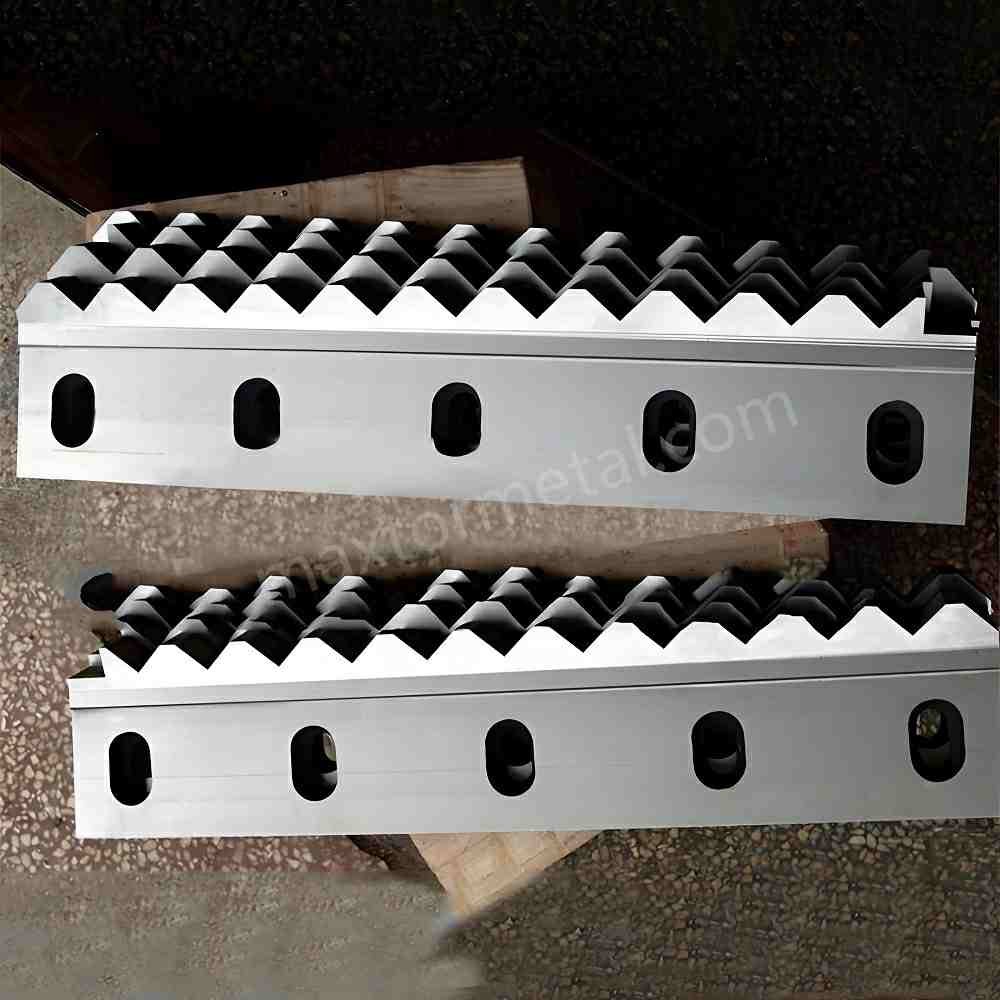
Pisau shredder konkaf mengubah kontak pertama antara material dan rotor pada shredder poros tunggal. Alih-alih menyajikan tepi yang sebagian besar rata yang sangat bergantung pada gaya pendorong dan gesekan untuk memulai pemotongan, tepi konkaf cenderung menciptakan keterikatan yang lebih “mencengkeram” yang mendorong gigitan dan pengumpanan mandiri yang terkendali.
Di lapangan, penghematan energi per ton dan peningkatan throughput sangat realistis ketika shredder sudah dalam kondisi mekanis yang sehat dan prosesnya dibatasi oleh efisiensi pemotongan, bukan oleh konveyor hilir atau penyumbatan saringan. Dalam kondisi tersebut, peningkatan terukur sekitar ~5–15% sering kali dapat dicapai—tetapi ini tidak terjadi secara otomatis, dan bukan hanya tentang geometri pisau.
Panduan ini menguraikan mekanisme (mengapa geometri konkaf dapat mengurangi energi spesifik), tuas penyetelan yang menentukan apakah Anda benar-benar melihat peningkatan, kompromi keausan dan perawatan, serta kerangka kerja TCO praktis untuk memutuskan apakah retrofit ini sepadan.
Poin penting (untuk tim perawatan & proses):
Tentang Penulis: Panduan ini ditulis dari perspektif teknik praktis dan dukungan pengadaan, yang berfokus pada bagaimana geometri pisau, celah pisau, kondisi pisau lawan, pemasangan saringan, dan pengaturan kontrol berinteraksi dalam kinerja harian shredder poros tunggal. (Tidak ada data uji spesifik lokasi yang diasumsikan—gunakan templat uji coba di bawah ini untuk mendokumentasikan hasil Anda sendiri.)
- Pisau shredder konkaf dapat mengurangi lonjakan torsi dan pemotongan ulang ketika gigitan menjadi faktor pembatas—sering kali meningkatkan throughput dan menurunkan kWh per ton.
- Hasil sangat bergantung pada celah pisau, kondisi pisau lawan, pemilihan saringan, Dan logika kontrol pendorong/torsi.
- Pantau uji coba berdasarkan hasil (kWh/ton, ton/jam, pembalikan arah per ton, peristiwa pembersihan saringan)—bukan hanya berdasarkan “keausan visual” semata.
- Geometri konkaf dapat menggeser konsentrasi keausan; konsistensi baja/perlakuan panas serta disiplin pengasahan ulang/pengindeksan sangatlah penting.
- Gunakan uji coba variabel tunggal dan kerangka kerja TCO sederhana untuk memutuskan apakah retrofit memberikan pengembalian investasi.
Bagaimana Geometri Konkaf Mengurangi Energi
Energi spesifik (kWh per ton) adalah KPI sederhana dengan banyak faktor di baliknya. Untuk shredder poros tunggal, hal ini didorong oleh seberapa efisien rotor mengubah torsi menjadi geseran yang berguna alih-alih membuang panas, gesekan, dan pemotongan ulang.
Mekanika gigitan dan pengumpanan mandiri
Tepi konkaf dapat meningkatkan probabilitas gigitan awal yang bersih—terutama saat memproses umpan yang licin atau fleksibel di mana pendorong melakukan sebagian besar pekerjaan. Ketika gigitan membaik, dua hal terjadi:
- Pendorong menghabiskan lebih sedikit waktu untuk “menahan” material pada rotor.
- Rotor menghabiskan lebih banyak waktu putarannya untuk melakukan geseran produktif alih-alih berputar tanpa beban di antara cengkeraman yang tidak konsisten.
Itu adalah jalur pertama menuju peningkatan throughput: lebih sedikit siklus mati.
Geseran terlokalisasi dan area kontak yang lebih kecil
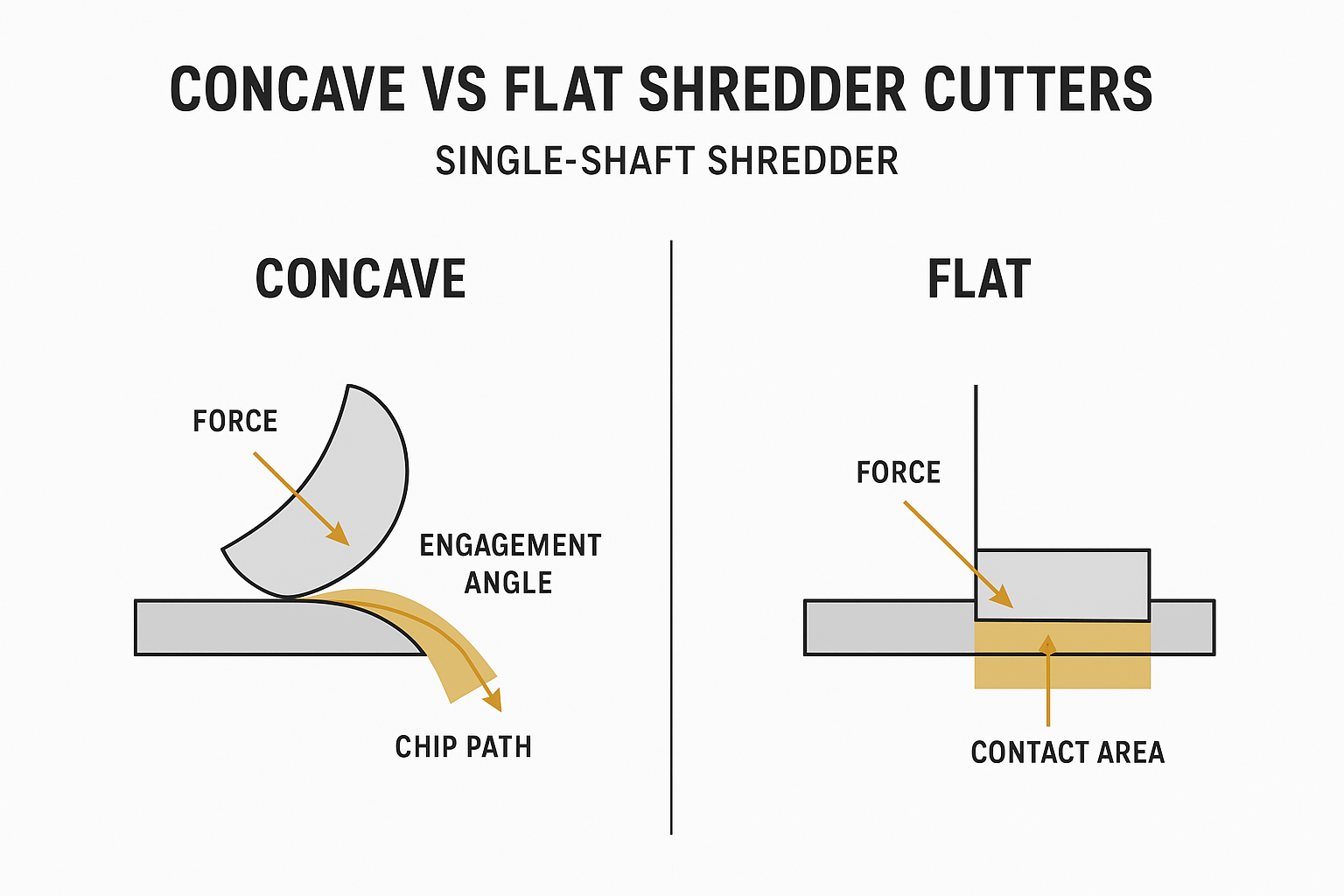
Tepi konkaf dapat memusatkan keterikatan ke dalam zona kontak efektif yang lebih kecil pada awal pemotongan. Dalam praktiknya, hal itu sering kali mengurangi gaya puncak yang diperlukan untuk memulai geseran karena Anda tidak mencoba menggeser di sepanjang tepi yang lebar sekaligus.
Gaya pemotongan puncak yang lebih rendah sangat penting karena mengurangi frekuensi dan keparahan lonjakan torsi. Ketika lonjakan torsi berkurang, shredder dapat mempertahankan kecepatan rotor yang lebih stabil dan menghabiskan lebih sedikit waktu dalam intervensi kontrol (misalnya, perlambatan, pembalikan arah, atau periode diam).
Lebih sedikit pemotongan ulang dan pembentukan serpihan yang lebih stabil
Jika geometri dan penyetelan menghasilkan pembentukan serpihan yang lebih konsisten, material cenderung tidak “memantul” atau melumuri dan kemudian terseret kembali ke zona pemotongan untuk beberapa pemotongan parsial. Pemotongan ulang sangat merugikan: ini menghabiskan energi dan waktu rotor tanpa menghasilkan throughput massa yang baru.
Jalur serpihan yang lebih mudah diprediksi juga membantu menstabilkan pengeluaran melalui saringan—dengan asumsi saringan dipasangkan dengan benar dan tidak menjadi hambatan.
Di Mana Pisau Shredder Konkaf Bekerja Paling Baik
Geometri konkaf adalah sebuah alat—bukan peningkatan universal. Ini cenderung menunjukkan hasil terbaik ketika efisiensi pemotongan dan konsistensi umpan membatasi kinerja.
Kelas material dan pemasangan saringan
Anda lebih mungkin melihat manfaat ketika:
- Umpan memiliki kecenderungan untuk tergelincir, terlilit, atau berubah bentuk sebelum dipotong (film, polimer fleksibel tertentu, campuran berserat).
- Proses ini sensitif terhadap ukuran pengeluaran yang stabil dan Anda sedang menyesuaikan pemilihan saringan.
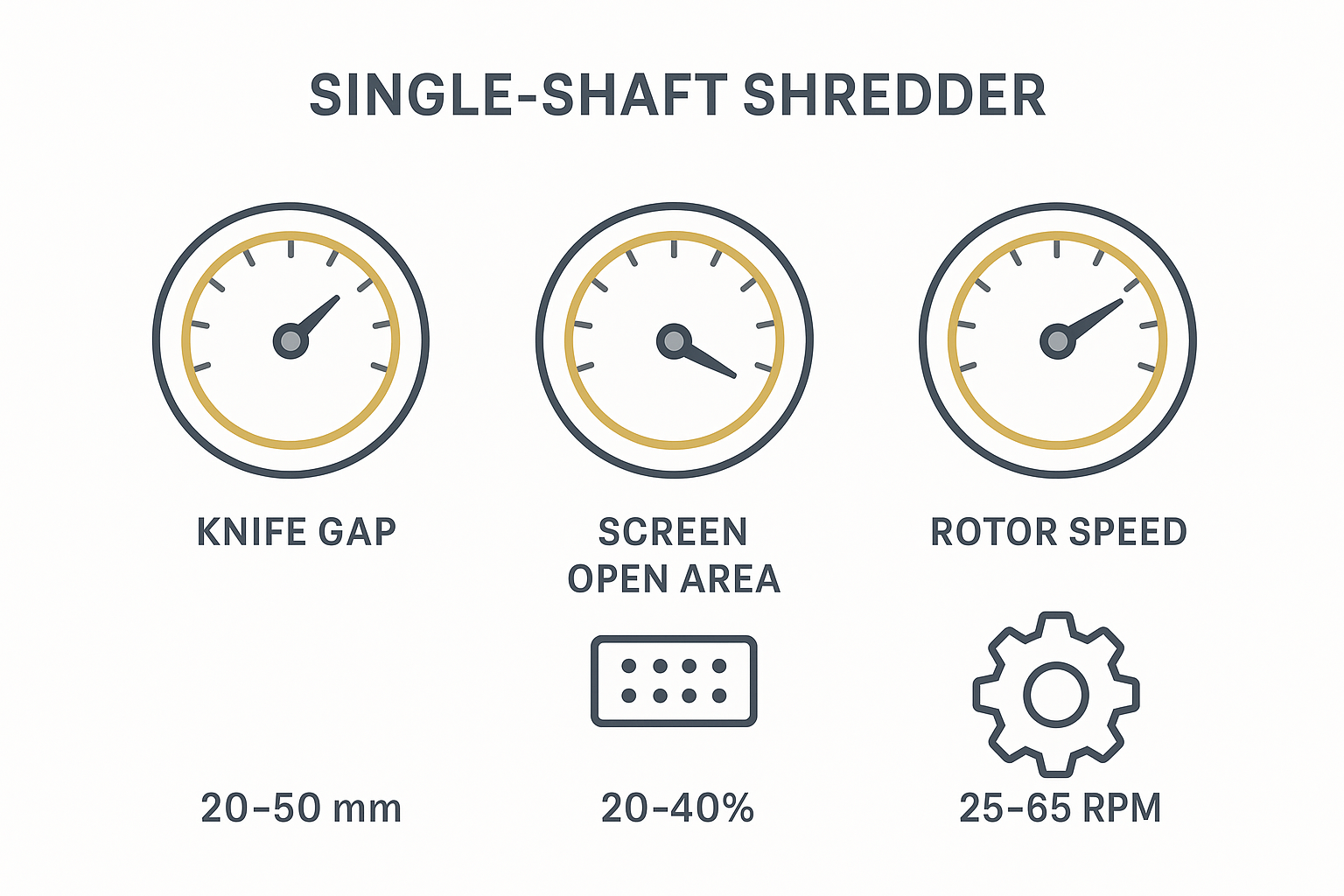
OEM menekankan bahwa pemilihan saringan secara langsung mengontrol ukuran pengeluaran dan memengaruhi seberapa “keras” rotor harus bekerja untuk mendorong material melewatinya. WEIMA mencatat bahwa saringan yang dapat diganti memungkinkan Anda untuk menyesuaikan ukuran output dan bahwa lubang yang lebih kecil menghasilkan material keluaran yang lebih halus pada halaman seri WLK-nya (yang juga menyiratkan kerja pemotongan yang lebih tinggi ketika Anda terlalu membatasi saringan) (Halaman shredder WLK 1000 WEIMA).
Celah pisau, ketajaman pisau lawan, dan kecepatan rotor
Pisau konkaf tidak akan menyelamatkan penyetelan mekanis yang buruk. Di banyak instalasi, kondisi celah dan pisau lawan lebih mendominasi hasil daripada bentuk tepi pisau.
Prinsip-prinsip utama:
- Penyelarasan celah pisau shredder dan pisau lawan: Jika celah terlalu besar, proses akan beralih dari pemotongan geser (shearing) menjadi perobekan/penggesekan. Jika terlalu rapat, Anda akan meningkatkan panas, kebisingan, dan risiko kerusakan pada mata pisau.
- Kondisi counter-knife: A blunt counter-knife turns clean shear into compress-and-smear behavior. That increases kWh/ton and worsens granulate consistency.
- Rotor speed: Higher speed can help bite on some materials but can also increase heat and wear. Use speed as a controlled variable—don’t “crank it up” to hide a gap problem.
WEIMA explicitly highlights maintaining a consistent cutting gap using adjustable and reversible counter-knives and notes that knife/counter-knife interaction strongly influences throughput and shredding results (WEIMA’s guidance on cutting gap maintenance).
Pusher logic and torque management
If you have control access (or can tune it via OEM settings), treat pusher behavior and torque logic as part of the retrofit—not an afterthought.
Practical checks:
- Pusher force vs. pusher timing: Over-aggressive pushing can increase rubbing and heat; under-feeding creates rotor “air time.”
- Torque limit and reversal thresholds: Too sensitive, and you waste time reversing; too lax, and you shock-load the edge.
- Feed consistency: Big, rigid chunks mixed with thin flexible material can negate the advantages of concave engagement.
Kompromi, Keausan, dan Perawatan
Concave geometry can shift Di mana wear concentrates. That’s not inherently bad—but it changes how you plan regrinds, indexing, and procurement.
Edge wear concentration and indexing/regrind
Because a concave edge can localize the cut initiation zone, it may also localize abrasive wear—especially in mixed waste with hard contaminants.
To keep performance stable:
- Track wear by tons processed per edge (not calendar time).
- Index or rotate replaceable knives before the edge becomes rounded enough to drive up kWh/ton.
- Regrind based on measured outcomes: rising motor load, more reversals, hotter discharge, or worsening size distribution.
Kiat Profesional: If you’re trialing concave blades, log kWh/ton, reversals per ton, and screen-cleaning events. Those three signals often tell the story faster than “does it look worn?”
Steel, heat treatment, and coatings selection
If concave knives reduce force spikes but increase localized abrasive wear, steel selection and heat treatment consistency become even more visible in your uptime.
This is where supplier evidence matters. For shredder blades and counter-knives, MAXTOR METAL documents common material options (e.g., 65Mn, 9CrSi, Cr12MoV, SKD-11, plus high-speed steel options) and describes multi-stage inspection practices such as incoming material inspection, in-process checks, and final inspection on its single-shaft shredder blade pages (MAXTOR METAL single-shaft shredding motorized blades dan MAXTOR METAL single-shaft shredder fixed blade).
For maintenance and procurement teams, the practical takeaway is simple:
- Mintalah material certificates tied to the batch.
- Request heat-treatment evidence (hardness targets and test method) and keep it with your spare-parts record.
- Make sure the supplier can provide QC/inspection documents that match your tolerance sensitivity—because knife gap performance doesn’t tolerate inconsistent thickness, flatness, or hardness.
Coatings can help in abrasive feeds, but they can also change edge behavior and chip formation. Treat coatings as a controlled trial variable—don’t stack multiple changes at once.
When flat or chamfered geometries are preferable
Flat or chamfered edges can outperform concave in scenarios where:
- Your feed is already easy to bite (rigid, consistent geometry) and you’re limited by screen throughput or downstream capacity.
- You need broader edge support for impact-heavy feeds (large rigid chunks, frequent tramp metal) where edge chipping is the dominant failure mode.
- Your maintenance process requires fast, predictable regrinds and your team is standardized on flat-edge inspection gauges.
Concave isn’t a universal “upgrade.” It’s a geometry choice that should match material behavior and your operational constraints.
Batasan Operasional dan Catatan Keselamatan

- Always follow your shredder OEM’s safety procedures for lockout/tagout and for any changes to knife gap, rotor speed, or control parameters.
- If you see rising discharge temperature, abnormal noise, frequent edge chipping, or rapid motor-load increase, stop the trial and re-check knife gap, counter-knife alignment, and feed consistency.
- Treat coatings, steel grade changes, and geometry changes as separate variables. If you change more than one variable at once, it becomes difficult to attribute improvements (or failures) to the right cause.
TCO dan Panduan Keputusan
Throughput and kWh/ton are only part of the decision. The full cost picture usually includes blade life, changeover labor, and the value of uptime.
Energy, blade life, and downtime math
A practical TCO frame for a retrofit trial:
- Energy cost impact = (baseline kWh/ton − trial kWh/ton) × $/kWh × tons processed
- Blade cost impact = (baseline cost per ton of knives) − (trial cost per ton of knives)
- Downtime impact = (changeovers/year × downtime hours/changeover) × $/hour value of line uptime
If your operation is downtime-driven, the fastest payback often comes from fewer unplanned stops—not from a small reduction in kWh/ton.
Material-dependent selection cues
Use these cues before you commit:
- If output size distribution is unstable, prioritize gap, counter-knife condition, and screen pairing before changing geometry.
- If the shredder reverses frequently with acceptable edge sharpness, look for feed inconsistency, pusher timing, or torque thresholds.
- If edges round quickly without chipping, consider whether concave geometry plus a more wear-resistant steel/heat treatment spec is a better fit.
Implementation checklist after retrofit
Trial log template (copy/paste)
| Kategori | What to record | Target / notes |
|---|---|---|
| Material & feed | Material type/grade, bulk density (if known), contamination notes, feed consistency | Keep feed mix consistent across baseline vs trial |
| Screen | Screen hole size, open area (if known), screen condition/plugging | Screen restrictions often dominate energy/throughput |
| Knife setup | Knife geometry (concave/flat), knife gap setting method & gauge, counter-knife condition | Use the same measurement method every time |
| Controls | Rotor speed, pusher force/timing, torque limit & reversal thresholds | Freeze settings for the first trial window |
| Trial window | Start/end timestamps, tons processed in the window | Use fixed tonnage windows (e.g., every X tons) |
| Performance KPIs | tons/hour, kWh/ton | Compare like-for-like windows |
| Stability signals | reversals per ton, screen-cleaning events, motor current (avg/peak) | Often explains KPI changes faster than visual wear |
| Wear notes | edge rounding, chipping, wear location on edge, tons per edge | Photograph at consistent intervals |
| Product quality | basic size distribution check (sieve/yield proxy), downstream issues | Ensure throughput gains don’t harm quality |
Keep the trial controlled. Change one main variable at a time.
- Verify counter-knife condition and alignment before installing the new knives.
- Set and record knife gap (and keep the same gauge/process for repeatability).
- Keep rotor speed and torque thresholds unchanged for the first run unless your baseline is unstable.
- Run a fixed-tonnage trial window and log:
- tons/hour
- kWh/ton
- reversals per ton
- screen-cleaning events
- granulate size distribution (basic sieve check or downstream yield proxy)
- Inspect edge wear pattern at the same tonnage interval each run.
Referensi
- WEIMA — WLK 1000 shredder page: https://weima.com/us/shredders/wlk-800-2000/wlk-1000/
- WEIMA — Cutting gap maintenance guidance (WLK 10 page): https://weima.com/us/shredders/wlk-6-s-20/wlk-10/
- MAXTOR METAL — Single-shaft shredding motorized blades: https://maxtormetal.com/product/single-shaft-shredding-motorized-blades/
- MAXTOR METAL — Single-shaft shredder fixed blade: https://maxtormetal.com/product/single-shaft-shredder-fixed-blade/
Kesimpulan
Concave shredder blades can improve throughput and cut kWh/ton when conditions align—especially when the baseline process is limited by inconsistent bite, high re-cut rates, or unstable chip formation.
But realized results typically depend more on setup discipline (knife gap, counter-knife sharpness, screen pairing, and controls) than geometry alone. OEM guidance also points to the knife/counter-knife interaction and maintaining a stable cutting gap as central to throughput and shredding quality.
Start with controlled trials, verify granulate quality, and track kWh/ton alongside operational signals like reversals and screen cleaning. If you’re sourcing replacement knives, make documentation part of the spec: material certs, heat-treatment evidence, and QC records are what make geometry improvements repeatable—not just anecdotal.

 English
  Spanish
  Italian
  French
  Portuguese
  Russian
  German
  Arabic
  Hindi
Hindi  Vietnamese
  Indonesian
  Japanese
  Korean