

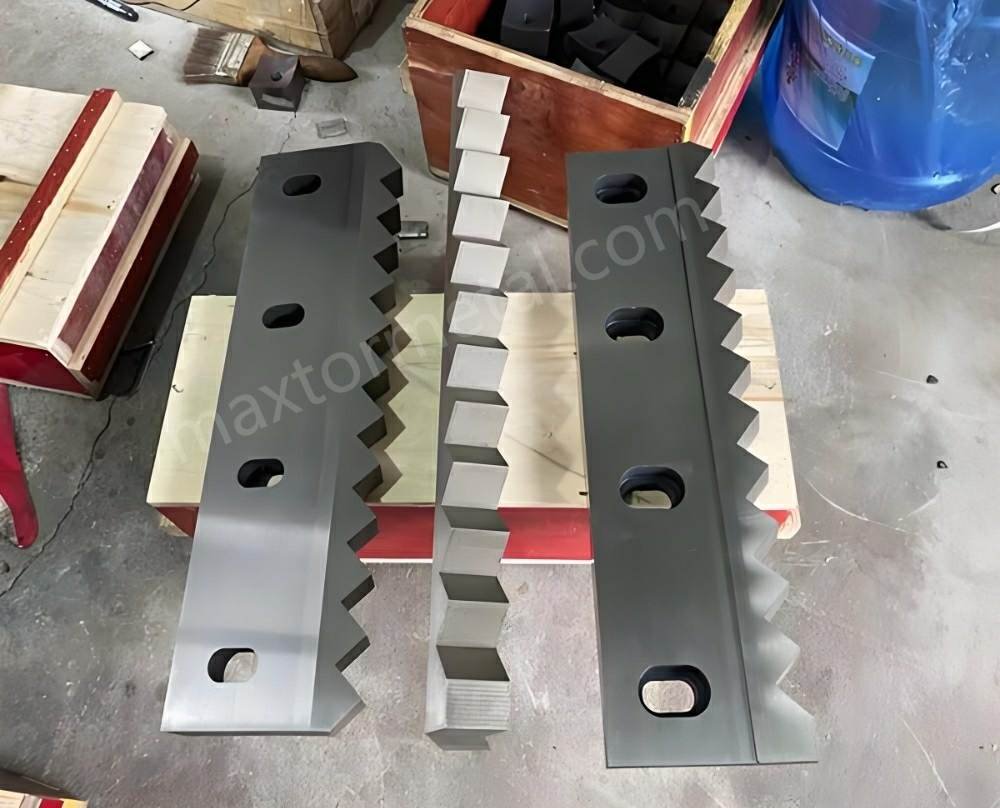
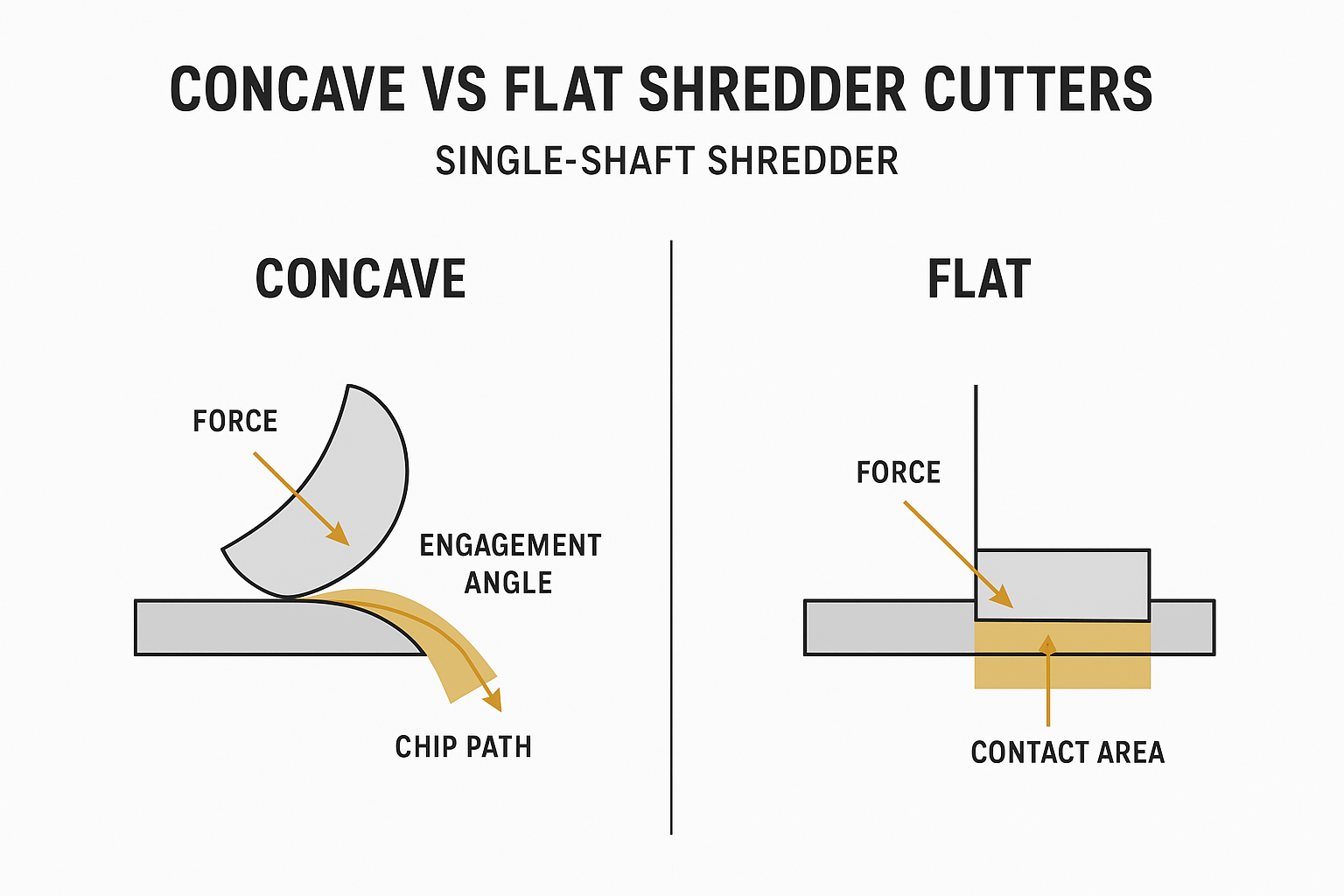
Concave shredder blades change the first contact between material and rotor in a single-shaft shredder. Instead of presenting a mostly flat edge that relies heavily on pusher force and friction to initiate a cut, a concave edge tends to create a more “hooking” engagement that encourages bite and controlled self-feeding.
In the field, energy-per-ton and throughput gains are realistic when the shredder is already mechanically healthy and the process is limited by cutting efficiency rather than downstream conveying or screen plugging. Under those conditions, a measured improvement on the order of ~5–15% is often achievable—but it’s not automatic, and it’s not just about knife geometry.
This guide breaks down the mechanisms (why concave geometry can reduce specific energy), the setup levers that determine whether you actually see gains, the wear and maintenance trade-offs, and a practical TCO framework to decide whether a retrofit is worth it.
Key takeaways (for maintenance & process teams):
Sobre o autor: This guide is written from a practical engineering and procurement-support perspective, focused on how knife geometry, knife gap, counter-knife condition, screen pairing, and control settings interact in day-to-day single-shaft shredder performance. (No site-specific test data is assumed—use the trial template below to document your own results.)
- Concave shredder blades can reduce torque spikes and re-cuts when bite is the limiting factor—often improving throughput and lowering kWh per ton.
- Results depend heavily on knife gap, counter-knife condition, screen selection, e pusher/torque control logic.
- Track trials by outcomes (kWh/ton, tons/hour, reversals per ton, screen-cleaning events)—not by “visual wear” alone.
- Concave geometry can shift wear concentration; steel/heat treatment consistency and regrind/indexing discipline matter.
- Use a single-variable trial and a simple TCO framework to decide whether a retrofit pays back.
How Concave Geometry Reduces Energy
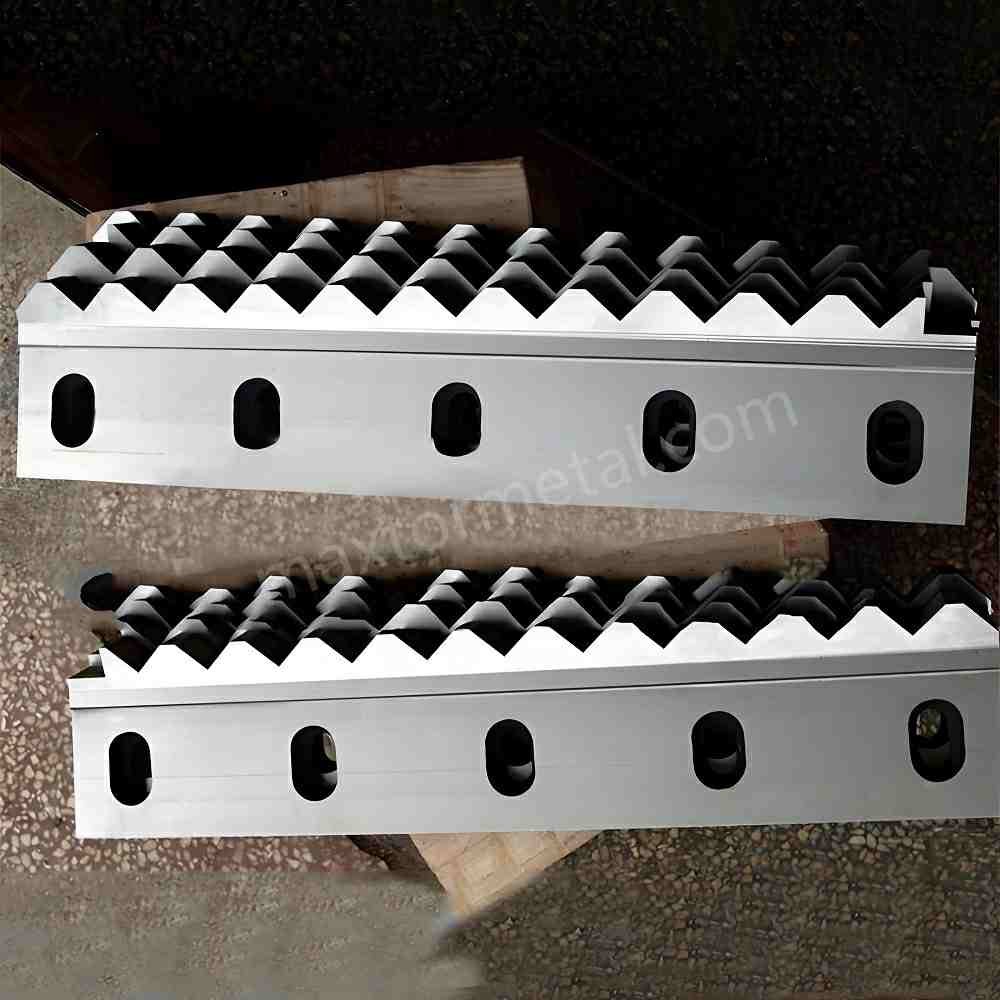
Specific energy (kWh per ton) is a simple KPI with a lot behind it. For a single-shaft shredder, it’s driven by how efficiently the rotor converts torque into useful shear instead of waste heat, rubbing, and re-cutting.
Bite and self-feeding mechanics
Concave edges can increase the probability of a clean initial bite—especially when processing slippery or flexible feed where the pusher is doing most of the work. When bite improves, two things happen:
- The pusher spends less time “staging” material against the rotor.
- The rotor spends more of its rotation doing productive shear instead of no-load spinning between inconsistent grabs.
That’s the first pathway to improved throughput: fewer dead cycles.
Localized shear and smaller contact area
A concave edge can concentrate the engagement into a smaller effective contact zone at the start of a cut. In practice, that often reduces the peak force needed to initiate shear because you’re not trying to shear across a wide edge all at once.
Lower peak cutting force matters because it reduces the frequency and severity of torque spikes. When torque spikes are reduced, the shredder can maintain steadier rotor speed and spend less time in control interventions (e.g., slowdowns, reversals, or dwell periods).
Fewer re-cuts and steadier chip formation
If the geometry and setup produce more consistent chip formation, material is less likely to “bounce” or smear and then get dragged back into the cutting zone for multiple partial cuts. Re-cutting is expensive: it consumes energy and rotor time without producing new mass throughput.
A more predictable chip path also helps stabilize discharge through the screen—assuming the screen is correctly paired and not becoming the bottleneck.
Where Concave Shredder Blades Work Best
Concave geometry is a tool—not a universal upgrade. It tends to show the best results when cutting efficiency and feed consistency are limiting performance.
Material classes and screen pairing
You’re more likely to see benefits when:
- The feed has a tendency to slip, wrap, or deform before cutting (films, certain flexible polymers, fibrous blends).
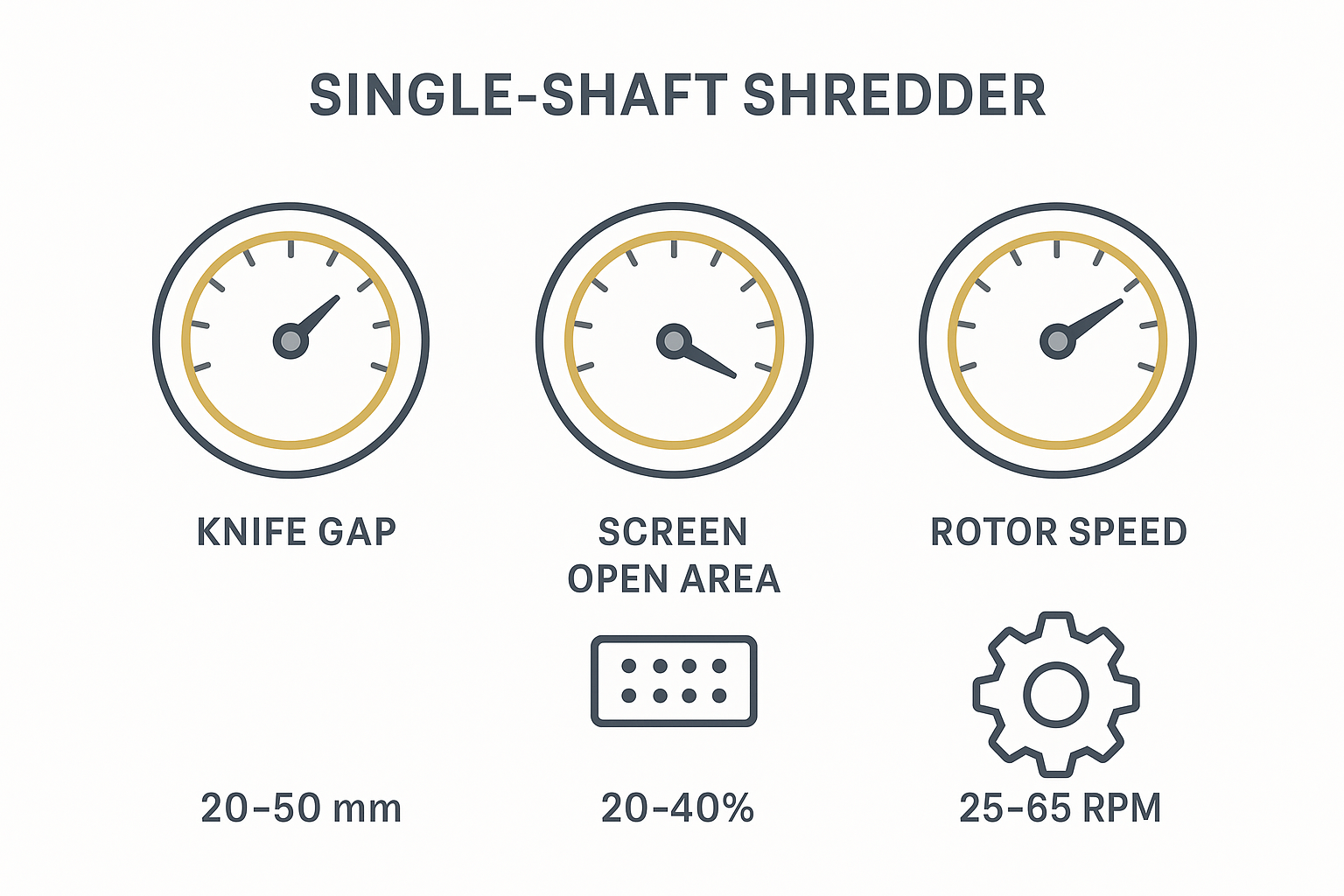
- The process is sensitive to stable discharge size and you’re dialing in screen selection.
OEMs emphasize that screen selection directly controls discharge size and influences how “hard” the rotor must work to push material through. WEIMA notes that interchangeable screens allow you to tune output size and that smaller openings yield finer discharged material on its WLK series pages (which also implies higher cutting work when you over-restrict the screen) (WEIMA’s WLK 1000 shredder page).
Knife gap, counter-knife sharpness, and rotor speed
Concave knives won’t rescue a poor mechanical setup. In many installations, the gap and counter-knife condition dominate results more than the edge shape.
Key principles:
- Shredder knife gap and counter-knife alignment: If the gap is too large, you shift from shearing to tearing/rubbing. If it’s too tight, you increase heat, noise, and risk of edge damage.
- Counter-knife condition: Uma contra-faca cega transforma o cisalhamento limpo em um comportamento de compressão e esmagamento. Isso aumenta o consumo de kWh/ton e piora a consistência do granulado.
- Velocidade do rotor: Uma velocidade mais alta pode ajudar na captura de alguns materiais, mas também pode aumentar o calor e o desgaste. Use a velocidade como uma variável controlada — não a “aumente ao máximo” para mascarar um problema de folga.
A WEIMA destaca explicitamente a manutenção de uma folga de corte consistente usando contra-facas ajustáveis e reversíveis, e observa que a interação faca/contra-faca influencia fortemente o rendimento e os resultados de trituração (Orientações da WEIMA sobre a manutenção da folga de corte).
Lógica do empurrador e gerenciamento de torque
Se você tiver acesso ao controle (ou puder ajustá-lo por meio das configurações do OEM), trate o comportamento do empurrador e a lógica de torque como parte do retrofit — e não como uma consideração secundária.
Verificações práticas:
- Força do empurrador vs. tempo do empurrador: Um empurrão excessivamente agressivo pode aumentar o atrito e o calor; a subalimentação cria “tempo ocioso” do rotor.”
- Limite de torque e limites de reversão: Muito sensível, e você perde tempo revertendo; muito tolerante, e você causa sobrecarga de impacto na aresta de corte.
- Consistência da alimentação: Pedaços grandes e rígidos misturados com materiais finos e flexíveis podem anular as vantagens do contato côncavo.
Trade-offs, Wear, and Maintenance
A geometria côncava pode deslocar onde onde o desgaste se concentra. Isso não é inerentemente ruim — mas altera a forma como você planeja as afiações, a indexação e as compras.
Concentração de desgaste na aresta e indexação/afiação
Como uma aresta côncava pode localizar a zona de início do corte, ela também pode localizar o desgaste abrasivo — especialmente em resíduos mistos com contaminantes duros.
Para manter o desempenho estável:
- Monitore o desgaste por toneladas processadas por aresta (não por tempo de calendário).
- Indexe ou rotacione as facas substituíveis antes que a aresta fique arredondada o suficiente para elevar o consumo de kWh/ton.
- Afie com base em resultados medidos: aumento da carga do motor, mais reversões, descarga mais quente ou piora na distribuição granulométrica.
Dica profissional: Se você estiver testando lâminas côncavas, registre kWh/ton, reversões por tonelada e eventos de limpeza de peneira. Esses três sinais geralmente contam a história mais rápido do que a pergunta “parece desgastado?”.”
Seleção de aço, tratamento térmico e revestimentos
Se as facas côncavas reduzem os picos de força, mas aumentam o desgaste abrasivo localizado, a seleção do aço e a consistência do tratamento térmico tornam-se ainda mais visíveis no seu tempo de atividade.
É aqui que as comprovações do fornecedor importam. Para lâminas para triturador e contra-facas, o MAXTOR METAL documenta opções comuns de materiais (por exemplo, 65Mn, 9CrSi, Cr12MoV, SKD-11, além de opções de aço rápido) e descreve práticas de inspeção em várias etapas, como inspeção de material recebido, verificações em processo e inspeção final em suas páginas de lâminas para triturador de eixo único (Lâminas motorizadas para trituração de eixo único MAXTOR METAL e Lâmina fixa para triturador de eixo único MAXTOR METAL).
Para as equipes de manutenção e compras, a lição prática é simples:
- Pedir certificados de materiais vinculados ao lote.
- Solicite comprovação de tratamento térmico (metas de dureza e método de teste) e guarde-a junto ao seu registro de peças de reposição.
- Certifique-se de que o fornecedor possa fornecer documentos de CQ/inspeção que correspondam à sua sensibilidade de tolerância — porque o desempenho da folga da faca não tolera inconsistências de espessura, planicidade ou dureza.
Os revestimentos podem ajudar em alimentações abrasivas, mas também podem alterar o comportamento da aresta e a formação de cavacos. Trate os revestimentos como uma variável de teste controlada — não acumule várias alterações de uma só vez.
Quando geometrias planas ou chanfradas são preferíveis
Arestas planas ou chanfradas podem superar as côncavas em cenários onde:
- Sua alimentação já é fácil de capturar (geometria rígida e consistente) e você está limitado pela capacidade da peneira ou pela capacidade do processo posterior.
- Você precisa de um suporte de aresta mais amplo para alimentações de alto impacto (grandes pedaços rígidos, presença frequente de metais estranhos), onde o lascamento da aresta é o principal modo de falha.
- Seu processo de manutenção exige afiações rápidas e previsíveis e sua equipe é padronizada no uso de calibradores de inspeção de aresta plana.
A geometria côncava não é um “upgrade” universal. É uma escolha geométrica que deve corresponder ao comportamento do material e às suas restrições operacionais.
Operating Boundaries and Safety Notes

- Siga sempre os procedimentos de segurança do fabricante (OEM) do seu triturador para bloqueio e etiquetagem (lockout/tagout) e para quaisquer alterações na folga da faca, velocidade do rotor ou parâmetros de controle.
- Se você notar aumento na temperatura de descarga, ruído anormal, lascamento frequente da aresta ou aumento rápido na carga do motor, interrompa o teste e verifique novamente a folga da faca, o alinhamento da contra-faca e a consistência da alimentação.
- Trate revestimentos, mudanças de classe de aço e alterações de geometria como variáveis separadas. If you change more than one variable at once, it becomes difficult to attribute improvements (or failures) to the right cause.
TCO and Decision Guidance
Throughput and kWh/ton are only part of the decision. The full cost picture usually includes blade life, changeover labor, and the value of uptime.
Energy, blade life, and downtime math
A practical TCO frame for a retrofit trial:
- Energy cost impact = (baseline kWh/ton − trial kWh/ton) × $/kWh × tons processed
- Blade cost impact = (baseline cost per ton of knives) − (trial cost per ton of knives)
- Downtime impact = (changeovers/year × downtime hours/changeover) × $/hour value of line uptime
If your operation is downtime-driven, the fastest payback often comes from fewer unplanned stops—not from a small reduction in kWh/ton.
Material-dependent selection cues
Use these cues before you commit:
- If output size distribution is unstable, prioritize gap, counter-knife condition, and screen pairing before changing geometry.
- If the shredder reverses frequently with acceptable edge sharpness, look for feed inconsistency, pusher timing, or torque thresholds.
- If edges round quickly without chipping, consider whether concave geometry plus a more wear-resistant steel/heat treatment spec is a better fit.
Implementation checklist after retrofit
Trial log template (copy/paste)
| Categoria | O que gravar | Target / notes |
|---|---|---|
| Material & feed | Material type/grade, bulk density (if known), contamination notes, feed consistency | Keep feed mix consistent across baseline vs trial |
| Screen | Screen hole size, open area (if known), screen condition/plugging | Screen restrictions often dominate energy/throughput |
| Knife setup | Knife geometry (concave/flat), knife gap setting method & gauge, counter-knife condition | Use the same measurement method every time |
| Controls | Rotor speed, pusher force/timing, torque limit & reversal thresholds | Freeze settings for the first trial window |
| Trial window | Start/end timestamps, tons processed in the window | Use fixed tonnage windows (e.g., every X tons) |
| Performance KPIs | tons/hour, kWh/ton | Compare like-for-like windows |
| Stability signals | reversals per ton, screen-cleaning events, motor current (avg/peak) | Often explains KPI changes faster than visual wear |
| Wear notes | edge rounding, chipping, wear location on edge, tons per edge | Photograph at consistent intervals |
| Product quality | basic size distribution check (sieve/yield proxy), downstream issues | Ensure throughput gains don’t harm quality |
Keep the trial controlled. Change one main variable at a time.
- Verify counter-knife condition and alignment before installing the new knives.
- Set and record knife gap (and keep the same gauge/process for repeatability).
- Keep rotor speed and torque thresholds unchanged for the first run unless your baseline is unstable.
- Run a fixed-tonnage trial window and log:
- tons/hour
- kWh/ton
- reversals per ton
- screen-cleaning events
- granulate size distribution (basic sieve check or downstream yield proxy)
- Inspect edge wear pattern at the same tonnage interval each run.
Referências
- WEIMA — WLK 1000 shredder page: https://weima.com/us/shredders/wlk-800-2000/wlk-1000/
- WEIMA — Cutting gap maintenance guidance (WLK 10 page): https://weima.com/us/shredders/wlk-6-s-20/wlk-10/
- MAXTOR METAL — Single-shaft shredding motorized blades: https://maxtormetal.com/product/single-shaft-shredding-motorized-blades/
- MAXTOR METAL — Single-shaft shredder fixed blade: https://maxtormetal.com/product/single-shaft-shredder-fixed-blade/
Conclusão
Concave shredder blades can improve throughput and cut kWh/ton when conditions align—especially when the baseline process is limited by inconsistent bite, high re-cut rates, or unstable chip formation.
But realized results typically depend more on setup discipline (knife gap, counter-knife sharpness, screen pairing, and controls) than geometry alone. OEM guidance also points to the knife/counter-knife interaction and maintaining a stable cutting gap as central to throughput and shredding quality.
Start with controlled trials, verify granulate quality, and track kWh/ton alongside operational signals like reversals and screen cleaning. If you’re sourcing replacement knives, make documentation part of the spec: material certs, heat-treatment evidence, and QC records are what make geometry improvements repeatable—not just anecdotal.

 English
  Spanish
  Italian
  French
  Portuguese
  Russian
  German
  Arabic
  Hindi
Hindi  Vietnamese
  Indonesian
  Japanese
  Korean