

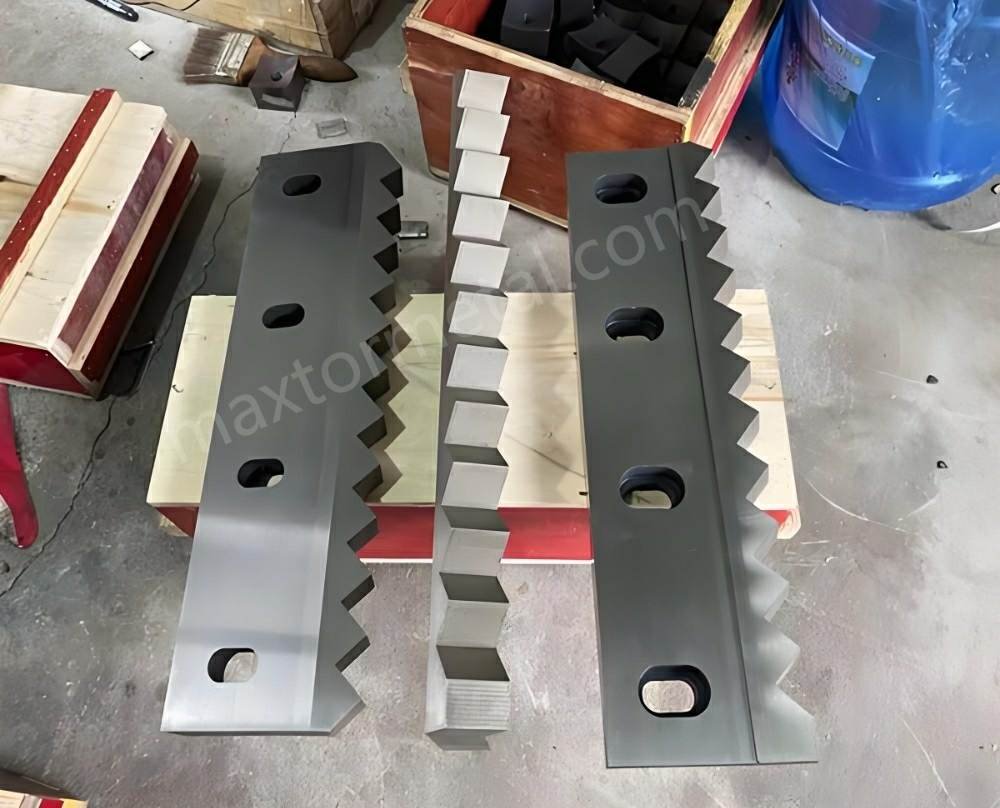
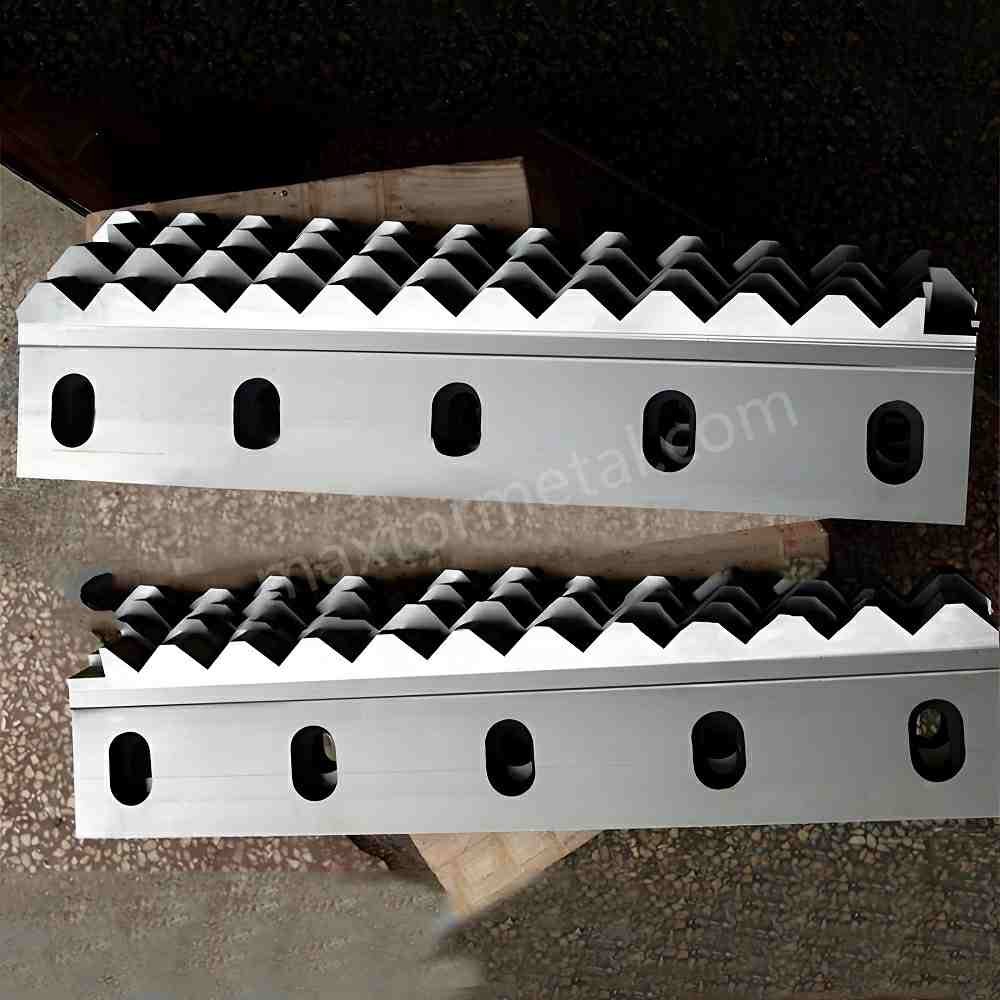
Concave shredder blades change the first contact between material and rotor in a single-shaft shredder. Instead of presenting a mostly flat edge that relies heavily on pusher force and friction to initiate a cut, a concave edge tends to create a more “hooking” engagement that encourages bite and controlled self-feeding.
In the field, energy-per-ton and throughput gains are realistic when the shredder is already mechanically healthy and the process is limited by cutting efficiency rather than downstream conveying or screen plugging. Under those conditions, a measured improvement on the order of ~5–15% is often achievable—but it’s not automatic, and it’s not just about knife geometry.
This guide breaks down the mechanisms (why concave geometry can reduce specific energy), the setup levers that determine whether you actually see gains, the wear and maintenance trade-offs, and a practical TCO framework to decide whether a retrofit is worth it.
Key takeaways (for maintenance & process teams):
Informazioni sull'autore: This guide is written from a practical engineering and procurement-support perspective, focused on how knife geometry, knife gap, counter-knife condition, screen pairing, and control settings interact in day-to-day single-shaft shredder performance. (No site-specific test data is assumed—use the trial template below to document your own results.)
- Concave shredder blades can reduce torque spikes and re-cuts when bite is the limiting factor—often improving throughput and lowering kWh per ton.
- Results depend heavily on knife gap, counter-knife condition, screen selection, E pusher/torque control logic.
- Track trials by outcomes (kWh/ton, tons/hour, reversals per ton, screen-cleaning events)—not by “visual wear” alone.
- Concave geometry can shift wear concentration; steel/heat treatment consistency and regrind/indexing discipline matter.
- Use a single-variable trial and a simple TCO framework to decide whether a retrofit pays back.
How Concave Geometry Reduces Energy
Specific energy (kWh per ton) is a simple KPI with a lot behind it. For a single-shaft shredder, it’s driven by how efficiently the rotor converts torque into useful shear instead of waste heat, rubbing, and re-cutting.
Bite and self-feeding mechanics
Concave edges can increase the probability of a clean initial bite—especially when processing slippery or flexible feed where the pusher is doing most of the work. When bite improves, two things happen:
- The pusher spends less time “staging” material against the rotor.
- The rotor spends more of its rotation doing productive shear instead of no-load spinning between inconsistent grabs.
That’s the first pathway to improved throughput: fewer dead cycles.
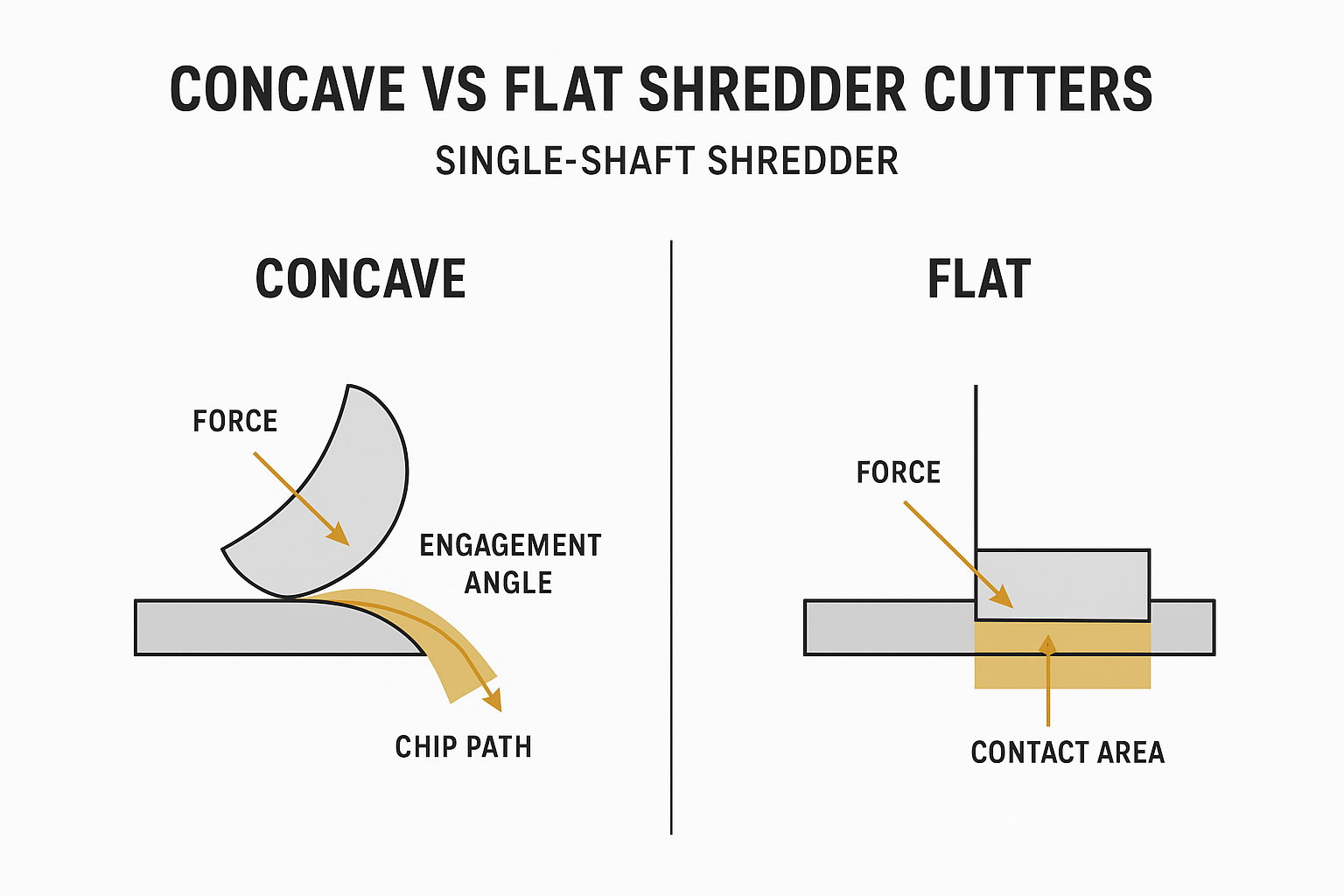
Localized shear and smaller contact area
A concave edge can concentrate the engagement into a smaller effective contact zone at the start of a cut. In practice, that often reduces the peak force needed to initiate shear because you’re not trying to shear across a wide edge all at once.
Lower peak cutting force matters because it reduces the frequency and severity of torque spikes. When torque spikes are reduced, the shredder can maintain steadier rotor speed and spend less time in control interventions (e.g., slowdowns, reversals, or dwell periods).
Fewer re-cuts and steadier chip formation
If the geometry and setup produce more consistent chip formation, material is less likely to “bounce” or smear and then get dragged back into the cutting zone for multiple partial cuts. Re-cutting is expensive: it consumes energy and rotor time without producing new mass throughput.
A more predictable chip path also helps stabilize discharge through the screen—assuming the screen is correctly paired and not becoming the bottleneck.
Where Concave Shredder Blades Work Best
Concave geometry is a tool—not a universal upgrade. It tends to show the best results when cutting efficiency and feed consistency are limiting performance.
Material classes and screen pairing
You’re more likely to see benefits when:
- The feed has a tendency to slip, wrap, or deform before cutting (films, certain flexible polymers, fibrous blends).
- The process is sensitive to stable discharge size and you’re dialing in screen selection.
OEMs emphasize that screen selection directly controls discharge size and influences how “hard” the rotor must work to push material through. WEIMA notes that interchangeable screens allow you to tune output size and that smaller openings yield finer discharged material on its WLK series pages (which also implies higher cutting work when you over-restrict the screen) (WEIMA’s WLK 1000 shredder page).
Knife gap, counter-knife sharpness, and rotor speed
Concave knives won’t rescue a poor mechanical setup. In many installations, the gap and counter-knife condition dominate results more than the edge shape.
Key principles:
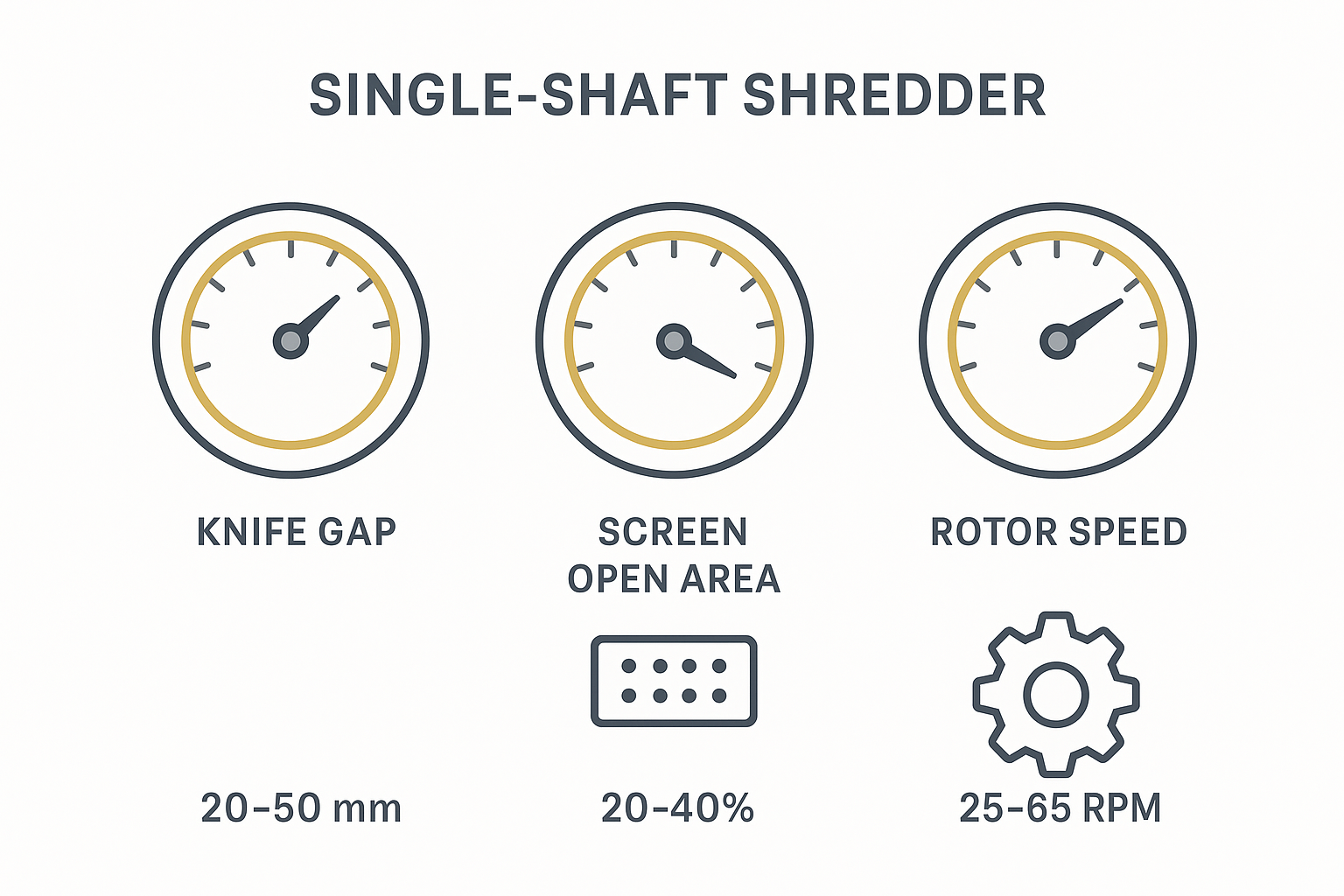
- Shredder knife gap and counter-knife alignment: If the gap is too large, you shift from shearing to tearing/rubbing. If it’s too tight, you increase heat, noise, and risk of edge damage.
- Counter-knife condition: A blunt counter-knife turns clean shear into compress-and-smear behavior. That increases kWh/ton and worsens granulate consistency.
- Rotor speed: Higher speed can help bite on some materials but can also increase heat and wear. Use speed as a controlled variable—don’t “crank it up” to hide a gap problem.
WEIMA explicitly highlights maintaining a consistent cutting gap using adjustable and reversible counter-knives and notes that knife/counter-knife interaction strongly influences throughput and shredding results (WEIMA’s guidance on cutting gap maintenance).
Pusher logic and torque management
If you have control access (or can tune it via OEM settings), treat pusher behavior and torque logic as part of the retrofit—not an afterthought.
Verifiche pratiche:
- Pusher force vs. pusher timing: Over-aggressive pushing can increase rubbing and heat; under-feeding creates rotor “air time.”
- Torque limit and reversal thresholds: Too sensitive, and you waste time reversing; too lax, and you shock-load the edge.
- Feed consistency: Big, rigid chunks mixed with thin flexible material can negate the advantages of concave engagement.
Trade-offs, Wear, and Maintenance
Concave geometry can shift Dove wear concentrates. That’s not inherently bad—but it changes how you plan regrinds, indexing, and procurement.
Edge wear concentration and indexing/regrind
Because a concave edge can localize the cut initiation zone, it may also localize abrasive wear—especially in mixed waste with hard contaminants.
To keep performance stable:
- Track wear by tons processed per edge (not calendar time).
- Index or rotate replaceable knives before the edge becomes rounded enough to drive up kWh/ton.
- Regrind based on measured outcomes: rising motor load, more reversals, hotter discharge, or worsening size distribution.
Suggerimento professionale: If you’re trialing concave blades, log kWh/tonnellata, reversals per ton, and screen-cleaning events. Those three signals often tell the story faster than “does it look worn?”
Steel, heat treatment, and coatings selection
If concave knives reduce force spikes but increase localized abrasive wear, steel selection and heat treatment consistency become even more visible in your uptime.
This is where supplier evidence matters. For shredder blades and counter-knives, MAXTOR METAL documents common material options (e.g., 65Mn, 9CrSi, Cr12MoV, SKD-11, plus high-speed steel options) and describes multi-stage inspection practices such as incoming material inspection, in-process checks, and final inspection on its single-shaft shredder blade pages (MAXTOR METAL single-shaft shredding motorized blades E MAXTOR METAL single-shaft shredder fixed blade).
For maintenance and procurement teams, the practical takeaway is simple:
- Chiedere material certificates tied to the batch.
- Request heat-treatment evidence (hardness targets and test method) and keep it with your spare-parts record.
- Make sure the supplier can provide QC/inspection documents that match your tolerance sensitivity—because knife gap performance doesn’t tolerate inconsistent thickness, flatness, or hardness.
Coatings can help in abrasive feeds, but they can also change edge behavior and chip formation. Treat coatings as a controlled trial variable—don’t stack multiple changes at once.
When flat or chamfered geometries are preferable
Flat or chamfered edges can outperform concave in scenarios where:
- Your feed is already easy to bite (rigid, consistent geometry) and you’re limited by screen throughput or downstream capacity.
- You need broader edge support for impact-heavy feeds (large rigid chunks, frequent tramp metal) where edge chipping is the dominant failure mode.
- Your maintenance process requires fast, predictable regrinds and your team is standardized on flat-edge inspection gauges.
Concave isn’t a universal “upgrade.” It’s a geometry choice that should match material behavior and your operational constraints.
Operating Boundaries and Safety Notes

- Always follow your shredder OEM’s safety procedures for lockout/tagout and for any changes to knife gap, rotor speed, or control parameters.
- If you see rising discharge temperature, abnormal noise, frequent edge chipping, or rapid motor-load increase, stop the trial and re-check knife gap, counter-knife alignment, and feed consistency.
- Treat coatings, steel grade changes, and geometry changes as separate variables. Se si modifica più di una variabile alla volta, diventa difficile attribuire i miglioramenti (o i guasti) alla causa corretta.
TCO and Decision Guidance
La produttività e i kWh/ton sono solo una parte della decisione. Il quadro completo dei costi include solitamente la durata delle lame, la manodopera per il cambio e il valore del tempo di operatività.
Calcolo di energia, durata delle lame e tempi di fermo macchina
Un quadro TCO pratico per una prova di retrofit:
- Impatto sui costi energetici = (kWh/ton di riferimento − kWh/ton di prova) × $/kWh × tonnellate lavorate
- Impatto sui costi delle lame = (costo per tonnellata delle lame di riferimento) − (costo per tonnellata delle lame di prova)
- Impatto sui tempi di fermo macchina = (cambi/anno × ore di fermo macchina/cambio) × $/ora valore del tempo di operatività della linea
Se l'operatività dipende fortemente dai tempi di fermo, il ritorno sull'investimento più rapido deriva spesso dalla riduzione degli arresti non programmati, e non da una minima riduzione dei kWh/ton.
Criteri di selezione in base al materiale
Utilizzare questi criteri prima di procedere:
- Se la distribuzione granulometrica del materiale in uscita è instabile, dare la priorità a gioco tra le lame, stato della contro-lama e abbinamento della griglia prima di modificare la geometria.
- Se il trituratore si inverte frequentemente pur mantenendo un'affilatura accettabile dei taglienti, verificare incostanza dell'alimentazione, tempistica dello spintore o soglie di coppia.
- Se i taglienti si arrotondano rapidamente senza scheggiarsi, valutare se una geometria concava associata a uno acciaio più resistente all'usura o a una specifica di trattamento termico adeguata sia la soluzione migliore.
Checklist di implementazione dopo il retrofit
Trial log template (copy/paste)
| Categoria | What to record | Obiettivo / note |
|---|---|---|
| Materiale e alimentazione | Tipo/grado di materiale, densità apparente (se nota), note di contaminazione, costanza dell'alimentazione | Mantenere costante la miscela di alimentazione tra il test di riferimento e quello di prova |
| Griglia | Dimensione dei fori della griglia, area utile di passaggio (se nota), stato/intasamento della griglia | Le restrizioni della griglia influiscono in modo determinante su energia e produttività |
| Configurazione delle lame | Geometria della lama (concava/piatta), metodo e spessimetro di regolazione del gioco lame, stato della contro-lama | Utilizzare sempre lo stesso metodo di misurazione |
| Controllo e parametri | Velocità del rotore, forza/tempistica dello spintore, limite di coppia e soglie di inversione | Bloccare le impostazioni per la prima finestra di prova |
| Finestra di prova | Data/ora di inizio e fine, tonnellate lavorate nella finestra di prova | Utilizzare finestre di tonnellaggio fisse (ad es. ogni X tonnellate) |
| KPI di prestazione | tonnellate/ora, kWh/ton | Confrontare finestre omogenee e direttamente comparabili |
| Indicatori di stabilità | inversioni per tonnellata, interventi di pulizia della griglia, corrente del motore (media/picco) | Spiega spesso le variazioni dei KPI più rapidamente dell'usura visiva |
| Note sull'usura | arrotondamento del tagliente, scheggiatura, localizzazione dell'usura sul tagliente, tonnellate per tagliente | Fotografare ad intervalli regolari |
| Qualità del prodotto | controllo base della granulometria (vaglio/resa stimata), problemi a valle | Assicurarsi che gli aumenti di produttività non compromettano la qualità |
Mantenere controllata la prova. Modificare una sola variabile principale alla volta.
- Verificare lo stato e l'allineamento della controlama prima di installare le nuove lame.
- Impostare e registrare il gioco lame (e mantenere lo stesso spessimetro/procedimento per la ripetibilità).
- Mantenere invariati la velocità del rotore e i limiti di coppia per il primo ciclo di funzionamento, a meno che il valore di riferimento non sia instabile.
- Eseguire una prova a tonnellaggio fisso e registrare:
- tonnellate/ora
- kWh/tonnellata
- inversioni per tonnellata
- eventi di pulizia della griglia
- distribuzione granulometrica (controllo base tramite setaccio o indicatore di resa a valle)
- Ispezionare il profilo di usura del tagliente allo stesso intervallo di tonnellaggio per ciascun ciclo.
Riferimenti bibliografici
- WEIMA — Pagina trituratore WLK 1000: https://weima.com/us/shredders/wlk-800-2000/wlk-1000/
- WEIMA — Guida alla manutenzione del gioco di taglio (pagina WLK 10): https://weima.com/us/shredders/wlk-6-s-20/wlk-10/
- MAXTOR METAL — Lame rotanti per triturazione monorotore: https://maxtormetal.com/product/single-shaft-shredding-motorized-blades/
- MAXTOR METAL — Lama fissa per trituratore monorotore: https://maxtormetal.com/product/single-shaft-shredder-fixed-blade/
Conclusione
Le lame concave per trituratori possono migliorare la produttività e ridurre i kWh/tonnellata quando le condizioni lo consentono, in particolare quando il processo di base è limitato da una presa incostante, da un'elevata frequenza di ritaglio o da una formazione instabile del truciolo.
Tuttavia, i risultati effettivi dipendono in genere più dal rigore nella regolazione (gioco lame, affilatura della controlama, abbinamento della griglia e controlli) che dalla sola geometria. Le linee guida OEM indicano inoltre l'interazione tra lama e controlama e il mantenimento di un gioco di taglio stabile come aspetti centrali per la resa e la qualità di triturazione.
Iniziare con prove controllate, verificare la qualità del granulato e monitorare i kWh/tonnellata insieme ai segnali operativi come le inversioni di marcia e la pulizia della griglia. Se si acquistano lame di ricambio, occorre rendere la documentazione parte integrante delle specifiche: certificati dei materiali, attestazioni dei trattamenti termici e registri di controllo qualità rendono i miglioramenti geometrici ripetibili, non solo aneddotici.

 English
 Spanish
 Italian
 French
 Portuguese
 Russian
 German
 Arabic
 Hindi
 Vietnamese
 Indonesian
 Japanese
 Korean