

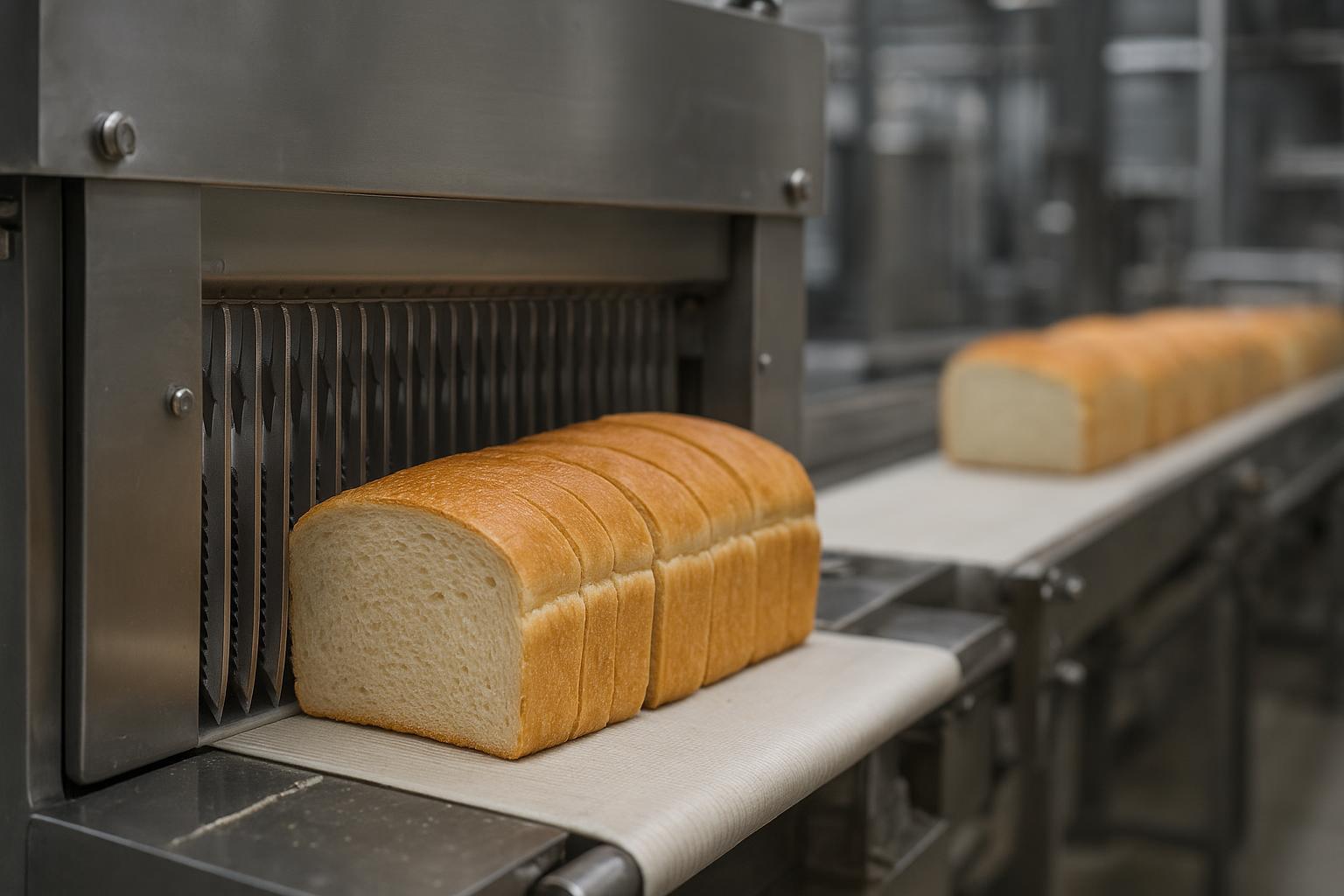
Bread crumb waste is easy to dismiss as “just housekeeping.” On an industrial slicing line, it’s a yield leak, an OEE problem, and a food-safety risk all at once.
免責事項: MAXTOR METAL supplies industrial cutting blades. The principles in this article are vendor-agnostic and focus on measurable process controls (crumb mass, thickness tolerance, downtime) so you can validate improvements on your own line—regardless of blade brand or slicer make.
The good news is that crumb waste is rarely mysterious. Most of it is created at a few predictable points: the first contact at the crust/crumb boundary, any drag along the blade sidewall, and any instability in guidance or loaf control.
- Why you need to reduce bread crumb waste to protect yield, OEE, and compliance
Every gram of crumbs in the crumb tray is product that can’t be sold. But the bigger cost is usually secondary:
- Yield and giveaway: crumb loss and torn slices often come with thickness drift. That pushes you into rework, repack, or conservative thickness settings that increase giveaway.
- OEE hit: crumb buildup changes friction and feed behavior. It increases jam rates, cleaning stops, and “mystery downtime” that’s hard to code correctly.
- Compliance exposure: crumbs accumulate in corners, under guides, and around guards. They’re a sanitation burden and a verification risk (especially when allergens or multiple SKUs share equipment).
A helpful mental model: crumb waste is a symptom of excess cutting force and uncontrolled friction. Serration geometry, coatings, and setup all change those two things.
- What changes serration geometry, coatings, and setup make on slice quality
Think of slice quality as three outcomes you can actually measure:
- Clean cut rate (visual tearing and “fuzz” at the cut face)
- Thickness stability (within a defined tolerance band)
- Crumb mass (crumbs collected per unit product)
Serration geometry decides how the blade “bites” into crust and transitions into soft crumb. Coatings and surface finish decide how much the blade sidewall drags, sticks, and carries residue. Setup decides whether the blade can do its job consistently: temperature, tension, guides, alignment, and sanitation discipline.
Bread crumb waste: what to measure before you change blades

If you want improvements that survive shift changes and audits, validate them like a process change—not a one-off trial.
- Crumb loss rate (by weight): collect crumbs from a defined period and weigh them, then divide by sliced product weight.
- Slice thickness tolerance: sample a run (for example, 20–30 consecutive slices) and measure thickness with calipers or your in-line gauge; calculate % within tolerance.
- Downtime and microstops: log stops by reason code (jams, cleaning, blade change, guide adjustment). Tie those minutes back to OEE.
によると American Society of Baking guidance on bread slicing (30–36°C / 86–97°F window), product temperature and blade condition strongly influence tearing, gumming, and crumb generation—so record temperature and blade-change timing alongside the metrics above.
Serration that cuts waste
Serration isn’t just “more aggressive” vs “less aggressive.” It’s geometry that controls where the cutting load goes—into clean shearing or into crushing/tearing.
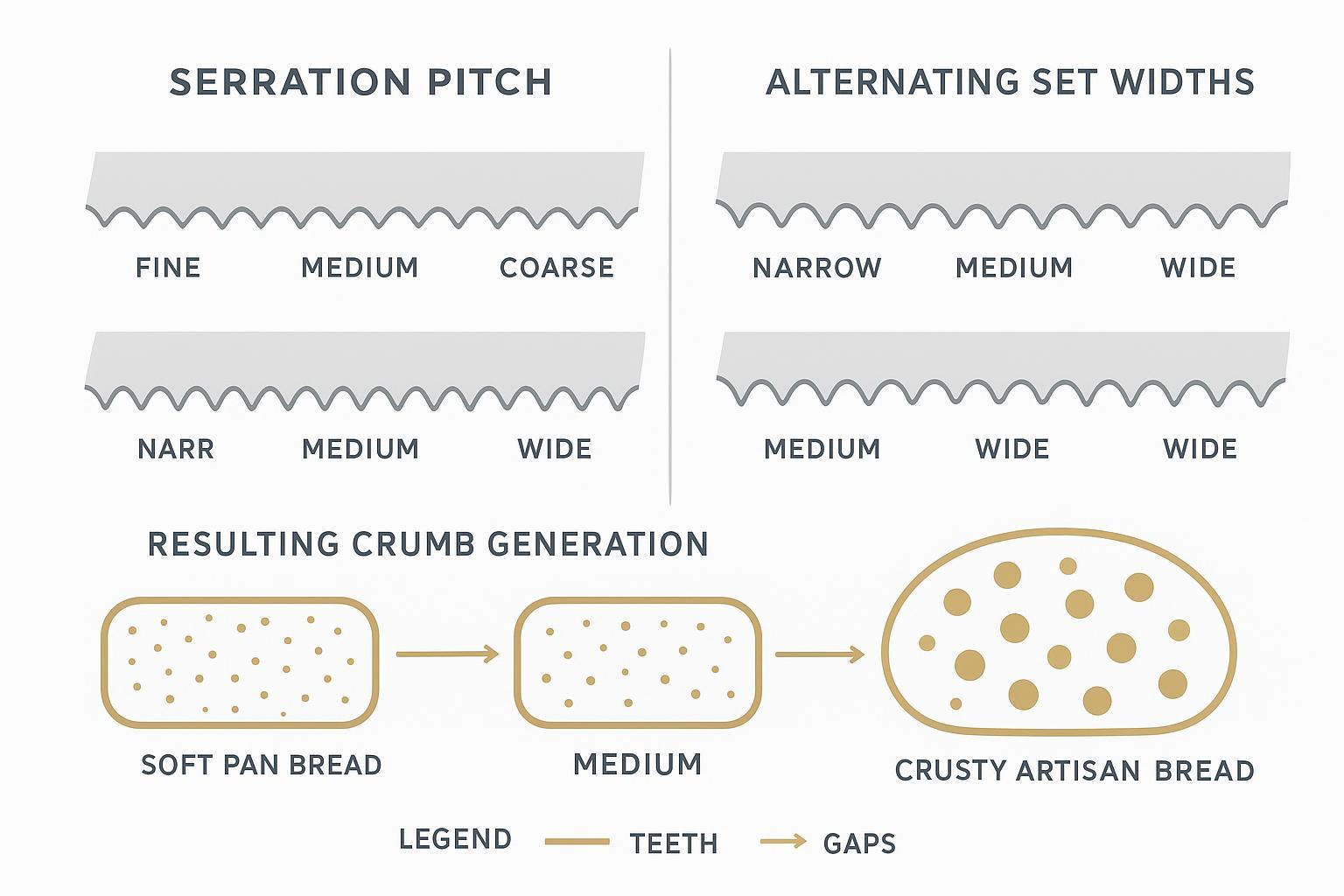
Geometry and pitch selection
Pitch and tooth form affect two failure modes that create crumbs:
- Crust penetration without crushing the crumb: teeth need enough bite to start the cut cleanly.
- Low-drag travel through the crumb: once the crust is breached, sidewall drag and tooth aggressiveness become the enemy.
Practical selection guidance:
- Soft pan bread / high-speed lines: favor a geometry that minimizes drag and sawing aggression. Too-fine or overly pointed teeth can “grab” and fuzz the cut face.
- Crusty artisan loaves: you typically need more bite to get through the crust cleanly, but that can raise crumb loss if the set is too wide or the edge is unstable.
Your goal is not “the sharpest tooth.” It’s the cleanest transition across the crust-to-crumb boundary with the least sidewall friction.
交互アサリと安定性
ブレードの走行軌道が不安定になると、スライスの厚みのばらつき、片側のむしれ、そして驚くほどの量のパン粉(コボレ屑)の発生として現れます。.
交互アサリのパターンは安定性を向上させるのに役立ちますが、切り幅やカット中にパンが支持される状態も変化させます。実務においては以下の通りです。
- アサリ量が大きすぎると、ガイドへの摩擦が増加し、機械内部に飛散するパン粉が増える可能性があります。.
- アサリ量が小さすぎると、側面接触やスミアリング(特に製品が温かい場合)が増加する原因になります。.
アサリ量の変更は管理されたテストとして実施してください。変数を1つだけ変更し、パン粉ロス率を測定し、スライス断面の外観を観察します。.
パンの種類と処理能力への適合
処理能力が重要となるのは、わずかな摩擦増加に対する感度が変化するためです。
- 高い loaves/hour(時間あたり処理個数)では、わずかな抵抗の増加が熱、付着物の蓄積、そしてジャム(詰まり)へとつながります。.
- 品種(SKU)によって挙動は異なります。リッチな食パン、ライ麦パン、種入りパン、高加水パンには、それぞれ異なる「むしれ閾値」が存在します。“
同一のスライサーで複数の異なる製品を流す場合、単一の「万能」な刃型を追い求めるのではなく、複数のセレーション形状を使い分ける(または段取り替え基準を設ける)必要があるかもしれません。.
Coatings and surface finish
セレーションがカットを開始し、表面状態がそれを仕上げます。.
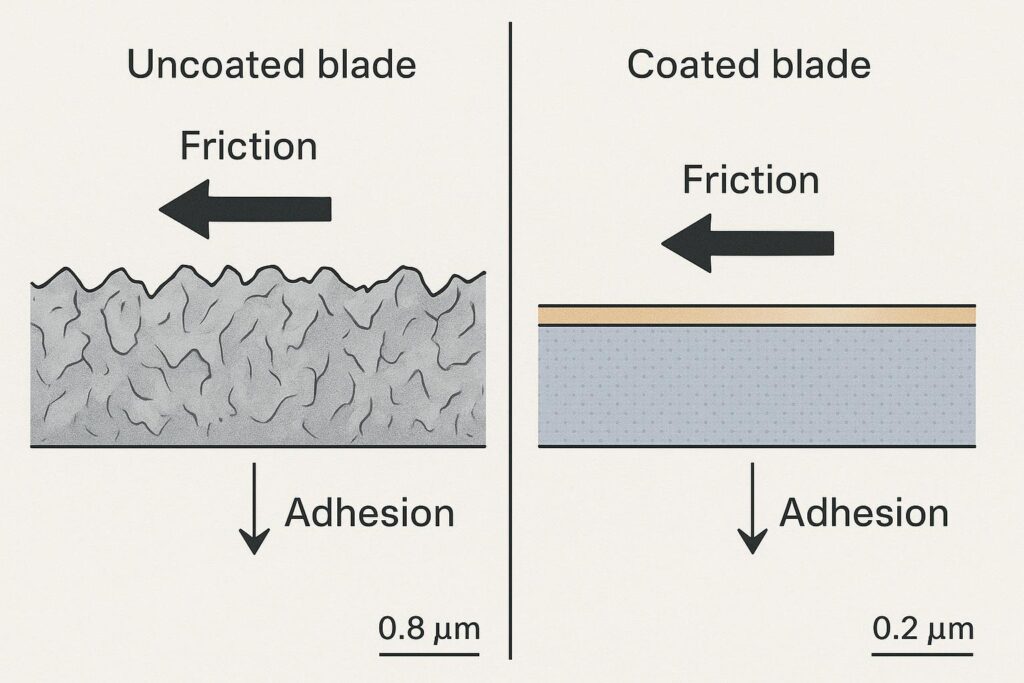
ブレード側面にパン粉の「膜」が見られたり、ガイドに付着物があったり、頻繁な拭き取り清掃が必要な場合、それは単に切れ味だけの問題ではなく、摩擦と凝着(付着)との戦いです。.
摩擦と付着における TiN vs DLC
大原則として、摩擦が低いほど抵抗や付着が少なくなり、結果としてむしれやパン粉の発生が減少する傾向にあります。.
コーティングを比較した査読付きのトライボロジー研究では、以下のことが明らかになっています。 DLC コーティングは、TiN(同テストでは ~0.7 範囲)よりも大幅に低い摩擦係数(~0.1 以下)を示しました。, 、この実験セットアップにおいて、DLC は一般的に、より低く安定した数値を維持しました(TiN と DLC の摩擦挙動を比較した査読付き研究).
スライス工程において、実務上の要点は正確な摩擦係数の数値そのものではなく、生産ライン上で観察される以下の現象です。
- 抵抗の低減 運転中を通じて、スミア(付着)の減少、蓄積物の低減、そしてより均一なスライス断面として現れることがよくあります。.
- 付着の減少 清掃サイクルを短縮し、残渣がさらなる残渣を呼ぶ「パン粉の雪だるま効果」を抑制できます。.
硬度と刃先寿命(HRC)
刃先寿命は、単に「硬ければ硬いほど良い」というものではありません。以下の要素の組み合わせによって決まります。
- 母材と熱処理(硬度、靭性)
- 刃先形状(応力集中)
- 製品構成の摩耗性の高さ(種、具材など)
- ブレードが洗浄薬品や機械的なスクレイピングにさらされる頻度
運転の後半にパン粉ロスが増加する場合、推測に頼るのではなく、寿命に達するまでのブレード稼働時間を記録し、それをパン粉ロス率や厚みのズレと関連付けてください。これにより、客観的な根拠に基づいた交換周期を設定でき、議論に頼ることなくブレード仕様を容易に比較できるようになります。.
Low-Ra 仕上げと清掃
表面粗さ(Ra)が重要となるのは、側面が粗いとパン粉や残渣が付着しやすくなるためです。.
より滑らかな表面仕上げには、以下のメリットがあります。
- カット時のパン粉の「引きずり」を低減する
- むしれの原因となる付着やスミアリングを低減する
- 残渣が剥離しやすくなるため、清掃時間を短縮する
目的は外観を美しく見せるための研磨ではありません。確実な衛生管理を可能にする仕上げを実現することです。.
Operating window and setup
最適な刃先形状や優れたコーティングであっても、適正な運転範囲を外れて稼働している生産ラインを救うことはできません。.
スライス前のパンの温度
温度は、パン粉ロスを発生させる(または排除する)最も直接的な要因の1つです。.
米国製パン技術協会(ASB)は、一般的なスライス適正温度帯として以下を挙げています。 30–36°C (86–97°F), 、パンが温かすぎるとブレードに付着してむしれが発生し、冷たすぎると過剰なパン粉が発生すると警告しています(ASB bread slicing guidance)。.
実務における管理ポイント:
- クラスト(外皮)ではなく、校正済みのプローブを用いて中心温度を測定する。.
- 検証済みの目標値に対して管理限界値を設定し、ダウンタイム後の再確認を義務付ける。.
テンション、ガイド、およびアライメント
スライスが蛇行する場合、通常はレシピの問題ではなく、機械的な安定性の問題が発生しています。.
以下の点に重点を置いて点検を行ってください。
- Tension consistency across the blade set (especially on band/lattice systems)
- Guide wear and contamination (crumb packed into guides changes the blade path)
- Infeed alignment and lane control (skewed entry turns into one-sided tearing)
If you need a practical troubleshooting baseline, this bread slicer tearing troubleshooting checklist lays out measurable checks for temperature control, alignment, and cleaning discipline.
Sanitation verification loop
Crumbs aren’t just waste. They’re a hygiene variable.
Build a loop that connects slicing performance to sanitation verification:
- Define “clean” for the slicer: where crumbs must not remain (guides, guards, under belts).
- Verify with a standard method (visual standard + swab/ATP where your program uses it).
- Close the loop: if sanitation fails, treat it like a process signal—review temperature, drag/sticking symptoms, and blade condition.
Where does MAXTOR METAL fit in this discussion? In plants that run Oliver or Berkel lines (or compatible systems), the practical need is often not “a generic replacement blade,” but a blade that matches the machine’s guidance and the product mix. マックストールメタル can be used as a source for compatible premium replacement blades and for specifying non-standard serration or coating options when you’re standardizing around measured crumb %, thickness tolerance, and cleanup time—without changing your slicer hardware.
結論
- Key takeaways to reduce bread crumb waste with serration, coatings, and setup
免責事項: MAXTOR METAL supplies industrial cutting blades. Recommendations in this article are intended to be vendor-agnostic and should be validated via controlled trials and documented line data.
- Treat bread crumb waste as a measurable KPI tied to yield, OEE, and sanitation—not just cleanup.
- 使用 serration geometry to control the crust-to-crumb transition and reduce tearing.
- 使用 coatings and low-Ra finishing to reduce sidewall drag and sticking that drives residue buildup and crumb “snowballing.”
- Lock the basics: loaf temperature control, tension/guides/alignment, and a sanitation verification loop.
- Your next steps: run trials, log data, and model TCO/ROI
Run a controlled trial (one variable at a time), and log:
- crumb loss rate (% by weight)
- slice thickness tolerance (% in spec)
- downtime minutes by reason code
Then model the tradeoff in plain terms: blade cost vs. recovered yield, reduced cleaning stops, and fewer rejects. That’s how crumb reduction becomes an improvement you can defend—on the floor, in procurement, and in audits.
参考文献
- American Society of Baking (ASB). Bread Slicing. https://asbe.org/article/bread-slicing/ (accessed 2026-05-03).
- Gola, A.; et al. The Effect of TiN and DLC Anti-Wear Coatings on the Tribofilm Formation and Frictional Heating in Dry Sliding Conditions against WC-Co and 100Cr6 Counterparts. 材料 (2021). https://pmc.ncbi.nlm.nih.gov/articles/PMC8235471/ (accessed 2026-05-03).
- ISO。. ISO 21920-2:2021 — Geometrical product specifications (GPS) — Surface texture: Profile — Part 2: Terms, definitions and surface texture parameters. https://www.iso.org/standard/76398.html (accessed 2026-05-03).
- ISO。. ISO 4287:1997 — Surface texture: Profile method — Terms, definitions and surface texture parameters (withdrawn). https://www.iso.org/standard/10132.html (accessed 2026-05-03).
- ASTM International. ASTM E1655 — Standard Practices for Infrared Multivariate Quantitative Analysis (often used in food & process industries; useful background for validation discipline). https://www.astm.org/e1655-05.html (accessed 2026-05-03).
- PMC (NIH). Implementation of ATP and Microbial Indicator Testing for Hygiene Monitoring in a Food Processing Facility. https://pmc.ncbi.nlm.nih.gov/articles/PMC8090886/ (accessed 2026-05-03).
ジェリー・チュウ は Technical Support Specialist で 南京金属工業、 と 10年 of hands-on experience supporting industrial cutting blade selection, troubleshooting, and process stabilization for production lines. He holds PMP そして CMRP credentials.
Third-party technical review is available upon request. If you need an independent validation of the measurement plan, sanitation verification loop, or trial design, consider requesting a review from your slicer OEM, your QA/food safety auditor, or an external sanitation/maintenance consultant.
Quality system note
MAXTOR METAL operates under an ISO-aligned quality management system with controls that typically include incoming material inspection, in-process checks、 そして final inspection/verification. Process documentation and material traceability details can be provided upon request to support supplier qualification and internal audits.

 English
 Spanish
 Italian
 French
 Portuguese
 Russian
 German
 Arabic
 Hindi
 Vietnamese
 Indonesian
 Japanese
 Korean