

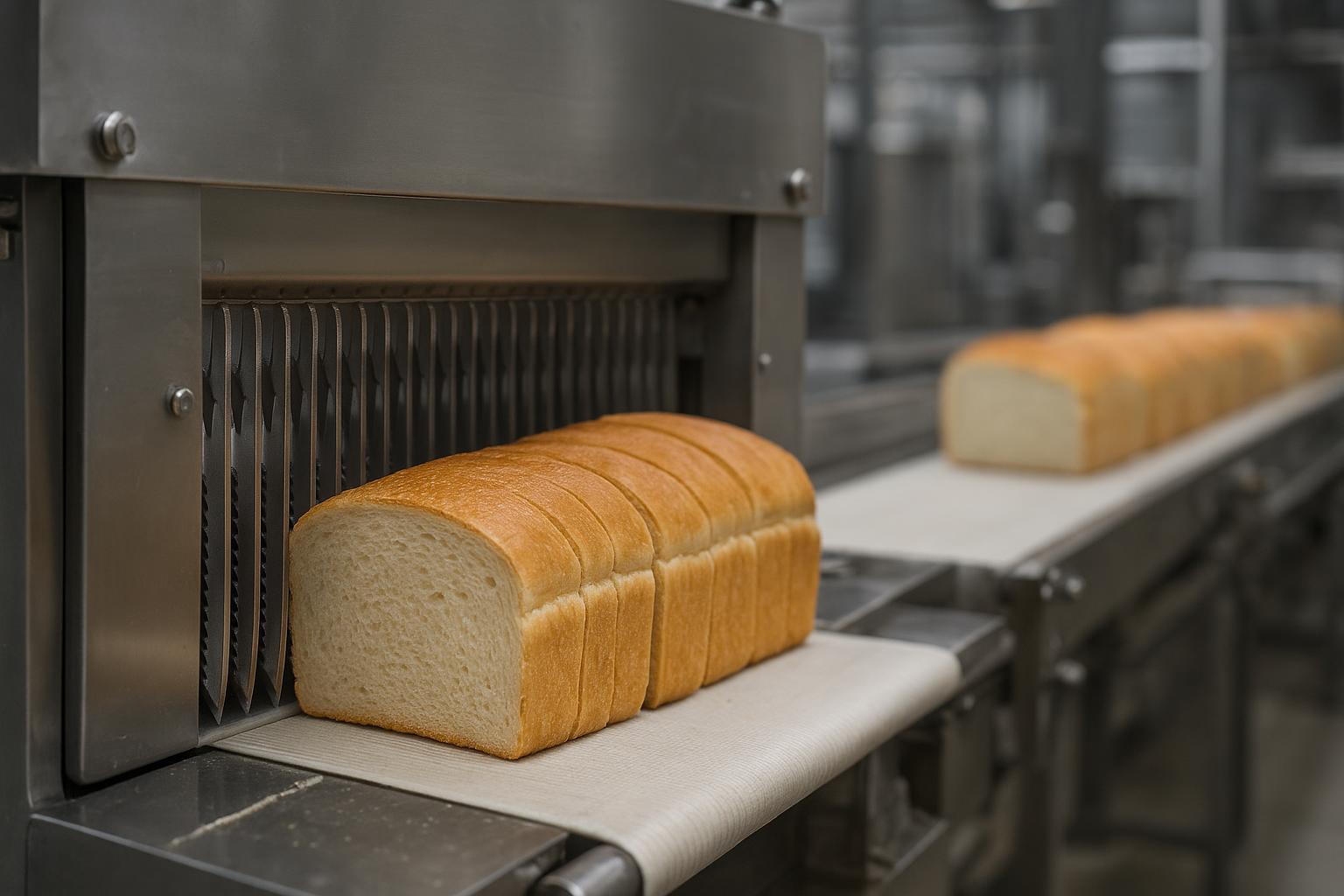
Vụn bánh mì hao hụt rất dễ bị xem nhẹ chỉ là “vấn đề vệ sinh”. Tuy nhiên, trên một dây chuyền cắt công nghiệp, đó là sự rò rỉ hiệu suất, vấn đề về OEE và đồng thời là rủi ro về an toàn thực phẩm.
Thông báo: MAXTOR METAL cung cấp các loại lưỡi dao cắt công nghiệp. Các nguyên lý trong bài viết này không phụ thuộc vào nhà cung cấp nào và tập trung vào các kiểm soát quy trình có thể đo lường được (khối lượng vụn, dung sai độ dày, thời gian dừng máy) để bạn có thể xác thực các cải tiến trên chính dây chuyền của mình — bất kể thương hiệu lưỡi dao hay hãng máy cắt nào.
Tin tốt là hao hụt vụn bánh mì hiếm khi là một bí ẩn. Hầu hết lượng vụn được tạo ra tại một vài điểm có thể dự đoán trước: điểm tiếp xúc đầu tiên tại ranh giới giữa vỏ và ruột bánh, lực cản dọc theo mặt bên của lưỡi dao, và bất kỳ sự mất ổn định nào trong việc dẫn hướng hoặc kiểm soát ổ bánh.
- Tại sao bạn cần giảm hao hụt vụn bánh mì để bảo vệ sản lượng, OEE và tính tuân thủ
Mỗi gam vụn trong khay hứng vụn là sản phẩm không thể bán được. Nhưng chi phí lớn hơn thường là những hệ lụy gián tiếp:
- Sản lượng và lượng sản phẩm dư thừa (giveaway): hao hụt vụn và lát cắt bị rách thường đi kèm với sự sai lệch độ dày. Điều đó buộc bạn phải làm lại, đóng gói lại hoặc thiết lập độ dày an toàn quá mức làm tăng lượng sản phẩm dư thừa.
- Ảnh hưởng đến OEE: sự tích tụ vụn bánh làm thay đổi ma sát và hoạt động cấp liệu. Nó làm tăng tỷ lệ kẹt máy, dừng máy để vệ sinh và “thời gian dừng máy bí ẩn” rất khó để phân loại chính xác.
- Rủi ro về tính tuân thủ: vụn bánh tích tụ trong các góc, dưới các thanh dẫn hướng và xung quanh các tấm chắn bảo vệ. Chúng là gánh nặng vệ sinh và là rủi ro khi kiểm định (đặc biệt là khi các chất gây dị ứng hoặc nhiều mã hàng SKU dùng chung thiết bị).
Một mô hình tư duy hữu ích: hao hụt vụn bánh mì là biểu hiện của lực cắt quá mức và ma sát không được kiểm soát. Hình học răng cưa, lớp phủ và việc thiết lập đều làm thay đổi hai yếu tố này.
- Những thay đổi về hình học răng cưa, lớp phủ và thiết lập ảnh hưởng thế nào đến chất lượng lát cắt
Hãy coi chất lượng lát cắt là ba kết quả mà bạn thực sự có thể đo lường:
- Tỷ lệ cắt sạch (vết rách trực quan và “xơ” tại bề mặt cắt)
- Độ ổn định của độ dày (trong phạm vi dung sai xác định)
- Khối vụn bánh (lượng vụn thu gom trên mỗi đơn vị sản phẩm)
Hình học răng cưa quyết định cách lưỡi dao “ăn” vào vỏ bánh và chuyển tiếp vào phần ruột mềm. Lớp phủ và độ bóng bề mặt quyết định mức độ ma sát, bám dính và mang theo cặn bẩn của mặt bên lưỡi dao. Việc thiết lập quyết định liệu lưỡi dao có thể thực hiện công việc một cách nhất quán hay không: nhiệt độ, lực căng, thanh dẫn hướng, căn chỉnh và kỷ luật vệ sinh.
Hao hụt vụn bánh mì: những gì cần đo lường trước khi thay lưỡi dao

Nếu bạn muốn những cải tiến duy trì hiệu quả qua các ca làm việc và các đợt đánh giá, hãy xác thực chúng như một sự thay đổi quy trình — chứ không phải là một thử nghiệm nhất thời.
- Tỷ lệ hao hụt vụn (theo trọng lượng): thu gom vụn bánh trong một khoảng thời gian xác định và cân chúng, sau đó chia cho trọng lượng sản phẩm đã cắt.
- Dung sai độ dày lát cắt: lấy mẫu một lượt chạy (ví dụ: 20–30 lát cắt liên tiếp) và đo độ dày bằng thước cặp hoặc thiết bị đo trên dây chuyền; tính toán % nằm trong dung sai.
- Thời gian dừng máy và các điểm dừng nhỏ: ghi nhận các lần dừng máy theo mã lý do (kẹt máy, vệ sinh, thay lưỡi dao, điều chỉnh thanh dẫn hướng). Liên kết số phút đó với OEE.
Dựa theo Hướng dẫn của Hiệp hội Làm bánh Hoa Kỳ (American Society of Baking) về cắt lát bánh mì (phạm vi 30–36°C / 86–97°F), nhiệt độ sản phẩm và tình trạng lưỡi dao ảnh hưởng mạnh mẽ đến việc rách, bết dính và tạo vụn — vì vậy hãy ghi lại nhiệt độ và thời điểm thay lưỡi dao cùng với các chỉ số trên.
Kiểu răng cưa giúp giảm thiểu hao hụt
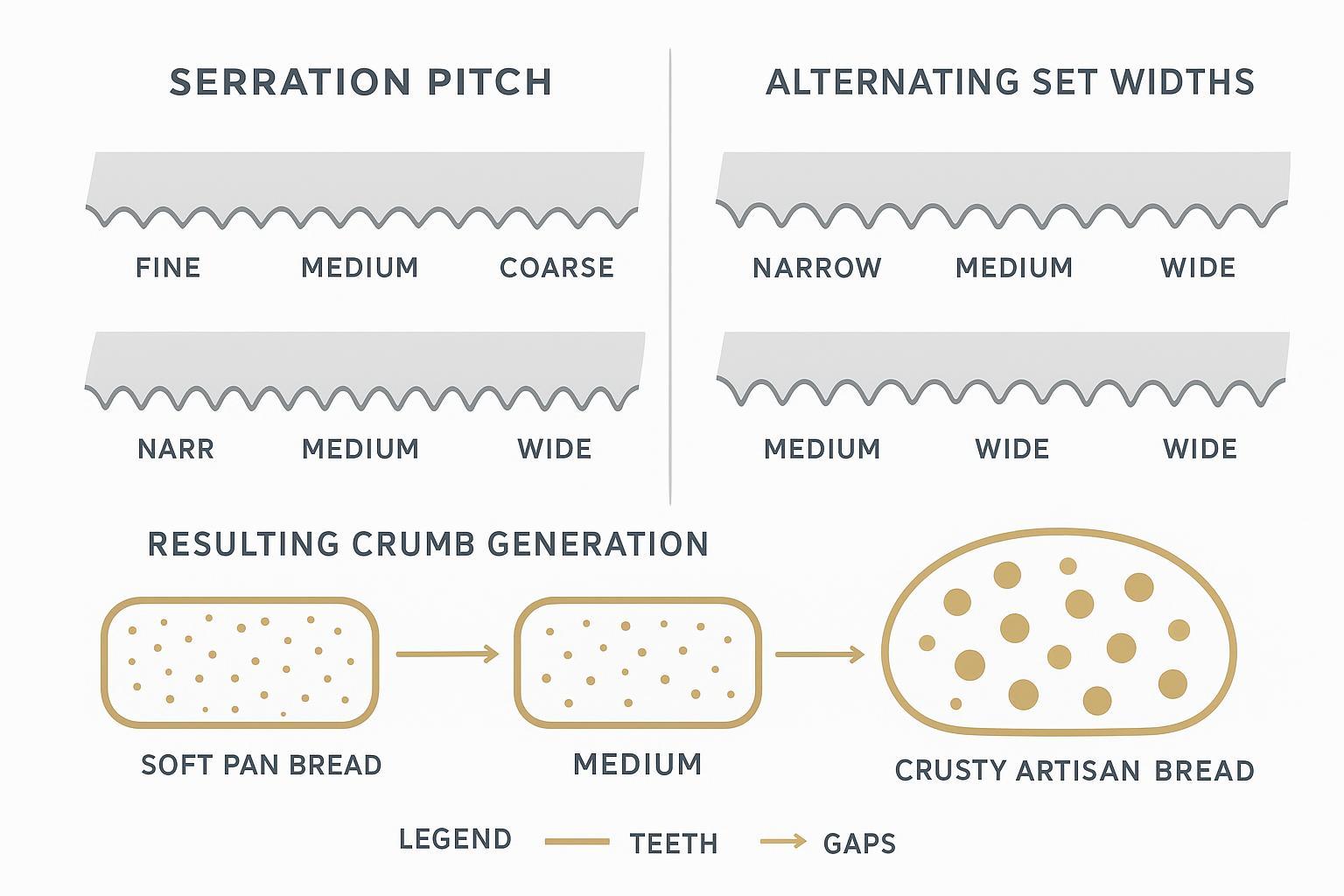
Răng cưa không chỉ đơn thuần là “sắc bén hơn” hay “ít sắc bén hơn”. Đó là cấu trúc hình học kiểm soát hướng đi của lực cắt — tạo ra lát cắt sạch hay gây dập nát/rách.
Lựa chọn hình học và bước răng
Bước răng và dạng răng ảnh hưởng đến hai dạng lỗi tạo ra vụn bánh:
- Đâm xuyên vỏ bánh mà không làm nát ruột bánh: răng dao cần đủ độ bám để bắt đầu vết cắt một cách gọn gàng.
- Di chuyển qua ruột bánh với lực cản thấp: một khi vỏ bánh đã được cắt đứt, lực cản của mặt bên và độ sắc bén quá mức của răng dao sẽ trở thành tác nhân gây hại.
Hướng dẫn lựa chọn thực tế:
- Bánh mì gối mềm / dây chuyền tốc độ cao: ưu tiên cấu trúc hình học giúp giảm thiểu lực cản và lực cưa quá mức. Răng quá mịn hoặc quá nhọn có thể “bám” và làm xơ bề mặt cắt.
- Bánh mì vỏ giòn kiểu truyền thống (artisan): thông thường bạn cần lực bám mạnh hơn để cắt qua lớp vỏ một cách gọn gàng, nhưng điều đó có thể làm tăng lượng vụn hao hụt nếu khoảng mở răng (set) quá rộng hoặc lưỡi dao không ổn định.
Mục tiêu của bạn không phải là “răng dao sắc nhất”. Đó là sự chuyển tiếp mượt mà nhất qua ranh giới từ vỏ đến ruột bánh với ma sát mặt bên ít nhất.
Alternating set and stability
If the blade path isn’t stable, you’ll see it as thick-thin slices, one-sided tearing, and a surprising amount of loose crumb.
Alternating set patterns can help stability, but they also change the kerf and the way the loaf is supported during the cut. In practice:
- Too much set can increase friction on guides and can throw more crumbs into the machine.
- Too little set can increase sidewall contact and smearing, especially when product is warm.
Treat set changes like a controlled trial: change one variable, measure crumb loss rate, and watch slice-face appearance.
Match to loaf type and throughput
Throughput matters because it changes how sensitive you are to small friction increases:
- At high loaves/hour, a small increase in drag becomes heat, residue buildup, and jams.
- Different SKUs behave differently: enriched sandwich bread, rye, seeded breads, and high-hydration loaves each have different “tear thresholds.”
If you run mixed products on the same slicer, you may need more than one serration geometry (or a changeover standard) instead of chasing a single “universal” tooth.
Lớp phủ và độ bóng bề mặt
Serration starts the cut. Surface condition finishes it.
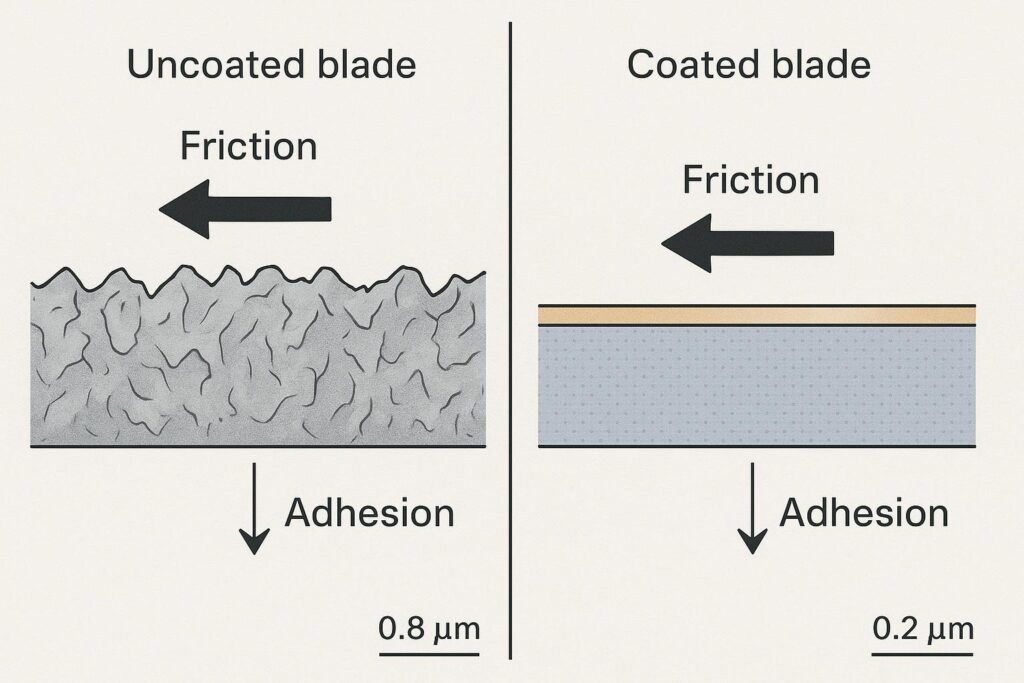
If you see crumb “film” on blade sidewalls, residue on guides, or frequent wipe-downs, you’re not just fighting sharpness—you’re fighting friction and adhesion.
TiN vs DLC for friction and sticking
As a high-level rule: lower friction tends to mean less drag and less sticking, which tends to mean fewer tears and fewer crumbs.
A peer-reviewed tribology study comparing coatings found that DLC coatings showed much lower coefficients of friction (~0.1 or below) than TiN (~0.7 range in their tests), with DLC generally remaining lower and more stable in that experimental setup (peer-reviewed study comparing TiN and DLC friction behavior).
For slicing operations, the practical takeaway isn’t the exact coefficient—it’s what you observe on the line:
- Lower drag often shows up as fewer smears, less buildup, and more consistent slice faces over a run.
- Less sticking can shorten cleaning cycles and reduce the “crumb snowball” effect where residue causes more residue.
Hardness and edge life (HRC)
Edge life is not just “harder is better.” It’s the combination of:
- base steel and heat treat (hardness, toughness)
- tooth geometry (stress concentration)
- how abrasive the product mix is (seeds, inclusions)
- how often the blade is exposed to cleaning chemicals and mechanical scraping
If your crumb waste climbs late in the run, don’t guess—mark blade-hours to failure and correlate it with crumb loss rate and thickness drift. That gives you a defensible replacement interval and makes it easier to compare blade specs without arguments.
Low-Ra finishing and cleanup
Surface roughness (Ra) matters because a rough sidewall gives crumbs and residue something to hang onto.
A smoother surface finish can:
- reduce the “carry” of crumbs along the cut
- reduce sticking and smearing that drives tearing
- shorten cleanup time because residue releases more readily
The point isn’t cosmetic polishing. It’s getting to a finish that supports predictable sanitation.
Phạm vi vận hành và thiết lập
The cleanest geometry and best coating won’t save a line that’s running outside its operating window.
Bread temperature before slicing
Temperature is one of the fastest ways to create (or eliminate) crumb waste.
The American Society of Baking notes a common slicing window of 30–36°C (86–97°F), warning that loaves that are too hot can gum blades and tear, while loaves that are too cool can generate excessive crumbs (ASB bread slicing guidance).
Practical control points:
- Measure center temperature with a calibrated probe (not the crust).
- Set action limits around your validated target and require a recheck after downtime.
Tension, guides, and alignment
When slices wander, you’re usually seeing a mechanical stability problem, not a recipe problem.
Focus your checks on:
- Tension consistency across the blade set (especially on band/lattice systems)
- Guide wear and contamination (crumb packed into guides changes the blade path)
- Infeed alignment and lane control (skewed entry turns into one-sided tearing)
If you need a practical troubleshooting baseline, this bread slicer tearing troubleshooting checklist lays out measurable checks for temperature control, alignment, and cleaning discipline.
Sanitation verification loop
Crumbs aren’t just waste. They’re a hygiene variable.
Build a loop that connects slicing performance to sanitation verification:
- Define “clean” for the slicer: where crumbs must not remain (guides, guards, under belts).
- Xác minh with a standard method (visual standard + swab/ATP where your program uses it).
- Close the loop: if sanitation fails, treat it like a process signal—review temperature, drag/sticking symptoms, and blade condition.
Where does MAXTOR METAL fit in this discussion? In plants that run Oliver or Berkel lines (or compatible systems), the practical need is often không “a generic replacement blade,” but a blade that matches the machine’s guidance and the product mix. KIM LOẠI MAXTOR can be used as a source for compatible premium replacement blades and for specifying non-standard serration or coating options when you’re standardizing around measured crumb %, thickness tolerance, and cleanup time—without changing your slicer hardware.
Kết luận
- Key takeaways to reduce bread crumb waste with serration, coatings, and setup
Thông báo: MAXTOR METAL supplies industrial cutting blades. Recommendations in this article are intended to be vendor-agnostic and should be validated via controlled trials and documented line data.
- Treat bread crumb waste as a measurable KPI tied to yield, OEE, and sanitation—not just cleanup.
- Sử dụng serration geometry to control the crust-to-crumb transition and reduce tearing.
- Sử dụng coatings and low-Ra finishing to reduce sidewall drag and sticking that drives residue buildup and crumb “snowballing.”
- Lock the basics: loaf temperature control, tension/guides/alignment, and a sanitation verification loop.
- Your next steps: run trials, log data, and model TCO/ROI
Run a controlled trial (one variable at a time), and log:
- crumb loss rate (% by weight)
- slice thickness tolerance (% in spec)
- downtime minutes by reason code
Then model the tradeoff in plain terms: blade cost vs. recovered yield, reduced cleaning stops, and fewer rejects. That’s how crumb reduction becomes an improvement you can defend—on the floor, in procurement, and in audits.
Tài liệu tham khảo
- American Society of Baking (ASB). Bread Slicing. https://asbe.org/article/bread-slicing/ (accessed 2026-05-03).
- Gola, A.; et al. The Effect of TiN and DLC Anti-Wear Coatings on the Tribofilm Formation and Frictional Heating in Dry Sliding Conditions against WC-Co and 100Cr6 Counterparts. Nguyên vật liệu (2021). https://pmc.ncbi.nlm.nih.gov/articles/PMC8235471/ (accessed 2026-05-03).
- ISO. ISO 21920-2:2021 — Geometrical product specifications (GPS) — Surface texture: Profile — Part 2: Terms, definitions and surface texture parameters. https://www.iso.org/standard/76398.html (accessed 2026-05-03).
- ISO. ISO 4287:1997 — Surface texture: Profile method — Terms, definitions and surface texture parameters (withdrawn). https://www.iso.org/standard/10132.html (accessed 2026-05-03).
- ASTM International. ASTM E1655 — Standard Practices for Infrared Multivariate Quantitative Analysis (often used in food & process industries; useful background for validation discipline). https://www.astm.org/e1655-05.html (accessed 2026-05-03).
- PMC (NIH). Implementation of ATP and Microbial Indicator Testing for Hygiene Monitoring in a Food Processing Facility. https://pmc.ncbi.nlm.nih.gov/articles/PMC8090886/ (accessed 2026-05-03).
Jerry Chu là một Technical Support Specialist Tại Công nghiệp kim loại Nam Kinh, với 10 năm of hands-on experience supporting industrial cutting blade selection, troubleshooting, and process stabilization for production lines. He holds PMP Và CMRP credentials.
Third-party technical review is available upon request. If you need an independent validation of the measurement plan, sanitation verification loop, or trial design, consider requesting a review from your slicer OEM, your QA/food safety auditor, or an external sanitation/maintenance consultant.
Lưu ý về hệ thống chất lượng
MAXTOR METAL operates under an ISO-aligned quality management system with controls that typically include incoming material inspection, in-process checks, Và final inspection/verification. Process documentation and material traceability details can be provided upon request to support supplier qualification and internal audits.

 English
  Spanish
  Italian
  French
  Portuguese
  Russian
  German
  Arabic
  Hindi
Hindi  Vietnamese
  Indonesian
  Japanese
  Korean