

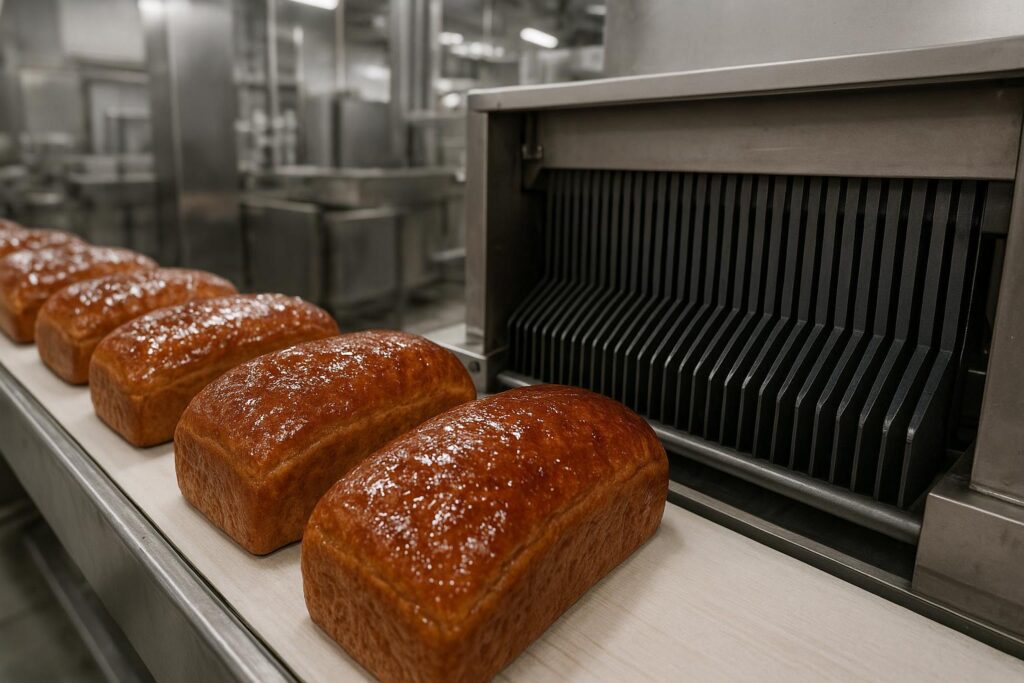
- Who this is for: production, maintenance, procurement at industrial bakeries and slicer OEMs.
- What you will learn: when to choose Teflon coated slicer blades vs TiN/DLC and how to set up for success.
- Outcomes: cleaner slices, fewer jams, faster changeovers, compliant documentation.
How PTFE helps on sticky breads
PTFE (often called Teflon) is a non-stick, low-friction surface. In bread slicing, that matters when your biggest enemy isn’t “dullness” yet—it’s 接着: sugars, glazes, warm crumb, and moisture building up on the blade path until the machine starts tearing, dragging, or jamming.
In other words: if you’re evaluating non-stick coating for bread slicing, PTFE is usually the first coating family worth testing because it targets adhesion directly.
Surface energy and friction
PTFE’s value is straightforward: it reduces the tendency of sticky residues to wet and adhere to the blade surface, and it lowers sliding friction. For bakeries, that typically shows up as:
- less drag through the loaf
- fewer “grab-and-tear” events at the exit side
- less residue transfer to guides and loaf supports
There’s a practical boundary, though: PTFE is still a coating, not a miracle layer. Under high abrasive load, it will wear.
Bread scenarios where it shines
PTFE-coated bread slicer blades usually earn their keep when the product is adhesion-limited, for example:
- high-sugar sandwich loaves (sticky crust, tacky top)
- glazed, topped, or syrupy SKUs
- warm slicing where the loaf hasn’t stabilized and the crumb is still “gummy”
- enriched doughs where fats and sugars smear rather than fracture cleanly
In these scenarios, “harder” doesn’t always mean “better.” A very hard coat can hold an edge longer, but if the blade still accumulates sticky buildup, you can lose more uptime to cleaning and jam clears than you gain in edge life.
Limits and trade-offs
PTFE has two main trade-offs you should plan for:
- Abrasion and edge-life: PTFE is chosen for release, not for fighting abrasive wear. Seeded crusts, heavy crumb grit, high tension, or aggressive guides can wear the coating faster.
- Thermal boundaries: PTFE has published continuous-use limits commonly cited around 260°C / 500°F (application-dependent). That’s typically above bread slicing temperatures, but it matters when you consider sanitation heat, upset conditions, or any process step that could expose the coating to higher temperatures. For a general reference on operating range, see Kintek’s overview of the operating temperature range for PTFE (2026).
The decision implication is simple: PTFE is best when your downtime is driven by sticking and cleanup, and you can control the abrasion environment.
PTFE coated bread slicer blades vs TiN vs DLC
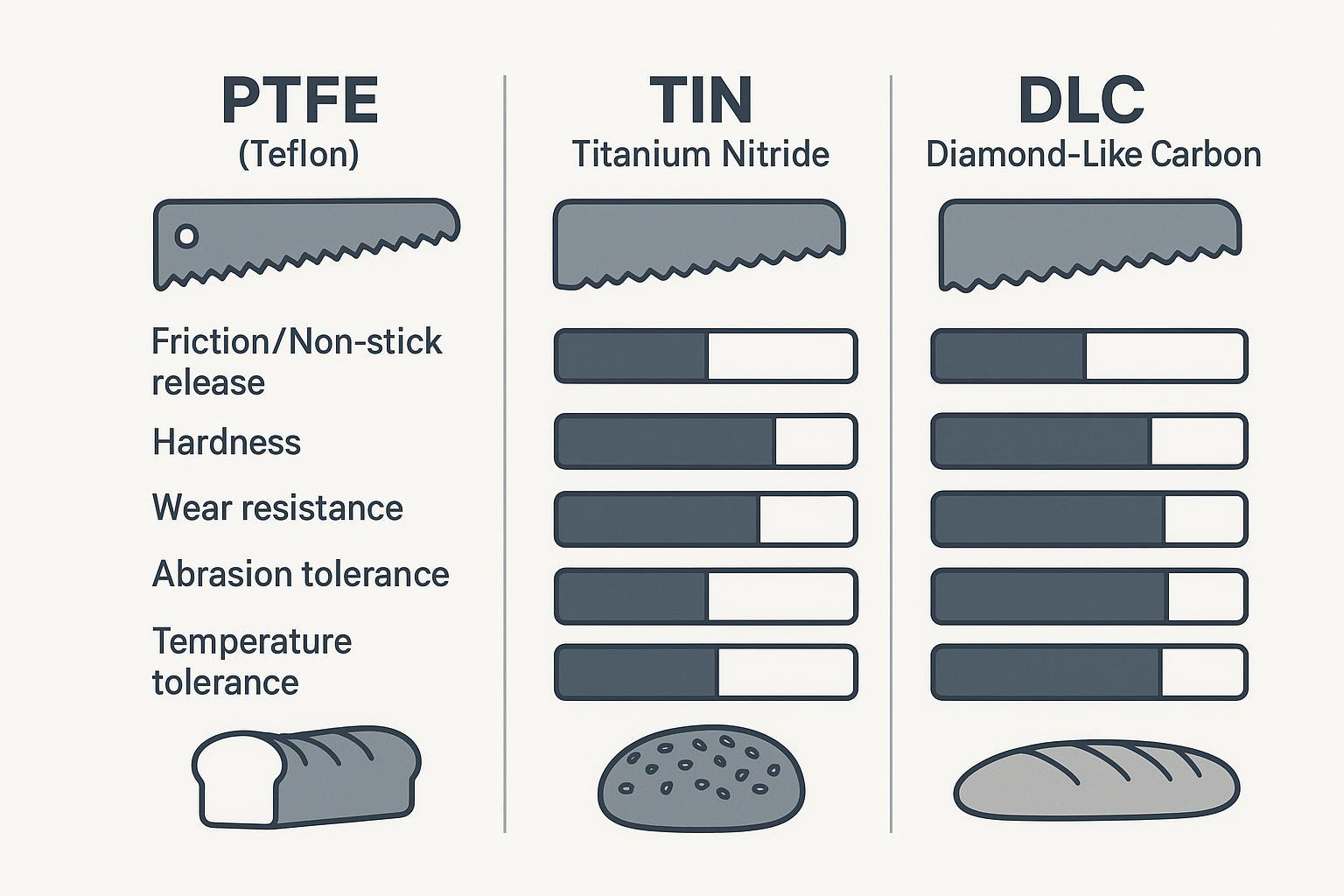
If you want a clean decision, separate two failure modes. This is the fastest way to choose between Teflon coated slicer blades (PTFE) and hard coats:
- Adhesion-limited: the blade edge is “fine,” but the product sticks and drags.
- Abrasion-limited: sticking is manageable, but the edge loses bite over long runs and slice quality decays.
MAXTOR METAL’s overview of food-grade circular knife materials and coating options is a useful reference point if you’re building a short list of coating families and the compliance documentation you’ll need to support them.
If you’re searching for a bread slicer blade coating selection framework, this section is the “compare like-for-like” core: release vs wear vs setup risk.
Non-stick performance
- PTFE is the non-stick specialist. If sticking drives jams, PTFE is often the fastest path to fewer stops.
- DLC can deliver a slick surface and reduced adhesion in some cutting contexts, but in bakery slicing the “non-stick win” usually still belongs to PTFE when sugars and glazes are the dominant issue.
- 錫 reduces friction versus bare steel in many applications, but it’s typically selected for wear behavior more than for true release against sticky food soils (a common reality when evaluating TiN coated blades food processing lines).
A good rule: if you’re currently wiping or scraping blades mid-shift to keep the line running, you’re probably looking at an adhesion problem first.
Edge retention and life
This is where hard coats earn their reputation. If you’re running long campaigns where edge wear drives quality loss, you’re typically comparing DLC coated food slicing blades against TiN and uncoated options, not against PTFE.
- 錫 そして DLC are hard coatings used to improve wear resistance. In practical bakery terms, they can help when you’re losing slice quality because the edge is rounding or micro-chipping over long campaigns.
- PTFE does not compete on hardness. Oerlikon Balzers notes that PTFE is known for low friction but is not recommended for high-load wear situations—which maps cleanly to abrasion-limited slicing.
If your dominant complaint is “it starts fine, then crumb increases and thickness consistency drifts over the run,” you’re likely in edge-life territory.
Temperature and abrasion
For bread slicing, temperature is usually secondary to abrasion—but abrasion comes in more forms than people expect:
- crust hardness (especially lean doughs)
- seeds and inclusions
- crumb grit recirculating in the cutting zone
- guide contact and tension choices
PTFE’s thermal ceiling is rarely the limiting factor in slicing itself. Abrasion and mechanical contact are. Hard coats generally tolerate abrasive environments better, while PTFE demands cleaner mechanics and better crumb control.
Here’s a qualitative summary table you can use to align coating choice with your dominant failure mode and operational risk.
| 基準 | PTFE | 錫 | DLC |
|---|---|---|---|
| Primary value | Non-stick release (adhesion control) | Wear resistance (edge-life) | Wear resistance + low friction (edge-life with some slickness) |
| Best when | Adhesion-limited SKUs (sugars/glazes/warm or gummy crumb) | Abrasion-limited runs where sticking is manageable | Abrasion-limited runs where friction and wear both matter |
| Typical operational win | Fewer stops for wiping/cleaning; reduced drag | Longer campaigns before quality drifts | Longer campaigns with smoother cutting feel (application-dependent) |
| Main risks | Faster wear under guide rub, inclusions, crumb grit | Not a “true” non-stick; sticking may still drive downtime | Benefits depend on substrate prep and operating conditions |
| Setup sensitivity | High: guide alignment, crumb control, and cleaning method matter | Medium: still needs good mechanics and crumb control | Medium–high: process control and surface prep matter |
Setup and operation
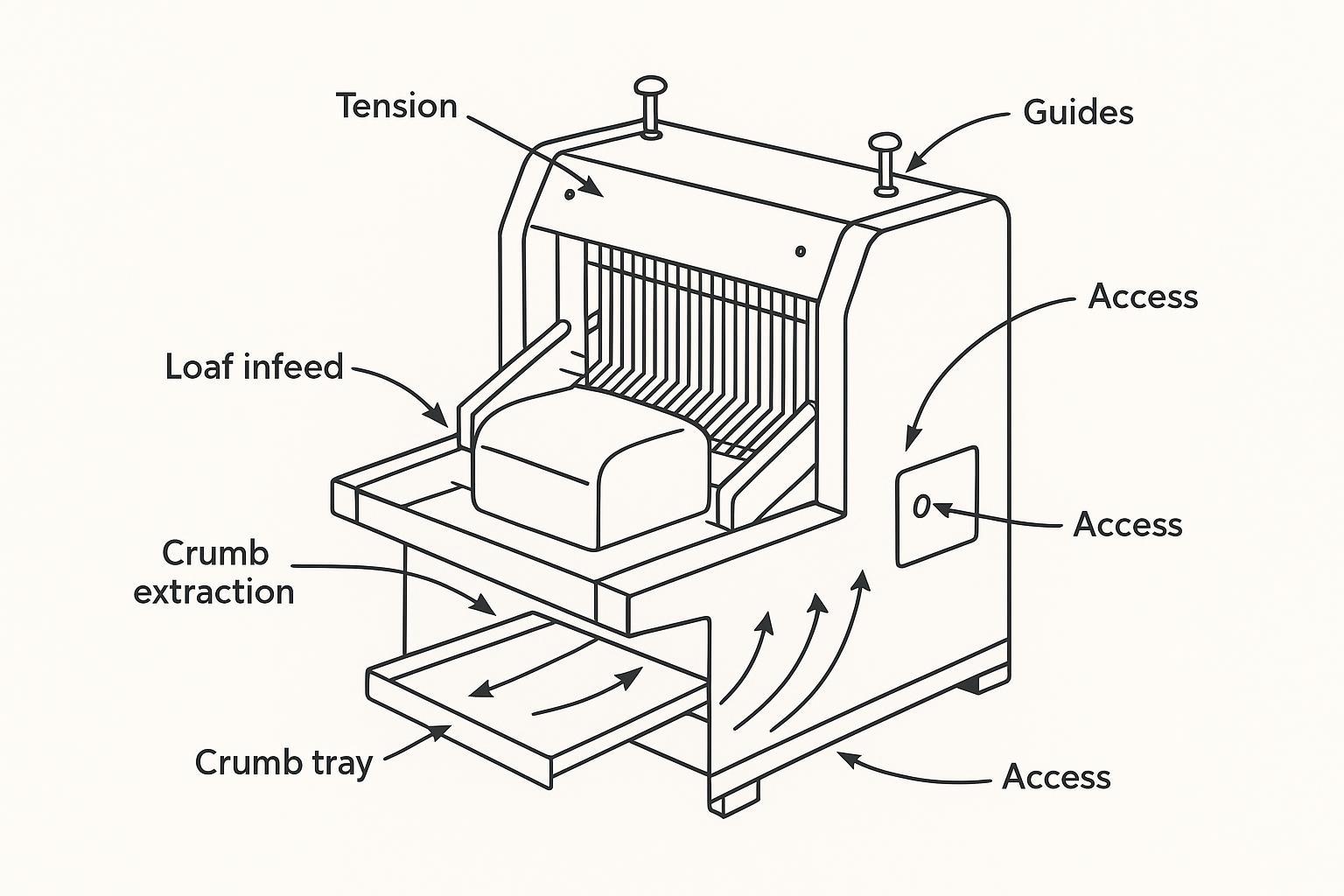
Coating selection won’t save a slicer that’s set up to grind crumbs into the blade pack or run loaves before they’re stable. The best-performing lines treat coating choice and setup as one system.
Loaf condition and cooling
If you want PTFE (or any coating) to behave predictably, control the loaf first:
- Slice after sufficient cooling so the crumb has set (reduces smearing and gumminess).
- Standardize loaf moisture and bake profiles for the SKUs running on the line.
- Reduce surface tack where possible (glaze handling, release agents, post-bake steps).
This is also the right place to bring validation discipline into the process. If you’re building a robust decision, archive two evidence artifacts:
- a compatibility matrix mapping your slicer model + guide system + loaf families to recommended blade/coating configurations
- a pilot validation protocol that defines what you measure, how you measure it, and how you’ll decide “pass/fail” (set thresholds to match your line capability and customer requirements)
A practical protocol can be as lean as this:
- Jam rate: record events per hour (and the root cause category: adhesion, guide contact, loaf condition, debris)
- Slice thickness consistency: take a timed sample (e.g., every 30–60 minutes), measure with a consistent method, and track average そして variability (e.g., standard deviation or max deviation)
- Clean-to-run time: measure from stop → cleaned → restarted → first acceptable slices (use the same acceptance check each time)
- Crumb mass: collect and weigh crumb from extraction trays per shift (or per defined run) to track debris load
- Coating condition checks: define a visual inspection interval and record wear patterns (edge rounding, face wear, localized rub marks)
Those documents turn “it feels better” into a decision procurement can defend.
Blade tension and geometry
Tension and geometry decide whether you cut cleanly or you saw and smear.
- Use tooth geometry appropriate for bread texture and crust. MAXTOR METAL’s blade geometry guide (2025) references serration pitch ranges and bevel-angle concepts that are directly relevant to reducing tearing and compression.
- Treat tension as a controlled setting with a check step, not tribal knowledge. Over-tension can accelerate wear and increase frictional heat; under-tension can amplify vibration and tearing.
プロのヒント: If you’re trialing PTFE to solve sticking, reduce the “abrasion budget” first—verify guides are aligned and not rubbing the blade faces. Otherwise you’ll blame the coating for wear that the machine caused.
Crumb extraction and changeover
Crumbs aren’t just hygiene debris—they’re abrasive particles that can increase drag and make sticking worse.
Operationally:
- Keep crumb extraction working as designed: airflow paths clear, ports unobstructed, trays emptied before overflow.
- Set a changeover routine that includes a fast visual check of guides, blade pack, and extraction points.
- Track “clean-to-run” time. If PTFE reduces stickiness but your changeover is still slow, the bottleneck may be access, tooling, or SOP design.
Failure modes and troubleshooting

When a coating trial “fails,” the fastest way to recover is to diagnose the dominant driver before changing blades again.
Common symptoms
- Sticking returns quickly after cleaning: adhesion is still the primary failure mode (loaf condition, temperature, glaze/sugar load, or insufficient release).
- Localized wear stripes or polished tracks on blade faces: guide contact/rub is likely driving abrasion (a machine/setup issue more than a coating issue).
- Early edge-life loss across the whole pack: debris load, inclusions, or excessive tension may be consuming your wear budget.
- Coating damage after sanitation changes: cleaning chemistry, dwell time, temperature, or mechanical scrubbing may be incompatible.
A practical check order
- Guides and alignment first: confirm guides aren’t rubbing blade faces; look for rub marks that repeat at the same positions.
- Tension and vibration: verify tension settings are within your internal spec and consistent across changeovers.
- Crumb extraction and debris flow: clear airflow paths, trays, and buildup points that recirculate grit into the cutting zone.
- Loaf condition: confirm cooling time, moisture, and SKU-to-setup matching (warm/gummy loaves can look like a blade problem).
- Sanitation method: confirm chemistry compatibility with coating/substrate and eliminate abrasive tools that can strip or scratch coatings.
If the above are stable and you still see downtime driven by adhesion (not wear), PTFE remains the most direct coating family to test.
卫生管理とコンプライアンス(規格適合)
For production teams, the goal is simple: clean fast without damaging the blade system. For procurement and QA, the goal is documentation that survives audits.
Cleaning chemistry and methods
Protect coating integrity and edge geometry:
- Use cleaning chemistry compatible with your coating and base material.
- Avoid aggressive abrasives that can mechanically strip coatings.
- Validate the cleaning method with inspection: coating integrity, edge condition, and residue removal.
If you’re changing coating type (PTFE → hard coat or vice versa), treat it like a process change: update your cleaning SOP and retrain.
FDA and EU requirements
Your exact obligations depend on the materials and your jurisdiction, but your operational posture should be consistent:
- confirm the coating and substrate are appropriate for food-contact use
- maintain traceability (what was installed, when, and on which line)
- document inspection and replacement triggers
For authoritative entry points, start with:
- FDA: the Inventory of Food Contact Substances Listed in 21 CFR (Indirect Additives) (useful for checking regulatory citations for coatings/polymers in food contact)
- EU framework: Regulation (EC) No 1935/2004 consolidated text
- EU GMP: Commission Regulation (EC) No 2023/2006 consolidated text
Operationally, ask your supplier to provide (and archive) a minimal, audit-friendly file set:
- food-contact compliance statement for the coating + substrate (with scope/limitations)
- traceability identifiers (lot/batch numbers) and manufacturing records
- installation and change log (line, date, responsible person)
- sanitation SOP and compatibility notes (chemistry, temperature, dwell time, tools)
- inspection checklist and replacement triggers (what “fail” looks like and who signs off)
MAXTOR METAL’s food-grade knife/coating overview summarizes common compliance themes (FDA/EU framing, traceability and inspection expectations) that can help structure your internal files.
Copy/paste template: pilot validation + documentation pack
Use this template as a single “audit file” for a coating trial. Copy it into your CMMS, QMS, or a shared worksheet and fill as you run.
1) Trial scope
- Line / slicer model:
- Blade pack configuration (count, pitch, geometry):
- Coating type (PTFE / TiN / DLC / other):
- Substrate/material:
- SKUs covered (loaf family):
- Run dates / shift(s):
- Operators / technicians:
合格/不合格基準(貴社ラインおよび顧客要件により設定)
- ジャム発生率目標(回/時間):
- スライス厚み目標値および許容バラツキ(測定方法指定):
- 清掃完了から運転再開までの時間目標(分):
- 品質ロス上限(1シフトあたり / 1製造ロットあたりの不良数):
- 許容最小コーティング寿命(時間 / パン個数 / シフト数):
測定プロトコル(測定方法の一貫性を保持)
- Jam rate
- 記録項目:発生回数/時間
- 根本原因の特定:付着 / ガイド接触 / パンの状態 / 異物・切粉 / その他
- Slice thickness consistency
- サンプリング頻度:____分ごと(例:30~60分)
- 測定方法/工具:__________________
- 追跡項目:平均値 + バラツキ(標準偏差または最大偏差)
- Clean-to-run time
- 時間定義:停止 → 清掃 → 再起動 → 最初の良品スライス完了
- 使用した受入検査方法:__________________
- Crumb mass
- 採取場所:回収トレイ / 指定エリア
- 頻度:1シフトあたり / 1製造ロットあたり
- 記録項目:グラム(g)
- Coating condition checks
- 間隔:____時間ごと / 段取り替えごと
- 記録内容:刃先の摩耗(ラウンド化)、刃面摩耗、局所的な摩擦痕、付着・堆積パターン
- 写真ログ:あり/なし(保存場所:__________________)
セットアップ検証チェックリスト(テスト前後)
- ガイドのアライメント調整完了;刃面との摩擦がないことを確認
- テンションを社内規格値に設定および検証済み
- パン粉回収用のエアフロー経路クリア;トレイの清掃完了
- パンの冷却時間および水分量がSKU標準内であること
- 清掃方法の適合性確認済み(薬品、保持時間、温度、工具)
保管すべきトレーサビリティおよびコンプライアンス文書
- ブレード仕様書(材質、形状、コーティング種類)
- 供給元の適合証明書 / トレーサビリティ文書(ロット/バッチ識別子)
- 取り付け記録(日付、ライン、作業者/技術者)
- 衛生管理SOP(標準作業手順書) + 改訂履歴
- 点検チェックリスト(コーティングの状態、テンション確認、ガイドのアライメント)
- 不適合ログ(ジャム、不良発生、是正措置)
判定サマリー
- 観察された主な損傷モード:付着起因 / 摩耗起因 / 複合
- 改善点:
- 悪化点:
- 判定:採用 / 条件変更のうえ再テスト / 不採用
- 次回テストでの変更点(ある場合):
Procurement and TCO

コーティングの選択はTCO(総保有コスト)の選択です。「最良」のブレードとは、全体の停止回数、段取り替え、品質不良率を最小限に抑えつつ、安定した良品スライスを実現するものです。.
PTFEコーティングを選択すべきケース
以下の場合は、PTFEコーティング済みのスライサーブレードを選択してください:
- 主な損失原因が粘着、残留物の付着、ジャム解消作業である場合
- 付着が不良の主因となる、粘着性の高い製品、高糖分製品、リッチ系製品を製造している場合
- 摩耗要因(パン粉の回収、ガイドのアライメント調整、適切なテンション管理)をコントロールできる場合
ハードコーティングを選択すべきケース
以下の場合は、TiN/DLCコーティングを選択してください:
- 主な損失原因が長時間運転による刃先の摩耗とスライス品質の低下である場合
- 摩耗性の高い製品や具材入りの製品(シード類、硬いクラスト、粗いパン粉など)を製造している場合
- ブレード交換までに最大限の刃先保持力(切れ味維持)が必要な場合
TCOと稼働率(アップタイム)の試算
会議でそのまま使えるシンプルな計算式:
- Downtime cost per event =(詰まり解消時間(分)+段取り再確認時間(分))× 1分あたりのラインコスト
- Changeover cost per shift = 段取り替え時間(分)× 人件費率 + 生産損失額
- 品質損失コスト = 不良品数 × 利益損失額(または手直しコスト)
次に、以下のシナリオを比較します:
- PTFEコーティングは、コーティング寿命が短い場合であっても、詰まりの解消時間や清掃時間を削減(稼働率向上)できる可能性があります。.
- TiN/DLCコーティングは、依然としてパン粉の飛散対策が必要であっても、刃先寿命を延長(メンテナンス性の向上)できる可能性があります。.
よくある質問
刃の切れ味は保たれているのに詰まりが増えている場合、PTFEを選択すべきですか?
多くの場合、答えは「はい」です。その現象は通常、 付着限界(adhesion-limited):刃先自体はまだ使用可能ですが、刃の通過経路に糖分、グレーズ、温かいパン粉、水分などが蓄積し、抵抗が増大することで、スライサーが生地を引き裂いたり、引っ張ったり、詰まらせたりし始めます。PTFEは濡れ性と付着を抑制するように設計されているため、最初にテストすべき代表的なコーティング群となります。.
製パンのスライス工程において、TiNやDLCがPTFEより優れているのはどのような場合ですか?
主な損失原因が 摩耗限界(abrasion-limited) によるパフォーマンス低下である場合です。スライス品質は最初は良好ですが、長時間の連続運転によって刃先が丸くなったり微小な欠けが発生したりして劣化していきます。TiNやDLCは耐摩耗性を目的とした硬質コーティングであり、長時間の連続生産や、配合物(具材)、クラストの硬さ、残渣負荷、ガイドとの接触によって摩耗が進みやすい条件で真価を発揮します。.
一部のラインでPTFEの「摩耗が早い」のはなぜですか?
多くのケースにおいて、コーティング自体が根本原因ではありません—機械的な要因に起因します. 。PTFEは研磨作用のある条件に弱く、特に以下の影響を受けます:
- ガイドの芯ズレによる刃面の擦れ
- 切断エリア内で硬いパン粉粒子が再循環すること
- 種子や配合物(具材)の多い製品
- 過度なテンションや過剰なガイド接触
PTFEが不適格だと結論付ける前に、ガイドの芯が合っていて擦れていないか、テンションが一定か、パン粉の抽出が正しく機能しているかを確認してください。.
付着限界か摩耗限界かを診断する最も迅速な方法は何ですか?
次の2つの指標で確認します:
- シフトの途中で運転を継続するために 刃の拭き取りや削り落とし作業を行っている 場合、付着限界である可能性が高いです。.
- 最初は順調にカットできていても、時間の経過とともに 厚みの均一性がブレていき パン粉の量が増加する場合は、摩耗限界である可能性が高いです。.
判断に迷う場合は、短期のトライアルを実施し、詰まりの発生率(回/時間)、清掃後の再稼働までの時間、およびスライス厚のばらつきを統一された手法で記録・追跡してください。.
購買部門やQA部門に承認されるようなコーティング検証試験はどのように設定すべきですか?
管理された変更手順として扱います。合否判定基準を定義し、測定方法の整合性を保ち、追跡可能性(トレーサビリティ)を記録保存します。シンプルなアプローチ例は以下の通りです:
- 詰まり発生率を「回/時間」として記録し、根本原因にタグ付けする
- 定期的なサンプリング計画(例:30~60分ごと)に基づいてスライス厚を測定する
- 統一した受入チェック基準を用いて、清掃後の再稼働までの時間を追跡する
- 写真ログを使用してコーティング状態の検査結果と摩耗パターンを記録化する
目的は、「感触が良くなった」という主観的な評価を、監査可能な定量的判断に変換することです。.
スライス工程でPTFEを選択する際、温度は重要ですか?
通常、摩耗や機械的要因に比べると重要度は低いです。パンのスライス温度は、一般に公表されているPTFEの連続使用限界温度を大幅に下回っていますが、 洗浄・消毒(サニテーション) や異常発生時には影響してきます。スライス工程におけるより一般的な制約要因は、熱限界ではなく機械的な摩耗(ガイド、残渣、具材)です。.
コーティング刃を最も傷つけやすい清掃上のミスは何ですか?
代表的なものは以下の2つです:
- Mechanical abrasion: aggressive scrubbing or abrasive tools that strip coatings or scratch blade faces.
- Chemistry/process changes: switching cleaners, dwell time, or temperature without confirming compatibility with the coating/substrate.
If you change coating type (PTFE ↔ hard coat), treat it like a process change: update the sanitation SOP, retrain, and verify the inspection criteria.
8) What compliance documents should I archive for coated bread slicer blades?
Keep an audit-friendly file set that matches your jurisdiction and materials:
- food-contact compliance statement for the coating + substrate (scope/limitations)
- supplier traceability identifiers (lot/batch)
- installation/change log (date, line, responsible person)
- sanitation SOP + revision history and compatibility notes
- inspection checklist and replacement triggers
For authoritative entry points, see FDA’s Inventory of Food Contact Substances Listed in 21 CFR (Indirect Additives) and the EU consolidated texts for 規則(EC)No 1935/2004 そして Commission Regulation (EC) No 2023/2006 linked in the article.
ナンシー・ウー は 上級製造エンジニア で 生産技術(PE) と 12年 of experience in industrial blade manufacturing and application. She specializes in machining characteristics and coating performance for common blade materials including D2, M2, H13, powder metallurgy steels, and tungsten carbide, and has advanced capability in high-precision CNC grinding programming.
認定資格: SME – CMfgE, PMP, シックスシグマブラックベルト, ASM International Certifications.
Published: 2026-05-06
最終更新日: 2026-05-06
Version: v1.0
技術レビュー: Reviewed by MAXTOR METAL’s Production Engineering team for manufacturing and application accuracy. For questions or corrections, please contact us via MAXTOR METAL Contact.
結論
- Key takeaways: use PTFE for adhesion-limited SKUs; use TiN/DLC for abrasion-limited runs.
- Next steps: validate on pilot runs, lock SOPs, maintain compliance files.

 English
 Spanish
 Italian
 French
 Portuguese
 Russian
 German
 Arabic
 Hindi
 Vietnamese
 Indonesian
 Japanese
 Korean