

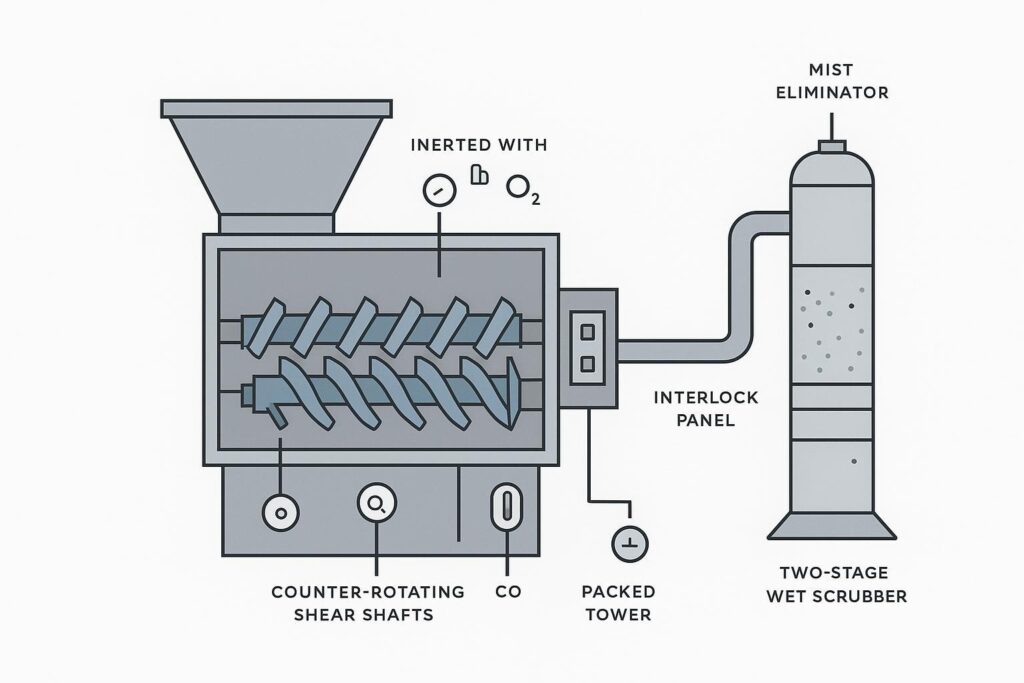
리튬이온 배터리(LIB) 감용 공정은 높은 저장 전기에너지, 가연성 전해액 증기, 전도성 분진, 부식성 가스 등 “기계적” 위험과 “화학적” 위험이 가장 치명적인 형태로 결합하는 작업 중 하나입니다.
본 가이드는 많은 시설에서 도입하고 있는 안전 설계(safety-by-design) 접근 방식에 초점을 맞춥니다. 저속 양방향 회전 전단 인터록, 모니터링, HF 처리 시설과 함께 제어된 분위기(불활성 가스 충진 또는 침매 방식)에서 수행되는 저속 전단 방식입니다. 본 가이드는 Maxtor Metal가 파쇄기 날 품질 및 검증 절차를 다룰 때 적용하는 문서화 우선(documentation-first) 원칙에 따라 작성되었습니다. 라인의 가동률을 유지하는 정밀한 세부 요소가 곧 안전을 지키는 핵심 요소이기 때문입니다.
시운전 초기, 현장 팀은 가동률 향상에 필요한 기본적 요소들(나이프 형상, 클리어런스 준수, QA 문서화)이 위험 관리 결과까지 결정짓는다는 점을 파악하게 됩니다. 파쇄기 날에 대해 정밀 검사 및 공차 사양이 일반적으로 어떻게 규정되는지 참조가 필요한 경우, Maxtor Metal 파쇄기 날 / 슈레더 나이프 페이지 가 실용적인 사례가 될 수 있습니다.
요약:
- 저속 전단 방식이 점화 에너지와 분진을 줄이는 이유 저속 전단 방식은 충격 에너지를 제한하고 고속 분쇄에 비해 마찰열 발생을 줄이며, 보다 제어된 거친 절단을 수행합니다. 이는 손상된 셀에서 가연성 가스가 배출될 때 화재 원인이 되는 국소 과열점(hot spot)과 부유 전도성 미세 분진 발생을 최소화합니다. 일반적인 저속 전단 파쇄기의 목적은 분쇄가 아닌 예측 가능한 절단입니다.
- 위험 프로필: 열폭주, HF 부식, 가동률 및 규제 준수 치명적인 사고는 단순한 화재에 그치지 않습니다. 열폭주는 주위로 전파될 수 있으며, 생성된 HF(불산)는 인체 상해와 설비 부식을 유발합니다. 또한 사고 발생 시 생산 중단, 보고 의무 발생, 인허가 취소 등의 심각한 결과로 이어질 수 있습니다.
- 본 가이드에서 다루는 내용(제어, 재질, 모니터링)과 다루지 않는 내용(자사 전용 설정) 본 가이드에서는 예방, 감지, 처리 제어에 대한 다층적 관점과 HF 노출 환경에 적합한 소재 선택 방안을 제공합니다. 다만, 관할 당국(AHJ), 공정위험성평가(PHA) 및 검증 테스트를 통해 자체 결정해야 하는 독자적인 설정값, 공급업체별 전용 레시피 또는 특정 수치는 포함되어 있지 않습니다.
컴플라이언스 필수 요건(규제 준수 기준)
최종 처리 시설에서의 파쇄 작업
미국 연방 범용 폐기물(Universal Waste) 프레임워크에 따라 배터리를 관리하는 경우, EPA는 다음 사항을 명확히 규정하고 있습니다. 범용 폐기물 취급자는 파쇄 작업을 수행할 수 없으며,— 파쇄는 최종 처리 시설 전용 작업입니다. EPA 규정에 따르면 배터리는 최종 처리 시설(예: 지정폐기물 재활용업체 또는 RCRA 허가를 받은 TSDF 시설)에 도착한 후 재활용을 위해 파쇄할 수 있으며, 도착 이후에는 기존과 동일한 범용 폐기물 규제를 적용받지 않습니다.EPA 리튬 배터리 재활용 규제 현황 FAQ (PDF)
핵심 요점: 다음 대상에 대한 SOP를 작성하는 경우 범용 폐기물 리튬 배터리 파쇄, 파쇄를 최종 처리 시설 공정으로 취급하고 인계 및 인수 기준을 명확히 문서화해야 합니다.
범용 폐기물 기준 및 역할 규정
범용 폐기물 제도는 유출 사고를 방지하는 관리 기준을 유지하면서 일반 유해 폐기물(배터리 포함)의 수거 및 관리를 효율화하기 위해 마련되었습니다. 관련 규정 구조 및 정의는 40 CFR Part 273 범용 폐기물 기준. 에서 확인할 수 있습니다. 주(State)별 프로그램이 연방 규정보다 엄격할 수 있으므로, Part 273을 연방 기본 기준으로 삼은 후 해당 주의 추가 규정 사항을 반드시 확인하시기 바랍니다.
HF 노출에 대한 OSHA/NIOSH 가이드라인
불화수소(HF)는 배터리 손상, 과열 또는 화재 발생 시 생성되며, 급성 인체 상해 위험과 장기적인 설비 부식을 유발하는 공정 위험 요소입니다.
작업자 보호 관점에서의 기준:
| 원천 | 미터법 | 항목 / 기준값 |
|---|---|---|
| 미국 직업안전보건청 | 허용 노출 기준(최고 농도) | 불화수소 3 ppm (최고 농도) — OSHA 불화수소 노출 기준 참조 |
| 미국 국립직업안전보건연구소 | 비상 대응 카드 | 건강 영향 및 권장 노출 기준 — 불화수소에 대한 NIOSH 비상 대응 카드 참조 |
| 미국 국립직업안전보건연구소 | 생명 및 건강에 즉시 유해한 농도 | 생명·건강에 즉각적 위험을 주는 농도 — 불화수소에 대한 NIOSH IDLH 값 참조 |
⚠️ 경고: HF에 의한 부상은 매우 심각하며 지연 발생할 수 있습니다. 따라서 모니터링, 개인보호구(PPE) 선정, 세안/세정 설비 준비, 의료 대응 계획 수립은 단순히 부수적인 EHS 작업이 아닌 공정 설계의 핵심 요소로 다루어져야 합니다.“
요약하자면: 배터리 파쇄는 범용 폐기물 규정에 따라 최종 처리 시설에서만 수행 가능한 작업이며, OSHA/NIOSH의 HF 노출 기준은 단순한 EHS 서류 작업이 아닌 핵심 공정 설계 인풋으로 반영되어야 합니다.
리튬 이온 배터리 파쇄 공정의 위험성

열폭주 유발 요인 및 전파
열폭주는 내부 단락, 기계적 충격, 과열 또는 제조 결함으로 인해 시작될 수 있습니다. 감용 및 파쇄 공정에서는 주로 전극 간 단락을 일으키는 압착 또는 전단, 분리막 손상, 잔여 충전 상태(SOC) 등 기계적 및 전기적 요인이 주된 원인이 됩니다. 배출(venting)이 시작된 후 산소와 점화원이 존재하는 경우 가연성 가스에 화재가 발생할 수 있습니다.
NFPA의 리튬 이온 배터리 관련 공공 지침은 일반 대중을 대상으로 작성되었지만, 핵심 요점은 재활용 공정에 그대로 적용됩니다. 배터리는 발화하여 심각한 화재를 일으킬 수 있으므로 “일반 폐기물”로 간주하지 않고 전용 취급 절차를 적용해야 합니다. 리튬 이온 배터리 화재 위험에 관한 NFPA 지침.
LiPF6 가수분해에 의한 HF 발생 및 부식
많은 LIB 전해액에는 LiPF6가 사용됩니다. 수분(습도, 세척수, 소화수, 습한 원료 등)이 존재하면 LiPF6가 가수분해되어 HF(불산)를 생성할 수 있습니다. 이는 사업장에서 작업자 노출 문제이자 설비 건전성 문제입니다. HF는 유리와 다양한 엘라스토머를 손상시키며, 부식에 취약한 합금의 부식 및 점식(pitting)을 가속화할 수 있습니다.
파쇄(size reduction) 공정 중 기계적 및 전기적 위험성
“저속” 작업이라 하더라도 파쇄 공정은 전형적인 산업 재해 위험을 유발합니다.
- 투입구에서의 기계적 협착점(pinch point) 및 비산 위험
- 끼인 모듈이 튀어 나오거나 이동할 때 발생하는 잔류 에너지(stored-energy) 위험
- 잔류 전압 및 전도성 이물질로 인한 감전/아크 위험
- 부적절한 위치에 미세 전도성 입자가 누적될 때 발생하는 분진 폭발/플래시 화재 위험
이를 관리하는 효과적인 방법은 파쇄기 셀을 단순한 “기계”가 아닌 명확한 경계, 센서 및 인터락을 갖춘 제어 대상 공정 유닛(controlled process unit)으로 취급하는 것입니다.
요약하자면: 리튬 이온 배터리(LIB) 파쇄 위험은 열폭주, 불산(HF) 형성 부식, 일반적인 기계적/전기적 위험에 이르기까지 다양하며, 파쇄기 셀을 제어 대상 공정 유닛으로 취급함으로써 이들을 통합 관리할 수 있습니다.
발화 방지를 위한 엔지니어링 제어 시스템
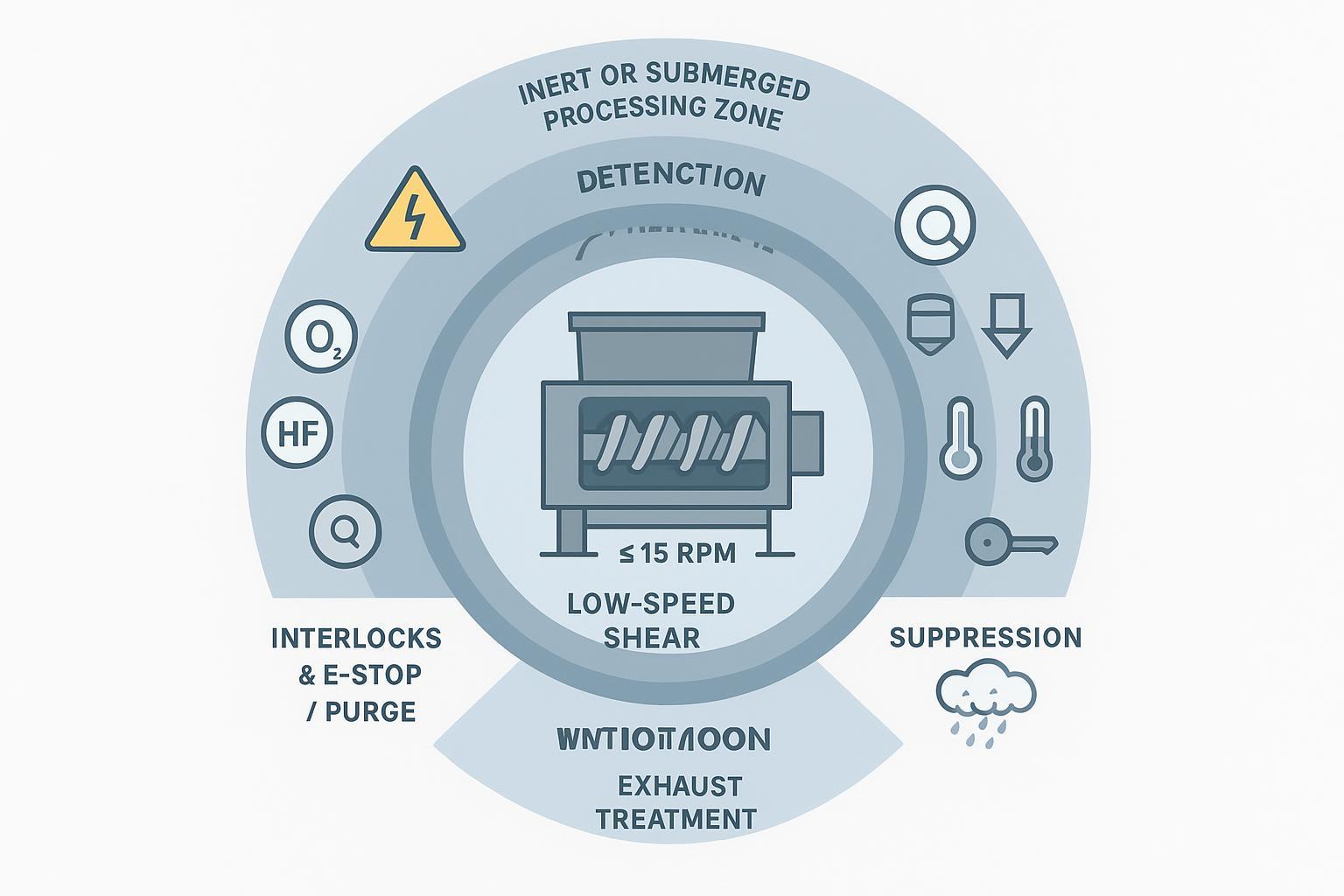
분위기 제어: 불활성화 또는 수중 공정
배터리 사고 사례에서 얻을 수 있는 한 가지 설계 교훈은 바로 산소 관리는 단기적 전술이 아니라 핵심 전략이라는 점입니다..
대표적인 두 가지 구조는 다음과 같습니다:
- 불활성 챔버 구조: 파쇄 챔버 및 바로 연결된 이송 구간을 밀폐하고 불활성화하여(주로 질소 사용) 누출된 전해액 증기가 인화성 혼합물을 형성할 가능성을 낮춥니다.
- 침매 / 습식 공정: 일부 라인에서는 절단 구역을 수중 침매 상태로 두거나 주수(flooding) 처리하여 열을 흡수하고, 비산 분진을 제어하며, 기상 점화 가능성을 낮춥니다.
두 방식 모두 “설치 후 방치'할 수 있는 시스템이 아닙니다. 실무적인 요구사항은 검증입니다. 즉, 과도 상태(투입량 변동, 걸림, 도어 개방, 유지보수 상태) 동안에도 분위기 제어가 실제로 유지됨을 입증해야 합니다.
≤15 RPM 대향 회전 전단 및 클리어런스
개요에서 ≤15 RPM을 강조하는 이유는 저속 샤프트 회전이 운동 에너지 전달을 제한하여 공정이 충격 분쇄(impact milling)로 변질되는 위험을 줄여주기 때문입니다. 그러나 더욱 세밀한 제어 요소는 클리어런스(간극) 관리 규율입니다..
저속 전단은 다음 조건에서 효과적으로 작동합니다:
- 공정이 격렬한 파열보다는 통제된 절단을 유도할 때
- 파쇄기가 손상되지 않은 셀을 반복적으로 타격하지 않을 때
- 칼날 간 및 칼날-고정날 간 클리어런스가 일정하게 검증되고 유지될 때
이러한 클리어런스 일관성을 뒷받침하는 공차 체인(기하공차(GD&T) 지시, 스페이서 선별 맞춤 및 조립 후 TIR 검증 포함)은 다음 내용에서 다룹니다: 다축 블레이드 공차 누적: GD&T 제어, 스페이서 선별 맞춤 및 조립 후 TIR 검증.
핵심 요점: LIB 파쇄의 경우 “저속” 자체만으로는 안전 제어가 완결되지 않으며,; 저속 + 제어된 전단 기하구조 + 제어된 클리어런스 + 분위기 제어 의 조합이 하나의 패키지로 작동해야 합니다.
감지, 인터락 및 수분/미스트 소화
감지는 위험한 공정을 통제 가능한 공정으로 전환해 주는 핵심 요소입니다.
실무적으로 적용되는 모니터링/인터락 구성은 다음과 같습니다:
- O2 모니터링 (불활성화 상태 검증 및 공기 유입 감지용)
- CO 모니터링 (초기 연소 지표)
- HF 모니터링 (작업자 보호 및 스크러버 설치 시 세정 성능 확인용)
- 온도 주요 지점(챔버, 베어링, 배기구, 하류 이송부)에서
- 모터 전류 / 토크 트렌드 (걸림 및 이상 마찰 지표)
인터락은 단순 경보가 아닌 실행 결과 중심으로 설계되어야 합니다:
- 경보 발생 → 제어된 정지 또는 투입 중지
- 경보 발생 → 불활성 퍼지 / 차단 시퀀스 작동
- 경보 발생 → 수분/미스트 또는 살수 장치(deluge) 작동 (설비 소방 전략에서 지원하는 경우)
Maxtor Metal의 슈레더 나이프 기술 문서는 유사한 트렌드 기반 로직을 따릅니다. 마모 및 클리어런스 데이터는 시운전 시 단 한 번만 검증하는 것이 아니라 각 유지보수 주기마다 추적 관리됩니다.
폐리튬이온 배터리에 대한 미국 환경청(EPA) 지침은 실무적 현실을 강조합니다. 즉, 리튬 배터리는 취급 및 운송 중 화재를 일으킬 수 있으므로 예방과 분리가 핵심입니다.폐리튬이온 배터리에 대한 EPA 지침.
대응 플레이북 (비수치적)
본 가이드의 실용성을 유지하기 위해 없이 안전이 검증되지 않은 “매직 넘버'를 공개하기보다는, 명확한 작업자 조치와 연동된 트렌드 및 상태 기반 트리거를 사용하십시오.
O₂ 농도가 상승 트렌드를 보이거나 챔버 압력이 변동할 경우 (공기 유입 가능성)
- 원료 투입 중단 및 라인을 제어 상태로 유지
- 도어 씰, 점검 포트 및 샘플링 라인의 밀폐성 검증
- Restore inerting and confirm stability before resuming
If CO appears or rises (early combustion indicator)
- Stop feed and upstream conveying
- Follow the site’s escalation path (operator → EHS → incident response)
- Execute the predefined isolation / purge / suppression sequence for the shredder cell
If HF alarms or acid mist is suspected (exposure + corrosion risk)
- Stop feed; keep personnel out of the cell boundary until conditions are verified
- Confirm scrubber + mist eliminator function; inspect sample conditioning (filters, moisture separators)
- Resume only after the cause is identified and controls are restored
If chamber temperature rises abnormally (process upset)
- Stop feed; verify no mechanical binding or repeated “hammering” of intact cells
- Check bearing temperatures and exhaust temperature trends; inspect for abnormal friction sources
If motor current / torque becomes unstable (jam / abnormal friction)
- Stop feed; execute the jam-recovery procedure (do not force restart)
- Require post-event inspection and supervisor authorization before resuming
메모: Treat transient states—door opening/closing, restart, material transition, and blockage recovery—as the highest-risk scenarios for drift, air ingress, and control-logic gaps. Validate interlocks specifically in these states during FAT/SAT and recurring EHS drills.
요약하자면: no single control is sufficient—low-speed shear, clearance discipline, atmosphere control, and outcome-based interlocks function together as one layered system.
나이프 재질 및 파쇄날 선정
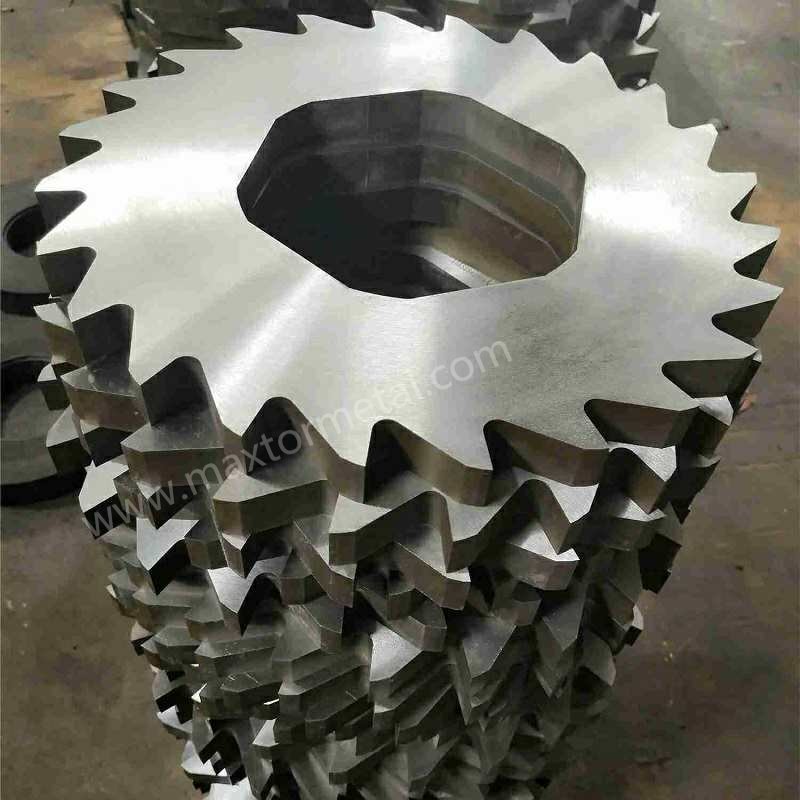
AISI 440C: wear benefits, HF limits, mitigations
AISI 440C is often chosen where wear resistance and edge retention matter, and it performs well in many abrasive, mixed-feed shredding environments. But HF changes the conversation.
Practical limitations in HF-exposed service:
- HF can accelerate corrosion and pitting at vulnerable sites (crevices, threads, under deposits)
- Corrosion can undercut the edge and degrade predictable wear patterns
Mitigations to consider:
- Keep HF in the gas path controlled with upstream scrubbing and mist elimination (don’t let acid mist become “ambient”)
- Favor designs that minimize crevices and trapped condensate
- Use inspection intervals and replacement criteria tied to measured corrosion, not calendar time
In programs Maxtor Metal has supported for corrosive-feed applications, knife deliveries included CMM dimensional reports and heat-treatment certifications — giving maintenance teams traceable baseline records for wear inspection and audit-ready commissioning.
Wetted components, seals, and coatings for HF
For wetted and condensate-prone areas (scrubber inlets, mist eliminators, drains, and any “cold spots” that condense acids), prioritize materials compatibility.
At a high level:
- Select elastomers and plastics based on verified HF compatibility in your concentration/temperature range
- Avoid mixed-metal galvanic couples in wet acidic zones
- Treat coatings as systems: surface prep, thickness control, holiday testing, and repair procedures matter as much as the nominal coating name
Maxtor Metal specifies wetted-component material compatibility at the design-review stage for corrosive-feed projects, rather than leaving it to field substitution after installation.
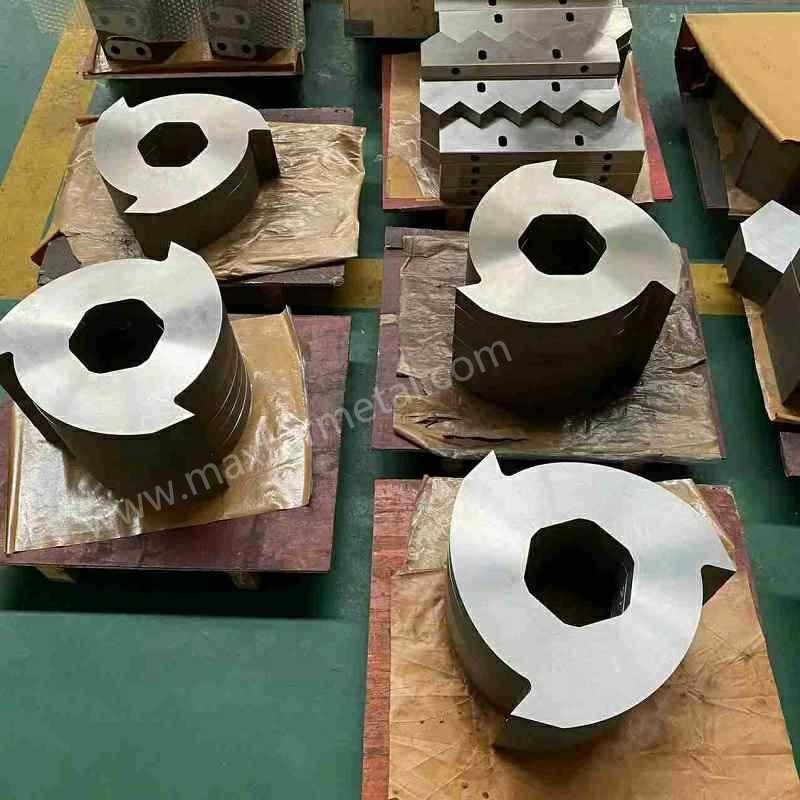
Installation tolerances and quick-change strategy
The fastest way to turn a safety design into an incident is to let installation drift.
A robust approach includes:
- Documented tolerances for knife seating, parallelism, and runout
- A repeatable quick-change procedure that preserves the critical geometry
- A verification step after every knife change (not just after “major” maintenance)
This is also where technical procurement and maintenance meet: if your replacement knives do not reliably meet the required tolerances, you inherit both uptime risk and hazard risk.
Maxtor Metal’s shredder knife line documents seating, parallelism, and runout tolerances as part of standard delivery, so this verification step doesn’t depend on the buyer reverse-engineering acceptance criteria.
For a complete incoming-inspection workflow covering GD&T spec control, CMM sampling plans, and MTR documentation for shredder knives, see 애프터마켓 파쇄기(shredder) 나이프 조달: 사양 관리, CMM 계획, MTR 검증 및 기능적 적합성 검증..
요약하자면: 440C remains a strong wear-resistance choice for HF-exposed shredding, provided corrosion is managed through upstream scrubbing, crevice-minimizing design, and condition-based (not calendar-based) replacement.
HF(불화수소) 배기 및 폐수 처리 공정
Two-stage wet scrubbing: venturi + packed tower
When HF and acid mists are credible byproducts, off-gas treatment is part of the process boundary.
A common high-level architecture is:
- Venturi scrubber (high-energy contact to capture fine droplets/particles and knock down soluble gases)
- Packed tower (additional contact time for mass transfer and neutralization)
The exact chemistry and operating targets are site-specific, but the design intent is universal: keep corrosive and toxic species out of occupied areas and out of downstream equipment.
Mist elimination and continuous HF monitoring
Mist elimination is easy to under-budget and expensive to ignore.
If acid mist leaves the scrubber:
- It corrodes ductwork and fans
- It creates exposure risk in maintenance tasks
- It contaminates sensors and causes false confidence
Where HF monitoring is deployed, treat it like an instrumented safety function: calibration discipline, sample conditioning, and defined responses to sensor fault states.
Fluoride precipitation and sludge handling
Scrubbing and neutralization often convert gaseous HF into fluoride-containing wastewater streams.
At a conceptual level, facilities commonly plan for:
- Fluoride precipitation/neutralization steps (chemistry chosen to meet discharge requirements)
- Solid-liquid separation
- Managed handling and disposal of fluoride-bearing sludge under applicable waste rules
Do not treat this as a “utilities” afterthought. If wastewater handling is capacity-limited, it becomes a throughput constraint.
요약하자면: HF treatment doesn’t end at the scrubber outlet—mist elimination and fluoride-bearing sludge handling are equally load-bearing parts of the system.
FAQ
Q: 리튬 이온 배터리 파쇄 공정의 주요 위험성은 무엇입니까?
열폭주(Thermal runaway)와 화재가 가장 대표적인 위험이지만, 입도 분쇄(Size reduction) 공정 중에는 HF(불화수소)를 포함한 유독성/부식성 배ोग가스 발생, 전도성 분진으로 인한 단락 위험, 그리고 전기적·기계적 위험에도 직면하게 됩니다.
Q: 리튬 이온 배터리 파쇄 시 저속 전단 방식이 더 안전한 이유는 무엇입니까?
저속 전단 방식은 고속 충격 분쇄 방식에 비해 충격 에너지와 마찰열 발생을 크게 줄여주며, 공기 중으로 비산되는 미세 분진의 양을 최소화합니다. 특히 정밀하게 제어된 칼날 간격(Clearance) 및 불활성 분위기 제어 기술과 결합할 때 안전성이 극대화됩니다.
Q: 범용 폐기물 규정(Universal Waste Rules)에 따라 리튬 이온 배터리를 파쇄할 수 있습니까?
미국 환경보호청(EPA)은 범용 폐기물 처리업자가 일반 관리 활동으로서 배터리를 파쇄하는 것은 불가능하다고 명시했습니다. 재활용을 위한 파쇄 및 분쇄 공정은 반드시 인가된 최종 처리 시설(Destination facility)에서만 수행되어야 합니다.
Q: 불활성 분위기가 조성된 배터리 파쇄실(셀) 내에는 주로 어떤 센서들이 사용됩니까?
일반적으로 배터리 재활용 설비에서는 산소 농도(불활성화 검증용), 일산화탄소(연소 징후 지표), 온도, 그리고 모터의 전류 및 토크 변동 트렌드를 모니터링합니다. HF(불화수소) 가스 누출 위험이 있는 공정의 경우, 작업자 노출 방지 및 배기 검증을 위해 HF 모니터링 시스템이 추가될 수 있습니다。
Q: 불화수소(HF) 노출에 대한 OSHA 및 NIOSH의 허容 기준(노출 한도)은 무엇입니까?
OSHA는 불화수소에 대해 3 ppm의 허용 노출 기준(PEL)을 최고 함량 한도(Ceiling)로 규정하고 있습니다. NIOSH는 권장 노출 한도(REL) 및 급성 위험 계획 값을 제공합니다.
Q: 리튬 이온 배터리 파쇄 및 재활용 과정에서 HF(불화수소)는 어떻게 생성됩니까?
HF는 LiPF6(육불화인산리튬)와 같은 전해질 염이 수분(공기 중의 습도, 세척수 또는 소화용수)과 반응할 때 형성될 수 있으며, 배터리의 과열 및 화재 사고 중에도 열분해를 통해 발생할 수 있습니다.
Q: 배터리 파쇄 공정 중 발생하는 HF(불화수소) 배출을 제어하는 실용적인 방법은 무엇입니까?
파쇄기(슈레더)를 완전 밀폐형 공정 장치로 취급하고, 배오가스를 고성능 미스트 제거기(Mist eliminator)가 장착된 습식 스크러버(Wet scrubbing) 시스템으로 이송해야 합니다. 이와 함께 산성 미스트가 작업장 내부로 유입되는 것을 방지하기 위한 정기적인 모니터링 및 유지보수 절차가 병행되어야 합니다.
Q: 배터리 파쇄 공정 중 초기 운전 이상(Upset conditions)을 감지하기 위해 어떤 KPI(주요 지표)를 모니터링해야 합니까?
처리량(Throughput)의 안정성, 입도 분포의 변화(특히 미분 발생 비율), 모터 전류 및 토크 트렌드, 주요 부위 온도(파쇄실 내부/배기/베アリング 및 축전지), 그리고 모니터링 센서가 설치된 경우 HF(불화수소)의 ppm 농도를 상시 점검해야 합니다.
결론
- Recap: controls to cut ignition, HF exposure, and downtime/ton The safest LIB shredding lines don’t rely on a single control. They stack low-speed shear, controlled atmosphere (inert or submerged), gas/temperature/current monitoring with interlocks, 그리고 suppression + scrubbing so that a bad cell becomes a managed upset, not an incident.
- KPIs: throughput stability, particle size control, current draw, temp, HF ppm Track a small set of “truth” signals:
| KPI | 목적 |
|---|---|
| Throughput stability | Detect unexplained process drift |
| Particle size distribution stability | Catch sudden fines spikes |
| Motor current trend | Proxy for friction/jam risk |
| Temperature (chamber/exhaust/bearings) | Early process-upset indicator |
| HF ppm (where measured) | Workplace exposure & exhaust verification |
The same documentation discipline that supports commissioning—traceable knife records, lot-level QC packs, and CMM reports—is standard practice in Maxtor Metal’s shredder knife supply; see the audit-ready procurement guide for a compatible receiving-dossier structure.
- Next steps: AHJ coordination, validation tests, SOP updates Coordinate early with your AHJ and permitting contacts, then validate controls with controlled tests: loss-of-inerting scenarios, jam recovery, shutdown and door-open states, and sensor/interlock proof testing. Update SOPs so maintenance and knife changes preserve the same verified clearances and safety functions.When you’re tightening up commissioning documentation, it can help to benchmark how knife tolerances and inspection are specified in practice; the shredder knife tolerance and inspection specifications provide concrete examples of tolerance language and inspection methods.
Jerry Chu — Technical Support Specialist, After-sales Service, Maxtor Metal. Jerry has 10년 of cross-industry field experience (papermaking, plastics recycling/shredding, metal slitting, woodworking) helping resolve practical cutting issues such as burrs, excessive dust, and unstable cut quality.
자격증: PMP, CMRP.
검토, 적용 범위 및 문서 버전
- 범위: Information-only best-practices guidance for engineering/EHS planning. It does not replace site-specific hazard analysis, OEM instructions, or requirements from your Authority Having Jurisdiction (AHJ).
- How to use: Validate controls, interlocks, and operating procedures through PHA/HAZOP and commissioning tests (FAT/SAT) before production.
- 버전: v1.1
- 최종 업데이트: 2026-07-12
검증 스냅샷(익명화): 인터록(Interlock) 및 다중 파라미터 모니터링 로직
The following anonymized commissioning snapshot illustrates 어떻게 facilities commonly verify interlocks and multi-parameter monitoring logic without disclosing sensitive setpoints or control code.
목적
Verify that the interlock stack can detect abnormal conditions and maintain the intended safety boundary during transient states—not merely that individual sensors function in isolation.
Covered signals (trend-based)
- O₂ trend
- CO trend
- HF monitoring effectiveness (sampling integrity + conditioning)
- Shredder chamber temperature
- Main motor current/torque trend
- Conveyor synchronization status
Method (as part of SAT)
Validation ran across multiple shifts and included typical operating states:
- Normal continuous feeding
- Simulated high-SOC battery mix-in scenario
- Blockage recovery
- Restart after shutdown
- Maintenance door open/close confirmation
- N₂ system switching drill
- Sensor inspection and alarm-function checks
All alarms and responses were compared using PLC event logs and SCADA historical trends, with emphasis on Sequence of Events (SoE) correctness rather than chasing fixed numeric targets.
Observed learnings (trend-level)
- Door open/close produced the clearest transient response: O₂ exhibited brief fluctuations and chamber pressure shifted slightly after door closure—highlighting that seal recovery speed can be more critical than machine response time.
- Blockage recovery showed higher process variability: after clearing a jam, motor current fluctuations increased, chamber temperature rose temporarily, and gas-trend stability degraded for a short period—making recovery phases a priority target for interlock protection.
- Acid mist influenced sampling maintenance intervals: after continuous operation, HF sampling remained functional, but sampling filters accumulated deposits and moisture separators required earlier maintenance; maintenance intervals were adjusted accordingly.
- Operator behavior changed alarm frequency: gradual feed reintroduction reduced nuisance current alarms compared with “full-load immediately” restart behavior; SOPs were updated and operator simulation training was added.
Automatic actions on interlock activation (generic)
- Stop material feeding and upstream conveying
- Maintain shredder rotation per the programmed safe sequence
- Activate suppression and/or inerting support where applicable
- Notify operator and EHS
- Require alarm acknowledgment before restart
- Record complete event history for investigation
Post-validation improvements (examples)
- Door seal inspection strengthened; gasket replacement checklist added
- Sampling-line cleaning frequency increased; routine sensor-response verification added
- Restart confirmation logic added to prevent immediate full-feed after an alarm clears
- Training expanded for blockage recovery, maintenance restart, and alarm acknowledgment
요약하자면: transient states—door openings, restarts, and blockage recovery—produced the largest deviations in this SAT validation, making them the priority target for interlock testing.
Public-information limits
Public summaries typically avoid disclosing: numeric setpoints (O₂/CO/HF), control code, SIS configuration, N₂ flow strategy, suppression start conditions, SOC ratios, customer throughput, equipment models, and detailed time-stamped event timelines.
참고 문헌 및 적용 표준(발췌)
Government / official guidance
- EPA — Lithium Battery Recycling Regulatory Status (FAQ PDF). https://rcrapublic.epa.gov/files/14957.pdf
- eCFR — 40 CFR Part 273: Standards for Universal Waste Management. https://www.ecfr.gov/current/title-40/chapter-I/subchapter-I/part-273
- OSHA — Hydrogen Fluoride: Exposure Limits. http://www.osha.gov/chemicaldata/622
- NIOSH — Emergency Response Card: Hydrogen Fluoride. https://www.cdc.gov/niosh/ershdb/emergencyresponsecard_29750030.html
- NIOSH — IDLH: Hydrogen fluoride. https://www.cdc.gov/niosh/idlh/7664393.html
- NFPA — Lithium‑ion battery fire risk (public guidance). https://www.nfpa.org/education-and-research/energy-transition/lithium-ion-batteries
- EPA — Used lithium‑ion batteries (handling and fire-prevention guidance). https://www.epa.gov/recycle/used-lithium-ion-batteries
Standards bodies (for further reading and project-specific compliance mapping)
- NFPA — Codes & standards catalog (includes fire protection and related standards). https://www.nfpa.org/codes-and-standards
- UL Standards — Standards catalog (includes battery safety standards; confirm the exact applicable standard(s) for your products and process). https://www.ulstandards.com/
- IEC — Standards catalog (international electrotechnical standards; confirm applicability). https://www.iec.ch/standards
- ANSI — Standards catalog (U.S. national standards portal). https://www.ansi.org/standards

 English
  Spanish
  Italian
  French
  Portuguese
  Russian
  German
  Arabic
  Hindi
Hindi  Vietnamese
  Indonesian
  Japanese
  Korean