

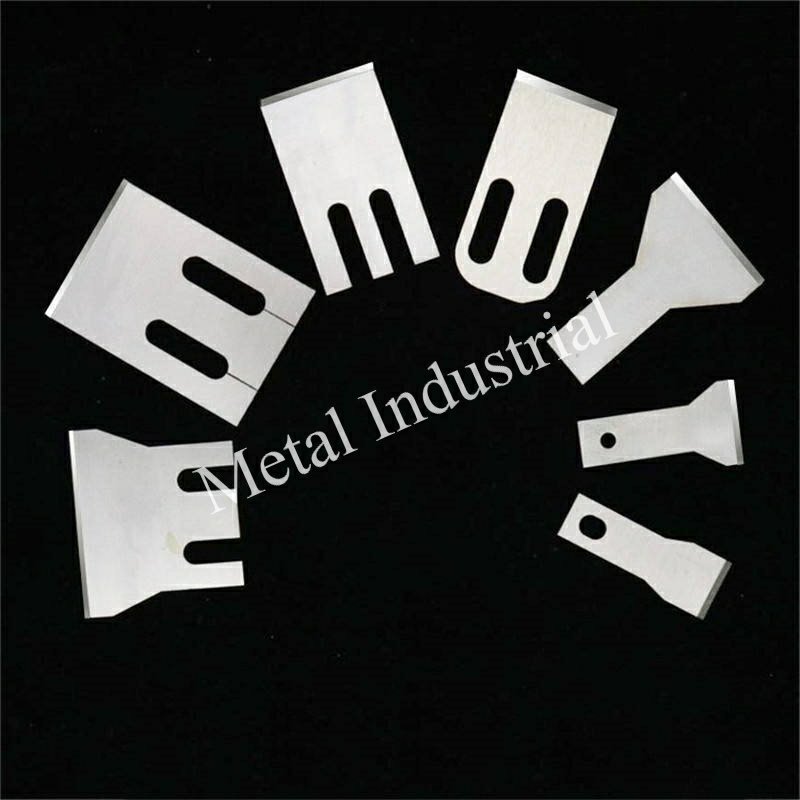
Краткий ответ: Налипание на ножи при подводной грануляции ТПУ — это системная проблема, а не просто вопрос выбора покрытия. Самое быстрое решение — сначала устранить причину механизма (восстановить стабильность плоскости реза и равномерность охлаждения), а затем подбирать покрытия: DLC на режущих кромках для обеспечения твердости и низкого трения, и PTFE на нерабочих поверхностях с низким износом для снижения адгезии. Использование покрытия DLC без устранения соосности или теплового дрейфа редко дает устойчивый результат — только проверенные рабочие интервалы и учет KPI обеспечивают стабильный эффект.
Налипание материала на ножи при подводном гранулировании ТПУ (на головке) обычно проявляется одинаково: поверхность гранул начинает размазываться, количество «хвостов» (на производстве часто называемых «ангельскими волосами») увеличивается, а содержание мелкой фракции растет, пока сита сушилки или водяные фильтры не укажут на проблему.
Самое неприятное заключается в том, что сам нож редко является единственным фактором. Адгезия — это системный эффект: здесь накладываются реология расплава на выходе из фильеры, условия охлаждения, кинематика ножа и поверхностная энергия в зоне резания.
В практике работы Maxtor Metal с ножами для водокольцевых и подводных систем самые быстрые результаты обычно достигаются, когда налипание рассматривается как механизм + поверхность + технологическое окно проблема, а не как задача “заточить поострее”. Если вы также эксплуатируете водокольцевую или подводную систему, требующую квалификации ножевой головки перед вводом в эксплуатацию, руководство Maxtor Metal по биению, классу балансировки и допустимому уровню вибрации для ножевых головок водокольцевых грануляторов охватывает всю схему квалификации, которая лежит в основе стабильной резки на головке, включая те же правила контакта и выравнивания, которые обсуждаются здесь.
В этой статье объясняется, почему налипание материала на ножи приводит к резкому росту количества «хвостов» и мелкой фракции в сценариях налипания материала на ножи при подводном гранулировании ТПУ , что влияет на адгезию (температура, вода, контакт, покрытия), и предлагается практический план действий: механизмы → покрытия → технологические окна → валидация/окупаемость (ROI).
Эта же логика обычно применима к ЭВА и другим высоковязким, липким эластомерам, где рез должен быть чистым, а и свежесрезанная поверхность должна быстро охлаждаться.
Ключевой вывод: Если количество «хвостов» и мелкой фракции растет одновременно, считайте, что резка на головке больше не является чистым сдвигом. Исправьте механическую часть (выравнивание/контакт + охлаждение), а затем подберите покрытия для снижения адгезии и замедления повторного износа.
Механизмы отказов и причины налипания на ножи при подводной грануляции ТПУ
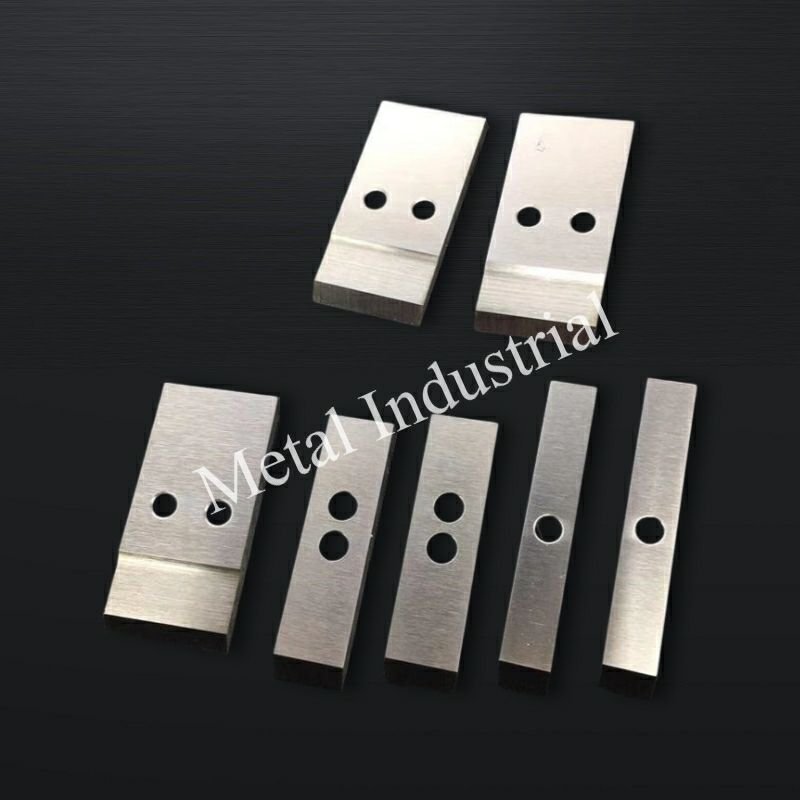
Термическое образование корки и липкость
ТПУ (и многие марки ЭВА) могут образовывать липкую поверхностную “корку” на выходе из фильеры, если поверхность охлаждается недостаточно быстро по сравнению со скоростью подачи. Эта корка приводит к двум последствиям, ухудшающим качество гранул:
- Она увеличивает адгезионный перенос материала на кромку ножа и поверхность фильеры.
- Она превращает то, что должно быть чистым сдвигом, в размазывание и разрыв , что приводит к образованию «хвостов», которые позже разрушаются, превращаясь в мелкую фракцию.
Что обычно приводит к такому режиму отказа:
- Слишком высокая температура расплава/фильеры для текущей рецептуры и производительности (поверхность остается мягкой в момент реза).
- Слишком высокая температура технологической воды или ее недостаточная скорость у поверхности фильеры (задержка охлаждения).
- Переходные процессы при запуске (поверхность фильеры еще не стабилизировалась по температуре; параметры водяного контура колеблются).
Полезный общий обзор процесса подводного гранулирования и роли быстрого охлаждения представлен в справочнике по пластмассам MAAG:, Руководство по пластмассам (MAAG Group, 2021 PDF).
Контакт и выравнивание ножа и фильеры
Чистый рез на головке зависит от стабильной плоскости резания. Две производственные реалии обычно нарушают эту стабильность:
- Износ режущей кромки ножа (скругленная кромка увеличивает площадь контакта → больше адгезии и нагрева).
- Износ / образование канавок на поверхности фильеры (расплав цепляется и растягивается, а не срезается).
Несоосность усугубляет обе проблемы. Если траектория ножа не остается концентричной поверхности фильеры, возникает неравномерное давление контакта: одна сторона трется (нагрев + размазывание), другая — недорезает (образование «хвостов»).
С точки зрения устранения неполадок, Plastics Technology отмечает износ фильеры/ножа и их настройку как основные первопричины ухудшения качества гранул при подводном гранулировании (а не только последующую транспортировку и обработку). См. Предотвращение и устранение проблем при подводном гранулировании (Plastics Technology, 2020) для ознакомления с практическими проверками состояния поверхности фильеры, настройки узла резки и стабильности процесса.
Химический состав воды и кавитация
В большинстве обсуждений налипания основное внимание уделяется температуре, однако состояние воды может незаметно привести к адгезии и нестабильной резке:
- Жесткость/накипь могут изменять пограничные слои у поверхности фильеры и нарушать локальный поток.
- Наличие мелкой фракции в контуре может создавать “притирочную суспензию”, которая ускоряет микроизнос кромки ножа и поверхности фильеры.
- Кавитация / аэрация вблизи корпуса узла резки могут дестабилизировать давление и микроохлаждение непосредственно в зоне резания.
Вам не нужен идеальный химический состав воды — вам нужен стабильный химический состав воды и стабильная гидравлика. Если налипание (комкование) полимера внезапно появляется после того, как “ничего не менялось”, проверьте, что изменилось в водяном контуре: перепад давления на фильтре (DP), состояние насоса, наличие воздуха в системе и загрязнение теплообменника.
Суммируя: налипание полимера на ножи при подводном гранулировании ТПУ вызвано тремя накладывающимися факторами: образованием термической корки на выходе из фильеры, нестабильностью плоскости резания и отклонениями в водяном контуре. Все три фактора должны быть под контролем, прежде чем покрытия смогут выполнять свою задачу.
Покрытия: PTFE против DLC
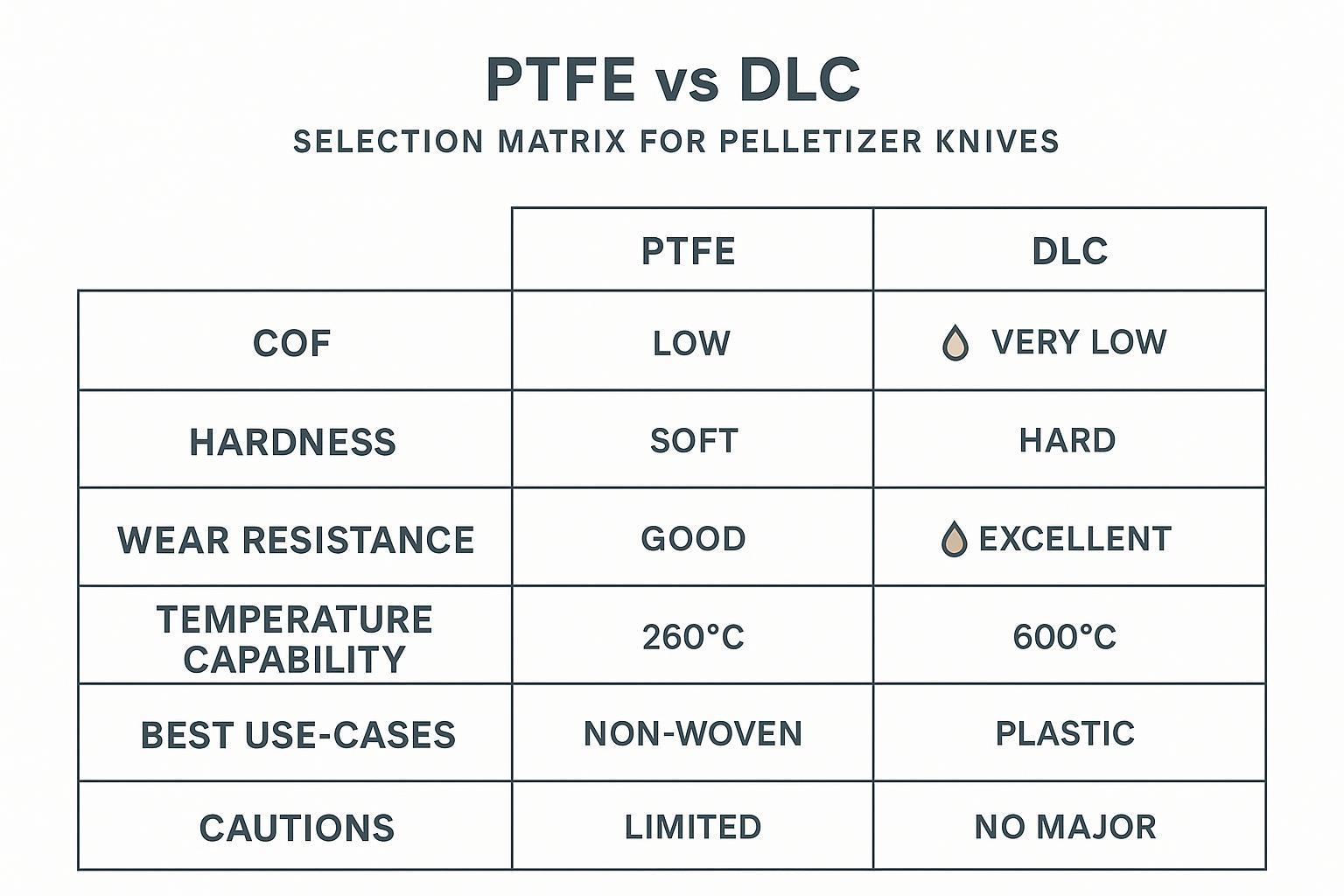
Покрытия не исправят дефекты плоскости резания. Но как только контакт и охлаждение взяты под контроль, покрытия могут выполнять две важные задачи:
- Снижать поверхностную энергию / трение в зоне контакта, чтобы снизить вероятность переноса и налипания ТПУ.
- Замедлять повторный износ, который превращает острую кромку в заминающую.
На ножах для грануляторов PTFE и DLC ведут себя совершенно по-разному, поэтому правильным решением обычно является “DLC там, где режете, PTFE там, где скользит”, а не выбор «или-или».
Свойства и ограничения PTFE
Финишные покрытия из PTFE популярны для липких полимеров благодаря своим антиадгезионным свойствам и низкому коэффициенту трения. В программах разработки ножей для грануляторов от Maxtor Metal для липких эластомеров покрытия из PTFE наносятся в виде тонких фторполимерных слоев для снижения адгезии на поверхностях, не являющихся режущими кромками, где контактное давление невелико — типичная толщина составляет единицы микрон.
Где PTFE помогает больше всего:
- Зоны с низкой нагрузкой, где начинается перенос полимера (например, нережущие грани, подверженные налипанию).
- Короткие циклы работы, где преобладает адгезия, а абразивный износ минимален.
Где PTFE обычно не оправдывает ожиданий:
- Основная режущая кромка при работе в условиях высокого контактного давления и микроабразивного износа.
- Потоки с наполнителями или загрязнениями, где покрытие быстро истирается.
Другими словами: PTFE — это средство против прилипания, а не износостойкая броня.
Свойства и разновидности DLC-PVD
DLC (алмазоподобное углеродное покрытие) — это семейство тонких углеродных пленок, наносимых методами PVD/PACVD. На практике ценность DLC в данном случае заключается в сочетании:
- Низкого трения (помогает снизить перенос материала)
- Высокой твердости (помогает замедлить скругление кромки)
В инжиниринге ножей Maxtor Metal для систем торцевой резки DLC (вариант a-C:H) является предпочтительным покрытием для режущих кромок на линиях ТПУ/ЭВА: наносимое методом PVD на микронном уровне, оно сочетает в себе низкую поверхностную энергию и твердость, необходимую для замедления скругления кромки.
Два практических замечания для инженеров:
- Варианты DLC различаются (водородсодержащие и легированные типы). Поставщик покрытия должен четко указать назначение (скольжение/адгезия или высокая ударная нагрузка).
- DLC не является панацеей против сильноабразивных сред; при работе с высоконаполненными материалами или загрязненным вторичным сырьем геометрия кромки и выбор материала основы по-прежнему играют решающую роль.
Для производств, использующих специальные сменные пластины WC–Co на тех же системах торцевой резки, взаимодействие между твердостью пластины (HRA 88–92), прочностью пайки и контактным давлением на фильеру определяет, сможет ли покрытие DLC или PTFE работать должным образом — см. наше руководство по выбору марок твердосплавных пластин из карбида вольфрама, пайке и контролю контакта для подводных грануляторов.
For glass-fiber-loaded compounds where substrate selection is the primary decision — comparing M390 and CPM S90V on abrasive wear resistance, corrosion defense, and grindability in thin blade geometries — see our guide on PM stainless pelletizer blade grade selection under high glass-fiber wear.
Если вам необходимо ознакомиться с тем, как обычно подтверждаются заявления о трении/износе, наиболее распространенным методом испытаний в трибологической литературе является метод «штифт-диск» (pin-on-disk). Стандартным методом является ASTM G99 (Испытания на износ на установке «штифт-диск»).
Базовые принципы трибологии DLC (почему водородсодержащие пленки a-C:H часто обеспечивают низкое трение и хорошую износостойкость, и почему важна окружающая среда/сопряженная поверхность) изложены в кратком обзоре в открытом доступе: Tribological Properties of DLC Coatings in Model-Based and Real Contacts (открытый доступ, 2025).
Матрица выбора по сценариям
Используйте это как практическое руководство для принятия решений непосредственно на производстве:
- ТПУ/ЭВА (липкий, с низким содержанием наполнителя), налипание является основной проблемой
- Начните с: полированная режущая фаска + DLC на режущей кромке / рабочей грани
- Дополнительно: PTFE на нережущих гранях, где происходит налипание
- ТПУ с частой сменой рецептуры и частыми пусками/остановами
- В приоритете: DLC для долговечности + строгое соблюдение температурного диапазона во избежание образования корки
- Используйте PTFE умеренно на участках, где его легко обслуживать
- Наполненный ЭВА / загрязненное вторичное сырье (абразивный водяной контур)
- В первую очередь боритесь с износом: материал основы + геометрия + фильтрация
- DLC может помочь, но износ останется лимитирующим фактором; PTFE обычно быстро сотрется
- Если на фильере уже образовались канавки
- Покрытия не устранят образование «хвостов». Сначала восстановите плоскость резания (ремонт фильеры + центровка), а затем наносите покрытие.
Суммируя: DLC должно наноситься на режущую кромку для обеспечения твердости и контроля трения; PTFE — на нережущие грани для защиты от прилипания. Рассматривать их как альтернативу, а не как дополнение друг к другу — самая распространенная ошибка при выборе покрытия.
Рабочие интервалы (параметры процесса)
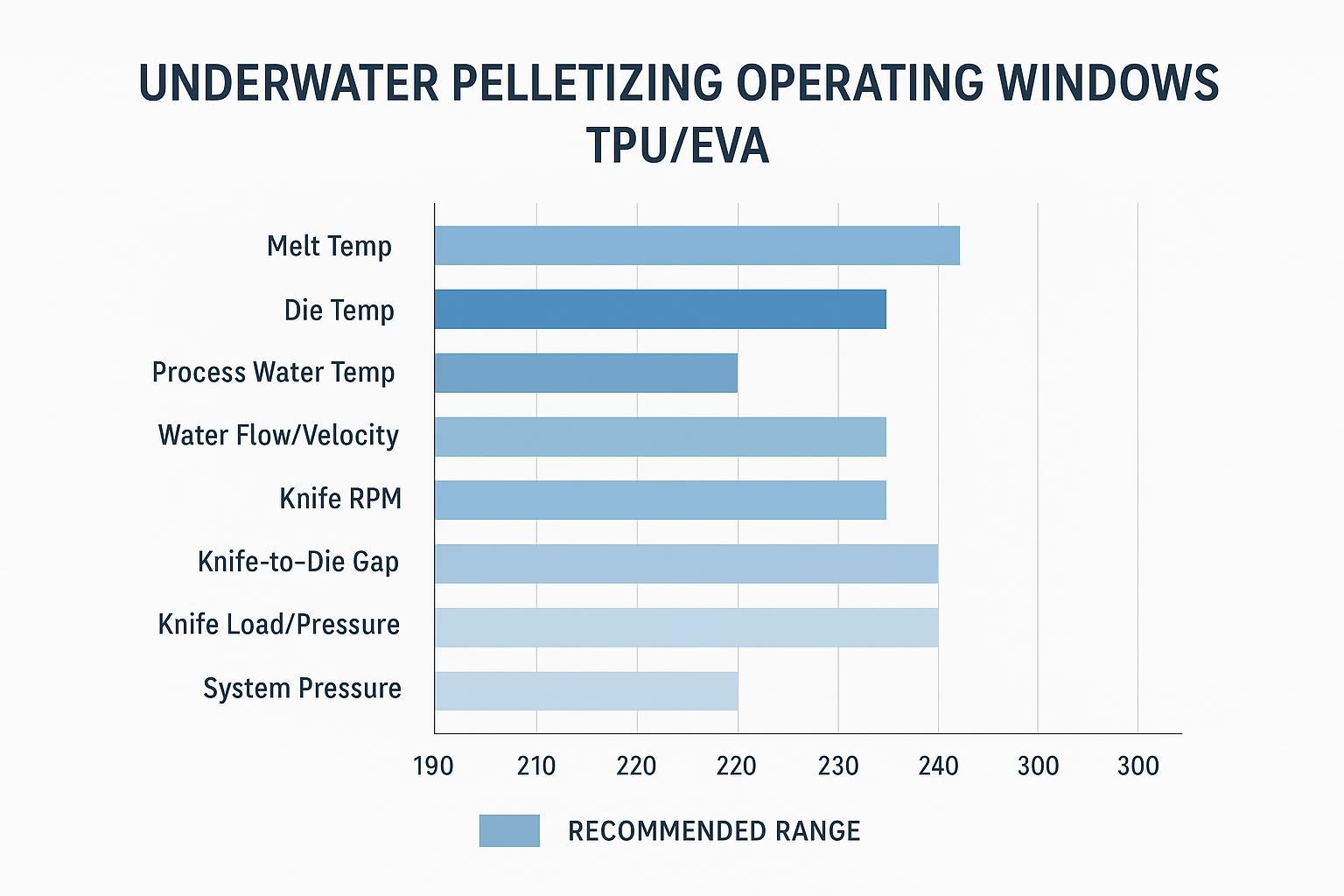
Цель “рабочего диапазона” — не найти одну волшебную уставку, а определить интервал, в котором:
- the die exit is hot enough to avoid freeze-off
- the pellet surface quenches fast enough to avoid tack
- the knife sees stable contact without rubbing heat
Treat the ranges below as начальные окна that must be validated on your specific die geometry, throughput, and recipe.
Thermal setpoints (TPU/EVA)
Practical heuristics that usually reduce gumming risk:
- Reduce peak melt temperature until torque/pressure stability starts to degrade, then step back up slightly.
- Keep die face temperature stable (avoid oscillation that alternates freeze-off and smear).
What failure looks like when you miss the window:
- Too hot: smear, stringing/tails, pellet-to-pellet sticking.
- Too cold: die freeze, hole blockage, surging, broken pellets (fines).
Water system: temp/flow/pH
Water has to do two jobs at once: quench the pellet surface and carry pellets away without letting them collide, smear, and agglomerate.
Best-practice checks:
- Water temperature: stabilize first; don’t tune knife load while water temperature is still drifting.
- Flow/velocity at die face: verify you have enough local velocity to sweep pellets away immediately after cut.
- Filtration and DP trend: log filter differential pressure and cleaning intervals; rising DP often correlates with rising fines.
- pH / hardness consistency: keep it consistent; sudden scale or corrosion products can destabilize the cut zone.
Knife setup, gap, pressure
For tacky elastomers, the knife setup is usually where small changes produce big quality swings.
Set-up discipline that prevents gumming from coming back:
- Knife-to-die gap / contact: aim for a stable cutting condition that’s consistent across the full rotation.
- Выравнивание: verify concentricity and runout before “tuning” process temperatures.
- Knife speed vs throughput: tails often indicate a mismatch—either too slow for the melt flow, or unstable contact that prevents clean shear.
⚠️ Предупреждение: If you “solve” tails by increasing knife pressure until they disappear, you may simply be accelerating die-face wear. Validate with die-face inspection intervals, not only pellet appearance.
Applicability & prerequisites (read before copying the window)
The mechanism and troubleshooting logic in this guide is broadly transferable, but the exact operating window is not. Validate on your line if any of the following differ:
- TPU formulation (polyether vs polyester, hardness, additives), regrind %, or any mineral filler/pigment package.
- System type (underwater vs water-ring), cutter hub design, or die-plate hardface material.
- Water-loop condition (fines loading, filtration DP, scale/hardness) that can change boundary cooling at the die face.
- Die-face condition: if the die plate is already grooved, restore the cutting plane first—coatings may reduce adhesion but won’t remove mechanical tail formation.
Treat all temperature/flow/pressure bands as starting points and use the KPI logging method below to confirm stability.
Суммируя: an operating window isn’t a single setpoint — it’s a validated band where die-exit quench, knife contact, and water-loop stability all overlap, and the only way to find it is to log KPIs through at least one recipe change and one start-up.
Валидация и окупаемость (ROI)
KPIs and data logging
If you want a change to stick across shifts and recipes, define KPIs that separate “looks better today” from “is actually under control.”
High-signal KPIs for underwater pelletizing gumming:
- Fines rate (by sieve cut or dust collection mass per ton)
- Tails/angel hair frequency (count per kg or visual standard + image log)
- Knife life (hours or tons to regrind/replace)
- Die face condition (inspection score: groove depth, flatness, wear pattern)
- Время простоя attributed to pelletizer cleaning / changeover
- Water loop indicators: temperature stability, filter DP trend, conductivity/pH trend
Log them with timestamps around:
- start-up
- recipe change
- water loop disturbances (filter change, pump swap, heat exchanger clean)
A/B trials and analysis
A controlled A/B trial is the fastest way to validate a coating change without turning the line into a moving target. Below is an anonymized example run on the same production line with a fixed process window so the result reflects surface behavior rather than setpoint drift.
Anonymized example (TPU underwater pelletizer, same recipe & operating window)
Примечание: This example is constructed from typical field patterns observed in pelletizer knife programs for tacky elastomers; it is not a single customer’s raw inspection record. Results will vary based on TPU formulation, filler content, die-face condition, and water-loop maturity.
- Resin: polyether-based TPU, no mineral filler, 15% regrind
- System: underwater pelletizer (equipment class similar to MAAG / Gala / BKG)
- Пропускная способность: 4.5–5.2 t/h (held constant within ±2%)
- A (baseline knife): M2 tool steel + PTFE coating
- B (change): same substrate (M2) + DLC (a-C:H) coating
- Trial duration: 12 weeks total, 18 production batches, 126 pellet-sample sets
Key outcomes (A vs B)
Note on ranges: The KPI ranges above are observed operating ranges—the typical engineering range recorded across multiple production batches under the same recipe and fixed operating window during the trial period (not a statistical confidence interval).
- Fines: 0.9–1.2 wt% → 0.35–0.55 wt%
- Tails / stringers: 0.8–1.1% → 0.15–0.35%
- Knife cleaning frequency: every 10–14 h → every 30–40 h
- Knife life (to regrind): 150–180 h → 320–420 h
- Unplanned cleaning stops: ~5–6/month → ~1–2/month
- Pellet shape stability: late-run variability → stable over the run
What stayed fixed (so the comparison is meaningful)
- Water temperature: 58–62°C
- Water flow: within ±3%
- Melt temperature: 198–205°C
- Knife RPM: 2,700–2,900 rpm
- Knife contact pressure: OEM setpoint, not adjusted
- Die plate: same plate, no regrind
What the data suggests (mechanism, not marketing)
PTFE often reduces initial adhesion thanks to low surface energy and low friction, but under long duty cycles a transfer film can build and cleaning frequency rises. In this trial, DLC did not “eliminate” gumming; it delayed transfer-film formation and maintained a cleaner shear condition longer, which reduced tails/fines and extended usable knife life.
In practice, Maxtor Metal’s role in trials is usually strongest in test design and documentation discipline, because it reduces “unknown unknowns.” Define a one-page trial record that captures the variables engineers actually need to reproduce a result:
- Knife incoming checks: flatness, thickness parallelism, bevel angle, and edge roughness class
- Coating description: type (PTFE vs DLC), coating thickness target (micron-scale), and which surfaces are coated
- Changeover SOP: alignment checks and sign-offs
That kind of documentation makes A/B results easier to interpret when something changes (recipe, operator behavior, water-loop disturbances) and helps keep the trial focused on one variable at a time.
This is the standard Maxtor Metal uses when supporting customer trials — one variable changed, one dossier per knife set, and a defined inspection rhythm tied to tonnage.
Evidence & QC data to include in coating trials (what you can actually verify)
To strengthen interpretation (and avoid debates like “the resin changed”), include a short evidence pack with every knife/coating comparison:
- Coating specification: coating type (PTFE vs DLC), which surfaces are coated, and the target thickness range. Thickness matters because it affects both durability and surface behavior.
- Геометрия ребер: edge radius (or a defined sharpness class) and bevel angle. A rounded edge increases contact area and heat, which increases smearing and transfer.
- Surface finish: working-face roughness Ra/Rz before vs after the run (or before vs after cleaning). Roughness drift is a strong indicator of when a good shear becomes a smear.
- Material & heat treatment: substrate grade plus hardness/heat-treatment proof. A coating cannot compensate for insufficient substrate support under contact pressure.
- Traceability & inspection scope: batch/lot traceability and a clear checklist of what was inspected (flatness, thickness parallelism, runout, coating coverage).
These checks don’t “guarantee” performance, but they make A/B data defensible and reproducible across shifts and repeat orders.
Risk controls and SOPs
Once you identify a stable window, lock it in with a short SOP focused on the variables that actually drift:
- Start-up checklist: water temperature stable, flow verified, filter DP acceptable, die face warm-up complete.
- Setup checklist: verify alignment/runout, confirm knife condition, confirm target gap/contact method.
- Drift controls: what triggers an intervention (e.g., tails exceed X visual standard for Y minutes).
- Inspection rhythm: die face inspection interval tied to tonnage, not calendar time.
Суммируя: a coating change is only validated when fines rate, tails frequency, and knife life are all tracked against a fixed process window — a visual check after one batch is not a trial.
FAQs:
В: Почему при подводной грануляции ТПУ внезапно начинают образовываться «хвосты» и пыль (мелкая фракция)?
О: Чаще всего процесс резания на головке гранулятора сместился от чистого сдвига к размазыванию/разрыву из-за сочетания повышенной липкости (термического образования пленки) и износа геометрии резания (скругления кромки, износа фильеры или перекоса). Сначала устраните механические причины — стабильность водного охлаждения и прижим ножа к фильере, прежде чем делать вывод об изменении свойств смолы.
В: Всегда ли причиной появления «ангельских волос» является нож гранулятора?
No. “Angel hair” is also commonly used for streamers created during pneumatic conveying from friction at elbows and high velocity. But if you see tails at the pellet exit and fines rise at the same time, the pelletizer cut zone is a likely source.
For conveying-related mechanisms, Plastics Technology discusses downstream causes in Keep Dust and Angel Hair Out of Your Process (Plastics Technology, 2017).
В: Что выбрать для предотвращения налипания на ножи при работе с ТПУ: DLC или PTFE?
О: Если местом адгезии (налипания) является режущая кромка, то DLC обычно оказывается лучшим выбором, так как сочетает низкий коэффициент трения с высокой твердостью, позволяя кромке дольше оставаться «острой». PTFE лучше всего использовать в качестве антипригарного покрытия для зон с меньшим износом; на главной режущей кромке оно имеет тенденцию быстро истираться.
В: Могут ли покрытия компенсировать износ и канавки (борозды) на фильере?
О: Надежно — нет. Износ и канавки на поверхности фильеры вызывают механическое образование «хвостов» (расплав вытягивается вдоль канавки). Покрытия могут временно снизить адгезию, но они не восстановят плоскость резания. Сначала перешлифуйте/отремонтируйте фильеру и проверьте соосность.
В: Какая температура технологической воды считается «слишком высокой» при подводной грануляции ТПУ/ЭВА?
О: Это зависит от рецептуры, производительности и геометрии фильеры. На практике температура «слишком высока», когда поверхность гранул остается липкой после резания и наблюдается налипание (размазывание) расплава на ноже. Относитесь к температуре воды как к контролируемой переменной и проверяйте ее, отслеживая образование «хвостов», мелкой фракции и интервалы между очистками, а не полагайтесь на единственную цифру.
В: Какой самый быстрый способ подтвердить эффективность смены покрытия?
О: Проведите контролируемый A/B-тест (на той же линии и на той же рецептуре) и измерьте уровень образования пыли (мелкой фракции), частоту появления «хвостов» и стойкость (срок службы) ножа как минимум за один запуск и одну смену производительности/рецептуры. Сравнивайте как вариативность (разброс показателей), так и средние значения.
В: Подойдет ли такой подход для ЭВА (EVA) и других липких эластомеров?
О: Да, механизм аналогичен: быстрое поверхностное охлаждение в сочетании со стабильной геометрией резания снижает адгезию (налипание), а выбор между DLC и PTFE подчиняется той же логике. Меняются лишь точные параметры интервала (температуры, скорость/прижим ножа) и чувствительность рецептуры к образованию поверхностной пленки (кожицы).
В: Как уменьшить налипание на ножи без увеличения износа фильеры?
О: Избегайте «решения» проблемы образования «хвостов» простым увеличением прижима ножа. Вместо этого восстановите соосность, установите стабильный температурный и водный режим и используйте поверхность с низкой адгезией (часто покрытие DLC на рабочих гранях). Затем проверяйте результат, осматривая характер износа поверхности фильеры через фиксированные интервалы наработанного тоннажа.
Заключение
При подводной грануляции ТПУ использование покрытия DLC на рабочих гранях ножа (особенно на режущей кромке) в сочетании со строгим соблюдением рабочих интервалов — один из самых надежных способов сократить количество «хвостов»/пыли и продлить эффективный срок службы ножа. PTFE остается полезным в качестве антипригарного верхнего покрытия в зонах с низким износом, но он редко является оптимальной стратегией для главной режущей кромки.
Порядок практических действий остается неизменным: подтвердить механизм отказа (термическая липкость + стабильность плоскости резания), выбрать покрытие в зависимости от сценария износа/адгезии, зафиксировать рабочие параметры воды/температуры/ножа и подтвердить результат с помощью учета KPI и простого A/B-теста.
For the full range of pelletizer knife materials, coating options (including PTFE and DLC thin films), and QC checkpoints Maxtor Metal applies to these blades, see the plastic pelletizer blade page — a useful starting point for aligning spec requirements with your procurement or quality team. The mechanism-first sequence — alignment and quench before coatings, coatings before pressure adjustment — is what separates a durable fix from one that holds for a batch and then drifts.
Автор
Нэнси Ву is a Senior Manufacturing Engineer in Production Engineering (PE) at Maxtor Metal with 12 years of experience in industrial blade manufacturing and application support. Her work spans the machining characteristics of common blade materials (D2, M2, H13, powder metallurgy steels, and carbide), coating selection and performance in polymer processing, and high-precision CNC grinding program development. She holds SME–CMfgE, PMP, Six Sigma Black Belt, and ASM International certifications.

 English
  Spanish
  Italian
  French
  Portuguese
  Russian
  German
  Arabic
  Hindi
Hindi  Vietnamese
  Indonesian
  Japanese
  Korean