1. Pisau Shredder Industrial: Spesifikasi Teknik & Panduan Pemilihan
White paper ini disusun berdasarkan pengalaman manufaktur Maxtor Metal di sektor penghancuran (shredding) industri, daur ulang, 및 pemrosesan limbah.
Dokumen teknis ini menetapkan dasar-dasar teknik, kriteria metalurgi, dan protokol manufaktur untuk pisau shredder berkinerja tinggi yang diterapkan dalam sistem daur ulang industri berat, manajemen limbah padat, dan pemrosesan biomassa. White paper ini berfungsi sebagai referensi utama bagi manajer pengadaan, insinyur mekanik, dan spesifikator manufaktur peralatan asli (OEM) yang membutuhkan masa pakai alat yang dapat diprediksi, retensi tepi potong yang tinggi, dan kontrol kegagalan katastropik tanpa cacat (zero-defect).
Poin penting:
- Maxtor Metal memproduksi pisau shredder industri single-shaft dan multi-shaft dalam grade AISI D2, DC53, H1.|3, M6V, dan baja tahan karat martensitik, dengan mematuhi protokol pengadaan dan kualitas siap-audit yang ketat untuk setiap pisau yang diproduksi. Pisau dikeraskan dengan metode vacuum hardening, distabilkan secara kriogenik pada suhu −196℃, dan digerinda secara presisi hingga toleransi seketat ±0.01 mm untuk kompatibilitas OEM dengan sistem Weima, SSI, UNTHA, Vecoplan, dan Andritz.
1 Matriks Spesifikasi Teknis
| Parameter | Pisau Penghancur Poros Tunggal | Pisau Shredder Multi-Shaft (Double/Four-Shaft) |
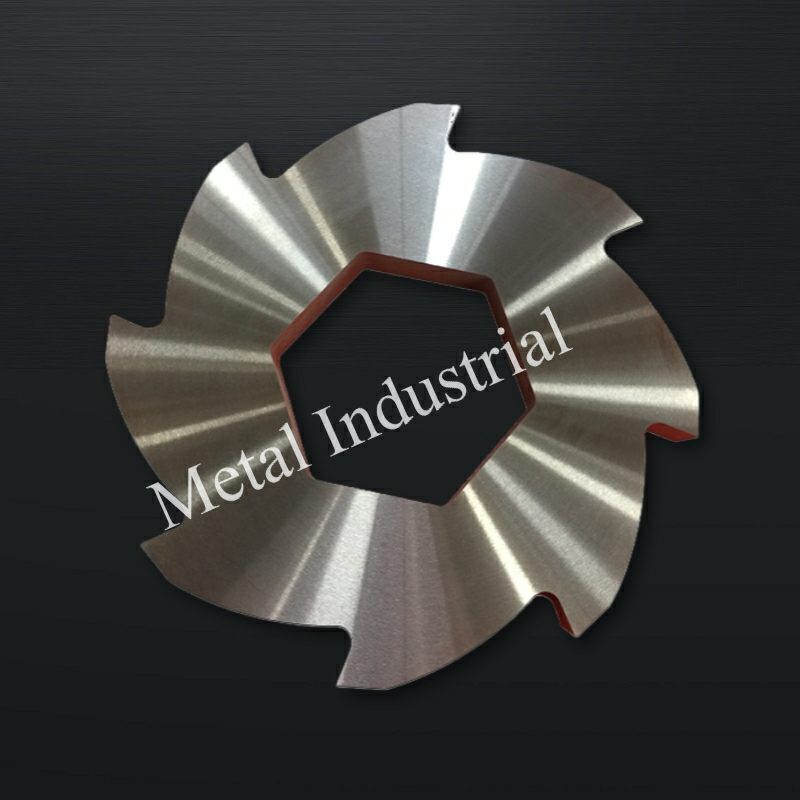
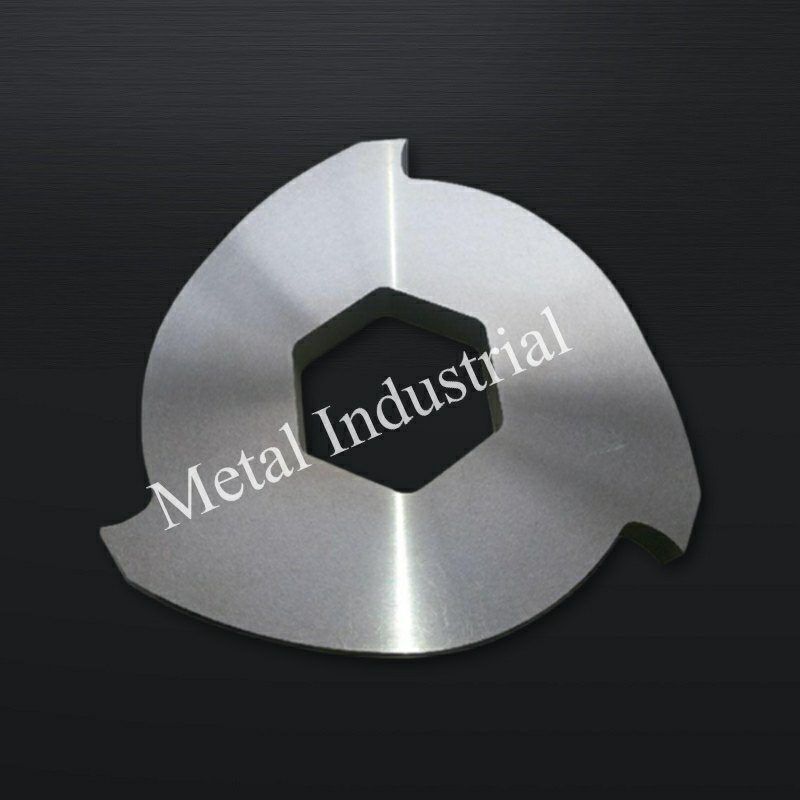
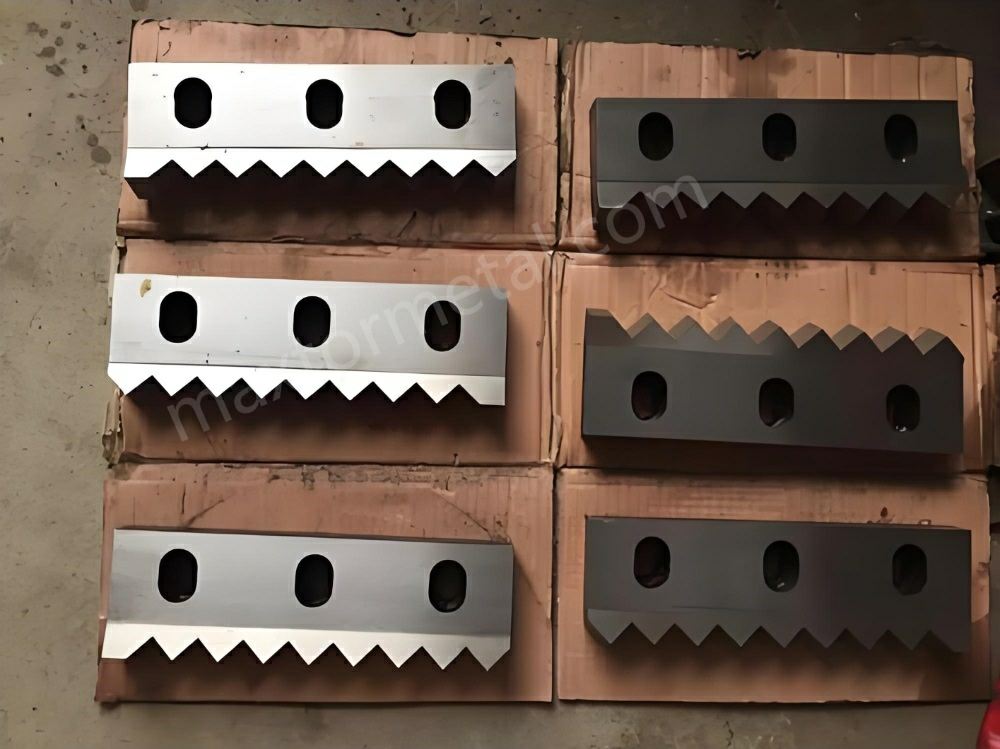
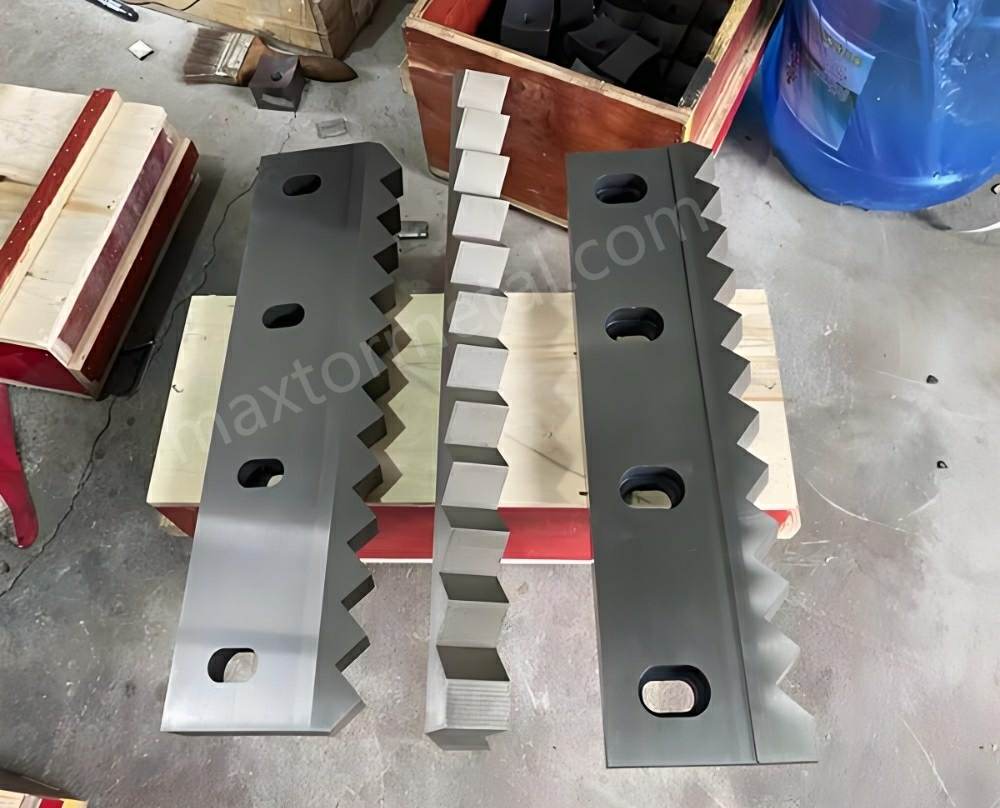
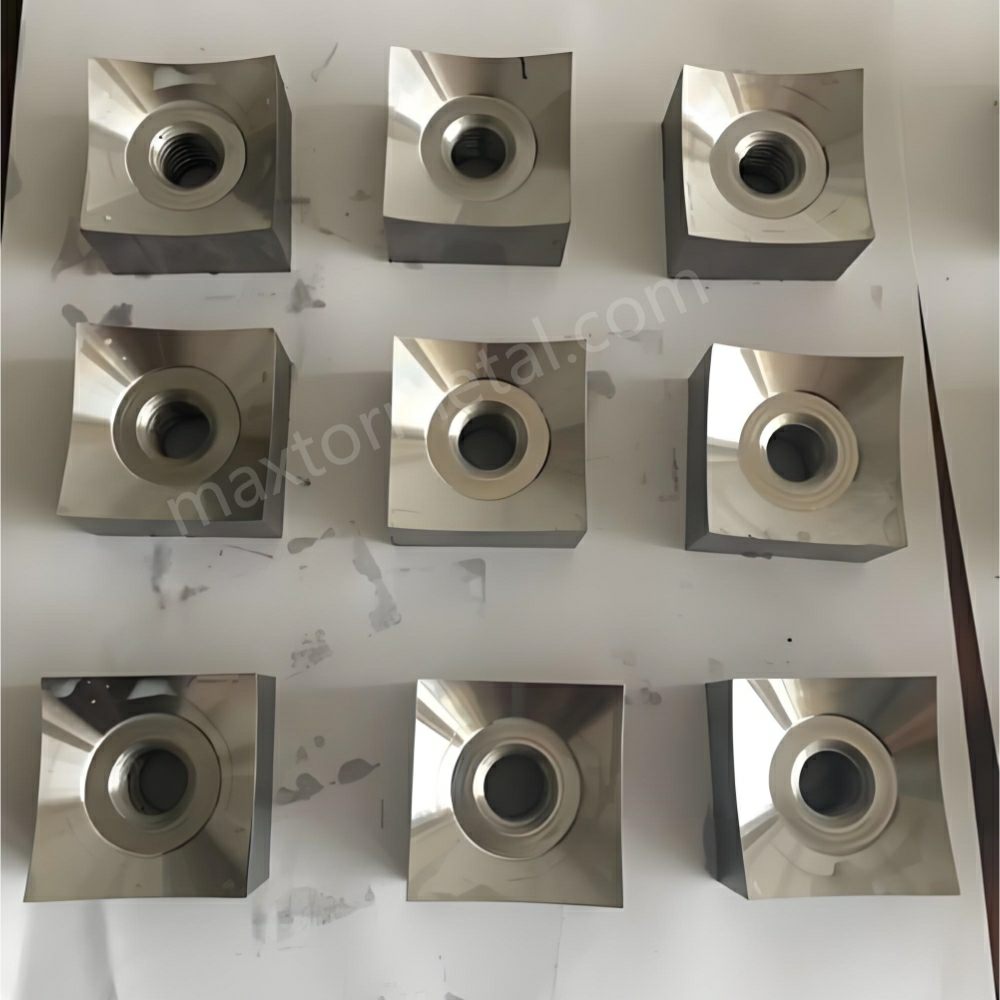
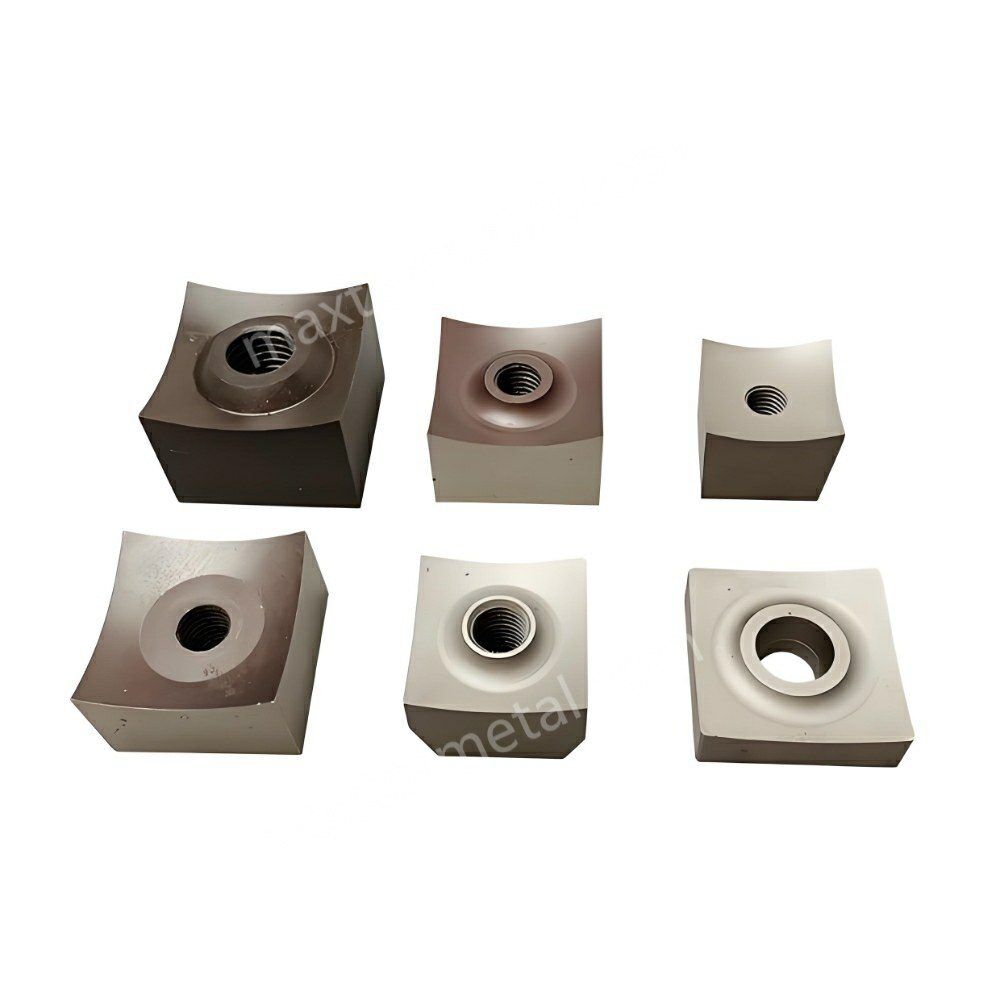
| Profil Pisau Utama | Blok putar (rotary block) cekung persegi multi-sudut, pisau dudukan stator (stator bed blades). | Pisau piringan interlocking multi-cakar (konfigurasi 3-cakar, 5-cakar, 8-cakar). |
| Mekanisme Pemotongan | Pemotongan presisi frekuensi tinggi berkecepatan tinggi melalui umpan ram hidrolik terhadap stator. | Pencengkeraman volumetrik, perobekan, dan penghancuran bertekanan tinggi dengan putaran berlawanan arah berkecepatan rendah dan torsi ultra-tinggi. |
| Material Inti | Basis AISI D2 (1.2379), DC53, AISI 4140 / AISI 1045 dengan sisipan Tungsten Carbide brazing. | AISI H13 (1.2344), AISI A8 Mod, AISI D2, AISI 4140, baja Vanadium M6V, DC53, AISI 420, AISI 440C. |
| Spektrum Kekerasan | Baja perkakas (tool steel): 58–60 HRC (vacuum hardened). Sisipan karbida (carbide inserts): 89–92 HRA pada matriks yang diperkeras. | 48–54 HRC (berorientasi ketangguhan), 56–60 HRC (berorientasi ketahanan aus), 48–52 HRC (anti-korosif), 58–60 HRC (martensitik karbon tinggi). |
| Dimensi Utama | 34×34×20 mm, 40×40×20 mm, 60×60×30 mm dengan lubang baut countersunk tengah. | Diameter Luar (OD): 150–600 mm. Ketebalan: 15–60 mm. Bore: Heksagonal, oktagonal, atau involute spline. |
| Toleransi Dimensi | Umum: ISO 2768-mK. Dudukan dasar & permukaan sambungan poros: Ketat ±0.02mm. | Ketebalan: ISO 2768-mK. Aplikasi presisi tinggi: Kerataan permukaan ujung hingga ±0.01mm. |
| Permukaan Akhir | Permukaan pemotongan cekung: Ra< 0.8μm. Dudukan pemasangan: Ra< 1.6μm. | Permukaan ujung yang dimilling/digerinda: Ra< 0.8μm. Profil kerja inti: Ra< 3.2μm. |
| Celah Rakitan (Assembled Clearance) | Pengaturan fly-knife celah mikro (micro-clearance): 0.1–0.5 mm menyesuaikan dengan ketebalan material spesifik. | Celah interlocking terbuka aksial: celah samping 0.15–0.40 mm (spacer lebih lebar 0.3–0.8 mm daripada pisau). |
| OEM yang Kompatibel | Weima, Vecoplan, Lindner, Herbold, dan sistem single-shaft global yang setara. | Weima (Four-Shaft), SSI, UNTHA, lini pemrosesan lingkungan heavy-duty Andritz. |

2. Tinjauan Rekayasa Teknik Pisau Shredder
Reduksi ukuran industri bergantung pada dua proses pemotongan mekanis yang berbeda: pemotongan presisi frekuensi tinggi dan perobekan torsi tinggi berkecepatan rendah. Memahami mekanika operasi ini sangat penting untuk memprediksi masa pakai alat dan efisiensi sistem.
2 Dinamika Perobekan Multi-Shaft
Shredder industri multi-shaft (konfigurasi dual atau quad-shaft) beroperasi melalui poros yang berputar berlawanan arah pada kecepatan yang lebih rendah tetapi dengan torsi tinggi. Proses ini mengandalkan profil cakar seperti kait yang saling mengunci (interlocking) yang menarik material besar dan padat ke tengah ruang pemotongan.
Aksi pencacahan menggunakan kombinasi perobekan tarik kait, penghancuran lateral bertekanan tinggi, dan pemotongan sisi samping yang saling mengunci. Alih-alih pemotongan bersih (clean shearing), mekanismenya berfokus pada perpindahan volumetrik dan perobekan struktural yang kuat. Sistem celah aksial terbuka (celah samping 0.15mm – 0.4mm per pisau) memungkinkan ekspansi termal independen dan menangani deformasi struktural di bawah beban tinggi.
1 Dinamika Pemotongan Single-Shaft
Sistem pencacahan single-shaft berjalan pada kecepatan rotasi yang lebih tinggi, menggunakan ram hidrolik untuk mendorong material curah ke rotor yang berputar pada kecepatan sedang hingga tinggi. Mekanisme pemotongan adalah aksi seperti gunting dengan celah mikro yang presisi yang terjadi di antara sisipan persegi yang berputar (pisau rotari) dan pisau lawan yang diam (pisau stator).
Tegangan utama yang diterapkan pada material adalah tegangan geser murni, yang didefinisikan oleh:
$$\tau = \frac{F_{potong}}{A_{geser}}$$
Mode tegangan yang dominan adalah geser, dengan gaya potong per unit area geser didefinisikan oleh τ = F/A. Dalam praktiknya, celah yang sempit (0.1–0.5 mm) juga menginduksi tegangan tekan normal terhadap bidang geser, mempercepat deformasi plastis dan patahan bersih pada benda kerja. Profil cekung persegi dari sisipan rotari menghasilkan sudut garuk (rake angle) positif lancip yang menurunkan puncak daya yang dibutuhkan dari poros penggerak utama. Ukuran partikel keluaran akhir diatur secara ketat oleh saringan klasifikasi yang diposisikan di bawah rakitan rotor.
3 Karakterisasi Keausan Industri
Pisau shredder beroperasi di lingkungan tribologi yang menuntut, dengan degradasi alat yang mengikuti empat pola keausan industri yang berbeda:
- Keausan Abrasif (Micro-Ploughing): Partikel kecil dan keras seperti pasir, kerak, serat kaca, atau debu mineral meluncur melintasi matriks baja perkakas, mengikis alur mikroskopis dan membulatkan tepi pemotongan yang tajam. Hal ini menumpulkan tepi pisau, meningkatkan konsumsi daya, dan menyebabkan material tercabut atau meregang alih-alih terpotong bersih.
- Kelelahan Dampak / Impact Fatigue (Chipping & Micro-Spalling): Ketika pengotor logam berat atau komponen asing yang tidak dapat dihancurkan masuk ke dalam mesin, mereka memberikan gaya kontak terlokalisasi yang tinggi pada tepi pemotongan. Jika ketangguhan retak (fracture toughness) material (K1c) tidak memadai, tegangan kontak ini menyebabkan micro-chipping langsung atau kegagalan bagian yang katastropik.
- Keausan Adhesif & Pelunakan Termal: Pemrosesan polimer padat atau elastomer dengan elastisitas tinggi menghasilkan gesekan tinggi pada area kontak pemotongan. Panas terlokalisasi ini dapat menyebabkan pelunakan temper lokal, yang mempercepat hilangnya material dan menyebabkan adhesi polimer pada permukaan pisau.
- Korosi Kimia Intergranular: Pemrosesan limbah padat perkotaan, limbah makanan, atau jaringan hewan memaparkan baja pada kelembapan tinggi, klorida, asam organik, dan garam (pH < 4). Lingkungan reaktif ini memicu korosi sumuran (pitting) yang cepat dan oksidasi antargranular, mengikis kromium dari matriks baja dan mempercepat keausan mekanis.
3. Aplikasi Industri Pisau Shredder
1 Reklamasi Plastik & Polimer Tingkat Lanjut
- Mesin Pemrosesan Target: Shredder poros tunggal berkapasitas tinggi dengan ram hidrolik torsi variabel.
- Komposisi Material Input: Pipa poliolefin berdinding tebal, sisa cetakan injeksi (purges), bumper otomotif, dan film pasca-pertanian yang terkontaminasi pasir atau tanah.
- Kriterian Rekayasa Operasional: Gesekan abrasif tinggi dari serat kaca dan pengisi mineral. Memerlukan retensi ketajaman tepi yang sangat baik untuk mencegah film plastik meregang dan melilit rotor.
- Spesifikasi yang Direkomendasikan: Sisipan rotari AISI D2 atau DC53 yang dikeraskan penuh (through-hardened) hingga 58–60 HRC. Untuk kontaminasi pasir yang berat, gunakan basis AISI 4140 dengan sisipan Tungsten Carbide (89–92 HRA) yang dibrasing.
2 Pemrosesan Kabel Listrik & E-Waste Berkapasitas Tinggi
- Mesin Pemrosesan Target: Granulator dan shredder poros tunggal presisi tinggi dengan celah mikro (micro-clearance).
- Komposisi Material Input: Kabel daya tembaga/aluminium lapis baja (armor-clad), jalur komunikasi, dan rakitan limbah elektronik.
- Kriterian Rekayasa Operasional: Memerlukan pemotongan presisi dengan celah rendah (0.1mm – 0.2mm) untuk memisahkan untaian tembaga secara bersih dari selubung elastomer tanpa menghasilkan panas berlebih atau pelelehan isolasi (insulation smear).
- Spesifikasi yang Direkomendasikan: Baja perkakas DC53 untuk mencegah micro-chipping yang disebabkan oleh pengikat baja yang tersembunyi. Aplikasikan pelapis Titanium Nitride (TiN) physical vapor deposition (PVD) (>2000HV) pada permukaan stator untuk memperpanjang masa pakai.
3 Manajemen Limbah Padat Industri & Limbah Berbahaya Heavy-Duty
- Mesin Pemrosesan Target: Shredder industri berat poros ganda atau poros empat dengan torsi tinggi dan kecepatan rendah.
- Komposisi Material Input: Drum baja, rongsokan otomotif struktural, wadah penyimpanan yang diperkuat, dan limbah berbahaya campuran yang mengandung pelat baja struktural.
- Kriterian Rekayasa Operasional: Beban kejut ekstrem dan gaya torsi tinggi pada cakar pemotong saat menghadapi komponen tebal yang tidak dapat dihancurkan.
- Spesifikasi yang Direkomendasikan: Baja perkakas AISI H13 (1.2344) atau AISI A8 yang dimodifikasi, dikeraskan penuh (through-hardened) hingga 48–54 HRC. Pemilihan ini memprioritaskan ketangguhan impak tinggi dan ketahanan struktural di atas ketahanan aus abrasif murni untuk mencegah keretakan pisau. Aplikasi material berbahaya yang terkait erat adalah daur ulang baterai lithium-ion, di mana geseran kecepatan rendah, atmosfer terkendali, dan material tahan HF diperlukan selain ketangguhan impak — lihat panduan Bahaya Penghancuran Baterai Lithium-Ion kami untuk kerangka kerja kontrol rekayasa lengkap.
4 Pemrosesan Ban & Karet Kendaraan Akhir Masa Pakai (ELV)
- Mesin Pemrosesan Target: Shredder lingkungan berat poros ganda yang dilengkapi dengan desain kait progresif.
- Komposisi Material Input: Ban kendaraan komersial utuh yang mengandung bundel kawat bead baja tebal berkekuatan tarik tinggi.
- Kriterian Rekayasa Operasional: Kombinasi parah dari gesekan abrasif tinggi dari senyawa karet vulkanisir dan beban tarik/geser tinggi dari pemotongan kawat baja pegas karbon tinggi.
- Spesifikasi yang Direkomendasikan: Special M6V vanadium-rich wear-resistant tool steel or premium DC53 hardened to 56–58 HRC to prevent claw breakage under wire tension. The right hardness target here is a trade-off, not a maximum — pushing HRC too high sacrifices the impact toughness needed to survive bead-wire shock and tramp metal strikes. See our guide on balancing hardness vs. toughness for scrap tire and ELV shredder blades for the full cost-per-ton analysis and a documented failure case.
5 Pemrosesan Biomassa & Bahan Bakar Pertanian Skala Besar
- Mesin Pemrosesan Target: Sistem shredder poros empat dengan torsi tinggi yang menggunakan konfigurasi multi-cakar.
- Komposisi Material Input: Jerami pertanian bal padat, batang tanaman, residu kehutanan, dan palet kayu yang mengandung pengikat struktural.
- Kriterian Rekayasa Operasional: Material biomassa berserat mudah melilit poros penghancur, menciptakan gaya radial dan gesekan yang tinggi. Batu atau kawat logam yang tersembunyi dapat menyebabkan beban kejut yang tiba-tiba.
- Spesifikasi yang Direkomendasikan: Baja perkakas struktural AISI 4140 (1.7225) yang dikeraskan penuh (through-hardened) hingga 48–54 HRC untuk operasi standar yang membutuhkan ketangguhan hemat biaya. Untuk lini pemrosesan RDF (Refuse-Derived Fuel) berkelanjutan, tingkatkan ke baja vanadium M6V premium. Pemilihan material saja tidak menjamin kepatuhan ukuran pada lini ini — geometri pemotong, rasio area terbuka saringan (screen open-area ratio), dan kontrol celah geser (shear-gap) juga sama menentukannya. Lihat panduan kami tentang rekayasa eliminasi reject strip panjang untuk efisiensi pemrosesan RDF/SRF untuk pendekatan tingkat sistem yang lengkap.
6 Limbah Organik Perkotaan, Limbah Makanan & Rendering Hewan
- Mesin Pemrosesan Target: Shredder limbah organik poros ganda dengan susunan penyegelan kedap cairan.
- Komposisi Material Input: Limbah makanan pasca-konsumen dengan campuran alat makan/keramik, bangkai hewan utuh, struktur tulang yang padat, dan kuku dari operasi rendering.
- Kriterian Rekayasa Operasional: Paparan parah terhadap asam organik dengan kelembapan tinggi, konsentrasi garam tinggi, dan keausan korosif terus-menerus, dikombinasikan dengan dampak kejut dari tulang padat atau peralatan makan campuran.
- Spesifikasi yang Direkomendasikan: Untuk limbah makanan yang sangat asam yang mengandung campuran keramik/alat makan, gunakan baja tahan karat martensitik AISI 420 yang dikeraskan hingga 48–52 HRC. Untuk pemrosesan bangkai murni dan rendering hewan tanpa tramp metal yang berat, gunakan baja martensitik karbon tinggi AISI 440C yang dikeraskan hingga 58–60 HRC untuk ketahanan korosi yang tinggi dan masa pakai tepi pemotong tulang yang lama.
4.Masalah Kegagalan Umum & Solusi Rekayasa
1 Chipping Alat Poros Tunggal akibat Tramp Metal
- Analisis Akar Penyebab: Ketika komponen baja yang tidak dapat dihancurkan (misalnya, baut yang dikeraskan, braket struktural) masuk ke dalam shredder poros tunggal, komponen tersebut terjebak di antara pisau putar dengan kekerasan tinggi (58–60 HRC) dan dudukan stator. Hambatan mendadak ini menghasilkan tegangan terlokalisasi yang melebihi ketangguhan patah (K1c) dari baja AISI D2, menyebabkan gumpil tepi yang parah atau patahnya badan pisau.
- Desain Ulang & Trade-off Rekayasa: Ganti AISI D2 dengan baja DC53. DC53 memiliki struktur karbida halus yang seragam yang melipatgandakan energi impak Charpy V-notch dibandingkan dengan D2 tradisional. Trade-off Rekayasa: Biaya material meningkat sekitar 25%, tetapi masa pakai alat dan ketahanan terhadap kegagalan katastropik meningkat secara signifikan.
2 Patahnya Cakar Multi-Poros di Bawah Tegangan Biomassa Tinggi
- Analisis Akar Penyebab: Pemrosesan biomassa berserat padat atau bundel jerami pertanian dapat menyebabkan serat panjang melilit erat di sekitar pangkal cakar pemotong. Tindakan melilit ini menjepit material di antara pisau yang berdekatan, menciptakan momen lentur dan beban tarik tinggi yang dapat mematahkan cakar pada pangkalnya.
- Desain Ulang & Trade-off Rekayasa: Ubah material pisau dari baja D2 dengan kekerasan tinggi ke AISI H13 (1.2344) dengan ketangguhan tinggi atau baja AISI A8 yang dimodifikasi, yang diberi perlakuan panas hingga 48–54 HRC. Ini menggeser matriks baja dari struktur karbida yang berfokus pada ketahanan aus ke struktur martensitik yang tahan guncangan. Trade-off Rekayasa: Lowering the hardness reduces abrasive wear resistance, requiring more frequent edge sharpening to maintain throughput.
4.3 Inner Drive Bore Cracking via Wire EDM Residual Stress
- Analisis Akar Penyebab: Precise internal driven profiles (such as hex or octagonal shapes) are commonly finished using Wire Electrical Discharge Machining (EDM) after heat treatment. The high temperatures of the EDM process melt and re-solidify the steel surface, creating a microscale brittle “white layer” filled with residual tensile stresses. Under high torque, these internal corners act as stress concentrators, initiating cracks that propagate outward and split the blade.
- Desain Ulang & Trade-off Rekayasa: Implement an immediate post-EDM low-temperature stress-relief temper at 180℃ – 200℃ for 4 hours to relieve the residual tensile stresses. Alternatively, upgrade the material to DC53, which can absorb these stresses without requiring special multi-step tempering steps.
4.4 Axial Expansion and Seizure of Multi-Shaft Assemblies
- Analisis Akar Penyebab: Processing dense materials over long, continuous runs generates high friction, heating the shredder blades up to 80℃ – 120℃. If the thermal expansion of the blades exceeds the original engineered axial clearances, the side faces of the interlocking cutters will grind against each other, leading to frictional lockup, shaft deflection, and gear drive overload.
- Desain Ulang & Trade-off Rekayasa: Increase the thickness of the spacer collars relative to the blades, setting a single-side clearance gap of 0.15 mm to 0.40 mm (making the spacer 0.3 mm to 0.8 mm wider than the corresponding blade). Additionally, apply a -196℃ cryogenic treatment during heat treatment to eliminate retained austenite, ensuring high dimensional stability over a wide temperature range. Trade-off Rekayasa: Larger clearance gaps can allow thin sheet materials to pass through without being fully shredded. For the full tolerance-chain analysis behind these clearance targets — including GD&T flatness/parallelism/perpendicularity callouts, spacer selective-fit binning, and post-assembly TIR acceptance gates — see our Multi-shaft Blade Tolerance Stacking guide.
4.5 Rapid Chemical Corrosion and Edge Softening in Biomass Processing
- Analisis Akar Penyebab: Processing organic food waste or animal carcasses releases high-moisture organic acids and chlorides (pH < 4). Standard cold-work tool steels like AISI D2 or DC53 lack sufficient free chromium, causing them to form iron oxides and pit rapidly under these conditions. This corrosion compromises the steel matrix, accelerating mechanical wear and causing the cutting edge to dull quickly.
- Desain Ulang & Trade-off Rekayasa: Upgrade the cutter material to AISI 420 martensitic stainless steel (hardened to 48–52 HRC) or AISI 440C high-carbon stainless steel (hardened to 58–60 HRC), depending on the amount of mixed tramp metal present. Trade-off Rekayasa: Stainless tool steels are more difficult to precision-grind, increasing manufacturing costs and lead times.
4.6 Single-Shaft Rotary Blade Seating Loosening
- Analisis Akar Penyebab: High-frequency cutting forces apply cyclic, pulsing loads to single-shaft rotary inserts. If the dimensional tolerance between the insert’s bottom seating face and the rotor’s machined pocket exceeds 0.05 mm, the insert can shift micro-axially during operation. This movement puts high cyclic shear stresses on the central fastening bolt, leading to bolt fatigue and eventual failure.
- Desain Ulang & Trade-off Rekayasa: Tighten the dimensional tolerances on the blade’s bottom seating and locator faces to a strict ±0.02mm via precision grinding. Trade-off Rekayasa: Requires high-precision CNC grinding fixtures, which increases tool manufacturing costs.
4.7 Severe Abrasive Edge Rounding from Glass-Fiber Reinforced Polymers
- Analisis Akar Penyebab: Glass fibers (GF) used in engineering plastics act as high-hardness abrasives during shredding. When these fibers slide across standard tool steel, they cause micro-ploughing that rapidly rounds the sharp cutting edge. Once rounded, the blade can no longer cut the plastic cleanly, increasing power consumption and generating friction that melts the polymer.
- Desain Ulang & Trade-off Rekayasa: Use composite blades featuring an AISI 1045 or 4140 structural steel body with brazed Tungsten Carbide (WC-Co) inserts at the cutting edges. The carbide inserts provide high hardness (89–92 HRA) to resist fiber abrasion, while the steel body maintains structural toughness. Trade-off Rekayasa: High-vibration environments or tramp metal impacts can cause the brittle carbide inserts to crack or debond from the steel base.
4.8 Premature Corner Chipping on Square Concave Inserts
- Analisis Akar Penyebab: The four corner tips of single-shaft square concave inserts concentrate stress during operation. If the concave radius is ground too deep, the resulting edge geometry becomes too fragile, making the corners prone to micro-chipping under standard impact loads.
- Desain Ulang & Trade-off Rekayasa: Optimize the grinding geometry by reducing the concave depth and introducing a small, controlled 0.1 mm chamfer or hone to the cutting edge. This reinforces the corner geometry with minimal impact on overall cutting sharpness.
4.9 Frictional Galling on Multi-Shaft Interlocking Faces
- Analisis Akar Penyebab: When shredding ductile materials like aluminum alloys or soft polymers, high lateral pressures can force the material into the side gaps between interlocking blades. This trapped material undergoes high friction and pressure, leading to localized cold-welding and material transfer (galling) onto the blade faces, which increases torque and friction.
- Desain Ulang & Trade-off Rekayasa: Precision-grind the blade side faces to a smooth surface finish of Ra< 0.8μm to reduce friction. For highly ductile applications, add shallow radial escape grooves across the blade faces to help eject trapped particles. Introduce radial scraper fins onto the side profiles of the blades to help eject fine particles from the gap.
4.10 Thermal Cracking (Heat Checking) from Continuous Friction
- Analisis Akar Penyebab: Shredding highly elastic materials can generate high continuous friction, creating localized thermal gradients across the blade edge. The resulting cyclical thermal expansion and contraction can cause microscale thermal cracks (heat checking) perpendicular to the cutting edge, which can lead to larger structural failures.
- Desain Ulang & Trade-off Rekayasa: Select tool steels with high thermal conductivity and temper resistance, such as AISI H13. Ensure the shredding system uses an automated reverse cycle or external cooling to manage operating temperatures.
5.Panduan Rekayasa Material
Selecting the proper steel alloy requires balancing three conflicting properties: wear resistance, impact toughness, and manufacturability (grindability).
5.1 Metallurgical Matrix Comparison
The following alloy comparison reflects Maxtor Metal’s qualified material library for shredder blade production.
| International Alloy Standard | Primary Microstructural Carbides | Charpy V-Notch Impact Energy (Toughness) | Ketahanan Aus Abrasif | Machining & Grindability Index |
| AISI D2 / DIN 1.2379 / SKD11 | Large, banded eutectic chromium carbides (Cr7C3). | Low (20 – 25 J/cm2). | High. | Difficult; high wheel wear. |
| DC53 (Premium Cold-Work) | Fine, evenly dispersed secondary alloy carbides. | Very High (28 – 45 J/cm2). | Excellent. | Fair; superior to D2. |
| AISI H13 / DIN 1.2344 | Fine vanadium/molybdenum carbides. | Exceptional (50 – 80 J/cm2). | Moderate. | Good; high machinability. |
| AISI A8 Mod (Toughness Tool) | Balanced chromium/molybdenum matrix. | Excellent (80 – 100J/cm2). | Medium-High. | Fair. |
| M6V (High-Vanadium Tool) | Ultra-hard vanadium carbides (VC, 2800HV). | Moderate-High (35 – 40J/cm2). | Superior long-life. | Difficult; requires specialized wheels. |
| AISI 4140 / DIN 1.7225 | Homogeneous tempered martensite (no primary carbides). | High structural ductility. | Low; requires base support. | Excellent; low manufacturing cost. |
| AISI 420 / DIN 1.4021 | Dispersed chromium carbides in a stainless matrix. | High (60 – 80J/cm2). | Medium. | Good. |
| AISI 440C / DIN 1.4125 | High-density primary chromium carbides. | Low-Moderate (15 – 22J/cm2). | High. | Difficult. |
| Tungsten Carbide (WC-Co) | Pure sintered Tungsten Carbide grains. | Brittle; low impact threshold. | Maximum Industrial. | Requires diamond grinding. |
Impact energy values are measured at target working hardness after vacuum hardening and triple tempering. Values at annealed state are significantly higher and are not representative of service conditions.
5.2 Advanced Metallurgical Selection Guidelines
5.2.1 AISI D2 vs. DC53
Traditional D2 steel contains large, non-uniform chromium carbides that form during solidification. These carbides act as stress concentration sites where micro-cracks can easily initiate under heavy shock loads. In contrast, DC53 modifies the chemical composition to eliminate these large carbide bands, resulting in a fine, uniform carbide distribution. This microstructural improvement doubles the material’s impact toughness while maintaining equivalent or superior wear resistance at high hardness levels (58–60 HRC).
5.2.2 Specialized Environmental Alloys (M6V, 420, 440C)
- M6V: Contains high amounts of vanadium, which forms ultra-hard vanadium carbides throughout the matrix. This alloy is ideal for high-volume, continuous processing lines like RDF generation, where long tool life is critical to reducing downtime.
- AISI 420 & 440C: These martensitic stainless steels are selected for highly corrosive applications. AISI 420 provides the impact toughness needed to handle mixed municipal waste containing occasional hard impurities. AISI 440C features higher carbon and chromium content, providing excellent edge retention and wear resistance for pure organic processing, such as animal carcass rendering. 440C’s corrosion resistance also extends to HF-exposed environments such as lithium-ion battery shredding; for material mitigations and wetted-component guidance in that setting, see Bahaya Penghancuran Baterai Litium-Ion: Kontrol Geseran Kecepatan Rendah, Desain Atmosfer Inert, dan Pengolahan HF.

6. Perlakuan Panas (Heat Treatment) & Keseimbangan Kekerasan Pisau
Industrial shredder blades require precise heat treatment to achieve the proper balance of hardness and toughness. Incorrect tempering or incomplete phase transformation can lead to premature tool failure.
6.1 Vacuum Austenitizing & Controlled Quenching
Blades are heat-treated in a high-vacuum furnace (10-4mbar) to prevent surface decarburization and oxidation. For premium tool steels like D2 and DC53, the material is preheated in stages to minimize thermal distortion before being brought to its final austenitizing temperature (1020℃ – 1040℃). Once uniform carbon dissolution is reached, the parts undergo a high-pressure gas nitrogen quench (6 – 10bar) to quickly transform the austenite matrix into hard martensite.
6.2 Deep Cryogenic Transformation Process
Following the quench, the steel matrix can retain up to 5% to 15% unstable retained austenite. To ensure long-term dimensional stability and prevent distortion or cracking under heavy structural loads, blades undergo a deep cryogenic treatment:
- The temperature is lowered at a controlled rate (1℃/min) down to -196℃ using liquid nitrogen.
- The blades are held at -196℃ for 12 to 24 hours.
This process forces the complete transformation of retained austenite into martensite and promotes the precipitation of fine η-carbides, improving both wear resistance and structural stability.
6.3 Precision Tempering Strategies
Tempering modifies the hard, brittle martensitic structure into a tougher, more resilient tempered martensite.
- High-Temperature Tempering (Secondary Hardening Window): For D2 and DC53 blades used in high-wear applications, triple tempering is performed at 520℃ – 540℃. This triggers secondary carbide precipitation, maximizing wear resistance while maintaining a stable hardness of 58–60 HRC.
- Low-Temperature Tempering (Toughness Window):
- For shredder blades utilizing AISI D2, tempering is conducted at 180℃ – 200℃ to relieve quenching stresses and achieve peak impact toughness while maintaining a high working hardness of 58–61 HRC. To prevent micro-cracking during subsequent Wire EDM for internal shaft bores, a mandatory post-EDM stress-relief temper at 180℃ – 200℃ for 4 hours must be enforced.
- For multi-shaft claw configurations subjected to severe operational shock loads, AISI H13 items must undergo high-temperature tempering cycles within 550℃ – 580℃. This drives complete secondary transformation and matrix stress-relief, establishing a stable tempered martensite structure that delivers its peak Charpy impact energy while targeting a hardness of 48–54 HRC.
7. Geometri Pisau & Rekayasa Tepi Potong
The geometric design of a shredder blade determines its cutting efficiency, material throughput, and structural durability.
7.1 Single-Shaft Insert Architecture
Single-shaft rotary knives are typically designed as multi-angle square concave inserts. The concave face creates an aggressive, positive rake angle (α = +10°to +15°) that helps pull material into the cutting zone, lowering the required drive motor power.
The center of the insert features a precision-machined countersunk hole designed to accept high-tensile socket head cap screws, securing the blade tightly into its rotor pocket. This pocket provides multi-surface support to absorb high radial and axial cutting forces.
7.2 Multi-Shaft Claw Profiles and Bore Mechanics
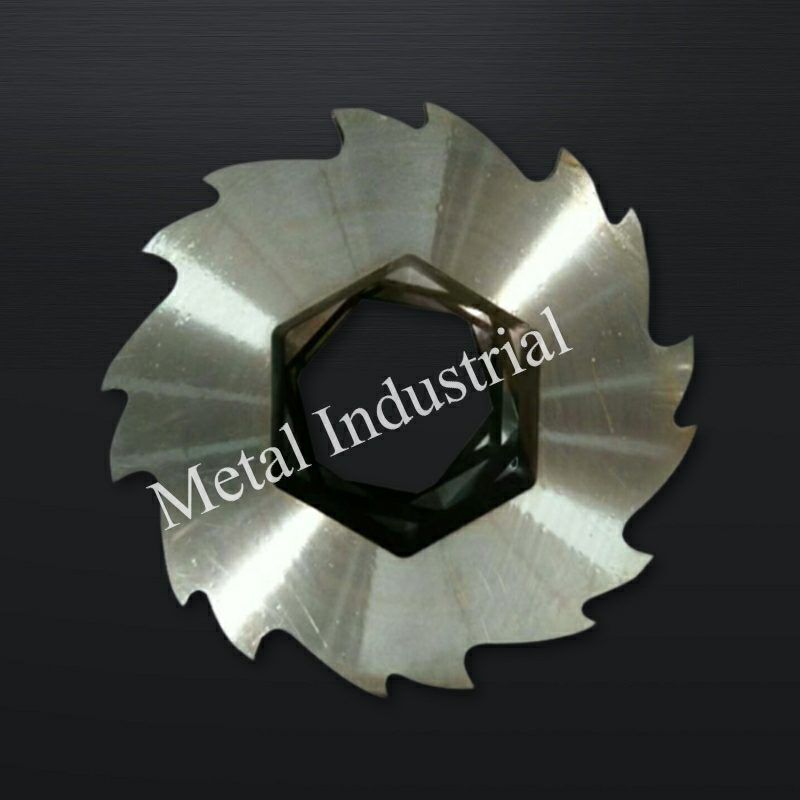
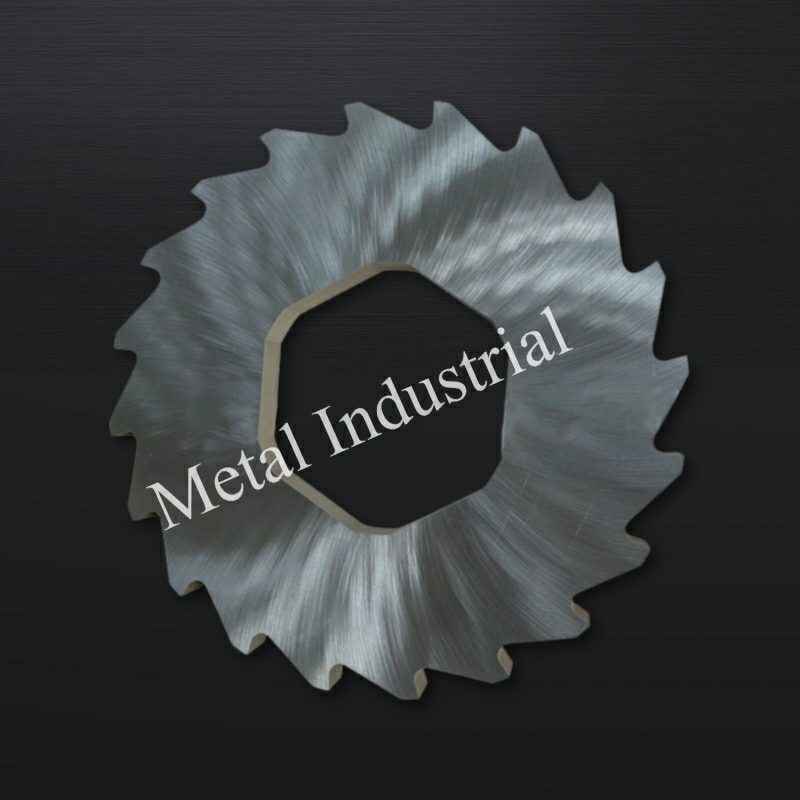
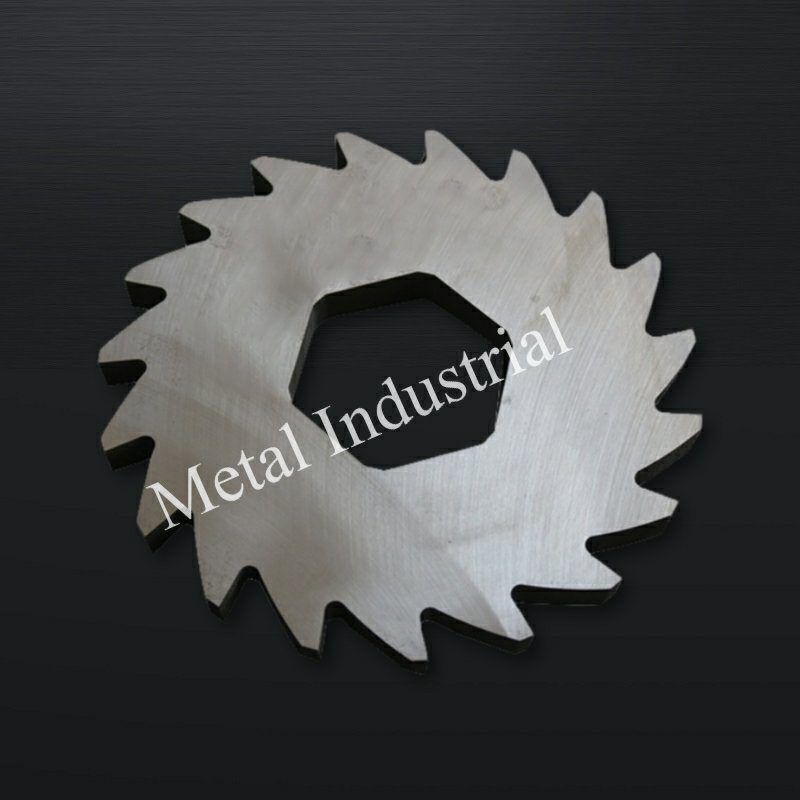
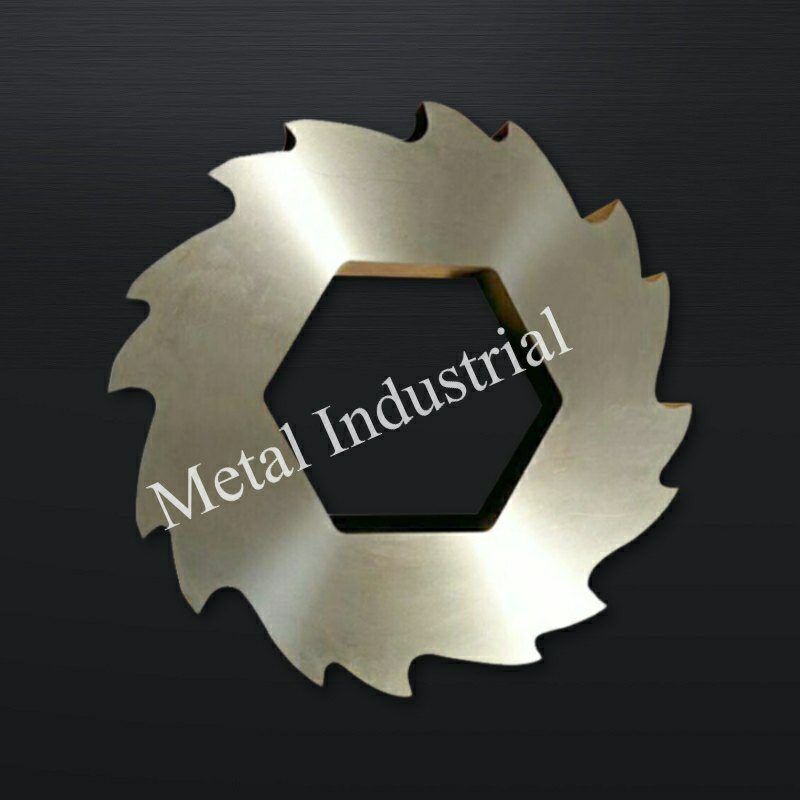
Multi-shaft blades are styled as disk cutters featuring a variable number of cutting claws (typically 3-claw, 5-claw, or 8-claw configurations).
- 3-Claw Profile: Features deep, aggressive hooks with a tall profile, making it ideal for grabbing and tearing bulky, hollow items like plastic drums or car body shells.
- 8-Claw Profile: Features shorter, closely spaced claws designed for high-density, uniform sizing applications, such as tire shredding or fine biomass processing.
The design of the internal drive bore is critical for delivering high torque from the main drive shaft:
- Hexagonal / Octagonal Bores: Provide positive mechanical engagement but feature sharp internal corners that act as stress concentrators.
- Involute Spline Bores: Feature a series of matching internal teeth that distribute torsional loads evenly across the entire circumference. This design significantly reduces localized stress concentration, making it ideal for heavy-duty recycling operations.
8. Proses Manufaktur & Inspeksi Kualitas Pisau Shredder
To ensure reliable performance in demanding recycling environments, shredder blades must follow strict, quality-controlled manufacturing stages.
8.1 Advanced Manufacturing Workflow
Maxtor Metal’s standard manufacturing sequence for industrial shredder blades follows eight controlled stages:
- Material Sourcing & Forging: Use clean, vacuum-degassed tool steel ingots. Perform 3D multi-directional forging to ensure uniform grain structure and break up coarse carbide bands.
- Spheroidized Annealing: Heat-treat to produce a uniform distribution of granular carbides within a soft ferrite matrix, ensuring consistent machinability and dimensional stability.
- CNC Rough Machining: Mill the core blade profiles, drill countersunk holes, and rough-turn the outer diameter, leaving a uniform 0.3mm – 0.5mm grinding allowance across all critical faces.
- Vacuum Heat Treatment & Cryogenic Stabilization: Execute the complete vacuum hardening, liquid nitrogen deep freeze, and triple tempering sequence to fix the material’s microstructural properties.
- Precision Super-Grinding: Use specialized CNC surface grinders equipped with vitrified CBN (Cubic Boron Nitride) or diamond wheels to finish the cutting edges to a smooth surface finish of Ra< 0.8μm.
- Wire EDM Profiling (For Complex Bores): Use high-precision wire EDM to cut internal hexagonal or spline bores into the hardened blade body.
- Low-Temperature Stress-Relief Tempering: Immediately temper the parts at 180℃ – 200℃ for a minimum of 4 hours to eliminate residual tensile stresses and the brittle EDM “white layer”.
- Final Quality Control Inspection: Validate all dimensions using automated Coordinate Measuring Machines (CMM).
8.2 Metrology Protocols & Inspection Tolerances
Every finished blade must pass three quality control checks before release:
- End-Face Flatness Verification: Measured using an optical flat or high-precision digital indicator across the entire blade diameter. For high-precision applications, flatness variation must not exceed ±0.01mm.
- Dual-Face Parallelism Testing: The thickness variation between opposing parallel faces is verified at four symmetric points. Total thickness deviation must remain within ±0.05mm to ensure uniform seating when blades are stacked together on a multi-shaft assembly.

9. Studi Kasus
9.1 Case Study 1: Preventing Cracking in Industrial Silver Recycling
The following data comes from Maxtor Metal’s project support for a precious metals reclamation operator; the customer name has been anonymized.
- Industrial Operator Profile: A high-volume precious metals reclamation plant processing dense, high-purity industrial silver scrap.
- Original Equipment Configuration: Multi-shaft heavy shredder using standard AISI D2 steel blades through-hardened to 60 HRC. Internal drive engagement was handled via a standard wire EDM-cut internal hexagonal bore.
- Operational Failure Analysis: The original D2 blades frequently cracked and split from the sharp corners of the internal hex bore outward during early operation. Investigation revealed that the high torque required to process dense silver scrap amplified the residual tensile stresses left behind by the wire EDM process. The localized micro-cracking was heavily aggravated by the uncontrolled tensile stress fields generated during the legacy vendor’s post-EDM wire cutting, which omitted the critical stress-relief tempering protocol required to eliminate the brittle recast white layer. The large, brittle carbide structures typical of standard D2 steel could not absorb these combined loads, leading to rapid crack propagation and failure.
Evaluation of Engineering Solutions
Solution A: Upgrade to Material DC53
- Engineering Approach: Replace AISI D2 steel with premium DC53 cold-work tool steel while maintaining standard, high-efficiency manufacturing methods.
- Result Matrix: The fine, uniform carbide structure of DC53 doubled the material’s impact energy compared to D2. This increased toughness allowed the steel matrix to naturally absorb the residual stresses from the EDM process and handle the high torque loads without cracking. The blades maintained a high surface hardness of 58–60 HRC, preserving full wear life while shortening manufacturing lead times.
Solution B: Modify Manufacturing via a Four-Step Process
- Engineering Approach: Maintain the original AISI D2 material but completely restructure the manufacturing sequence to isolate and relieve internal stresses:
- Vacuum-harden the blank to a lower, tougher hardness level of 52 HRC.
- Rough-grind both faces, leaving a 0.1mm – 0.2mm machining allowance.
- Wire-EDM cut the internal hexagonal bore profile.
- Perform a long, low-temperature stress-relief temper at 180℃ – 200℃ to relieve internal tensile stresses before a final finish grind.
- Result Matrix: This process successfully prevented internal bore cracking and achieved a precise flatness tolerance of ±0.01mm. However, lowering the hardness to 52 HRC reduced the blades’ wear life by roughly 35%. This approach also significantly increased manufacturing costs, required more complex processing steps, and extended production lead times.
- Final Implementation Decision: The operator chose Solution A. Upgrading to DC53 eliminated the cracking failures, maintained optimal edge wear life, simplified manufacturing, and reduced overall tool production times.
9.2 Case Study 2: Extending Tool Life in Corrosive Organic Waste Processing
The following data comes from Maxtor Metal’s project support for a municipal solid waste processing facility; the customer name has been anonymized.
- Industrial Operator Profile: A municipal solid waste facility operating continuous organic waste and animal rendering lines.
- Original Equipment Configuration: Heavy-duty dual-shaft shredder fitted with standard AISI D2 tool steel multi-claw blades.
- Operational Failure Analysis: The original D2 blades showed severe surface rust and pitting corrosion within hours of processing acidic organic waste (pH < 4.5). This chemical corrosion quickly dulled the cutting edges, causing fibrous materials to wrap around the shafts and clog the machine. The resulting friction led to high operating temperatures, motor overloads, and frequent unscheduled maintenance shutdowns.
- Implemented Engineering Redesign: The D2 blades were replaced with high-carbon martensitic stainless steel (AISI 440C), vacuum-hardened and low-temperature tempered to a stable 59 HRC. The side clearance gaps were also opened to 0.25 mm using wider, corrosion-resistant spacers to handle thermal expansion.
- Quantified Performance Improvement: The upgraded AISI 440C stainless blades resisted organic acid pitting, maintaining a clean cutting edge over long runs. Continuous operating life between sharpening intervals increased from 72 hours to 300 – 580 hours depending on waste stream acidity and throughput rate. Frictional heat generation was significantly reduced, eliminating thermal clogging and lowering overall motor power consumption by 14%.
10. Bagian Pertanyaan Sering Diajukan (FAQ)
Mengapa baja AISI D2 sering kali gumpal (chip) atau gagal saat mencacah limbah padat domestik campuran?
AISI D2 mengandung karbida kromium besar dan tidak seragam yang terbentuk selama pembekuan. Pita karbida ini rapuh dan bertindak sebagai pemusat tegangan internal. Ketika mesin shredder membentur logam asing yang tidak dapat dihancurkan atau batu berat, beban benturan mendadak akan melebihi ketangguhan patah (fracture toughness) dari matriks D2, menyebabkan micro-chipping atau retak fatal pada bodi pisau.
Q2: How does upgrading to DC53 help prevent shredder blades from cracking?
A2: DC53 reduces the large chromium carbide bands typical of D2, replacing them with a fine, uniform carbide distribution. Based on Maxtor Metal’s material qualification testing, this microstructural adjustment approximately doubles the Charpy V-notch impact energy compared to standard D2 at equivalent working hardness (58–60 HRC), allowing the blade to better absorb sudden impacts and high torque without fracturing.
Q3: What is the optimal side clearance gap for multi-shaft shredder blades, and why is it necessary?
A3: Based on Maxtor Metal’s multi-shaft assembly specifications, the standard single-side clearance gap ranges from 0.15 mm to 0.40 mm, achieved by making the spacer collar 0.3 mm to 0.8 mm wider than the blade thickness. This built-in clearance accommodates thickness tolerances (ISO 2768-mK) and allows the blades to expand freely as friction heats them up during operation, preventing axial binding and seizure.
Q4: When should Tungsten Carbide inserts be used instead of solid tool steel for single-shaft shredders?
A4: Tungsten Carbide inserts are ideal for high-abrasion applications with low risk of heavy impact, such as shredding agricultural film contaminated with sand or processing glass-fiber reinforced engineering plastics. The carbide tips provide high hardness (89–92 HRA) to resist abrasive wear, while a tough steel base like AISI 4140 provides structural support.
Q5: Why is deep cryogenic treatment (-196℃) recommended for heavy-duty shredder blades?
A5: Cryogenic treatment forces unstable retained austenite to transform completely into stable martensite. In Maxtor Metal’s heat treatment protocol, blades are held at −196℃ for 12 to 24 hours following quench, eliminating residual microstructural stresses that could cause warping or distortion in service, and promoting the precipitation of fine secondary carbides that improve overall wear resistance.
Q6: What causes inner drive bores (hex or octagonal) to split open, and how can this be fixed?
A6: Finishing internal drive bores with wire EDM creates a thin, brittle “white layer” on the steel surface that contains high residual tensile stresses. The sharp corners of hexagonal or octagonal bores also naturally concentrate stress. Under heavy torque, cracks can easily initiate at these corners and propagate outward. This can be prevented by applying a post-EDM stress-relief temper at 180℃ – 200℃ or by upgrading the blade material to high-toughness DC53.
Q7: Which blade material is best for processing corrosive organic food waste?
A7: For organic waste containing high moisture and acids, AISI 420 or AISI 440C martensitic stainless steels are recommended. AISI 420 provides good impact toughness for mixed waste streams, while AISI 440C offers higher hardness (58–60 HRC) and excellent edge retention for high-volume rendering applications, such as carcass processing.
Q8: What surface finish is required for single-shaft rotary blade faces?
A8: Per Maxtor Metal’s grinding and inspection standards, the concave cutting face must be precision-ground to Ra < 0.8 μm to maintain a sharp, low-friction cutting edge, while the flat mounting seats require Ra < 1.6 μm to ensure rigid, secure seating in the rotor pocket.
Q9: Why are standard tool steels ineffective for animal rendering and carcass processing?
A9: Animal fluids contain high concentrations of organic acids and salts that cause standard tool steels like D2 or DC53 to rust and pit rapidly. This corrosive wear breaks down the steel matrix and quickly dulls the cutting edge, leading to material wrapping, friction, and eventual machine overload. Martensitic stainless steels like AISI 440C are required to withstand these conditions.
Apa kegunaan lapisan PVD TiN pada pisau statis (stator) mesin shredder poros tunggal?
A10: A Titanium Nitride (TiN) coating increases surface hardness to over 2000 HV on the primary shearing faces. This coating acts as a barrier against abrasive wear, making it highly effective for precision applications like electrical cable recycling, where maintaining a clean, sharp edge is critical to preventing insulation smearing.
Bagaimana perbedaan aplikasi profil pisau multi-poros 3-cakar (3-claw) dibandingkan dengan profil 8-cakar (8-claw)?
A11: A 3-claw profile features tall, aggressive hooks designed to grab and rip bulky, hollow materials like plastic drums, tires, or car scrap. An 8-claw profile features shorter, more frequent hooks that provide less aggressive tearing but deliver higher, more uniform sizing, making it ideal for processing loose biomass or shredded rubber.
Q12: Why are dimensional tolerances for single-shaft blade bases restricted to ±0.02mm?
A12: Single-shaft shredders operate with a high-frequency, pulsing cutting action. Maxtor Metal enforces a strict ±0.02 mm tolerance on blade base seating and locator faces — verified via precision CNC grinding — to ensure a rigid fit within the rotor pocket and prevent the micro-movements that cause fatigue failure of the primary fastening bolts.
Q13: What engineering trade-offs occur when lowering blade hardness to improve toughness?
A13: Lowering a blade’s hardness (for example, tempering D2 steel down to 52 HRC) increases its impact toughness and resistance to cracking. However, this reduces its abrasive wear resistance, meaning the cutting edges will dull faster and require more frequent sharpening or replacement, which increases operational downtime.
Q14: What is the benefit of an involute spline bore over a standard hexagonal bore for multi-shaft drives?
A14: A hexagonal bore concentrates torsional stresses at its six sharp corners, which can lead to fatigue cracks over time. An involute spline bore uses a series of curved teeth to distribute driving torque evenly across the entire circumference of the shaft, significantly lowering localized stress and extending blade life under heavy loads.
Q15: How can you identify if a blade failure was caused by abrasive wear versus impact fatigue?
A15: Abrasive wear shows up as smooth micro-grooves, scratches, and a gradual rounding of the cutting edge over time. Impact fatigue causes sudden micro-chipping, spalling, or large, jagged cracks across the blade body, typically triggered by encountering an uncrushable object.
Call to Action Teknik Final
Optimalkan Throughput Kapasitas Sistem Shredder Anda
Does your production line experience frequent downtime due to blade chipping, corner cracking, or rapid wear? Shifting from generic replacement parts to precision-engineered shredder blades can stabilize your processing costs and improve system reliability.
Maxtor Metal’s engineering team can review your system drawings and material requirements to develop customized solutions:
- Custom Alloy Matching: We select and treat materials (including DC53, M6V, and AISI 440C) based on your specific waste stream dynamics.
- Manufaktur Presisi: All parts are finished with advanced vacuum heat treatments, cryogenic stabilization, and precision CNC grinding down to ±0.01mm tolerances.
- Direct RFQ Support: Submit your CAD files (.STEP, .DWG) or OEM part numbers today for a detailed technical review and production quote.
Contact our engineering consulting office directly to speak with an industrial knife specialist.
Pisau Penghancur Menampilkan:


Video:
Blog Terkait:
-
Analisis Komprehensif Penghancur Poros Ganda
-
Panduan Komprehensif Penghancur Poros Tunggal: Jenis, Proses Kerja, Komponen, Perawatan dan Bilah
-
Pisau Penghancur: Analisis Klasifikasi, Pemilihan Material, Masa Pakai, dan Teknik Desain
Lebih banyak blog……


 English