Lame per trituratori a uncino, set di coltelli per trituratori, trituratori a uncino, lame per trituratori a doppio albero, coltelli per trituratori circolari, lame per trituratori a 4 alberi
1. Lame per Trituratori Industriali: Specifiche Tecniche e Selezione
Questo libro bianco si basa sull'esperienza di produzione di Maxtor Metal nei settori della triturazione industriale, del riciclaggio e del trattamento dei rifiuti.
Questo documento tecnico stabilisce le linee guida ingegneristiche, i criteri metallurgici e i protocolli di produzione per lame da triturazione ad alte prestazioni impiegate in sistemi industriali gravosi di riciclaggio, gestione dei rifiuti solidi e trattamento delle biomasse. Questo libro bianco funge da riferimento essenziale per responsabili degli acquisti, ingegneri meccanici e specialisti OEM (Original Equipment Manufacturer) che richiedono una durata dell'utensile prevedibile, un'elevata tenuta del tagliente e un controllo a zero difetti dei cedimenti catastrofici.
Punto chiave:
Maxtor Metal manufactures single-shaft and multi-shaft industrial shredder blades in AISI D2, DC53, H1.|3, M6V, and martensitic stainless steel grades, adhering to strict audit-ready quality and procurement protocolsfor every blade produced. Blades are vacuum hardened, cryogenically stabilized at −196℃, and precision-ground to tolerances as tight as ±0.01 mm for OEM compatibility with Weima, SSI, UNTHA, Vecoplan, and Andritz systems.
1.1 Technical Specifications Matrix
Parametro
Lame per trituratore ad albero singolo
Multi-Shaft Shredder Blades (Double/Four-Shaft)
Primary Blade Profiles
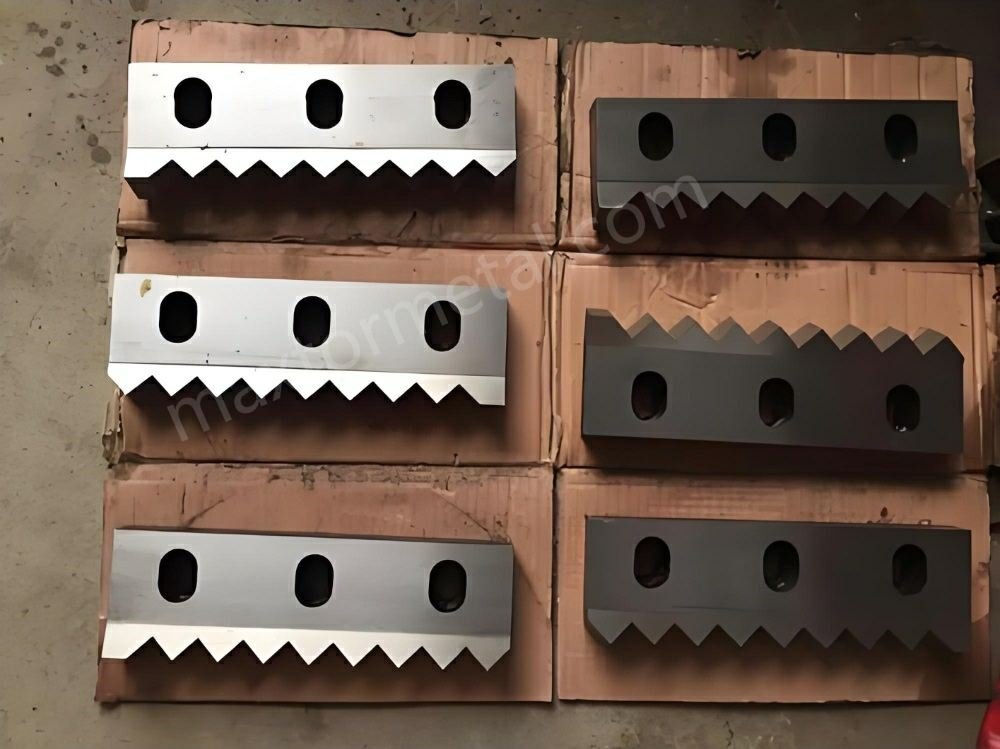
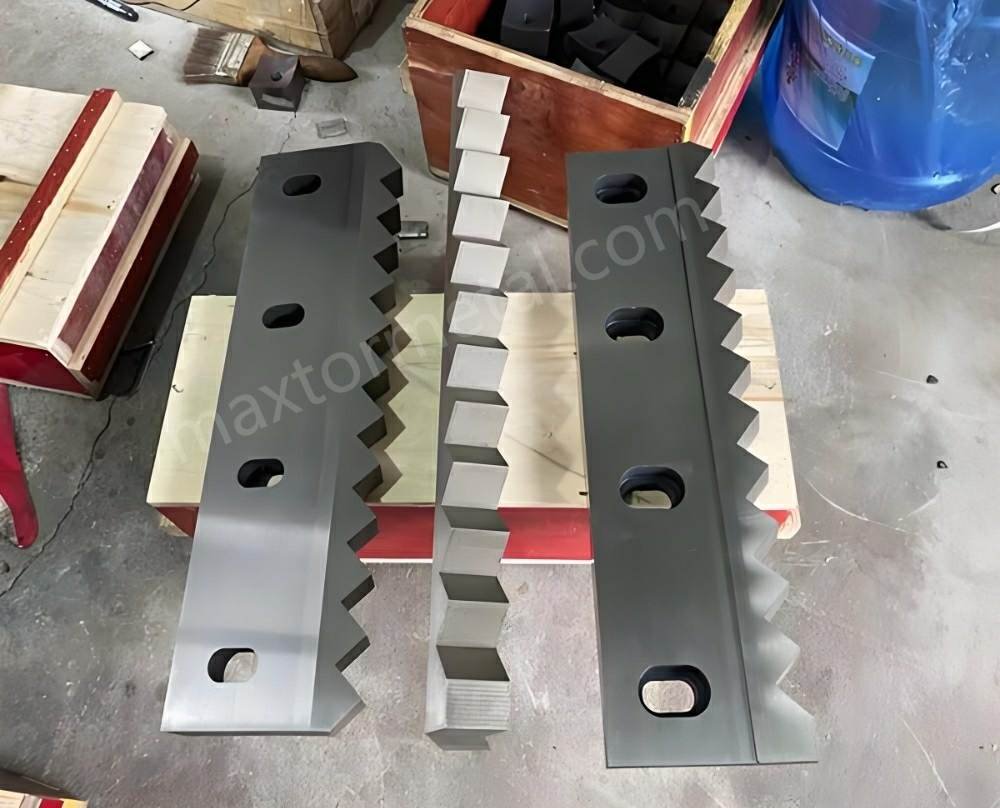
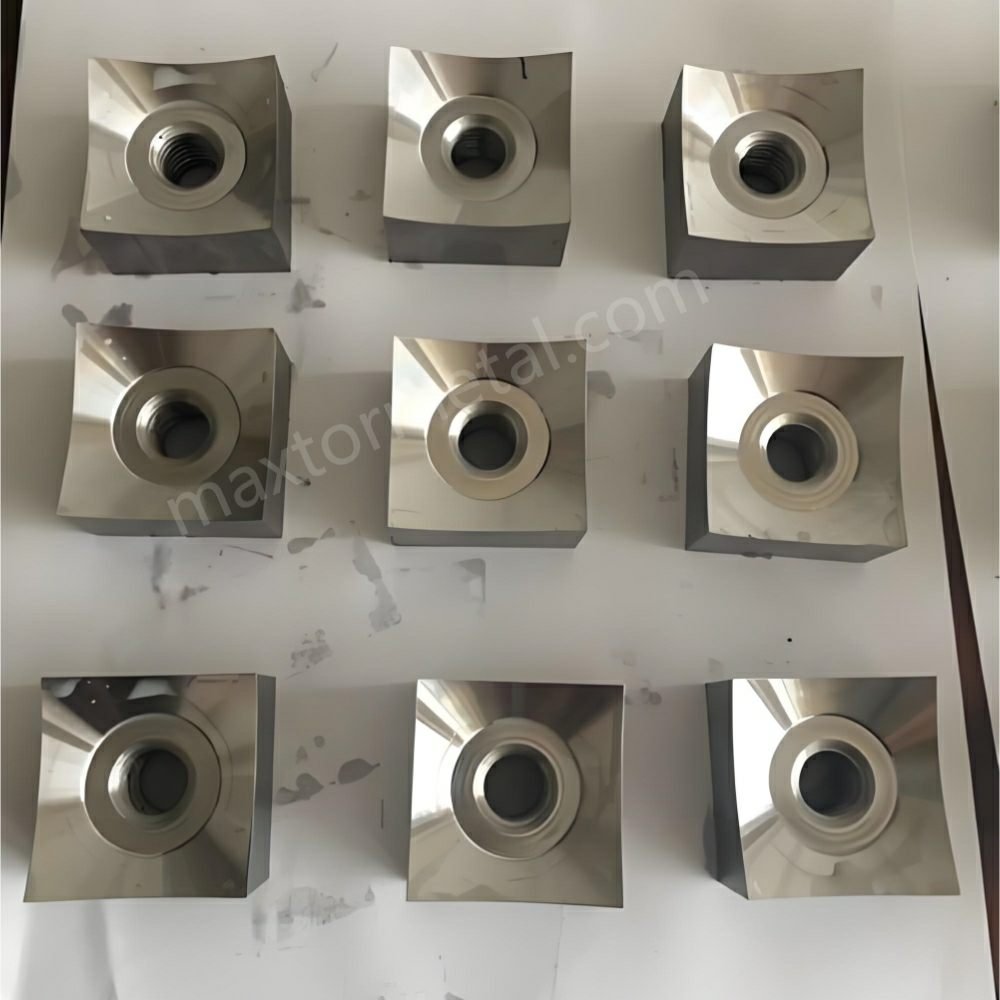
Multi-angle square concave rotary blocks, stator bed blades.
2. Panoramica Ingegneristica delle Lame per Trituratori
Industrial size reduction depends on two distinct mechanical shearing processes: high-frequency precision clipping and low-speed high-torque tearing. Understanding the mechanics of these operations is vital for predicting tool life and system efficiency.
2.2 Multi-Shaft Tearing Dynamics
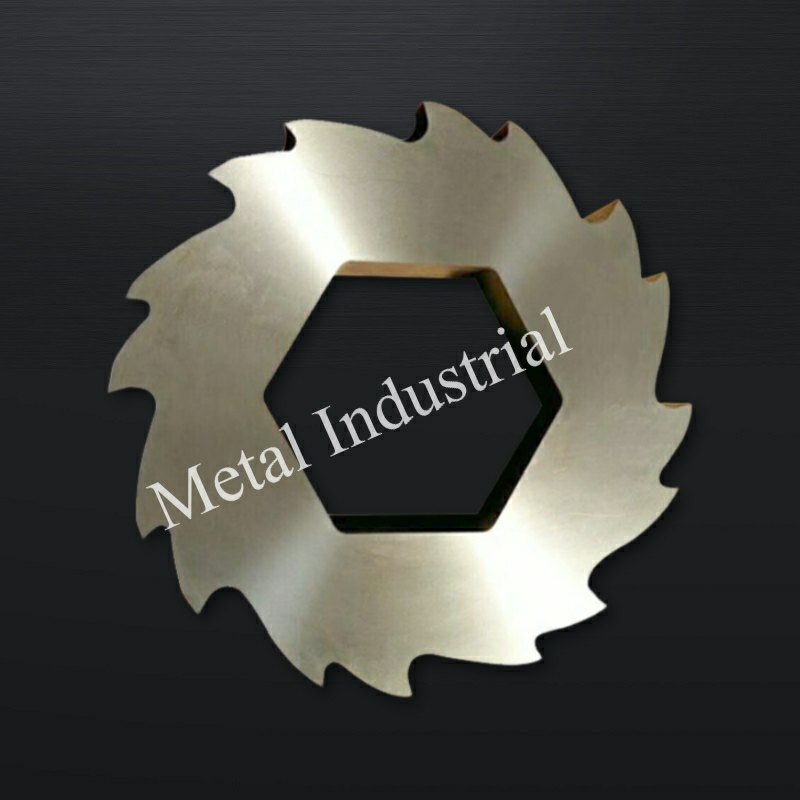
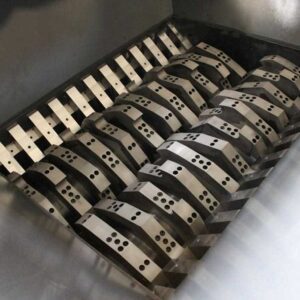
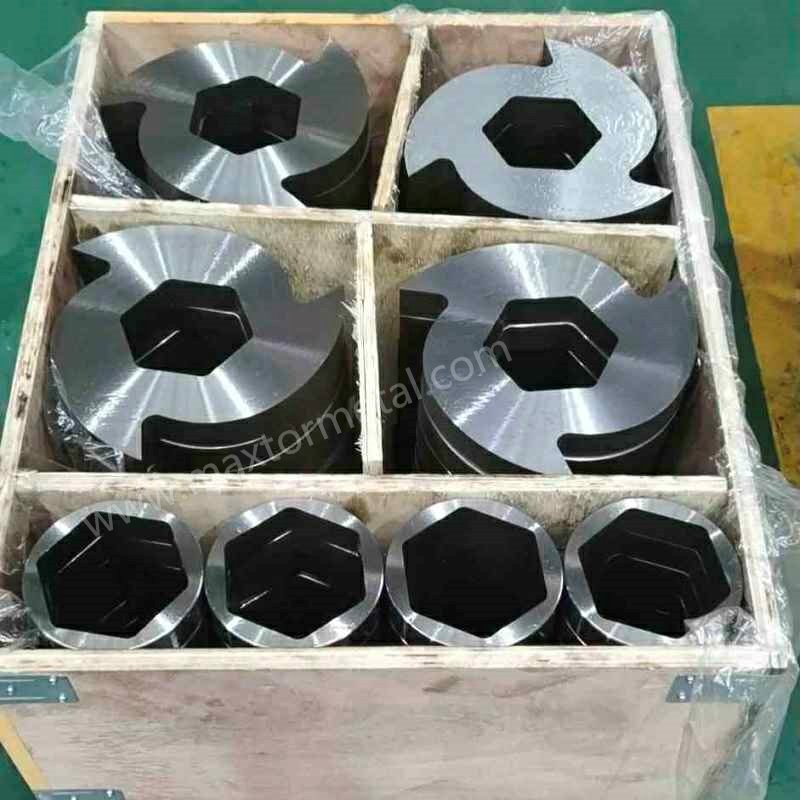
Multi-shaft industrial shredders (dual or quad-shaft configurations) operate via counter-rotating shafts turning at lower speeds but with high torque. The process relies on interlocking hook-like claw profiles that pull large, dense materials down into the center of the cutting chamber.
The shredding action uses a combination of hook tensile tearing, high-pressure lateral crushing, and interlocking side-face shearing. Rather than clean shearing, the mechanics focus on volumetric displacement and severe structural tearing. The open axial clearance system (0.15mm – 0.4mm side-gap per blade) permits independent thermal expansion and handles structural deformation under high loads.
2.1 Single-Shaft Cutting Dynamics
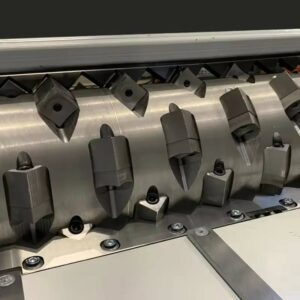
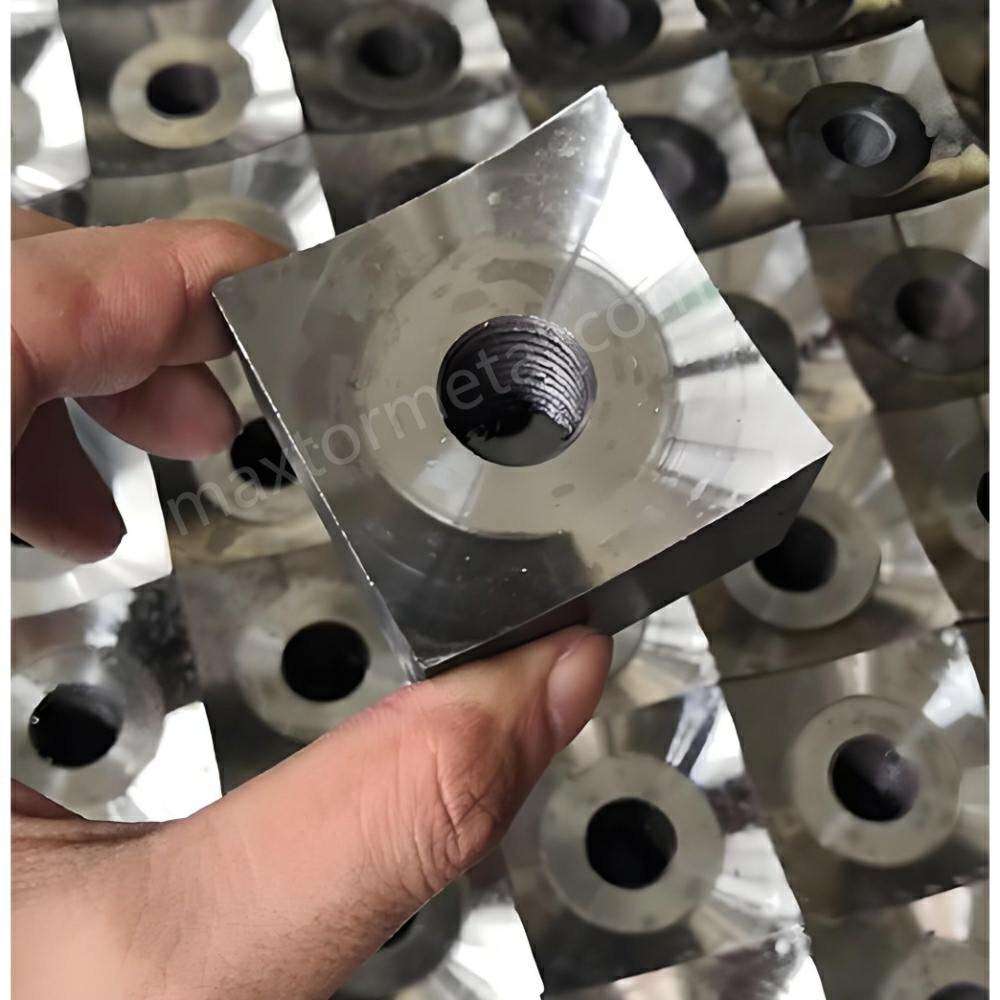
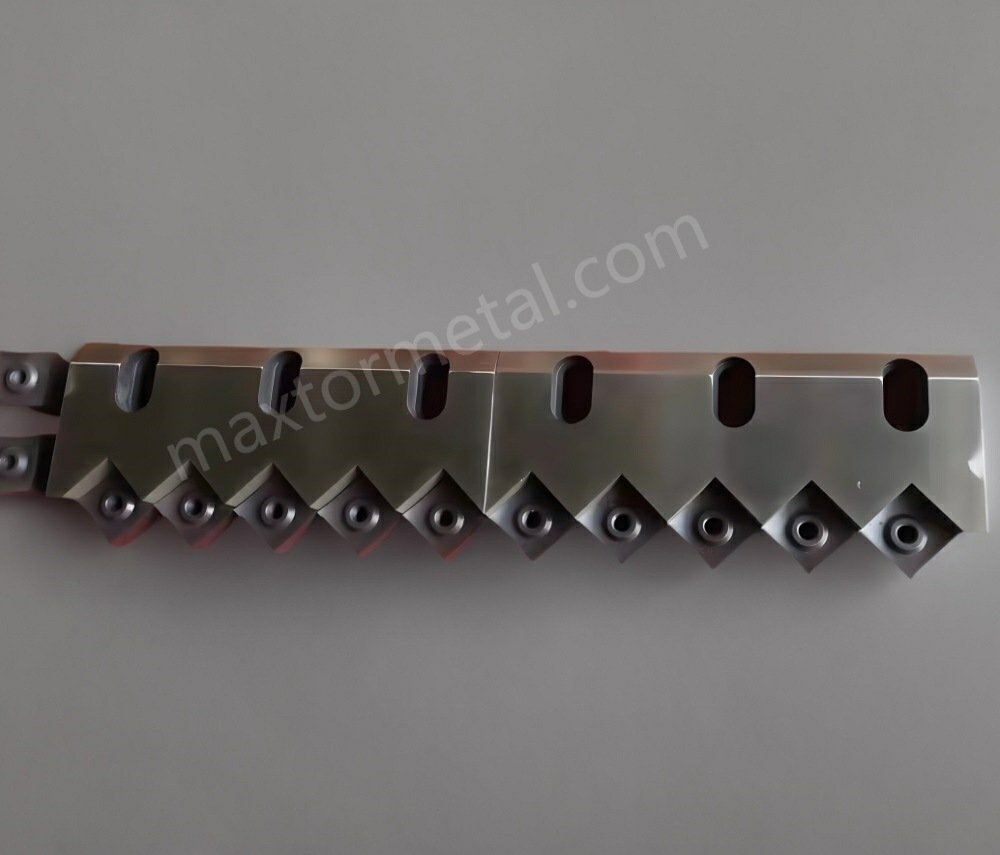
Single-shaft shredding systems run at higher rotational velocities, using a hydraulic ram to push bulk materials against a rotor turning at moderate-to-high speeds. The cutting mechanism is a precise, micro-gap scissor-like action occurring between the rotating square insert (rotary blade) and the stationary counter-knife (stator blade).
The primary stress applied to the material is pure shear stress, defined by:
$$\tau = \frac{F_{cutting}}{A_{shear}}$$
The dominant stress mode is shear, with the cutting force per unit shear area defined by τ = F/A. In practice, the narrow clearance (0.1–0.5 mm) also induces compressive stress normal to the shear plane, accelerating plastic deformation and clean fracture of the workpiece. The square concave profile of the rotary insert creates an acute positive rake angle that lowers the peak power needed from the main drive shaft. Final output particle size is strictly governed by a classification screen positioned beneath the rotor assembly.
2.3 Industrial Wear Characterization
Shredder blades operate in demanding tribological environments, with tool degradation following four distinct industrial wear patterns:
Abrasive Wear (Micro-Ploughing): Small, hard particles like sand, scale, glass fiber, or mineral dust slide across the tool steel matrix, cutting microscopic grooves and rounding the sharp cutting edges. This blunts the edge, increases power draw, and causes material pull-out or stretching instead of clean cutting.
Impact Fatigue (Chipping & Micro-Spalling): When heavy metallic impurities or uncrushable tramp components enter the machine, they exert high localized contact forces on the cutting edge. If the material’s fracture toughness (K1c) is insufficient, this contact stress causes immediate micro-chipping or catastrophic section failure.
Adhesive Wear & Thermal Softening: Processing dense polymers or highly elastic elastomers generates high friction at the cutting interface. This localized heat can cause localized temper-softening, which accelerates material loss and leads to polymer adhesion on the blade faces.
Intergranular Chemical Corrosion: Processing municipal solid waste, food waste, or animal tissue exposes the steel to high moisture, chlorides, organic acids, and salts (pH < 4). This reactive environment induces rapid pitting and intergranular oxidation, stripping the steel matrix of chromium and accelerating mechanical wear.
3. Applicazioni delle Lame per Trituratori Industriali
3.1 Advanced Plastics & Polymer Reclamation
Target Processing Machinery: High-throughput single-shaft shredders with variable-torque hydraulic rams.
Input Material Composition: Heavy-wall polyolefin pipes, injection-molded purges, automotive bumpers, and post-agricultural film contaminated with sand or soil.
Operational Engineering Criteria: High abrasive friction from glass fibers and mineral fillers. Requires excellent edge retention to prevent plastic film from stretching and wrapping around the rotor.
Recommended Specification: AISI D2 or DC53 rotary inserts through-hardened to 58–60 HRC. For heavy sand contamination, use an AISI 4140 base with brazed Tungsten Carbide (89–92 HRA) inserts.
Target Processing Machinery: High-precision, micro-clearance single-shaft granulators and shredders.
Input Material Composition: Armor-clad copper/aluminum power cables, communication lines, and electronic waste assemblies.
Operational Engineering Criteria: Requires precise, low-clearance cutting (0.1mm – 0.2mm) to cleanly separate copper strands from elastomer jackets without generating excess heat or insulation smear.
Recommended Specification: DC53 tool steel to prevent micro-chipping caused by hidden steel fasteners. Apply a physical vapor deposition (PVD) Titanium Nitride (TiN) coating (>2000HV) to the stator face to extend service life.
Target Processing Machinery: High-torque, low-speed dual-shaft or quad-shaft heavy industrial shredders.
Input Material Composition: Steel drums, structural automotive scrap, reinforced storage containers, and mixed hazardous waste containing structural steel plates.
Operational Engineering Criteria: Extreme shock loading and high torsion forces on the cutting claws when encountering thick uncrushable components.
Recommended Specification: AISI H13 (1.2344) or modified AISI A8 tool steel through-hardened to 48–54 HRC. This selection prioritizes high impact toughness and structural resistance over pure abrasive wear resistance to prevent blade shattering. A closely related hazardous-material application is lithium-ion battery recycling, where low-speed shear, controlled atmosphere, and HF-resistant materials are required in addition to impact toughness — see our Lithium-Ion Battery Shredding Hazards guide for the full engineering control framework.
Operational Engineering Criteria: Severe combination of high abrasive friction from vulcanized rubber compounds and high tensile/shear loads from cutting high-carbon spring steel wire.
Recommended Specification: Special M6V vanadium-rich wear-resistant tool steel or premium DC53 hardened to 56–58 HRC to prevent claw breakage under wire tension. The right hardness target here is a trade-off, not a maximum — pushing HRC too high sacrifices the impact toughness needed to survive bead-wire shock and tramp metal strikes. See our guide on balancing hardness vs. toughness for scrap tire and ELV shredder blades for the full cost-per-ton analysis and a documented failure case.
Target Processing Machinery: High-torque quad-shaft shredder systems utilizing multi-claw configurations.
Input Material Composition: High-density baled agricultural straw, crop stalks, forestry residues, and wood pallets containing structural fasteners.
Operational Engineering Criteria: Fibrous biomass materials easily wrap around shredding shafts, creating high radial forces and friction. Hidden stones or metal wires can cause sudden impact loads.
Recommended Specification: AISI 4140 (1.7225) structural tool steel through-hardened to 48–54 HRC for standard operations requiring cost-effective toughness. For continuous RDF (Refuse-Derived Fuel) processing lines, upgrade to premium M6V vanadium steel. Material selection alone doesn’t guarantee sizing compliance on these lines — cutter geometry, screen open-area ratio, and shear-gap control are equally decisive. See our guide onprogettazione per eliminare gli scarti di strisce lunghe per l'efficienza del trattamento di RDF/SRF for the full system-level approach.
3.6 Organic Municipal Waste, Food Waste & Animal Rendering
Input Material Composition: Post-consumer food waste with mixed cutlery/ceramics, whole animal carcasses, dense bone structures, and hooves from rendering operations.
Operational Engineering Criteria: Severe exposure to high-moisture organic acids, high salt concentrations, and continuous corrosive wear, combined with shock impacts from dense bone or mixed tableware.
Recommended Specification: For highly acidic food waste containing mixed ceramics/cutlery, use AISI 420 martensitic stainless steel hardened to 48–52 HRC. For pure carcass processing and animal rendering without heavy tramp metal, use high-carbon AISI 440C martensitic steel hardened to 58–60 HRC for high corrosion resistance and bone-shredding edge life.
4.Problemi di Guasto Comuni e Soluzioni Ingegneristiche
4.1 Single-Shaft Tool Chipping from Tramp Metal
Analisi delle cause profonde: When uncrushable steel components (e.g., hardened bolts, structural brackets) enter a single-shaft shredder, they get trapped between the high-hardness rotary knife (58–60 HRC) and the stator bed. This sudden obstruction generates localized stresses that exceed the fracture toughness (K1c) of AISI D2 steel, causing severe edge chipping or body fracturing.
Engineering Redesign & Trade-offs: Replace AISI D2 with DC53 steel. DC53 features uniform, fine carbide structures that double the Charpy V-notch impact energy compared to traditional D2. Compromesso ingegneristico: Material costs increase by approximately 25%, but tool lifetime and resistance to catastrophic failure improve substantially.
4.2 Multi-Shaft Claw Fracture Under High Biomass Stress
Analisi delle cause profonde: Processing dense, fibrous biomass or agricultural straw bundles can cause long fibers to wrap tightly around the root of the cutter claws. This wrapping action wedges material between adjacent blades, creating high bending moments and tensile loads that can snap the claws off at the root.
Engineering Redesign & Trade-offs: Change the blade material from high-hardness D2 steel to high-toughness AISI H13 (1.2344) or a modified AISI A8 steel, heat-treated to 48–54 HRC. This shifts the steel matrix from a wear-focused carbide structure to a shock-resistant martensitic structure. Compromesso ingegneristico: Lowering the hardness reduces abrasive wear resistance, requiring more frequent edge sharpening to maintain throughput.
4.3 Inner Drive Bore Cracking via Wire EDM Residual Stress
Analisi delle cause profonde: Precise internal driven profiles (such as hex or octagonal shapes) are commonly finished using Wire Electrical Discharge Machining (EDM) after heat treatment. The high temperatures of the EDM process melt and re-solidify the steel surface, creating a microscale brittle “white layer” filled with residual tensile stresses. Under high torque, these internal corners act as stress concentrators, initiating cracks that propagate outward and split the blade.
Engineering Redesign & Trade-offs: Implement an immediate post-EDM low-temperature stress-relief temper at 180℃ – 200℃ for 4 hours to relieve the residual tensile stresses. Alternatively, upgrade the material to DC53, which can absorb these stresses without requiring special multi-step tempering steps.
4.4 Axial Expansion and Seizure of Multi-Shaft Assemblies
Analisi delle cause profonde: Processing dense materials over long, continuous runs generates high friction, heating the shredder blades up to 80℃ – 120℃. If the thermal expansion of the blades exceeds the original engineered axial clearances, the side faces of the interlocking cutters will grind against each other, leading to frictional lockup, shaft deflection, and gear drive overload.
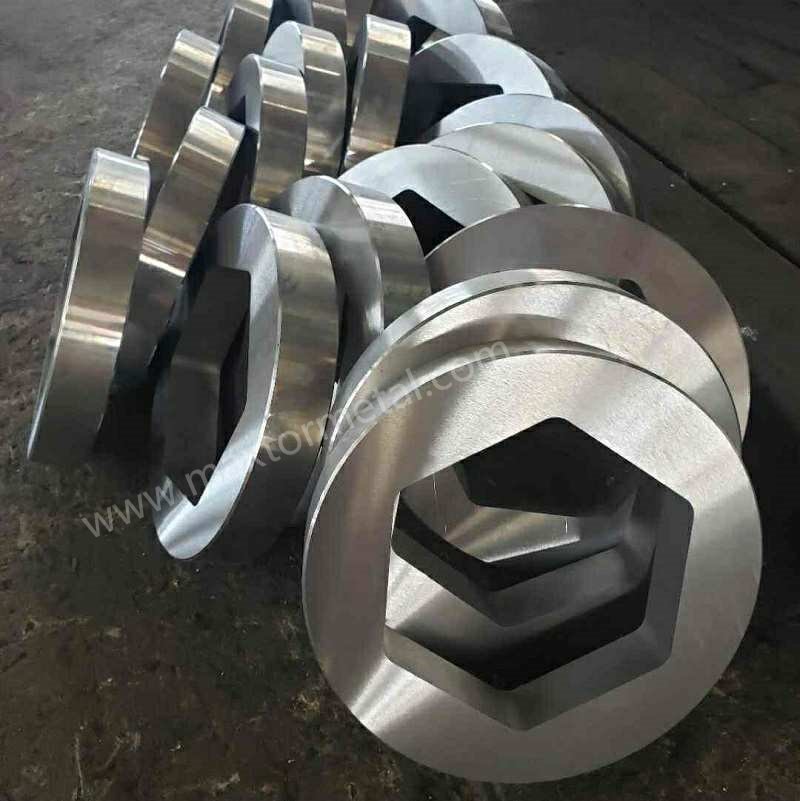
Engineering Redesign & Trade-offs: Increase the thickness of the spacer collars relative to the blades, setting a single-side clearance gap of 0.15 mm to 0.40 mm (making the spacer 0.3 mm to 0.8 mm wider than the corresponding blade). Additionally, apply a -196℃ cryogenic treatment during heat treatment to eliminate retained austenite, ensuring high dimensional stability over a wide temperature range. Compromesso ingegneristico: Larger clearance gaps can allow thin sheet materials to pass through without being fully shredded. For the full tolerance-chain analysis behind these clearance targets — including GD&T flatness/parallelism/perpendicularity callouts, spacer selective-fit binning, and post-assembly TIR acceptance gates — see our Multi-shaft Blade Tolerance Stacking guide.
4.5 Rapid Chemical Corrosion and Edge Softening in Biomass Processing
Analisi delle cause profonde: Processing organic food waste or animal carcasses releases high-moisture organic acids and chlorides (pH < 4). Standard cold-work tool steels like AISI D2 or DC53 lack sufficient free chromium, causing them to form iron oxides and pit rapidly under these conditions. This corrosion compromises the steel matrix, accelerating mechanical wear and causing the cutting edge to dull quickly.
Engineering Redesign & Trade-offs: Upgrade the cutter material to AISI 420 martensitic stainless steel (hardened to 48–52 HRC) or AISI 440C high-carbon stainless steel (hardened to 58–60 HRC), depending on the amount of mixed tramp metal present. Compromesso ingegneristico: Stainless tool steels are more difficult to precision-grind, increasing manufacturing costs and lead times.
4.6 Single-Shaft Rotary Blade Seating Loosening
Analisi delle cause profonde: High-frequency cutting forces apply cyclic, pulsing loads to single-shaft rotary inserts. If the dimensional tolerance between the insert’s bottom seating face and the rotor’s machined pocket exceeds 0.05 mm, the insert can shift micro-axially during operation. This movement puts high cyclic shear stresses on the central fastening bolt, leading to bolt fatigue and eventual failure.
Engineering Redesign & Trade-offs: Tighten the dimensional tolerances on the blade’s bottom seating and locator faces to a strict ±0.02mm via precision grinding. Compromesso ingegneristico: Requires high-precision CNC grinding fixtures, which increases tool manufacturing costs.
4.7 Severe Abrasive Edge Rounding from Glass-Fiber Reinforced Polymers
Analisi delle cause profonde: Glass fibers (GF) used in engineering plastics act as high-hardness abrasives during shredding. When these fibers slide across standard tool steel, they cause micro-ploughing that rapidly rounds the sharp cutting edge. Once rounded, the blade can no longer cut the plastic cleanly, increasing power consumption and generating friction that melts the polymer.
Engineering Redesign & Trade-offs: Use composite blades featuring an AISI 1045 or 4140 structural steel body with brazed Tungsten Carbide (WC-Co) inserts at the cutting edges. The carbide inserts provide high hardness (89–92 HRA) to resist fiber abrasion, while the steel body maintains structural toughness. Compromesso ingegneristico: High-vibration environments or tramp metal impacts can cause the brittle carbide inserts to crack or debond from the steel base.
4.8 Premature Corner Chipping on Square Concave Inserts
Analisi delle cause profonde: The four corner tips of single-shaft square concave inserts concentrate stress during operation. If the concave radius is ground too deep, the resulting edge geometry becomes too fragile, making the corners prone to micro-chipping under standard impact loads.
Engineering Redesign & Trade-offs: Optimize the grinding geometry by reducing the concave depth and introducing a small, controlled 0.1 mm chamfer or hone to the cutting edge. This reinforces the corner geometry with minimal impact on overall cutting sharpness.
4.9 Frictional Galling on Multi-Shaft Interlocking Faces
Analisi delle cause profonde: When shredding ductile materials like aluminum alloys or soft polymers, high lateral pressures can force the material into the side gaps between interlocking blades. This trapped material undergoes high friction and pressure, leading to localized cold-welding and material transfer (galling) onto the blade faces, which increases torque and friction.
Engineering Redesign & Trade-offs: Precision-grind the blade side faces to a smooth surface finish of Ra< 0.8μm to reduce friction. For highly ductile applications, add shallow radial escape grooves across the blade faces to help eject trapped particles. Introduce radial scraper fins onto the side profiles of the blades to help eject fine particles from the gap.
4.10 Thermal Cracking (Heat Checking) from Continuous Friction
Analisi delle cause profonde: Shredding highly elastic materials can generate high continuous friction, creating localized thermal gradients across the blade edge. The resulting cyclical thermal expansion and contraction can cause microscale thermal cracks (heat checking) perpendicular to the cutting edge, which can lead to larger structural failures.
Engineering Redesign & Trade-offs: Select tool steels with high thermal conductivity and temper resistance, such as AISI H13. Ensure the shredding system uses an automated reverse cycle or external cooling to manage operating temperatures.
5.Guida all'Ingegneria dei Materiali
Selecting the proper steel alloy requires balancing three conflicting properties: wear resistance, impact toughness, and manufacturability (grindability).
5.1 Metallurgical Matrix Comparison
The following alloy comparison reflects Maxtor Metal’s qualified material library for shredder blade production.
International Alloy Standard
Primary Microstructural Carbides
Charpy V-Notch Impact Energy (Toughness)
Resistenza all'usura abrasiva
Machining & Grindability Index
AISI D2 / DIN 1.2379 / SKD11
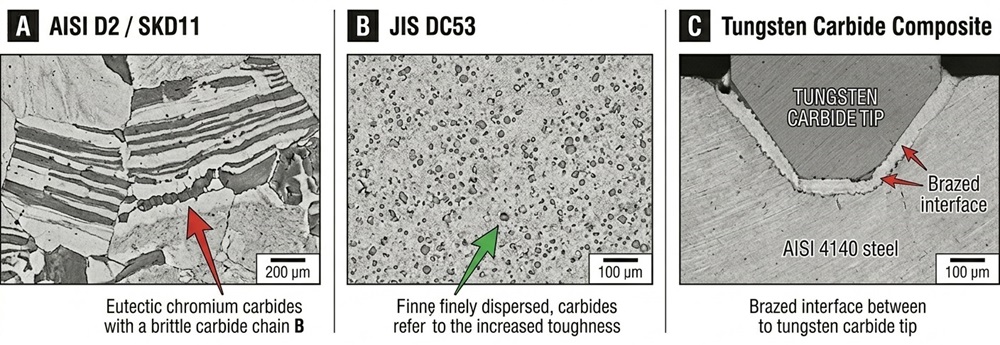
Large, banded eutectic chromium carbides (Cr7C3).
Low (20 – 25 J/cm2).
High.
Difficult; high wheel wear.
DC53 (Premium Cold-Work)
Fine, evenly dispersed secondary alloy carbides.
Very High (28 – 45 J/cm2).
Excellent.
Fair; superior to D2.
AISI H13 / DIN 1.2344
Fine vanadium/molybdenum carbides.
Exceptional (50 – 80 J/cm2).
Moderate.
Good; high machinability.
AISI A8 Mod (Toughness Tool)
Balanced chromium/molybdenum matrix.
Excellent (80 – 100J/cm2).
Medium-High.
Fair.
M6V (High-Vanadium Tool)
Ultra-hard vanadium carbides (VC, 2800HV).
Moderate-High (35 – 40J/cm2).
Superior long-life.
Difficult; requires specialized wheels.
AISI 4140 / DIN 1.7225
Homogeneous tempered martensite (no primary carbides).
High structural ductility.
Low; requires base support.
Excellent; low manufacturing cost.
AISI 420 / DIN 1.4021
Dispersed chromium carbides in a stainless matrix.
High (60 – 80J/cm2).
Medium.
Good.
AISI 440C / DIN 1.4125
High-density primary chromium carbides.
Low-Moderate (15 – 22J/cm2).
High.
Difficult.
Tungsten Carbide (WC-Co)
Pure sintered Tungsten Carbide grains.
Brittle; low impact threshold.
Maximum Industrial.
Requires diamond grinding.
Impact energy values are measured at target working hardness after vacuum hardening and triple tempering. Values at annealed state are significantly higher and are not representative of service conditions.
5.2 Advanced Metallurgical Selection Guidelines
5.2.1 AISI D2 vs. DC53
Traditional D2 steel contains large, non-uniform chromium carbides that form during solidification. These carbides act as stress concentration sites where micro-cracks can easily initiate under heavy shock loads. In contrast, DC53 modifies the chemical composition to eliminate these large carbide bands, resulting in a fine, uniform carbide distribution. This microstructural improvement doubles the material’s impact toughness while maintaining equivalent or superior wear resistance at high hardness levels (58–60 HRC).
M6V: Contains high amounts of vanadium, which forms ultra-hard vanadium carbides throughout the matrix. This alloy is ideal for high-volume, continuous processing lines like RDF generation, where long tool life is critical to reducing downtime.
AISI 420 & 440C: These martensitic stainless steels are selected for highly corrosive applications. AISI 420 provides the impact toughness needed to handle mixed municipal waste containing occasional hard impurities. AISI 440C features higher carbon and chromium content, providing excellent edge retention and wear resistance for pure organic processing, such as animal carcass rendering. 440C’s corrosion resistance also extends to HF-exposed environments such as lithium-ion battery shredding; for material mitigations and wetted-component guidance in that setting, see Rischi nella triturazione delle batterie agli ioni di litio: Controllo del taglio a bassa velocità, progettazione dell'atmosfera inerte e trattamento dell'HF.
6. Trattamento Termico e Bilanciamento della Durezza delle Lame
Industrial shredder blades require precise heat treatment to achieve the proper balance of hardness and toughness. Incorrect tempering or incomplete phase transformation can lead to premature tool failure.
6.1 Vacuum Austenitizing & Controlled Quenching
Blades are heat-treated in a high-vacuum furnace (10-4mbar) to prevent surface decarburization and oxidation. For premium tool steels like D2 and DC53, the material is preheated in stages to minimize thermal distortion before being brought to its final austenitizing temperature (1020℃ – 1040℃). Once uniform carbon dissolution is reached, the parts undergo a high-pressure gas nitrogen quench (6 – 10bar) to quickly transform the austenite matrix into hard martensite.
6.2 Deep Cryogenic Transformation Process
Following the quench, the steel matrix can retain up to 5% to 15% unstable retained austenite. To ensure long-term dimensional stability and prevent distortion or cracking under heavy structural loads, blades undergo a deep cryogenic treatment:
The temperature is lowered at a controlled rate (1℃/min) down to -196℃ using liquid nitrogen.
The blades are held at -196℃ for 12 to 24 hours.
This process forces the complete transformation of retained austenite into martensite and promotes the precipitation of fine η-carbides, improving both wear resistance and structural stability.
6.3 Precision Tempering Strategies
Tempering modifies the hard, brittle martensitic structure into a tougher, more resilient tempered martensite.
High-Temperature Tempering (Secondary Hardening Window): For D2 and DC53 blades used in high-wear applications, triple tempering is performed at 520℃ – 540℃. This triggers secondary carbide precipitation, maximizing wear resistance while maintaining a stable hardness of 58–60 HRC.
Low-Temperature Tempering (Toughness Window):
For shredder blades utilizing AISI D2, tempering is conducted at 180℃ – 200℃ to relieve quenching stresses and achieve peak impact toughness while maintaining a high working hardness of 58–61 HRC. To prevent micro-cracking during subsequent Wire EDM for internal shaft bores, a mandatory post-EDM stress-relief temper at 180℃ – 200℃ for 4 hours must be enforced.
For multi-shaft claw configurations subjected to severe operational shock loads, AISI H13 items must undergo high-temperature tempering cycles within 550℃ – 580℃. This drives complete secondary transformation and matrix stress-relief, establishing a stable tempered martensite structure that delivers its peak Charpy impact energy while targeting a hardness of 48–54 HRC.
7. Geometria della Lama e Ingegneria del Tagliente
The geometric design of a shredder blade determines its cutting efficiency, material throughput, and structural durability.
7.1 Single-Shaft Insert Architecture
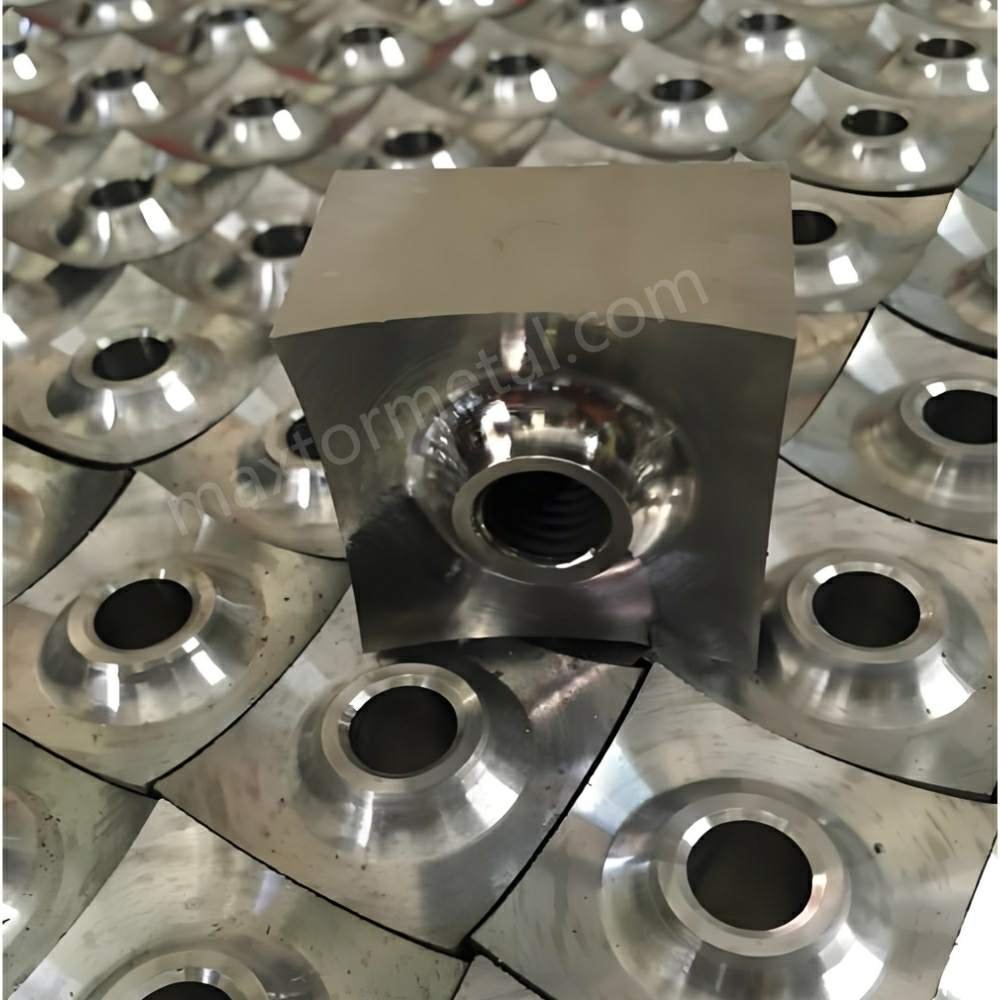
Single-shaft rotary knives are typically designed as multi-angle square concave inserts. The concave face creates an aggressive, positive rake angle (α = +10°to +15°) that helps pull material into the cutting zone, lowering the required drive motor power.
The center of the insert features a precision-machined countersunk hole designed to accept high-tensile socket head cap screws, securing the blade tightly into its rotor pocket. This pocket provides multi-surface support to absorb high radial and axial cutting forces.
7.2 Multi-Shaft Claw Profiles and Bore Mechanics
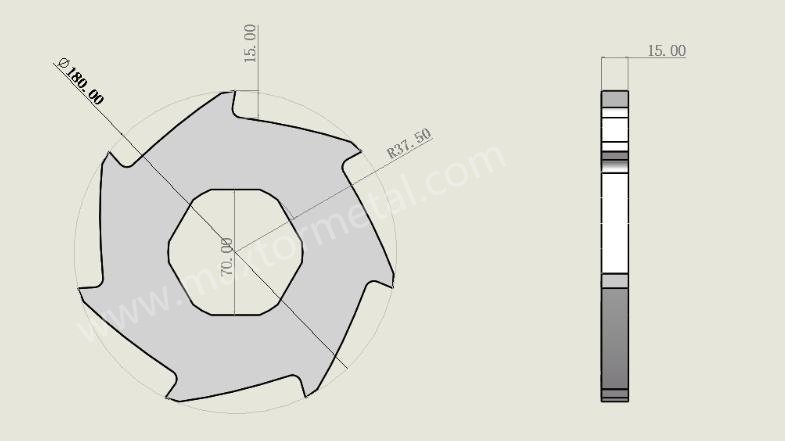
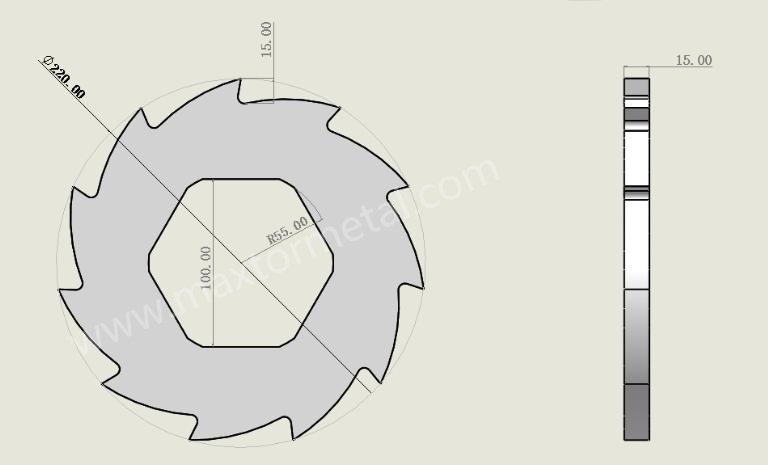
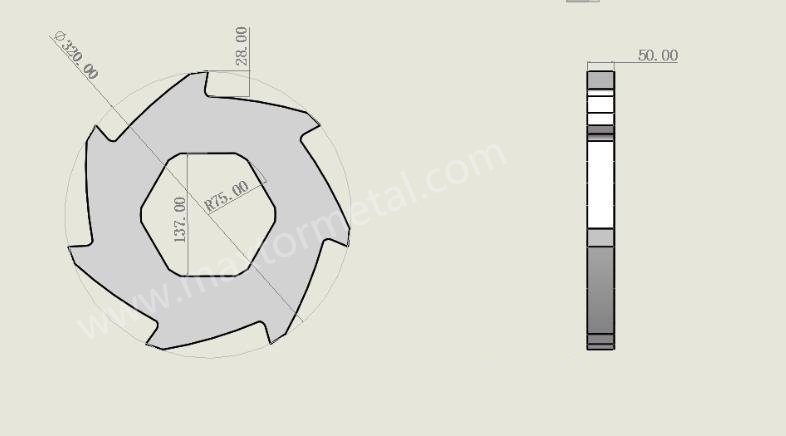
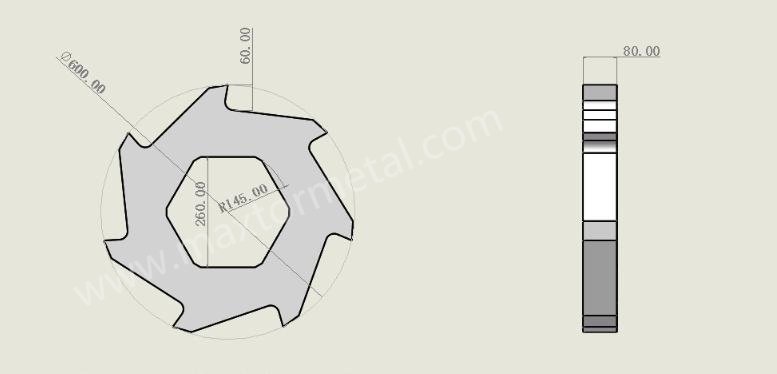
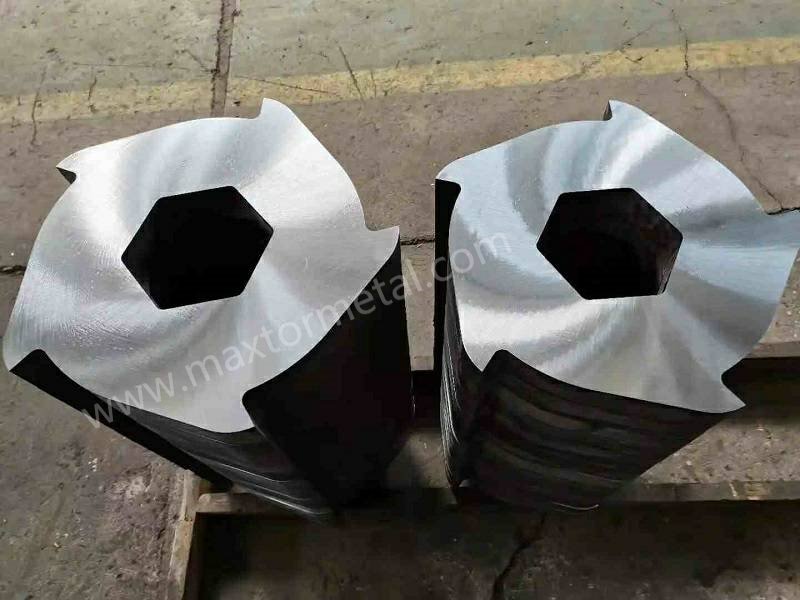
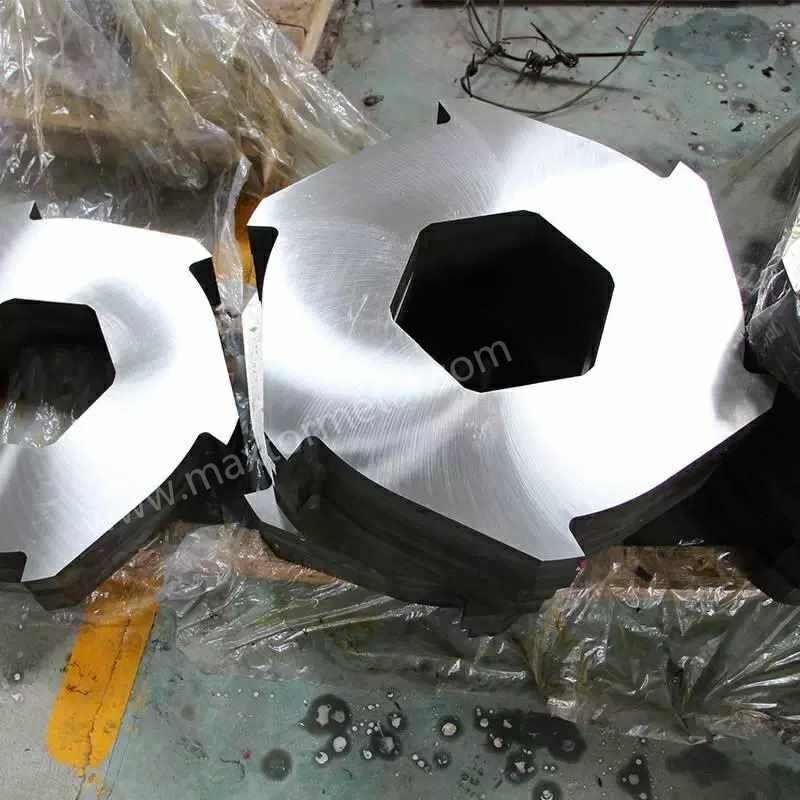
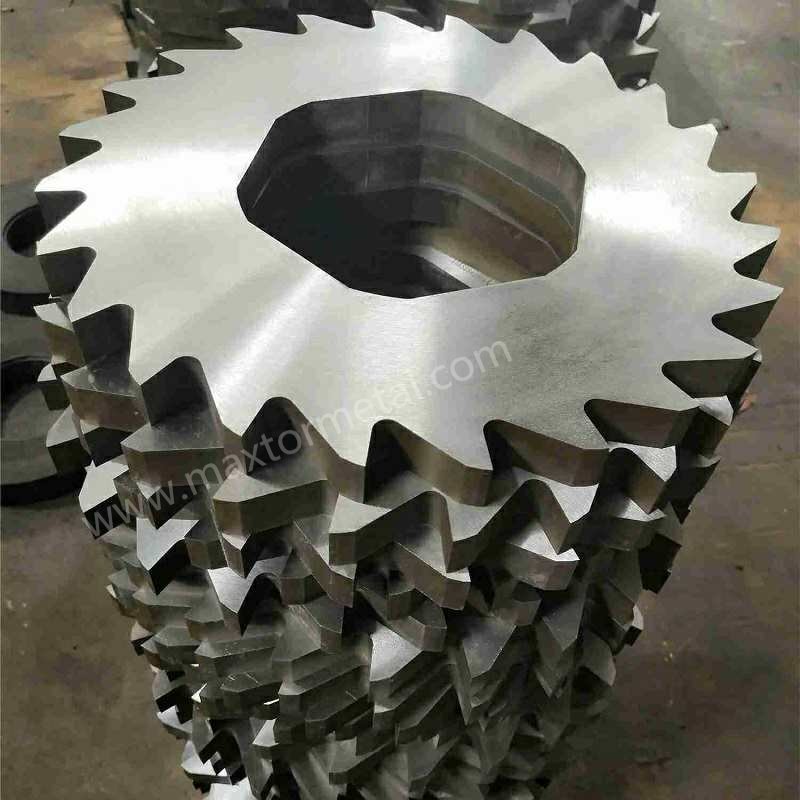
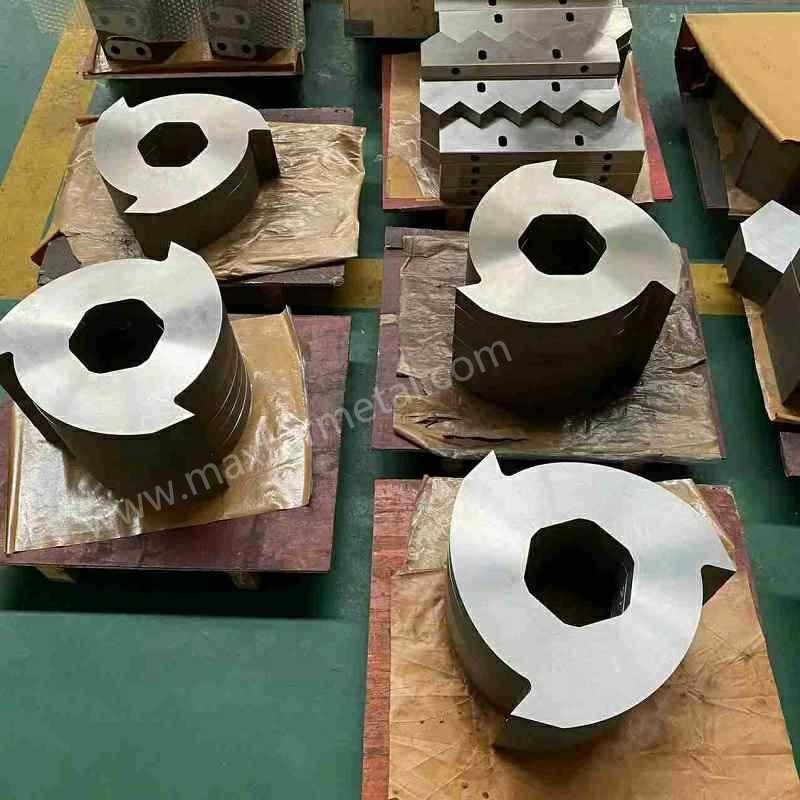
Multi-shaft blades are styled as disk cutters featuring a variable number of cutting claws (typically 3-claw, 5-claw, or 8-claw configurations).
3-Claw Profile: Features deep, aggressive hooks with a tall profile, making it ideal for grabbing and tearing bulky, hollow items like plastic drums or car body shells.
8-Claw Profile: Features shorter, closely spaced claws designed for high-density, uniform sizing applications, such as tire shredding or fine biomass processing.
The design of the internal drive bore is critical for delivering high torque from the main drive shaft:
Hexagonal / Octagonal Bores: Provide positive mechanical engagement but feature sharp internal corners that act as stress concentrators.
Involute Spline Bores: Feature a series of matching internal teeth that distribute torsional loads evenly across the entire circumference. This design significantly reduces localized stress concentration, making it ideal for heavy-duty recycling operations.
8. Processo di Produzione e Controllo Qualità delle Lame
To ensure reliable performance in demanding recycling environments, shredder blades must follow strict, quality-controlled manufacturing stages.
8.1 Advanced Manufacturing Workflow
Maxtor Metal’s standard manufacturing sequence for industrial shredder blades follows eight controlled stages:
Material Sourcing & Forging: Use clean, vacuum-degassed tool steel ingots. Perform 3D multi-directional forging to ensure uniform grain structure and break up coarse carbide bands.
Spheroidized Annealing: Heat-treat to produce a uniform distribution of granular carbides within a soft ferrite matrix, ensuring consistent machinability and dimensional stability.
CNC Rough Machining: Mill the core blade profiles, drill countersunk holes, and rough-turn the outer diameter, leaving a uniform 0.3mm – 0.5mm grinding allowance across all critical faces.
Vacuum Heat Treatment & Cryogenic Stabilization: Execute the complete vacuum hardening, liquid nitrogen deep freeze, and triple tempering sequence to fix the material’s microstructural properties.
Precision Super-Grinding: Use specialized CNC surface grinders equipped with vitrified CBN (Cubic Boron Nitride) or diamond wheels to finish the cutting edges to a smooth surface finish of Ra< 0.8μm.
Wire EDM Profiling (For Complex Bores): Use high-precision wire EDM to cut internal hexagonal or spline bores into the hardened blade body.
Low-Temperature Stress-Relief Tempering: Immediately temper the parts at 180℃ – 200℃ for a minimum of 4 hours to eliminate residual tensile stresses and the brittle EDM “white layer”.
Final Quality Control Inspection: Validate all dimensions using automated Coordinate Measuring Machines (CMM).
8.2 Metrology Protocols & Inspection Tolerances
Every finished blade must pass three quality control checks before release:
End-Face Flatness Verification: Measured using an optical flat or high-precision digital indicator across the entire blade diameter. For high-precision applications, flatness variation must not exceed ±0.01mm.
Dual-Face Parallelism Testing: The thickness variation between opposing parallel faces is verified at four symmetric points. Total thickness deviation must remain within ±0.05mm to ensure uniform seating when blades are stacked together on a multi-shaft assembly.
9. Casi di Studio
9.1 Case Study 1: Preventing Cracking in Industrial Silver Recycling
The following data comes from Maxtor Metal’s project support for a precious metals reclamation operator; the customer name has been anonymized.
Original Equipment Configuration: Multi-shaft heavy shredder using standard AISI D2 steel blades through-hardened to 60 HRC. Internal drive engagement was handled via a standard wire EDM-cut internal hexagonal bore.
Operational Failure Analysis: The original D2 blades frequently cracked and split from the sharp corners of the internal hex bore outward during early operation. Investigation revealed that the high torque required to process dense silver scrap amplified the residual tensile stresses left behind by the wire EDM process. The localized micro-cracking was heavily aggravated by the uncontrolled tensile stress fields generated during the legacy vendor’s post-EDM wire cutting, which omitted the critical stress-relief tempering protocol required to eliminate the brittle recast white layer. The large, brittle carbide structures typical of standard D2 steel could not absorb these combined loads, leading to rapid crack propagation and failure.
Evaluation of Engineering Solutions
Solution A: Upgrade to Material DC53
Engineering Approach: Replace AISI D2 steel with premium DC53 cold-work tool steel while maintaining standard, high-efficiency manufacturing methods.
Result Matrix: The fine, uniform carbide structure of DC53 doubled the material’s impact energy compared to D2. This increased toughness allowed the steel matrix to naturally absorb the residual stresses from the EDM process and handle the high torque loads without cracking. The blades maintained a high surface hardness of 58–60 HRC, preserving full wear life while shortening manufacturing lead times.
Solution B: Modify Manufacturing via a Four-Step Process
Engineering Approach: Maintain the original AISI D2 material but completely restructure the manufacturing sequence to isolate and relieve internal stresses:
Vacuum-harden the blank to a lower, tougher hardness level of 52 HRC.
Rough-grind both faces, leaving a 0.1mm – 0.2mm machining allowance.
Wire-EDM cut the internal hexagonal bore profile.
Perform a long, low-temperature stress-relief temper at 180℃ – 200℃ to relieve internal tensile stresses before a final finish grind.
Result Matrix: This process successfully prevented internal bore cracking and achieved a precise flatness tolerance of ±0.01mm. However, lowering the hardness to 52 HRC reduced the blades’ wear life by roughly 35%. This approach also significantly increased manufacturing costs, required more complex processing steps, and extended production lead times.
Final Implementation Decision: The operator chose Solution A. Upgrading to DC53 eliminated the cracking failures, maintained optimal edge wear life, simplified manufacturing, and reduced overall tool production times.
9.2 Case Study 2: Extending Tool Life in Corrosive Organic Waste Processing
The following data comes from Maxtor Metal’s project support for a municipal solid waste processing facility; the customer name has been anonymized.
Industrial Operator Profile: A municipal solid waste facility operating continuous organic waste and animal rendering lines.
Original Equipment Configuration: Heavy-duty dual-shaft shredder fitted with standard AISI D2 tool steel multi-claw blades.
Operational Failure Analysis: The original D2 blades showed severe surface rust and pitting corrosion within hours of processing acidic organic waste (pH < 4.5). This chemical corrosion quickly dulled the cutting edges, causing fibrous materials to wrap around the shafts and clog the machine. The resulting friction led to high operating temperatures, motor overloads, and frequent unscheduled maintenance shutdowns.
Implemented Engineering Redesign: The D2 blades were replaced with high-carbon martensitic stainless steel (AISI 440C), vacuum-hardened and low-temperature tempered to a stable 59 HRC. The side clearance gaps were also opened to 0.25 mm using wider, corrosion-resistant spacers to handle thermal expansion.
Quantified Performance Improvement: The upgraded AISI 440C stainless blades resisted organic acid pitting, maintaining a clean cutting edge over long runs. Continuous operating life between sharpening intervals increased from 72 hours to 300 – 580 hours depending on waste stream acidity and throughput rate. Frictional heat generation was significantly reduced, eliminating thermal clogging and lowering overall motor power consumption by 14%.
10. Sezione Domande Frequenti (FAQ)
Perché l'acciaio AISI D2 spesso si scheggia o si rompe durante la triturazione di rifiuti solidi urbani misti?
L'AISI D2 contiene carburi di cromo grandi e non uniformi che si formano durante la solidificazione. In queste bande, i carburi sono fragili e agiscono come concentratori di stress interni. Quando il trituratore incontra metalli estranei non frantumabili o pietre pesanti, i carichi d'impatto improvvisi superano la tenacità alla frattura della matrice D2, causando micro-scheggiature o gravi crepe strutturali.
En che modo il passaggio al DC53 aiuta a prevenire le crepe sulle lame del trituratore?
Il DC53 riduce le grandi bande di carburo di cromo tipiche del D2, sostituendole con una distribuzione dei carburi fine e uniforme. In base ai test di qualificazione dei materiali di Maxtor Metal, questo adeguamento microstrutturale raddoppia approssimativamente l'energia di impatto Charpy con intaglio a V rispetto al D2 standard a parità di durezza di lavoro (58–60 HRC), consentendo alla lama di assorbire meglio gli urti improvvisi e le coppie elevate senza fratturarsi.
Qual è il gioco laterale ottimale per le lame di un trituratore multialbero e perché è necessario?
In base alle specifiche di assemblaggio multialbero di Maxtor Metal, il gioco laterale standard per singolo lato varia da 0.15 mm a 0.40 mm, ottenuto realizzando l'anello distanziatore da 0.3 mm a 0.8 mm più largo rispetto allo spessore della lama. Questo gioco integrato compensa le tolleranze di spessore (ISO 2768-mK) e consente alle lame di espandersi liberamente quando l'attrito le riscalda durante il funzionamento, prevenendo il bloccaggio assiale e il grippaggio.
Quando si dovrebbero utilizzare gli inserti in carburo di tungsteno rispetto all'acciaio per utensili solido per i trituratori monoalbero?
Gli inserti in carburo di tungsteno sono ideali per applicazioni ad alta abrasione con un basso rischio di forti impatti, come la triturazione di film agricoli contaminati da sabbia o la lavorazione di tecnopolimeri rinforzati con fibra di vetro. Le placchette in carburo offrono un'elevata durezza (89–92 HRA) per resistere all'usura abrasiva, mentre una base in acciaio tenace come l'AISI 4140 fornisce il supporto strutturale.
Perché il trattamento criogenico profondo (-196 °C) è raccomandato per le lame di trituratori per impieghi gravosi?
Il trattamento criogenico costringe l'austenite residua instabile a trasformarsi completamente in martensite stabile. Nel protocollo di trattamento termico di Maxtor Metal, le lame vengono mantenute a −196 °C per un periodo da 12 a 24 horas dopo lo spegnimento, eliminando le tensioni microstrutturali residue che potrebbero causare deformazioni o distorsioni durante il servizio e favorendo la precipitazione di fini carburi secondari che migliorano la resistenza complessiva all'usura.
Qual è la causa della rottura dei fori di trascinamento interni (esagonali o ottagonali) e come si può risolvere questo problema?
La finitura dei fori di trascinamento interni tramite elettroerosione a filo (wire EDM) crea un "colletto bianco" sottile e fragile sulla superficie dell'acciaio che contiene elevate tensioni di trazione residue. Gli angoli vivi dei fori esagonali o ottagonali concentrano naturalmente le sollecitazioni. Sotto l'azione di coppie elevate, le crepe possono facilmente innescarsi in corrispondenza di questi spigoli e propagarsi verso l'esterno. Ciò può essere evitato applicando un rinvenimento di distensione post-elettroerosione a 180 °C - 200 °C o passando a un materiale della lama ad alta tenacità come il DC53.
Quale materiale per lame è il migliore per la lavorazione di rifiuti alimentari organici corrosivi?
Per i rifiuti organici ad alto contenuto di umidità e acidi, si raccomandano gli acciai inossidabili martensitici AISI 420 o AISI 440C. L'AISI 420 offre una buona tenacità all'impatto per flussi di rifiuti misti, mentre l'AISI 440C garantisce una durezza superiore (58–60 HRC) e un'eccellente tenuta del filo per applicazioni di rendering ad alto volume, come la lavorazione di carcasse animali.
Quale finitura superficiale è richiesta per le facce delle lame rotanti monoalbero?
Secondo gli standard di rettifica e ispezione di Maxtor Metal, la faccia di taglio concava deve essere rettificata di precisione a Ra < 0.8 μm per mantenere un tagliente affilato e a basso attrito, mentre le sedi di montaggio piatte richiedono un valore di Ra < 1.6 μm per garantire un alloggiamento rigido e sicuro nella tasca del rotore.
Perché gli acciai per utensili standard sono inefficaci per il rendering animale e la lavorazione delle carcasse?
I fluidi animali contengono elevate concentrazioni di acidi organici e sali che causano la rapida ruggine e corrosione intergranulare (pitting) degli acciai per utensili standard come il D2 o il DC53. Questa usura corrosiva degrada la matrice dell'acciaio e smussa rapidamente il tagliente, portando all'attorcigliamento del materiale, attrito e conseguente sovraccarico della macchina. Per resistere a queste condizioni sono necessari acciai inossidabili martensitici come l'AISI 440C.
Qual è lo scopo del rivestimento PVD in TiN sulle lame fisse (statori) monoalbero?
Il rivestimento in nitruro di titanio (TiN) aumenta la durezza superficial a oltre 2000 HV sulle facce di cesoiamento principali. Questo rivestimento funge da barriera contro l'usura abrasiva, rendendolo estremamente efficace per applicazioni di precisione come il riciclaggio di cavi elettrici, dove il mantenimento di un tagliente pulito e affilato è fondamentale per evitare lo sbaffo dell'isolamento.
In che modo il profilo di una lama multialbero a 3 becchi si differenzia in termini di applicazione da uno a 8 becchi?
Il profilo a 3 becchi presenta ganci alti e aggressivi, progettati per afferrare e lacerare materiali voluminosi e cavi come fusti di plastica, pneumatici o rottami di automobili. Il profilo a 8 becchi presenta ganci più corti e frequenti che offrono una lacerazione meno aggressiva, ma garantiscono una riduzione volumetrica più uniforme e fine, rendendolo ideale per la lavorazione di biomassa sfusa o gomma pre-tritata.
Perché le tolleranze dimensionali per le basi delle lame monoalbero sono limitate a ±0.02 mm?
I trituratori monoalbero funzionano con un'azione di taglio pulsante e ad alta frequenza. Maxtor Metal impone una severa tolleranza di ±0.02 mm sulla sede della base della lama e sulle facce di posizionamento —verificata tramite rettifica CNC di precisione— per garantire un accoppiamento rigido all'interno della tasca del rotore e prevenire i micromovimenti che causano la rottura per fatica dei bulloni di fissaggio principali.
Quali compromessi ingegneristici si verificano quando si riduce la durezza della lama per migliorarne la tenacità?
Ridurre la durezza di una lama (ad esempio, rinvenendo l'acciaio D2 a 52 HRC) aumenta la sua tenacità all'impatto e la sua resistenza alle crepe. Tuttavia, questo riduce la sua resistenza all'usura abrasiva, il che significa che i taglienti si smusseranno più rapidamente e richiederanno un'affilatura o una sostituzione più frequente, aumentando i tempi di fermo macchina operativi.
Qual è il vantaggio di un foro scanalato a evolvente (involute spline) rispetto a un foro esagonale standard per trasmissioni multialbero?
Un foro esagonale concentra gli sforzi di torsione nei suoi sei angoli vivi, il che può portare a cricche da fatica nel tempo. Un foro scanalato a evolvente, invece, utilizza una serie di denti curvi per distribuire la coppia motrice in modo uniforme su l'intera circonferenza dell'albero, riducendo significativamente le sollecitazioni localizzate e prolungando la durata della lama sotto carichi pesanti.
Come si può identificare se il cedimento di una lama è stato causato da usura abrasiva o da fatica da impatto?
L'usura abrasiva si presenta sotto forma di microsanalature lisce, graffi e un graduale arrotondamento del tagliente nel tempo. La fatica da impatto provoca micro-scheggiature improvvise, sfogliatura (spalling) o grandi crepe frastagliate lungo il corpo della lama, tipicamente innescate dall'incontro con un oggetto non frantumabile.
Call to Action Ingegneristica Finale
Ottimizza la Produttività del tuo Sistema di Triturazione
Does your production line experience frequent downtime due to blade chipping, corner cracking, or rapid wear? Shifting from generic replacement parts to precision-engineered shredder blades can stabilize your processing costs and improve system reliability.
Maxtor Metal’s engineering team can review your system drawings and material requirements to develop customized solutions:
Custom Alloy Matching: We select and treat materials (including DC53, M6V, and AISI 440C) based on your specific waste stream dynamics.
Produzione di precisione: All parts are finished with advanced vacuum heat treatments, cryogenic stabilization, and precision CNC grinding down to ±0.01mm tolerances.
Direct RFQ Support: Submit your CAD files (.STEP, .DWG) or OEM part numbers today for a detailed technical review and production quote.









 English
  Spanish
 Italian
 French
 Portuguese
 Russian
 German
 Arabic
 Hindi
Hindi
 Vietnamese
 Indonesian
 Japanese
 Korean


