

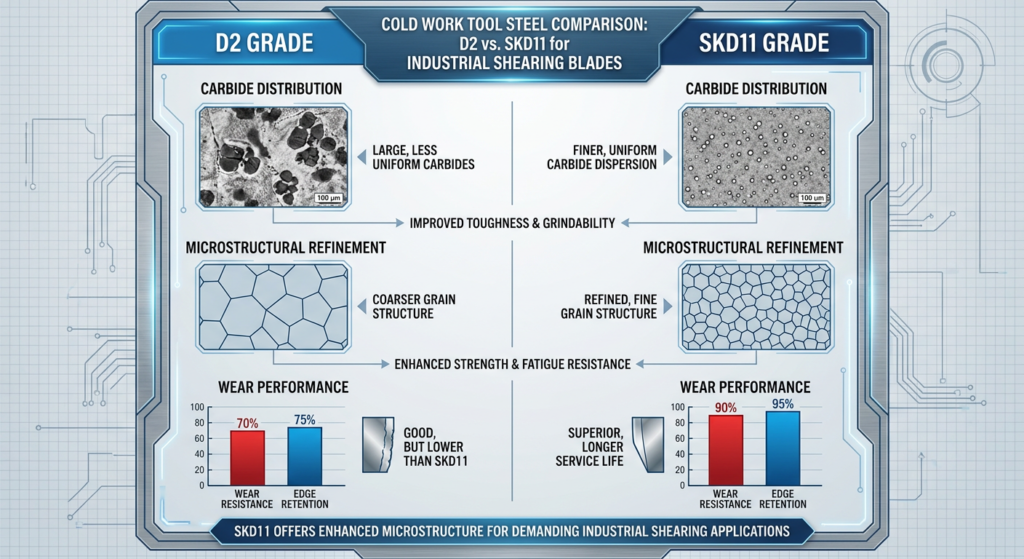
요약: D2 and SKD11 are compositionally near-identical high-carbon, high-chromium cold-work tool steels, but D2’s higher vanadium content (0.50–1.10%) delivers stronger abrasive wear resistance for clean, high-volume sub-6mm cutting, while SKD11’s finer carbide structure provides better impact toughness for stainless steel, variable feed, or chipping-prone operations. The decision turns on your dominant failure mode—wear or chipping—not the grade label alone. ESR refining quality from your supplier matters as much as the designation.
엔지니어링 참고 사항: D2 vs SKD11 tool steel selection for shearing blades is a carbide microstructure decision, not a brand substitution. Both grades occupy the same ledeburitic cold-work steel family (high-C, high-Cr), and their nominal composition windows overlap substantially across ASTM A681, JIS G4404, and DIN 1.2379. The performance gap emerges from vanadium content, melt refinement practice, and heat treatment control—variables that only material test certificates and carbide inspection can verify. See Maxtor Metal shear blade specifications and material options.
Both D2 and SKD11 belong to the same high-carbon, high-chromium cold-work tool steel family, yet blade buyers often treat them as interchangeable without understanding the metallurgical nuances. When sourcing replacement tooling for hydraulic guillotine shears, mechanical power shears, or coil slitting lines, selecting between these two specifications requires looking far beyond basic hardness numbers.
The real differentiator in shearing blade performance lies not in the grade name but in carbide distribution and how each grade responds to specific failure modes. While nominal alloy tables look nearly identical, subtle variations in vanadium content, melting practice, and heat-treatment response dictate whether a blade suffers premature micro-chipping or maintains a crisp edge across hundreds of thousands of cuts.
This guide breaks down the composition, carbide structure, and wear behavior of both steels — helping you select the right blade for sub-6mm sheet cutting. By understanding these metallurgical fundamentals, tooling engineers and procurement teams evaluating high-performance precision-ground shearing blades can optimize tool life, lower cost per cut, and eliminate unexpected downtime in metal fabrication environments.
D2 및 SKD11 공구강의 화학 성분 비교
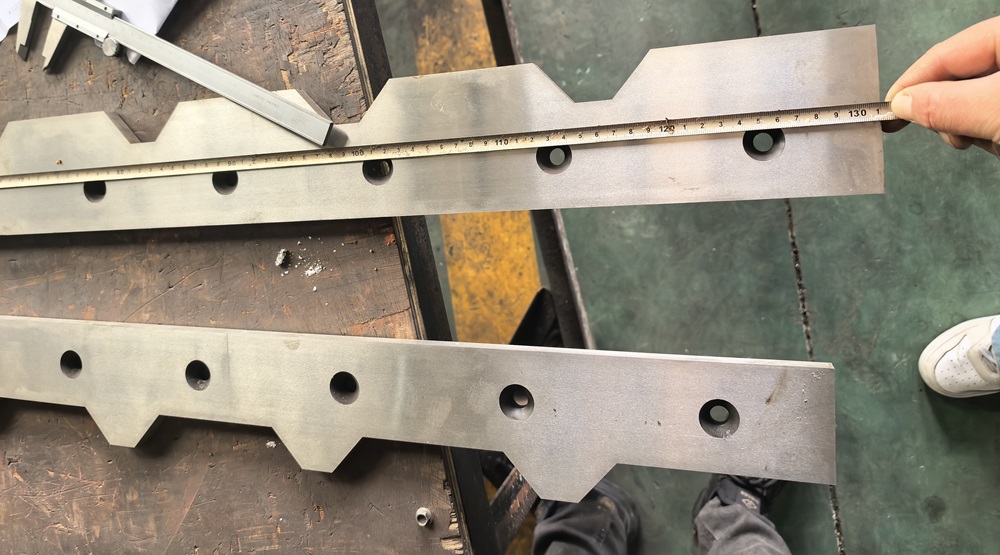
Both grades share nearly identical carbon and chromium ranges, with subtle differences in vanadium and molybdenum that shape their microstructures. At their core, both alloys contain roughly 1.5% carbon and 12% chromium, classifying them as ledeburitic tool steels. During solidification, this high chromium and carbon concentration forms a substantial volume fraction of hard primary eutectic carbides (M₇C_3 type) embedded in a martensitic matrix after heat treatment.
Understanding these compositional variations is the first step in evaluating how each steel will perform in your specific shearing operation. While the nominal overlap leads many suppliers to market them interchangeably, small shifts in alloying elements dictate carbide precipitation, secondary hardening response, and grain-refinement capabilities.
요약하자면: D2 and SKD11 share the same Cr-C backbone, but D2’s broader vanadium range (up to 1.10%) gives it more hard VC monocarbides—the key variable for abrasive wear resistance.
A comparative composition table clarifies the technical overlap and highlights where metallurgical control matters most:
| 요소 | AISI D2 (ASTM A681) | JIS SKD11 (JIS G4404) | DIN 1.2379 (EN ISO 4957) | Metallurgical Role |
|---|---|---|---|---|
| 탄소(C) | 1.40% – 1.60% | 1.40% – 1.60% | 1.45% – 1.60% | Matrix hardness & carbide formation |
| 크롬(Cr) | 11.00% – 13.00% | 11.00% – 13.00% | 11.00% – 13.00% | Wear resistance & M₇C_3 primary carbides |
| 몰리브덴(Mo) | 0.70% – 1.20% | 0.80% – 1.20% | 0.70% – 1.00% | Hardenability & secondary hardening |
| Vanadium (V) | 0.50% – 1.10% | 0.20% – 0.50% | 0.70% – 1.00% | Ultra-hard VC monocarbides & grain refinement |
| Silicon (Si) | 0.10% – 0.60% | ≤ 0.40% | 0.15% – 0.60% | Deoxidation & matrix solid-solution strengthening |
| Manganese (Mn) | 0.10% – 0.60% | ≤ 0.60% | 0.20% – 0.60% | Deep hardenability & deoxidation |
D2 Standard Designations and Properties
D2 spans multiple global standards, including AISI D2 in North America, ASTM A681 (Standard Specification for Tool Steels Alloy Steel), and European DIN EN ISO 4957 Grade 1.2379, giving it broad availability across North American and European supply chains.
Its higher vanadium content (typically 0.50% to 1.10%) promotes finer vanadium monocarbides (VC). These VC particles feature an extremely high hardness (roughly 2800 HV, compared to 1500–1800 HV for M₇C_3 chromium carbides), which significantly contributes to edge retention in highly abrasive cutting conditions.
SKD11 Standard Designations and Properties
SKD11 follows the JIS G4404 Alloy Tool Steels Standard, widely stocked across Asian manufacturing hubs and favored for its dimensional stability and consistent heat-treatment response.
Its lower vanadium content (0.20% to 0.50%) leaves the microstructure more heavily dominated by M₇C_3 chromium carbides. This subtle chemical shift slightly reduces extreme abrasive wear resistance compared to high-vanadium D2 heats, but it shapes its toughness characteristics, making the material less prone to sudden micro-fracture under moderate impact loading.
탄화물 분포: 두 강종을 결정짓는 핵심 차이점

The grade label tells you the chemistry window, but carbide size, distribution, and refinement determine how the blade actually performs in production. Two blocks of steel with identical chemical laboratory certifications can exhibit radically different tool life if one contains coarse, clustered carbide networks while the other features fine, uniformly dispersed carbide particles.
Coarse, banded primary carbides create stress concentrators, acting as initiation sites for micro-cracks under cyclic impact, while fine, uniformly dispersed carbides deliver better edge toughness and dimensional stability. During heavy-duty shearing, shock waves travel through the blade edge upon impact with the sheet; large carbide clusters interrupt the matrix continuity and precipitate micro-chipping.
Buyers should look beyond the designation and examine carbide structure when evaluating blade suppliers. Verifying melt refinement and forging reduction ratio ensures that the raw stock has been processed to break up eutectic carbide networks.
요약하자면: Two blades with identical certs can perform differently. Carbide size (3–8 µm vs 8–20 µm) and ESR refining quality are the real differentiators—ask your supplier for metallographic evidence, not just the grade stamp.
How Carbide Size and Distribution Affect Edge Performance
Conventional D2 heats typically develop coarse primary carbides ranging from 8 to 20 micrometers (µm) in size. These large M₇C_3 carbide stringers provide strong abrasive wear resistance when shearing clean mild steel, but they introduce greater chipping risk along sharp cutting edges.
Refined heats and SKD11-type chemistry deliver finer carbides in the 3 to 8 micrometer range. This microstructural refinement improves edge toughness under cyclic and impact loading, preventing small segments of the cutting rake from breaking away during high-speed shearing runs.
The Role of Refining Processes in Carbide Quality
Maxtor Metal sources only ESR-refined or vacuum-arc-remelted (VAR) D2 and SKD11 stock for shear blade production—a procurement standard that eliminates the carbide banding variability common in conventionally cast tool steel.
Electroslag remelting (ESR) and controlled melt routes reduce segregation and carbide banding, producing a finer, more uniform carbide dispersion throughout the matrix. By remelting raw electrodes through a reactive slag bath, ESR processing eliminates non-metallic inclusions and suppresses coarse eutectic segregation during solidification.
Importantly, the JIS designation alone does not guarantee ESR-level refinement — two SKD11 blades from different suppliers can perform very differently depending on whether they were produced via basic electric-arc melting or secondary ESR refinement.
To guarantee batch-to-batch consistency, leading industrial tooling engineers emphasize strict raw material quality control, favoring premium ESR-refined tool steel stock for precision-ground shearing blades. At Maxtor Metal, shear blade manufacturing integrates controlled vacuum heat treatment with calibrated CNC grinding to eliminate internal stresses and coarse carbide banding. Each production batch is accompanied by hardness mapping reports and, on request, metallographic inspection images confirming carbide size and distribution within spec. This ensures that every blade edge maintains stable alignment, high edge sharpness, and optimal resistance to impact chipping.
6mm 이하 절단에서의 내마모 성능 및 파손 모드

For sheet metal under 6mm thickness, both D2 and SKD11 can deliver long service life — but the dominant failure mode determines which grade will last longer in your production line. Selecting the wrong grade often results in repeated blade removal for premature regrinding, driving up tooling overhead and labor costs.
Wear-dominated operations favor D2’s superior abrasion resistance, while impact and chipping conditions call for SKD11’s higher toughness. Matching the steel’s microstructural strengths to your line’s mechanical realities prevents catastrophic edge breakdown.
Understanding the failure mode is the most direct path to lower cost per cut and fewer unplanned stoppages. When evaluating worn blades during planned maintenance, inspect the cutting edge under magnification to identify whether the primary issue is flank wear, micro-chipping, or gross cracking.
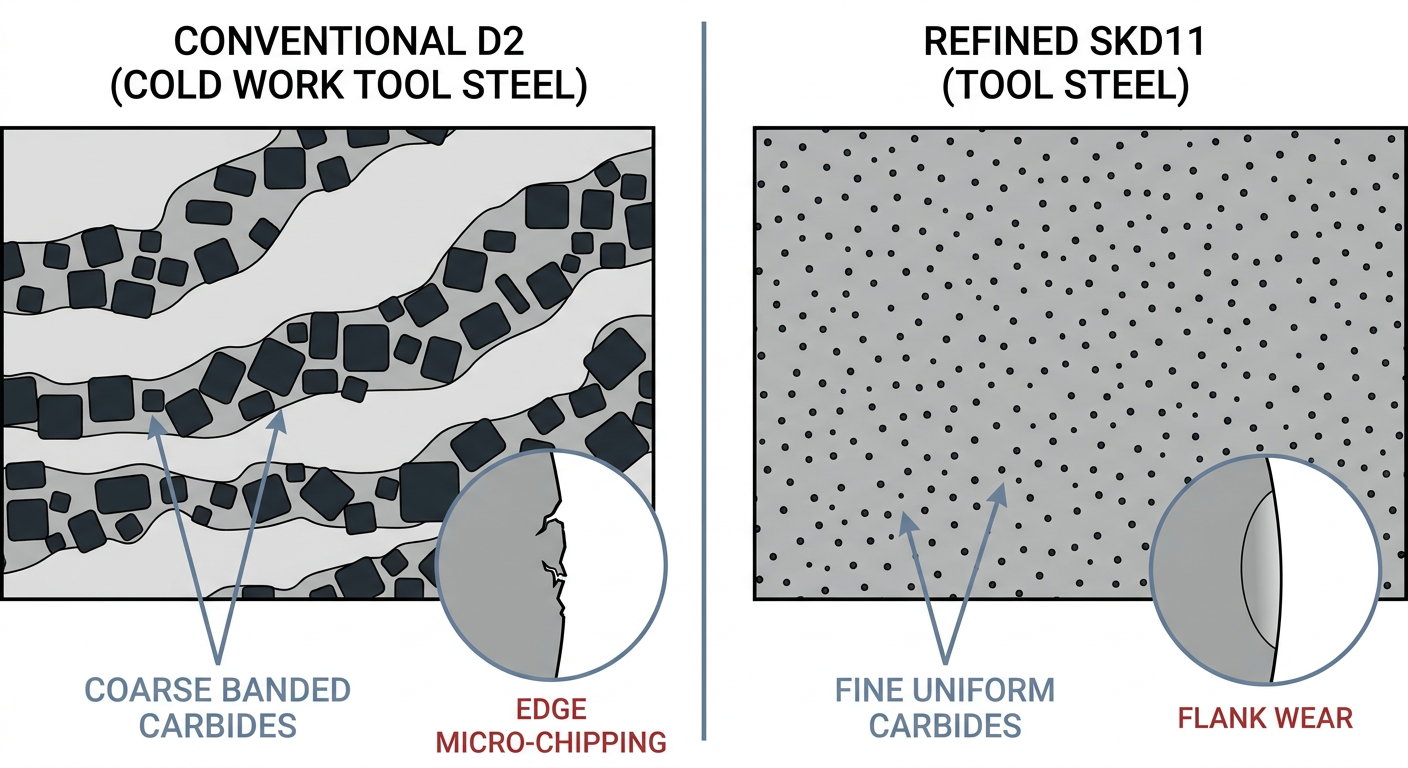
요약하자면: Identify your blade’s dominant failure mode first. Flank wear calls for D2’s abrasion resistance; micro-chipping calls for SKD11’s toughness. The wrong match accelerates both failure modes.
핵심 요점: Abrasive flank wear requires higher carbide volume and hardness (favoring D2), whereas edge chipping and notch cracking require microstructural homogeneity and finer carbide size (favoring ESR-refined SKD11).
Wear Resistance: Edge Retention and Blade Life
D2 targeted at 60–62 HRC offers stronger abrasive wear resistance, typically sustaining a sharper cutting tip across high-volume shearing of carbon and low-alloy steel sheets. The high volume fraction of vanadium and chromium carbides acts as an array of microscopic armors, protecting the martensitic matrix from abrasive erosion.
SKD11 targeted at 58–60 HRC trades marginal wear resistance for improved toughness, making it safer under less-than-ideal machine conditions where minor deflection, bed flexing, or mechanical play may occur.
Chipping and Crack Resistance: When Toughness Matters
Chipping occurs when impact loading, misalignment, or clearance variation concentrates stress at the blade edge — conditions where SKD11’s finer carbide structure provides better resistance to crack initiation. In guillotine shears cutting high-tensile sheet stock, entry impact can easily shear off coarse carbide particles in conventional D2, causing rapid edge degradation.
Cracking risk increases at higher hardness levels, particularly near the upper 62 HRC range if thin edge geometry or unstable feeding is present. Operating at 62 HRC leaves minimal margin for error if sheet thickness fluctuates or if hard spots are present in the coil stock.
가공 공정에 최적화된 샤링 날(Blade) 선택 가이드
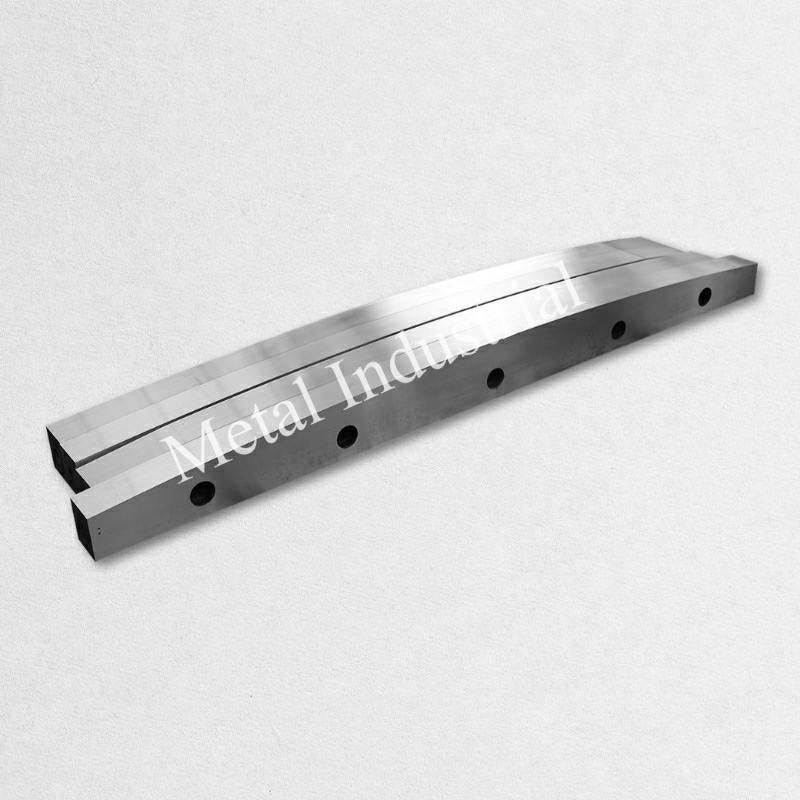
The practical selection rule is straightforward: identify whether your blade fails from wear or from impact and chipping, then match the grade accordingly. Conducting a forensic examination of your pulled blades reveals whether the cutting edge rounded off gradually or suffered premature micro-fractures.
Clean, stable, high-volume shearing favors D2’s wear advantage, while operations with unstable feed, clearance variation, or frequent sheet thickness changes benefit from SKD11’s forgiveness.
Set blade clearance at 5–10 percent of sheet thickness and monitor flank wear to time regrinds effectively. Setting improper clearance is the single leading cause of premature blade failure; excessive clearance induces burrs and sheet bending, while insufficient clearance increases cutting force and accelerates edge chipping.
요약하자면: Pull a worn blade and inspect under magnification. Rounded flank = wear problem → D2. Chipped or fractured edge = toughness problem → ESR SKD11.
Decision Framework for Wear-Dominated Operations
If your blades fail by gradual edge rounding and burr growth in clean carbon-steel cutting, D2 at 58–60 HRC delivers the longest useful blade life. In these steady-state applications, the primary economic goal is maximizing the tonnage cut between regrind cycles.
Regrind intervals can extend to roughly 100,000 cuts on 5mm low-carbon steel before reaching the 0.4mm flank wear threshold, provided machine rigidity and knife clearance remain properly calibrated.
For the measurement-based rotation and regrind decision SOP—including burr threshold bands and audit-ready log templates—see the 4-edge reversible blade rotation schedule and regrind criteria SOP.
Decision Framework for Impact and Chipping Scenarios
If chipping, micro-cracking, or edge fracture appears on your blades, SKD11 at 58–60 HRC provides the toughness buffer your operation needs. The finer carbide morphology of SKD11 dissipates localized stress concentrations more effectively, preventing micro-fractures from expanding across the cutting bevel.
In high-duty coil processing—such as shearing 4mm stainless steel (AISI 304) sheet with frequent entry shock—field benchmark evaluations indicate that switching from conventional EAF-melted D2 to ESR-refined SKD11 increases blade regrind intervals by approximately 25% to 30%, largely due to the elimination of edge micro-chipping. This interval improvement is consistent with regrind records Maxtor Metal documents for customers processing 4mm stainless steel on hydraulic guillotine lines (internal production data; n = 3 accounts, 4-month observation period).
Recheck clearance settings, blade parallelism, and feed alignment — process corrections often extend blade life more than a grade change alone. Ensuring rigid machine gibs and parallel blade seats prevents localized overloads during the cutting stroke.
Before switching grades, confirm the chipping mode by reading the fracture surface: fatigue-mode chipping (beach marks, clam-shell pattern) means a setup or grinding variable is the root cause and a grade change will not resolve it; impact-mode chipping (coarse cleavage, irregular facets) is the genuine indication for a tougher grade such as ESR-refined SKD11. The Shear Blade Edge Chipping Root Cause Analysis: Fractography and Decision Tree provides the shop-floor reading method and confirms when a metallurgy correction is actually warranted.
공급업체의 나이프 재질 Quality(품질) 검증 방법
A grade designation stamped on a blade tells you what the steel should be, not what it actually is — verification is essential for consistent performance. In global tooling supply chains, nominal grade labels can obscure variations in scrap quality, deoxidation practice, and forging reduction.
Requesting material test certificates, hardness reports, and metallographic carbide inspection ensures you receive genuine, correctly heat-treated steel. Establishing clear acceptance criteria with your tooling manufacturer prevents substandard blades from reaching your production floor.
요약하자면: Grade labels are claims, not guarantees. An MTC 3.1 cert, hardness mapping report, and carbide inspection image are the minimum documents to require before accepting a blade shipment.
What to Check Before Ordering Shearing Blades
To guarantee tooling longevity and eliminate premature failure risks, require your blade supplier to provide the following documentation prior to dispatch:
- Require an EN 10204 / MTC 3.1 certificate confirming heat number, verified chemical composition, and heat-treatment condition for every blade order.
- Request metallographic images showing carbide size and distribution (verifying absence of severe eutectic banding or oversize carbide clusters exceeding 15 µm).
- Ask for Rockwell C (HRC) hardness verification reports taken across multiple points along the finished blade length to ensure uniform heat treatment.
- Request Maxtor Metal’s standard quality documentation package—MTC 3.1, hardness mapping, and carbide inspection images are issued with each precision shear blade order and available for third-party audit review.
If your operation shears AHSS or UHSS, consider tungsten carbide inlaid blades as a third option for high-throughput lines where D2/SKD11 regrind frequency becomes the binding constraint. See the tungsten carbide inlaid shear blades ROI guide for AHSS lines for a full TCO comparison.
FAQs:
Q: SKD11 공구강은 D2와 완전히 동일한 강종인가요?
A: SKD11(JIS G4404)과 D2(ASTM A681 / DIN 1.2379)는 모두 고탄소·고크롬 냉간 금형강 계열에 속하며 주요 성분 범위가 유사하지만, 100% 동일하지는 않습니다. D2는 일반적으로 바나듐 함량(최대 1.10%)이 높아 연삭 마모에 강한 고경도 바나듐 탄화물을 형성하는 반면, SKD11은 바나듐 함량(0.20%–0.50%)이 약간 낮아 평균 탄화물 입도가 미세하며 내충격 충격 인성(Toughness)이 우수합니다.
Q: 6mm 이하 스테인리스 스틸 판재 샤링 절단에는 어떤 공구강 재질이 더 적합한가요?
A: 스테인리스 스틸(AISI 304 또는 316 등) 절단에는 열처리를 통해 58–60 HRC로 맞춘 SKD11 또는 ESR 정련 D2 강종을 권장합니다. 스테인리스 스틸은 가공 경화 성향이 강하고 전단 강도가 높아 나이프 날 끝에 큰 충격 하중을 가합니다. SKD11의 뛰어난 충격 인성은 스테인리스 절단 저항으로 인해 흔히 발생하는 날 끝 치핑(미세 손상)을 효과적으로 방지합니다.
Q: D2 및 SKD11 샤링 날(Shear Blades)의 권장 열처리 경도는 얼마인가요?
A: 6mm 이하 판재 절단 시, 높은 충격 인성이 요구되는 범용 절단에는 58–60 HRC, 연강(Mild carbon steel)의 대량 절단 및 내마모 중심 절단에는 60–62 HRC의 경도 범위를 권장합니다. 62 HRC를 초과하는 경도는 날 끝 치핑(Chipping) 및 심각한 나이프 균열(Cracking) 위험을 현저히 증가시킵니다.
Q: D2 샤링 날(Shear Blades)의 미세 치핑(Micro-chipping) 원인은 무엇인가요?
A: D2 나이프의 미세 치핑은 주로 내부 응력 집중점을 형성하는 조대한 1차 탄화물 응집체(8–20 µm), 부적절한 간격(Clearance) 설정(판재 두께의 5% 미만 또는 10% 초과), 프레임/베드 변형, 또는 설계 전단 강도를 초과하는 피삭재 절단으로 인해 발생합니다.
Q: 샤링 날(Shear Blades)에서 일렉트로슬래그 재용해(ESR) 정련이 중요한 이유는 무엇인가요?
A: ESR(Electroslag Remelting) 정련은 용융강을 정제하고 비금속 개재물을 제거하며 응고 과정에서 조대한 탄화물 편석을 방지하는 2차 정련 공정입니다. ESR 정련 공구강은 미세하고 균일한 탄화물 조직(3–8 µm)을 형성하여 일반 대기 용해강에 비해 내충격 인성과 날 끝 내구성을 획기적으로 향상시킵니다.
Q: 샤링 날(Shear Blades)의 재연마(Regrinding) 주기 및 타이밍은 어떻게 되나요?
A: 재연마 주기는 피삭재 재질, 절단량 및 유지보수 기준에 따라 달라집니다. 표준 기준으로서, 간격 설정(Clearance)이 정확히 맞추어진 D2 또는 SKD11 나이프로 5mm 연강(Mild steel)을 절단할 경우, 플랭크 마모(Flank wear)가 약 0.4mm에 도달했을 때 재연마해야 하며, 이는 일반적으로 80,000~100,000회 절단(Cuts)에 해당합니다.
결론
D2 and SKD11 are metallurgical cousins, but carbide distribution, heat treatment consistency, and failure-mode matching determine which blade delivers better value in your shearing line. Choosing between them requires analyzing your specific operational challenges rather than relying solely on nominal equivalency charts.
Once you have selected the right grade, managing thickness loss across regrind cycles is the next critical step. For the shim calculation method and overlap verification protocol after each regrind, see the regrinding thickness reduction compensation and shim stack guide.
For wear-dominated sub-6mm cutting, D2 offers superior edge retention due to its higher vanadium carbide content; for impact-prone operations or lines with variable sheet properties, SKD11 provides the toughness buffer your line needs to avoid premature chipping.
Verify carbide quality, heat treatment consistency, and HRC hardness testing from your blade supplier to ensure batch-to-batch consistency and predictable blade life. Maxtor Metal supplies precision-ground D2 and SKD11 shearing blades manufactured from ESR-refined tool steel stock, with vacuum heat treatment and hardness verification standard on every order. For operations making a first-time grade switch, Maxtor Metal can provide comparative blade sets with matched geometry for side-by-side trial evaluation.
작성자 프로필
낸시 우
Senior Manufacturing Engineer, Production Engineering (PE) | Maxtor Metal
With over 12 years of experience in industrial blade manufacturing, Nancy specializes in the machining characteristics, heat treatment, and surface coating behaviors of high-carbon cold-work tool steels (including SKD11, D2), high-speed steels (M2), hot-work steel (H13), powder metallurgy alloys, and tungsten carbide. She holds advanced qualifications in high-precision CNC grinding programming and process optimization.
인증: SME Certified Manufacturing Engineer (CMfgE), Project Management Professional (PMP), Six Sigma Black Belt, ASM International Tool Steel Metallurgy Certifications.

 English
  Spanish
  Italian
  French
  Portuguese
  Russian
  German
  Arabic
  Hindi
Hindi  Vietnamese
  Indonesian
  Japanese
  Korean