

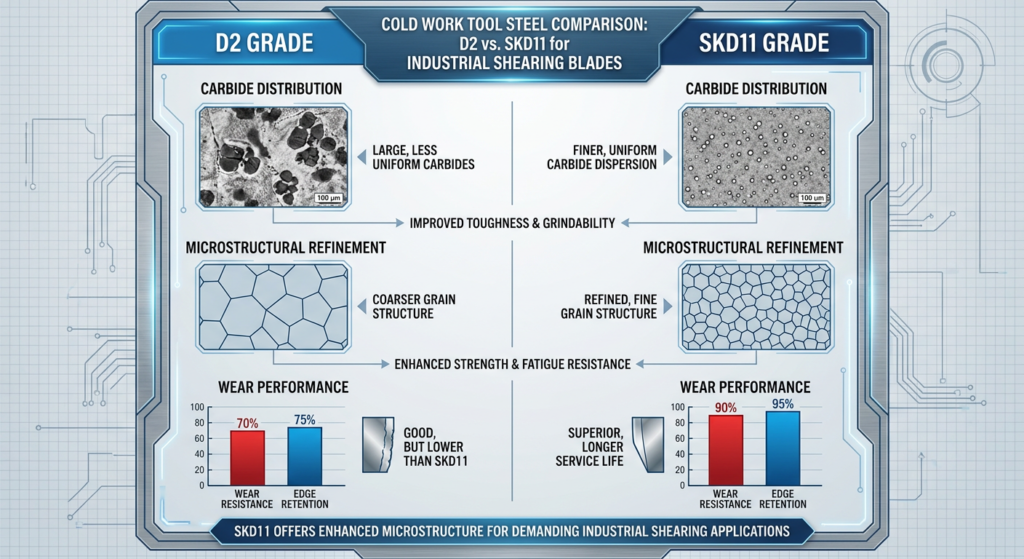
त्वरित उत्तर: D2 और SKD11 संरचनात्मक रूप से लगभग समान उच्च-कार्बन, उच्च-क्रोमियम कोल्ड-वर्क टूल स्टील्स हैं, लेकिन D2 की उच्च वैनेडियम सामग्री (0.50–1.10%) साफ, उच्च-मात्रा वाले 6mm से कम के कटिंग के लिए अधिक मजबूत अपघर्षक घिसाव प्रतिरोध प्रदान करती है, जबकि SKD11 की महीन कार्बाइड संरचना स्टेनलेस स्टील, परिवर्तनशील फ़ीड, या चिपिंग की संभावना वाले ऑपरेशन्स के लिए बेहतर प्रभाव क्रूरता प्रदान करती है। निर्णय आपके मुख्य विफलता मोड—घिसाव या चिपिंग—पर निर्भर करता है, न कि केवल ग्रेड लेबल पर। आपके आपूर्तिकर्ता से ESR रिफाइनिंग गुणवत्ता भी उतनी ही मायने रखती है जितनी कि उसका पदनाम।.
इंजीनियरिंग नोट: शियर ब्लेड के लिए D2 बनाम SKD11 टूल स्टील का चयन एक कार्बाइड माइक्रोस्ट्रक्चर का निर्णय है, न कि कोई ब्रांड प्रतिस्थापन। दोनों ग्रेड एक ही लेडेब्यूरिटिक कोल्ड-वर्क स्टील परिवार (उच्च-C, उच्च-Cr) के अंतर्गत आते हैं, और उनकी नाममात्र संरचना सीमाएं ASTM A681, JIS G4404, और DIN 1.2379 में काफी हद तक ओवरलैप होती हैं। प्रदर्शन का अंतर वैनेडियम सामग्री, मेल्ट रिफाइनमेंट प्रक्रिया और हीट ट्रीटमेंट नियंत्रण से उत्पन्न होता है—ये ऐसे चर हैं जिन्हें केवल सामग्री परीक्षण प्रमाणपत्र और कार्बाइड निरीक्षण ही सत्यापित कर सकते हैं। देखें Maxtor Metal शियर ब्लेड विनिर्देश और सामग्री विकल्प.
D2 और SKD11 दोनों एक ही उच्च-कार्बन, उच्च-क्रोमियम कोल्ड-वर्क टूल स्टील परिवार से संबंधित हैं, फिर भी ब्लेड खरीदार अक्सर धातुकर्म संबंधी बारीकियों को समझे बिना उन्हें विनिमेय मान लेते हैं। हाइड्रोलिक गिलोटिन शियर्स, मैकेनिकल पावर शियर्स, या कॉइल स्लिटिंग लाइनों के लिए प्रतिस्थापन टूलिंग की सोर्सिंग करते समय, इन दोनों विनिर्देशों के बीच चयन करने के लिए बुनियादी कठोरता संख्याओं से कहीं आगे देखने की आवश्यकता होती है।.
शियरिंग ब्लेड के प्रदर्शन में वास्तविक अंतर ग्रेड के नाम में नहीं बल्कि कार्बाइड वितरण में है और इस बात पर निर्भर करता है कि प्रत्येक ग्रेड विशिष्ट विफलता मोड के प्रति कैसी प्रतिक्रिया देता है। हालांकि नाममात्र मिश्र धातु तालिकाएं लगभग समान दिखती हैं, लेकिन वैनेडियम सामग्री, मेल्टिंग प्रक्रिया और हीट-ट्रीटमेंट प्रतिक्रिया में सूक्ष्म बदलाव यह तय करते हैं कि ब्लेड समय से पहले माइक्रो-चिपिंग का शिकार होगा या सैकड़ों-हजारों कटों तक एक तेज धार बनाए रखेगा।.
यह गाइड दोनों स्टील्स की संरचना, कार्बाइड संरचना और घिसाव व्यवहार का विश्लेषण करती है — जिससे आपको 6mm से कम की शीट कटिंग के लिए सही ब्लेड चुनने में मदद मिलेगी। इन धातुकर्म सिद्धांतों को समझकर, उच्च-प्रदर्शन वाले सटीक-ग्राउंड शियरिंग ब्लेड का मूल्यांकन करने वाले टूलिंग इंजीनियर और खरीद टीमें टूल लाइफ को अनुकूलित कर सकती हैं, प्रति कट लागत को कम कर सकती हैं, और मेटल फैब्रिकेशन वातावरण में अप्रत्याशित डाउनटाइम को समाप्त कर सकती हैं।.
D2 और SKD11 के पीछे का रसायन विज्ञान
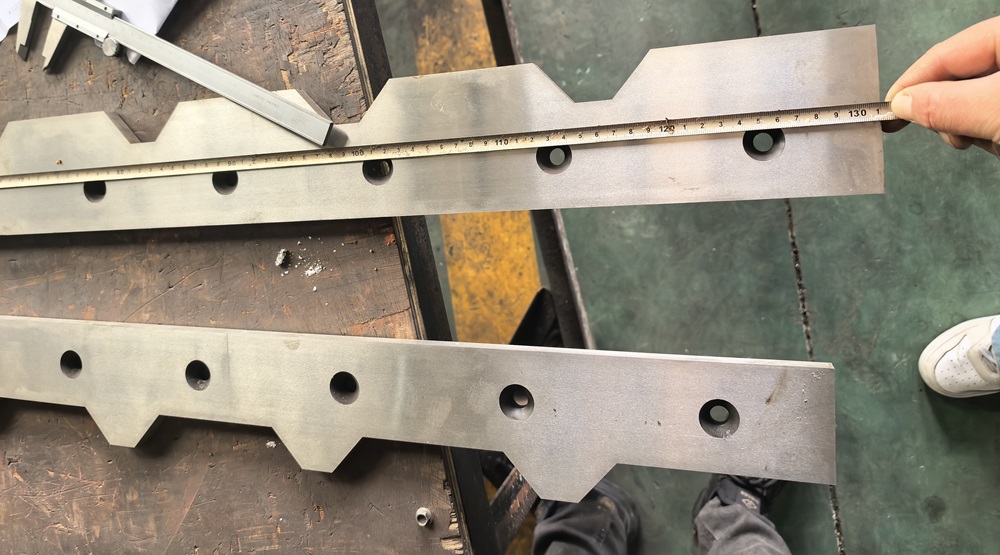
दोनों ग्रेड लगभग समान कार्बन और क्रोमियम रेंज साझा करते हैं, जिसमें वैनेडियम और मोलिब्डेनम में सूक्ष्म अंतर होते हैं जो उनके माइक्रोस्ट्रक्चर को आकार देते हैं। अपने मूल रूप में, दोनों मिश्र धातुओं में लगभग 1.5% कार्बन और 12% क्रोमियम होता है, जो उन्हें लेडेब्यूरिटिक टूल स्टील्स के रूप में वर्गीकृत करता है। जमने के दौरान, यह उच्च क्रोमियम और कार्बन सांद्रता हीट ट्रीटमेंट के बाद मार्टेंसिटिक मैट्रिक्स में एम्बेडेड कठोर प्राथमिक यूटेक्टिक कार्बाइड (M₇C_3 प्रकार) का एक बड़ा वॉल्यूम अंश बनाती है।.
इन संरचनात्मक विविधताओं को समझना यह मूल्यांकन करने का पहला कदम है कि प्रत्येक स्टील आपके विशिष्ट शियरिंग ऑपरेशन में कैसा प्रदर्शन करेगा। हालांकि नाममात्र ओवरलैप के कारण कई आपूर्तिकर्ता उन्हें विनिमेय के रूप में विपणन करते हैं, मिश्र धातु तत्वों में छोटे बदलाव कार्बाइड अवक्षेपण, द्वितीयक सख्त प्रतिक्रिया, और ग्रेन-रिफाइनमेंट क्षमताओं को निर्धारित करते हैं।.
संक्षेप में: D2 और SKD11 एक ही Cr-C बैकबोन साझा करते हैं, लेकिन D2 की व्यापक वैनेडियम रेंज (1.10% तक) इसे अधिक कठोर VC मोनोकार्बाइड प्रदान करती है—जो अपघर्षक घिसाव प्रतिरोध के लिए प्रमुख चर है।.
एक तुलनात्मक संरचना तालिका तकनीकी ओवरलैप को स्पष्ट करती है और यह उजागर करती है कि धातुकर्म नियंत्रण कहाँ सबसे अधिक मायने रखता है:
| तत्व | AISI D2 (ASTM A681) | JIS SKD11 (JIS G4404) | DIN 1.2379 (EN ISO 4957) | धातुकर्म भूमिका |
|---|---|---|---|---|
| कार्बन (C) | 1.40% – 1.60% | 1.40% – 1.60% | 1.45% – 1.60% | मैट्रिक्स कठोरता और कार्बाइड निर्माण |
| क्रोमियम (Cr) | 11.00% – 13.00% | 11.00% – 13.00% | 11.00% – 13.00% | घिसाव प्रतिरोध और M₇C_3 प्राथमिक कार्बाइड |
| मोलिब्डेनम (Mo) | 0.70% – 1.20% | 0.80% – 1.20% | 0.70% – 1.00% | हार्डनेबिलिटी और सेकेंडरी हार्डनिंग |
| वैनेडियम (V) | 0.50% – 1.10% | 0.20% – 0.50% | 0.70% – 1.00% | अति-कठोर VC मोनोकार्बाइड और ग्रेन रिफाइनमेंट |
| सिलिकॉन (Si) | 0.10% – 0.60% | ≤ 0.40% | 0.15% – 0.60% | डीऑक्सीडेशन और मैट्रिक्स सॉलिड-सॉल्यूशन सुदृढ़ीकरण |
| मैंगनीज (Mn) | 0.10% – 0.60% | ≤ 0.60% | 0.20% – 0.60% | गहरी हार्डनेबिलिटी और डीऑक्सीडेशन |
D2 मानक पदनाम और गुण
D2 कई वैश्विक मानकों तक फैला हुआ है, जिसमें उत्तरी अमेरिका में AISI D2, ASTM A681 (टूल स्टील्स अलॉय स्टील के लिए मानक विशिष्टता), और यूरोपीय DIN EN ISO 4957 ग्रेड 1.2379, जो इसे उत्तरी अमेरिकी और यूरोपीय आपूर्ति श्रृंखलाओं में व्यापक उपलब्धता प्रदान करता है।.
इसकी उच्च वैनेडियम सामग्री (आमतौर पर 0.50% से 1.10%) महीन वैनेडियम मोनोकार्बाइड (VC) को बढ़ावा देती है। इन VC कणों में अत्यधिक उच्च कठोरता (लगभग 2800 HV, जबकि M₇C_3 क्रोमियम कार्बाइड के लिए 1500–1800 HV होती है) होती है, जो अत्यधिक अपघर्षक कटिंग स्थितियों में धार बनाए रखने में महत्वपूर्ण योगदान देती है।.
SKD11 मानक पदनाम और गुण
SKD11 निम्नलिखित का पालन करता है JIS G4404 अलॉय टूल स्टील्स मानक, जो एशियाई विनिर्माण केंद्रों में व्यापक रूप से स्टॉक किया जाता है और इसकी आयामी स्थिरता तथा सुसंगत हीट-ट्रीटमेंट प्रतिक्रिया के लिए पसंद किया जाता है।.
इसका कम वैनेडियम घटक (0.20% से 0.50%) इसकी सूक्ष्म संरचना (microstructure) में M₇C_3 क्रोमियम कार्बाइड का प्रभुत्व अधिक रखता है। यह सूक्ष्म रासायनिक बदलाव उच्च-वैनेडियम D2 हीट्स की तुलना में अत्यधिक अपघर्षक घिसाव प्रतिरोध (abrasive wear resistance) को थोड़ा कम करता है, लेकिन यह इसकी टफनेस (toughness) विशेषताओं को बेहतर बनाता है, जिससे मध्यम प्रभाव लोडिंग (impact loading) के तहत सामग्री में अचानक सूक्ष्म-दरारें (micro-fracture) पड़ने की संभावना कम हो जाती है।.
कार्बाइड वितरण: इन स्टील्स को वास्तव में क्या अलग करता है

ग्रेड लेबल आपको रासायनिक संरचना की सीमा (chemistry window) बताता है, लेकिन कार्बाइड का आकार, वितरण और शोधन (refinement) यह निर्धारित करता है कि ब्लेड वास्तव में उत्पादन में कैसा प्रदर्शन करता है। समान रासायनिक प्रयोगशाला प्रमाणपत्रों वाले स्टील के दो ब्लॉक टूल लाइफ में भारी अंतर दिखा सकते हैं, यदि एक में मोटे, गुच्छेदार कार्बाइड नेटवर्क हों जबकि दूसरे में बारीक, समान रूप से बिखरे हुए कार्बाइड कण हों।.
मोटे, धारीदार प्राथमिक कार्बाइड तनाव सांद्रक (stress concentrators) बनाते हैं, जो चक्रीय प्रभाव (cyclic impact) के तहत सूक्ष्म-दरारों की शुरुआत के बिंदु के रूप में कार्य करते हैं, जबकि बारीक, समान रूप से बिखरे हुए कार्बाइड बेहतर धार टफनेस (edge toughness) और आयामी स्थिरता (dimensional stability) प्रदान करते हैं। हैवी-ड्यूटी शीयरिंग के दौरान, शीट के साथ टकराने पर शॉक वेव्स ब्लेड की धार से होकर गुजरती हैं; बड़े कार्बाइड गुच्छे मैट्रिक्स की निरंतरता को बाधित करते हैं और सूक्ष्म-चिपिंग (micro-chipping) का कारण बनते हैं।.
ब्लेड आपूर्तिकर्ताओं का मूल्यांकन करते समय खरीदारों को केवल ग्रेड के नाम (designation) से आगे बढ़कर कार्बाइड संरचना की जांच करनी चाहिए। मेल्ट रिफाइनमेंट (melt refinement) और फोर्जिंग रिडक्शन रेशियो (forging reduction ratio) को सत्यापित करने से यह सुनिश्चित होता है कि कच्चे माल (raw stock) को यूटेक्टिक कार्बाइड नेटवर्क को तोड़ने के लिए संसाधित किया गया है।.
संक्षेप में: समान प्रमाणपत्रों (certs) वाले दो ब्लेड अलग-अलग प्रदर्शन कर सकते हैं। कार्बाइड का आकार (3–8 µm बनाम 8–20 µm) और ESR रिफाइनिंग गुणवत्ता ही वास्तविक अंतर पैदा करने वाले कारक हैं—अपने आपूर्तिकर्ता से केवल ग्रेड स्टैम्प के बजाय मेटलोग्राफिक साक्ष्य (metallographic evidence) मांगें।.
कार्बाइड का आकार और वितरण धार के प्रदर्शन (Edge Performance) को कैसे प्रभावित करते हैं
पारंपरिक D2 हीट्स में आमतौर पर 8 से 20 माइक्रोमीटर (µm) आकार के मोटे प्राथमिक कार्बाइड विकसित होते हैं। ये बड़े M₇C_3 कार्बाइड स्ट्रिंगर्स साफ माइल्ड स्टील की शीयरिंग करते समय मजबूत अपघर्षक घिसाव प्रतिरोध (abrasive wear resistance) प्रदान करते हैं, लेकिन वे तेज काटने वाली धारों (sharp cutting edges) पर चिपिंग का अधिक जोखिम पैदा करते हैं।.
रिफाइंड हीट्स और SKD11-प्रकार की केमिस्ट्री 3 से 8 micrometer रेंज में महीन कार्बाइड प्रदान करती है। यह माइक्रोस्ट्रक्चरल रिफाइनमेंट चक्रीय और प्रभाव लोडिंग के तहत एज की टफनेस में सुधार करता है, जिससे हाई-स्पीड शियरिंग के दौरान कटिंग रेक के छोटे हिस्सों को टूटने से बचाया जा सकता है।.
कार्बाइड की गुणवत्ता में रिफाइनिंग प्रक्रियाओं की भूमिका
Maxtor Metal शियर ब्लेड उत्पादन के लिए केवल ESR-रिफाइंड या वैक्यूम-आर्क-रीमेल्टेड (VAR) D2 और SKD11 स्टॉक का उपयोग करता है—यह एक खरीद मानक है जो पारंपरिक रूप से कास्ट टूल स्टील में आम कार्बाइड बैंडिंग की भिन्नता को समाप्त करता है।.
इलेक्ट्रोस्लैग रीमेल्टिंग (ESR) और नियंत्रित मेल्ट रूट सेग्रिगेशन और कार्बाइड बैंडिंग को कम करते हैं, जिससे पूरे मैट्रिक्स में एक महीन, अधिक समान कार्बाइड फैलाव उत्पन्न होता है। एक रिएक्टिव स्लैग बाथ के माध्यम से कच्चे इलेक्ट्रोड को फिर से पिघलाकर, ESR प्रोसेसिंग नॉन-मेटालिक इन्क्लूशन्स को समाप्त करती है और सॉलिडिफिकेशन के दौरान मोटे यूटेक्टिक सेग्रिगेशन को दबाती है।.
महत्वपूर्ण बात यह है कि केवल JIS पदनाम ही ESR-स्तर के रिफाइनमेंट की गारंटी नहीं देता है — विभिन्न आपूर्तिकर्ताओं के दो SKD11 ब्लेड इस बात के आधार पर बहुत अलग प्रदर्शन कर सकते हैं कि वे बुनियादी इलेक्ट्रिक-आर्क मेल्टिंग के माध्यम से उत्पादित किए गए थे या सेकेंडरी ESR रिफाइनमेंट के माध्यम से।.
बैच-दर-बैच निरंतरता की गारंटी देने के लिए, अग्रणी औद्योगिक टूलिंग इंजीनियर सख्त कच्चे माल के गुणवत्ता नियंत्रण पर जोर देते हैं, और प्रिसिजन-ग्राउंड शियरिंग ब्लेड के लिए प्रीमियम ESR-रिफाइंड टूल स्टील स्टॉक को प्राथमिकता देते हैं। Maxtor Metal में, शियर ब्लेड निर्माण आंतरिक तनाव और मोटे कार्बाइड बैंडिंग को समाप्त करने के लिए कैलिब्रेटेड CNC ग्राइंडिंग के साथ नियंत्रित वैक्यूम हीट ट्रीटमेंट को एकीकृत करता है। प्रत्येक प्रोडक्शन बैच के साथ हार्डनेस मैपिंग रिपोर्ट और, अनुरोध पर, विनिर्देश के भीतर कार्बाइड के आकार और वितरण की पुष्टि करने वाली मेटलोग्राफिक निरीक्षण छवियां प्रदान की जाती हैं। यह सुनिश्चित करता है कि प्रत्येक ब्लेड का किनारा स्थिर संरेखण, उच्च एज शार्पनेस और इम्पैक्ट चिपिंग के प्रति इष्टतम प्रतिरोध बनाए रखे।.
6mm से कम की शियरिंग में घिसाव प्रदर्शन और विफलता के प्रकार

6mm से कम मोटाई वाली शीट मेटल के लिए, D2 और SKD11 दोनों लंबी सर्विस लाइफ प्रदान कर सकते हैं — लेकिन मुख्य विफलता मोड यह निर्धारित करता है कि आपकी प्रोडक्शन लाइन में कौन सा ग्रेड अधिक समय तक चलेगा। गलत ग्रेड का चयन करने से अक्सर समय से पहले रीग्राइंडिंग के लिए बार-बार ब्लेड को निकालना पड़ता है, जिससे टूलिंग ओवरहेड और श्रम लागत बढ़ जाती है।.
घिसाव-प्रधान संचालन D2 के बेहतर घर्षण प्रतिरोध के अनुकूल होते हैं, जबकि प्रभाव और चिपिंग की स्थिति में SKD11 की उच्च टफनेस की आवश्यकता होती है। स्टील की माइक्रोस्ट्रक्चरल ताकत को आपकी लाइन की मैकेनिकल वास्तविकताओं से मिलाना विनाशकारी एज ब्रेकडाउन को रोकता है।.
विफलता मोड को समझना प्रति कट कम लागत और कम अनियोजित ठहराव का सबसे सीधा रास्ता है। नियोजित रखरखाव के दौरान घिसे हुए ब्लेडों का मूल्यांकन करते समय, आवर्धन के तहत कटिंग एज का निरीक्षण करें ताकि यह पहचाना जा सके कि प्राथमिक समस्या फ्लैंक वियर, माइक्रो-चिपिंग, या ग्रॉस क्रैकिंग है।.
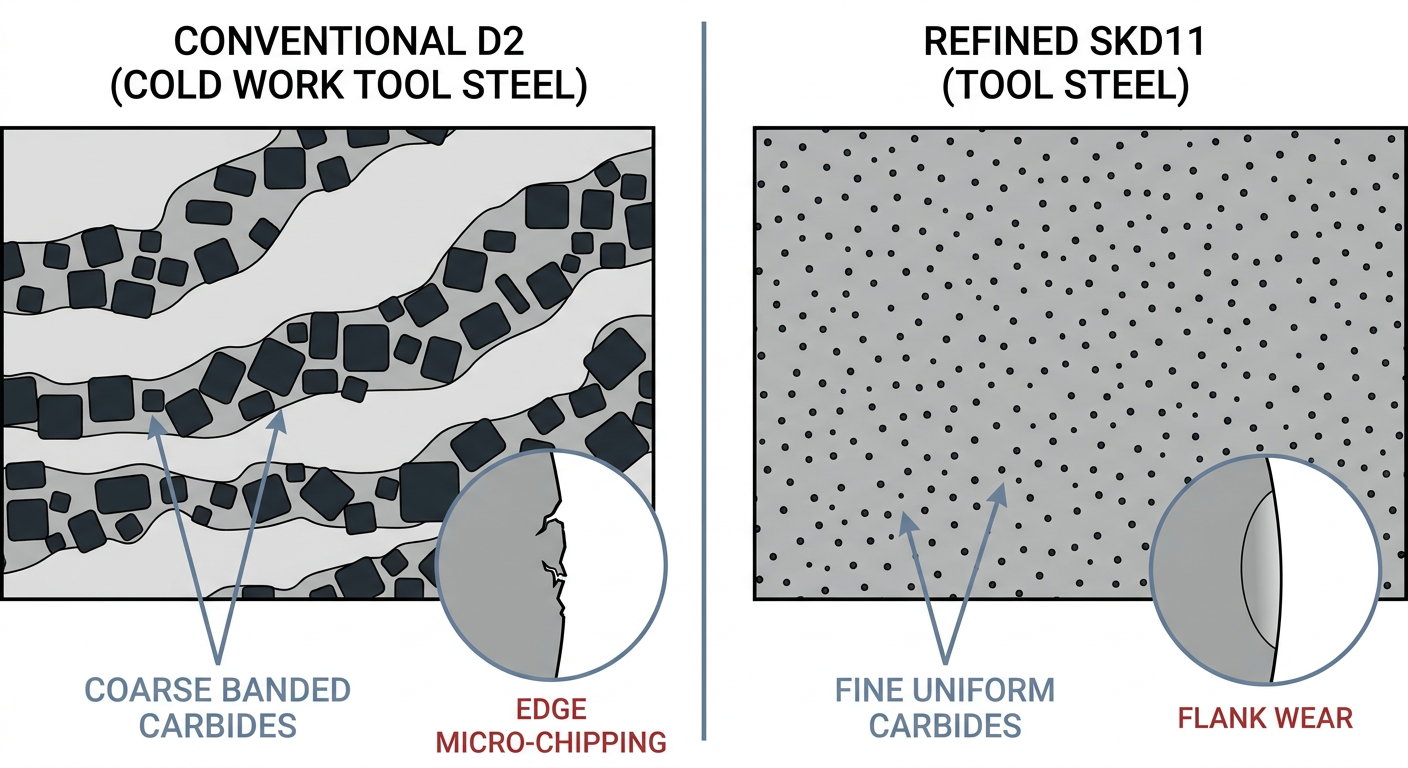
संक्षेप में: सबसे पहले अपने ब्लेड के मुख्य विफलता मोड की पहचान करें। फ्लैंक वियर के लिए D2 के घर्षण प्रतिरोध की आवश्यकता होती है; माइक्रो-चिपिंग के लिए SKD11 की टफनेस की आवश्यकता होती है। गलत मिलान दोनों विफलता मोड को तेज करता है।.
कुंजी ले जाएं: एब्रैसिव फ्लैंक वियर के लिए उच्च कार्बाइड वॉल्यूम और हार्डनेस की आवश्यकता होती है (जो D2 के अनुकूल है), जबकि एज चिपिंग और नॉच क्रैकिंग के लिए माइक्रोस्ट्रक्चरल समरूपता और महीन कार्बाइड आकार की आवश्यकता होती है (जो ESR-रिफाइंड SKD11 के अनुकूल है)।.
घिसाव प्रतिरोध: एज रिटेंशन और ब्लेड लाइफ
60–62 HRC पर लक्षित D2 मजबूत एब्रैसिव वियर रेजिस्टेंस प्रदान करता है, जो आमतौर पर कार्बन और लो-अलॉय स्टील शीट की हाई-वॉल्यूम शियरिंग में अधिक समय तक शार्प कटिंग टिप बनाए रखता है। वैनेडियम और क्रोमियम कार्बाइड का उच्च वॉल्यूम अंश सूक्ष्म आर्मर की एक श्रृंखला के रूप में कार्य करता है, जो मार्टेंसिटिक मैट्रिक्स को एब्रैसिव क्षरण से बचाता है।.
58–60 HRC पर लक्षित SKD11 बेहतर टफनेस के लिए मामूली घिसाव प्रतिरोध से समझौता करता है, जिससे यह कम-आदर्श मशीन स्थितियों के तहत अधिक सुरक्षित हो जाता है जहां मामूली डिफ्लेक्शन, बेड फ्लेक्सिंग या मैकेनिकल प्ले हो सकता है।.
चिपिंग और क्रैक प्रतिरोध: जब टफनेस महत्वपूर्ण हो
चिपिंग तब होती है जब इम्पैक्ट लोडिंग, मिसअलाइनमेंट, या क्लीयरेंस भिन्नता ब्लेड के किनारे पर तनाव को केंद्रित करती है — ऐसी स्थितियां जहां SKD11 की महीन कार्बाइड संरचना क्रैक की शुरुआत के प्रति बेहतर प्रतिरोध प्रदान करती है। हाई-टेन्साइल शीट स्टॉक को काटने वाली गिलोटिन शियर्स में, एंट्री इम्पैक्ट पारंपरिक D2 में मोटे कार्बाइड कणों को आसानी से कतर सकता है, जिससे तेजी से एज डिग्रेडेशन होता है।.
उच्च हार्डनेस स्तरों पर क्रैकिंग का जोखिम बढ़ जाता है, विशेष रूप से ऊपरी 62 HRC रेंज के करीब यदि पतली एज ज्योमेट्री या अस्थिर फीडिंग मौजूद हो। यदि शीट की मोटाई में उतार-चढ़ाव होता है या कॉइल स्टॉक में हार्ड स्पॉट मौजूद होते हैं, तो 62 HRC पर काम करने से त्रुटि की न्यूनतम गुंजाइश बचती है।.
अपने कटिंग ऑपरेशन के लिए सही ब्लेड का चयन करना
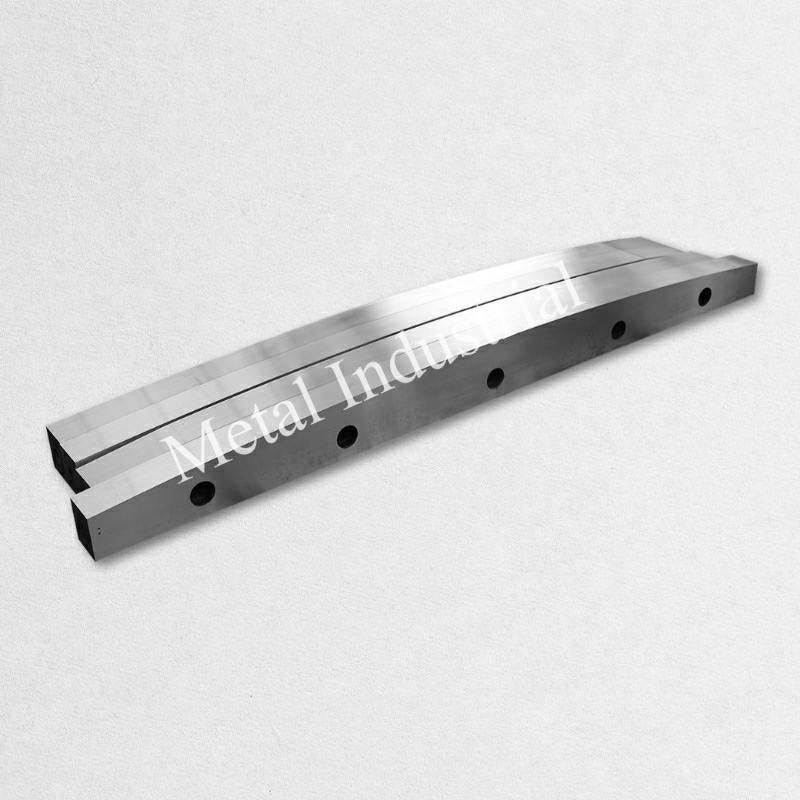
व्यावहारिक चयन नियम सीधा है: पहचानें कि आपका ब्लेड घिसाव के कारण विफल हो रहा है या प्रभाव और चिपिंग के कारण, फिर उसी के अनुसार ग्रेड का मिलान करें। अपने निकाले गए ब्लेडों की फोरेंसिक जांच करने से पता चलता है कि कटिंग एज धीरे-धीरे गोल हो गई थी या समय से पहले माइक्रो-फ्रैक्चर का शिकार हुई थी।.
साफ, स्थिर, हाई-वॉल्यूम शियरिंग D2 के घिसाव लाभ के अनुकूल होती है, जबकि अस्थिर फीड, क्लीयरेंस भिन्नता, या बार-बार शीट की मोटाई में बदलाव वाले संचालन को SKD11 की सहनशीलता से लाभ होता है।.
ब्लेड क्लीयरेंस को शीट की मोटाई के 5–10 प्रतिशत पर सेट करें और रीग्राइंडिंग के समय को प्रभावी ढंग से निर्धारित करने के लिए फ्लैंक वियर (flank wear) की निगरानी करें। गलत क्लीयरेंस सेट करना ब्लेड के समय से पहले खराब होने का सबसे बड़ा कारण है; अत्यधिक क्लीयरेंस से बर्र (burrs) बनते हैं और शीट मुड़ जाती है, जबकि अपर्याप्त क्लीयरेंस से कटिंग फोर्स बढ़ जाती है और किनारों के टूटने (edge chipping) की गति तेज हो जाती है।.
संक्षेप में: घिसे हुए ब्लेड को निकालें और आवर्धन (magnification) के तहत निरीक्षण करें। राउंडेड फ्लैंक (Rounded flank) = घिसाव (wear) की समस्या → D2। चिपका हुआ या टूटा हुआ किनारा (Chipped or fractured edge) = टफनेस (toughness) की समस्या → ESR SKD11।.
घिसाव-प्रधान (Wear-Dominated) ऑपरेशन्स के लिए निर्णय ढांचा (Decision Framework)
यदि साफ कार्बन-स्टील की कटिंग में आपके ब्लेड धीरे-धीरे किनारों के गोल होने और बर्र (burr) बढ़ने के कारण विफल हो जाते हैं, तो 58–60 HRC पर D2 सबसे लंबा उपयोगी ब्लेड जीवन प्रदान करता है। इन स्थिर-अवस्था (steady-state) अनुप्रयोगों में, प्राथमिक आर्थिक लक्ष्य रीग्राइंड चक्रों के बीच काटे गए टन भार (tonnage) को अधिकतम करना है।.
5mm लो-कार्बन स्टील पर रीग्राइंड अंतराल लगभग 100,000 कट्स तक बढ़ सकता है, इससे पहले कि यह 0.4mm फ्लैंक वियर थ्रेशोल्ड तक पहुंचे, बशर्ते मशीन की कठोरता (rigidity) और नाइफ क्लीयरेंस ठीक से कैलिब्रेटेड रहें।.
माप-आधारित रोटेशन और रीग्राइंड निर्णय SOP के लिए—जिसमें बर्र थ्रेशोल्ड बैंड और ऑडिट-रेडी लॉग टेम्पलेट शामिल हैं—देखें: 4-एज रिवर्सिबल ब्लेड रोटेशन शेड्यूल और रीग्राइंड मानदंड SOP.
इम्पैक्ट और चिपिंग (Chipping) परिदृश्यों के लिए निर्णय ढांचा
यदि आपके ब्लेड पर चिपिंग, माइक्रो-क्रैकिंग, या एज फ्रैक्चर दिखाई देता है, तो 58–60 HRC पर SKD11 वह टफनेस बफर प्रदान करता है जिसकी आपके ऑपरेशन को आवश्यकता है। SKD11 की महीन कार्बाइड मॉर्फोलॉजी (carbide morphology) स्थानीयकृत तनाव सांद्रता (localized stress concentrations) को अधिक प्रभावी ढंग से समाप्त करती है, जिससे माइक्रो-फ्रैक्चर को कटिंग बेवल (cutting bevel) में फैलने से रोका जा सकता है।.
हाई-ड्यूटी कॉइल प्रोसेसिंग में—जैसे कि बार-बार एंट्री शॉक के साथ 4mm स्टेनलेस स्टील (AISI 304) शीट की शियरिंग करना—फील्ड बेंचमार्क मूल्यांकन संकेत देते हैं कि पारंपरिक EAF-मेल्टेड D2 से ESR-रिफाइंड SKD11 पर स्विच करने से ब्लेड रीग्राइंड अंतराल लगभग 25% से 30% तक बढ़ जाता है, जिसका मुख्य कारण एज माइक्रो-चिपिंग का समाप्त होना है। यह अंतराल सुधार उन रीग्राइंड रिकॉर्ड्स के अनुरूप है जो Maxtor Metal हाइड्रोलिक गिलोटिन लाइनों पर 4mm स्टेनलेस स्टील को प्रोसेस करने वाले ग्राहकों के लिए दस्तावेज करता है (आंतरिक उत्पादन डेटा; n = 3 खाते, 4-महीने की अवलोकन अवधि)।.
क्लीयरेंस सेटिंग्स, ब्लेड पैरेललिज्म (parallelism), और फीड एलाइनमेंट की दोबारा जांच करें — केवल ग्रेड बदलने की तुलना में प्रोसेस सुधार अक्सर ब्लेड के जीवन को अधिक बढ़ाते हैं। मशीन के रिजिड गिब्स (gibs) और समानांतर ब्लेड सीटों को सुनिश्चित करना कटिंग स्ट्रोक के दौरान स्थानीयकृत ओवरलोड को रोकता है।.
Before switching grades, confirm the chipping mode by reading the fracture surface: fatigue-mode chipping (beach marks, clam-shell pattern) means a setup or grinding variable is the root cause and a grade change will not resolve it; impact-mode chipping (coarse cleavage, irregular facets) is the genuine indication for a tougher grade such as ESR-refined SKD11. The Shear Blade Edge Chipping Root Cause Analysis: Fractography and Decision Tree provides the shop-floor reading method and confirms when a metallurgy correction is actually warranted.
अपने आपूर्तिकर्ता से ब्लेड सामग्री की गुणवत्ता का सत्यापन करना
ब्लेड पर स्टैम्प किया गया ग्रेड पदनाम (grade designation) आपको यह बताता है कि स्टील क्या होना चाहिए, न कि यह वास्तव में क्या है — लगातार प्रदर्शन के लिए सत्यापन (verification) आवश्यक है। वैश्विक टूलिंग आपूर्ति श्रृंखलाओं में, नाममात्र ग्रेड लेबल स्क्रैप की गुणवत्ता, डीऑक्सीडेशन अभ्यास और फ़ोर्जिंग रिडक्शन में भिन्नता को छिपा सकते हैं।.
मटीरियल टेस्ट सर्टिफिकेट, हार्डनेस रिपोर्ट और मेटलोग्राफिक कार्बाइड निरीक्षण का अनुरोध करना यह सुनिश्चित करता है कि आपको वास्तविक, सही ढंग से हीट-ट्रीटेड स्टील मिले। अपने टूलिंग निर्माता के साथ स्पष्ट स्वीकृति मानदंड (acceptance criteria) स्थापित करना घटिया ब्लेडों को आपके प्रोडक्शन फ्लोर तक पहुंचने से रोकता है।.
संक्षेप में: ग्रेड लेबल दावे हैं, गारंटी नहीं। ब्लेड शिपमेंट स्वीकार करने से पहले एक MTC 3.1 सर्टिफिकेट, हार्डनेस मैपिंग रिपोर्ट और कार्बाइड निरीक्षण इमेज न्यूनतम आवश्यक दस्तावेज हैं।.
शियरिंग ब्लेड्स (Shearing Blades) ऑर्डर करने से पहले क्या जांचें
टूलिंग की लंबी उम्र की गारंटी देने और समय से पहले विफलता के जोखिमों को समाप्त करने के लिए, अपने ब्लेड आपूर्तिकर्ता से डिस्पैच से पहले निम्नलिखित दस्तावेज प्रदान करने की मांग करें:
- प्रत्येक ब्लेड ऑर्डर के लिए हीट नंबर, सत्यापित रासायनिक संरचना (chemical composition), और हीट-ट्रीटमेंट स्थिति की पुष्टि करने वाले EN 10204 / MTC 3.1 सर्टिफिकेट की मांग करें।.
- कार्बाइड के आकार और वितरण को दर्शाने वाली मेटलोग्राफिक छवियों (metallographic images) का अनुरोध करें (यह सत्यापित करते हुए कि कोई गंभीर यूटेक्टिक बैंडिंग या 15 µm से अधिक आकार के कार्बाइड क्लस्टर मौजूद नहीं हैं)।.
- समान हीट ट्रीटमेंट सुनिश्चित करने के लिए तैयार ब्लेड की लंबाई के साथ कई बिंदुओं पर ली गई Rockwell C (HRC) हार्डनेस वेरिफिकेशन रिपोर्ट मांगें।.
- Maxtor Metal के मानक गुणवत्ता दस्तावेज़ीकरण पैकेज का अनुरोध करें—प्रत्येक सटीक शियर ब्लेड (precision shear blade) ऑर्डर के साथ MTC 3.1, हार्डनेस मैपिंग और कार्बाइड निरीक्षण चित्र जारी किए जाते हैं और तीसरे पक्ष के ऑडिट रिव्यू के लिए उपलब्ध होते हैं।.
यदि आपका ऑपरेशन AHSS या UHSS की शियरिंग करता है, तो उन हाई-थ्रूपुट लाइनों के लिए टंगस्टन कार्बाइड इनलेड ब्लेड्स (tungsten carbide inlaid blades) को तीसरे विकल्प के रूप में विचार करें जहां D2/SKD11 रीग्राइंड आवृत्ति एक बाधा बन जाती है। देखें: AHSS लाइनों के लिए टंगस्टन कार्बाइड इनलेड शियर ब्लेड्स ROI गाइड पूर्ण TCO तुलना के लिए।.
FAQs:
क्या SKD11, D2 टूल स्टील के समान है?
हालांकि SKD11 (JIS G4404) और D2 (ASTM A681 / DIN 1.2379) एक ही हाई-कार्बन, high-chromium कोल्ड-वर्क स्टील परिवार से संबंधित हैं और प्रमुख संरचना श्रेणियों को साझा करते हैं, वे 100% समान नहीं हैं। D2 में आमतौर पर अधिक वैनेडियम (1.10% तक) होता है, जो एब्रैसिव वियर (abrasive wear) के लिए कठोर वैनेडियम कार्बाइड को बढ़ावा देता है, जबकि SKD11 में थोड़ा कम वैनेडियम (0.20%–0.50%) होता है, जो एक महीन औसत कार्बाइड आकार प्रदान करता है जो इम्पैक्ट टफनेस (impact toughness) में सुधार करता है।.
6mm से कम की स्टेनलेस स्टील शीट की शियरिंग के लिए कौन सा स्टील ग्रेड बेहतर है?
स्टेनलेस स्टील शियरिंग (जैसे AISI 304 या 316) के लिए, आमतौर पर 58–60 HRC तक हीट-ट्रीटेड SKD11 या ESR-रिफाइंड D2 को प्राथमिकता दी जाती है। स्टेनलेस स्टील वर्क-हार्डनिंग प्रवृत्तियां और उच्च शियर स्ट्रेंथ प्रदर्शित करता है, जिससे कटिंग एज पर अधिक शॉक लोड पड़ता है। SKD11 की उत्कृष्ट टफनेस किनारों के टूटने (edge chipping) का प्रभावी ढंग से विरोध करती है, जो आमतौर पर स्टेनलेस स्टील के कटिंग रेजिस्टेंस के कारण होता है।.
D2 और SKD11 शियरिंग ब्लेड के लिए अनुशंसित हार्डनेस क्या है?
6mm से कम की शीट मेटल शियरिंग के लिए, उच्च टफनेस की आवश्यकता वाली सामान्य-उद्देश्यीय कटिंग के लिए अनुशंसित हार्डनेस रेंज 58–60 HRC है, और माइल्ड कार्बन स्टील की हाई-वॉल्यूम, वियर-डोमिनेटेड कटिंग के लिए 60–62 HRC है। 62 HRC से अधिक का हार्डनेस स्तर एज चिपिंग और ब्लेड के गंभीर रूप से टूटने (catastrophic blade cracking) के जोखिम को काफी बढ़ा देता है।.
D2 शियर ब्लेड पर माइक्रो-चिपिंग का क्या कारण है?
D2 शियर ब्लेड पर माइक्रो-चिपिंग मुख्य रूप से मोटे प्राथमिक कार्बाइड क्लस्टर्स (8–20 µm) के कारण होती है जो आंतरिक तनाव बढ़ाने वाले कारकों (internal stress raisers) के रूप में कार्य करते हैं, अनुचित नाइफ क्लीयरेंस सेटिंग्स (शीट की मोटाई के 5% से कम या 10% से अधिक), मशीन बेड डिफ्लेक्शन, या शियरिंग मटेरियल का ब्लेड की डिज़ाइन स्ट्रेंथ रेटिंग से अधिक होना है।.
Q: कतरनी ब्लेड (shear blades) के लिए इलेक्ट्रोस्लैग रीमेल्टिंग (ESR) क्यों महत्वपूर्ण है?
A: इलेक्ट्रोस्लैग रीमेल्टिंग (ESR) एक द्वितीयक रिफाइनिंग प्रक्रिया है जो पिघले हुए स्टील को शुद्ध करती है, गैर-धातु समावेशन (non-metallic inclusions) को हटाती है, और जमने के दौरान मोटे कार्बाइड पृथक्करण (carbide segregation) को रोकती है। ESR-रिफाइंड टूल स्टील एक महीन, एकसमान कार्बाइड संरचना (3–8 µm) देता है, जो पारंपरिक रूप से डाले गए स्टील की तुलना में इम्पैक्ट टफनेस और एज ड्यूरेबिलिटी को काफी बढ़ाता है।
Q: कतरनी ब्लेड (shear blades) को कितनी बार रीग्राइंड (reground) किया जाना चाहिए?
A: रीग्राइंडिंग की आवृत्ति (regrind frequency) शीट सामग्री, कटिंग वॉल्यूम और रखरखाव मानकों पर निर्भर करती है। एक मानक आधार के रूप में, 5mm माइल्ड कार्बन स्टील को काटने वाले एक अच्छी तरह से संरेखित D2 या SKD11 ब्लेड को तब रीग्राइंड किया जाना चाहिए जब फ्लैंक वियर (flank wear) लगभग 0.4mm तक पहुंच जाए, जो आमतौर पर 80,000 से 100,000 कट से मेल खाता है।
निष्कर्ष
D2 and SKD11 are metallurgical cousins, but carbide distribution, heat treatment consistency, and failure-mode matching determine which blade delivers better value in your shearing line. Choosing between them requires analyzing your specific operational challenges rather than relying solely on nominal equivalency charts.
Once you have selected the right grade, managing thickness loss across regrind cycles is the next critical step. For the shim calculation method and overlap verification protocol after each regrind, see रीग्राइंडिंग मोटाई में कमी क्षतिपूर्ति और शिम स्टैक गाइड.
For wear-dominated sub-6mm cutting, D2 offers superior edge retention due to its higher vanadium carbide content; for impact-prone operations or lines with variable sheet properties, SKD11 provides the toughness buffer your line needs to avoid premature chipping.
Verify carbide quality, heat treatment consistency, and HRC hardness testing from your blade supplier to ensure batch-to-batch consistency and predictable blade life. Maxtor Metal supplies precision-ground D2 and SKD11 shearing blades manufactured from ESR-refined tool steel stock, with vacuum heat treatment and hardness verification standard on every order. For operations making a first-time grade switch, Maxtor Metal can provide comparative blade sets with matched geometry for side-by-side trial evaluation.
लेखक प्रोफ़ाइल
Nancy Wu
Senior Manufacturing Engineer, Production Engineering (PE) | Maxtor Metal
With over 12 years of experience in industrial blade manufacturing, Nancy specializes in the machining characteristics, heat treatment, and surface coating behaviors of high-carbon cold-work tool steels (including SKD11, D2), high-speed steels (M2), hot-work steel (H13), powder metallurgy alloys, and tungsten carbide. She holds advanced qualifications in high-precision CNC grinding programming and process optimization.
प्रमाणपत्र: SME Certified Manufacturing Engineer (CMfgE), Project Management Professional (PMP), Six Sigma Black Belt, ASM International Tool Steel Metallurgy Certifications.

 English
  Spanish
  Italian
  French
  Portuguese
  Russian
  German
  Arabic
  Hindi
Hindi  Vietnamese
  Indonesian
  Japanese
  Korean