

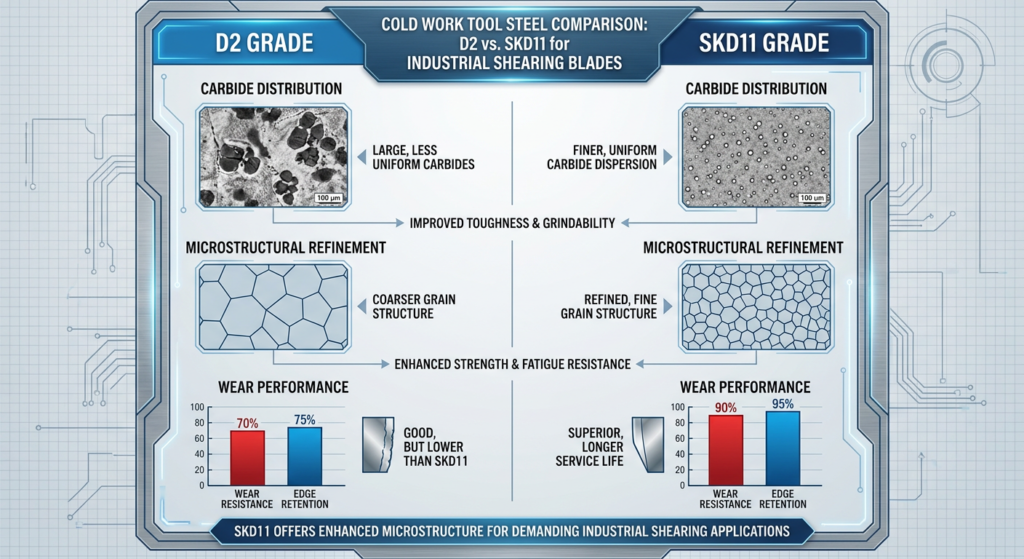
Tóm tắt nhanh: D2 and SKD11 are compositionally near-identical high-carbon, high-chromium cold-work tool steels, but D2’s higher vanadium content (0.50–1.10%) delivers stronger abrasive wear resistance for clean, high-volume sub-6mm cutting, while SKD11’s finer carbide structure provides better impact toughness for stainless steel, variable feed, or chipping-prone operations. The decision turns on your dominant failure mode—wear or chipping—not the grade label alone. ESR refining quality from your supplier matters as much as the designation.
Ghi chú kỹ thuật: D2 vs SKD11 tool steel selection for shearing blades is a carbide microstructure decision, not a brand substitution. Both grades occupy the same ledeburitic cold-work steel family (high-C, high-Cr), and their nominal composition windows overlap substantially across ASTM A681, JIS G4404, and DIN 1.2379. The performance gap emerges from vanadium content, melt refinement practice, and heat treatment control—variables that only material test certificates and carbide inspection can verify. See Maxtor Metal shear blade specifications and material options.
Both D2 and SKD11 belong to the same high-carbon, high-chromium cold-work tool steel family, yet blade buyers often treat them as interchangeable without understanding the metallurgical nuances. When sourcing replacement tooling for hydraulic guillotine shears, mechanical power shears, or coil slitting lines, selecting between these two specifications requires looking far beyond basic hardness numbers.
The real differentiator in shearing blade performance lies not in the grade name but in carbide distribution and how each grade responds to specific failure modes. While nominal alloy tables look nearly identical, subtle variations in vanadium content, melting practice, and heat-treatment response dictate whether a blade suffers premature micro-chipping or maintains a crisp edge across hundreds of thousands of cuts.
This guide breaks down the composition, carbide structure, and wear behavior of both steels — helping you select the right blade for sub-6mm sheet cutting. By understanding these metallurgical fundamentals, tooling engineers and procurement teams evaluating high-performance precision-ground shearing blades can optimize tool life, lower cost per cut, and eliminate unexpected downtime in metal fabrication environments.
Thành phần hóa học đằng sau thép D2 và SKD11
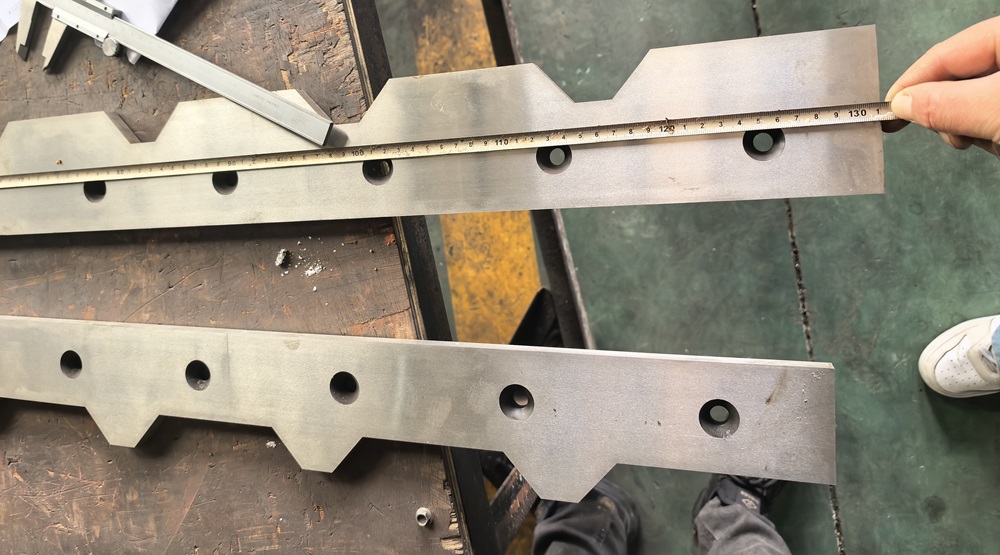
Both grades share nearly identical carbon and chromium ranges, with subtle differences in vanadium and molybdenum that shape their microstructures. At their core, both alloys contain roughly 1.5% carbon and 12% chromium, classifying them as ledeburitic tool steels. During solidification, this high chromium and carbon concentration forms a substantial volume fraction of hard primary eutectic carbides (M₇C_3 type) embedded in a martensitic matrix after heat treatment.
Understanding these compositional variations is the first step in evaluating how each steel will perform in your specific shearing operation. While the nominal overlap leads many suppliers to market them interchangeably, small shifts in alloying elements dictate carbide precipitation, secondary hardening response, and grain-refinement capabilities.
Nói tóm lại: D2 and SKD11 share the same Cr-C backbone, but D2’s broader vanadium range (up to 1.10%) gives it more hard VC monocarbides—the key variable for abrasive wear resistance.
A comparative composition table clarifies the technical overlap and highlights where metallurgical control matters most:
| Yếu tố | AISI D2 (ASTM A681) | JIS SKD11 (JIS G4404) | DIN 1.2379 (EN ISO 4957) | Metallurgical Role |
|---|---|---|---|---|
| Carbon (C) | 1.40% – 1.60% | 1.40% – 1.60% | 1.45% – 1.60% | Matrix hardness & carbide formation |
| Crom (Cr) | 11.00% – 13.00% | 11.00% – 13.00% | 11.00% – 13.00% | Wear resistance & M₇C_3 primary carbides |
| Molybdan (Mo) | 0.70% – 1.20% | 0.80% – 1.20% | 0.70% – 1.00% | Hardenability & secondary hardening |
| Vanadi (V) | 0.50% – 1.10% | 0.20% – 0.50% | 0.70% – 1.00% | Ultra-hard VC monocarbides & grain refinement |
| Silicon (Si) | 0.10% – 0.60% | ≤ 0.40% | 0.15% – 0.60% | Deoxidation & matrix solid-solution strengthening |
| Manganese (Mn) | 0.10% – 0.60% | ≤ 0.60% | 0.20% – 0.60% | Deep hardenability & deoxidation |
D2 Standard Designations and Properties
D2 spans multiple global standards, including AISI D2 in North America, ASTM A681 (Standard Specification for Tool Steels Alloy Steel), and European DIN EN ISO 4957 Grade 1.2379, giving it broad availability across North American and European supply chains.
Its higher vanadium content (typically 0.50% to 1.10%) promotes finer vanadium monocarbides (VC). These VC particles feature an extremely high hardness (roughly 2800 HV, compared to 1500–1800 HV for M₇C_3 chromium carbides), which significantly contributes to edge retention in highly abrasive cutting conditions.
SKD11 Standard Designations and Properties
SKD11 follows the JIS G4404 Alloy Tool Steels Standard, widely stocked across Asian manufacturing hubs and favored for its dimensional stability and consistent heat-treatment response.
Its lower vanadium content (0.20% to 0.50%) leaves the microstructure more heavily dominated by M₇C_3 chromium carbides. This subtle chemical shift slightly reduces extreme abrasive wear resistance compared to high-vanadium D2 heats, but it shapes its toughness characteristics, making the material less prone to sudden micro-fracture under moderate impact loading.
Phân bố cacbit: Điều thực sự tạo nên sự khác biệt giữa các mác thép này

The grade label tells you the chemistry window, but carbide size, distribution, and refinement determine how the blade actually performs in production. Two blocks of steel with identical chemical laboratory certifications can exhibit radically different tool life if one contains coarse, clustered carbide networks while the other features fine, uniformly dispersed carbide particles.
Coarse, banded primary carbides create stress concentrators, acting as initiation sites for micro-cracks under cyclic impact, while fine, uniformly dispersed carbides deliver better edge toughness and dimensional stability. During heavy-duty shearing, shock waves travel through the blade edge upon impact with the sheet; large carbide clusters interrupt the matrix continuity and precipitate micro-chipping.
Buyers should look beyond the designation and examine carbide structure when evaluating blade suppliers. Verifying melt refinement and forging reduction ratio ensures that the raw stock has been processed to break up eutectic carbide networks.
Nói tóm lại: Two blades with identical certs can perform differently. Carbide size (3–8 µm vs 8–20 µm) and ESR refining quality are the real differentiators—ask your supplier for metallographic evidence, not just the grade stamp.
How Carbide Size and Distribution Affect Edge Performance
Conventional D2 heats typically develop coarse primary carbides ranging from 8 to 20 micrometers (µm) in size. These large M₇C_3 carbide stringers provide strong abrasive wear resistance when shearing clean mild steel, but they introduce greater chipping risk along sharp cutting edges.
Refined heats and SKD11-type chemistry deliver finer carbides in the 3 to 8 micrometer range. This microstructural refinement improves edge toughness under cyclic and impact loading, preventing small segments of the cutting rake from breaking away during high-speed shearing runs.
The Role of Refining Processes in Carbide Quality
Maxtor Metal sources only ESR-refined or vacuum-arc-remelted (VAR) D2 and SKD11 stock for shear blade production—a procurement standard that eliminates the carbide banding variability common in conventionally cast tool steel.
Electroslag remelting (ESR) and controlled melt routes reduce segregation and carbide banding, producing a finer, more uniform carbide dispersion throughout the matrix. By remelting raw electrodes through a reactive slag bath, ESR processing eliminates non-metallic inclusions and suppresses coarse eutectic segregation during solidification.
Importantly, the JIS designation alone does not guarantee ESR-level refinement — two SKD11 blades from different suppliers can perform very differently depending on whether they were produced via basic electric-arc melting or secondary ESR refinement.
To guarantee batch-to-batch consistency, leading industrial tooling engineers emphasize strict raw material quality control, favoring premium ESR-refined tool steel stock for precision-ground shearing blades. At Maxtor Metal, shear blade manufacturing integrates controlled vacuum heat treatment with calibrated CNC grinding to eliminate internal stresses and coarse carbide banding. Each production batch is accompanied by hardness mapping reports and, on request, metallographic inspection images confirming carbide size and distribution within spec. This ensures that every blade edge maintains stable alignment, high edge sharpness, and optimal resistance to impact chipping.
Hiệu suất mài mòn và dạng hư hỏng trong cắt tôn dưới 6mm

For sheet metal under 6mm thickness, both D2 and SKD11 can deliver long service life — but the dominant failure mode determines which grade will last longer in your production line. Selecting the wrong grade often results in repeated blade removal for premature regrinding, driving up tooling overhead and labor costs.
Wear-dominated operations favor D2’s superior abrasion resistance, while impact and chipping conditions call for SKD11’s higher toughness. Matching the steel’s microstructural strengths to your line’s mechanical realities prevents catastrophic edge breakdown.
Understanding the failure mode is the most direct path to lower cost per cut and fewer unplanned stoppages. When evaluating worn blades during planned maintenance, inspect the cutting edge under magnification to identify whether the primary issue is flank wear, micro-chipping, or gross cracking.
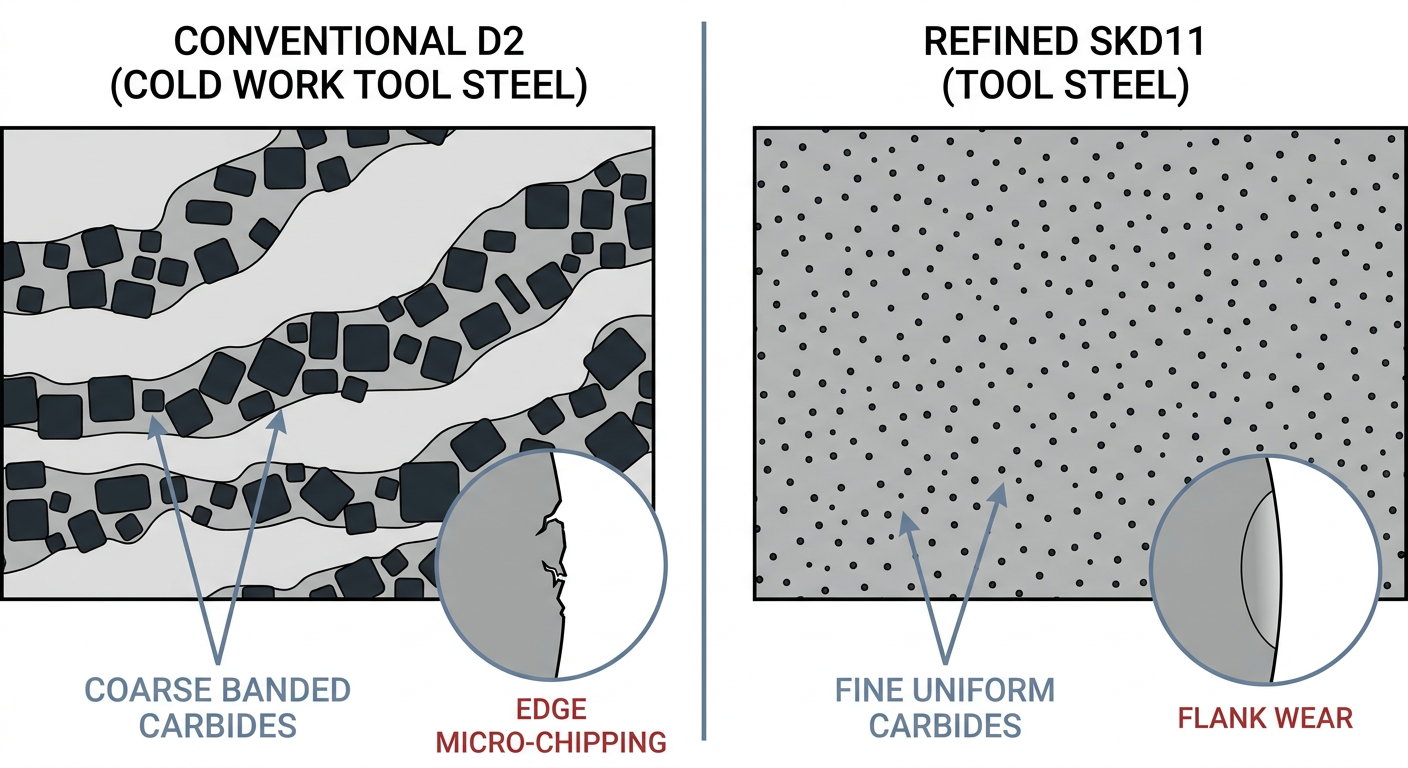
Nói tóm lại: Identify your blade’s dominant failure mode first. Flank wear calls for D2’s abrasion resistance; micro-chipping calls for SKD11’s toughness. The wrong match accelerates both failure modes.
Điểm chính: Abrasive flank wear requires higher carbide volume and hardness (favoring D2), whereas edge chipping and notch cracking require microstructural homogeneity and finer carbide size (favoring ESR-refined SKD11).
Wear Resistance: Edge Retention and Blade Life
D2 targeted at 60–62 HRC offers stronger abrasive wear resistance, typically sustaining a sharper cutting tip across high-volume shearing of carbon and low-alloy steel sheets. The high volume fraction of vanadium and chromium carbides acts as an array of microscopic armors, protecting the martensitic matrix from abrasive erosion.
SKD11 targeted at 58–60 HRC trades marginal wear resistance for improved toughness, making it safer under less-than-ideal machine conditions where minor deflection, bed flexing, or mechanical play may occur.
Chipping and Crack Resistance: When Toughness Matters
Chipping occurs when impact loading, misalignment, or clearance variation concentrates stress at the blade edge — conditions where SKD11’s finer carbide structure provides better resistance to crack initiation. In guillotine shears cutting high-tensile sheet stock, entry impact can easily shear off coarse carbide particles in conventional D2, causing rapid edge degradation.
Cracking risk increases at higher hardness levels, particularly near the upper 62 HRC range if thin edge geometry or unstable feeding is present. Operating at 62 HRC leaves minimal margin for error if sheet thickness fluctuates or if hard spots are present in the coil stock.
Lựa chọn lưỡi dao phù hợp cho công đoạn cắt của bạn
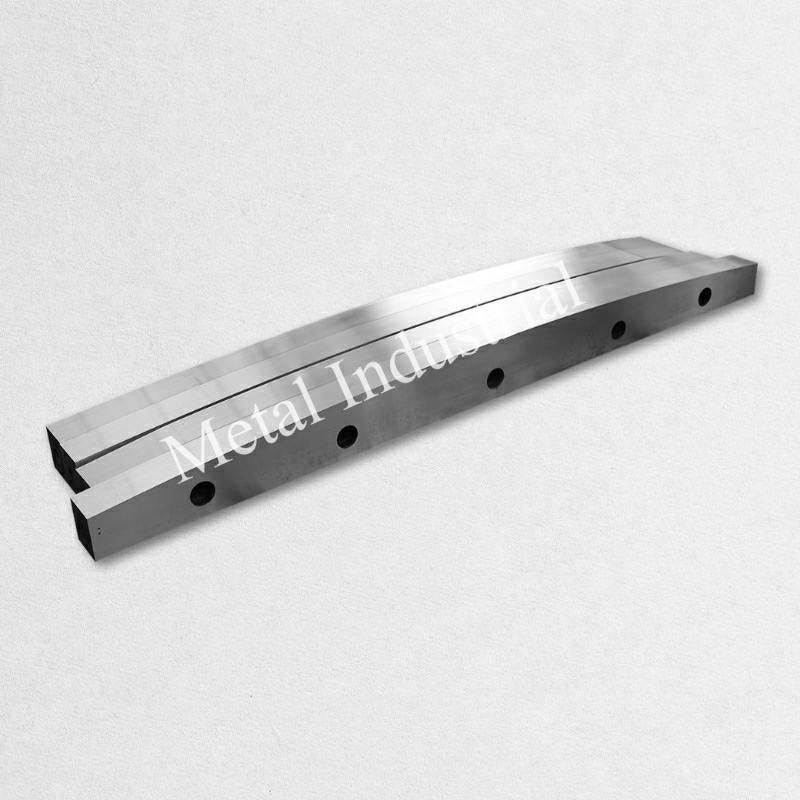
The practical selection rule is straightforward: identify whether your blade fails from wear or from impact and chipping, then match the grade accordingly. Conducting a forensic examination of your pulled blades reveals whether the cutting edge rounded off gradually or suffered premature micro-fractures.
Clean, stable, high-volume shearing favors D2’s wear advantage, while operations with unstable feed, clearance variation, or frequent sheet thickness changes benefit from SKD11’s forgiveness.
Set blade clearance at 5–10 percent of sheet thickness and monitor flank wear to time regrinds effectively. Setting improper clearance is the single leading cause of premature blade failure; excessive clearance induces burrs and sheet bending, while insufficient clearance increases cutting force and accelerates edge chipping.
Nói tóm lại: Pull a worn blade and inspect under magnification. Rounded flank = wear problem → D2. Chipped or fractured edge = toughness problem → ESR SKD11.
Decision Framework for Wear-Dominated Operations
If your blades fail by gradual edge rounding and burr growth in clean carbon-steel cutting, D2 at 58–60 HRC delivers the longest useful blade life. In these steady-state applications, the primary economic goal is maximizing the tonnage cut between regrind cycles.
Regrind intervals can extend to roughly 100,000 cuts on 5mm low-carbon steel before reaching the 0.4mm flank wear threshold, provided machine rigidity and knife clearance remain properly calibrated.
For the measurement-based rotation and regrind decision SOP—including burr threshold bands and audit-ready log templates—see the 4-edge reversible blade rotation schedule and regrind criteria SOP.
Decision Framework for Impact and Chipping Scenarios
If chipping, micro-cracking, or edge fracture appears on your blades, SKD11 at 58–60 HRC provides the toughness buffer your operation needs. The finer carbide morphology of SKD11 dissipates localized stress concentrations more effectively, preventing micro-fractures from expanding across the cutting bevel.
In high-duty coil processing—such as shearing 4mm stainless steel (AISI 304) sheet with frequent entry shock—field benchmark evaluations indicate that switching from conventional EAF-melted D2 to ESR-refined SKD11 increases blade regrind intervals by approximately 25% to 30%, largely due to the elimination of edge micro-chipping. This interval improvement is consistent with regrind records Maxtor Metal documents for customers processing 4mm stainless steel on hydraulic guillotine lines (internal production data; n = 3 accounts, 4-month observation period).
Recheck clearance settings, blade parallelism, and feed alignment — process corrections often extend blade life more than a grade change alone. Ensuring rigid machine gibs and parallel blade seats prevents localized overloads during the cutting stroke.
Before switching grades, confirm the chipping mode by reading the fracture surface: fatigue-mode chipping (beach marks, clam-shell pattern) means a setup or grinding variable is the root cause and a grade change will not resolve it; impact-mode chipping (coarse cleavage, irregular facets) is the genuine indication for a tougher grade such as ESR-refined SKD11. The Shear Blade Edge Chipping Root Cause Analysis: Fractography and Decision Tree provides the shop-floor reading method and confirms when a metallurgy correction is actually warranted.
Kiểm chứng chất lượng vật liệu dao cắt từ nhà cung cấp của bạn
A grade designation stamped on a blade tells you what the steel should be, not what it actually is — verification is essential for consistent performance. In global tooling supply chains, nominal grade labels can obscure variations in scrap quality, deoxidation practice, and forging reduction.
Requesting material test certificates, hardness reports, and metallographic carbide inspection ensures you receive genuine, correctly heat-treated steel. Establishing clear acceptance criteria with your tooling manufacturer prevents substandard blades from reaching your production floor.
Nói tóm lại: Grade labels are claims, not guarantees. An MTC 3.1 cert, hardness mapping report, and carbide inspection image are the minimum documents to require before accepting a blade shipment.
What to Check Before Ordering Shearing Blades
To guarantee tooling longevity and eliminate premature failure risks, require your blade supplier to provide the following documentation prior to dispatch:
- Require an EN 10204 / MTC 3.1 certificate confirming heat number, verified chemical composition, and heat-treatment condition for every blade order.
- Request metallographic images showing carbide size and distribution (verifying absence of severe eutectic banding or oversize carbide clusters exceeding 15 µm).
- Ask for Rockwell C (HRC) hardness verification reports taken across multiple points along the finished blade length to ensure uniform heat treatment.
- Request Maxtor Metal’s standard quality documentation package—MTC 3.1, hardness mapping, and carbide inspection images are issued with each precision shear blade order and available for third-party audit review.
If your operation shears AHSS or UHSS, consider tungsten carbide inlaid blades as a third option for high-throughput lines where D2/SKD11 regrind frequency becomes the binding constraint. See the tungsten carbide inlaid shear blades ROI guide for AHSS lines for a full TCO comparison.
FAQs:
Q: Thép làm dao SKD11 có hoàn toàn giống thép D2 không?
A: Mặc dù SKD11 (JIS G4404) và D2 (ASTM A681 / DIN 1.2379) đều thuộc cùng một họ thép làm việc nguội hàm lượng cacbon cao, crom cao và có dải thành phần hóa học chính tương đồng, chúng không hoàn toàn giống nhau 100%. D2 thường chứa hàm lượng vanadi cao hơn (lên đến 1.10%), thúc đẩy tạo thành cacbit vanadi cứng chống mài mòn, trong khi SKD11 có hàm lượng vanadi thấp hơn một chút (0.20%–0.50%), mang lại kích thước hạt cacbit trung bình mịn hơn giúp cải thiện độ bền va đập.
Q: Mác thép nào tốt hơn để cắt tôn inox/thép không gỉ dưới 6mm?
A: Đối với cắt tôn inox (như AISI 304 hoặc 316), thép SKD11 hoặc D2 tinh luyện ESR được xử lý nhiệt đạt 58–60 HRC thường được ưu tiên lựa chọn. Inox có xu hướng biến cứng khi gia công và độ bền cắt cao hơn, gây ra tải trọng va đập lớn hơn lên mép dao. Độ bền va đập vượt trội của SKD11 giúp chống mẻ mép dao - hiện tượng thường xảy ra do lực lực cản cắt của inox.
Q: Độ cứng khuyến nghị cho dao cắt tôn/chấn bằng thép D2 và SKD11 là bao nhiêu?
A: Đối với cắt tôn kim loại dưới 6mm, dải độ cứng khuyến nghị là 58–60 HRC cho các ứng dụng cắt đa dụng yêu cầu độ bền dẻo cao, và 60–62 HRC cho cắt thép cacbon thấp sản lượng lớn thiên về chống mài mòn. Độ cứng vượt quá 62 HRC sẽ làm tăng đáng kể nguy cơ mẻ mép dao và nứt vỡ dao nghiêm trọng.
Q: Nguyên nhân nào gây ra hiện tượng mẻ mép li ti (micro-chipping) trên dao cắt tôn bằng thép D2?
A: Hiện tượng mẻ mép li ti trên dao cắt D2 chủ yếu do các cụm cacbit sơ cấp thô (8–20 µm) đóng vai trò là điểm tập trung ứng suất nội bộ, cài đặt khe hở dao không hợp lý (dưới 5% hoặc trên 10% độ dày tấm tôn), độ võng của thân máy cắt, hoặc cắt vật liệu vượt quá giới hạn độ bền thiết kế của dao.
Q: Tại sao công nghệ luyện kim tinh luyện điện xỉ (ESR) lại quan trọng đối với dao cắt tôn?
A: Tinh luyện điện xỉ (ESR) là quá trình tinh luyện thứ cấp giúp làm sạch thép nóng chảy, loại bỏ các tạp chất phi kim loại và ngăn ngừa hiện tượng thiên tích cacbit thô trong quá trình đông đặc. Thép làm dao tinh luyện ESR tạo ra cấu trúc hạt cacbit mịn, đồng nhất (3–8 µm), giúp tăng cường đáng kể độ bền va đập và độ bền mép dao so với thép đúc thông thường.
Q: Bao lâu thì nên mài lại dao cắt tôn/máy cắt sắt?
A: Tần suất mài lại dao phụ thuộc vào vật liệu tôn, sản lượng cắt và tiêu chuẩn bảo trì. Theo quy chuẩn cơ bản, một bộ dao bằng thép D2 hoặc SKD11 được cân chỉnh chuẩn khi cắt thép cacbon thấp dày 5mm nên được mài lại khi độ mòn mặt sau (flank wear) đạt khoảng 0,4mm, tương ứng với khoảng 80.000 đến 100.000 lượt cắt.
Kết luận
D2 and SKD11 are metallurgical cousins, but carbide distribution, heat treatment consistency, and failure-mode matching determine which blade delivers better value in your shearing line. Choosing between them requires analyzing your specific operational challenges rather than relying solely on nominal equivalency charts.
Once you have selected the right grade, managing thickness loss across regrind cycles is the next critical step. For the shim calculation method and overlap verification protocol after each regrind, see the regrinding thickness reduction compensation and shim stack guide.
For wear-dominated sub-6mm cutting, D2 offers superior edge retention due to its higher vanadium carbide content; for impact-prone operations or lines with variable sheet properties, SKD11 provides the toughness buffer your line needs to avoid premature chipping.
Verify carbide quality, heat treatment consistency, and HRC hardness testing from your blade supplier to ensure batch-to-batch consistency and predictable blade life. Maxtor Metal supplies precision-ground D2 and SKD11 shearing blades manufactured from ESR-refined tool steel stock, with vacuum heat treatment and hardness verification standard on every order. For operations making a first-time grade switch, Maxtor Metal can provide comparative blade sets with matched geometry for side-by-side trial evaluation.
Hồ sơ tác giả
Nancy Wu
Senior Manufacturing Engineer, Production Engineering (PE) | Maxtor Metal
With over 12 years of experience in industrial blade manufacturing, Nancy specializes in the machining characteristics, heat treatment, and surface coating behaviors of high-carbon cold-work tool steels (including SKD11, D2), high-speed steels (M2), hot-work steel (H13), powder metallurgy alloys, and tungsten carbide. She holds advanced qualifications in high-precision CNC grinding programming and process optimization.
Chứng nhận: SME Certified Manufacturing Engineer (CMfgE), Project Management Professional (PMP), Six Sigma Black Belt, ASM International Tool Steel Metallurgy Certifications.

 English
  Spanish
  Italian
  French
  Portuguese
  Russian
  German
  Arabic
  Hindi
Hindi  Vietnamese
  Indonesian
  Japanese
  Korean