

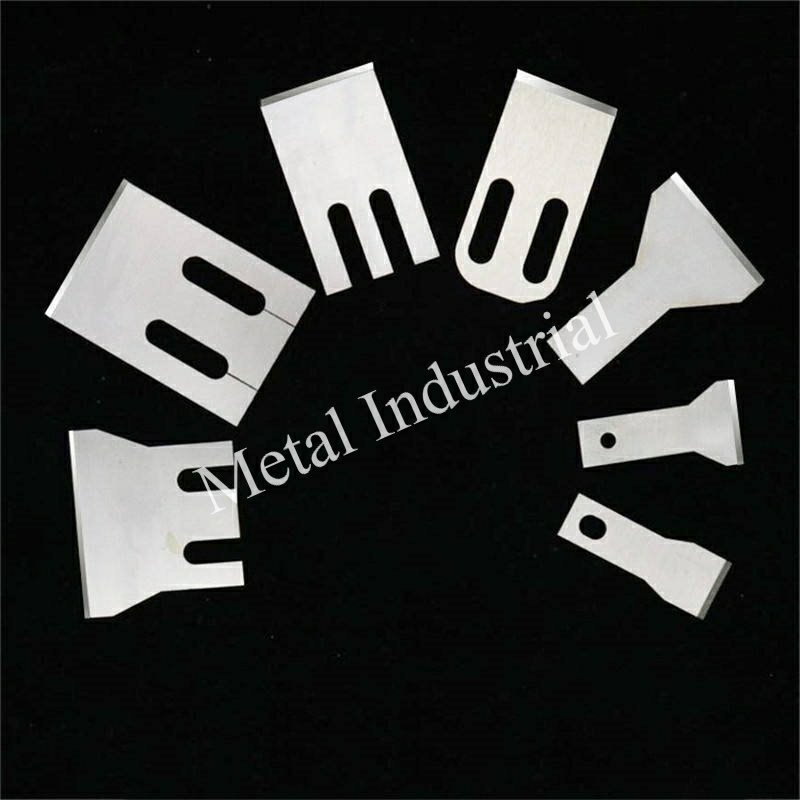
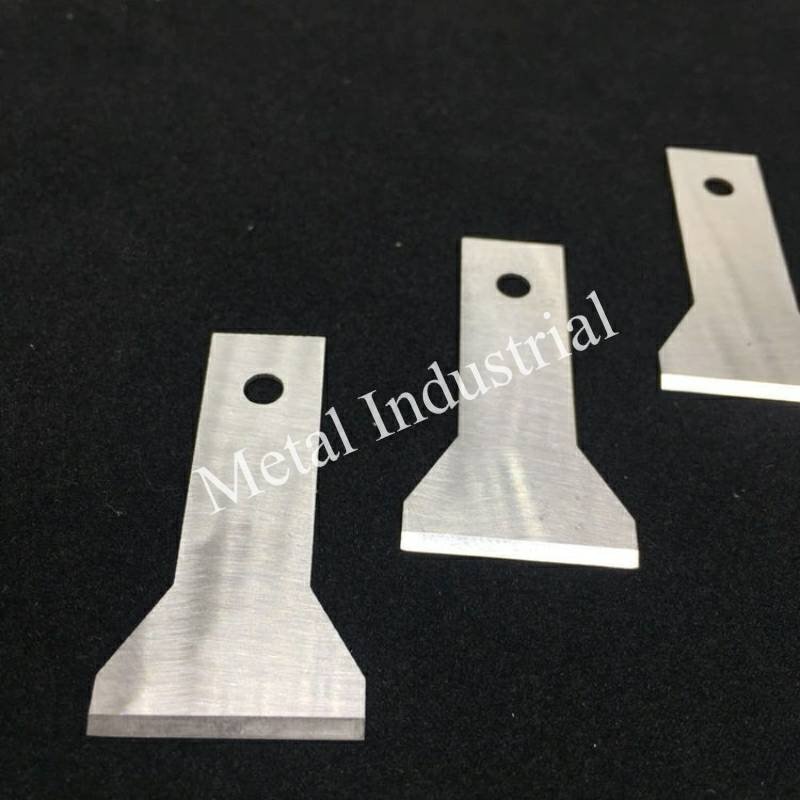
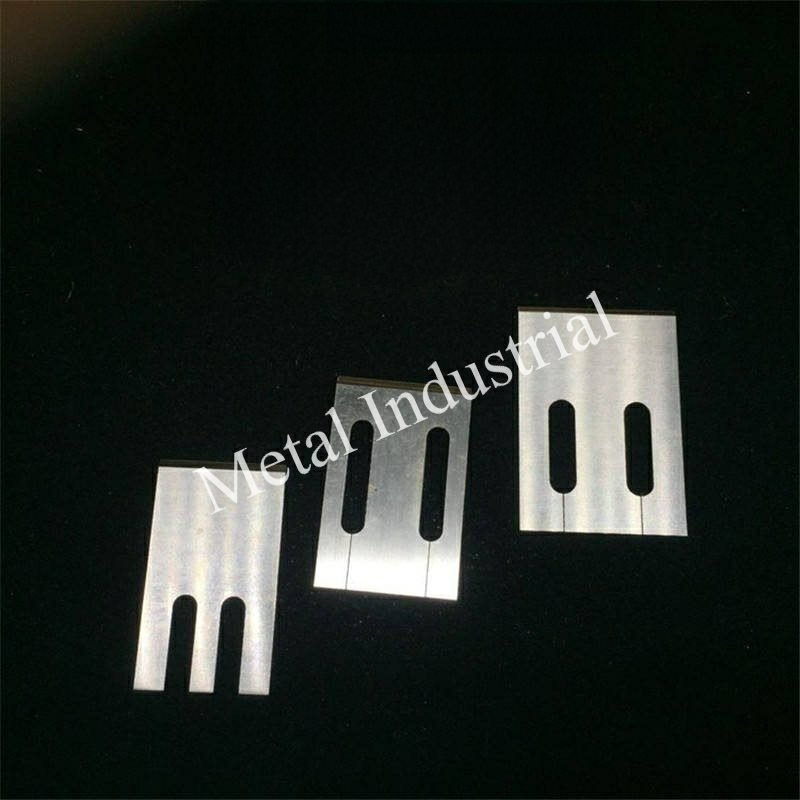
요약 답변: 의료용 폴리머 페렛타이징(Pelletizing) 공정에서 420과 440C 스테인리스강은 상호 대체될 수 없습니다. 420은 고강도 세척/소독이 빈번하거나 수질 화학 성분이 변동하는 수냉 루프에서 더 높은 인성, 우수한 광택 연마성 및 부식 누적 내성을 제공합니다. 반면 440C는 화학 성분이 안정적으로 제어되는 루프에서 연삭성이 강한 폴리머를 절단할 때 독보적인 날 유지력(Edge retention)을 발휘합니다. 두 강재 모두 Ra ≤ 0.4 µm 앙상한 거울면 광택(Mirror finish)과 ASTM A967에 따른 검증된 수동태화(Passivation) 처리가 필수적이며, 단순히 합금 재질뿐만 아니라 '표면 공학(Surface engineering)'이 오염 방지의 핵심 제어 요소입니다. 의료용 페렛의 흑점(Black specks)은 대부분 시스템적 문제입니다. 즉, 수냉 루프의 부식 잔해와 표준 미달 칼날에서 발생한 마모 파편이 복합적으로 작용하여 발생합니다.
의료용 폴리머 페렛의 흑점(Black specks)은 단일 원인으로 발생하는 경우가 드뭅니다. 생산 팀은 이를 수지 열화(Resin degradation)나 퍼지 잔류물(Purge residue) 탓으로 돌리는 경우가 많지만, 체계적인 원인 조사를 거치고 나면 주된 원인이 온수 순환 루프에서 유입된 부식 잔해와 표준 미달 절단 시스템에서 발생한 칼날 마모 파편임을 알게 됩니다.
까다로운 폴리머 응용 분야용 페렛타이저 칼날(Pelletizer blades)은 엄격한 치수 공차와 철저한 오염 제어 요구 사항을 충족해야 합니다. 특히 육안 오염 Zero 및 페렛 입자의 균일성이 타협 불가능한 필수 조건인 의료용 생산 라인에서는 더욱 그렇습니다. 올바른 스테인리스 강재 등급, 표면 조도(Surface finish) 및 수냉 순환 관리 프로토콜의 선정이 이러한 품질 보증의 공학적 토대입니다. 연삭성이 강하거나 유리 섬유(Glass-fiber)가 충전된 컴파운드를 생산하여 부식보다 마모가 지배적인 라인의 경우 강재 선정 로지속이 달라지며, M390 대 CPM S90V 분말야금 페렛타이저 나이프: 고유리섬유 마모 환경에서의 강종 선정 covers that scenario in detail.
의료용 및 산업용 고機能 폴리머 생산 라인을 위한 Maxtor Metal의 맞춤형 페렛타이저 칼날(Pelletizer knives) 프로그램에서, 블랙 스펙(Black specks, 검은 점)의 근본 원인 조사 결과는 일관되게 수냉 순환 라인 부식, 칼날 표면 조도(Surface finish) 미달, 그리고 강재 등급 미스매치라는 3가지 제어 가능한 변수로 귀결됩니다. 이는 엄격한 사양 정의와 공정 규율을 통해 모두 해결할 수 있습니다.
흑점(Black Specks): 발생 원인 및 리스크
Differentiating Polymer vs Metallic Specks
Not all black specks share the same origin, and misidentifying the source wastes investigation time. A simple initial screen separates the two categories:
- Metallic specks are hard, gritty, and often magnetic. Under a stereomicroscope they show metallic luster or angular fracture surfaces. A rare-earth disc magnet drawn across a spread pellet sample will attract these particles.
- Polymer specks are soft, compressible, smear under fingernail pressure, and frequently show a carbonized or thermally degraded cross-section. They originate from dead zones in the extruder barrel, screen-pack bypass, or contact with overheated die surfaces.
Mixed contamination — where metallic debris seeds polymer carbonization — is common in long-run campaigns. Resolving it requires addressing both pathways simultaneously.
Warm-Water Loop Corrosion Pathways
The closed warm-water loop in an underwater pelletizing system is a persistent contamination source when poorly managed. A 2025 NIH technical bulletin on corrosion in closed-loop water systems identifies black magnetic iron oxide (magnetite) and mill-scale debris as the dominant black-speck contributors in recirculating systems. The mechanism is directly applicable to pelletizing loops.
The corrosion cycle follows a predictable path: oxygen ingress plus elevated chlorides triggers pitting on wetted metal surfaces, magnetite forms, particles migrate through the loop, and contamination reaches the die face and pellet stream. For loops operating outside controlled chemistry limits, this cycle accelerates until pellet color deviations become routine.
Impact on Compliance and OEE
ISO 13485 may be relevant when the polymer-processing operation is part of a medical-device organization’s controlled supply chain or QMS. It should not be treated as a universal production standard for all medical-grade polymer pelletizing lines. Where ISO 13485 controls apply, black-speck events should be handled through the site’s documented nonconformance, investigation, change-control, and CAPA procedures.
From an OEE perspective, uncontrolled black-speck events degrade all three components. Availability suffers as corrective purges, die changes, and system flushes consume production time. Performance drops when operators reduce throughput to control thermal history. Quality losses accumulate through quarantined or scrapped lots.
핵심 요점: Metallic black specks from knife wear or loop corrosion are a compliance event on medical polymer lines — not a cosmetic issue. The investigation pathway and corrective action must be documented and closed within the quality system.
요약하자면: black specks in medical polymer pellets are a system problem — corrosion debris from the water loop and wear fragments from a poorly specified knife typically act together, and addressing only one without the other rarely holds
420 vs 440C 스테인리스강 핵심 비교
Composition, Hardness, Wear vs Corrosion
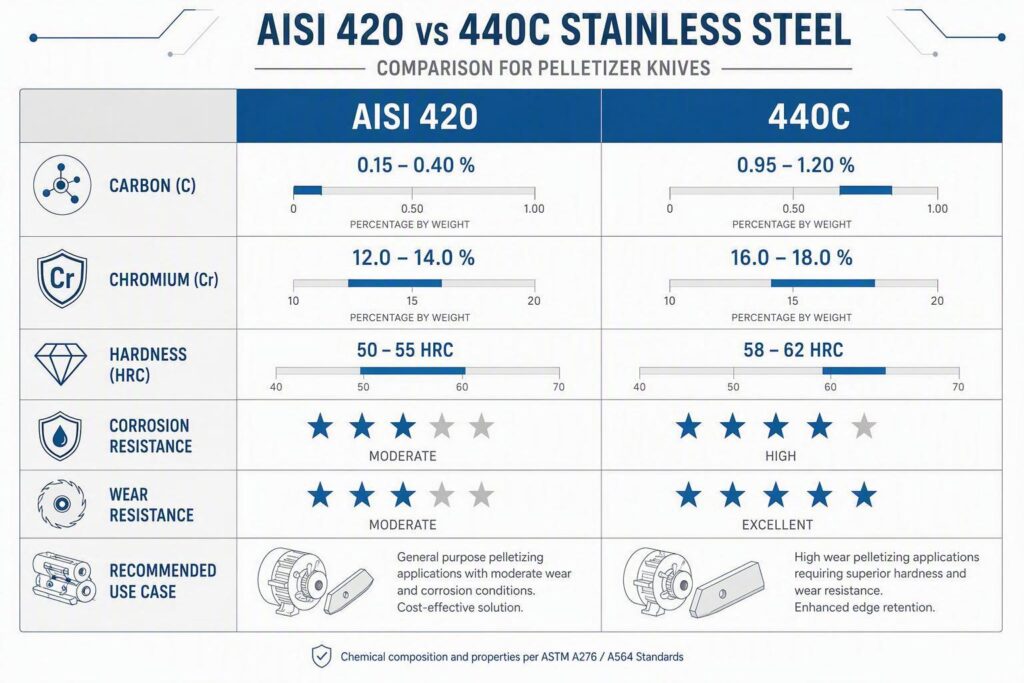
Both AISI 420 and 440C are martensitic stainless steels — heat-treatable, chromium-bearing grades capable of achieving the hardness needed for precision cutting-tool applications. Their differences are consequential for pelletizer knife selection.
| 재산 | AISI 420 | AISI 440C |
|---|---|---|
| 탄소(%) | 0.15 – 0.40 | 0.95 – 1.20 |
| 크롬(%) | 12 – 14 | 16 – 18 |
| Typical HRC (hardened) | 50 – 52 | 58 – 60 |
| 내마모성 | 보통의 | 높은 |
| 부식 저항성 | Good (high free Cr in solution) | Good (carbide formation reduces free Cr) |
| 인성 | 더 높은 | 낮추다 |
| Polishability | 훌륭한 | 좋은 |
440C’s high carbon content drives significantly more hard chromium carbides into the microstructure, which is the source of its wear advantage. Those carbides, however, reduce the chromium available in the matrix to sustain the passive oxide film — a trade-off reflected in Crucible Industries’ 440C material data, which specifies the grade for high wear resistance with only moderate corrosion resistance in mild environments. In corrosive or sanitization-intensive environments, this trade-off is material.
420 retains more free chromium in solution. Atlas Steels’ Grade 420 data sheet describes it as a hardenable 12% chromium grade offering good corrosion resistance in the hardened and polished condition — a state directly relevant to lines where weekly CIP cycles and warm-water contact are standard.
Selection by Risk Profile and Water Quality
The practical selection decision depends on three factors: polymer abrasivity, loop water quality, and the downstream consequence of contamination.
| 상태 | Preferred Grade |
|---|---|
| Abrasive polymer (glass-filled, mineral-loaded compounds) | 440도 |
| Deionized loop water, chlorides consistently < 50 ppm | 440C acceptable |
| Municipally conditioned or fluctuating chloride water | 420 |
| Frequent caustic CIP cycles (pH > 9.5) | 420 |
| Maximum edge retention is the primary objective | 440도 |
| Maximum chip resistance and toughness required | 420 |
For a quick field orientation, the following decision matrix compresses polymer abrasivity, loop water quality, and contamination consequence into a single risk-based recommendation. It is a proprietary summary framework, not a substitute for the line-specific qualification trial described later in this article.
| Abrasivity | Loop Water Quality | Contamination Consequence | Recommended Grade |
|---|---|---|---|
| 낮은 | Controlled (chlorides < 50 ppm) | Critical | 420 with premium finish |
| 낮은 | Variable / elevated chlorides | Critical | 420 |
| 높은 | Controlled | Critical | 440도 |
| 높은 | 변하기 쉬운 | Critical | 440C with enhanced loop control |
| 높은 | Controlled | 보통의 | 440도 |
| 낮은 | Controlled | 보통의 | Either — finish drives outcome |
Neither grade is universally superior. The selection should be documented in the knife specification and formally linked to the water-quality SOP for the specific line.
Finish and Passivation Dominance
For black-speck control, surface condition often matters more than alloy choice. A properly polished and passivated 420 knife will outperform a poorly finished 440C knife in contamination-sensitive applications. Grade selection sets the performance ceiling; surface engineering determines where the knife actually operates within it.
요약하자면: the 420 vs 440C decision comes down to which failure mode governs your line — choose 440C for edge retention under abrasive load in a stable loop, and 420 for corrosion tolerance and polishability when loop chemistry varies or sanitization intensity is high.
나이프 및 칼날용 표면 공학 (Surface Engineering)
Surface Roughness and Polish Targets
그만큼 Australian Stainless Steel Development Association identifies Ra ≤ 0.5 µm as a critical surface roughness threshold for maintaining effective passive-film integrity on abraded stainless steel. For medical-grade pelletizer knives, apply the following zonal targets:
- Cutting edge and die-face contact zones: Ra ≤ 0.4 µm (≤ 0.2 µm preferred for highest cleanability)
- Side flanks and blade body: Ra ≤ 0.8 µm
- Bore and mounting surfaces: Ra ≤ 1.6 µm
These targets require CBN or diamond grinding followed by mechanical polishing. Electropolishing is optional but improves passive-film uniformity and eliminates the micro-crevice points that trap biomass or corrosion product on conventionally polished surfaces.
ASTM A967 Passivation and Verification
ASTM A967/A967M is the governing specification for chemical passivation of stainless steel parts. It covers both nitric acid and citric acid treatment protocols, with defined concentration, temperature, and immersion-time windows for each.
Passivation removes free iron contamination — grinding swarf, embedded tooling particles, iron-tool marks — that would otherwise become active corrosion sites in service. It does not alter surface roughness or repair mechanical defects. The specification requires the treated part to show no etching, pitting, or frosting on visual inspection after treatment.
Verification methods specified under ASTM A967 include the water immersion test, high-humidity exposure (48 h at 95–100% RH), salt spray per ASTM B117, copper sulfate test, and potassium ferricyanide–nitric acid test. For medical-grade knife supply, the potassium ferricyanide test or salt spray test should be the minimum acceptance criterion, with results documented on the material certificate.
Coating Choices and Flake Risk
Thin hard coatings (TiN, TiAlN, DLC) can extend knife life in abrasive polymers, but they carry a flake-risk burden in medical applications. The three coating families used on pelletizer knives differ sharply in what they deposit, how thick they sit, and what they demand of the substrate.
| 코팅 | Typical thickness | Hardness / friction | Medical-grade suitability |
|---|---|---|---|
| PVD TiN / TiAlN | 1–4 µm | ~2,000–3,500 HV; COF 0.4–0.6 | Permitted with validated adhesion; hard and diffusion-bonded to substrate |
| DLC (a-C:H, ta-C) | 1–3 µm | 2,000–6,000 HV; COF 0.05–0.15 | Lower friction, but internal stress and flake sensitivity require interlayer control |
| PTFE (dry-film lubricant) | 5–25 µm | Soft; applied as a low-friction layer | Generally not preferred where the coating contacts the pellet stream — soft film sheds |
Two thickness effects matter for a medical pelletizer knife. First, PVD hard coatings at 1–4 µm usually need no dimensional compensation — a 2 µm film adds 2 µm per coated face, well inside the ±0.005 mm flatness and typical edge tolerances for precision pelletizer knives. Second, PTFE at 5–25 µm is thick enough to shift geometry: a fully coated diameter can grow 10–50 µm, which measurably alters edge relief, slot width, and knife-to-die contact unless the drawing carries an explicit coating allowance. For a knife specified to ±0.005 mm/100 mm flatness, that is not a rounding error — it is a design change.
Flake risk can be quantified rather than assumed. Adhesion is measured by scratch testing per ISO 20502, which defines progressive critical loads (Lc): Lc1 marks the first cohesive cracking, Lc2 the onset of adhesive chipping, and Lc3 the first spalling. Published TiN-on-stainless studies report Lc values around 20 N, 40 N, and 65 N for the successive failure stages, while well-adhered DLC duplex systems with chromium interlayers exceed 49–51 N at first critical load. A practical acceptance framework for medical tooling follows from those values:
| Adhesion criterion | Lc2 (adhesive chipping) | Rockwell HF class | Risk interpretation |
|---|---|---|---|
| Minimum acceptable | ≥ 30 N | HF 1–3 | Coating survives service loading; monitor at tool change |
| Robust industrial | ≥ 50 N | HF 1–2 | Low flake probability under cyclic thermal and mechanical load |
| Preferred for medical | ≥ 70 N | HF 1 | Negligible flake risk with controlled interlayer and roughness |
| Reject | < 20 N | HF 5–6 | Coating not industrially admissible; HF6 is a known fail class even for DLC |
A coating without a bonding interlayer regularly lands in the HF5–HF6 range and should not be deployed on a medical line. Substrate preparation is not optional: a chromium or Cr/CrC interlayer plus controlled pre-treatment is what moves DLC from a few newtons of critical load to the 70 N class. Require the coating supplier to report Lc2 values and the Rockwell HF class on the certificate, measured on the same substrate and heat treatment as the delivered knife, not on a generic test coupon.
⚠️ 경고: In ISO 13485-regulated lines, any knife coating must be validated for flake-generation behavior under process conditions before deployment. An unvalidated coating change is a formal process change requiring documented risk assessment and change control.
For most medical-grade polyolefin, PET, and PEEK pelletizing applications, uncoated and well-passivated 420 or 440C is the lower-risk choice. Where a coating is justified by abrasive loading, specify a PVD TiN or TiAlN system at 2–4 µm with a documented Lc2 ≥ 50 N, and confirm the added thickness does not disturb the knife-to-die contact recorded during installation.
요약하자면: surface finish and passivation are the primary contamination controls in medical polymer pelletizing — alloy grade sets the ceiling, but Ra ≤ 0.4 µm and verified ASTM A967 passivation are what keep metallic specks out of the product stream.
온수 순환 루프 제어 (Warm-Water Loop Control)
Water Chemistry and Numeric Targets
Applying NIH closed-loop water chemistry guidance and stainless steel corrosion control principles to a warm-water pelletizer system yields the following parameter framework. The water-loop disciplines here apply equally to TPU and EVA lines — for the intersection of loop control and knife coating selection in those materials, see TPU 수중 페렛타이징 나이프의 수지 껌밍 현상: DLC 대 PTFE 코팅 선정 및 최적 가동 조건(Operating Windows).
| 매개변수 | Target Range | Action Limit |
|---|---|---|
| pH | 7.0 – 9.0 | < 6.5 or > 10.0: investigate makeup source |
| Chlorides | < 50 ppm | > 100 ppm: drain and recharge loop |
| Total iron | < 0.3 mg/L | > 1.0 mg/L: flush and identify corrosion source |
| 전도도 | 100 – 400 µS/cm | > 800 µS/cm: check makeup water and dosing |
| Suspended solids | < 5 mg/L | > 20 mg/L: increase filtration frequency |
The NIH technical bulletin targets pH 9.0–10.5 for carbon steel service. For a loop dominated by stainless steel contact surfaces, the lower setpoint range of 7.0–9.0 is defensible and reduces scaling risk while maintaining passive-film stability.
프로 팁: A rising chloride trend in a closed loop is almost always a signal of external ingress — makeup water contamination, resin leachables, or cleaning chemical carryover. Trend the data; do not treat chloride as a one-time acceptance check.
Filtration Architecture and Hydraulics
A two-stage filtration architecture is the practical minimum for medical-grade loops:
- Coarse strainer (100–200 µm mesh): Installed on the main circulation line upstream of the pump and die head. Captures flakes, scale, and large debris. Schedule cleaning against the differential pressure indicator, not a fixed calendar interval.
- Side-stream bag or cartridge filter (5–25 µm): Polishes approximately 5–10% of total loop flow continuously. Effective at capturing magnetite fines that pass the coarse strainer and would otherwise reach the die face.
Sanitation and Degassing Strategy
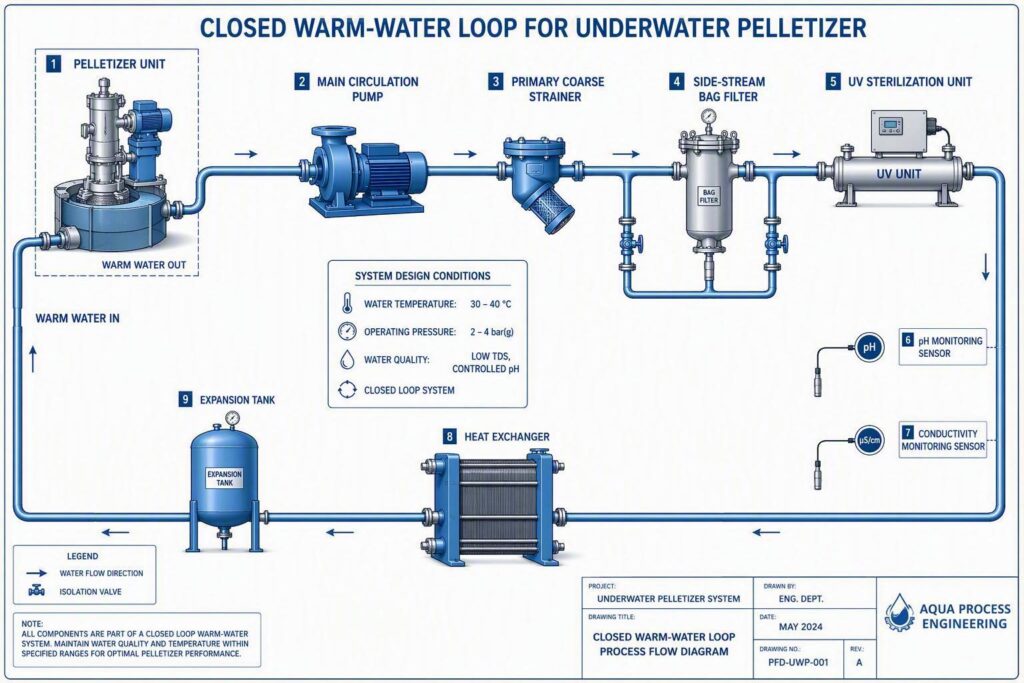
UV sterilization at 254 nm (minimum 30 mJ/cm² dose) on the main return line suppresses biofilm accumulation that concentrates corrosion products and increases under-deposit attack on wetted surfaces.
A membrane degasser or closed expansion tank with nitrogen blanket reduces dissolved oxygen to below 0.1 mg/L on critical lines. Dissolved oxygen is the primary accelerant of pitting corrosion in warm recirculating loops — reducing it is one of the highest-return engineering controls available.
Following any maintenance event involving pipe or component replacement, flush the system of debris and passivate new stainless surfaces before returning to production, consistent with NIH guidance on system startup after tie-ins.
요약하자면: the warm-water loop is not a utility — it is a process variable, and without pH, conductivity, and filtration targets codified in a formal SOP linked to the knife specification, loop-sourced black specks will recur regardless of knife grade.
기술 사양서 및 표준 작업 절차서 (SOPs)
Controlled A/B Trial: 420 vs 440C on a Medical-Grade PP Line
The selection logic above becomes concrete when it is tested under a controlled comparison. The following trial was run by Maxtor Metal’s engineering team on an anonymized medical polymer compounding line producing medical-grade PP pellets. The goal was not to declare a universally superior grade, but to quantify the difference in particle-quality stability and edge retention under identical process conditions.
Trial setup and controlled variables
| 매개변수 | Control Requirement |
|---|---|
| Melt temperature | ±3 °C |
| Pelletizer speed | ±2% |
| 냉각수 온도 | ±2 °C |
| Water flow | ±3% |
| 처리량 | ±2–3% |
| Die plate | Same plate for both runs |
| Polymer grade | Same grade (medical-grade PP, unfilled, 0% regrind) |
| Knife pressure | Held identical for A and B |
| 목 | Case A — 420 |
| 산업 | Medical polymer compounding |
| Filler / regrind | None / 0% |
| Line | Underwater pelletizer, ~2–3 t/h |
| 압형 | AISI 420, approx. 52–55 HRC |
| 표면 조도 | Polished, Ra ≤ 0.4 µm |
| Run period | Approx. 6–8 weeks |
| Cumulative output | Approx. 250–350 t |
Measurement sequence
- Incoming blade inspection — hardness, thickness, edge straightness, edge roughness, and visual inspection under magnification.
- Cutter installation — record cutter-head runout, blade protrusion, knife-to-die contact, and tightening torque.
- Start-up stabilization — the first 30–60 minutes of data are excluded from the A/B comparison, since start-up pellet quality does not represent steady-state production.
- Production sampling — every 4 hours: collect a 500–1,000 g pellet sample; sieve for fines; inspect 1,000 pellets for size and shape; count black specks per the specified sampling method.
- Blade condition — at each planned stop: microscope inspection of the edge, wear-land measurement, micro-chipping check, and cumulative tonnage logged.
Observed outcome (A vs B)
| KPI | 420 (A) | 440C (B) | Direction |
|---|---|---|---|
| Black specks | approx. 18–30 ppm | approx. 8–15 ppm | ↓ approx. 40–60% |
| 미분 | approx. 0.30–0.50 wt% | approx. 0.18–0.30 wt% | ↓ approx. 30–40% |
| Off-size / irregular pellets | approx. 0.8–1.3% | approx. 0.4–0.8% | ↓ approx. 30–50% |
| Tool life to regrind | approx. 180–260 h | approx. 300–420 h | ↑ approx. 1.5–1.8× |
| Unplanned knife changes | approx. 3–4 per 6 weeks | approx. 1–2 per 6 weeks | ↓ approx. 40–60% |
| Production yield | approx. 98.5–99.1% | approx. 99.1–99.5% | + approx. 0.3–0.6 pp |
How the failure mode actually developed
The 420 blades were not “non-conforming” at the outset. For the first 2–3 weeks, pellet dimensions were normal, fines held around 0.3–0.4 wt%, and black specks stayed low. As cumulative output increased, a predictable drift appeared: the edge dulled slightly, cutting load rose, the die-face contact shifted toward a more abrasive wiping action, and trace polymer residue began to accumulate near the blade and die plate. Cleaning temporarily cleared the symptom, but it returned after further running.
The first corrective attempt was simply to raise knife pressure. Tails dropped briefly, but the black-speck issue persisted and edge wear accelerated. Only then was the grade changed from 420 to 440C while holding knife pressure, pelletizer speed, die plate, and polymer formulation constant.
핵심 요점: During the controlled trial, black-spec occurrence decreased by approximately 40–60% after changing from hardened 420 to 440C blades. This is a trial result under the stated conditions — not a universal guarantee, since black-spec contamination in medical plastics can also originate from pellet conveying, dust, and material handling rather than the cutting tool alone.
For context, both grades are established martensitic stainless steels in the medical tooling family, and ASTM F899 lists 420 and 440C within the martensitic stainless system used for surgical instruments. That is why the comparison is a genuine qualification question rather than a manufactured contrast — and why the honest conclusion is conditional:
Engineering conclusion: The A/B trial indicated that 440C provided longer edge retention and lower particle-quality drift under the tested medical-grade PP conditions, while 420 remained a viable option where toughness, machining cost, and moderate wear requirements were prioritized.
Maxtor Metal’s own technical documentation lists 420/440C martensitic stainless with Ra ≤ 0.4 µm mirror finishing as a material system for medical-grade and food-packaging pelletizer applications. This is a brand-side engineering basis; it should not be presented as independent third-party validation.
요약하자면: a knife specification that stops at alloy grade and hardness is incomplete — material traceability, surface finish, passivation verification, and a linked water-loop SOP are what make a pelletizer knife program auditable to ISO 13485 expectations.
Knife Spec Template (420/440C)
A formalized knife specification eliminates ambiguity in procurement and incoming inspection. The following framework reflects the precision-grinding capabilities and documentation practices — including EN 10204 MTC 3.1 certificates — that apply to custom pelletizer knife programs for technical and medical polymer lines. Maxtor Metal’s approach to custom knife manufacturing integrates material traceability, heat-treatment records, and verified surface finish from a single source.
| 기인하다 | AISI 420 Specification | AISI 440C Specification |
|---|---|---|
| Base material | AISI 420 (UNS S42000) | AISI 440C (UNS S44004) |
| 열처리 | Vacuum hardened + tempered; 50–52 HRC ±1 | Vacuum hardened + tempered; 58–60 HRC ±1 |
| Surface finish — cutting edge | Ra ≤ 0.4 µm | Ra ≤ 0.4 µm |
| Surface finish — blade body | Ra ≤ 0.8 µm | Ra ≤ 0.8 µm |
| Passivation standard | ASTM A967/A967M, citric or nitric acid method | ASTM A967/A967M, citric or nitric acid method |
| Passivation verification | Potassium ferricyanide test, pass | Potassium ferricyanide test, pass |
| Material certificate | EN 10204 MTC 3.1 | EN 10204 MTC 3.1 |
| Dimensional tolerance | Per drawing; flatness ≤ 0.005 mm/100 mm | Per drawing; flatness ≤ 0.005 mm/100 mm |
| 코팅 | 코팅되지 않음 | 코팅되지 않음 |
For the component-level qualification framework that governs how these dimensional and hardness tolerances are verified at incoming inspection — covering runout/TIR acceptance, balance grade per ISO 21940, and QA dossier structure — see our knife block qualification guide for water-ring pelletizers.
For a full overview of knife formats and configurations available for underwater and die-face pelletizing systems, see Maxtor Metal’s industrial blades for plastic processing guide, which covers material options, dimensional standards, and application-matched configurations across pelletizer types.
Water-Loop Quality Specification
The water-loop SOP must be formally linked to the knife specification to create a coherent, auditable contamination-prevention program. Key document elements include: makeup water source and treatment with acceptance criteria; chemical inhibitor type, dose, and monitoring interval; filtration change schedule; analytical sampling plan (weekly pH and conductivity; monthly total iron and chlorides during normal operation; daily during startup or post-maintenance); alert and action limits as defined in the chemistry table above; loop flush and passivation procedure for post-maintenance restart; and records retention for a minimum of three years.
Maintenance, Inspection, and Records
For knife assemblies: inspect cutting edges and die-face contact surfaces at each tool change for chipping, pitting, and corrosion discoloration; record regrind cycles per knife set and replace at the minimum height specified in the OEM drawing; retain hardness test and passivation verification records for each incoming lot; log every observed black-speck event with date, lot number, retained pellet sample, and investigative findings.
문제 진단 및 프로세스 복구
Microscopy and Magnet Tests
When a black-speck event occurs, the initial classification requires no laboratory equipment. Spread a 200 g pellet sample on white paper and draw a rare-earth disc magnet across the surface at 5–10 mm standoff. Metallic specks migrate toward the magnet; polymer carbonization particles remain stationary.
For confirmation, mount five to ten particles from each category at 40–100× magnification. Metallic particles show angular fractures and bright metallic surfaces, with possible brown-black magnetite smear under oblique illumination. Polymer particles are amorphous, compressible, and show laminar carbonization layers when cross-sectioned with a razor.
Correlation with Water Metrics
Plot total iron and suspended solids values from the loop log against the production record for the same period. A sustained upward trend in loop iron typically correlates with metallic speck events that appear within 24–72 hours — the lag reflecting loop volume and filtration efficiency. When total iron exceeds 1.0 mg/L without a corresponding maintenance event, treat it as an active corrosion indicator and inspect wetted surfaces before the next production run.
Remediation and Verification Steps
- Drain and flush the warm-water loop with clean deionized water until effluent total iron is below 0.1 mg/L
- Inspect the knife set for edge chipping, pitting, and corrosion — replace if any corrosion pitting is visible on the die-face contact zone
- Verify passivation on replacement knives before installation (potassium ferricyanide or salt spray per ASTM A967)
- Restart the loop with a fresh inhibitor charge; verify pH, conductivity, and chloride are within specification before resuming production
- Run a 15-minute qualification lot: inspect pellets under 10× magnification and perform a magnet test before releasing. For die-face systems running WC–Co insert blocks, the parallel restart discipline — verifying contact pressure, insert condition, and braze integrity before resuming production — is covered in our guide on 수중 펠레타이저용 텅스텐 카바이드 인서트 등급 선택, 브레이징 및 접촉 제어.
- Close the CAPA record with documented root cause, corrective action, and preventive action — including any spec or SOP revision triggered by the event
For lines where the black-speck or contamination event traces back to blade contact instability — specifically, hydrodynamic lift at operating speed overcoming the axial preload and opening a micro-gap at the die face — the force-balance diagnostic and gap measurement sequence is covered in our guide on dynamic blade float, preload mechanics, and the 0.03 mm contact threshold.
요약하자면: when black specks recur after a knife or loop change, the magnet test and microscopy results together tell you whether the source is metallic or polymeric — treating the wrong source first is the most common recovery delay.
FAQ
Q: 페렛타이저 칼날(Pelletizer knives)용 420 및 440C 스테인리스강의 주요 차이점은 무엇인가요?
A: 420은 탄소 0.15–0.40%, 크롬 12–14%를 함유하여 50–52 HRC 경도를 달성하며, 우수한 내식성과 높은 인성(Toughness)을 제공합니다. 반면 440C는 탄소 0.95–1.20%, 크롬 16–18%를 함유하여 58–60 HRC의 높은 경도와 탁월한 내마모성을 자랑하지만, 탄화물 형성으로 인해 인성과 내식성은 약간 낮습니다. 수냉 순환 수질이 관리되는 연삭성/아브레이시브(Abrasive) 폴리머 라인에는 440C를, 부식성 환경이나 빈번한 소독/세정(Sanitization) 작업이 필요한 라인에는 420을 추천합니다.
Q: 의료용 폴리머 펠렛에서 금속성 블랙 스펙(Metallic black specks, 검은 점)이 발생 원인은 무엇인가요?
A: 금속성 블랙 스펙은 주로 3가지 원인에서 발생합니다: 취성 파괴나 충격 하중으로 인한 칼날의 미세 이놀림(Micro-chipping), 온수 순환 라인에서 유입되는 부식 잔여물(마그네타이트, 산화철), 그리고 칼날 표면의 부적절한 패시베이션(Passivation, 불활성화) 처리로 인한 유리 철(Free-iron) 오염입니다. 금속성 이물과 수지 탄화물을 구분하기 위한 1차 진단 도구로는 자석 테스트와 광학 현미경 분석이 사용됩니다.
Q: 의료용 페렛타이저 칼날(Pelletizer knives)이 달성해야 하는 표면 조도(Ra)는 얼마인가요?
A: 절삭날 및 다이 페이스(Die-face) 접촉 영역은 Ra ≤ 0.4 µm 이하를 달성해야 합니다. 호주 스테인리스강 개발 협회(ASSDA)는 연삭 처리된 스테인리스강의 수동태 피막(Passive film) 완전성을 유지하기 위한 임계 임계값을 Ra ≤ 0.5 µm로 정의하며, 이 값 이하에서 내식성이 현저히 향상됩니다. 표면 조도가 더 거칠 경우 내식성이 약화될 뿐만 아니라 펠렛 흐름 내 미세 입자(Particulate) 유출 위험이 증가합니다.
Q: ASTM A967に基づくパシベーション(不活性化処理)の効果は何ですか?また、それだけで黒点・微小異物(Black specks)を防ぐことができますか?
A: ASTM A967/A967M 규격에 따른 패시베이션은 스테인리스강 표면의 유리 철(Free iron), 잔류 연삭 입자 및 표면 오염 물질을 제거하여 수동태 산화 크롬 피막(Chromium oxide film)을 복원합니다. 하지만 표면 조도(Ra)를 변경하거나 기계적 결함을 복구하지는 못합니다. 패시베이션은 필수적이지만 단독으로는 충분하지 않습니다. 패시베이션 전 칼날을 목표 표면 조도(Ra)까지 연마해야 하며, 온수 순환 라인의 수질 관리도 독립적으로 시행되어야 합니다.
Q: 스테인리스 칼날을 사용하는 페렛타이저 온수 순환 라인에서 안전한 염화물(Chloride) 농도는 얼마인가요?
A: 420 또는 440C 칼날 사용 시 염화물 농도는 50 ppm 미만으로 유지해야 합니다. 100 ppm을 초과하는 농도는 두 강재 모두에서 공식/점식 부식(Pitting corrosion)을 가속화하며, 이로 인해 발생한 부식 잔여물이 펠렛 흐름으로 직접 유입됩니다. NIH 밀폐 순환계 부식 가이드라인에 따르면, 염화물 농도를 일회성 승인 기준이 아닌 지속적인 공정 관리 지표(Trend indicator)로 추적/관리할 것을 권장합니다.
Q: 의료용 페렛타이저 칼날에 TiN 또는 DLC 코팅을 사용해야 하나요?
A: 실제 공정 조건에서 박리/박편 발생(Flake-generation) 동작에 대한 완전한 검증(Validation)을 거친 후에만 사용해야 합니다. 얇은 경질 코팅은 연삭성 응용 분야에서 칼날 수명을 연장하지만, 코팅 박리(Delamination)는 의료용 라인에서 치명적인 오염 리스크가 됩니다. ISO 13485 규격에 따르면 칼날 코팅 도입은 공식적인 공정 변경(Process change)에 해당하며, 양산 적용 전 문서화된 위험 평가(Risk assessment) 및 공정 검증이 필수적입니다.
Q: 온수 순환 라인의 수질 샘플링 및 처리는 얼마나 자주 수행해야 하나요?
A: 정상 작동 중에는 pH 및 전기 전도도(Conductivity)를 매주 샘플링하고, 총 철(Total iron) 및 염화물(Chlorides) 농도는 매월 측정하십시오. 배관이나 부품 교체를 포함한 유지보수 작업 후에는 양산을 재개하기 전에 전체 순환 라인 플러싱(세정) 및 재충전을 실시해야 합니다. 최근 유지보수 이력이 없음에도 총 철 농도가 1.0 mg/L를 초과하는 경우, 진행성 부식(Active corrosion) 현상으로 간주하고 즉시 순환 라인을 플러싱하십시오.
Q: 의료용 페렛타이저 칼날 주문 시 어떤 품질 문서가 동봉되어야 하나요?
A: 각 납품 로트(Lot)에는 용해 번호(Heat No.) 및 화학 성분 추적성이 보장되는 EN 10204 MTC 3.1 자재 검사 증명서, 실물 측정 경도 시험 결과(HRC), 표면 조도(Surface finish) 측정 증명서, 및 파시베이션(Passivation) 검증 기록(ASTM A967 규격에 따른 포타슘 페리시안화물 시험 또는 염수분무 시험)이 포함되어야 합니다. 이러한 기록은 ISO 13485 규격의 공급업체 자격 평가 및 자재 수입 검사 요구사항을 충족합니다.
결론
의료용 고분자(Polymer) 페렛타이징에서 420 대 440C 강재의 선택은 위험 평가에 맞춘 공학적 최적화의 문제이며, 단 하나의 정답만 존재하는 것이 아닙니다. 440C는 수질이 제어된 순환수 환경에서 연삭성(Abrasive) 폴리머에 대해 우수한 날 유지력(Edge retention)을 제공합니다. 반면 420은 소독 강도가 높거나 수질 변동성이 큰 환경에서 더 뛰어난 인성(Toughness), 광택 연마성(Polishability) 및 부식 저항성을 제공합니다.
두 경우 모두, 절삭날(Cutting edge)의 표면 조도 Ra ≤ 0.4 µm 래핑 마감 및 ASTM A967/A967M 규격에 따른 파시베이션(Passivation) 검증이 오염 방지를 위한 핵심 관리 요인이며, 단지 합금 강종 선택만으로 해결되지 않습니다. 수질 화학 목표 수치, 2단계 여과, UV 살균 및 탈기(Degassing) 공정이 표준화된 온수 순환 라인 SOP를 운영함으로써 금속성 블랙 스펙(Black specks)을 유발하는 부식 경로를 근본적으로 차단할 수 있습니다. EN 10204 MTC 3.1 문서로 입증된 칼날 사양과 결합하여 ISO 13485 기준을 완벽히 충족하고 감사가 가능한 품질 관리 체계를 구축할 수 있습니다.
실행 로드맵은 명확합니다. 폴리머의 특성과 수질 화학 조건의 조합에 맞게 칼날 사양을 정확히 선정하고, 자재 수입 검사(Incoming inspection) 단계에서 표면 조도 및 파시베이션(Passivation) 상태를 검증하며, 온수 순환 라인 수질 SOP 및 분석 모니터링 계획을 수립하여 칼날의 절삭 성능 데이터와 수질 관리 데이터를 물리적·절차적으로 완벽히 선순환(Closed-loop)시키는 것입니다.
For precision-ground plastic pelletizer blades and pelletizing knives manufactured to the tolerances described above, contact the Maxtor Metal engineering team with your machine drawing and polymer program requirements.
적용 표준 및 참고 문헌
The specifications and controls in this article are drawn from the following standards and sources. Readers qualifying a specific line should consult the current revision of each document.
Metallurgy and material data
- AISI 420 (UNS S42000) and AISI 440C (UNS S44004) grade data — Atlas Steels Grade 420 data sheet; Crucible Industries 440C material data.
- ASTM F899 — Standard Specification for Wrought Stainless Steels for Surgical Instruments.
- ASTM A276 / A314 — Standard specifications for stainless steel bars and billets (440C and 420 forms).
- ASM Handbook, Vol. 16 — Machining (tool material selection context).
Surface finish and passivation
- ASSDA (Australian Stainless Steel Development Association) — pickling and passivation of stainless steel; Ra ≤ 0.5 µm passive-film threshold.
- ASTM A967/A967M — Standard Specification for Chemical Passivation Treatments for Stainless Steel Parts.
- ASTM B117 — Standard Practice for Operating Salt Spray (Fog) Apparatus.
Coating adhesion
- ISO 20502 — Fine ceramics (advanced ceramics, advanced technical ceramics) — Determination of adhesion of ceramic coatings by scratch testing.
- Published TiN-on-stainless and DLC duplex scratch-test critical-load studies (Lc1/Lc2/Lc3 data).
Water-loop corrosion and control
- NIH Technical Bulletin (2025) — Corrosion in Closed Loop Water Systems, Part 2: Evaluation and Prevention.
- ISO 13485:2016 — Medical devices — Quality management systems.
- FDA 21 CFR 211.67(a) — Equipment cleaning and maintenance.
Brand engineering basis
- Maxtor Metal technical documentation — 420/440C martensitic stainless with Ra ≤ 0.4 µm mirror finishing as a material system for medical-grade and food-packaging pelletizer applications. Note: brand-side engineering basis, not independent third-party validation.
저자 소개
낸시 우 is a Senior Manufacturing Engineer in Production Engineering at Maxtor Metal, with 12 years of experience in industrial cutting-blade manufacturing. She specializes in the machining and material behavior of common industrial blade steels — including SKD11, 420, 440C, D2, M2, H13, powder metallurgy steels, and cemented carbide — covering their processing characteristics, material properties, and coating behavior, alongside high-precision CNC grinding programming. She holds SME CMfgE, PMP, Six Sigma Black Belt, and ASM International certifications.

 English
 Spanish
 Italian
 French
 Portuguese
 Russian
 German
 Arabic
 Hindi
 Vietnamese
 Indonesian
 Japanese
 Korean