

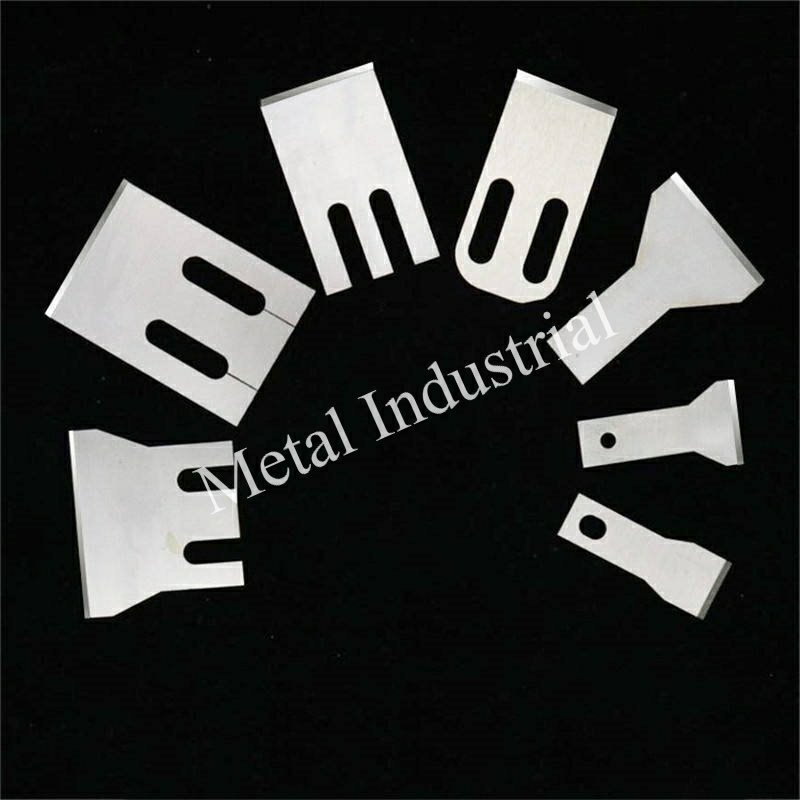
إجابة سريعة: في تحبيب البوليمرات الطبية، لا يمكن استبدال الفولاذ المقاوم للصدأ 420 و 440C ببعضهما البعض: يوفر الفولاذ 420 متانة أعلى، وإمكانية تلميع أفضل، وتحملاً أكبر للتآكل في دورات المياه كثيفة التعقيم أو ذات الكيمياء المتغيرة؛ بينما يوفر الفولاذ 440C احتفاظًا ممتازًا بحافة القطع للبوليمرات الكاشطة في دورات المياه ذات الكيمياء المستقرة والمضبوطة. يتطلب كلا الدرجتين إنهاء السطح بدرجة صقل المرآة Ra ≤ 0.4 µm وتحييداً محققاً (Passivation) وفقًا لـ ASTM A967 — تُعد هندسة السطح، وليس نوع السبيكة بمفرده، إجراء التحكم الرئيسي لمنع التلوث. غالبًا ما تكون النقاط السوداء في الحبيبات الطبية مشكلة نظامية: ناتجة عن حطام التآكل من دورة المياه وشظايا التآكل الميكانيكي من سكين غير مطابق للمواصفات يعملان معًا.
نادراً ما تكون النقاط السوداء في حبيبات البوليمر الطبية ناتجة عن مصدر واحد. غالباً ما يعزوها فرق الإنتاج إلى تحلل الراتنج أو بقايا تنظيف الماكينة (Purge residue)، ليكتشفوا بعد بحث منهجي أن المحرك الرئيسي هو حطام التآكل المتسرب من دورة المياه الدافئة وشظايا تآكل السكاكين الناتجة عن نظام قطع غير مطابق للمواصفات.
التطلب تفاوتات أبعاد دقيقة ومتطلبات صارمة للتحكم في التلوث — لا سيما في خطوط الإنتاج الطبية حيث تشكل النظافة البصرية التامة وانتظام الحبيبات شرطين أساسيين لا يقبلان المساومة. يُعد الاختيار الصحيح لدرجة الفولاذ المقاوم للصدأ، وتشطيب السطح، وبروتوكول إدارة دورة المياه الأساس الهندسي لضمان ذلك. بالنسبة للخطوط التي تعالج مركبّات كاشطة أو محشوة بألياف الزجاج حيث يسود التآكل الميكانيكي على التآكل الكيميائي، تختلف منطقية اختيار الدرجة؛ تغطي الإرشادات التفصيلية ذلك في "سكاكين التحبيب المصنوعة من مساحيق شفرات تحبيل البلاستيك من ميتالورجيا المساحيق M390 مقابل CPM S90V: اختيار الدرجة تحت ظروف التآكل العالي بألياف الزجاج covers that scenario in detail.
في برامج سكاكين التحبيب المخصصة من Maxtor Metal لخطوط إنتاج البوليمرات الطبية والتقنية، تعود التحقيقات في السبب الجذر لظهور النقاط السوداء (black specks) باستمرار إلى ثلاثة متغیرات يمكن التحكم فيها: التآكل في دورة المياه، والتشطيب السطحي غير الكافي للسكين، وعدم ملاءمة درجة الفولاذ — ويمكن معالجة كل منها من خلال التحديد الدقيق للمواصفات والانضباط في العمليات.
النقاط السوداء: المصادر والمخاطر
Differentiating Polymer vs Metallic Specks
Not all black specks share the same origin, and misidentifying the source wastes investigation time. A simple initial screen separates the two categories:
- Metallic specks are hard, gritty, and often magnetic. Under a stereomicroscope they show metallic luster or angular fracture surfaces. A rare-earth disc magnet drawn across a spread pellet sample will attract these particles.
- Polymer specks are soft, compressible, smear under fingernail pressure, and frequently show a carbonized or thermally degraded cross-section. They originate from dead zones in the extruder barrel, screen-pack bypass, or contact with overheated die surfaces.
Mixed contamination — where metallic debris seeds polymer carbonization — is common in long-run campaigns. Resolving it requires addressing both pathways simultaneously.
Warm-Water Loop Corrosion Pathways
The closed warm-water loop in an underwater pelletizing system is a persistent contamination source when poorly managed. A 2025 NIH technical bulletin on corrosion in closed-loop water systems identifies black magnetic iron oxide (magnetite) and mill-scale debris as the dominant black-speck contributors in recirculating systems. The mechanism is directly applicable to pelletizing loops.
The corrosion cycle follows a predictable path: oxygen ingress plus elevated chlorides triggers pitting on wetted metal surfaces, magnetite forms, particles migrate through the loop, and contamination reaches the die face and pellet stream. For loops operating outside controlled chemistry limits, this cycle accelerates until pellet color deviations become routine.
Impact on Compliance and OEE
ISO 13485 may be relevant when the polymer-processing operation is part of a medical-device organization’s controlled supply chain or QMS. It should not be treated as a universal production standard for all medical-grade polymer pelletizing lines. Where ISO 13485 controls apply, black-speck events should be handled through the site’s documented nonconformance, investigation, change-control, and CAPA procedures.
From an OEE perspective, uncontrolled black-speck events degrade all three components. Availability suffers as corrective purges, die changes, and system flushes consume production time. Performance drops when operators reduce throughput to control thermal history. Quality losses accumulate through quarantined or scrapped lots.
أهم النقاط الرئيسية: Metallic black specks from knife wear or loop corrosion are a compliance event on medical polymer lines — not a cosmetic issue. The investigation pathway and corrective action must be documented and closed within the quality system.
باختصار: black specks in medical polymer pellets are a system problem — corrosion debris from the water loop and wear fragments from a poorly specified knife typically act together, and addressing only one without the other rarely holds
أساسيات الصلب 420 مقابل 440C
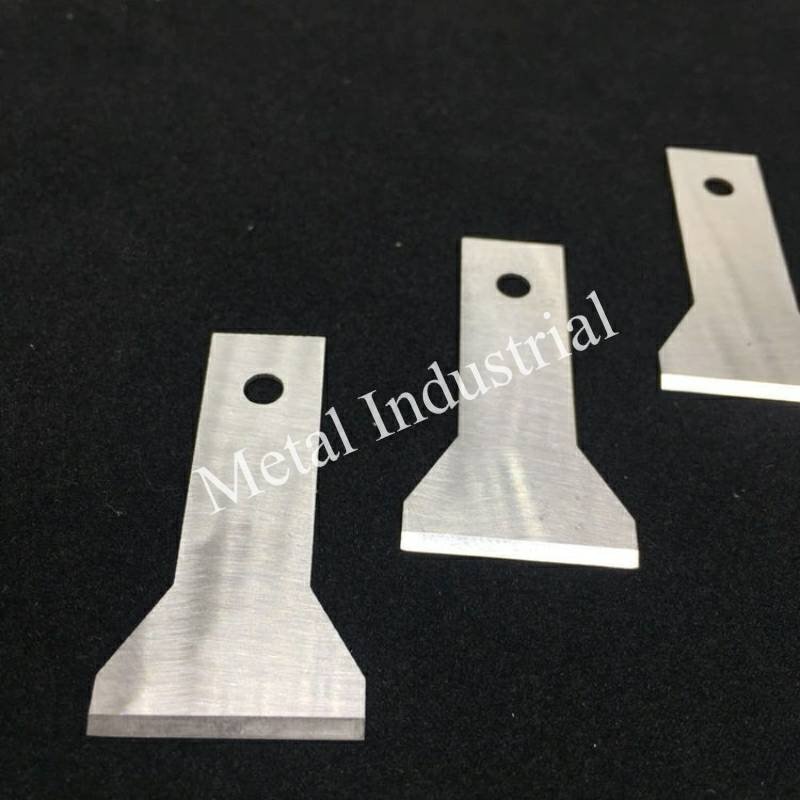
Composition, Hardness, Wear vs Corrosion
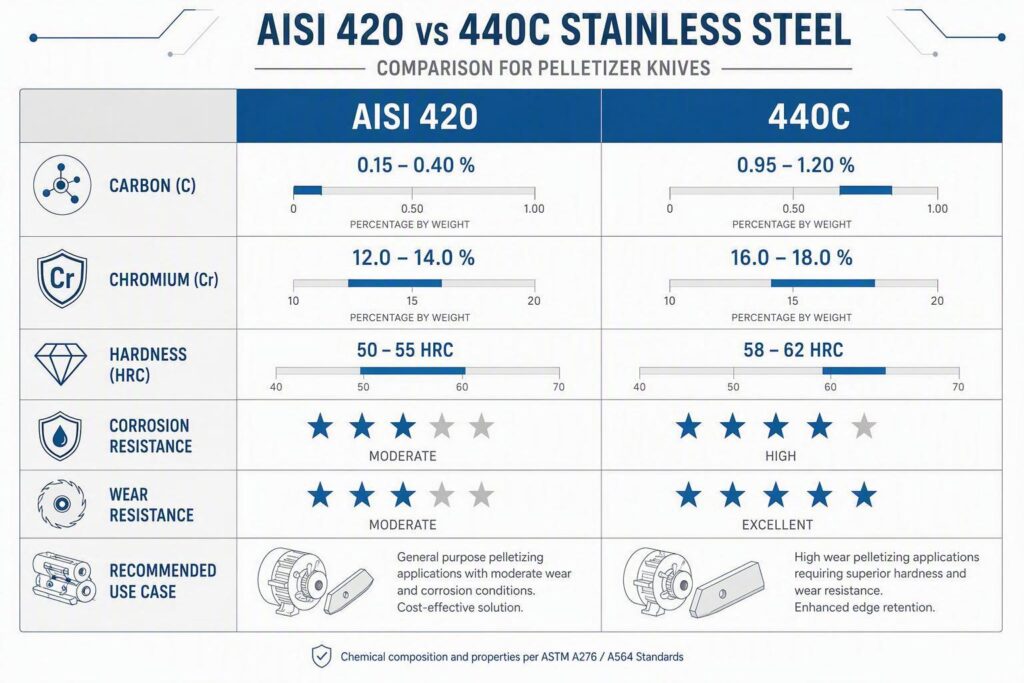
Both AISI 420 and 440C are martensitic stainless steels — heat-treatable, chromium-bearing grades capable of achieving the hardness needed for precision cutting-tool applications. Their differences are consequential for pelletizer knife selection.
| ملكية | AISI 420 | AISI 440C |
|---|---|---|
| الكربون (%) | 0.15 – 0.40 | 0.95 – 1.20 |
| الكروم (%) | 12 – 14 | 16 – 18 |
| Typical HRC (hardened) | 50 – 52 | 58 – 60 |
| مقاومة التآكل | معتدل | عالي |
| مقاومة التآكل | Good (high free Cr in solution) | Good (carbide formation reduces free Cr) |
| صلابة | أعلى | أدنى |
| Polishability | ممتاز | جيد |
440C’s high carbon content drives significantly more hard chromium carbides into the microstructure, which is the source of its wear advantage. Those carbides, however, reduce the chromium available in the matrix to sustain the passive oxide film — a trade-off reflected in Crucible Industries’ 440C material data, which specifies the grade for high wear resistance with only moderate corrosion resistance in mild environments. In corrosive or sanitization-intensive environments, this trade-off is material.
420 retains more free chromium in solution. Atlas Steels’ Grade 420 data sheet describes it as a hardenable 12% chromium grade offering good corrosion resistance in the hardened and polished condition — a state directly relevant to lines where weekly CIP cycles and warm-water contact are standard.
Selection by Risk Profile and Water Quality
The practical selection decision depends on three factors: polymer abrasivity, loop water quality, and the downstream consequence of contamination.
| Condition | Preferred Grade |
|---|---|
| Abrasive polymer (glass-filled, mineral-loaded compounds) | 440 درجة مئوية |
| Deionized loop water, chlorides consistently < 50 ppm | 440C acceptable |
| Municipally conditioned or fluctuating chloride water | 420 |
| Frequent caustic CIP cycles (pH > 9.5) | 420 |
| Maximum edge retention is the primary objective | 440 درجة مئوية |
| Maximum chip resistance and toughness required | 420 |
For a quick field orientation, the following decision matrix compresses polymer abrasivity, loop water quality, and contamination consequence into a single risk-based recommendation. It is a proprietary summary framework, not a substitute for the line-specific qualification trial described later in this article.
| Abrasivity | Loop Water Quality | Contamination Consequence | Recommended Grade |
|---|---|---|---|
| قليل | Controlled (chlorides < 50 ppm) | Critical | 420 with premium finish |
| قليل | Variable / elevated chlorides | Critical | 420 |
| عالي | Controlled | Critical | 440 درجة مئوية |
| عالي | عامل | Critical | 440C with enhanced loop control |
| عالي | Controlled | معتدل | 440 درجة مئوية |
| قليل | Controlled | معتدل | Either — finish drives outcome |
Neither grade is universally superior. The selection should be documented in the knife specification and formally linked to the water-quality SOP for the specific line.
Finish and Passivation Dominance
For black-speck control, surface condition often matters more than alloy choice. A properly polished and passivated 420 knife will outperform a poorly finished 440C knife in contamination-sensitive applications. Grade selection sets the performance ceiling; surface engineering determines where the knife actually operates within it.
باختصار: the 420 vs 440C decision comes down to which failure mode governs your line — choose 440C for edge retention under abrasive load in a stable loop, and 420 for corrosion tolerance and polishability when loop chemistry varies or sanitization intensity is high.
هندسة السطح للسكاكين الصناعية
Surface Roughness and Polish Targets
ال Australian Stainless Steel Development Association identifies Ra ≤ 0.5 µm as a critical surface roughness threshold for maintaining effective passive-film integrity on abraded stainless steel. For medical-grade pelletizer knives, apply the following zonal targets:
- Cutting edge and die-face contact zones: Ra ≤ 0.4 µm (≤ 0.2 µm preferred for highest cleanability)
- Side flanks and blade body: Ra ≤ 0.8 µm
- Bore and mounting surfaces: Ra ≤ 1.6 µm
These targets require CBN or diamond grinding followed by mechanical polishing. Electropolishing is optional but improves passive-film uniformity and eliminates the micro-crevice points that trap biomass or corrosion product on conventionally polished surfaces.
ASTM A967 Passivation and Verification
ASTM A967/A967M is the governing specification for chemical passivation of stainless steel parts. It covers both nitric acid and citric acid treatment protocols, with defined concentration, temperature, and immersion-time windows for each.
Passivation removes free iron contamination — grinding swarf, embedded tooling particles, iron-tool marks — that would otherwise become active corrosion sites in service. It does not alter surface roughness or repair mechanical defects. The specification requires the treated part to show no etching, pitting, or frosting on visual inspection after treatment.
Verification methods specified under ASTM A967 include the water immersion test, high-humidity exposure (48 h at 95–100% RH), salt spray per ASTM B117, copper sulfate test, and potassium ferricyanide–nitric acid test. For medical-grade knife supply, the potassium ferricyanide test or salt spray test should be the minimum acceptance criterion, with results documented on the material certificate.
Coating Choices and Flake Risk
Thin hard coatings (TiN, TiAlN, DLC) can extend knife life in abrasive polymers, but they carry a flake-risk burden in medical applications. The three coating families used on pelletizer knives differ sharply in what they deposit, how thick they sit, and what they demand of the substrate.
| طلاء | Typical thickness | Hardness / friction | Medical-grade suitability |
|---|---|---|---|
| PVD TiN / TiAlN | 1–4 µm | ~2,000–3,500 HV; COF 0.4–0.6 | Permitted with validated adhesion; hard and diffusion-bonded to substrate |
| DLC (a-C:H, ta-C) | 1–3 µm | 2,000–6,000 HV; COF 0.05–0.15 | Lower friction, but internal stress and flake sensitivity require interlayer control |
| PTFE (dry-film lubricant) | 5–25 µm | Soft; applied as a low-friction layer | Generally not preferred where the coating contacts the pellet stream — soft film sheds |
Two thickness effects matter for a medical pelletizer knife. First, PVD hard coatings at 1–4 µm usually need no dimensional compensation — a 2 µm film adds 2 µm per coated face, well inside the ±0.005 mm flatness and typical edge tolerances for precision pelletizer knives. Second, PTFE at 5–25 µm is thick enough to shift geometry: a fully coated diameter can grow 10–50 µm, which measurably alters edge relief, slot width, and knife-to-die contact unless the drawing carries an explicit coating allowance. For a knife specified to ±0.005 mm/100 mm flatness, that is not a rounding error — it is a design change.
Flake risk can be quantified rather than assumed. Adhesion is measured by scratch testing per ISO 20502, which defines progressive critical loads (Lc): Lc1 marks the first cohesive cracking, Lc2 the onset of adhesive chipping, and Lc3 the first spalling. Published TiN-on-stainless studies report Lc values around 20 N, 40 N, and 65 N for the successive failure stages, while well-adhered DLC duplex systems with chromium interlayers exceed 49–51 N at first critical load. A practical acceptance framework for medical tooling follows from those values:
| Adhesion criterion | Lc2 (adhesive chipping) | Rockwell HF class | Risk interpretation |
|---|---|---|---|
| Minimum acceptable | ≥ 30 N | HF 1–3 | Coating survives service loading; monitor at tool change |
| Robust industrial | ≥ 50 N | HF 1–2 | Low flake probability under cyclic thermal and mechanical load |
| Preferred for medical | ≥ 70 N | HF 1 | Negligible flake risk with controlled interlayer and roughness |
| Reject | < 20 N | HF 5–6 | Coating not industrially admissible; HF6 is a known fail class even for DLC |
A coating without a bonding interlayer regularly lands in the HF5–HF6 range and should not be deployed on a medical line. Substrate preparation is not optional: a chromium or Cr/CrC interlayer plus controlled pre-treatment is what moves DLC from a few newtons of critical load to the 70 N class. Require the coating supplier to report Lc2 values and the Rockwell HF class on the certificate, measured on the same substrate and heat treatment as the delivered knife, not on a generic test coupon.
⚠️ تحذير: In ISO 13485-regulated lines, any knife coating must be validated for flake-generation behavior under process conditions before deployment. An unvalidated coating change is a formal process change requiring documented risk assessment and change control.
For most medical-grade polyolefin, PET, and PEEK pelletizing applications, uncoated and well-passivated 420 or 440C is the lower-risk choice. Where a coating is justified by abrasive loading, specify a PVD TiN or TiAlN system at 2–4 µm with a documented Lc2 ≥ 50 N, and confirm the added thickness does not disturb the knife-to-die contact recorded during installation.
باختصار: surface finish and passivation are the primary contamination controls in medical polymer pelletizing — alloy grade sets the ceiling, but Ra ≤ 0.4 µm and verified ASTM A967 passivation are what keep metallic specks out of the product stream.
التحكم في دورة المياه الدافئة
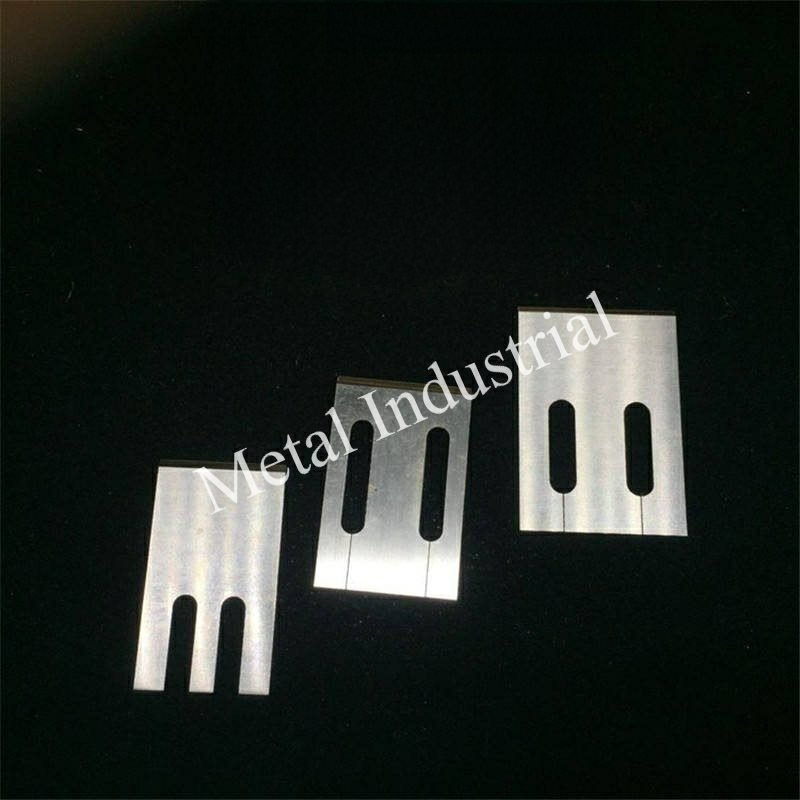
Water Chemistry and Numeric Targets
Applying NIH closed-loop water chemistry guidance and stainless steel corrosion control principles to a warm-water pelletizer system yields the following parameter framework. The water-loop disciplines here apply equally to TPU and EVA lines — for the intersection of loop control and knife coating selection in those materials, see التصاق المادة بسكاكين التحبيب تحت الماء لـ TPU: اختيار طلاء DLC مقابل PTFE ونوافذ التشغيل..
| المعلمة | Target Range | Action Limit |
|---|---|---|
| pH | 7.0 – 9.0 | < 6.5 or > 10.0: investigate makeup source |
| Chlorides | < 50 ppm | > 100 ppm: drain and recharge loop |
| Total iron | < 0.3 mg/L | > 1.0 mg/L: flush and identify corrosion source |
| Conductivity | 100 – 400 µS/cm | > 800 µS/cm: check makeup water and dosing |
| Suspended solids | < 5 mg/L | > 20 mg/L: increase filtration frequency |
The NIH technical bulletin targets pH 9.0–10.5 for carbon steel service. For a loop dominated by stainless steel contact surfaces, the lower setpoint range of 7.0–9.0 is defensible and reduces scaling risk while maintaining passive-film stability.
نصيحة احترافية: A rising chloride trend in a closed loop is almost always a signal of external ingress — makeup water contamination, resin leachables, or cleaning chemical carryover. Trend the data; do not treat chloride as a one-time acceptance check.
Filtration Architecture and Hydraulics
A two-stage filtration architecture is the practical minimum for medical-grade loops:
- Coarse strainer (100–200 µm mesh): Installed on the main circulation line upstream of the pump and die head. Captures flakes, scale, and large debris. Schedule cleaning against the differential pressure indicator, not a fixed calendar interval.
- Side-stream bag or cartridge filter (5–25 µm): Polishes approximately 5–10% of total loop flow continuously. Effective at capturing magnetite fines that pass the coarse strainer and would otherwise reach the die face.
Sanitation and Degassing Strategy
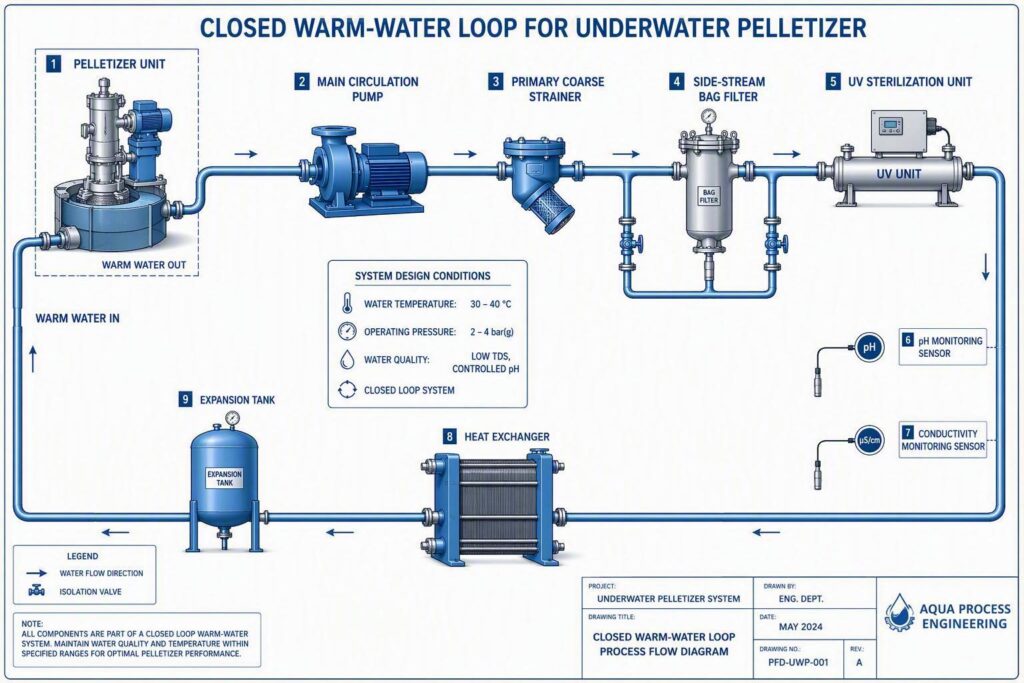
UV sterilization at 254 nm (minimum 30 mJ/cm² dose) on the main return line suppresses biofilm accumulation that concentrates corrosion products and increases under-deposit attack on wetted surfaces.
A membrane degasser or closed expansion tank with nitrogen blanket reduces dissolved oxygen to below 0.1 mg/L on critical lines. Dissolved oxygen is the primary accelerant of pitting corrosion in warm recirculating loops — reducing it is one of the highest-return engineering controls available.
Following any maintenance event involving pipe or component replacement, flush the system of debris and passivate new stainless surfaces before returning to production, consistent with NIH guidance on system startup after tie-ins.
باختصار: the warm-water loop is not a utility — it is a process variable, and without pH, conductivity, and filtration targets codified in a formal SOP linked to the knife specification, loop-sourced black specks will recur regardless of knife grade.
المواصفات وإجراءات التشغيل القياسية (SOPs)
Controlled A/B Trial: 420 vs 440C on a Medical-Grade PP Line
The selection logic above becomes concrete when it is tested under a controlled comparison. The following trial was run by Maxtor Metal’s engineering team on an anonymized medical polymer compounding line producing medical-grade PP pellets. The goal was not to declare a universally superior grade, but to quantify the difference in particle-quality stability and edge retention under identical process conditions.
Trial setup and controlled variables
| المعلمة | Control Requirement |
|---|---|
| Melt temperature | ±3 °C |
| Pelletizer speed | ±2% |
| درجة حرارة الماء | ±2 °C |
| Water flow | ±3% |
| معدل الإنتاج | ±2–3% |
| Die plate | Same plate for both runs |
| Polymer grade | Same grade (medical-grade PP, unfilled, 0% regrind) |
| Knife pressure | Held identical for A and B |
| غرض | Case A — 420 |
| صناعة | Medical polymer compounding |
| Filler / regrind | None / 0% |
| Line | Underwater pelletizer, ~2–3 t/h |
| الأدوات | AISI 420, approx. 52–55 HRC |
| تشطيب السطح | Polished, Ra ≤ 0.4 µm |
| Run period | Approx. 6–8 weeks |
| Cumulative output | Approx. 250–350 t |
Measurement sequence
- Incoming blade inspection — hardness, thickness, edge straightness, edge roughness, and visual inspection under magnification.
- Cutter installation — record cutter-head runout, blade protrusion, knife-to-die contact, and tightening torque.
- Start-up stabilization — the first 30–60 minutes of data are excluded from the A/B comparison, since start-up pellet quality does not represent steady-state production.
- Production sampling — every 4 hours: collect a 500–1,000 g pellet sample; sieve for fines; inspect 1,000 pellets for size and shape; count black specks per the specified sampling method.
- Blade condition — at each planned stop: microscope inspection of the edge, wear-land measurement, micro-chipping check, and cumulative tonnage logged.
Observed outcome (A vs B)
| مؤشرات الأداء الرئيسية | 420 (A) | 440C (B) | الاتجاه |
|---|---|---|---|
| Black specks | approx. 18–30 ppm | approx. 8–15 ppm | ↓ approx. 40–60% |
| الغرامات | approx. 0.30–0.50 wt% | approx. 0.18–0.30 wt% | ↓ approx. 30–40% |
| Off-size / irregular pellets | approx. 0.8–1.3% | approx. 0.4–0.8% | ↓ approx. 30–50% |
| Tool life to regrind | approx. 180–260 h | approx. 300–420 h | ↑ approx. 1.5–1.8× |
| Unplanned knife changes | approx. 3–4 per 6 weeks | approx. 1–2 per 6 weeks | ↓ approx. 40–60% |
| Production yield | approx. 98.5–99.1% | approx. 99.1–99.5% | + approx. 0.3–0.6 pp |
How the failure mode actually developed
The 420 blades were not “non-conforming” at the outset. For the first 2–3 weeks, pellet dimensions were normal, fines held around 0.3–0.4 wt%, and black specks stayed low. As cumulative output increased, a predictable drift appeared: the edge dulled slightly, cutting load rose, the die-face contact shifted toward a more abrasive wiping action, and trace polymer residue began to accumulate near the blade and die plate. Cleaning temporarily cleared the symptom, but it returned after further running.
The first corrective attempt was simply to raise knife pressure. Tails dropped briefly, but the black-speck issue persisted and edge wear accelerated. Only then was the grade changed from 420 to 440C while holding knife pressure, pelletizer speed, die plate, and polymer formulation constant.
أهم النقاط الرئيسية: During the controlled trial, black-spec occurrence decreased by approximately 40–60% after changing from hardened 420 to 440C blades. This is a trial result under the stated conditions — not a universal guarantee, since black-spec contamination in medical plastics can also originate from pellet conveying, dust, and material handling rather than the cutting tool alone.
For context, both grades are established martensitic stainless steels in the medical tooling family, and ASTM F899 lists 420 and 440C within the martensitic stainless system used for surgical instruments. That is why the comparison is a genuine qualification question rather than a manufactured contrast — and why the honest conclusion is conditional:
Engineering conclusion: The A/B trial indicated that 440C provided longer edge retention and lower particle-quality drift under the tested medical-grade PP conditions, while 420 remained a viable option where toughness, machining cost, and moderate wear requirements were prioritized.
Maxtor Metal’s own technical documentation lists 420/440C martensitic stainless with Ra ≤ 0.4 µm mirror finishing as a material system for medical-grade and food-packaging pelletizer applications. This is a brand-side engineering basis; it should not be presented as independent third-party validation.
باختصار: a knife specification that stops at alloy grade and hardness is incomplete — material traceability, surface finish, passivation verification, and a linked water-loop SOP are what make a pelletizer knife program auditable to ISO 13485 expectations.
Knife Spec Template (420/440C)
A formalized knife specification eliminates ambiguity in procurement and incoming inspection. The following framework reflects the precision-grinding capabilities and documentation practices — including EN 10204 MTC 3.1 certificates — that apply to custom pelletizer knife programs for technical and medical polymer lines. Maxtor Metal’s approach to custom knife manufacturing integrates material traceability, heat-treatment records, and verified surface finish from a single source.
| يصف | AISI 420 Specification | AISI 440C Specification |
|---|---|---|
| Base material | AISI 420 (UNS S42000) | AISI 440C (UNS S44004) |
| المعالجة الحرارية | Vacuum hardened + tempered; 50–52 HRC ±1 | Vacuum hardened + tempered; 58–60 HRC ±1 |
| Surface finish — cutting edge | Ra ≤ 0.4 µm | Ra ≤ 0.4 µm |
| Surface finish — blade body | Ra ≤ 0.8 µm | Ra ≤ 0.8 µm |
| Passivation standard | ASTM A967/A967M, citric or nitric acid method | ASTM A967/A967M, citric or nitric acid method |
| Passivation verification | Potassium ferricyanide test, pass | Potassium ferricyanide test, pass |
| Material certificate | EN 10204 MTC 3.1 | EN 10204 MTC 3.1 |
| Dimensional tolerance | Per drawing; flatness ≤ 0.005 mm/100 mm | Per drawing; flatness ≤ 0.005 mm/100 mm |
| طلاء | غير مطلي | غير مطلي |
For the component-level qualification framework that governs how these dimensional and hardness tolerances are verified at incoming inspection — covering runout/TIR acceptance, balance grade per ISO 21940, and QA dossier structure — see our دليل تأهيل كتلة السكاكين لمصانع تحبيب الكريات ذات الحلقة المائية.
For a full overview of knife formats and configurations available for underwater and die-face pelletizing systems, see Maxtor Metal’s industrial blades for plastic processing guide, which covers material options, dimensional standards, and application-matched configurations across pelletizer types.
Water-Loop Quality Specification
The water-loop SOP must be formally linked to the knife specification to create a coherent, auditable contamination-prevention program. Key document elements include: makeup water source and treatment with acceptance criteria; chemical inhibitor type, dose, and monitoring interval; filtration change schedule; analytical sampling plan (weekly pH and conductivity; monthly total iron and chlorides during normal operation; daily during startup or post-maintenance); alert and action limits as defined in the chemistry table above; loop flush and passivation procedure for post-maintenance restart; and records retention for a minimum of three years.
Maintenance, Inspection, and Records
For knife assemblies: inspect cutting edges and die-face contact surfaces at each tool change for chipping, pitting, and corrosion discoloration; record regrind cycles per knife set and replace at the minimum height specified in the OEM drawing; retain hardness test and passivation verification records for each incoming lot; log every observed black-speck event with date, lot number, retained pellet sample, and investigative findings.
التشخيص التعافي من الأعطال
Microscopy and Magnet Tests
When a black-speck event occurs, the initial classification requires no laboratory equipment. Spread a 200 g pellet sample on white paper and draw a rare-earth disc magnet across the surface at 5–10 mm standoff. Metallic specks migrate toward the magnet; polymer carbonization particles remain stationary.
For confirmation, mount five to ten particles from each category at 40–100× magnification. Metallic particles show angular fractures and bright metallic surfaces, with possible brown-black magnetite smear under oblique illumination. Polymer particles are amorphous, compressible, and show laminar carbonization layers when cross-sectioned with a razor.
Correlation with Water Metrics
Plot total iron and suspended solids values from the loop log against the production record for the same period. A sustained upward trend in loop iron typically correlates with metallic speck events that appear within 24–72 hours — the lag reflecting loop volume and filtration efficiency. When total iron exceeds 1.0 mg/L without a corresponding maintenance event, treat it as an active corrosion indicator and inspect wetted surfaces before the next production run.
Remediation and Verification Steps
- Drain and flush the warm-water loop with clean deionized water until effluent total iron is below 0.1 mg/L
- Inspect the knife set for edge chipping, pitting, and corrosion — replace if any corrosion pitting is visible on the die-face contact zone
- Verify passivation on replacement knives before installation (potassium ferricyanide or salt spray per ASTM A967)
- Restart the loop with a fresh inhibitor charge; verify pH, conductivity, and chloride are within specification before resuming production
- Run a 15-minute qualification lot: inspect pellets under 10× magnification and perform a magnet test before releasing. For die-face systems running WC–Co insert blocks, the parallel restart discipline — verifying contact pressure, insert condition, and braze integrity before resuming production — is covered in our guide on اختيار درجة حشوة كربيد التنجستن، واللحام، والتحكم في التلامس لمكربنات التكوير تحت الماء.
- Close the CAPA record with documented root cause, corrective action, and preventive action — including any spec or SOP revision triggered by the event
For lines where the black-speck or contamination event traces back to blade contact instability — specifically, hydrodynamic lift at operating speed overcoming the axial preload and opening a micro-gap at the die face — the force-balance diagnostic and gap measurement sequence is covered in our guide on dynamic blade float, preload mechanics, and the 0.03 mm contact threshold.
باختصار: when black specks recur after a knife or loop change, the magnet test and microscopy results together tell you whether the source is metallic or polymeric — treating the wrong source first is the most common recovery delay.
FAQ
س: ما هو الفرق الرئيسي بين الفولاذ المقاوم للصدأ 420 و 440C لسكاكين التحبيب؟
ج: يحتوي الفولاذ 420 على 0.15-0.40% كربون و 12-14% كروم، ويصل إلى صلابة 50-52 HRC مع مقاومة جيدة للتآكل ومتانة أعلى. بينما يحتوي 440C على 0.95-1.20% كربون و 16-18% كروم، ليحقق صلابة 58-60 HRC مع مقاومة فائقة للتآكل، ولكن بمتانة أقل ومقاومة أقل للصدأ بسب تشكل الكربيدات. اختر 440C للبوليمرات الكاشطة مع مياه دورة محكومة؛ واختر 420 للبيئات المسببة للتآكل أو التي تتطلب تعقيمًا مكثفًا.
س: لماذا تظهر النقاط السوداء المعدنية في حبيبات البوليمر المخصصة للاستخدام الطبي؟
ج: تنشأ النقاط السوداء المعدنية عادةً من ثلاثة مصادر: التكسر الدقيق (micro-chipping) لحافة السكين الناتج عن الكسر الهش أو أحمال الصدمات؛ ورواسب التآكل (الماجنيتيت، أكسيد الحديد) المنتقلة من دورة المياه الدافئة؛ أو التلوث بالحديد الحر على أسطح السكاكين غير المعالجة بالخمل (غير المخملة) بشكل كافٍ. وتعد اختبارات المغناطيس والمجهر الضوئي أداة التشخيص الأساسية للتمييز بين النقاط المعدنية والنقاط ذات الأصل البوليمري.
س: ما هي الخشونة السطحية (Ra) التي يجب أن تحققها سكاكين التحبيب المخصصة للاستخدام الطبي؟
ج: يجب أن تصل حافة القطع ومناطق التلامس مع قوالب التشكيل (die-face) إلى Ra ≤ 0.4 ميكرومتر. تحدد الجمعية الأسترالية لتطوير الفولاذ المقاوم للصدأ (ASSDA) أن Ra ≤ 0.5 ميكرومتر هي العتبة الحرجة لسلامة طبقة الخمول (passive-film) على الفولاذ المصقول — وتحت هذه القيمة، تحسن مقاومة التآكل بشكل ملحوظ. وتزيد اللمسات السطحية الأكثر خشونة من قابلية التآكل وانبعاث الجسيمات في تدفق الحبيبات.
س: ماذا تحقق معالجة الخمول (الخمولة) وفقًا للمعيار ASTM A967، وهل هي كافية لمنع ظهور النقاط السوداء (black specks)؟
ج: تعمل التخميل وفقًا لمعيار ASTM A967/A967M على إزالة الحديد الحر ورواسب التجليخ المدمجة والتلوث السطحي من الفولاذ المقاوم للصدأ، مما يستعيد طبقة أكسيد الكروم الخاملة. ولا تتسبب هذه المعالجة في تغيير الخشونة السطحية أو إصلاح العيوب الميكانيكية. يُعد التخميل أمرًا ضروريًا ولكنه غير كافٍ — إذ يجب صقل السكين للوصول إلى قيمة Ra المستهدفة قبل التخميل، كما يجب إدارة دورة المياه الدافئة بشكل مستقل.
س: ما هي تركيز الكلوريد الآمن في دورة المياه الدافئة لمحبب يعمل بسكاكين من الفولاذ المقاوم للصدأ؟
ج: يجب أن يظل تركيز الكلوريد أقل من 50 جزءًا في المليون (ppm) عند استخدام سكاكين من الفولاذ 420 أو 440C. تؤدي التركيزات التي تزيد عن 100 جزء في المليون إلى تسريع التآكل النُقَري (pitting corrosion) في كلا الدرجتين، وتنتقل رواسب التآكل الناتجة مباشرة إلى تدفق الحبيبات. توصي إرشادات NIH للتآكل في الدوائر المغلقة بمتابعة اتجاه تركيز الكلوريد كمؤشر عملية مستمر بدلاً من التعامل معه كمعيار قبول لمرة واحدة.
س: هل ينبغي استخدام طلاءات TiN أو DLC على سكاكين التحبيب المخصصة للاستخدام الطبي؟
ج: فقط بعد التحقق الكامل من سلوك تكسر وتشوف الطلاء (flake-generation) تحت ظروف العملية الفعلية. تزيد الطلاءات الصلبة الرقيقة من عمر السكين في التطبيقات الكاشطة، لكن انفصال الطلاء (delamination) يشكل خطر تلوث حقيقي على الخطوط الطبية. بموجب معيار ISO 13485، يُعد تقديم طلاء للسكين تغييرًا رسميًا في العملية يتطلب تقييمًا موثقًا للمخاطر والتحقق من صحته قبل الاستخدام في الإنتاج.
س: كم مرة يجب أخذ عينات من دورة المياه الدافئة ومعالجتها؟
ج: قم بأخذ عينات من الرقم الهيدروجيني (pH) والموصلية الكهربائية أسبوعيًا أثناء التشغيل العادي؛ وقم بقياس إجمالي الحديد والكلوريدات شهريًا. بعد أي عملية صيانة تتضمن استبدال الأنابيب أو المكونات، قم بإجراء غسيل كامل للدورة وإعادة ملئها قبل استئناف الإنتاج. إذا تجاوز إجمالي الحديد 1.0 ملغم/لتر دون وجود سبب متعلق بالصيانة الحديثة، فتعامل مع الأمر على أنه حدث تآكل نشط وقم بغسيل الدورة.
س: ما هي الوثائق التي يجب أن ترافق طلب سكاكين التحبيب المخصصة للاستخدام الطبي؟
ج: يجب أن تتضمن كل دفعة شهادة اختبار المواد EN 10204 MTC 3.1 مع تتبع الصهرة والتركيب الكيميائي، ونتائج اختبار الصلادة (HRC المقاسة على الأجزاء الموردة)، وشهادة قياس التشطيب السطحي، وسجل التحقق من الخمول/التبميل (فيروسيانيد البوتاسيوم أو رذاذ الملح وفقًا لـ ASTM A967). تدعم هذه السجلات متطلبات تأهيل الموردين والفحص الوارد بموجب معيار ISO 13485.
الخاتمة
بالنسبة لتحبيب البوليمرات المخصصة للاستخدام الطبي، يُعد الاختيار بين الفولاذ 420 و440C قرارًا هندسيًا قائمًا على تقييم المخاطر وليس إجابة واحدة مطلقة. يوفر الفولاذ 440C احتفاظًا متفوقًا بحافة القطع للبوليمرات الكاشطة في بيئات مياه الدورة المحكومة. بينما يوفر الفولاذ 420 متانة أفضل، وقابلية أصلح للتلميع، وتحملاً أعلى للتآكل حيثما تكون شدة التعقيم أو تباين جودة المياه أعلى.
في كلا الحالتين، يُعد التشطيب السطحي عند Ra ≤ 0.4 µm على حافة القطع والتحقق من الخمول/التبميل وفقًا لـ ASTM A967/A967M هما ضوابط منع التلوث الأساسية — وليس درجة السبائك بمفردها. إن إجراء التشغيل القياسي (SOP) الموثق لدورة المياه الدافئة، والذي يتضمن أهدافًا كيميائية، وترشيحًا على مرحلتين، وتعقيمًا بالأشعة فوق البنفسجية، وإزالة الغازات، يغلق مسار التآكل الذي يولد البقع السوداء المعدنية. وبالاقتران مع مواصفات السكاكين المرتبطة بتوثيق EN 10204 MTC 3.1، تنشئ هذه الضوابط برنامجًا قابلًا للتدقيق ومتوافقًا تمامًا مع توقعات ISO 13485.
إن خارطة طريق التنفيذ واضحة ومباشرة: تحديد مواصفات السكين بشكل صحيح لتناسب المزيج المكون من البوليمر وكيمياء المياه، والتحقق من التشطيب السطحي والخمول/التبميل عند الفحص الوارد، وإرساء إجراء التشغيل القياسي (SOP) لكيمياء الدورة وخطة المراقبة التحليلية، وإغلاق الدائرة — حرفيًا وإجرائيًا — بين أداء السكين وبيانات جودة المياه.
For precision-ground plastic pelletizer blades and pelletizing knives manufactured to the tolerances described above, contact the Maxtor Metal engineering team with your machine drawing and polymer program requirements.
المعايير والمراجع
The specifications and controls in this article are drawn from the following standards and sources. Readers qualifying a specific line should consult the current revision of each document.
Metallurgy and material data
- AISI 420 (UNS S42000) and AISI 440C (UNS S44004) grade data — Atlas Steels Grade 420 data sheet; Crucible Industries 440C material data.
- ASTM F899 — Standard Specification for Wrought Stainless Steels for Surgical Instruments.
- ASTM A276 / A314 — Standard specifications for stainless steel bars and billets (440C and 420 forms).
- ASM Handbook, Vol. 16 — Machining (tool material selection context).
Surface finish and passivation
- ASSDA (Australian Stainless Steel Development Association) — pickling and passivation of stainless steel; Ra ≤ 0.5 µm passive-film threshold.
- ASTM A967/A967M — Standard Specification for Chemical Passivation Treatments for Stainless Steel Parts.
- ASTM B117 — Standard Practice for Operating Salt Spray (Fog) Apparatus.
Coating adhesion
- ISO 20502 — Fine ceramics (advanced ceramics, advanced technical ceramics) — Determination of adhesion of ceramic coatings by scratch testing.
- Published TiN-on-stainless and DLC duplex scratch-test critical-load studies (Lc1/Lc2/Lc3 data).
Water-loop corrosion and control
- NIH Technical Bulletin (2025) — Corrosion in Closed Loop Water Systems, Part 2: Evaluation and Prevention.
- ISO 13485:2016 — Medical devices — Quality management systems.
- FDA 21 CFR 211.67(a) — Equipment cleaning and maintenance.
Brand engineering basis
- Maxtor Metal technical documentation — 420/440C martensitic stainless with Ra ≤ 0.4 µm mirror finishing as a material system for medical-grade and food-packaging pelletizer applications. Note: brand-side engineering basis, not independent third-party validation.
حول المؤلف
نانسي وو is a Senior Manufacturing Engineer in Production Engineering at Maxtor Metal, with 12 years of experience in industrial cutting-blade manufacturing. She specializes in the machining and material behavior of common industrial blade steels — including SKD11, 420, 440C, D2, M2, H13, powder metallurgy steels, and cemented carbide — covering their processing characteristics, material properties, and coating behavior, alongside high-precision CNC grinding programming. She holds SME CMfgE, PMP, Six Sigma Black Belt, and ASM International certifications.

 English
 Spanish
 Italian
 French
 Portuguese
 Russian
 German
 Arabic
 Hindi
 Vietnamese
 Indonesian
 Japanese
 Korean