

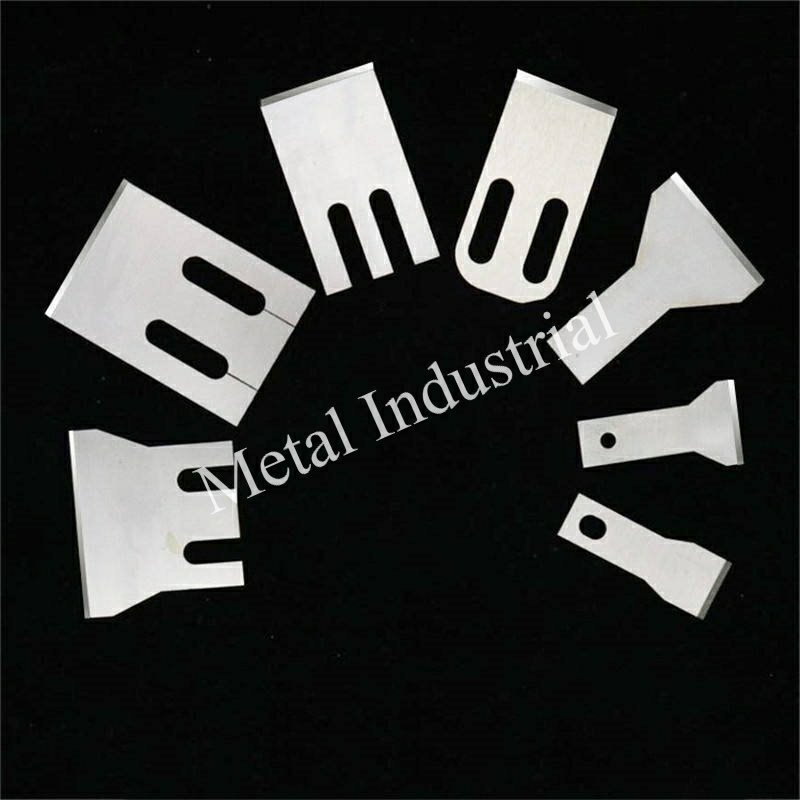
Trả lời nhanh: Trong quy trình cắt hạt nhựa polymer ngành y tế, thép không gỉ 420 và 440C không thể thay thế cho nhau: 420 mang lại độ dẻo dai cao hơn, khả năng đánh bóng tốt hơn এবং chịu ăn mòn tốt hơn trong vòng tuần hoàn nước khử trùng cường độ cao hoặc hóa tính biến đổi; 440C mang lại khả năng giữ cạnh sắc bén vượt trội cho các polymer có độ mài mòn cao trong vòng nước ổn định kiểm soát hóa tính. Cả hai mác thép đều yêu cầu độ bóng gương Ra ≤ 0,4 µm và chứng nhận thụ động hóa (passivation) theo ASTM A967 — kỹ thuật xử lý bề mặt, chứ không chỉ riêng mác hợp kim, mới là biện pháp kiểm soát chống nhiễm bẩn cốt lõi. Vết đốm đen (black specks) trong hạt nhựa y tế thường là sự cố mang tính hệ thống: cặn ăn mòn từ vòng nước combined với các mảnh vụن mài mòn từ lưỡi dao không đạt tiêu chuẩn kỹ thuật.
Vết đốm đen (black specks) trong hạt nhựa polymer ngành y tế hiếm khi chỉ do một nguyên nhân duy nhất. Các đội ngũ sản xuất thường đổ lỗi cho sự phân hủy nhựa hoặc cặn xả vệ sinh (purge residue) — để rồi sau khi điều tra bài bản mới phát hiện ra rằng, nguyên nhân cốt lõi chính là cặn ăn mòn di chuyển từ vòng nước ấm và các mảnh vụn mài mòn lưỡi dao sinh ra do hệ thống cắt không đạt tiêu chuẩn kỹ thuật.
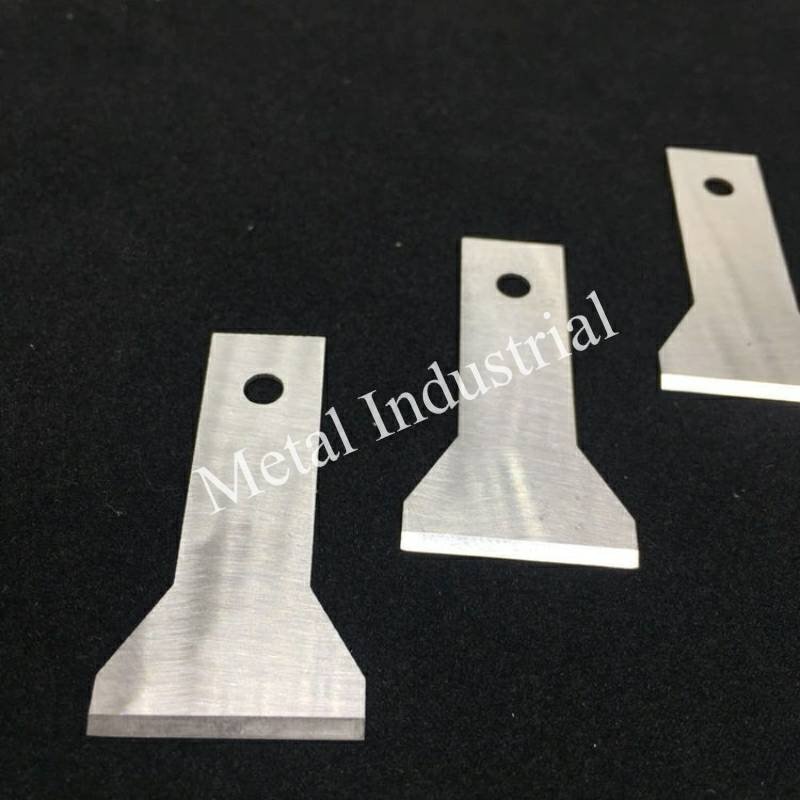
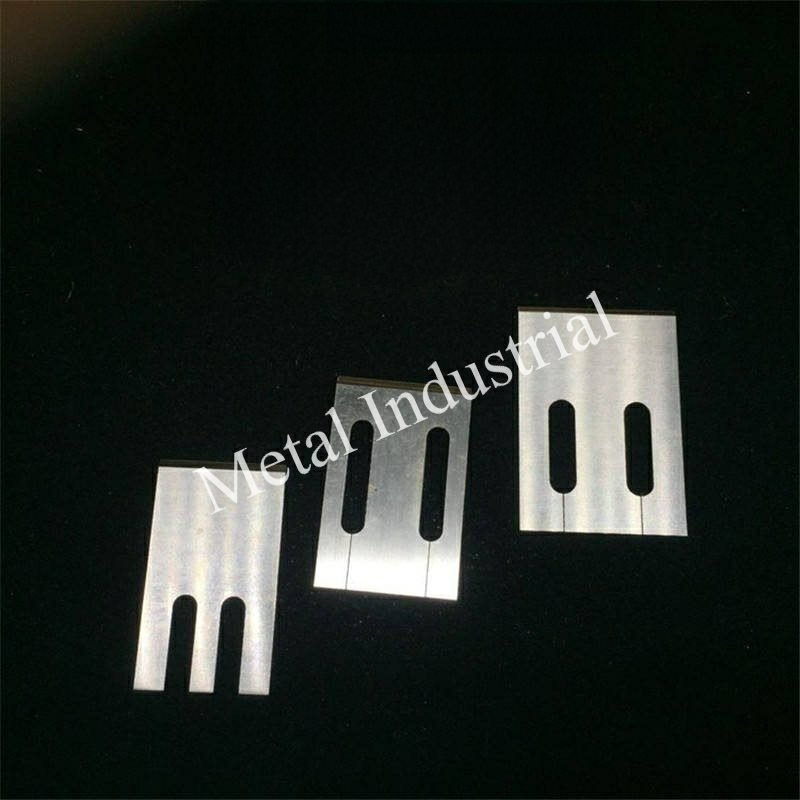
Lưỡi dao cắt hạt nhựa (pelletizer blades) cho các ứng dụng polymer yêu cầu khắt khe phải đáp ứng dung sai kích thước chặt chẽ và các yêu cầu kiểm soát nhiễm bẩn nghiêm ngặt — đặc biệt trên các dây chuyền cấp y tế, nơi không thể đánh đổi tiêu chuẩn không nhiễm bẩn cảm quan và độ đồng đều của hạt nhựa. Việc lựa chọn đúng mác thép không gỉ, độ bóng bề mặt và quy trình quản lý vòng nước là nền tảng kỹ thuật đảm bảo điều đó. Đối với các dây chuyền chạy hợp chất mài mòn hoặc nhựa gia cường sợi thủy tinh, nơi độ mài mòn chiếm ưu thế so với ăn mòn hóa học, logic chọn mác thép sẽ khác; Dao cắt hạt nhựa bột kim loại M390 vs CPM S90V: Lựa chọn mác thép trong điều kiện mài mòn cao bởi sợi thủy tinh đề cập chi tiết đến kịch bản đó.
Trong các chương trình dao cắt hạt nhựa (pelletizer knives) tùy chỉnh của Maxtor Metal dành cho các dây chuyền polymer kỹ thuật và y tế, các điều tra nguyên nhân gốc rễ gây ra đốm đen (black specks) luôn dẫn về ba biến số có thể kiểm soát: sự ăn mòn vòng nước, độ bóng bề mặt dao chưa đạt e-kíp এবং sự không tương thích mác thép — mỗi yếu tố đều có thể giải quyết thông qua việc chuẩn hóa quy cách và kỷ luật quy trình.
Vết đốm đen (Black Specks): Nguồn gốc và Rủi ro
Phân biệt đốm tạp chất Polymer và đốm Kim loại
Không phải tất cả các đốm đen đều có cùng nguồn gốc, và việc xác định sai nguồn gốc sẽ làm lãng phí thời gian điều tra. Phương pháp sàng lọc ban đầu đơn giản sẽ giúp phân loại hai nhóm này:
- Đốm kim loại thường cứng, sần sùi và thường có tính từ. Dưới kính hiển vi soi nổi, chúng thể hiện ánh kim hoặc bề mặt gãy góc cạnh. Rà một nam châm đĩa đất hiếm qua mẫu hạt nhựa trải rộng sẽ hút các hạt này.
- Đốm polymer thường mềm, dễ nén, bị dính bệt dưới áp lực móng tay và thường cho thấy mặt cắt ngang bị cacbon hóa hoặc thoái hóa nhiệt. Chúng bắt nguồn từ các vùng chết trong nòng máy đùn, hiện tượng lọt lưới lọc (screen-pack bypass), hoặc do tiếp xúc với bề mặt khuôn đùn bị quá nhiệt.
Tạp chất hỗn hợp — nơi các mảnh vụn kim loại kích hoạt quá trình cacbon hóa polymer — rất phổ biến trong các đợt sản xuất kéo dài. Để giải quyết, cần xử lý đồng thời cả hai nguyên nhân.
Các đường truyền ăn mòn trong vòng tuần hoàn nước ấm
Vòng tuần hoàn nước ấm kín trong hệ thống cắt hạt dưới nước là nguồn gây ô nhiễm dai dẳng nếu quản lý kém. Bản tin kỹ thuật NIH năm 2025 về sự ăn mòn trong hệ thống nước vòng kín xác định oxit sắt từ màu đen (magnetite) và vảy cán kim loại là các tác nhân chính gây ra đốm đen trong hệ thống tuần hoàn. Cơ chế này áp dụng trực tiếp cho các vòng tuần hoàn cắt hạt.
Chu trình ăn mòn diễn ra theo một quy luật có thể dự đoán: sự xâm nhập của oxy kết hợp với nồng độ chloride cao kích hoạt sự ăn mòn rỗ trên các bề mặt kim loại tiếp xúc với nước, tạo thành magnetite, các hạt di chuyển qua vòng tuần hoàn, và tạp chất đi đến mặt khuôn đùn cùng dòng hạt nhựa. Đối với các vòng tuần hoàn hoạt động ngoài giới hạn hóa chất được kiểm soát, chu trình này sẽ tăng tốc cho đến khi sự lệch màu của hạt nhựa trở thành sự cố thường xuyên.
Tác động đến sự tuân thủ quy chuẩn và OEE
ISO 13485 có thể áp dụng khi công đoạn chế biến polymer là một phần của chuỗi cung ứng hoặc QMS được kiểm soát của nhà sản xuất thiết bị y tế. Không nên coi đây là tiêu chuẩn sản xuất chung cho tất cả các dây chuyền cắt hạt polymer dùng trong y tế. Tại những nơi áp dụng các quy định kiểm soát của ISO 13485, các sự cố đốm đen phải được xử lý thông qua các quy trình xử lý sự cố không phù hợp, điều tra, kiểm soát thay đổi và CAPA đã được lưu hồ sơ của nhà máy.
Dưới góc độ OEE, các sự cố đốm đen không được kiểm soát sẽ làm suy giảm cả ba yếu tố cấu thành. Mức độ sẵn sàng (Availability) bị ảnh hưởng do công đoạn xả máy khắc phục, thay khuôn đùn và súc rửa hệ thống làm tiêu tốn thời gian sản xuất. Hiệu suất (Performance) giảm khi công nhân vận hành phải giảm sản lượng để kiểm soát lịch sử nhiệt. Tổn thất chất lượng (Quality) tích tụ qua các lô hàng bị cách ly hoặc loại bỏ.
Điểm chính: Đốm đen kim loại từ sự mài mòn dao cắt hoặc ăn mòn vòng tuần hoàn là sự cố vi phạm tuân thủ trên các dây chuyền polymer y tế — chứ không đơn thuần là vấn đề thẩm mỹ. Quy trình điều tra và hành động khắc phục phải được ghi chép vào hồ sơ và hoàn tất trong hệ thống quản lý chất lượng.
Nói tóm lại: đốm đen trong hạt polymer dùng cho y tế là sự cố mang tính hệ thống — mảnh vụn ăn mòn từ vòng tuần hoàn nước và mảnh mài mòn từ dao cắt chọn sai quy cách thường tác động cùng nhau, và việc chỉ xử lý một trong hai nguyên nhân hiếm khi mang lại hiệu quả lâu dài
Những yếu tố cốt lõi: Thép 420 vs 440C
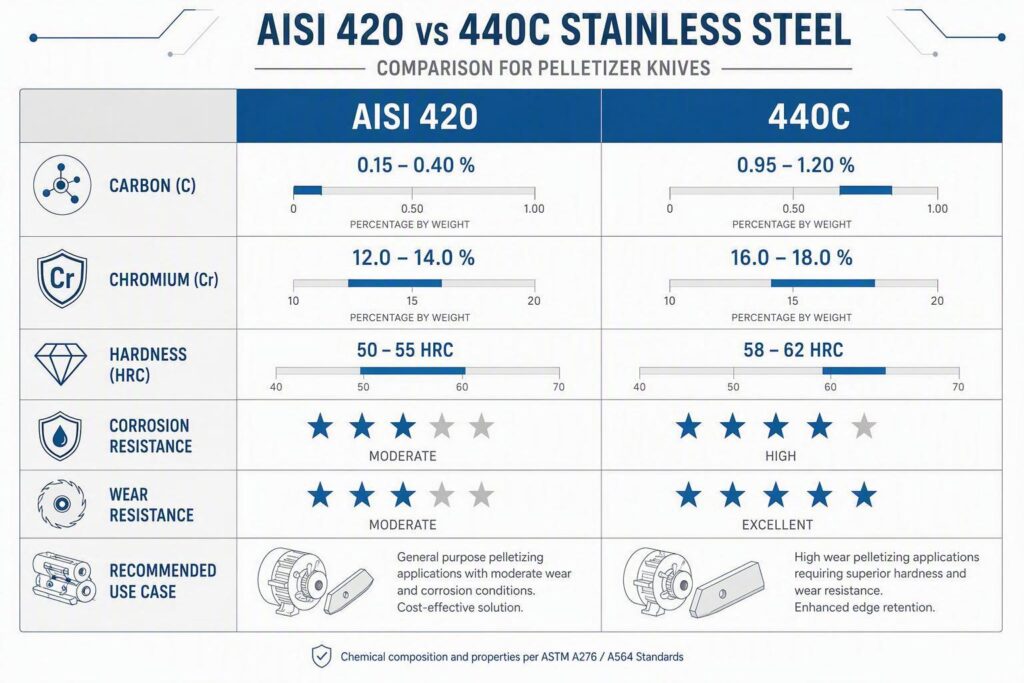
Thành phần, Độ cứng, Khả năng chống mài mòn vs Chống ăn mòn
Cả AISI 420 và 440C đều là thép không gỉ martensite — các mác thép chứa crom có thể nhiệt luyện, có khả năng đạt độ cứng cần thiết cho các ứng dụng dụng cụ cắt gọt chính xác. Sự khác biệt giữa chúng có ảnh hưởng quyết định đến việc lựa chọn dao cắt hạt nhựa.
| Tài sản | AISI 420 | AISI 440C |
|---|---|---|
| Cacbon (%) | 0.15 – 0.40 | 0.95 – 1.20 |
| Crom (%) | 12 – 14 | 16 – 18 |
| Độ cứng HRC điển hình (sau khi tôi) | 50 – 52 | 58 – 60 |
| Khả năng chống mài mòn | Vừa phải | Cao |
| Khả năng chống ăn mòn | Tốt (hàm lượng Cr tự do cao trong dung dịch) | Tốt (sự hình thành carbide làm giảm Cr tự do) |
| độ dẻo dai | Cao hơn | Thấp hơn |
| Khả năng đánh bóng | Xuất sắc | Tốt |
Hàm lượng carbon cao trong 440C tạo ra nhiều carbide crom cứng hơn đáng kể trong vi cấu trúc, đây là nguồn gốc tạo nên ưu thế về khả năng chống mài mòn của nó. Tuy nhiên, các carbide này lại làm giảm lượng crom có sẵn trong nền kim loại để duy trì màng oxide thụ động — một sự đánh đổi được thể hiện trong dữ liệu vật liệu 440C của Crucible Industries, trong đó chỉ định mác thép này có khả năng chống mài mòn cao nhưng chỉ có khả năng chống ăn mòn vừa phải trong môi trường nhẹ. Trong môi trường ăn mòn hoặc yêu cầu tiệt trùng cao, sự đánh đổi này là rất đáng kể.
420 giữ lại nhiều crom tự do hơn trong dung dịch. Bảng dữ liệu kỹ thuật mác 420 của Atlas Steels mô tả đây là mác thép chứa 12% crom có thể tôi cứng, mang lại khả năng chống ăn mòn tốt ở trạng thái đã tôi cứng và đánh bóng — một trạng thái liên quan trực tiếp đến các dây chuyền có chu kỳ vệ sinh CIP hàng tuần và tiếp xúc với nước ấm là tiêu chuẩn.
Lựa chọn theo đặc tính rủi ro và chất lượng nước
Quyết định lựa chọn thực tế phụ thuộc vào ba yếu tố: độ mài mòn của polymer, chất lượng nước trong vòng tuần hoàn, và hậu quả ô nhiễm ở công đoạn hạ nguồn.
| Tình trạng | Mác thép ưu tiên |
|---|---|
| Polymer có tính mài mòn (hợp chất gia cường sợi thủy tinh, độn khoáng) | 440°C |
| Nước vòng tuần hoàn khử ion, nồng độ chloride luôn < 50 ppm | 440C chấp nhận được |
| Nước cấp sinh hoạt đã xử lý hoặc có nồng độ chloride biến động | 420 |
| Chu kỳ CIP kiềm tần suất cao (pH > 9.5) | 420 |
| Khả năng giữ độ sắc bén tối đa là mục tiêu chính | 440°C |
| Yêu cầu khả năng chống sứt mẻ và độ bền dẻo tối đa | 420 |
Để nhanh chóng định hướng thực địa, ma trận quyết định sau đây tóm tắt độ mài mòn của polymer, chất lượng nước tuần hoàn và hậu quả ô nhiễm thành một khuyến nghị dựa trên rủi ro. Đây là khuôn khổ tóm tắt độc quyền, không thay thế cho thử nghiệm đánh giá theo từng dây chuyền cụ thể được mô tả ở phần sau của bài viết này.
| Độ mài mòn | Chất lượng nước vòng tuần hoàn | Hậu quả nhiễm bẩn | Mác vật liệu đề xuất |
|---|---|---|---|
| Thấp | Đã kiểm soát (clorua < 50 ppm) | Nghiêm trọng | 420 with premium finish |
| Thấp | Variable / elevated chlorides | Nghiêm trọng | 420 |
| Cao | Controlled | Nghiêm trọng | 440°C |
| Cao | Biến | Nghiêm trọng | 440C with enhanced loop control |
| Cao | Controlled | Vừa phải | 440°C |
| Thấp | Controlled | Vừa phải | Either — finish drives outcome |
Neither grade is universally superior. The selection should be documented in the knife specification and formally linked to the water-quality SOP for the specific line.
Finish and Passivation Dominance
For black-speck control, surface condition often matters more than alloy choice. A properly polished and passivated 420 knife will outperform a poorly finished 440C knife in contamination-sensitive applications. Grade selection sets the performance ceiling; surface engineering determines where the knife actually operates within it.
Nói tóm lại: the 420 vs 440C decision comes down to which failure mode governs your line — choose 440C for edge retention under abrasive load in a stable loop, and 420 for corrosion tolerance and polishability when loop chemistry varies or sanitization intensity is high.
Kỹ thuật xử lý bề mặt cho Dao cắt
Surface Roughness and Polish Targets
Các Australian Stainless Steel Development Association identifies Ra ≤ 0.5 µm as a critical surface roughness threshold for maintaining effective passive-film integrity on abraded stainless steel. For medical-grade pelletizer knives, apply the following zonal targets:
- Cutting edge and die-face contact zones: Ra ≤ 0.4 µm (≤ 0.2 µm preferred for highest cleanability)
- Side flanks and blade body: Ra ≤ 0.8 µm
- Bore and mounting surfaces: Ra ≤ 1.6 µm
These targets require CBN or diamond grinding followed by mechanical polishing. Electropolishing is optional but improves passive-film uniformity and eliminates the micro-crevice points that trap biomass or corrosion product on conventionally polished surfaces.
ASTM A967 Passivation and Verification
ASTM A967/A967M is the governing specification for chemical passivation of stainless steel parts. It covers both nitric acid and citric acid treatment protocols, with defined concentration, temperature, and immersion-time windows for each.
Passivation removes free iron contamination — grinding swarf, embedded tooling particles, iron-tool marks — that would otherwise become active corrosion sites in service. It does not alter surface roughness or repair mechanical defects. The specification requires the treated part to show no etching, pitting, or frosting on visual inspection after treatment.
Verification methods specified under ASTM A967 include the water immersion test, high-humidity exposure (48 h at 95–100% RH), salt spray per ASTM B117, copper sulfate test, and potassium ferricyanide–nitric acid test. For medical-grade knife supply, the potassium ferricyanide test or salt spray test should be the minimum acceptance criterion, with results documented on the material certificate.
Coating Choices and Flake Risk
Thin hard coatings (TiN, TiAlN, DLC) can extend knife life in abrasive polymers, but they carry a flake-risk burden in medical applications. The three coating families used on pelletizer knives differ sharply in what they deposit, how thick they sit, and what they demand of the substrate.
| Lớp phủ | Typical thickness | Hardness / friction | Medical-grade suitability |
|---|---|---|---|
| PVD TiN / TiAlN | 1–4 µm | ~2,000–3,500 HV; COF 0.4–0.6 | Permitted with validated adhesion; hard and diffusion-bonded to substrate |
| DLC (a-C:H, ta-C) | 1–3 µm | 2,000–6,000 HV; COF 0.05–0.15 | Lower friction, but internal stress and flake sensitivity require interlayer control |
| PTFE (dry-film lubricant) | 5–25 µm | Soft; applied as a low-friction layer | Generally not preferred where the coating contacts the pellet stream — soft film sheds |
Two thickness effects matter for a medical pelletizer knife. First, PVD hard coatings at 1–4 µm usually need no dimensional compensation — a 2 µm film adds 2 µm per coated face, well inside the ±0.005 mm flatness and typical edge tolerances for precision pelletizer knives. Second, PTFE at 5–25 µm is thick enough to shift geometry: a fully coated diameter can grow 10–50 µm, which measurably alters edge relief, slot width, and knife-to-die contact unless the drawing carries an explicit coating allowance. For a knife specified to ±0.005 mm/100 mm flatness, that is not a rounding error — it is a design change.
Flake risk can be quantified rather than assumed. Adhesion is measured by scratch testing per ISO 20502, which defines progressive critical loads (Lc): Lc1 marks the first cohesive cracking, Lc2 the onset of adhesive chipping, and Lc3 the first spalling. Published TiN-on-stainless studies report Lc values around 20 N, 40 N, and 65 N for the successive failure stages, while well-adhered DLC duplex systems with chromium interlayers exceed 49–51 N at first critical load. A practical acceptance framework for medical tooling follows from those values:
| Adhesion criterion | Lc2 (adhesive chipping) | Rockwell HF class | Risk interpretation |
|---|---|---|---|
| Minimum acceptable | ≥ 30 N | HF 1–3 | Coating survives service loading; monitor at tool change |
| Robust industrial | ≥ 50 N | HF 1–2 | Low flake probability under cyclic thermal and mechanical load |
| Preferred for medical | ≥ 70 N | HF 1 | Negligible flake risk with controlled interlayer and roughness |
| Reject | < 20 N | HF 5–6 | Coating not industrially admissible; HF6 is a known fail class even for DLC |
A coating without a bonding interlayer regularly lands in the HF5–HF6 range and should not be deployed on a medical line. Substrate preparation is not optional: a chromium or Cr/CrC interlayer plus controlled pre-treatment is what moves DLC from a few newtons of critical load to the 70 N class. Require the coating supplier to report Lc2 values and the Rockwell HF class on the certificate, measured on the same substrate and heat treatment as the delivered knife, not on a generic test coupon.
⚠️ Cảnh báo: In ISO 13485-regulated lines, any knife coating must be validated for flake-generation behavior under process conditions before deployment. An unvalidated coating change is a formal process change requiring documented risk assessment and change control.
For most medical-grade polyolefin, PET, and PEEK pelletizing applications, uncoated and well-passivated 420 or 440C is the lower-risk choice. Where a coating is justified by abrasive loading, specify a PVD TiN or TiAlN system at 2–4 µm with a documented Lc2 ≥ 50 N, and confirm the added thickness does not disturb the knife-to-die contact recorded during installation.
Nói tóm lại: surface finish and passivation are the primary contamination controls in medical polymer pelletizing — alloy grade sets the ceiling, but Ra ≤ 0.4 µm and verified ASTM A967 passivation are what keep metallic specks out of the product stream.
Kiểm soát vòng tuần hoàn nước ấm
Water Chemistry and Numeric Targets
Applying NIH closed-loop water chemistry guidance and stainless steel corrosion control principles to a warm-water pelletizer system yields the following parameter framework. The water-loop disciplines here apply equally to TPU and EVA lines — for the intersection of loop control and knife coating selection in those materials, see Hiện tượng bám dính dao cắt hạt dưới nước TPU: Lựa chọn lớp phủ DLC vs PTFE và khoảng thông số vận hành..
| Tham số | Target Range | Action Limit |
|---|---|---|
| pH | 7.0 – 9.0 | < 6.5 or > 10.0: investigate makeup source |
| Chlorides | < 50 ppm | > 100 ppm: drain and recharge loop |
| Total iron | < 0.3 mg/L | > 1.0 mg/L: flush and identify corrosion source |
| Conductivity | 100 – 400 µS/cm | > 800 µS/cm: check makeup water and dosing |
| Suspended solids | < 5 mg/L | > 20 mg/L: increase filtration frequency |
The NIH technical bulletin targets pH 9.0–10.5 for carbon steel service. For a loop dominated by stainless steel contact surfaces, the lower setpoint range of 7.0–9.0 is defensible and reduces scaling risk while maintaining passive-film stability.
Mẹo chuyên nghiệp: A rising chloride trend in a closed loop is almost always a signal of external ingress — makeup water contamination, resin leachables, or cleaning chemical carryover. Trend the data; do not treat chloride as a one-time acceptance check.
Filtration Architecture and Hydraulics
A two-stage filtration architecture is the practical minimum for medical-grade loops:
- Coarse strainer (100–200 µm mesh): Installed on the main circulation line upstream of the pump and die head. Captures flakes, scale, and large debris. Schedule cleaning against the differential pressure indicator, not a fixed calendar interval.
- Side-stream bag or cartridge filter (5–25 µm): Polishes approximately 5–10% of total loop flow continuously. Effective at capturing magnetite fines that pass the coarse strainer and would otherwise reach the die face.
Sanitation and Degassing Strategy
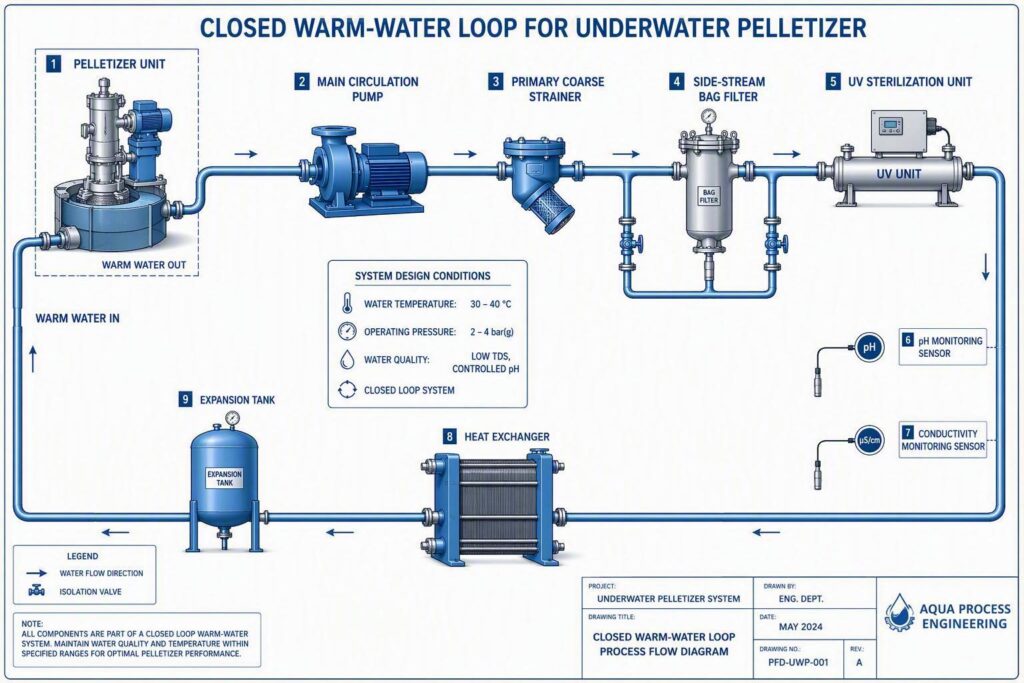
UV sterilization at 254 nm (minimum 30 mJ/cm² dose) on the main return line suppresses biofilm accumulation that concentrates corrosion products and increases under-deposit attack on wetted surfaces.
A membrane degasser or closed expansion tank with nitrogen blanket reduces dissolved oxygen to below 0.1 mg/L on critical lines. Dissolved oxygen is the primary accelerant of pitting corrosion in warm recirculating loops — reducing it is one of the highest-return engineering controls available.
Following any maintenance event involving pipe or component replacement, flush the system of debris and passivate new stainless surfaces before returning to production, consistent with NIH guidance on system startup after tie-ins.
Nói tóm lại: the warm-water loop is not a utility — it is a process variable, and without pH, conductivity, and filtration targets codified in a formal SOP linked to the knife specification, loop-sourced black specks will recur regardless of knife grade.
Thông số kỹ thuật và Quy trình vận hành chuẩn (SOPs)
Controlled A/B Trial: 420 vs 440C on a Medical-Grade PP Line
The selection logic above becomes concrete when it is tested under a controlled comparison. The following trial was run by Maxtor Metal’s engineering team on an anonymized medical polymer compounding line producing medical-grade PP pellets. The goal was not to declare a universally superior grade, but to quantify the difference in particle-quality stability and edge retention under identical process conditions.
Trial setup and controlled variables
| Tham số | Control Requirement |
|---|---|
| Melt temperature | ±3 °C |
| Pelletizer speed | ±2% |
| Nhiệt độ nước | ±2 °C |
| Water flow | ±3% |
| Thông lượng | ±2–3% |
| Die plate | Same plate for both runs |
| Polymer grade | Same grade (medical-grade PP, unfilled, 0% regrind) |
| Knife pressure | Held identical for A and B |
| Mục | Case A — 420 |
| Ngành công nghiệp | Medical polymer compounding |
| Filler / regrind | None / 0% |
| Line | Underwater pelletizer, ~2–3 t/h |
| Tooling | AISI 420, approx. 52–55 HRC |
| Độ bóng bề mặt | Polished, Ra ≤ 0.4 µm |
| Run period | Approx. 6–8 weeks |
| Cumulative output | Approx. 250–350 t |
Measurement sequence
- Incoming blade inspection — hardness, thickness, edge straightness, edge roughness, and visual inspection under magnification.
- Cutter installation — record cutter-head runout, blade protrusion, knife-to-die contact, and tightening torque.
- Start-up stabilization — the first 30–60 minutes of data are excluded from the A/B comparison, since start-up pellet quality does not represent steady-state production.
- Production sampling — every 4 hours: collect a 500–1,000 g pellet sample; sieve for fines; inspect 1,000 pellets for size and shape; count black specks per the specified sampling method.
- Blade condition — at each planned stop: microscope inspection of the edge, wear-land measurement, micro-chipping check, and cumulative tonnage logged.
Observed outcome (A vs B)
| KPI | 420 (A) | 440C (B) | Direction |
|---|---|---|---|
| Black specks | approx. 18–30 ppm | approx. 8–15 ppm | ↓ approx. 40–60% |
| Hạt mịn | approx. 0.30–0.50 wt% | approx. 0.18–0.30 wt% | ↓ approx. 30–40% |
| Off-size / irregular pellets | approx. 0.8–1.3% | approx. 0.4–0.8% | ↓ approx. 30–50% |
| Tool life to regrind | approx. 180–260 h | approx. 300–420 h | ↑ approx. 1.5–1.8× |
| Unplanned knife changes | approx. 3–4 per 6 weeks | approx. 1–2 per 6 weeks | ↓ approx. 40–60% |
| Production yield | approx. 98.5–99.1% | approx. 99.1–99.5% | + approx. 0.3–0.6 pp |
How the failure mode actually developed
The 420 blades were not “non-conforming” at the outset. For the first 2–3 weeks, pellet dimensions were normal, fines held around 0.3–0.4 wt%, and black specks stayed low. As cumulative output increased, a predictable drift appeared: the edge dulled slightly, cutting load rose, the die-face contact shifted toward a more abrasive wiping action, and trace polymer residue began to accumulate near the blade and die plate. Cleaning temporarily cleared the symptom, but it returned after further running.
The first corrective attempt was simply to raise knife pressure. Tails dropped briefly, but the black-speck issue persisted and edge wear accelerated. Only then was the grade changed from 420 to 440C while holding knife pressure, pelletizer speed, die plate, and polymer formulation constant.
Điểm chính: During the controlled trial, black-spec occurrence decreased by approximately 40–60% after changing from hardened 420 to 440C blades. This is a trial result under the stated conditions — not a universal guarantee, since black-spec contamination in medical plastics can also originate from pellet conveying, dust, and material handling rather than the cutting tool alone.
For context, both grades are established martensitic stainless steels in the medical tooling family, and ASTM F899 lists 420 and 440C within the martensitic stainless system used for surgical instruments. That is why the comparison is a genuine qualification question rather than a manufactured contrast — and why the honest conclusion is conditional:
Engineering conclusion: The A/B trial indicated that 440C provided longer edge retention and lower particle-quality drift under the tested medical-grade PP conditions, while 420 remained a viable option where toughness, machining cost, and moderate wear requirements were prioritized.
Maxtor Metal’s own technical documentation lists 420/440C martensitic stainless with Ra ≤ 0.4 µm mirror finishing as a material system for medical-grade and food-packaging pelletizer applications. This is a brand-side engineering basis; it should not be presented as independent third-party validation.
Nói tóm lại: a knife specification that stops at alloy grade and hardness is incomplete — material traceability, surface finish, passivation verification, and a linked water-loop SOP are what make a pelletizer knife program auditable to ISO 13485 expectations.
Knife Spec Template (420/440C)
A formalized knife specification eliminates ambiguity in procurement and incoming inspection. The following framework reflects the precision-grinding capabilities and documentation practices — including EN 10204 MTC 3.1 certificates — that apply to custom pelletizer knife programs for technical and medical polymer lines. Maxtor Metal’s approach to custom knife manufacturing integrates material traceability, heat-treatment records, and verified surface finish from a single source.
| Thuộc tính | AISI 420 Specification | AISI 440C Specification |
|---|---|---|
| Base material | AISI 420 (UNS S42000) | AISI 440C (UNS S44004) |
| Xử lý nhiệt | Vacuum hardened + tempered; 50–52 HRC ±1 | Vacuum hardened + tempered; 58–60 HRC ±1 |
| Surface finish — cutting edge | Ra ≤ 0.4 µm | Ra ≤ 0.4 µm |
| Surface finish — blade body | Ra ≤ 0.8 µm | Ra ≤ 0.8 µm |
| Passivation standard | ASTM A967/A967M, citric or nitric acid method | ASTM A967/A967M, citric or nitric acid method |
| Passivation verification | Potassium ferricyanide test, pass | Potassium ferricyanide test, pass |
| Material certificate | EN 10204 MTC 3.1 | EN 10204 MTC 3.1 |
| Dimensional tolerance | Per drawing; flatness ≤ 0.005 mm/100 mm | Per drawing; flatness ≤ 0.005 mm/100 mm |
| Lớp phủ | Uncoated | Uncoated |
For the component-level qualification framework that governs how these dimensional and hardness tolerances are verified at incoming inspection — covering runout/TIR acceptance, balance grade per ISO 21940, and QA dossier structure — see our knife block qualification guide for water-ring pelletizers.
For a full overview of knife formats and configurations available for underwater and die-face pelletizing systems, see Maxtor Metal’s industrial blades for plastic processing guide, which covers material options, dimensional standards, and application-matched configurations across pelletizer types.
Water-Loop Quality Specification
The water-loop SOP must be formally linked to the knife specification to create a coherent, auditable contamination-prevention program. Key document elements include: makeup water source and treatment with acceptance criteria; chemical inhibitor type, dose, and monitoring interval; filtration change schedule; analytical sampling plan (weekly pH and conductivity; monthly total iron and chlorides during normal operation; daily during startup or post-maintenance); alert and action limits as defined in the chemistry table above; loop flush and passivation procedure for post-maintenance restart; and records retention for a minimum of three years.
Maintenance, Inspection, and Records
For knife assemblies: inspect cutting edges and die-face contact surfaces at each tool change for chipping, pitting, and corrosion discoloration; record regrind cycles per knife set and replace at the minimum height specified in the OEM drawing; retain hardness test and passivation verification records for each incoming lot; log every observed black-speck event with date, lot number, retained pellet sample, and investigative findings.
Chẩn đoán sự cố và Khôi phục quy trình
Microscopy and Magnet Tests
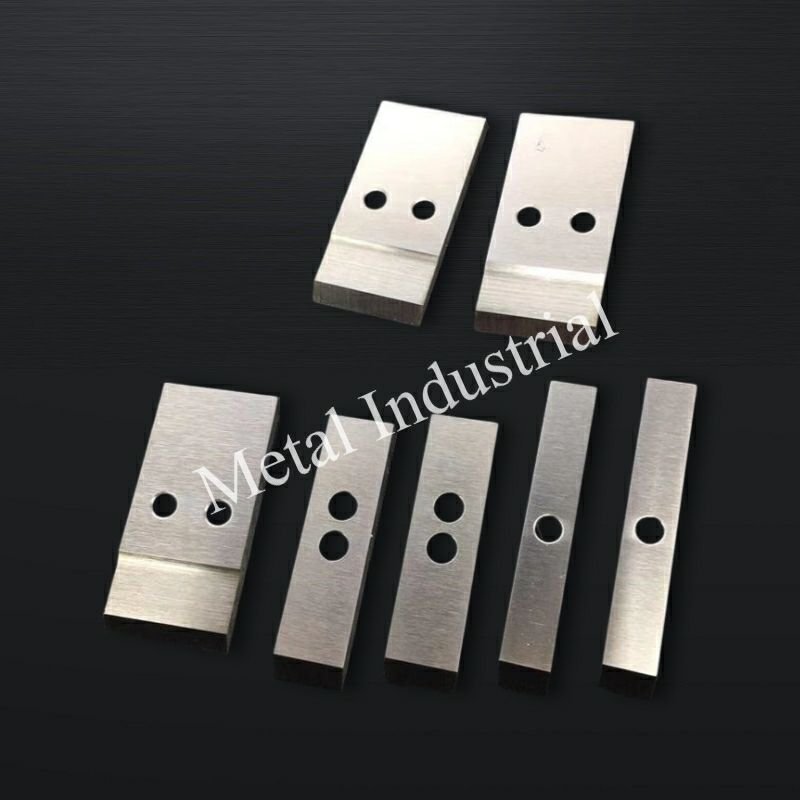
When a black-speck event occurs, the initial classification requires no laboratory equipment. Spread a 200 g pellet sample on white paper and draw a rare-earth disc magnet across the surface at 5–10 mm standoff. Metallic specks migrate toward the magnet; polymer carbonization particles remain stationary.
For confirmation, mount five to ten particles from each category at 40–100× magnification. Metallic particles show angular fractures and bright metallic surfaces, with possible brown-black magnetite smear under oblique illumination. Polymer particles are amorphous, compressible, and show laminar carbonization layers when cross-sectioned with a razor.
Correlation with Water Metrics
Plot total iron and suspended solids values from the loop log against the production record for the same period. A sustained upward trend in loop iron typically correlates with metallic speck events that appear within 24–72 hours — the lag reflecting loop volume and filtration efficiency. When total iron exceeds 1.0 mg/L without a corresponding maintenance event, treat it as an active corrosion indicator and inspect wetted surfaces before the next production run.
Remediation and Verification Steps
- Drain and flush the warm-water loop with clean deionized water until effluent total iron is below 0.1 mg/L
- Inspect the knife set for edge chipping, pitting, and corrosion — replace if any corrosion pitting is visible on the die-face contact zone
- Verify passivation on replacement knives before installation (potassium ferricyanide or salt spray per ASTM A967)
- Restart the loop with a fresh inhibitor charge; verify pH, conductivity, and chloride are within specification before resuming production
- Run a 15-minute qualification lot: inspect pellets under 10× magnification and perform a magnet test before releasing. For die-face systems running WC–Co insert blocks, the parallel restart discipline — verifying contact pressure, insert condition, and braze integrity before resuming production — is covered in our guide on lựa chọn mác mảnh hợp kim vonfram cacbua (tungsten carbide), hàn liên kết và kiểm soát tiếp xúc cho máy tạo hạt nhựa dưới nước.
- Close the CAPA record with documented root cause, corrective action, and preventive action — including any spec or SOP revision triggered by the event
For lines where the black-speck or contamination event traces back to blade contact instability — specifically, hydrodynamic lift at operating speed overcoming the axial preload and opening a micro-gap at the die face — the force-balance diagnostic and gap measurement sequence is covered in our guide on dynamic blade float, preload mechanics, and the 0.03 mm contact threshold.
Nói tóm lại: when black specks recur after a knife or loop change, the magnet test and microscopy results together tell you whether the source is metallic or polymeric — treating the wrong source first is the most common recovery delay.
FAQ
Hỏi: Điểm khác biệt chính giữa thép không gỉ 420 và 440C đối với dao cắt hạt nhựa (pelletizer knives) là gì?
Đáp: Thép 420 chứa 0,15–0,40% cacbon và 12–14% crom, đạt độ cứng 50–52 HRC với khả năng chống ăn mòn tốt và độ dẻo dai (toughness) cao hơn. Thép 440C chứa 0,95–1,20% cacbon và 16–18% crom, đạt độ cứng 58–60 HRC cho khả năng chống mài mòn vượt trội, nhưng độ dẻo dai thấp hơn và khả năng chịu ăn mòn giảm nhẹ do sự hình thành các-bit. Chọn 440C cho các loại polymer có tính mài mòn cao trong điều kiện nước vòng tuần hoàn được kiểm soát; chọn 420 cho môi trường dễ bị ăn mòn hoặc yêu cầu khử trùng/vệ sinh định kỳ cao.
Hỏi: Tại sao các đốm đen kim loại xuất hiện trong hạt nhựa polymer dùng trong y tế?
Đáp: Các đốm đen kim loại thường bắt nguồn từ ba nguyên nhân: hiện tượng mẻ vi mô (micro-chipping) lưỡi dao do gãy giòn hoặc tải trọng va đập; cặn ăn mòn (mẻ quặng magnetite, sắt oxit) di chuyển từ vòng nước ấm; hoặc sự nhiễm bẩn sắt tự do trên bề mặt dao chưa được thụ động hóa (passivated) đúng cách. Kiểm tra bằng nam châm và kính hiển vi quang học là các công cụ chẩn đoán hàng đầu để phân biệt đốm kim loại với đốm gốc polymer.
Hỏi: Độ nhám bề mặt (Ra) của dao cắt hạt nhựa (pelletizer knives) dùng trong y tế cần đạt bao nhiêu?
Đáp: Lưỡi cắt và vùng tiếp xúc với mặt khuôn (die-face) phải đạt độ nhám Ra ≤ 0,4 µm. Hiệp hội Phát triển Thép không gỉ Úc (ASSDA) xác định Ra ≤ 0,5 µm là ngưỡng gạn lọc cốt yếu cho độ toàn vẹn của màng thụ động (passive-film) trên thép không gỉ được gia công — dưới giá trị này, khả năng chống ăn mòn tăng lên rõ rệt. Bề mặt thô hơn sẽ làm tăng cả nguy cơ bị ăn mòn lẫn sự phát tán các hạt vi nhựa/kim loại vào dòng hạt nhựa.
Hỏi: Quá trình thụ động hóa theo tiêu chuẩn ASTM A967 đạt được điều gì, và nó có đủ để ngăn ngừa các đốm đen (black specks) không?
Đáp: Thụ động hóa theo ASTM A967/A967M loại bỏ sắt tự do, các hạt mài bị găm vào bề mặt và các tạp chất bề mặt khỏi thép không gỉ, khôi phục lại lớp màng crom oxit thụ động. Quá trình này không làm thay đổi độ nhám bề mặt cũng như không sửa chữa các khuyết tật cơ học. Thụ động hóa là điều kiện cần nhưng chưa đủ — dao phải được đánh bóng đạt độ nhám Ra mục tiêu trước khi thụ động hóa, và hệ thống vòng nước ấm phải được quản lý độc lập.
Hỏi: Nồng độ clorua bao nhiêu là an toàn trong vòng nước ấm của máy cắt hạt nhựa sử dụng dao bằng thép không gỉ?
Đáp: Nồng độ clorua nên duy trì dưới 50 ppm đối với dao bằng thép 420 hoặc 440C. Nồng độ trên 100 ppm sẽ đẩy nhanh quá trình ăn mòn lỗ (pitting corrosion) trên cả hai mác thép, và cặn ăn mòn sinh ra sẽ di chuyển trực tiếp vào dòng hạt nhựa. Hướng dẫn chống ăn mòn vòng kín của NIH khuyến nghị theo dõi xu hướng nồng độ clorua như một chỉ số quy trình liên tục thay vì coi đó là tiêu chí nghiệm thu một lần.
Hỏi: Có nên sử dụng lớp phủ TiN hoặc DLC trên dao cắt hạt nhựa dùng trong y tế không?
Đáp: Chỉ nên dùng sau khi đã xác nhận (validation) đầy đủ hiện tượng bong tróc mảng (flake-generation) trong điều kiện vận hành thực tế. Các lớp phủ cứng mỏng giúp kéo dài tuổi thọ dao trong các ứng dụng mài mòn, nhưng sự bong tách lớp phủ (delamination) là nguy cơ gây nhiễm bẩn thực sự trên các dây chuyền y tế. Theo ISO 13485, việc áp dụng lớp phủ cho dao là một thay đổi quy trình chính thức, đòi hỏi phải đánh giá rủi ro bằng văn bản và xác nhận trước khi đưa vào sản xuất.
Hỏi: Bao lâu thì nên lấy mẫu và xử lý vòng nước ấm một lần?
Đáp: Lấy mẫu độ pH và độ dẫn điện (conductivity) hàng tuần trong điều kiện vận hành bình thường; đo tổng lượng sắt và clorua hàng tháng. Sau bất kỳ hoạt động bảo trì nào liên quan đến việc thay thế đường ống hoặc linh kiện, hãy thực hiện súc rửa (flush) toàn bộ vòng tuần hoàn và nạp lại nước trước khi khôi phục sản xuất. Nếu tổng lượng sắt vượt quá 1,0 mg/L mà không có lý do bảo trì gần đây, hãy xử lý đó như một sự cố ăn mòn đang diễn ra và tiến hành súc rửa vòng nước.
Hỏi: Những tài liệu nào cần đi kèm với một đơn hàng dao cắt hạt nhựa dùng trong y tế?
Đáp: Mỗi lô hàng phải đi kèm chứng chỉ kiểm định vật liệu EN 10204 MTC 3.1 có truy xuất nguồn gốc mẻ nấu (heat) và thành phần hóa học, kết quả đo độ cứng (HRC đo trực tiếp trên linh kiện giao hàng), chứng chỉ đo độ bóng/độ nhám bề mặt và biên bản xác nhận thụ động hóa (thử nghiệm potassium ferricyanide hoặc phun sương muối theo ASTM A967). Các hồ sơ này đáp ứng các yêu cầu đánh giá nhà cung cấp và kiểm tra hàng đầu vào theo ISO 13485.
Kết luận
Đối với quy trình cắt hạt nhựa dùng trong y tế, việc lựa chọn giữa thép 420 và 440C là một quyết định kỹ thuật tương thích với mức độ rủi ro, chứ không có một đáp án duy nhất. Thép 440C mang lại khả năng giữ lưỡi sắc bén (edge retention) vượt trội đối với các loại nhựa có tính mài mòn trong môi trường nước tuần hoàn được kiểm soát. Thép 420 cung cấp độ dẻo dai (toughness), khả năng đánh bóng và độ chịu ăn mòn tốt hơn ở những nơi có cường độ khử trùng cao hoặc chất lượng nước biến động.
Trong cả hai trường hợp, độ bóng bề mặt Ra ≤ 0,4 µm trên lưỡi cắt và quy trình thụ động hóa được xác nhận theo ASTM A967/A967M là các biện pháp kiểm soát ngăn ngừa nhiễm bẩn cốt lõi — chứ không chỉ riêng mác hợp kim. Quy trình vận hành chuẩn (SOP) được mã hóa cho vòng nước ấm, với các mục tiêu hóa học, hệ thống lọc hai giai đoạn, khử trùng bằng tia UV và khử khí (degassing), sẽ triệt tiêu con đường ăn mòn tạo ra các chấm đen kim loại (black specks). Kết hợp với các thông số kỹ thuật của dao gắn liền với chứng nhận EN 10204 MTC 3.1, các biện pháp kiểm soát này tạo ra một chương trình có thể kiểm toán, hoàn toàn đáp ứng các kỳ vọng của ISO 13485.
Lộ trình triển khai rất rõ ràng: quy định thông số kỹ thuật của dao chính xác cho sự kết hợp giữa loại nhựa và đặc tính hóa học của nước, xác nhận độ bóng bề mặt và quy trình thụ động hóa khi kiểm tra hàng đầu vào, thiết lập quy trình chuẩn (SOP) cho hóa chất vòng nước và kế hoạch giám sát phân tích, đồng thời khép kín quy trình — cả về mặt vật lý lẫn thủ tục — giữa hiệu suất của dao và dữ liệu chất lượng nước.
For precision-ground plastic pelletizer blades and pelletizing knives manufactured to the tolerances described above, contact the Maxtor Metal engineering team with your machine drawing and polymer program requirements.
Tiêu chuẩn và Tài liệu tham khảo
The specifications and controls in this article are drawn from the following standards and sources. Readers qualifying a specific line should consult the current revision of each document.
Metallurgy and material data
- AISI 420 (UNS S42000) and AISI 440C (UNS S44004) grade data — Atlas Steels Grade 420 data sheet; Crucible Industries 440C material data.
- ASTM F899 — Standard Specification for Wrought Stainless Steels for Surgical Instruments.
- ASTM A276 / A314 — Standard specifications for stainless steel bars and billets (440C and 420 forms).
- ASM Handbook, Vol. 16 — Machining (tool material selection context).
Surface finish and passivation
- ASSDA (Australian Stainless Steel Development Association) — pickling and passivation of stainless steel; Ra ≤ 0.5 µm passive-film threshold.
- ASTM A967/A967M — Standard Specification for Chemical Passivation Treatments for Stainless Steel Parts.
- ASTM B117 — Standard Practice for Operating Salt Spray (Fog) Apparatus.
Coating adhesion
- ISO 20502 — Fine ceramics (advanced ceramics, advanced technical ceramics) — Determination of adhesion of ceramic coatings by scratch testing.
- Published TiN-on-stainless and DLC duplex scratch-test critical-load studies (Lc1/Lc2/Lc3 data).
Water-loop corrosion and control
- NIH Technical Bulletin (2025) — Corrosion in Closed Loop Water Systems, Part 2: Evaluation and Prevention.
- ISO 13485:2016 — Medical devices — Quality management systems.
- FDA 21 CFR 211.67(a) — Equipment cleaning and maintenance.
Brand engineering basis
- Maxtor Metal technical documentation — 420/440C martensitic stainless with Ra ≤ 0.4 µm mirror finishing as a material system for medical-grade and food-packaging pelletizer applications. Note: brand-side engineering basis, not independent third-party validation.
Về tác giả
Nancy Wu is a Senior Manufacturing Engineer in Production Engineering at Maxtor Metal, with 12 years of experience in industrial cutting-blade manufacturing. She specializes in the machining and material behavior of common industrial blade steels — including SKD11, 420, 440C, D2, M2, H13, powder metallurgy steels, and cemented carbide — covering their processing characteristics, material properties, and coating behavior, alongside high-precision CNC grinding programming. She holds SME CMfgE, PMP, Six Sigma Black Belt, and ASM International certifications.

 English
 Spanish
 Italian
 French
 Portuguese
 Russian
 German
 Arabic
 Hindi
 Vietnamese
 Indonesian
 Japanese
 Korean