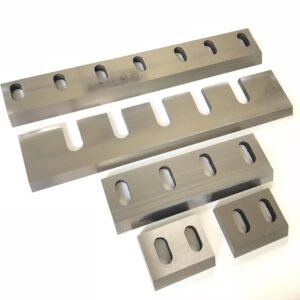
Lâminas trituradoras de gancho, conjuntos de facas trituradoras, trituradoras de gancho, lâminas trituradoras de eixo duplo, facas trituradoras circulares, lâminas trituradoras de 4 eixos
1. Lâminas para Trituradores Industriais: Especificações de Engenharia e Seleção
Este white paper baseia-se na experiência de fabricação da Maxtor Metal nos setores de trituração industrial, reciclagem e processamento de resíduos.
Este documento técnico estabelece as diretrizes de engenharia, os critérios metalúrgicos e os protocolos de fabricação para lâminas de trituradores de alto desempenho aplicadas em sistemas industriais pesados de reciclagem, gestão de resíduos sólidos e processamento de biomassa. Este white paper serve como referência central para gerentes de suprimentos, engenheiros mecânicos e especialistas em fabricação de equipamento original (OEM) que exigem uma vida útil previsível da ferramenta, alta retenção do gume e controle de falhas catastróficas com zero defeitos.
Ponto principal:
A Maxtor Metal fabrica lâminas para trituradores industriais de eixo único e multieixo em aços inoxidáveis AISI D2, DC53, H1.13, M6V e martensíticos, seguindo rigorosos padrões de qualidade. Protocolos de qualidade e aquisição prontos para auditoriaPara cada lâmina produzida, são aplicados métodos de têmpera a vácuo, estabilização criogênica a −196 °C e retificação de precisão com tolerâncias de até ±0,01 mm para compatibilidade com os sistemas OEM da Weima, SSI, UNTHA, Vecoplan e Andritz.
1.1 Matriz de Especificações Técnicas
Parâmetro
Lâminas trituradoras de eixo único
Lâminas trituradoras de múltiplos eixos (eixo duplo/quadri-eixo)
Perfis de lâmina primários
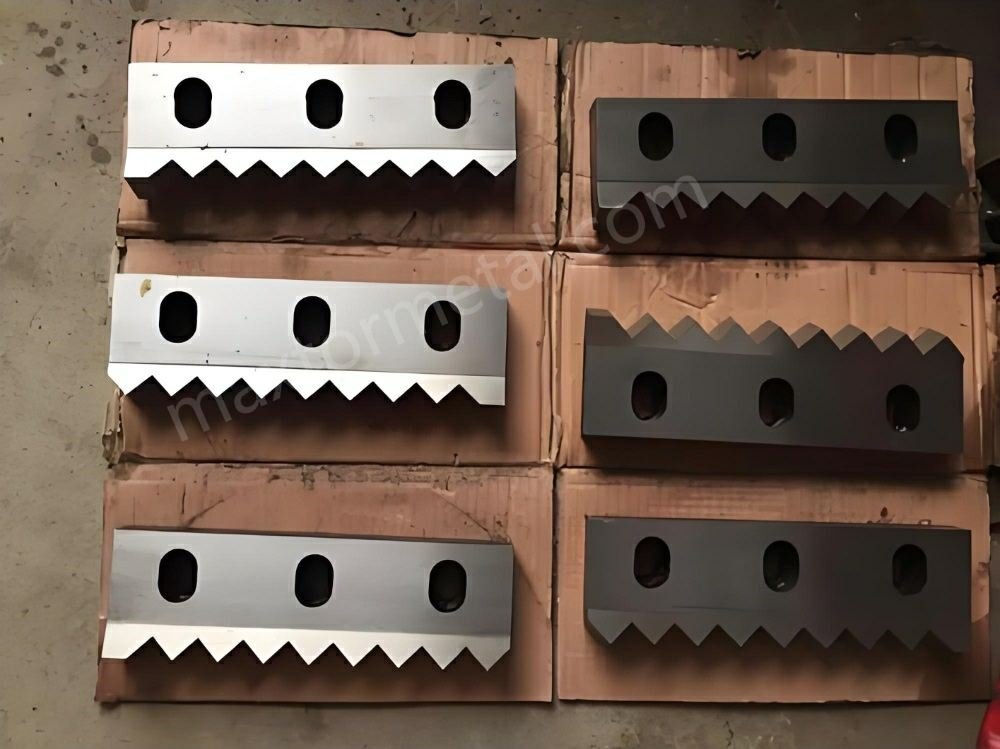
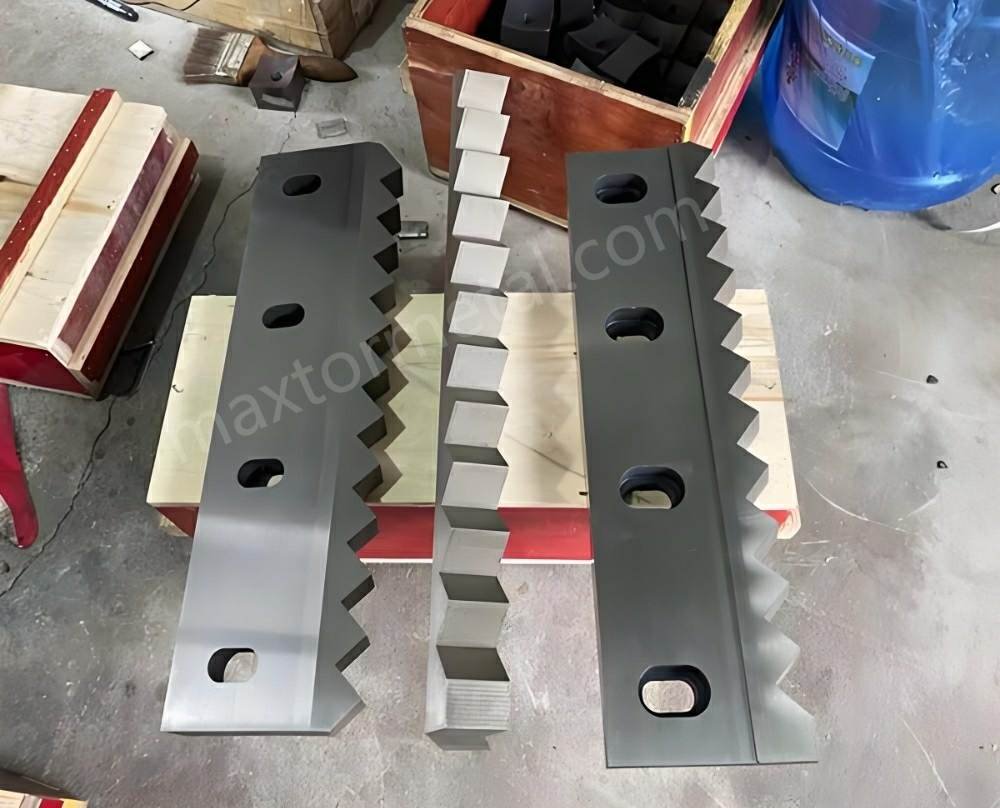
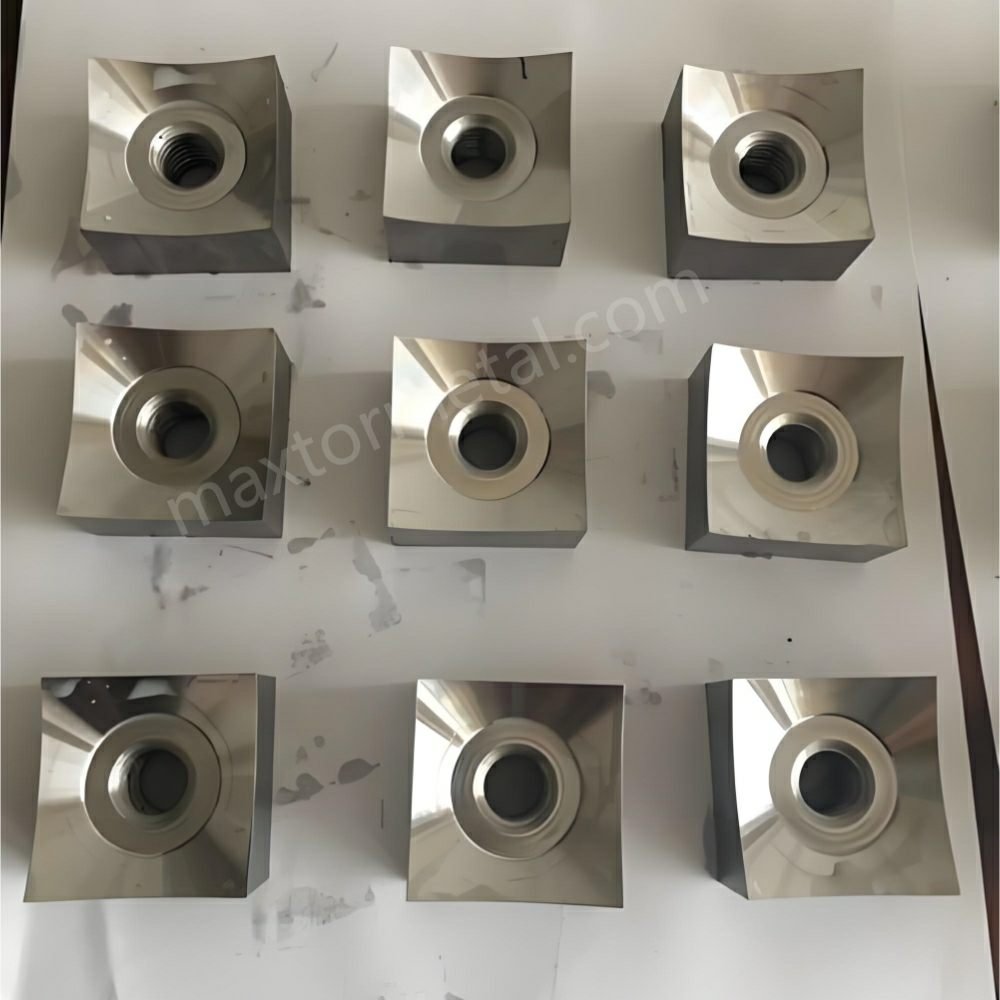
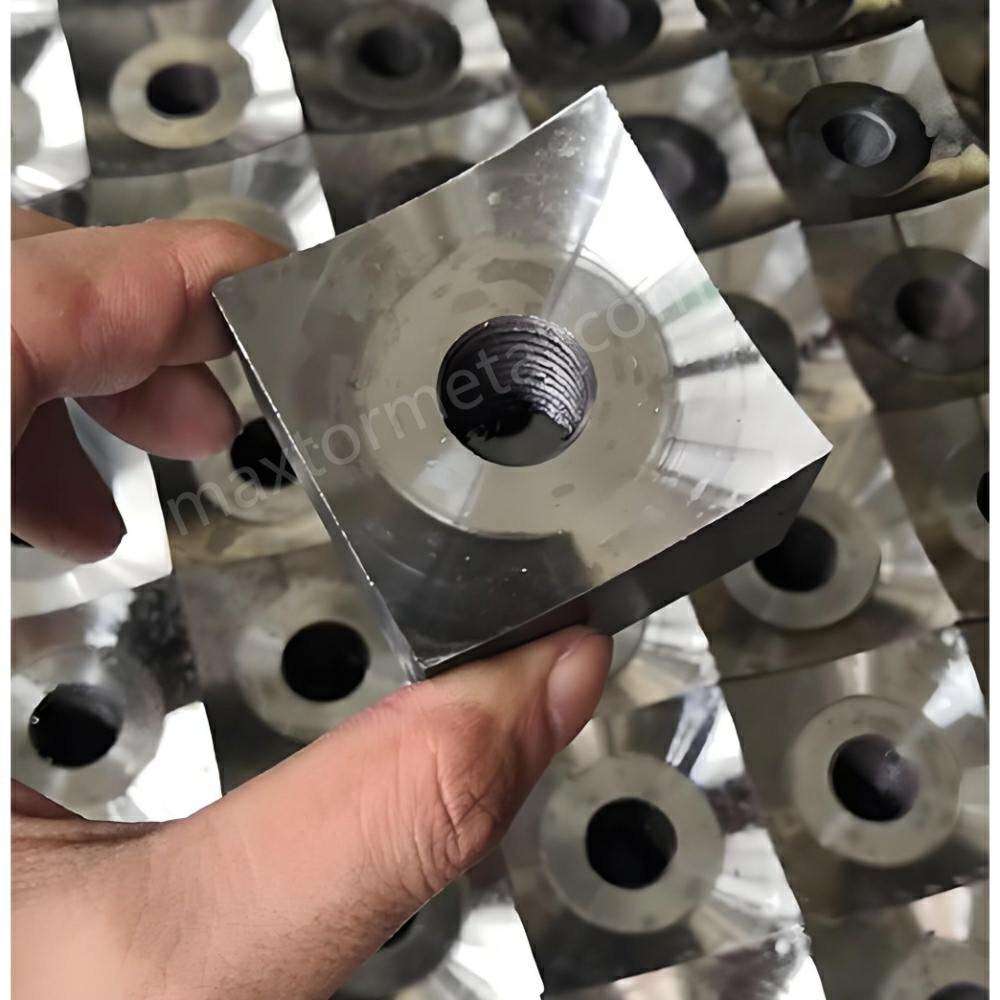
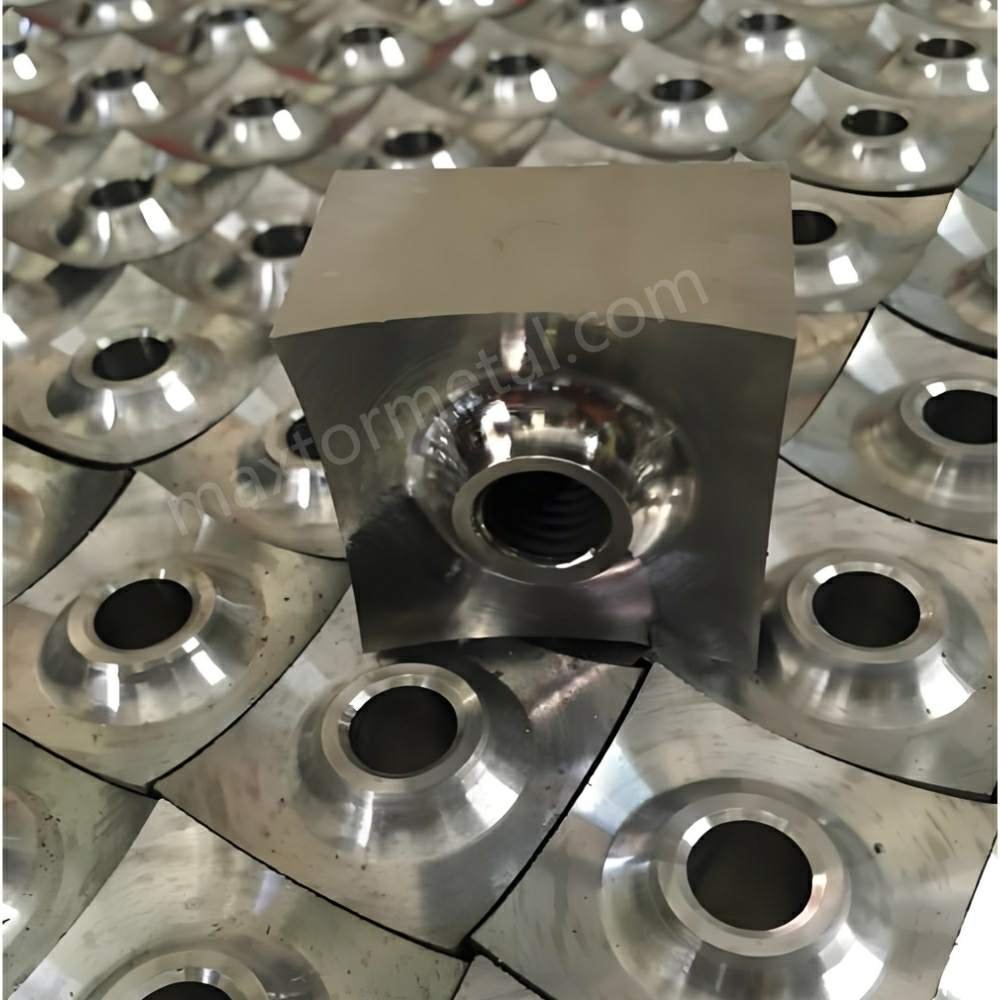
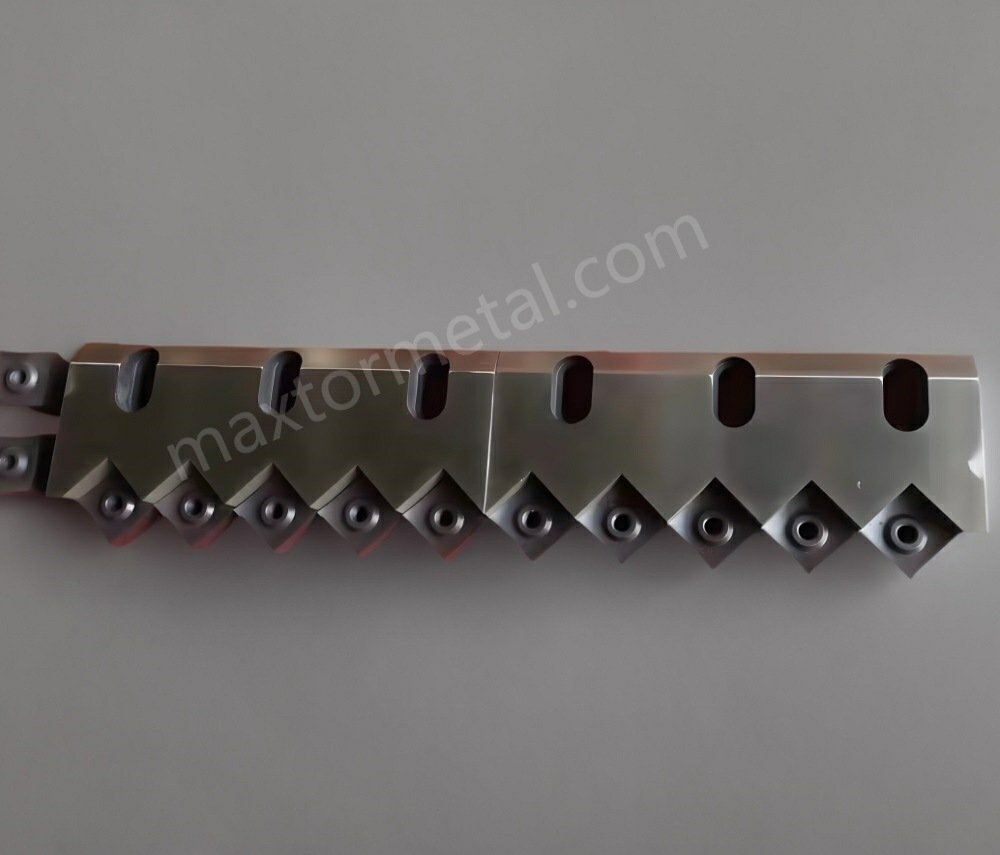
Blocos rotativos côncavos quadrados multiangulares, lâminas de leito estator.
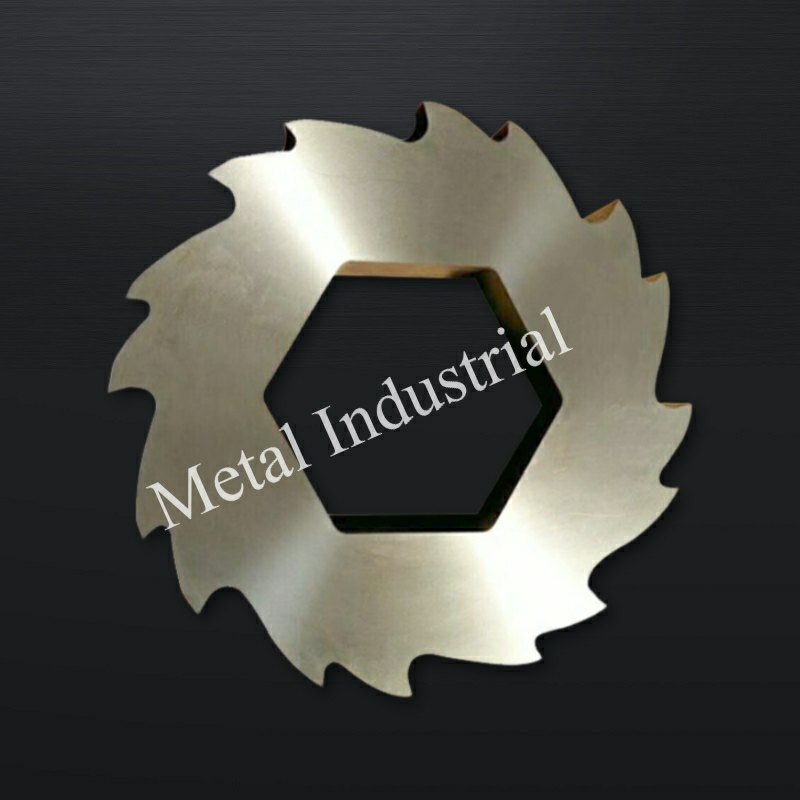
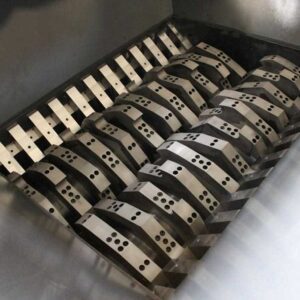
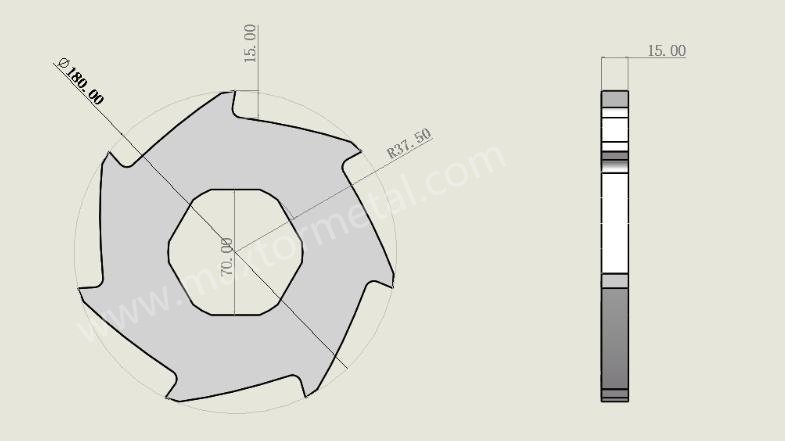
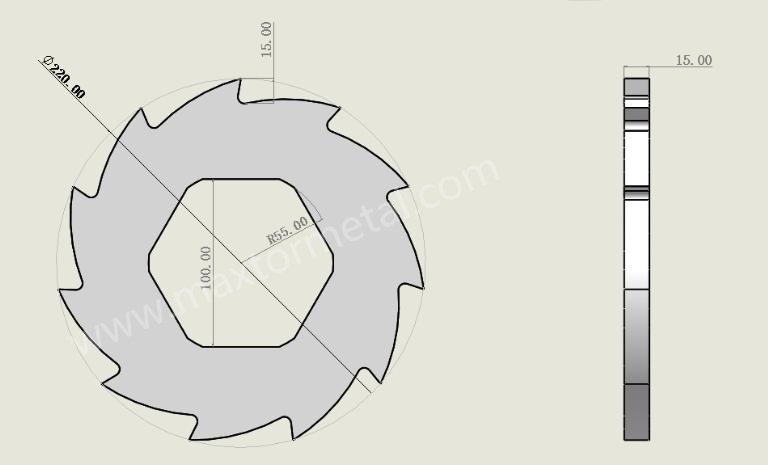
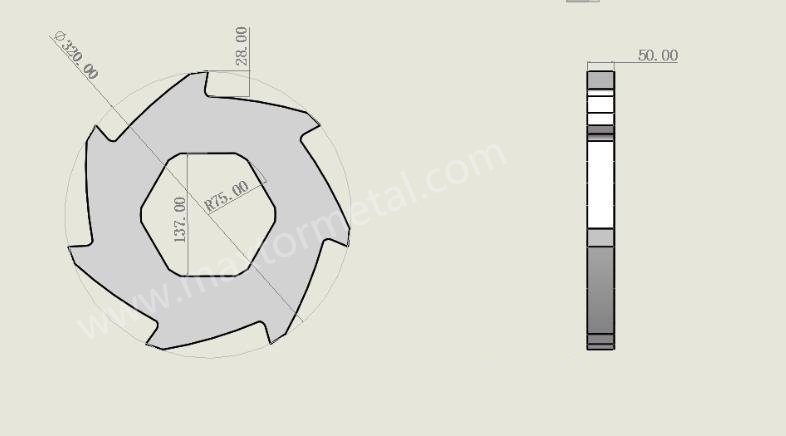
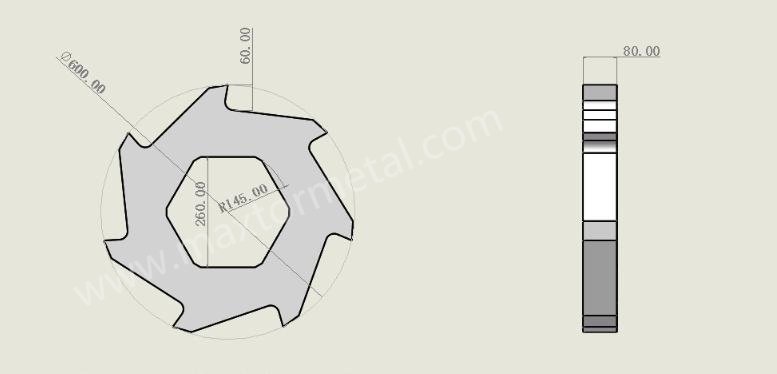
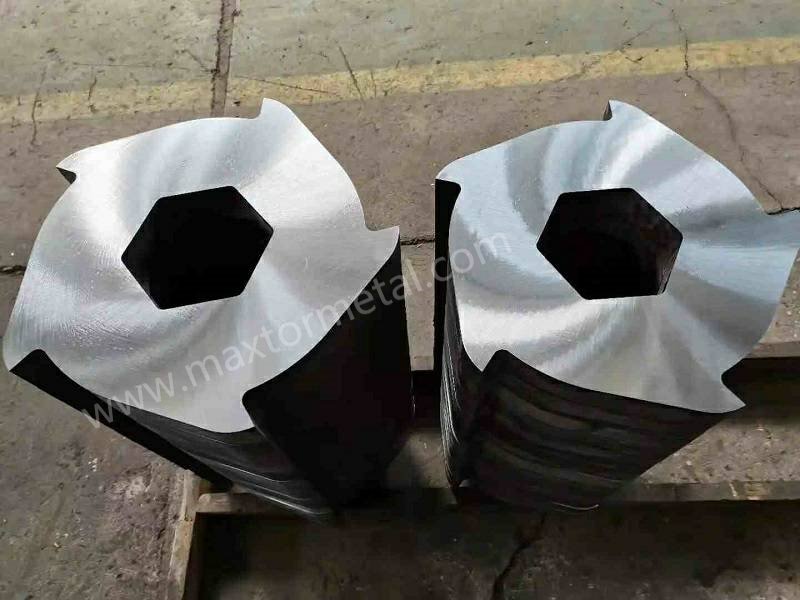
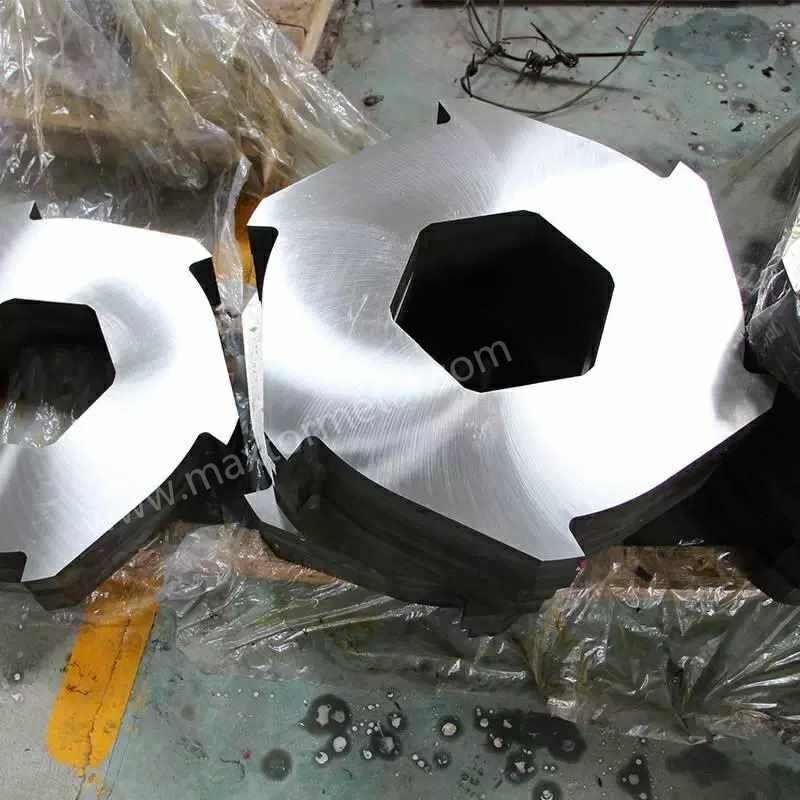
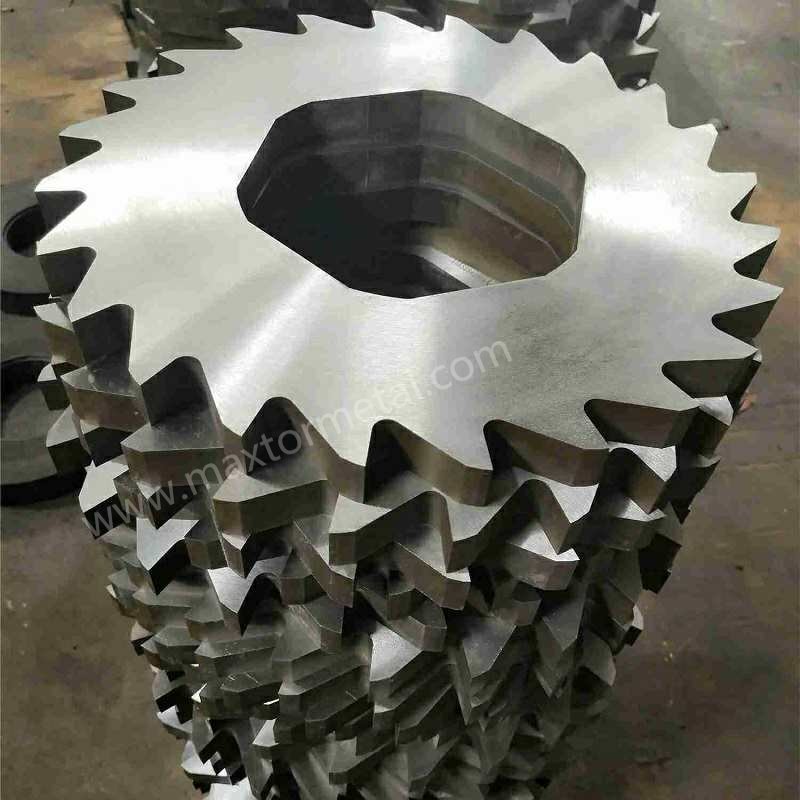
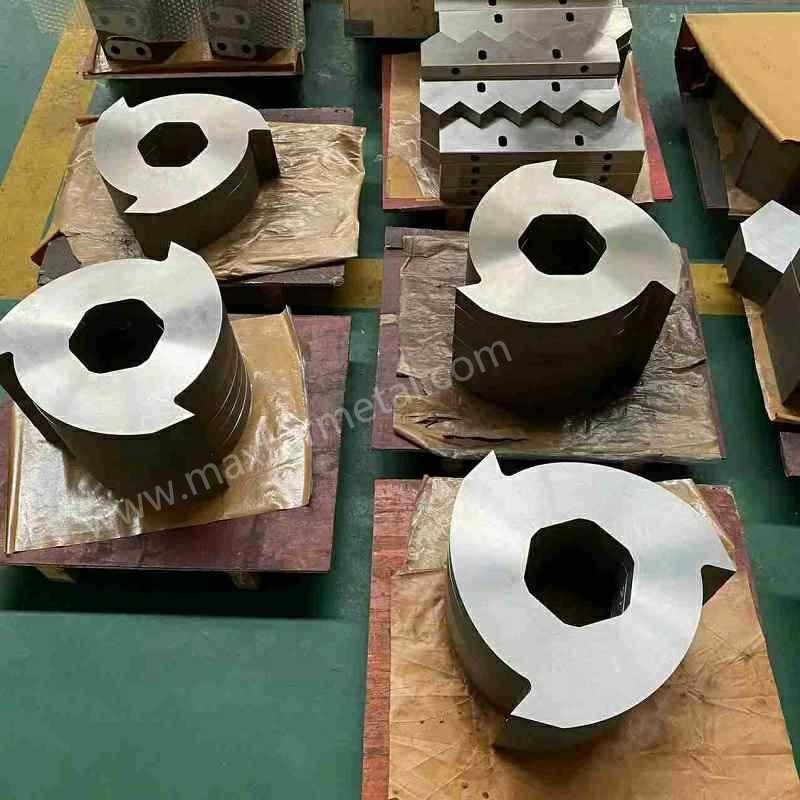
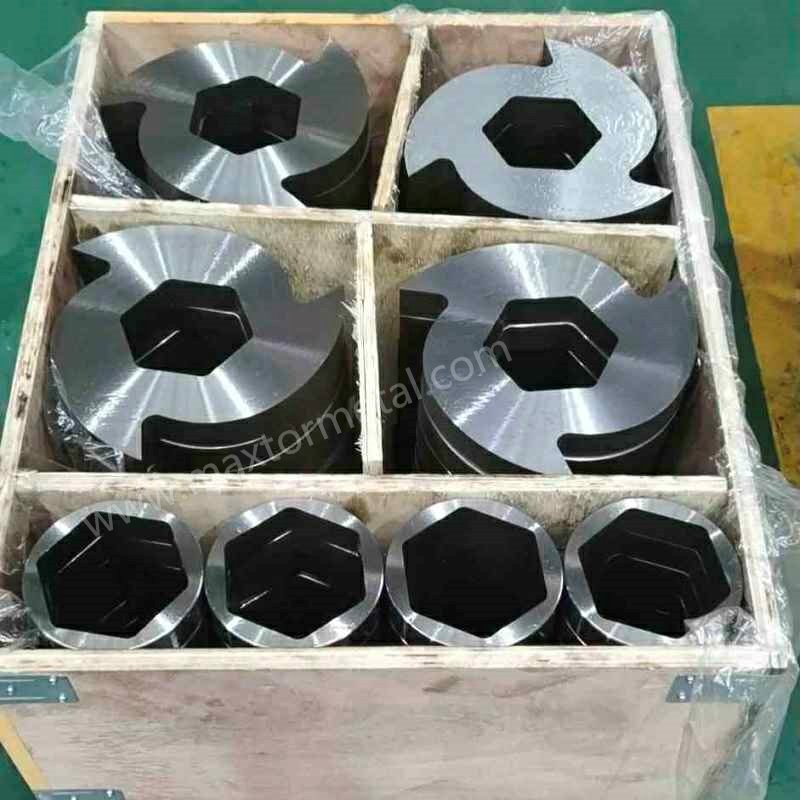
Lâminas de disco intertravadas com múltiplas garras (configurações de 3, 5 e 8 garras).
Mecanismo de corte
Cisalhamento de precisão em alta velocidade e alta frequência por meio de alimentação hidráulica por pistão contra um estator.
Aperto volumétrico contrarrotativo de baixa velocidade e torque ultra-elevado, rasgamento e esmagamento de alta pressão.
Materiais Essenciais
Base AISI D2 (1.2379), DC53, AISI 4140 / AISI 1045 com pastilhas de carboneto de tungstênio soldadas.
Aço ferramenta: 58–60 HRC (endurecido a vácuo). Pastilhas de metal duro: 89–92 HRA em matriz reforçada.
48–54 HRC (resistência à corrosão), 56–60 HRC (resistência ao desgaste), 48–52 HRC (anticorrosivo), 58–60 HRC (martensítico de alto carbono).
Dimensões principais
34×34×20 mm, 40×40×20 mm, 60×60×30 mm com furos centrais escareados para parafusos.
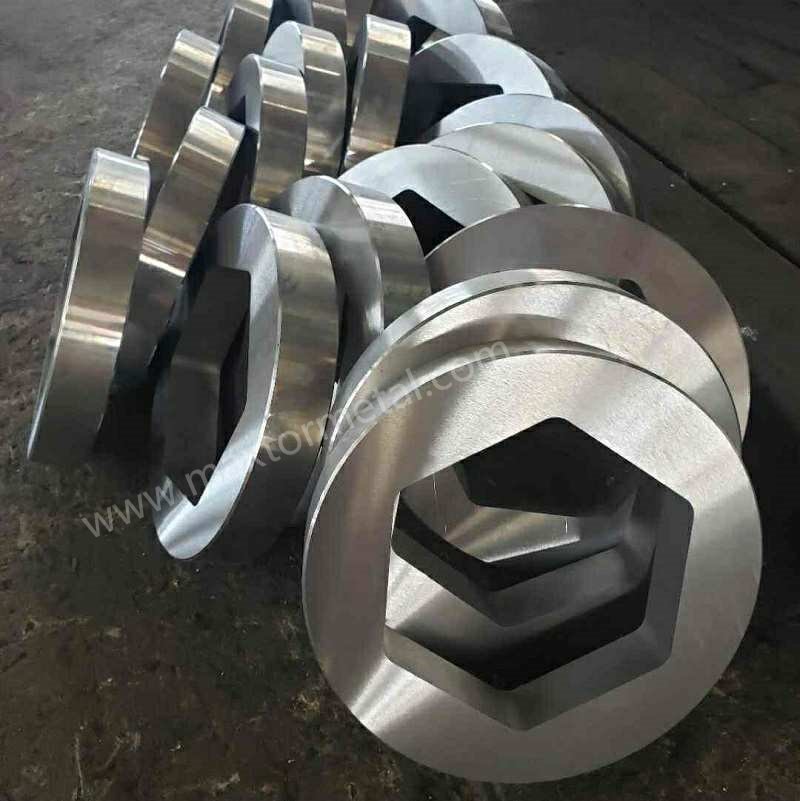
Diâmetro externo (DE): 150–600 mm. Espessura: 15–60 mm. Furo: Hexagonal, octogonal ou estriado involuto.
Tolerâncias dimensionais
Geral: ISO 2768-mK. Assento da base e faces de acoplamento do eixo: Tolerância rigorosa de ±0,02 mm.
Espessura: ISO 2768-mK. Aplicações de alta precisão: Planicidade da face final de até ±0,01 mm.
Acabamento de superfície
Superfície de corte côncava: Ra < 0,8 μm. Área de montagem: Ra < 1,6 μm.
Faces das extremidades fresadas/retificadas: Ra < 0,8 μm. Perfil de trabalho do núcleo: Ra < 3,2 μm.
Folga após montagem
Configuração de lâmina de corte com microfolga: ajuste de 0,1 a 0,5 mm para espessuras específicas do material.
Folga axial de intertravamento: folga lateral de 0,15 a 0,40 mm (o espaçador é 0,3 a 0,8 mm mais largo que a lâmina).
Fabricantes de equipamentos originais (OEMs) compatíveis
Weima, Vecoplan, Lindner, Herbold e sistemas globais equivalentes de eixo único.
Linhas de processamento ambiental para serviço pesado Weima (quatro eixos), SSI, UNTHA, Andritz.
2. Visão Geral da Engenharia de Lâminas de Triturador
A redução de dimensões industriais depende de dois processos distintos de corte mecânico: o corte de precisão em alta frequência e o rasgo em baixa velocidade e alto torque. Compreender a mecânica dessas operações é fundamental para prever a vida útil da ferramenta e a eficiência do sistema.
2.2 Dinâmica de Rasgamento Multieixo
Trituradores industriais multieixos (configurações de eixo duplo ou quádruplo) operam por meio de eixos contrarrotativos que giram em velocidades mais baixas, mas com alto torque. O processo se baseia em perfis de garras interligadas em forma de gancho que puxam materiais grandes e densos para o centro da câmara de corte.
A ação de trituração utiliza uma combinação de tração por gancho, esmagamento lateral de alta pressão e cisalhamento lateral intertravado. Em vez de um cisalhamento limpo, a mecânica concentra-se no deslocamento volumétrico e no rasgamento estrutural severo. O sistema de folga axial aberta (folga lateral de 0,15 mm a 0,4 mm por lâmina) permite a expansão térmica independente e suporta a deformação estrutural sob altas cargas.
2.1 Dinâmica de corte de eixo único
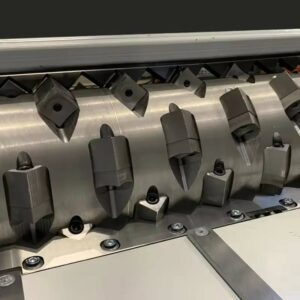
Os sistemas de trituração de eixo único operam em velocidades de rotação mais altas, utilizando um pistão hidráulico para empurrar materiais a granel contra um rotor que gira em velocidades moderadas a altas. O mecanismo de corte é uma ação precisa, semelhante à de uma tesoura, que ocorre entre a lâmina quadrada rotativa (lâmina rotativa) e a contra-lâmina estacionária (lâmina do estator).
A principal tensão aplicada ao material é a tensão de cisalhamento pura, definida por:
$$\tau = \frac{F_{corte}}{A_{cisalhamento}}$$
O modo de tensão dominante é o cisalhamento, com a força de corte por unidade de área de cisalhamento definida por τ = F/A. Na prática, a folga estreita (0,1–0,5 mm) também induz tensão compressiva normal ao plano de cisalhamento, acelerando a deformação plástica e a fratura limpa da peça. O perfil côncavo quadrado da pastilha rotativa cria um ângulo de ataque positivo agudo que reduz a potência máxima necessária do eixo de acionamento principal. O tamanho final das partículas de saída é rigorosamente controlado por uma peneira de classificação posicionada abaixo do conjunto do rotor.
2.3 Caracterização do Desgaste Industrial
As lâminas do triturador operam em ambientes tribológicos exigentes, com a degradação da ferramenta seguindo quatro padrões distintos de desgaste industrial:
Desgaste abrasivo (microaragem): Partículas pequenas e duras, como areia, escamas, fibra de vidro ou pó mineral, deslizam sobre a matriz de aço da ferramenta, cortando sulcos microscópicos e arredondando as arestas de corte afiadas. Isso desgasta o fio, aumenta o consumo de energia e causa arrancamento ou estiramento do material em vez de um corte limpo.
Fadiga por impacto (lascamento e microdescascamento): Quando impurezas metálicas pesadas ou componentes estranhos não esmagáveis entram na máquina, exercem altas forças de contato localizadas na aresta de corte. Se a tenacidade à fratura do material (K)1cSe a tensão de contato for insuficiente, ela causa lascamento imediato ou falha catastrófica da seção.
Desgaste adesivo e amolecimento térmico: O processamento de polímeros densos ou elastômeros altamente elásticos gera alto atrito na interface de corte. Esse calor localizado pode causar amolecimento localizado por revenimento, o que acelera a perda de material e leva à adesão do polímero nas faces da lâmina.
Corrosão química intergranular: O processamento de resíduos sólidos urbanos, restos de comida ou tecido animal expõe o aço a altos níveis de umidade, cloretos, ácidos orgânicos e sais (pH < 4). Esse ambiente reativo induz corrosão por pite e oxidação intergranular rápidas, removendo o cromo da matriz de aço e acelerando o desgaste mecânico.
3. Aplicações de Lâminas para Trituradores Industriais
3.1 Plásticos Avançados e Reciclagem de Polímeros
Maquinaria de processamento alvo: Trituradores de eixo único de alto rendimento com cilindros hidráulicos de torque variável.
Composição do material de entrada: Tubos de poliolefina de parede espessa, purgas moldadas por injeção, para-choques automotivos e película pós-agrícola contaminada com areia ou solo.
Critérios de Engenharia Operacional: Alto atrito abrasivo devido às fibras de vidro e aos materiais de enchimento mineral. Requer excelente retenção de borda para evitar que a película plástica se estique e enrole ao redor do rotor.
Especificação recomendada: Pastilhas rotativas AISI D2 ou DC53 com dureza de 58–60 HRC. Para contaminação severa por areia, utilize uma base AISI 4140 com pastilhas de carboneto de tungstênio brasadas (89–92 HRA).
3.2 Processamento de Cabos Elétricos de Alta Capacidade e Resíduos Eletrônicos
Maquinaria de processamento alvo: Granuladores e trituradores de eixo único de alta precisão e microfolga.
Composição do material de entrada: Cabos de energia de cobre/alumínio com revestimento blindado, linhas de comunicação e conjuntos de resíduos eletrônicos.
Critérios de Engenharia Operacional: Requer corte preciso e com folga reduzida (0,1 mm – 0,2 mm) para separar os fios de cobre das capas de elastômero de forma limpa, sem gerar calor excessivo ou manchas de isolamento.
Especificação recomendada: Aço ferramenta DC53 para evitar microlascas causadas por fixadores de aço ocultos. Aplicação de revestimento de nitreto de titânio (TiN) por deposição física de vapor (PVD) (>2000 HV) na face do estator para prolongar a vida útil.
3.3 Gestão de Resíduos Sólidos Industriais Pesados e Resíduos Perigosos
Maquinaria de processamento alvo: Trituradores industriais pesados de alto torque e baixa velocidade, com eixo duplo ou quádruplo.
Composição do material de entrada: Tambores de aço, sucata estrutural automotiva, contêineres de armazenamento reforçados e resíduos perigosos mistos contendo placas de aço estrutural.
Critérios de Engenharia Operacional: Cargas de choque extremas e altas forças de torção nas garras de corte ao encontrarem componentes espessos e indestrutíveis.
Especificação recomendada: Aço ferramenta AISI H13 (1.2344) ou AISI A8 modificado, temperado em toda a sua extensão a 48–54 HRC. Essa seleção prioriza alta resistência ao impacto e resistência estrutural em detrimento da resistência ao desgaste abrasivo puro para evitar a quebra da lâmina. Uma aplicação intimamente relacionada com materiais perigosos é a reciclagem de baterias de íon-lítio, onde materiais resistentes a cisalhamento em baixa velocidade, atmosfera controlada e HF são necessários, além da resistência ao impacto — veja nosso Guia de riscos da destruição de baterias de íon-lítio para toda a estrutura de controle de engenharia.
3.4 Processamento de pneus e borracha de veículos em fim de vida útil (ELV)
Maquinaria de processamento alvo: Trituradores ambientais de eixo duplo para materiais pesados, equipados com designs de gancho progressivos.
Composição do material de entrada: Pneus inteiros para veículos comerciais contendo feixes de arame de aço de alta resistência e espessura reforçada.
Critérios de Engenharia Operacional: Combinação severa de alto atrito abrasivo proveniente de compostos de borracha vulcanizada e altas cargas de tração/cisalhamento resultantes do corte de arame de aço-mola de alto carbono.
Especificação recomendada: Special M6V vanadium-rich wear-resistant tool steel or premium DC53 hardened to 56–58 HRC to prevent claw breakage under wire tension. The right hardness target here is a trade-off, not a maximum — pushing HRC too high sacrifices the impact toughness needed to survive bead-wire shock and tramp metal strikes. See our guide on equilibrando dureza vs. tenacidade para lâminas de triturador de sucata de pneus e ELV for the full cost-per-ton analysis and a documented failure case.
3.5 Processamento em larga escala de biomassa e combustíveis agrícolas
Maquinaria de processamento alvo: Sistemas trituradores de quatro eixos de alto torque utilizando configurações de múltiplas garras.
Composição do material de entrada: Palha agrícola enfardada em alta densidade, talos de culturas, resíduos florestais e paletes de madeira contendo fixadores estruturais.
Critérios de Engenharia Operacional: Materiais fibrosos de biomassa se enrolam facilmente em torno dos eixos de trituração, criando altas forças radiais e atrito. Pedras ou fios de metal escondidos podem causar impactos repentinos.
Especificação recomendada: AISI 4140 (1.7225) structural tool steel through-hardened to 48–54 HRC for standard operations requiring cost-effective toughness. For continuous RDF (Refuse-Derived Fuel) processing lines, upgrade to premium M6V vanadium steel. Material selection alone doesn’t guarantee sizing compliance on these lines — cutter geometry, screen open-area ratio, and shear-gap control are equally decisive. See our guide onengineering out long-strip rejects for RDF/SRF processing efficiency for the full system-level approach.
3.6 Resíduos orgânicos urbanos, resíduos alimentares e resíduos animais
Maquinaria de processamento alvo: Trituradores de resíduos orgânicos de eixo duplo com sistemas de vedação à prova de líquidos.
Composição do material de entrada: Resíduos alimentares pós-consumo contendo talheres/cerâmicas variados, carcaças inteiras de animais, estruturas ósseas densas e cascos provenientes de operações de processamento de resíduos animais.
Critérios de Engenharia Operacional: Exposição severa a ácidos orgânicos com alto teor de umidade, altas concentrações de sal e desgaste corrosivo contínuo, combinada com impactos de choque provenientes de ossos densos ou utensílios de mesa mistos.
Especificação recomendada: Para resíduos alimentares altamente ácidos contendo cerâmica/talheres misturados, utilize aço inoxidável martensítico AISI 420 com dureza de 48–52 HRC. Para processamento de carcaças puras e subprodutos animais sem metais pesados, utilize aço martensítico AISI 440C com alto teor de carbono e dureza de 58–60 HRC, que oferece alta resistência à corrosão e maior durabilidade das lâminas para triturar ossos.
4.Problemas de Falha Comuns e Soluções de Engenharia
4.1 Lascamento de metal estranho em ferramentas de eixo único
Análise da Causa Raiz: Quando componentes de aço não esmagáveis (por exemplo, parafusos temperados, suportes estruturais) entram em um triturador de eixo único, eles ficam presos entre a lâmina rotativa de alta dureza (58–60 HRC) e a base do estator. Essa obstrução repentina gera tensões localizadas que excedem a tenacidade à fratura (K).1c) de aço AISI D2, causando lascamento severo nas bordas ou fraturamento do corpo.
Redesenho de Engenharia e Concessões: Substitua o aço AISI D2 pelo aço DC53. O DC53 apresenta estruturas de carbonetos uniformes e finas que duplicam a energia de impacto Charpy V-notch em comparação com o D2 tradicional. Compensação em Engenharia: Os custos dos materiais aumentam em aproximadamente 25%, mas a vida útil da ferramenta e a resistência a falhas catastróficas melhoram substancialmente.
4.2 Fratura de garra multieixo sob alta tensão de biomassa
Análise da Causa Raiz: O processamento de biomassa densa e fibrosa ou feixes de palha agrícola pode fazer com que as fibras longas se enrolem firmemente na base das garras de corte. Essa ação de enrolamento comprime o material entre as lâminas adjacentes, criando altos momentos de flexão e cargas de tração que podem quebrar as garras na base.
Redesenho de Engenharia e Concessões: Altere o material da lâmina de aço D2 de alta dureza para aço AISI H13 (1.2344) de alta tenacidade ou um aço AISI A8 modificado, tratado termicamente para 48–54 HRC. Isso altera a matriz do aço de uma estrutura de carbonetos propensa ao desgaste para uma estrutura martensítica resistente a impactos. Compensação em Engenharia: A redução da dureza diminui a resistência ao desgaste abrasivo, exigindo afiações mais frequentes para manter a produtividade.
4.3 Trincas no furo interno da unidade devido à tensão residual na eletroerosão a fio
Análise da Causa Raiz: Perfis internos precisos (como formas hexagonais ou octogonais) são geralmente finalizados por eletroerosão a fio (EDM) após tratamento térmico. As altas temperaturas do processo de EDM fundem e solidificam novamente a superfície do aço, criando uma camada branca frágil em microescala, repleta de tensões residuais de tração. Sob alto torque, esses cantos internos atuam como concentradores de tensão, iniciando trincas que se propagam para fora e fendem a lâmina.
Redesenho de Engenharia e Concessões: Implemente um tratamento térmico imediato pós-EDM para alívio de tensões a baixa temperatura, entre 180 °C e 200 °C, durante 4 horas, para aliviar as tensões residuais de tração. Como alternativa, utilize o material DC53, que pode absorver essas tensões sem a necessidade de etapas especiais de têmpera em múltiplos estágios.
4.4 Expansão axial e travamento de conjuntos de múltiplos eixos
Análise da Causa Raiz: O processamento de materiais densos em longos períodos de operação contínua gera alto atrito, aquecendo as lâminas do triturador a temperaturas entre 80 °C e 120 °C. Se a expansão térmica das lâminas exceder as folgas axiais originais de projeto, as faces laterais das lâminas intertravadas irão friccionar umas contra as outras, causando travamento por atrito, deflexão do eixo e sobrecarga da engrenagem de transmissão.
Redesenho de Engenharia e Concessões: Aumente a espessura dos anéis espaçadores em relação às lâminas, definindo uma folga unilateral de 0,15 mm a 0,40 mm (tornando o espaçador de 0,3 mm a 0,8 mm mais largo que a lâmina correspondente). Além disso, aplique um tratamento criogênico a -196 °C durante o tratamento térmico para eliminar a austenita retida, garantindo alta estabilidade dimensional em uma ampla faixa de temperatura. Compensação em Engenharia: Folgas maiores podem permitir a passagem de materiais em lâminas finas sem serem completamente triturados. Para a análise completa da cadeia de tolerâncias por trás dessas metas de folga — incluindo especificações de planicidade/paralelismo/perpendicularidade GD&T, classificação de ajuste seletivo de espaçadores e critérios de aceitação TIR pós-montagem — consulte nosso Guia de empilhamento de tolerância de lâminas de múltiplos eixos.
4.5 Corrosão química rápida e amolecimento das bordas no processamento de biomassa
Análise da Causa Raiz: O processamento de resíduos orgânicos de alimentos ou carcaças de animais libera ácidos orgânicos e cloretos com alto teor de umidade (pH < 4). Os aços-ferramenta padrão para trabalho a frio, como o AISI D2 ou o DC53, não possuem cromo livre suficiente, o que faz com que formem óxidos de ferro e sofram corrosão por pite rapidamente nessas condições. Essa corrosão compromete a matriz do aço, acelerando o desgaste mecânico e causando a perda rápida do fio de corte.
Redesenho de Engenharia e Concessões: Atualize o material da lâmina de corte para aço inoxidável martensítico AISI 420 (endurecido a 48–52 HRC) ou aço inoxidável de alto carbono AISI 440C (endurecido a 58–60 HRC), dependendo da quantidade de metais estranhos presentes. Compensação em Engenharia: Os aços inoxidáveis para ferramentas são mais difíceis de retificar com precisão, aumentando os custos de fabricação e os prazos de entrega.
4.6 Afrouxamento do assento da lâmina rotativa de eixo único
Análise da Causa Raiz: As forças de corte de alta frequência aplicam cargas cíclicas e pulsantes às pastilhas rotativas de eixo único. Se a tolerância dimensional entre a face de assentamento inferior da pastilha e o alojamento usinado do rotor exceder 0,05 mm, a pastilha pode sofrer um deslocamento microaxial durante a operação. Esse movimento impõe altas tensões de cisalhamento cíclicas no parafuso de fixação central, levando à fadiga do parafuso e eventual falha.
Redesenho de Engenharia e Concessões: Reduza as tolerâncias dimensionais nas faces de encaixe e de localização da lâmina para um valor rigoroso de ±0,02 mm por meio de retificação de precisão. Compensação em Engenharia: Requer dispositivos de retificação CNC de alta precisão, o que aumenta os custos de fabricação da ferramenta.
4.7 Arredondamento severo das bordas por abrasão em polímeros reforçados com fibra de vidro
Análise da Causa Raiz: As fibras de vidro (FV) utilizadas em plásticos de engenharia atuam como abrasivos de alta dureza durante o processo de trituração. Quando essas fibras deslizam sobre o aço ferramenta padrão, causam micro-sulcos que arredondam rapidamente a aresta de corte afiada. Uma vez arredondada, a lâmina não consegue mais cortar o plástico de forma limpa, aumentando o consumo de energia e gerando atrito que derrete o polímero.
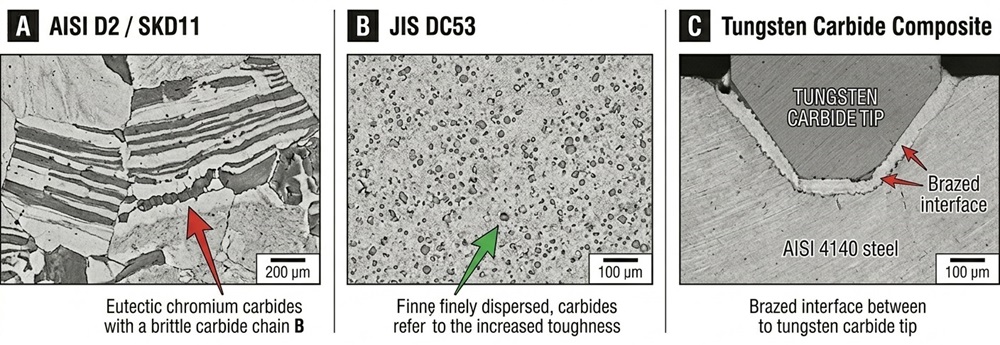
Redesenho de Engenharia e Concessões: Utilize lâminas compostas com corpo em aço estrutural AISI 1045 ou 4140 e insertos de carboneto de tungstênio (WC-Co) brasados nas arestas de corte. Os insertos de carboneto proporcionam alta dureza (89–92 HRA) para resistir à abrasão por fibras, enquanto o corpo de aço mantém a tenacidade estrutural. Compensação em Engenharia: Ambientes com alta vibração ou impactos de metais estranhos podem fazer com que as pastilhas de metal duro se quebrem ou se desprendam da base de aço.
4.8 Lascamento prematuro nos cantos de insertos côncavos quadrados
Análise da Causa Raiz: As quatro pontas dos insertos côncavos quadrados de eixo único concentram a tensão durante a operação. Se o raio côncavo for retificado em excesso, a geometria da borda resultante torna-se muito frágil, tornando os cantos propensos a microlascas sob cargas de impacto padrão.
Redesenho de Engenharia e Concessões: Otimize a geometria de afiação reduzindo a profundidade da concavidade e introduzindo um pequeno chanfro ou brunimento controlado de 0,1 mm na aresta de corte. Isso reforça a geometria do canto com impacto mínimo na capacidade de corte geral.
4.9 Gripagem por atrito em faces intertravadas de múltiplos eixos
Análise da Causa Raiz: Ao triturar materiais dúcteis, como ligas de alumínio ou polímeros macios, altas pressões laterais podem forçar o material para os espaços laterais entre as lâminas interligadas. Esse material aprisionado sofre alto atrito e pressão, levando à soldagem a frio localizada e à transferência de material (gripagem) para as faces das lâminas, o que aumenta o torque e o atrito.
Redesenho de Engenharia e Concessões: Retifique com precisão as faces laterais das lâminas até obter um acabamento superficial liso com rugosidade Ra < 0,8 μm para reduzir o atrito. Para aplicações que exigem alta ductilidade, adicione ranhuras radiais rasas ao longo das faces das lâminas para auxiliar na ejeção de partículas retidas. Introduza aletas raspadoras radiais nos perfis laterais das lâminas para auxiliar na ejeção de partículas finas da fenda.
4.10 Trincas Térmicas (Fissuração por Calor) devido ao Atrito Contínuo
Análise da Causa Raiz: Triturar materiais altamente elásticos pode gerar um atrito contínuo elevado, criando gradientes térmicos localizados ao longo da aresta da lâmina. A expansão e contração térmica cíclicas resultantes podem causar microfissuras térmicas (rachaduras térmicas) perpendiculares à aresta de corte, o que pode levar a falhas estruturais maiores.
Redesenho de Engenharia e Concessões: Selecione aços para ferramentas com alta condutividade térmica e resistência à têmpera, como o AISI H13. Certifique-se de que o sistema de trituração utilize um ciclo reverso automatizado ou resfriamento externo para controlar as temperaturas de operação.
5.Guia de Engenharia de Materiais
A seleção da liga de aço adequada exige o equilíbrio de três propriedades conflitantes: resistência ao desgaste, resistência ao impacto e capacidade de fabricação (retificação).
5.1 Comparação da Matriz Metalúrgica
A comparação de ligas a seguir reflete a biblioteca de materiais qualificados da Maxtor Metal para a produção de lâminas de trituradores.
International Alloy Standard
Primary Microstructural Carbides
Charpy V-Notch Impact Energy (Toughness)
Abrasive Wear Resistance
Machining & Grindability Index
AISI D2 / DIN 1.2379 / SKD11
Large, banded eutectic chromium carbides (Cr7C3).
Low (20 – 25 J/cm2).
High.
Difficult; high wheel wear.
DC53 (Premium Cold-Work)
Fine, evenly dispersed secondary alloy carbides.
Very High (28 – 45 J/cm2).
Excellent.
Fair; superior to D2.
AISI H13 / DIN 1.2344
Fine vanadium/molybdenum carbides.
Exceptional (50 – 80 J/cm2).
Moderate.
Good; high machinability.
AISI A8 Mod (Toughness Tool)
Balanced chromium/molybdenum matrix.
Excellent (80 – 100J/cm2).
Medium-High.
Fair.
M6V (High-Vanadium Tool)
Ultra-hard vanadium carbides (VC, 2800HV).
Moderate-High (35 – 40J/cm2).
Superior long-life.
Difficult; requires specialized wheels.
AISI 4140 / DIN 1.7225
Homogeneous tempered martensite (no primary carbides).
High structural ductility.
Low; requires base support.
Excellent; low manufacturing cost.
AISI 420 / DIN 1.4021
Dispersed chromium carbides in a stainless matrix.
High (60 – 80J/cm2).
Medium.
Good.
AISI 440C / DIN 1.4125
High-density primary chromium carbides.
Low-Moderate (15 – 22J/cm2).
High.
Difficult.
Tungsten Carbide (WC-Co)
Pure sintered Tungsten Carbide grains.
Brittle; low impact threshold.
Maximum Industrial.
Requires diamond grinding.
Impact energy values are measured at target working hardness after vacuum hardening and triple tempering. Values at annealed state are significantly higher and are not representative of service conditions.
5.2 Advanced Metallurgical Selection Guidelines
5.2.1 AISI D2 vs. DC53
Traditional D2 steel contains large, non-uniform chromium carbides that form during solidification. These carbides act as stress concentration sites where micro-cracks can easily initiate under heavy shock loads. In contrast, DC53 modifies the chemical composition to eliminate these large carbide bands, resulting in a fine, uniform carbide distribution. This microstructural improvement doubles the material’s impact toughness while maintaining equivalent or superior wear resistance at high hardness levels (58–60 HRC).
M6V: Contains high amounts of vanadium, which forms ultra-hard vanadium carbides throughout the matrix. This alloy is ideal for high-volume, continuous processing lines like RDF generation, where long tool life is critical to reducing downtime.
AISI 420 & 440C: These martensitic stainless steels are selected for highly corrosive applications. AISI 420 provides the impact toughness needed to handle mixed municipal waste containing occasional hard impurities. AISI 440C features higher carbon and chromium content, providing excellent edge retention and wear resistance for pure organic processing, such as animal carcass rendering. 440C’s corrosion resistance also extends to HF-exposed environments such as lithium-ion battery shredding; for material mitigations and wetted-component guidance in that setting, see Riscos na trituração de baterias de íons de lítio: Controles de cisalhamento de baixa velocidade, projeto de atmosfera inerte e tratamento de HF.
6. Tratamiento Térmico e Equilíbrio de Dureza das Lâminas
Industrial shredder blades require precise heat treatment to achieve the proper balance of hardness and toughness. Incorrect tempering or incomplete phase transformation can lead to premature tool failure.
6.1 Vacuum Austenitizing & Controlled Quenching
Blades are heat-treated in a high-vacuum furnace (10-4mbar) to prevent surface decarburization and oxidation. For premium tool steels like D2 and DC53, the material is preheated in stages to minimize thermal distortion before being brought to its final austenitizing temperature (1020℃ – 1040℃). Once uniform carbon dissolution is reached, the parts undergo a high-pressure gas nitrogen quench (6 – 10bar) to quickly transform the austenite matrix into hard martensite.
6.2 Deep Cryogenic Transformation Process
Following the quench, the steel matrix can retain up to 5% to 15% unstable retained austenite. To ensure long-term dimensional stability and prevent distortion or cracking under heavy structural loads, blades undergo a deep cryogenic treatment:
The temperature is lowered at a controlled rate (1℃/min) down to -196℃ using liquid nitrogen.
The blades are held at -196℃ for 12 to 24 hours.
This process forces the complete transformation of retained austenite into martensite and promotes the precipitation of fine η-carbides, improving both wear resistance and structural stability.
6.3 Precision Tempering Strategies
Tempering modifies the hard, brittle martensitic structure into a tougher, more resilient tempered martensite.
High-Temperature Tempering (Secondary Hardening Window): For D2 and DC53 blades used in high-wear applications, triple tempering is performed at 520℃ – 540℃. This triggers secondary carbide precipitation, maximizing wear resistance while maintaining a stable hardness of 58–60 HRC.
Low-Temperature Tempering (Toughness Window):
For shredder blades utilizing AISI D2, tempering is conducted at 180℃ – 200℃ to relieve quenching stresses and achieve peak impact toughness while maintaining a high working hardness of 58–61 HRC. To prevent micro-cracking during subsequent Wire EDM for internal shaft bores, a mandatory post-EDM stress-relief temper at 180℃ – 200℃ for 4 hours must be enforced.
For multi-shaft claw configurations subjected to severe operational shock loads, AISI H13 items must undergo high-temperature tempering cycles within 550℃ – 580℃. This drives complete secondary transformation and matrix stress-relief, establishing a stable tempered martensite structure that delivers its peak Charpy impact energy while targeting a hardness of 48–54 HRC.
7. Geometria da Lâmina e Engenharia do Gume
The geometric design of a shredder blade determines its cutting efficiency, material throughput, and structural durability.
7.1 Single-Shaft Insert Architecture
Single-shaft rotary knives are typically designed as multi-angle square concave inserts. The concave face creates an aggressive, positive rake angle (α = +10°to +15°) that helps pull material into the cutting zone, lowering the required drive motor power.
The center of the insert features a precision-machined countersunk hole designed to accept high-tensile socket head cap screws, securing the blade tightly into its rotor pocket. This pocket provides multi-surface support to absorb high radial and axial cutting forces.
7.2 Multi-Shaft Claw Profiles and Bore Mechanics
Multi-shaft blades are styled as disk cutters featuring a variable number of cutting claws (typically 3-claw, 5-claw, or 8-claw configurations).
3-Claw Profile: Features deep, aggressive hooks with a tall profile, making it ideal for grabbing and tearing bulky, hollow items like plastic drums or car body shells.
8-Claw Profile: Features shorter, closely spaced claws designed for high-density, uniform sizing applications, such as tire shredding or fine biomass processing.
The design of the internal drive bore is critical for delivering high torque from the main drive shaft:
Hexagonal / Octagonal Bores: Provide positive mechanical engagement but feature sharp internal corners that act as stress concentrators.
Involute Spline Bores: Feature a series of matching internal teeth that distribute torsional loads evenly across the entire circumference. This design significantly reduces localized stress concentration, making it ideal for heavy-duty recycling operations.
8. Processo de Fabricação e Inspeção de Qualidade das Lâminas
To ensure reliable performance in demanding recycling environments, shredder blades must follow strict, quality-controlled manufacturing stages.
8.1 Advanced Manufacturing Workflow
Maxtor Metal’s standard manufacturing sequence for industrial shredder blades follows eight controlled stages:
Material Sourcing & Forging: Use clean, vacuum-degassed tool steel ingots. Perform 3D multi-directional forging to ensure uniform grain structure and break up coarse carbide bands.
Spheroidized Annealing: Heat-treat to produce a uniform distribution of granular carbides within a soft ferrite matrix, ensuring consistent machinability and dimensional stability.
CNC Rough Machining: Mill the core blade profiles, drill countersunk holes, and rough-turn the outer diameter, leaving a uniform 0.3mm – 0.5mm grinding allowance across all critical faces.
Vacuum Heat Treatment & Cryogenic Stabilization: Execute the complete vacuum hardening, liquid nitrogen deep freeze, and triple tempering sequence to fix the material’s microstructural properties.
Precision Super-Grinding: Use specialized CNC surface grinders equipped with vitrified CBN (Cubic Boron Nitride) or diamond wheels to finish the cutting edges to a smooth surface finish of Ra< 0.8μm.
Wire EDM Profiling (For Complex Bores): Use high-precision wire EDM to cut internal hexagonal or spline bores into the hardened blade body.
Low-Temperature Stress-Relief Tempering: Immediately temper the parts at 180℃ – 200℃ for a minimum of 4 hours to eliminate residual tensile stresses and the brittle EDM “white layer”.
Final Quality Control Inspection: Validate all dimensions using automated Coordinate Measuring Machines (CMM).
8.2 Metrology Protocols & Inspection Tolerances
Every finished blade must pass three quality control checks before release:
End-Face Flatness Verification: Measured using an optical flat or high-precision digital indicator across the entire blade diameter. For high-precision applications, flatness variation must not exceed ±0.01mm.
Dual-Face Parallelism Testing: The thickness variation between opposing parallel faces is verified at four symmetric points. Total thickness deviation must remain within ±0.05mm to ensure uniform seating when blades are stacked together on a multi-shaft assembly.
9. Estudos de Caso
9.1 Case Study 1: Preventing Cracking in Industrial Silver Recycling
The following data comes from Maxtor Metal’s project support for a precious metals reclamation operator; the customer name has been anonymized.
Original Equipment Configuration: Multi-shaft heavy shredder using standard AISI D2 steel blades through-hardened to 60 HRC. Internal drive engagement was handled via a standard wire EDM-cut internal hexagonal bore.
Operational Failure Analysis: The original D2 blades frequently cracked and split from the sharp corners of the internal hex bore outward during early operation. Investigation revealed that the high torque required to process dense silver scrap amplified the residual tensile stresses left behind by the wire EDM process. The localized micro-cracking was heavily aggravated by the uncontrolled tensile stress fields generated during the legacy vendor’s post-EDM wire cutting, which omitted the critical stress-relief tempering protocol required to eliminate the brittle recast white layer. The large, brittle carbide structures typical of standard D2 steel could not absorb these combined loads, leading to rapid crack propagation and failure.
Evaluation of Engineering Solutions
Solution A: Upgrade to Material DC53
Engineering Approach: Replace AISI D2 steel with premium DC53 cold-work tool steel while maintaining standard, high-efficiency manufacturing methods.
Result Matrix: The fine, uniform carbide structure of DC53 doubled the material’s impact energy compared to D2. This increased toughness allowed the steel matrix to naturally absorb the residual stresses from the EDM process and handle the high torque loads without cracking. The blades maintained a high surface hardness of 58–60 HRC, preserving full wear life while shortening manufacturing lead times.
Solution B: Modify Manufacturing via a Four-Step Process
Engineering Approach: Maintain the original AISI D2 material but completely restructure the manufacturing sequence to isolate and relieve internal stresses:
Vacuum-harden the blank to a lower, tougher hardness level of 52 HRC.
Rough-grind both faces, leaving a 0.1mm – 0.2mm machining allowance.
Wire-EDM cut the internal hexagonal bore profile.
Perform a long, low-temperature stress-relief temper at 180℃ – 200℃ to relieve internal tensile stresses before a final finish grind.
Result Matrix: This process successfully prevented internal bore cracking and achieved a precise flatness tolerance of ±0.01mm. However, lowering the hardness to 52 HRC reduced the blades’ wear life by roughly 35%. This approach also significantly increased manufacturing costs, required more complex processing steps, and extended production lead times.
Final Implementation Decision: The operator chose Solution A. Upgrading to DC53 eliminated the cracking failures, maintained optimal edge wear life, simplified manufacturing, and reduced overall tool production times.
9.2 Case Study 2: Extending Tool Life in Corrosive Organic Waste Processing
The following data comes from Maxtor Metal’s project support for a municipal solid waste processing facility; the customer name has been anonymized.
Industrial Operator Profile: A municipal solid waste facility operating continuous organic waste and animal rendering lines.
Original Equipment Configuration: Heavy-duty dual-shaft shredder fitted with standard AISI D2 tool steel multi-claw blades.
Operational Failure Analysis: The original D2 blades showed severe surface rust and pitting corrosion within hours of processing acidic organic waste (pH < 4.5). This chemical corrosion quickly dulled the cutting edges, causing fibrous materials to wrap around the shafts and clog the machine. The resulting friction led to high operating temperatures, motor overloads, and frequent unscheduled maintenance shutdowns.
Implemented Engineering Redesign: The D2 blades were replaced with high-carbon martensitic stainless steel (AISI 440C), vacuum-hardened and low-temperature tempered to a stable 59 HRC. The side clearance gaps were also opened to 0.25 mm using wider, corrosion-resistant spacers to handle thermal expansion.
Quantified Performance Improvement: The upgraded AISI 440C stainless blades resisted organic acid pitting, maintaining a clean cutting edge over long runs. Continuous operating life between sharpening intervals increased from 72 hours to 300 – 580 hours depending on waste stream acidity and throughput rate. Frictional heat generation was significantly reduced, eliminating thermal clogging and lowering overall motor power consumption by 14%.
10. Seção de Perguntas Frecuentes (FAQ)
Por que o aço AISI D2 frequentemente lasca ou falha ao triturar resíduos sólidos urbanos mistos?
O AISI D2 contém grandes carbonetos de cromo não uniformes que se formam durante a solidificação. Essas bandas de carboneto são frágeis e atuam como concentradores de tensão interna. Quando o triturador encontra metais estranhos não trituráveis ou pedras pesadas, as cargas de impacto repentinas excedem a tenacidade à fratura da matriz D2, levando a micro-lascamentos ou grandes trincas no corpo da lâmina.
Como a atualização para o DC53 ajuda a evitar que as lâminas do triturador trinquem?
O DC53 reduz as grandes bandas de carboneto de cromo típicas do D2, substituindo-as por uma distribuição de carbonetos fina e uniforme. Com base nos testes de qualificação de materiais da Maxtor Metal, esse ajuste microestrutural aproximadamente dobra a energia de impacto Charpy com entalhe em V em comparação com o D2 padrão na mesma dureza de trabalho (58–60 HRC), permitindo que a lâmina absorva melhor impactos repentinos e alto torque sem se fraturar.
Qual é a folga lateral ideal para lâminas de triturador de múltiplos eixos e por que ela é necessária?
Com base nas especificações de montagem multi-eixo da Maxtor Metal, a folga lateral padrão por lado varia de 0.15 mm a 0.40 mm, sendo alcançada ao fabricar o anel distanciador de 0.3 mm a 0.8 mm mais largo do que a espessura da lâmina. Essa folga integrada acomoda as tolerâncias de espessura (ISO 2768-mK) e permite que as lâminas se expandam livremente conforme o atrito as aquece durante a operação, evitando travamento axial e engripamento.
Quando as pastilhas de carboneto de tungstênio devem ser usadas em vez de aço-ferramenta maciço para trituradores de eixo único?
As pastilhas de carboneto de tungstênio são ideais para aplicações de alta abrasão com baixo risco de forte impacto, como a trituração de filmes agrícolas contaminados com areia ou o processamento de plásticos de engenharia reforçados com fibra de vidro. As pastilhas de carboneto oferecem alta dureza (89–92 HRA) para resistir ao desgaste abrasivo, enquanto uma base de aço tenaz como o AISI 4140 fornece o suporte estrutural.
Por que o tratamento criogênico profundo (-196 °C) é recomendado para lâminas de trituradores de alta resistência?
O tratamento criogênico força a austenita retida instável a se transformar completamente em martensita estável. No protocolo de tratamento térmico da Maxtor Metal, as lâminas são mantidas a −196 °C por 12 a 24 horas após a têmpera, eliminando as tensões microestruturais residuais que poderiam causar empenamento ou distorção em serviço, e promovendo a precipitação de finos carbonetos secundários que melhoram a resistência geral ao desgaste.
O que causa a fissura nos furos internos de arrasto (hexagonais ou octogonais) e como isso pode ser corrigido?
O acabamento de furos internos de arrasto por eletroerosão a fio (wire EDM) cria uma "camada branca" fina e frágil na superfície do aço que contém altas tensões de tração residuais. Os cantos vivos dos furos hexagonais ou octogonais também concentram tensões naturalmente. Sob alto torque, as trincas podem se iniciar facilmente nesses cantos e se propagar para o exterior. Isso pode ser evitado aplicando um revenimento para alívio de tensões pós-EDM entre 180 °C e 200 °C ou atualizando o material da lâmina para o DC53 de alta tenacidade.
Qual material de lâmina é o melhor para processar resíduos alimentares orgânicos corrosivos?
For resíduos orgânicos que contêm alta umidade e ácidos, os aços inoxidáveis martensíticos AISI 420 ou AISI 440C são recomendados. O AISI 420 oferece boa tenacidade ao impacto para fluxos de resíduos mistos, enquanto o AISI 440C proporciona maior dureza (58–60 HRC) e excelente retenção de corte para aplicações de processamento de subprodutos (rendering) de grande volume, como o processamento de carcaças.
Qual acabamento de superfície é necessário para as faces das lâminas rotativas de eixo único?
De acordo com os padrões de retificação e inspeção da Maxtor Metal, a face de corte côncava deve ser retificada com precisão para Ra < 0.8 μm para manter um gume de corte afiado e de baixo atrito, enquanto os assentos de montagem planos exigem Ra < 1.6 μm para garantir um encaixe rígido e seguro no alojamento do rotor.
Por que os aços-ferramenta padrão são ineficazes para o processamento de subprodutos animais (rendering) e carcaças?
Os fluidos animais contêm altas concentrações de ácidos orgânicos e sais que fazem com que os aços-ferramenta padrão, como o D2 ou o DC53, enferrujem e sofram corrosão por pites rapidamente. Esse desgaste corrosivo degrada a matriz do aço e embota rapidamente o gume de corte, levando ao entrelaçamento do material, atrito e eventual sobrecarga da máquina. Aços inoxidáveis martensíticos como o AISI 440C são necessários para suportar essas condições.
Qual é a finalidade do revestimento PVD TiN em contra-lâminas (estatores) de eixo único?
O revestimento de nitreto de titânio (TiN) aumenta a dureza superficial para mais de 2000 HV nas faces de cisalhamento primárias. Esse revestimento atua como uma barreira contra o desgaste abrasivo, tornando-o altamente eficaz para aplicações de precisão, como a reciclagem de cabos elétricos, onde a manutenção de um gume limpo e afiado é crítica para evitar a deformação do isolamento.
Como o perfil de uma lâmina multi-eixo de 3 garras difere em aplicação de um perfil de 8 garras?
O perfil de 3 garras apresenta ganchos altos e agressivos projetados para agarrar e rasgar materiais volumosos e ocos, como tambores plásticos, pneus ou sucata automotiva. O perfil de 8 garras possui ganchos mais curtos e frequentes que realizam um rasgamento menos agressivo, porém entregam uma granulometria mais uniforme e fina, tornando-o ideal para processar biomassa solta ou borracha pré-triturada.
Por que as tolerâncias dimensionais para as bases das lâminas de eixo único são restritas a ±0.02 mm?
Os trituradores de eixo único operam com uma ação de corte pulsante de alta frequência. A Maxtor Metal aplica uma tolerância estrita de ±0.02 mm nos assentos da base da lâmina e nas faces de localização —verificada por meio de retificação CNC de precisão— para garantir um ajuste rígido dentro do alojamento do rotor e evitar micro-movimentos que causam falha por fadiga dos parafusos de fixação principais.
Quais compensações de engenharia ocorrem ao reduzir a dureza da lâmina para melhorar a tenacidade?
Reduzir a dureza de uma lâmina (por exemplo, revenindo o aço D2 para 52 HRC) aumenta sua tenacidade ao impacto e resistência a trincas. No entanto, isso reduz sua resistência ao desgaste abrasivo, o que significa que os gumes de corte perderão o corte mais rapidamente e exigirão afiação ou substituição mais frequentes, aumentando o tempo de inatividade operacional.
Qual é a vantagem de um furo estriado envolvente (involute spline) em relação a un furo hexagonal padrão para acionamentos multi-eixo?
O furo hexagonal concentra as tensões torcionais em seus seis cantos vivos, o que pode levar a trincas por fadiga com o tempo. Já o furo estriado envolvente utiliza uma série de dentes curvos para distribuir o torque de acionamento uniformemente por toda a circunferência do eixo, reduzindo significativamente o estresse localizado e prolongando a vida útil da lâmina sob cargas pesadas.
Como identificar se a falha de uma lâmina foi causada por desgaste abrasivo ou por fadiga por impacto?
O desgaste abrasivo manifesta-se como microrranhuras suaves, arranhões e um arredondamento gradual do gume de corte ao longo do tempo. A fadiga por impacto causa micro lascamento repentino, esfoliação (spalling) ou trincas grandes e denteadas em todo o corpo da lâmina, normalmente desencadeadas pelo impacto com um objeto não triturável.
Chamada para Ação de Engenharia Final
Otimize a Produtividade do seu Sistema de Trituração
Does your production line experience frequent downtime due to blade chipping, corner cracking, or rapid wear? Shifting from generic replacement parts to precision-engineered shredder blades can stabilize your processing costs and improve system reliability.
Maxtor Metal’s engineering team can review your system drawings and material requirements to develop customized solutions:
Custom Alloy Matching: We select and treat materials (including DC53, M6V, and AISI 440C) based on your specific waste stream dynamics.
Fabricação de precisão: All parts are finished with advanced vacuum heat treatments, cryogenic stabilization, and precision CNC grinding down to ±0.01mm tolerances.
Direct RFQ Support: Submit your CAD files (.STEP, .DWG) or OEM part numbers today for a detailed technical review and production quote.









 English
  Spanish
 Italian
 French
 Portuguese
 Russian
 German
 Arabic
 Hindi
Hindi
 Vietnamese
 Indonesian
 Japanese
 Korean