

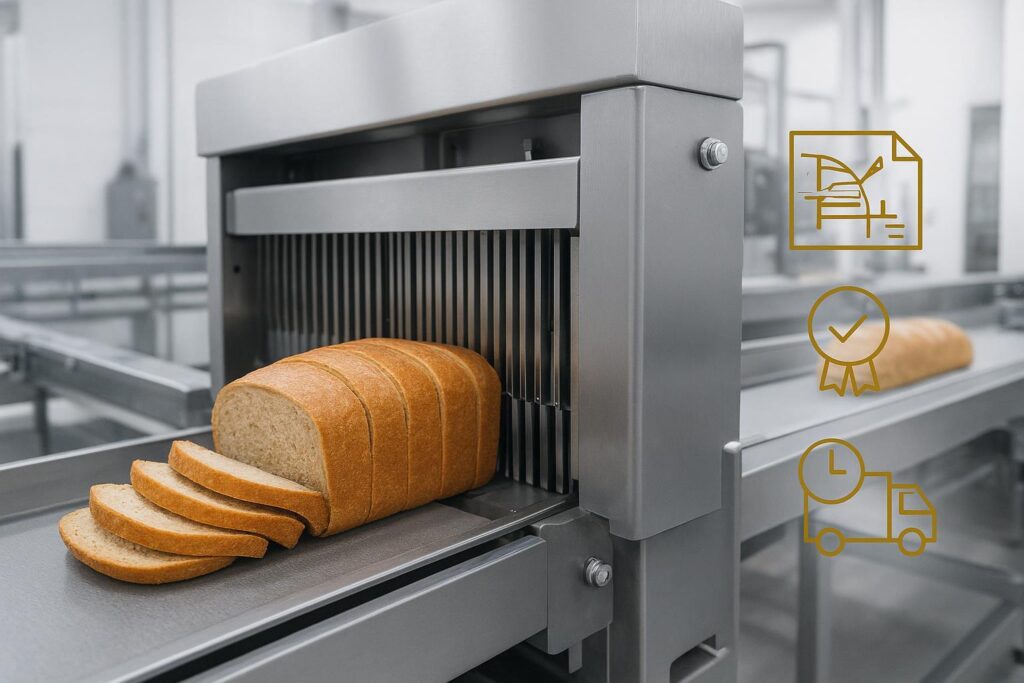
Die Wahl eines Herstellers für Brotschneidemesser ist eine langfristige betriebliche Entscheidung und nicht nur der Kauf eines Ersatzteils. Wenn Sie den Lieferanten richtig qualifizieren – technische Kompetenz, QS-/Compliance-Disziplin und Lieferzuverlässigkeit –, erhalten Sie sauberere Schnitte, weniger Krümel und Ausschuss, längere Laufzeiten zwischen den Wechseln und niedrigere Gesamtbetriebskosten (TCO).
Dieser Leitfaden wurde für industrielle Brotschneidemesser entwickelt, die in Hochleistungs-Backlinien und OEM-Bauprogrammen eingesetzt werden, bei denen die Wiederholgenauigkeit über Chargen hinweg wichtiger ist als ein einzelnes gutes Muster.
Was Sie bewerten werden: Technik, QS/Compliance, Lieferzuverlässigkeit
Ergebnisse: bessere Schnittqualität, niedrigere TCO, weniger Messerwechsel und Ausschuss
So nutzen Sie diesen Leitfaden: Daten anfordern, Pilotprojekte durchführen, Dokumente prüfen, dann skalieren
Auswahlrahmen für einen Hersteller von Brotschneidemessern

Qualifizierung eines Herstellers
Beginnen Sie mit einer Qualifizierungsprüfung, die sich nicht manipulieren lässt. Für eine langfristige Belieferung kommt es auf die Wiederholgenauigkeit über Chargen hinweg an, nicht auf ein einmaliges “gutes Muster”.”
Technische Kompetenz (können sie das bauen, was Ihre Linie benötigt?)
- Können sie auf der Grundlage von Zeichnungen, Mustern oder Fotos arbeiten und diese in kontrollierte Abmessungen und Schneidengeometrien umsetzen?
- Können sie erklären, wie sie Stahl, Wärmebehandlung, Zielhärten und Schneidenfinish für verschiedene Brotsorten und Liniengeschwindigkeiten auswählen?
- Können sie eine Passfähigkeits-Checkliste (Maschinenmodell, Messeranzahl, Länge/Breite/Dicke, Lochbild, Führungen, Spannmethode) bereitstellen und Toleranzen bestätigen, bevor sie ein Angebot erstellen?
QS-/Compliance-Kompetenz (können Sie Audits mit deren Dokumenten bestehen?)
- Können sie eine chargenbasierte Rückverfolgbarkeit (Rohmaterial → Wärmebehandlung → Schleifen → Endkontrolle → Verpackung) gewährleisten?
- Können sie Konformitätserklärungen für den Lebensmittelkontakt und Hygienedokumente bereitstellen, die für Ihre Region und die Anforderungen Ihrer Kunden geeignet sind?
- Verfügen sie über kontrollierte Prüfschritte (Wareneingang, In-Prozess-Kontrollen, Endkontrolle) und Aufzeichnungen, die Sie auditieren können?
Lieferzuverlässigkeit (können sie Ihren Betrieb über 12–36 Monate aufrechterhalten?)
- Können sie sich auf Lieferzeitfenster und OTIF-Leistungsziele (On-Time-In-Full) verpflichten?
- Können sie Sicherheitsbestände/VMI unterstützen, wenn Ihre Messerwechsel häufig sind oder die Nachfrage saisonal schwankt?
- Gibt es einen definierten Eskalationspfad, wenn ein Fehler an einer laufenden Linie auftritt?
Wichtigste Erkenntnis: Ein “qualifizierter” Messerlieferant ist jemand, bei dem Sie nachbestellen können, ohne die harten Lektionen erneut lernen zu müssen – weil die technischen Vorgaben, QS-Aufzeichnungen und das Liefermodell alle kontrolliert sind.
KPI- und Testplandesign
Ein Lieferantenvergleich scheitert, wenn die KPIs vage sind (“schneidet gut”) oder sich der Versuchsaufbau von Durchlauf zu Durchlauf ändert. Definieren Sie Ihre KPIs und Testbedingungen, bevor Sie den ersten Laib schneiden.
Definieren Sie KPIs, die Sie in der Produktion messen können
- Slice thickness variance: Messen Sie die Verteilung der Scheibendicke (Zielwert, Toleranzband und Drift im Zeitverlauf).
- Crumb generation: Wiegen Sie die Krümel pro X Laibe oder messen Sie das Krümelvolumen, das von Ihrem Auffangsystem während eines definierten Durchlaufs erfasst wird.
- Defektrate: Reißen, gequetschte Scheiben, unsaubere Kanten, “Engelshaar”, Fehler bei den Endscheiben.
- Blade life: Laibe oder Stunden bis zu einer definierten Verschleißgrenze (z. B. Krümelrate überschreitet Grenzwert, Dickenschwankung überschreitet Grenzwert oder optische Mängel überschreiten den Grenzwert).
- Umrüstzeit: Minuten von der Abschaltung bis zum ersten verifizierten einwandfreien Laib.
- Auswirkungen auf die Linie: Ausfallminuten, die auf den Messerwechsel/die Messereinstellung zurückzuführen sind; Nachspann- oder Ausrichtungsereignisse nach dem Wechsel.
Testbedingungen festlegen
- Brotsorte und -spezifikation (weiches Toastbrot, krustiges Brot, angereichertes Brot usw.).
- Produkttemperaturbereich (insbesondere wenn Warmschneiden vorgesehen ist).
- Schneidemaschineneinstellungen: Spannungssollwert, Zustand der Führungen, Geschwindigkeit und Reinigungsintervall.
Wenn Sie eine fundierte Referenz darüber benötigen, worauf es an der Schnittstelle zwischen Messer und Linie am meisten ankommt, hebt BakingBusiness Teilung, Schneide und Spannung als die Kerneigenschaften hervor, die die Schneidleistung in Produktionsumgebungen bestimmen (Die drei Kerneigenschaften von Brotschneidemessern — Baking Business).
Hochlauf und Requalifizierung
Eine langfristige Belieferung erfordert Kontrollen nach der Pilotphase.
- Hochlaufplan: Definieren Sie, wie Sie von Pilotmengen auf das volle Produktionsvolumen übergehen (z. B. 1 Linie → 1 Werk → mehrere Standorte).
- Goldenes Muster + Revisionskontrolle: Legen Sie ein Referenzmesser fest (Abmessungen + Schneidenspezifikation + Finishspezifikation) und fordern Sie eine kontrollierte Änderungsmitteilung.
- Auslöser für eine Requalifizierung: neue Stahlschmelze, neue Schleifscheibe/neuer Schleifprozess, neue Beschichtung, neue Verpackung oder jede Designänderung.
- Laufende Verifizierung: regelmäßige Wareneingangsprüfungen (Abmessungen, Härte-/Schneidenprüfungen, falls zutreffend) und Trendüberwachung der Krümel- und Dicke-KPIs.
Technik und Leistung

Materialien und Zielhärten
Ihre Messermaterialien und Zielhärten sollten auf der Grundlage von drei Gegebenheiten ausgewählt werden: Brotsorte, Reinigungsumgebung und die Schadensfälle, die Sie keinesfalls tolerieren können.
- Corrosion resistance vs edge retention: food-contact environments demand cleanable surfaces and corrosion resistance, but you still need edge stability under high throughput.
- Toughness vs brittleness: a very hard blade can hold an edge longer but may be less forgiving if alignment or tension is inconsistent. In tool steels, hardness and toughness commonly trade off—harder conditions tend to chip/crack more easily under shock, while tougher conditions may wear faster (overview: https://www.edconsteel.com.au/articles/steel-and-metal-articles/hardness-vs-toughness-tool-steel/).
What to request from a manufacturer:
- Material grade options and why they recommend them for your bread and slicer type.
- Heat treatment method and controlled hardness range (and how they verify it per lot). Heat treatment is a primary lever for tailoring hardness, ductility, toughness, and wear behavior (general explanation: https://www.metalsupermarkets.com/how-heat-treatment-of-metals-work/).
- Any surface finishing or coating options intended to reduce sticking/drag (evaluate these in your crumb and warm-bread tests).
For background reading on bread-blade materials and selection factors, you can reference MAXTOR METAL’s internal guide on bread cutting blades for industrial use.
Edge geometry and finish
Edge geometry is where slice quality, crumb behavior, and blade life meet. If your supplier can’t describe geometry in measurable terms, you’re buying outcomes blind.
- Tooth form and pitch: affects how aggressively the blade enters the crumb and crust.
- Oberflächengüte der Schneide: burr control and grind quality influence crumb generation and how quickly the edge degrades.
- Matched sets: for multi-blade frames, consistency across a set matters as much as the average.
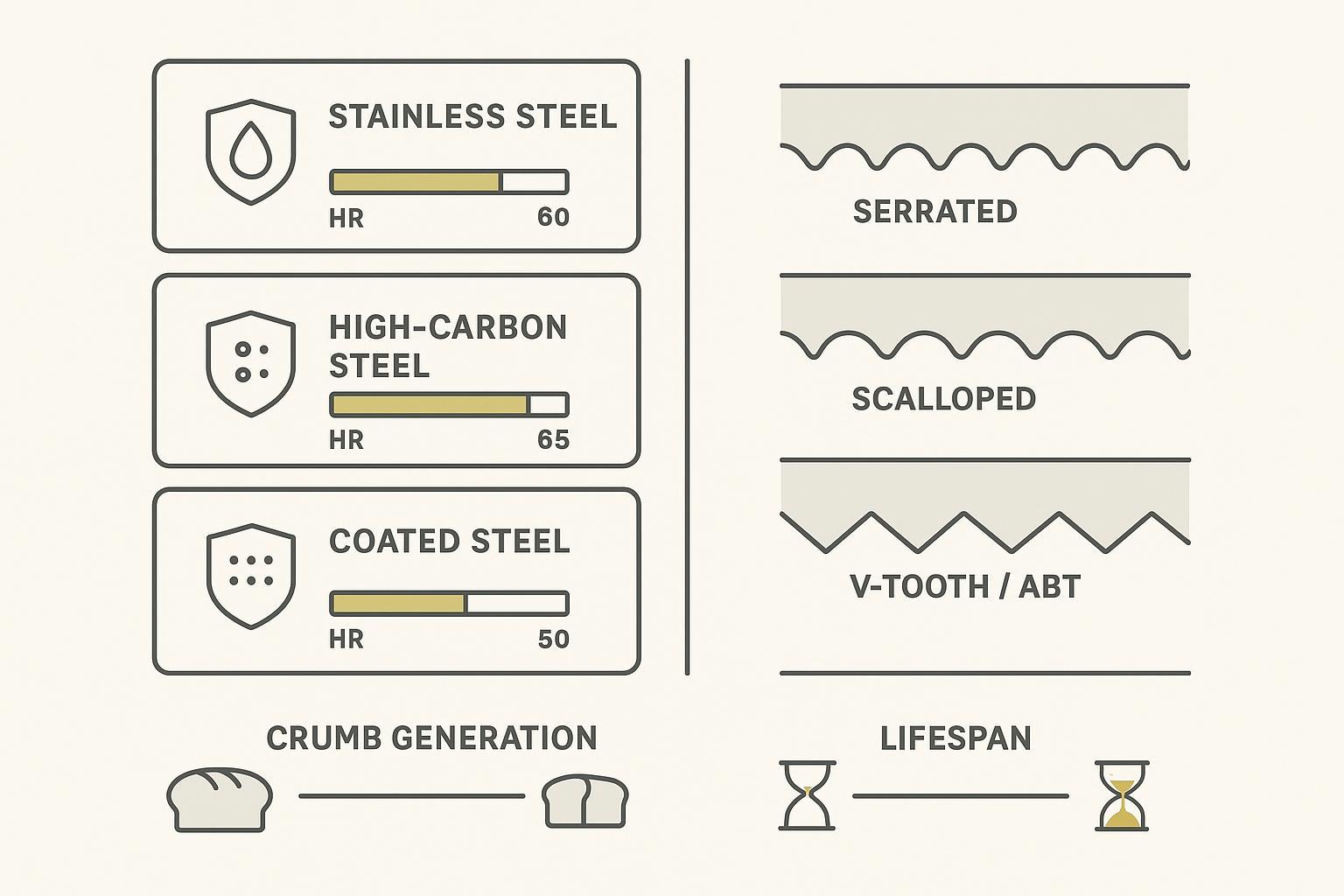
A practical way to compare profiles is to map them to your defect modes:
- If you fight tearing and ragged edges, geometry and tension stability are usually the first variables to verify.
- If you fight crumb load and sanitation burden, edge finish (burr control) and the profile’s rubbing behavior matter.
For a deeper internal breakdown of edge options (without turning this post into a product brochure), see MAXTOR METAL’s comparison of scallop vs V-tooth vs ABT bread slicer blade edges.
Warm bread and crumb control
Warm slicing is where many “fine in the lab” blades fail on the floor. As product temperature rises, crumb softens, stickiness increases, and small geometry differences show up as compression, drag, and tearing.
What to validate in a warm-bread pilot:
- Stick/slip and drag: does the blade start pulling the loaf, or does it cut cleanly at speed?
- Crumb buildup pattern: where does debris accumulate (guides, blade face, tension points), and does it cause thickness drift?
- Cleaning interval sensitivity: does slice quality fall off sharply if sanitation is delayed by one cycle?
Profi-Tipp: Treat warm-bread slicing as its own qualification condition. If your production sometimes slices warm, don’t accept a supplier that only tests on fully cooled loaves.
Compliance and QA
Food-contact and hygiene basis
For bakeries and OEMs, “food contact” is not a slogan—it’s a documentation and cleanability discipline.
For EU markets, your supplier’s documentation should align with the EU food-contact framework requirements and good manufacturing practice expectations—at a minimum, the general safety principles in Verordnung (EG) Nr. 1935/2004 and GMP controls in Regulation (EC) No 2023/2006 (see the European Commission overview of food contact materials: https://food.ec.europa.eu/food-safety/chemical-safety/food-contact-materials_en).
For metals and alloys specifically, it’s also common to reference the EDQM (Council of Europe) guidance on metals and alloys used as food contact materials, which provides release-limit guidance and test approaches used across Europe (EDQM activities page: https://www.edqm.eu/en/metals-and-alloys-used-in-food-contact-materials-and-articles).
At minimum, you want the manufacturer to clearly state:
- Which blade materials are intended for food-contact environments and how they control surface condition (finish, burrs, corrosion risk) for food-grade slicer blades.
- What cleaning/sanitation chemicals are assumed in their material recommendations.
- How blades are packaged to prevent corrosion and contamination in transit and storage.
Traceability and ISO 9001
Traceability is your fastest path to root-cause analysis when slice quality changes.
What to request:
- Lot-level traceability: material heat/lot, heat treatment batch, in-process inspection records, final inspection results, and packing identification.
- ISO 9001 documentation: certificate validity, scope, and the supplier’s actual inspection and nonconformance control records tied to your product. For buyers, a practical check is whether the supplier can show controlled “documented information” and audit evidence consistent with ISO 9001:2015 expectations (ISO overview: https://asq.org/quality-resources/iso-9001).
- CoA / material certificate pack: composition where applicable, hardness verification method/range, and dimensional inspection report.
Neutral capability note (MAXTOR METAL): MAXTOR METAL can provide standard QA documentation packages for industrial blades—typically including a lot-linked Certificate of Analysis (CoA) and a Declaration of Conformity (DoC) upon request, along with inspection records aligned to an ISO 9001 quality management approach—so buyers can support supplier approval and internal audit requirements.
Sanitation SOPs and audit records
For long-term supply, don’t just request documents—verify that the supplier’s hygiene controls match your reality.
- Ask for a sanitation SOP that covers handling, packing, and contamination control.
- Request example audit records or inspection logs (with sensitive details redacted) that show repeatable execution.
- Define how nonconformances are handled: containment, root cause, corrective action, and re-release criteria.
Compatibility and customization

OEM fit and guides
Most “blade problems” show up as fitment and guiding problems in production.
Before you scale a new supplier, verify:
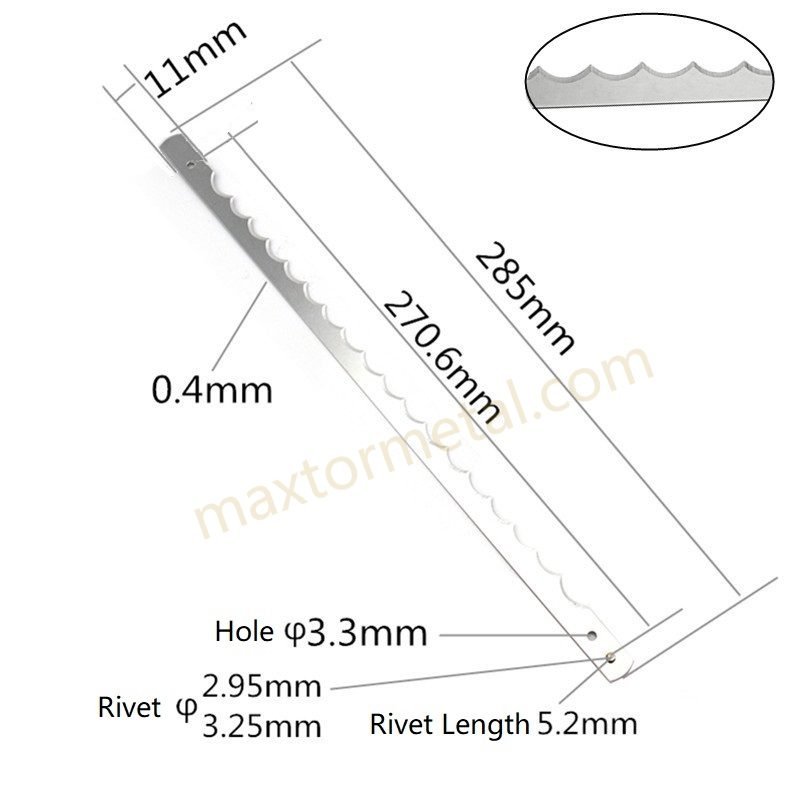
- Blade dimensions and mounting interface match your slicer design.
- Guides and wear parts are within spec; worn guides can turn a good blade into a crumb generator.
- The supplier can provide a fitment confirmation checklist tied to your machine model and drawing revision.
If you need a reference point for what information a supplier typically requests to avoid fitment surprises, MAXTOR METAL’s bread slicer blades page summarizes common configurations and manufacturing scope.
Non-standard designs and iterations
OEMs and high-mix bakeries often need iteration: tooth form changes, finish changes, material changes, or small dimensional adjustments.
To make iterations safe and fast:
- Require revision control on drawings/specs.
- Define what changes require requalification (material, heat treat, coating, edge geometry).
- Run short “A/B” pilots with the same bread spec and the same sanitation cycle.
Changeover, tension, alignment
Changeover is where supply decisions become OEE decisions.
What to evaluate in a supplier’s solution:
- Does the blade set arrive as a matched set that reduces time spent chasing tension balance?
- Are installation and tensioning instructions explicit, verifiable, and safe?
- Does the blade hold alignment across a run, or do you see repeated re-tension events?
If you want a quick refresher on how tension and edge properties drive slice outcomes, refer back to BakingBusiness’ pitch/edge/tension overview cited earlier.
Supply model and commercials

Lead times, MOQ, VMI options
A long-term blade supplier is also a supply-chain partner. For high-volume lines, the best engineering outcome still fails if you stock out.
Options to evaluate:
- Lead time bands (standard vs expedited) with documented historical performance.
- MOQ policy that doesn’t force you into excess inventory.
- VMI / safety stock for plants with seasonal demand or frequent changeovers.
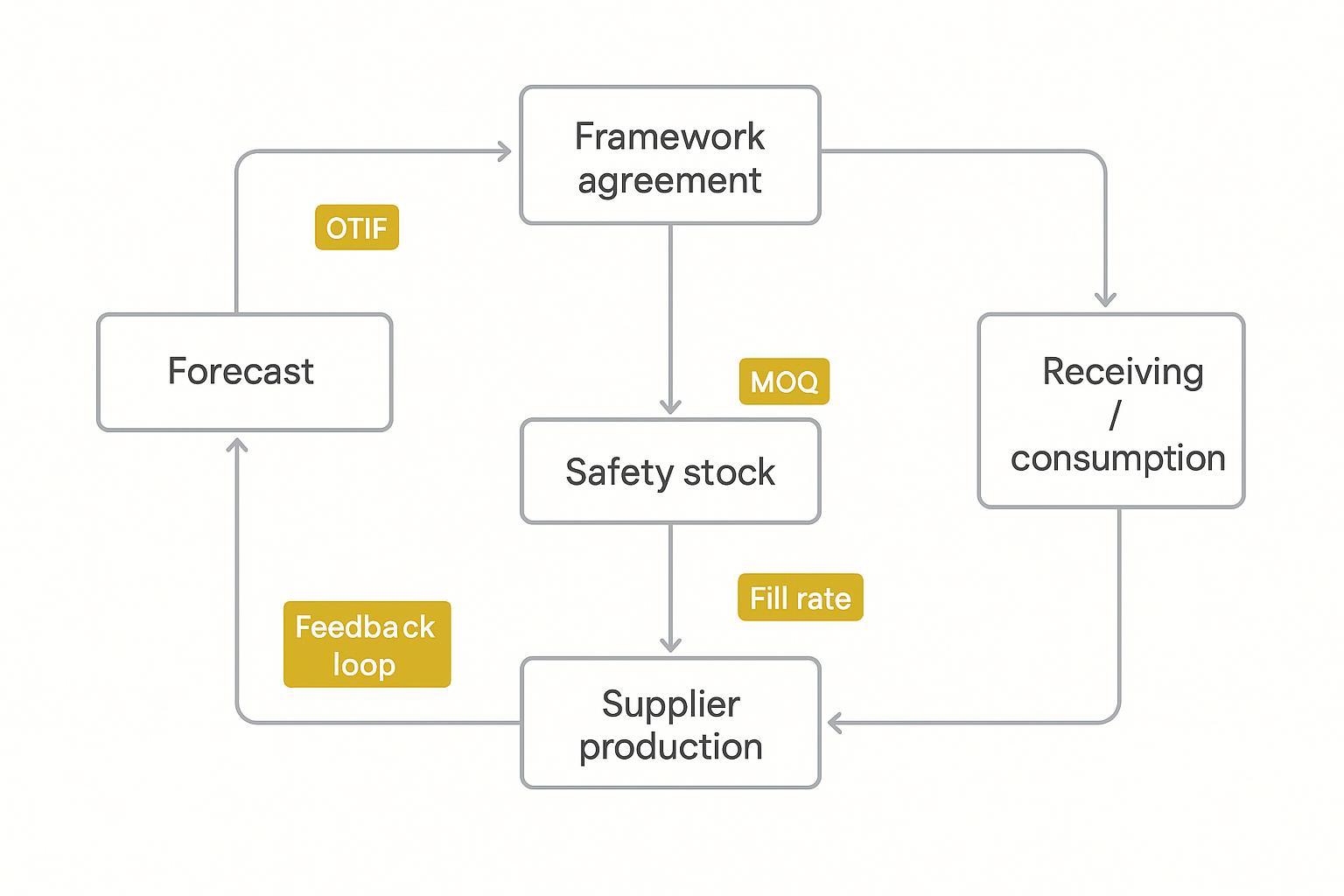
A practical VMI model for blades usually includes:
- rolling forecast (your demand signal)
- agreed safety stock at the supplier or local hub
- OTIF tracking and an escalation path when performance slips
Terms, SLAs, and KPIs
If you want long-term stability, put operational definitions into the commercial agreement.
Beispiele:
- OTIF: define “on time” and “in full” precisely.
- Quality escape rate: what counts as a defect in your process, and how it’s measured.
- Corrective action timing: response time, containment timeline, and replacement policy.
- Change notification: mandatory notice for material/process changes and the requalification requirement.
Warranty and after-sales
Blades are consumables, but the supplier relationship shouldn’t be disposable.
Check whether the manufacturer provides:
- Clear warranty scope tied to measurable criteria (not vague promises).
- After-sales support for troubleshooting: tension guidance, fitment checks, and iteration support.
- A documented feedback loop: how pilot data becomes the next design iteration.
For a practical operations-oriented approach to keeping performance stable after installation, MAXTOR METAL’s bread slicer blade maintenance guide is a useful internal reference you can align with your own SOPs.
Fazit
Key takeaways: verify KPIs, compliance docs, and supply terms before commitment
Next steps: issue RFI/RFQ, run pilot on your SKUs, finalize framework and VMI
If you want to move from “supplier quotes” to a controlled long-term supply decision, build your RFI/RFQ around the qualification framework above, attach your drawings/specs, and require a pilot plan with acceptance KPIs (crumb, thickness variance, defect rate, blade life, and changeover time).
Hinweis: This article is an operational buyer’s guide. Any references to MAXTOR METAL are provided as optional examples and further reading; you should validate fit, performance, and compliance against your specific line conditions and regional requirements.
Letzte Aktualisierung: 2026-05-03
When you’re ready to run a pilot, MAXTOR METAL can support engineering review from drawings/samples and align the QA document pack (e.g., CoA/DoC and lot traceability requirements) so your scale-up decision is based on verified data—not assumptions.
Häufig gestellte Fragen
What information should I send a manufacturer for a correct quote?
Send a drawing whenever possible, plus a fitment checklist: slicer model, blade count, length/width/thickness, hole pattern, guide style, and how your frame tensions the blades. Also include bread type, line speed, cleaning chemistry, and whether you ever slice warm—those inputs drive material, hardness, and edge geometry decisions.
Which KPIs matter most in a blade pilot?
Use measurable, floor-friendly KPIs: slice thickness variance, crumb generation, defect rate (tearing, ragged edges, compression), blade life to a defined end-of-life threshold, and changeover time. The key is consistency: lock your test conditions so results are comparable across lots and suppliers.
How do I avoid being fooled by a “good sample” that can’t be repeated?
Treat the pilot as a process qualification, not a one-off test. Ask for lot-based traceability, confirm controlled dimensions and edge specs, and require revision control on the “golden sample.” Then define requalification triggers (new steel heat, new grinding wheel/process, coating changes, or packaging changes) before you scale.
What should EU buyers ask for on food-contact compliance?
At a minimum, ask the supplier to state the intended food-contact material(s), the assumed sanitation chemicals, and the packaging method that prevents corrosion/contamination. For EU markets, make sure they can support the general safety expectations under the EU framework for food contact materials and GMP controls—summarized by the European Commission in Food contact materials—and be able to discuss how they evaluate metals and alloys against recognized European guidance such as EDQM metals and alloys used in food contact materials and articles.
What does ISO 9001 tell me about a supplier’s quality discipline?
ISO 9001 doesn’t guarantee “no defects,” but it does indicate the supplier should have structured controls for documented information, internal audits, and nonconformance handling. When you review a supplier, verify that their certificate scope actually covers your product/process and that they can show product-linked inspection and corrective-action records consistent with ISO 9001:2015 concepts outlined by ASQ’s ISO 9001 overview.
How do materials and heat treatment affect crumb, tearing, and blade life?
In practice, you’re balancing corrosion resistance, wear resistance, and fracture resistance. Harder conditions often improve wear but can chip more easily under shock or misalignment, while tougher conditions may tolerate variability but wear faster—an overview is described in Edcon Steel’s hardness vs toughness discussion. Heat treatment is one of the main levers that shifts this balance by changing microstructure and mechanical properties; see Metal Supermarkets’ heat treatment overview.
Should we qualify warm slicing separately?
Yes. Warm product increases stickiness and deformation, so small geometry and finish differences show up quickly as drag, compression, and tearing. If warm slicing occurs in your operation—even occasionally—treat it as a separate qualification condition with its own acceptance thresholds and cleaning-interval sensitivity checks.
Autor
Jesse Xu — Senior Quality Engineer, QA (Quality Assurance). 15 years of experience in industrial blade quality and failure analysis.
- Failure analysis focus: Able to distinguish whether issues like edge chipping and poor wear resistance are driven primarily by heat treatment process problems or by material segregation.
- Zertifizierungen: ASQ – CQE; ISO 9001 Lead Auditor; ASNT Level II.

 English
  Spanish
  Italian
  French
  Portuguese
  Russian
  German
  Arabic
  Hindi
Hindi  Vietnamese
  Indonesian
  Japanese
  Korean