

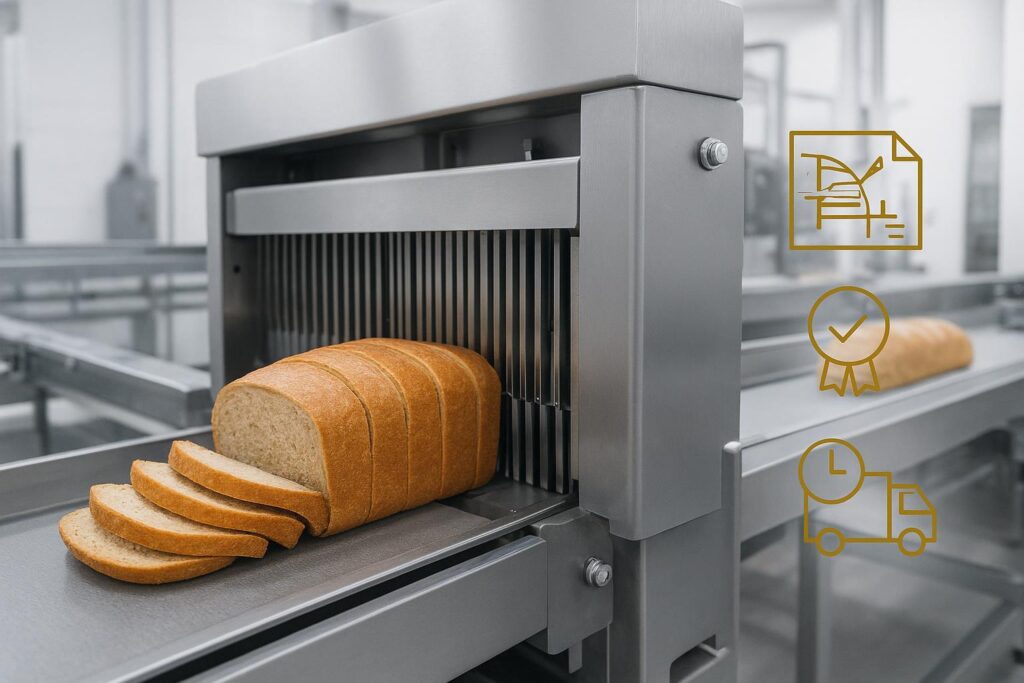
Choosing a bread slicer blade manufacturer is a long-term operations decision, not just a spare-parts purchase. If you qualify the supplier correctly—engineering capability, QA/compliance discipline, and supply reliability—you get cleaner slices, fewer crumbs and defects, longer run time between changeovers, and a lower total cost of ownership (TCO).
This guide is written for industrial bread slicing blades used in high-throughput bakery lines and OEM build programs, where repeatability across lots matters more than a single good sample.
What you will evaluate: engineering, QA/compliance, supply reliability
Outcomes: better slice quality, lower TCO, fewer changeovers and defects
How to use this guide: request data, run pilots, verify documents, then scale
Selection framework for a bread slicer blade manufacturer

Qualifying a manufacturer
Start with a qualification screen that’s hard to game. For long-term supply, you’re looking for repeatability across lots, not a one-time “good sample.”
Engineering capability (can they build what your line needs?)
- Can they work from drawings, samples, or photos and turn that into controlled dimensions and edge geometry?
- Can they explain how they choose steel, heat treatment, hardness targets, and edge finishing for different bread types and line speeds?
- Can they provide a fitment checklist (machine model, blade count, length/width/thickness, hole pattern, guides, tension method) and confirm tolerances before they quote?
QA/compliance capability (can you pass audits with their paperwork?)
- Can they provide lot-based traceability (raw material → heat treat → grinding → final inspection → packing)?
- Can they provide food-contact and hygiene documentation appropriate for your region and customer requirements?
- Do they have controlled inspection steps (incoming material, in-process checks, final inspection) and records you can audit?
Supply reliability (can they keep you running for 12–36 months?)
- Can they commit to lead time bands and on-time-in-full (OTIF) performance targets?
- Can they support buffer stock/VMI if your changeovers are frequent or demand is seasonal?
- Do they have a defined escalation path when a defect shows up on a running line?
Điểm chính: A “qualified” blade supplier is one you can re-order from without re-learning the hard lessons—because the engineering inputs, QA records, and supply model are all controlled.
KPI and test plan design
A supplier comparison fails when KPIs are vague (“cuts well”) or the pilot setup changes from run to run. Define your KPIs and test conditions before you cut the first loaf.
Define KPIs you can measure on the floor
- Slice thickness variance: measure slice thickness distribution (target, tolerance band, and drift over time).
- Crumb generation: weigh crumbs per X loaves or measure crumb volume captured by your collection system over a defined run.
- Defect rate: tearing, compressed slices, ragged edges, “angel hair,” end-slice failures.
- Cuộc sống lưỡi kiếm: loaves or hours to a defined end-of-life threshold (e.g., crumb rate exceeds limit, thickness variance exceeds limit, or visual defects exceed limit).
- Thời gian chuyển đổi: minutes from lock-off to verified first-good loaf.
- Line impact: downtime minutes attributable to blade change/adjustment; post-change re-tension or alignment events.
Lock test conditions
- Bread type and spec (soft sandwich, crusty, enriched, etc.).
- Product temperature window (especially if warm slicing is in scope).
- Slicer settings: tension setpoint, guide condition, speed, and cleaning interval.
If you need a grounding reference for what matters most at the blade/line interface, BakingBusiness highlights pitch, edge, and tension as the core properties that drive slicing performance in production settings (The three core properties of bread slicing blades — Baking Business).
Ramp-up and requalification
Long-term supply requires controls after the pilot.
- Ramp-up plan: define how you move from pilot quantities to full production volume (e.g., 1 line → 1 plant → multi-site).
- Golden sample + revision control: lock a reference blade (dimensions + edge spec + finish spec) and require controlled change notification.
- Requalification triggers: new steel heat, new grinding wheel/process, new coating, new packaging, or any design iteration.
- Ongoing verification: periodic incoming checks (dimensions, hardness/edge checks as applicable) and trend monitoring on crumb and thickness KPIs.
Engineering and performance

Materials and hardness targets
Your blade material and hardness targets should be chosen around three realities: bread type, sanitation environment, and the failure mode you can’t tolerate.
- Corrosion resistance vs edge retention: food-contact environments demand cleanable surfaces and corrosion resistance, but you still need edge stability under high throughput.
- Toughness vs brittleness: a very hard blade can hold an edge longer but may be less forgiving if alignment or tension is inconsistent. In tool steels, hardness and toughness commonly trade off—harder conditions tend to chip/crack more easily under shock, while tougher conditions may wear faster (overview: https://www.edconsteel.com.au/articles/steel-and-metal-articles/hardness-vs-toughness-tool-steel/).
What to request from a manufacturer:
- Material grade options and why they recommend them for your bread and slicer type.
- Heat treatment method and controlled hardness range (and how they verify it per lot). Heat treatment is a primary lever for tailoring hardness, ductility, toughness, and wear behavior (general explanation: https://www.metalsupermarkets.com/how-heat-treatment-of-metals-work/).
- Any surface finishing or coating options intended to reduce sticking/drag (evaluate these in your crumb and warm-bread tests).
For background reading on bread-blade materials and selection factors, you can reference MAXTOR METAL’s internal guide on bread cutting blades for industrial use.
Edge geometry and finish
Edge geometry is where slice quality, crumb behavior, and blade life meet. If your supplier can’t describe geometry in measurable terms, you’re buying outcomes blind.
- Tooth form and pitch: affects how aggressively the blade enters the crumb and crust.
- Độ bóng cạnh cắt: burr control and grind quality influence crumb generation and how quickly the edge degrades.
- Matched sets: for multi-blade frames, consistency across a set matters as much as the average.
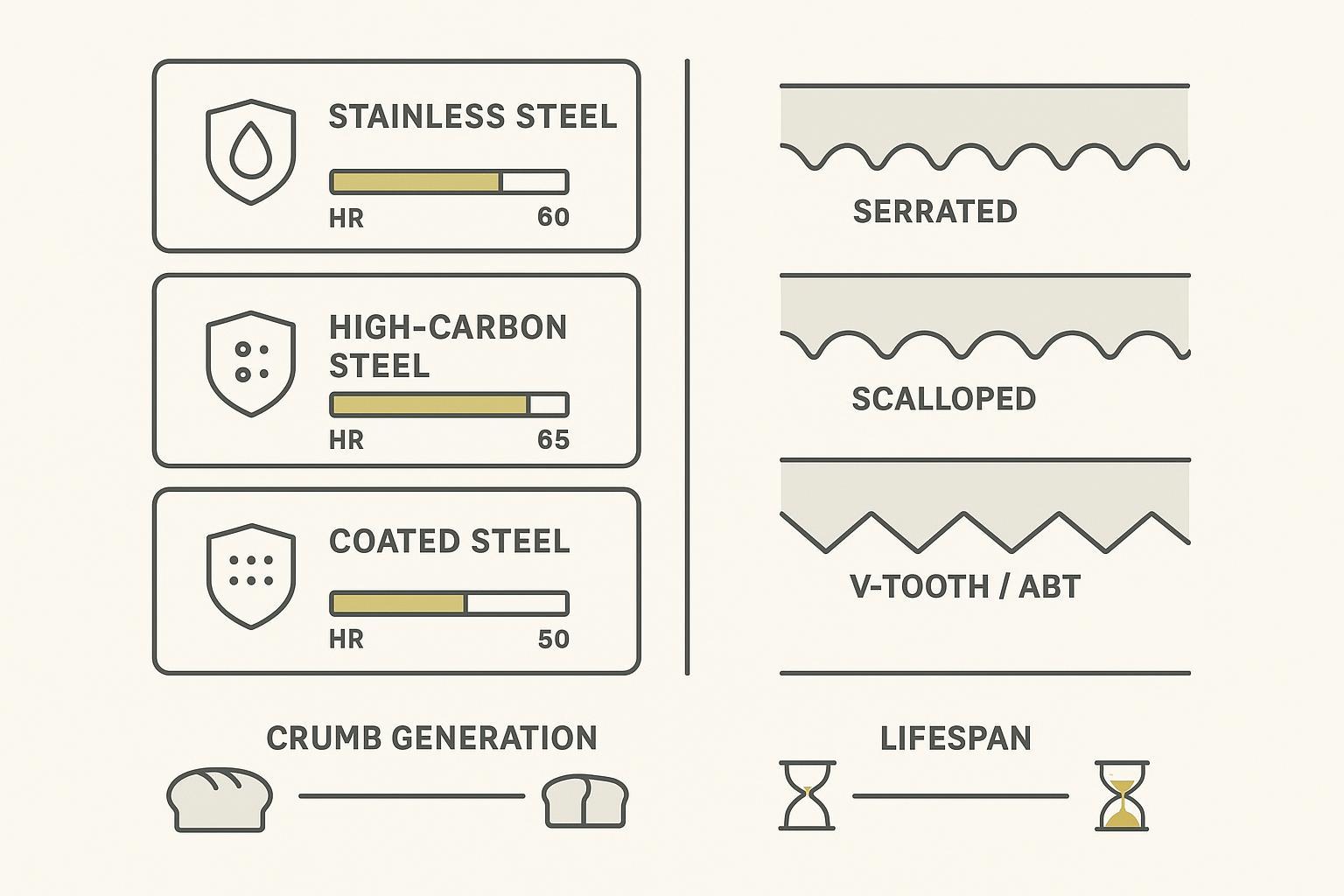
A practical way to compare profiles is to map them to your defect modes:
- If you fight tearing and ragged edges, geometry and tension stability are usually the first variables to verify.
- If you fight crumb load and sanitation burden, edge finish (burr control) and the profile’s rubbing behavior matter.
For a deeper internal breakdown of edge options (without turning this post into a product brochure), see MAXTOR METAL’s comparison of scallop vs V-tooth vs ABT bread slicer blade edges.
Warm bread and crumb control
Warm slicing is where many “fine in the lab” blades fail on the floor. As product temperature rises, crumb softens, stickiness increases, and small geometry differences show up as compression, drag, and tearing.
What to validate in a warm-bread pilot:
- Stick/slip and drag: does the blade start pulling the loaf, or does it cut cleanly at speed?
- Crumb buildup pattern: where does debris accumulate (guides, blade face, tension points), and does it cause thickness drift?
- Cleaning interval sensitivity: does slice quality fall off sharply if sanitation is delayed by one cycle?
Mẹo chuyên nghiệp: Treat warm-bread slicing as its own qualification condition. If your production sometimes slices warm, don’t accept a supplier that only tests on fully cooled loaves.
Compliance and QA
Food-contact and hygiene basis
For bakeries and OEMs, “food contact” is not a slogan—it’s a documentation and cleanability discipline.
For EU markets, your supplier’s documentation should align with the EU food-contact framework requirements and good manufacturing practice expectations—at a minimum, the general safety principles in Quy định (EC) số 1935/2004 and GMP controls in Regulation (EC) No 2023/2006 (see the European Commission overview of food contact materials: https://food.ec.europa.eu/food-safety/chemical-safety/food-contact-materials_en).
For metals and alloys specifically, it’s also common to reference the EDQM (Council of Europe) guidance on metals and alloys used as food contact materials, which provides release-limit guidance and test approaches used across Europe (EDQM activities page: https://www.edqm.eu/en/metals-and-alloys-used-in-food-contact-materials-and-articles).
At minimum, you want the manufacturer to clearly state:
- Which blade materials are intended for food-contact environments and how they control surface condition (finish, burrs, corrosion risk) for food-grade slicer blades.
- What cleaning/sanitation chemicals are assumed in their material recommendations.
- How blades are packaged to prevent corrosion and contamination in transit and storage.
Traceability and ISO 9001
Traceability is your fastest path to root-cause analysis when slice quality changes.
What to request:
- Lot-level traceability: material heat/lot, heat treatment batch, in-process inspection records, final inspection results, and packing identification.
- ISO 9001 documentation: certificate validity, scope, and the supplier’s actual inspection and nonconformance control records tied to your product. For buyers, a practical check is whether the supplier can show controlled “documented information” and audit evidence consistent with ISO 9001:2015 expectations (ISO overview: https://asq.org/quality-resources/iso-9001).
- CoA / material certificate pack: composition where applicable, hardness verification method/range, and dimensional inspection report.
Neutral capability note (MAXTOR METAL): MAXTOR METAL can provide standard QA documentation packages for industrial blades—typically including a lot-linked Certificate of Analysis (CoA) and a Declaration of Conformity (DoC) upon request, along with inspection records aligned to an ISO 9001 quality management approach—so buyers can support supplier approval and internal audit requirements.
Sanitation SOPs and audit records
For long-term supply, don’t just request documents—verify that the supplier’s hygiene controls match your reality.
- Ask for a sanitation SOP that covers handling, packing, and contamination control.
- Request example audit records or inspection logs (with sensitive details redacted) that show repeatable execution.
- Define how nonconformances are handled: containment, root cause, corrective action, and re-release criteria.
Compatibility and customization

OEM fit and guides
Most “blade problems” show up as fitment and guiding problems in production.
Before you scale a new supplier, verify:
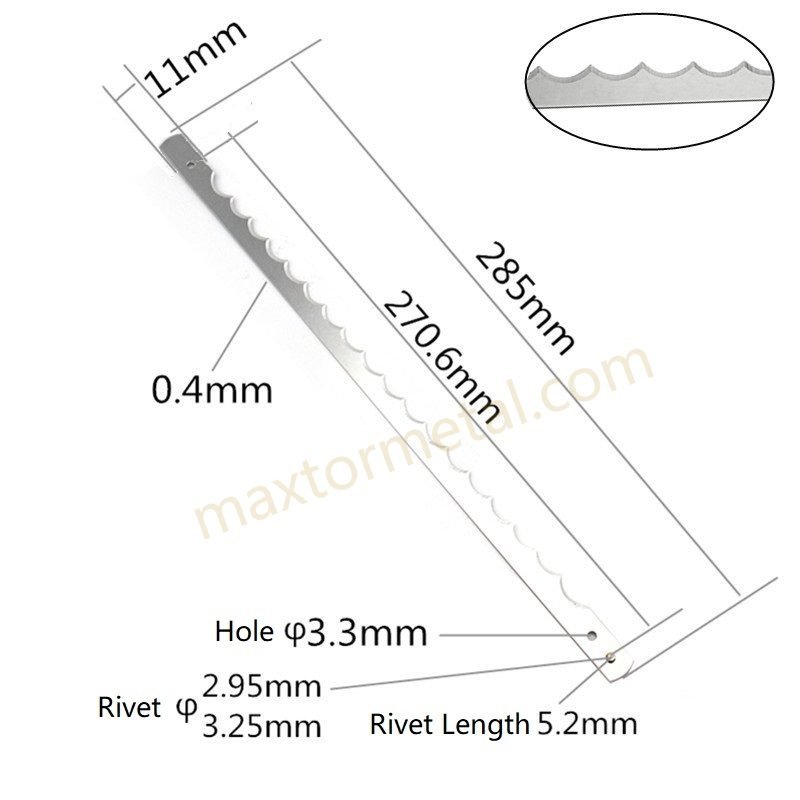
- Blade dimensions and mounting interface match your slicer design.
- Guides and wear parts are within spec; worn guides can turn a good blade into a crumb generator.
- The supplier can provide a fitment confirmation checklist tied to your machine model and drawing revision.
If you need a reference point for what information a supplier typically requests to avoid fitment surprises, MAXTOR METAL’s bread slicer blades page summarizes common configurations and manufacturing scope.
Non-standard designs and iterations
OEMs and high-mix bakeries often need iteration: tooth form changes, finish changes, material changes, or small dimensional adjustments.
To make iterations safe and fast:
- Require revision control on drawings/specs.
- Define what changes require requalification (material, heat treat, coating, edge geometry).
- Run short “A/B” pilots with the same bread spec and the same sanitation cycle.
Changeover, tension, alignment
Changeover is where supply decisions become OEE decisions.
What to evaluate in a supplier’s solution:
- Does the blade set arrive as a matched set that reduces time spent chasing tension balance?
- Are installation and tensioning instructions explicit, verifiable, and safe?
- Does the blade hold alignment across a run, or do you see repeated re-tension events?
If you want a quick refresher on how tension and edge properties drive slice outcomes, refer back to BakingBusiness’ pitch/edge/tension overview cited earlier.
Supply model and commercials

Lead times, MOQ, VMI options
A long-term blade supplier is also a supply-chain partner. For high-volume lines, the best engineering outcome still fails if you stock out.
Options to evaluate:
- Lead time bands (standard vs expedited) with documented historical performance.
- MOQ policy mà không buộc bạn phải tích trữ hàng tồn kho dư thừa.
- VMI / tồn kho an toàn dành cho các nhà máy có nhu cầu theo mùa hoặc thường xuyên thay đổi dòng sản phẩm.
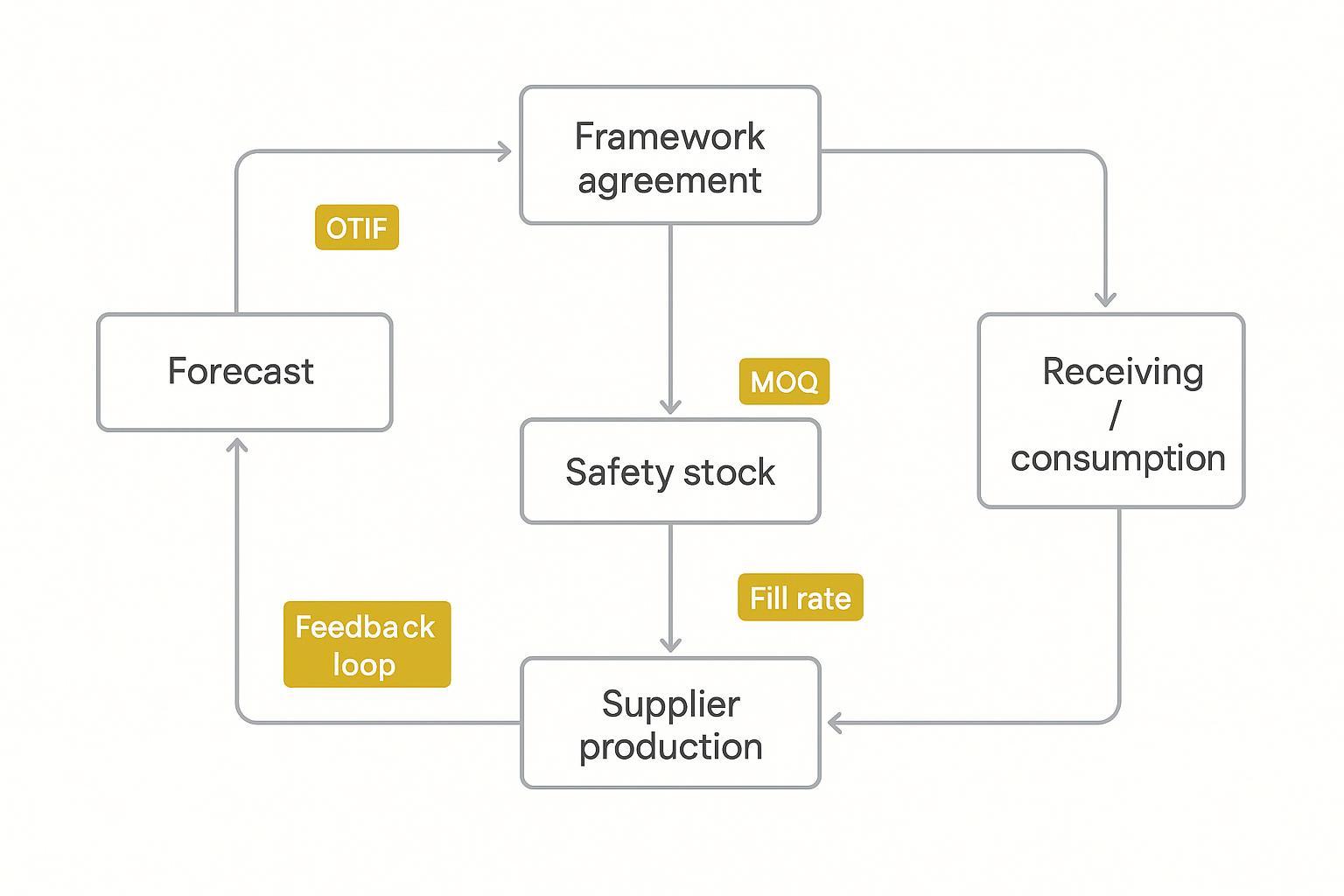
Một mô hình VMI thực tế cho lưỡi dao thường bao gồm:
- dự báo cuốn chiếu (tín hiệu nhu cầu của bạn)
- mức tồn kho an toàn đã thỏa thuận tại nhà cung cấp hoặc trung tâm phân phối địa phương
- theo dõi OTIF và quy trình xử lý khi hiệu suất suy giảm
Các điều khoản, SLA và KPI
Nếu bạn muốn có sự ổn định lâu dài, hãy đưa các định nghĩa vận hành vào thỏa thuận thương mại.
Ví dụ:
- Đúng hạn và Đầy đủ: định nghĩa chính xác thế nào là “đúng giờ” (on time) và “đầy đủ” (in full).
- Tỷ lệ lỗi lọt lưới chất lượng (Quality escape rate): những gì được coi là lỗi trong quy trình của bạn và cách đo lường lỗi đó.
- Thời gian thực hiện hành động khắc phục: thời gian phản hồi, thời hạn khoanh vùng sự cố và chính sách thay thế.
- Thông báo thay đổi: thông báo bắt buộc đối với các thay đổi về vật liệu/quy trình và yêu cầu tái đánh giá chất lượng.
Bảo hành và hậu mãi
Lưỡi dao là vật tư tiêu hao, nhưng mối quan hệ với nhà cung cấp thì không phải là thứ dùng một lần rồi bỏ.
Hãy kiểm tra xem nhà sản xuất có cung cấp:
- Phạm vi bảo hành rõ ràng gắn liền với các tiêu chí có thể đo lường được (không phải những lời hứa mơ hồ).
- Hỗ trợ hậu mãi để khắc phục sự cố: hướng dẫn lực căng, kiểm tra độ vừa vặn và hỗ trợ cải tiến thử nghiệm.
- Quy trình phản hồi được ghi chép bằng văn bản: cách dữ liệu thử nghiệm trở thành cơ sở cho lần cải tiến thiết kế tiếp theo.
Để có một phương pháp tiếp cận thực tế hướng đến vận hành nhằm giữ hiệu suất ổn định sau khi lắp đặt, tài liệu của MAXTOR METAL hướng dẫn bảo trì lưỡi dao cắt bánh mì là một tài liệu tham khảo nội bộ hữu ích mà bạn có thể đồng bộ hóa với các SOP của riêng mình.
Kết luận
Điểm mấu chốt: xác minh KPI, tài liệu tuân thủ và các điều khoản cung ứng trước khi cam kết
Các bước tiếp theo: gửi RFI/RFQ, chạy thử nghiệm trên các mã hàng (SKU) của bạn, hoàn thiện hợp đồng khung và VMI
Nếu bạn muốn chuyển từ việc chỉ nhận “báo giá của nhà cung cấp” sang một quyết định cung ứng dài hạn có kiểm soát, hãy xây dựng RFI/RFQ của bạn xoay quanh khung đánh giá năng lực ở trên, đính kèm bản vẽ/thông số kỹ thuật của bạn và yêu cầu một kế hoạch chạy thử nghiệm với các KPI nghiệm thu (lượng vụn bánh, độ lệch độ dày, tỷ lệ lỗi, tuổi thọ lưỡi dao và thời gian thay dao).
Thông báo: Bài viết này là hướng dẫn dành cho người mua hàng vận hành. Mọi đề cập đến MAXTOR METAL đều được cung cấp dưới dạng ví dụ tùy chọn và tài liệu đọc thêm; bạn nên xác thực độ phù hợp, hiệu suất và tính tuân thủ đối với các điều kiện dây chuyền cụ thể và yêu cầu khu vực của mình.
Cập nhật lần cuối: 2026-05-03
Khi bạn đã sẵn sàng chạy thử nghiệm, KIM LOẠI MAXTOR có thể hỗ trợ đánh giá kỹ thuật từ bản vẽ/mẫu thử và đồng bộ hóa bộ tài liệu QA (ví dụ: CoA/DoC và các yêu cầu truy xuất nguồn gốc theo lô) để quyết định mở rộng quy mô của bạn dựa trên dữ liệu đã được xác minh — chứ không phải giả định.
Câu hỏi thường gặp
Tôi nên gửi thông tin gì cho nhà sản xuất để nhận được báo giá chính xác?
Hãy gửi bản vẽ bất cứ khi nào có thể, cùng với danh sách kiểm tra độ tương thích: kiểu máy cắt, số lượng lưỡi dao, chiều dài/chiều rộng/độ dày, sơ đồ lỗ, kiểu dẫn hướng và cách khung máy của bạn căng lưỡi dao. Ngoài ra, hãy cung cấp thông tin về loại bánh mì, tốc độ dây chuyền, hóa chất vệ sinh và liệu bạn có cắt bánh khi còn ấm hay không — những thông tin đầu vào đó sẽ quyết định việc lựa chọn vật liệu, độ cứng và hình học cạnh cắt.
Những KPI nào quan trọng nhất trong việc chạy thử nghiệm lưỡi dao?
Hãy sử dụng các KPI có thể đo lường được và thực tế với nhà xưởng: độ lệch độ dày lát cắt, lượng vụn bánh tạo ra, tỷ lệ lỗi (rách, cạnh lởm chởm, bị nén), tuổi thọ lưỡi dao cho đến ngưỡng kết thúc vòng đời được xác định và thời gian thay dao. Chìa khóa là sự nhất quán: cố định các điều kiện thử nghiệm của bạn để kết quả có thể so sánh được giữa các lô và các nhà cung cấp khác nhau.
Làm thế nào để tôi không bị đánh lừa bởi một “mẫu thử tốt” nhưng không thể tái sản xuất hàng loạt?
Hãy coi việc chạy thử nghiệm là một quá trình đánh giá năng lực quy trình, chứ không phải là một thử nghiệm một lần. Hãy yêu cầu khả năng truy xuất nguồn gốc theo lô, xác nhận các kích thước được kiểm soát và thông số kỹ thuật cạnh cắt, đồng thời yêu cầu kiểm soát phiên bản đối với “mẫu chuẩn” (golden sample). Sau đó, hãy xác định các yếu tố kích hoạt tái đánh giá chất lượng (mẻ thép mới, đá mài/quy trình mài mới, thay đổi lớp phủ hoặc thay đổi bao bì) trước khi bạn mở rộng quy mô.
Người mua ở EU nên yêu cầu những gì về tính tuân thủ tiếp xúc với thực phẩm?
Tối thiểu, hãy yêu cầu nhà cung cấp nêu rõ (các) vật liệu tiếp xúc với thực phẩm dự kiến, các hóa chất vệ sinh giả định và phương pháp đóng gói giúp ngăn ngừa ăn mòn/nhiễm bẩn. Đối với thị trường EU, hãy đảm bảo họ có thể đáp ứng các kỳ vọng chung về an toàn theo khung quy định của EU đối với vật liệu tiếp xúc với thực phẩm và kiểm soát GMP — được Ủy ban Châu Âu tóm tắt trong Vật liệu tiếp xúc với thực phẩm— và có thể thảo luận về cách họ đánh giá kim loại và hợp kim so với các hướng dẫn được công nhận của Châu Âu như Kim loại và hợp kim EDQM được sử dụng trong các vật liệu và vật phẩm tiếp xúc với thực phẩm.
Tiêu chuẩn ISO 9001 cho tôi biết điều gì về kỷ luật chất lượng của nhà cung cấp?
ISO 9001 không đảm bảo “không có lỗi”, nhưng nó cho thấy nhà cung cấp có các biện pháp kiểm soát có cấu trúc đối với thông tin dạng văn bản, đánh giá nội bộ và xử lý sự không phù hợp. Khi bạn đánh giá một nhà cung cấp, hãy xác minh xem phạm vi chứng nhận của họ có thực sự bao gồm sản phẩm/quy trình của bạn hay không và họ có thể xuất trình các hồ sơ kiểm tra và hành động khắc phục liên kết với sản phẩm nhất quán với các khái niệm ISO 9001:2015 được phác thảo bởi Tổng quan về ISO 9001 của ASQ.
Vật liệu và xử lý nhiệt ảnh hưởng như thế nào đến lượng vụn bánh, hiện tượng rách và tuổi thọ của lưỡi dao?
Trên thực tế, bạn đang cân bằng giữa khả năng chống ăn mòn, chống mài mòn và chống nứt gãy. Độ cứng cao hơn thường cải thiện khả năng chống mài mòn nhưng có thể dễ bị mẻ hơn khi bị va đập hoặc lệch trục, trong khi độ dẻo dai cao hơn có thể chịu được sự biến động nhưng mài mòn nhanh hơn — một cái nhìn tổng quan được mô tả trong Thảo luận về độ cứng so với độ dẻo dai của Edcon Steel. Xử lý nhiệt là một trong những yếu tố then chốt giúp dịch chuyển sự cân bằng này bằng cách thay đổi cấu trúc vi mô và cơ tính; xem Metal Supermarkets’ heat treatment overview.
Should we qualify warm slicing separately?
Yes. Warm product increases stickiness and deformation, so small geometry and finish differences show up quickly as drag, compression, and tearing. If warm slicing occurs in your operation—even occasionally—treat it as a separate qualification condition with its own acceptance thresholds and cleaning-interval sensitivity checks.
Tác giả
Jesse Xu — Senior Quality Engineer, QA (Quality Assurance). 15 years of experience in industrial blade quality and failure analysis.
- Failure analysis focus: Able to distinguish whether issues like edge chipping and poor wear resistance are driven primarily by heat treatment process problems or by material segregation.
- Chứng nhận: ASQ – CQE; ISO 9001 Lead Auditor; ASNT Level II.

 English
 Spanish
 Italian
 French
 Portuguese
 Russian
 German
 Arabic
 Hindi
 Vietnamese
 Indonesian
 Japanese
 Korean