

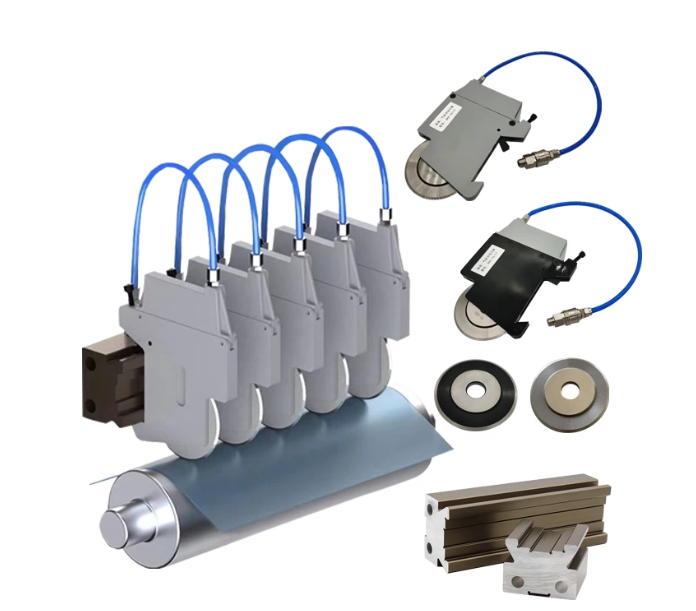
Si vous transformez des films minces ou des non-tissés à grande vitesse, le refendage par cisaillement cesse d'être « un simple réglage de couteaux » pour devenir un problème de stabilité : un faux-rond infime, un contact irrégulier ou une dérive de la pression de précharge pneumatique du porte-couteau se traduisent par des défauts de lisière et des temps d'arrêt.
Ce guide est rédigé selon l'approche pratique d'atelier que Maxtor Metal utilise pour accompagner ses clients sur les lignes de refendage de films et de non-tissés : définir les références à partir de données mesurées, vérifier avec des instruments et documenter les réglages afin que le résultat soit reproductible d'un opérateur et d'une équipe à l'autre, et non conservé dans la tête d'une seule persona.
Pour plus d'informations sur les formats de couteaux circulaires et les familles de lames utilisées pour le refendage, voir Couteaux et lames circulaires Maxtor Metal (lié ici uniquement comme point de référence pour la terminologie et les configurations typiques).
- À qui s'adresse ce guide : responsables, maintenance, ingénieurs procédés
- Ce que résout le refendage par cisaillement à jeu nul et à ressort : il stabilise le point de coupe en maintenant un contact contrôlé lorsque les conditions changent (vitesse, tension, dilatation thermique, légers mouvements de l'arbre).
- Résultats : bords plus nets, durée de vie prolongée, temps de fonctionnement accru
Points clés à retenir: Dans le refendage par cisaillement à grande vitesse, on ne se contente pas de “ régler les couteaux ”. On contrôle un système : géométrie + rigidité + précharge + vérification. C'est le principe que l'équipe de terrain de Maxtor Metal applique à tous les travaux de mise en service et de dépannage des lignes de refendage.
Notes d'applicabilité et de validation
Les points de consigne et les “ fenêtres de référence ” de ce guide sont destinés à servir de points de départ pratiques pour les opérateurs expérimentés et les équipes de maintenance.
Application typique (là où ce guide est le plus efficace) : refendage par cisaillement (cisaille rotative) de films minces et de non-tissés sur des lignes utilisant des porte-couteaux pneumatiques ou à ressort, où la répétabilité à grande vitesse dépend d'un chevauchement/angle d'engagement/précharge contrôlés et d'un faux-rond vérifié.
À valider sur votre ligne : Le diamètre du couteau, la conception du porte-couteau (à ressort vs pneumatique vs hybride), la structure de la bande, la vitesse, la tension, la dilatation thermique et la dynamique de l'arbre peuvent décaler la fenêtre de stabilité. Effectuez des essais courts et contrôlés et documentez les résultats.
Si votre procédé diffère : le refendage par écrasement, le refendage par rainurage, la transformation à très basse vitesse, les bandes épaisses/rigides ou les revêtements/adhésifs inhabituels peuvent nécessiter une géométrie et une stratégie de force différentes — utilisez les instructions de votre OEM comme référence principale.
Note de sécurité : Cet article constitue un guide général et ne remplace pas votre manuel OEM, les procédures de consignation (LOTO) spécifiques au site ou les exigences HSE.
Principes d'ingénierie

La configuration à ressort ne fonctionne que si les fondamentaux sont corrects : géométrie stable, chevauchement et angle d'engagement contrôlés, et rigidité mécanique.
Géométrie de cisaillement et stabilité du point de coupe
Le refendage par cisaillement est une action de ciseaux entre des couteaux circulaires qui se chevauchent. En pratique, une “ coupe nette ” dépend moins du tranchant des couteaux que de la stabilité du point de coupe à mesure que la ligne accélère, chauffe et subit des variations de tension.
C'est là qu'une configuration de refendage par cisaillement à ressort prend tout son sens : elle permet de maintenir un contact et une charge constants au point de coupe, réduisant ainsi les interventions correctives de l'opérateur.
Ce qui déstabilise le plus souvent le point de coupe :
- Le faux-rond axial (voile) qui module le chevauchement à chaque tour.
- Le faux-rond radial qui modifie la pénétration effective et crée des marques périodiques sur les bords.
- La flexibilité du porte-couteau (ou une précharge de ressort/d'air irrégulière) qui provoque une perte de contact à grande vitesse.
Pour faire simple : si la paire de couteaux ne rencontre pas la bande de la même manière à 0°, 90°, 180° et 270° de rotation, votre bord ne pourra pas rester régulier.
Valeurs de référence pour le chevauchement et l'angle d'engagement
Utilisez les valeurs de référence comme points de départ, puis affinez-les par une coupe d'essai contrôlée.
Valeurs de référence pour le chevauchement (profondeur d'intersection) pour le réglage du chevauchement en refendage par cisaillement rotatif :
- Films plastiques minces : ~0,50–0,75 mm (≈0,020–0,030 po)
- Non-tissés : ~0,75–1,0 mm (≈0,030–0,040 po)
Pour une analyse complète basée sur les plans d'expériences (DOE) de l'interaction entre la profondeur de chevauchement et le jeu latéral selon les types de substrats — y compris les compromis de Pareto entre la qualité des bords et la durée de vie des couteaux — voir Optimisation de la profondeur de chevauchement et du jeu latéral des couteaux circulaires.
Ces plages reflètent les points de départ pratiques que l'équipe d'ingénierie de Maxtor Metal utilise lors de la mise en service de nouvelles lignes de refendage ou du dépannage d'une qualité de bord instable dans les projets de transformation de films et de non-tissés. Si le chevauchement est trop faible, vous constaterez une séparation incomplète, des déchirements ou des défauts de bord intermittents. Si le chevauchement est trop élevé, vous constaterez un effet de “ labourage ”, des bords dentelés, un excès de poussière et une usure accélérée.
Signaux rapides sur le terrain (chevauchement trop faible vs trop élevé) :
- Trop faible : séparation intermittente, le bord commence à faire un effet “ fermeture éclair ” à grande vitesse, les défauts s'accentuent avec la variation de tension.
- Trop élevé : augmentation de la poussière, ondulations visibles sur le bord, accumulation de chaleur plus rapide et apparition de bandes de polissage sur la zone de contact du couteau.
Valeurs de référence pour l'angle d'engagement pour les configurations de refendage de film par cisaillement avec angle d'engagement :
- Film plastique : ~0,25–0,5°
- Non-tissés : ~0,75–1,0°
Maxtor Metal’s field experience across BOPP, PE, and PET slitting projects consistently shows that exceeding 0.5° cant angle on thin films accelerates bevel wear at the nip contact zone—validating the conservative upper bound of this window. If cant angle is trop faible, the knives tend to rub (heat/dust) and traction at the nip becomes unreliable. If cant angle is trop élevé, the nip becomes overly aggressive and blade wear (and sometimes edge nicking/chipping) increases.
Quick field signals (cant angle too low vs too high):
- Too low: rubbing/heat, adhesive pickup, dust without clean separation.
- Too high: faster wear, edge damage risk increases, and the cut can become “grabby” at the nip.
A useful cross-check is to confirm your setup logic against an established industry slitting reference guide. These references typically summarize the practical relationships among overlap, shear angle, and measurable outcomes—useful for aligning your team on a common starting baseline.
Mounting rigidity and runout targets
If you want a stable zero-clearance shear slitting setup, you need targets that your maintenance team can actually measure.
Practical runout targets (typical baselines):
- Axial TIR (knife face/edge): aim around 0.002 in
- Radial TIR (knife OD): aim around 0.004 in
These numbers come from runout target baselines commonly cited in industry slitting setup references and are useful as a starting point for maintenance. For the bore-fit logic that underpins these targets—including ISO 286 H7/h6 vs H7/g6 selection and assembled TIR verification routines—see Tolérance d'alésage central et faux-rond : optimisation des ajustements ISO 286 pour les lames de refendage à grande vitesse.
How to measure (quick method):
- Lock bottom knives to the driven shaft.
- Place a dial indicator on the knife edge (axial) and rotate slowly; repeat on the OD (radial).
For shear slitting, holder bearing condition also matters. A common diagnostic is to confirm the knifeholder bearing does not show excessive radial/axial runout; many industry shear-slitting maintenance guides emphasize the same troubleshooting logic: mechanical condition first, then process adjustments.
Étalonnage et configuration sur ressort

The goal of spring-loaded knifeholders is to make “contact” a controlled variable, not something that drifts with temperature, minor shaft movement, or operator feel.
Zero-clearance contact and verification
Entrée : clean arbors/bores/spacers, sharp knives, guarded access, and a runout measurement baseline.
Action:
- Clean and inspect mating surfaces (arbor shaft, spacer faces, knife bores). One trapped chip can become runout.
- Assemble with rigidity in mind: minimize spacer count per pocket; keep the largest spacer nearest the knife where possible.
- Bring knives to zero-clearance contact at the intended cut point using your holder’s adjustment method.
Verify (done when…):
- You can confirm consistent contact around rotation (no “high spot only” contact).
- Your axial/radial runout is within your plant target window before you tune parameters.
If you need a repeatable method for documenting these checks, keep a simple setup sheet that records: knife OD, overlap, cant angle, preload/air pressure, speed, tension, and a quick edge-quality score.
Setting overlap and micro-preload pressure
Zero clearance does not mean “maximum force.” For thin webs, the best setup is usually minimum effective force that keeps the nip stable.
Overlap:
- Start with 0.030–0.040 in overlap for nonwovens and similar compliant webs.
- Start slightly lower for many films, then increase only if separation is unstable.
Micro-preload (airflow/pressure):
- Use the holder’s air assist as a micro-preload, not a clamp.
- A common working window is 20–60 psi at the holder supply (actual force at the knife depends on cylinder area, regulator accuracy, and friction losses).
Quick field signals (preload too low vs too high):
- Too low: contact unloading at speed, lane-to-lane inconsistency, defects increase as speed ramps.
- Too high: unnecessary friction/heat, faster polishing wear bands, and potential web damage (especially on softer structures).
Verify (done when…):
- You can run at target speed without contact unloading (edge defect frequency does not rise with speed).
- Knife wear pattern is even (no localized shiny bands indicating intermittent contact).
Live tuning and documentation
Live tuning is where you turn baselines into a repeatable SOP. The Maxtor Metal field engineering team uses a consistent action sequence to avoid chasing multiple variables at once.
Action sequence (keep it consistent):
- Run a short trial at production speed with your baseline settings locked in.
- Adjust one variable at a time—overlap first, then cant angle, then preload. Never change two simultaneously.
- After each adjustment, re-inspect the edge and log the change before proceeding.
What to log (minimum):
- Overlap setpoint, cant angle, air pressure setpoint, line speed, web tension, and material batch.
- A quick defect code against each trial: fuzzing / feathering / tearing / scallop / dusting.
Verify (done when…):
- Two operators can reproduce the same edge quality on different shifts using the same logged settings without verbal handoff.
Keep the Setup Sheet (see below) filled out for every trial run. Once two consecutive shifts confirm stable edge quality, the current settings become the locked baseline for that material.
Listes de contrôle SOP (imprimables)
Pre-start checklist (before bringing knives into contact)
- Verify LOTO/guarding status and controlled access.
- Clean arbor/bores/spacer faces; remove adhesive and trapped chips.
- Confirm spacer stack plan (minimize thin spacers; largest spacer near the knife where possible). For stack-up math and spacer matching discipline that prevents axial shift from compounding across the pack, see Controlling Cumulative Thickness Tolerance in Multi-Knife Slitting.
- Confirm bottom knife lock/drive condition and holder bearing health.
- Measure and record runout baseline (axial/radial TIR).
Trial cut checklist (first 5–10 minutes at production speed)
- Start from baseline overlap/cant/preload; change one variable at a time.
- Inspect edge for feathering, tearing, scallop, and dust bursts.
- Watch for speed-triggered defects (e.g., only above a threshold speed).
- Confirm air supply stability under dynamic load (no droop).
Acceptance checklist (run is “good enough to lock”)
- Edge is stable from start-up to thermal steady state.
- No periodic signature tied to knife circumference/shaft rotation.
- Wear pattern is even across the contact band (no localized polish bands).
- Settings are logged (overlap, cant, preload, speed, tension, material batch).
Shift-change / roll-change checklist (repeatability control)
- Re-check air setpoint and gauge behavior.
- Quick visual inspection for adhesive pickup and dust buildup.
- Spot-check one station for contact consistency (no “high spot only” contact).
- Record any drift and corrective action taken.
Setup Sheet template (copy/paste)
Use a simple one-page record to make results repeatable across operators.
- Date / Shift / Operator:
- Line / Station / Lane ID:
- Material & batch: (film/nonwoven, structure, thickness)
- Knife OD / thickness / bevel details:
- Holder type: (spring / pneumatic / hybrid) and model:
- Overlap setpoint: ____ (in / mm)
- Cant angle setpoint: ____ (deg)
- Preload (air) supply setpoint: ____ (psi / bar)
- Line speed: ____ (m/min)
- Web tension: ____ (N or your unit)
- Runout baseline:
- Axial TIR: ____
- Radial TIR: ____
- Edge quality score (1–5) + defect codes: fuzzing / feathering / tearing / scallop / dusting
- Notes (what changed, one variable at a time):
Performances et mesures
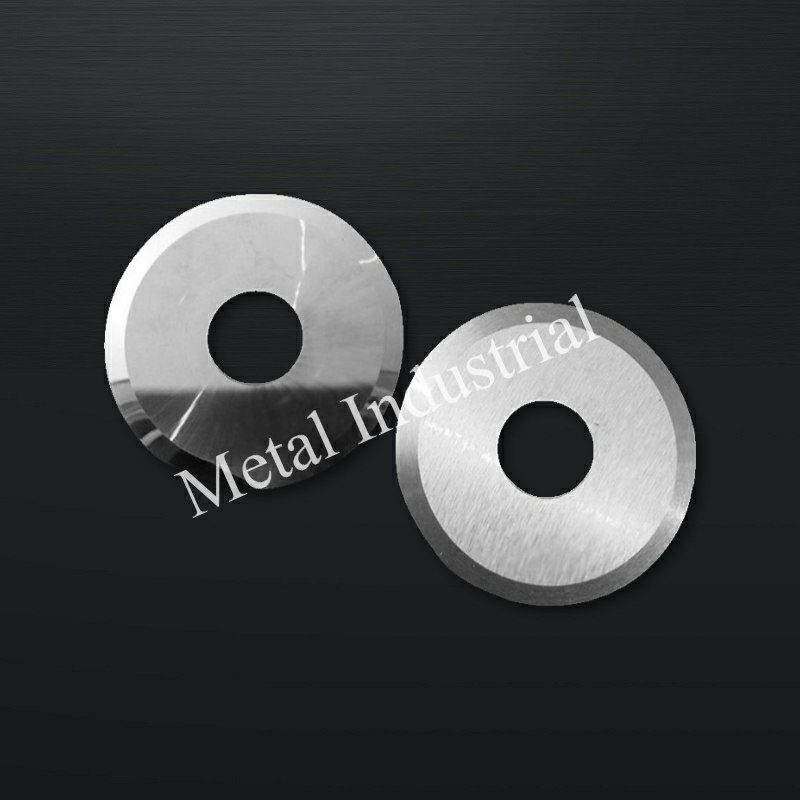
At speed, edge quality is less about a single “perfect” setting and more about whether the system stays inside a stable window.
Track outcomes that connect directly to cost:
- Edge acceptance rate (pass/fail per roll).
- Defect frequency (defects per 1,000 m or per roll).
- Temps de changement (minutes to first acceptable roll).
- Knife life (runtime or linear meters per grind/change).
If your edge defects appear with a periodic spacing that matches knife circumference or shaft rotation, treat it as a runout/rigidity clue—not a “material problem.”
Recommended setpoints by substrate
Use these as practical starting points, then validate with your own material and line dynamics.
Maxtor Metal’s recommended starting setpoints by substrate type for spring-loaded zero-clearance shear slitting:
| Substrate | Cant Angle | Chevaucher | Air Preload (supply) |
|---|---|---|---|
| Thin plastic films (PE/PP/PET, <50 μm) | ~0,25–0,5° | ~0.020–0.030 in (0.50–0.75 mm) | Start low: 20–35 psi; increase only if contact unloads |
| Nonwovens / compliant fibrous webs | ~0,75–1,0° | ~0.030–0.040 in (0.75–1.0 mm) | Mid-window: 35–55 psi to maintain stable nip |
| Laminates / coated webs | Closer to film baseline (~0.25–0.5°) | Tune to minimize dusting; avoid plowing the coating | Start low; coating debris accelerates wear if preload is excessive |
Conseil de pro: If you’re forced to increase preload to “stop defects,” pause and re-check runout and spacer stack rigidity first. Preload should compensate for small dynamics, not mask mechanical faults.
Blade materials and coatings selection
Blade life is a wear-mode problem: abrasion, adhesive pickup, heat, corrosion, and micro-chipping don’t respond to the same steel or coating.
Common selection logic (general industry practice):
- Tool steels (e.g., D2): often chosen when you need wear resistance and stable edges in abrasive or filled webs.
- High-speed steels (e.g., M2): often chosen when you need toughness and edge stability under higher thermal load.
- Carbure: used when abrasion dominates and you can control brittleness risks (alignment, vibration).
For a rigidity-led framework on choosing single, double, or compound bevel geometry before spring-loaded setup begins, see Biseaux simples, doubles et composés pour couteaux à refendre circulaires.
Coatings are usually chosen to shift friction, heat, and adhesion behavior:
- TiN / TiCN / CrN families: used to improve wear and reduce galling in many metalworking and converting contexts.
- DLC: particularly relevant in high-speed spring-loaded shear slitting of thin films, where reduced surface friction at the nip means the minimum effective preload stays lower—less heat, less polish wear, and a wider stable operating window at speed. Maxtor Metal applies DLC on circular shear knives for customers running PE/PP films above 400 m/min where adhesive pickup and friction-driven edge rounding are the primary wear modes.
Long knife life in a spring-loaded setup depends on consistency across shipments, not just initial sharpness. Maxtor Metal maintains lot/heat traceability on all shear slitting blades, with documented hardness verification and dimensional inspection records available per batch. This means when a setup is dialed in and performing well, the next blade order should behave the same way—not require a new round of parameter tuning.
Étude de cas sur le terrain : le porte-couteau sur ressort rétablit un refendage par cisaillement stable à jeu nul
The following case was handled by Maxtor Metal’s after-sales technical team, led by Jerry Chu, in collaboration with a flexible packaging film manufacturer. It is shared as a real-world troubleshooting example. Customer and site details are anonymized; your exact stable window may differ—validate on your line.
Application
- Matériel: BOPP packaging film, 30–40 μm
- Slitting method: pneumatic spring-loaded shear slitting (zero-clearance contact)
- Line speed: 450–650 m/min (defects appeared mainly above ~550 m/min)
- Operating mode: continuous production with 12-hour shifts; multiple top shear holders on a linear rail
- Air supply: approximately 5.5–6.0 bar (observed stable at ~5.8 ±0.05 bar)
Initial symptoms
After about one week of continuous production:
- Intermittent feathered slit edges
- Periodic fine dust bursts
- One slit lane unloading from the bottom knife every 15–20 minutes
- Edge quality changing without recipe modification
Inspection sequence (mechanical first)
- Measure knife runout (dial indicator):
- Bottom knife TIR: 0.008 mm
- Top knife TIR: 0.010 mm
- Both within the team’s acceptable limits
- Check spacer stack: clean faces, no burrs, width consistency OK
- Inspect bearings: rotation smooth; no abnormal play or temperature rise
- Verify pneumatic supply: stable pressure; no leaks found
Root cause
Focus shifted to the spring-loaded knife holder mechanism:
- One holder had noticeably lower manual retraction force than adjacent holders.
- Disassembly found a partially fatigued return spring, contamination in the guide mechanism, and inconsistent engagement stroke.
At high speed, the holder occasionally lost constant side-load against the bottom knife. The upper knife momentarily separated and re-engaged, producing periodic feathering, dust bursts, and lane unloading.
Corrective actions
- Replaced the fatigued return spring
- Cleaned and lubricated the guide mechanism
- Reset overlap and rechecked engagement stroke
- Reduced holder air pressure slightly after confirming stable knife contact (to avoid unnecessary friction)
- Verified side-load consistency across all knife holders before restart
Results (two production shifts)
- Feathered edge occurrence: intermittent every 15–20 min → not observed
- Slitting dust: frequent visible bursts → barely noticeable
- Knife unloading events: several per shift → none recorded
- Top knife service interval: baseline → ~15–20% longer before resharpening (primarily from reduced unnecessary friction)
Why lower pressure can extend knife life: once stable contact is maintained, excess pneumatic preload mainly increases sliding friction and heat—accelerating polish wear and edge rounding without improving separation.
Practical lessons learned
- Stable zero-clearance shear slitting depends on consistent side-load, not maximum air pressure.
- If runout, spacers, bearings, and air supply look normal, inspect the holder mechanism (spring condition, guide contamination, engagement stroke).
- A structured order—runout → spacer stack → bearings → pneumatic supply → holder mechanism—reduces wasted blade changes and downtime. For a measurement-first approach to axial and radial TIR diagnosis—including cold-to-hot drift checks—see Axial Runout, Dynamic TIR, and Slit Edge Quality.
- Key calibration steps to standardize SOPs: verify runout/rigidity first, then set zero-clearance contact, set overlap, set micro-preload, and only then tune cant angle and tension with one-variable changes.
- Parameter windows for thin films/nonwovens: films often stabilize around ~0.020–0.030 in overlap and ~0.25–0.5° cant angle, while nonwovens often need ~0.030–0.040 in overlap and ~0.75–1.0° cant angle—then fine-tune for your exact web and speed.
- Next actions: verify runout, log settings, review TCO
If you want to standardize the knife and blade side of that SOP across lines, keep the internal reference for your team here: circular knives and blades for slitting applications.
Dépannage de la configuration
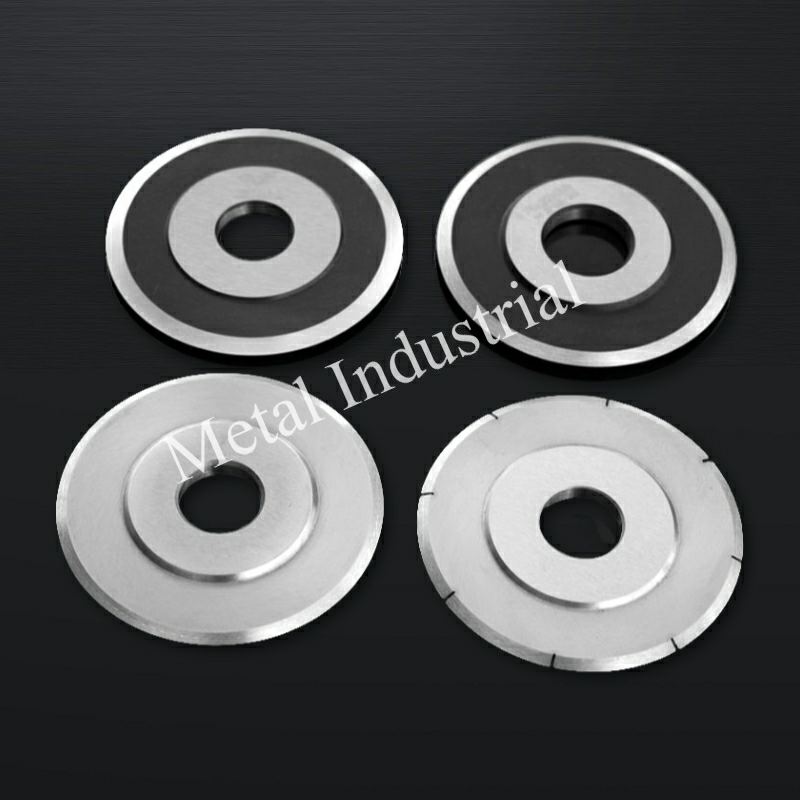
Edge defects and corrective levers
One-page decision tree (symptom → checks → levers)
Use this to keep troubleshooting consistent and avoid “turn everything up.”
1) Is the defect periodic (spacing matches knife circumference or shaft rotation)?
- Yes → Treat as mechanical first:
- Check axial/radial runout → spacer stack cleanliness/rigidity → arbor fit → bearing play
- No → Go to process window checks.
2) Does the defect appear only above a speed threshold?
- Yes → Suspect contact unloading / holder compliance / vibration sensitivity:
- Verify preload stability under dynamic load
- Inspect holder mechanism consistency lane-to-lane
- Re-check engagement stroke and side-load behavior
3) Pick the dominant symptom and adjust one variable at a time (after mechanical checks):
- Feathering/fuzzing → overlap slightly up, cant modestly up (within window), verify tension stability
- Tearing/intermittent separation → overlap up, verify contact unloading, re-check axial runout
- Scallop/plowing signature → overlap down, preload down, verify knives aren’t forcing the web
- Excess dust/heat → verify cant not too low, overlap not excessive, check sharpness and pickup
Use defect-driven adjustment instead of “turn everything up.”
- Feathering / fuzzing (common in nonwovens):
- Increase overlap slightly within your window.
- Increase cant angle modestly if the nip isn’t establishing a clean separation line.
- Verify tension stability at the slitting point.
- Tearing / intermittent separation:
- Check overlap is not too low.
- Check for contact unloading (preload too low, air instability).
- Re-check axial runout; overlap may be oscillating.
- Scalloped / wavy edge (“plowing” signature):
- Reduce overlap.
- Reduce preload (if excessive) and confirm knives aren’t forcing the web into the bottom band.
- Excess dusting:
- Check cant angle is not negative/too low (rubbing).
- Check overlap is not excessive.
- Confirm knife sharpness and surface condition.
Mechanical faults and fixes
When troubleshooting slitting edge defects, separate parameter issues from mechanical ones.
If you need a tighter shorthand for the work order queue, label this block as “slitting edge defects troubleshooting: mechanical checks first.”
Mechanical checks that pay back quickly:
- Verify axial and radial runout against your plant targets.
- Inspect spacer stack: too many thin spacers increases cumulative tolerance error.
- Check knife bores and arbor fit: loose fit or damage will show up as periodic defects.
- Check bearings: play or roughness becomes vibration at speed.
If you need an external reference for measurement practice, follow the same core logic used in many slitting maintenance manuals: lock the driven shaft, measure axial TIR at the knife face/edge and radial TIR at the OD, and record results at a consistent location so trends are comparable over time.
Air system and continuity checks
Stop-and-recheck triggers (don’t “tune through” these)
If you see any of the following, stop changing multiple process knobs and go back to mechanical verification first:
- You have to keep increasing preload just to hold edge quality.
- Defects are periodic with spacing tied to knife circumference or shaft rotation.
- One lane behaves differently from adjacent lanes with the same recipe.
- Edge quality is stable at low speed but collapses above a threshold speed.
These are strong signals of runout, spacer stack issues, bearing condition, or holder mechanism inconsistency (spring fatigue, contamination, engagement stroke).
If your spring-loaded system uses pneumatics, treat air quality and stability as part of process control.
Continuity checklist:
- Regulator holds setpoint under flow (no pressure droop during dynamic load).
- Filter/dryer condition is acceptable (water/oil carryover increases variability).
- No audible leaks; fittings and hoses are secure.
- Gauge accuracy is verified on a schedule.
Done when… you can run from start-up to thermal steady state without needing to “chase” preload.
If setup variables are confirmed correct but lane drift persists, the failure mode has likely shifted to tension, alignment, or air dynamics. For a multi-subsystem diagnostic that sequences these checks, see Éliminer les coupures en serpentin lors du découpage de films : une liste de contrôle des systèmes.
Maintenance et conformité

Daily to quarterly SOPs
A simple cadence prevents “mystery failures.”
Tous les jours:
- Clean knives/holders and check for adhesive pickup.
- Record: overlap, cant angle, preload setpoint, speed, and edge outcome.
Hebdomadaire:
- Inspect spacer faces and knife bores for nicks and fretting.
- Verify regulator and gauge function.
Mensuel:
- Dial-indicator check of arbor runout at a consistent measurement location.
- Confirm bearing condition (noise, heat, play).
Quarterly:
- Review logs: correlate edge defects and knife life to settings.
- Re-validate baseline settings for your top 3 substrates.
Safety and LOTO essentials
Slitting lines store energy (rotational inertia, pneumatic pressure, nip points). Your SOP should align to OSHA requirements for hazardous energy control and guarding.
Two authoritative starting points:
⚠️ Avertissement: Zero-clearance setup requires controlled access near rotating elements. Treat stored energy and unexpected restart as first-order hazards, not paperwork.
Traceability and material compliance
If you’re trying to stabilize knife life across quarters (not just across shifts), traceability matters.
Practical expectations to build into procurement and QC:
- Lot/heat identification that ties finished knives back to the source material.
- Documented inspection practices (dimensions, hardness, runout checks) that are consistent between batches.
- Material and substance compliance evidence when required by your end market.
For compliance context:
- REACH overview and legal basis: ECHA’s “Understanding REACH” et EUR-Lex Regulation (EC) No 1907/2006 (REACH)
- RoHS overview and legal basis: European Commission RoHS Directive overview et EUR-Lex Directive 2011/65/EU (RoHS)
(For many converting operations, these frameworks show up as customer flow-down requirements and supplier declarations, even when the slitting line itself is not an electrical product.)
Conclusion
Spring-loaded setup for zero-clearance shear slitting is a systems problem, not a single-parameter adjustment. The consistent finding from Maxtor Metal’s field engineering work across film and nonwoven converting lines is that edge quality problems almost always trace back to one of four root categories: runout exceeding plant targets, spacer stack compliance, holder mechanism condition (spring fatigue, guide contamination, engagement stroke), or air supply instability under dynamic load.
The practical sequence that works: verify mechanical condition first, establish zero-clearance contact, set overlap and micro-preload to the minimum effective level, then tune cant angle one variable at a time. Log every change. Lock the baseline when two operators can reproduce the same result on different shifts.
Knife and blade material selection sits downstream of this setup discipline—DLC-coated or high-speed steel blades cannot compensate for unstable contact or misaligned runout. When the mechanical system is right, blade life and edge consistency follow. For Maxtor Metal’s blade and coating options for shear slitting applications, see circular knives and blades for slitting applications.
FAQs:
Q: Qu'est-ce qu'une configuration de refendage par cisaillement sur ressort et quand en avez-vous besoin ?
R: Une configuration sur ressort utilise une force contrôlée (par ressort ou pneumatique) para maintenir la paire de couteaux en contact stable pendant le fonctionnement de la ligne. Vous en avez généralement besoin lorsque la qualité de la lisière varie en fonction de la vitesse, du préchauffage ou des variations de tension de bobine en bobine.
Q: Comment régler le recouvrement sur un débobineur-refendeur rotatif pour films minces ?
R: Commencez entre 0,020 et 0,030 pouce et n'augmentez que jusqu'à ce que la séparation soit stable. Si le recouvrement est trop profond, vous constaterez souvent des lisières dentelées (en forme de vagues), un excès de poussière et une usure prématurée des couteaux.
Q: Quel angle de croisement (cant angle) dois-je utiliser pour le refendage par cisaillement de films plastiques ?
R: Une plage de départ courante se situe entre ~0,25 et 0,5°. Un angle trop faible a tendance à frotter et à générer de la chaleur/poussière ; un angle trop élevé accélère l'usure. Validez par un court essai à vitesse de production.
Q: Pourquoi est-ce que j'obtiens des lisières pelucheuses lors du refendage de non-tissés ?
R: Le peluchage (fuzzing) est souvent le signe que le point de pincement (nip) ne crée pas une ligne de séparation nette. Un recouvrement légèrement plus important (souvent ~0,030–0,040 pouce) et un angle de croisement plus élevé (~0,75–1,0°) peuvent aider, si le faux-rond (runout) et la tension sont déjà maîtrisés.
Q: Quel faux-rond (runout) est acceptable pour le refendage par cisaillement à grande vitesse ?
R: En guise de référence pratique, de nombreuses configurations visent environ 0,002 pouce de TIR axial et 0,004 pouce de TIR radial au niveau du couteau. Si les défauts se répètent avec un espacement périodique correspondant à la rotation, revérifiez le faux-rond avant de modifier les paramètres du processus.
Q: Quelle pression d'air dois-je utiliser sur un porte-couteau pneumatique sur ressort ?
R: Utilisez la pression minimale qui évite la perte de contact (unloading) à grande vitesse. Une plage d'alimentation courante se situe entre 20 et 60 psi, mais la force réelle dépend de la conception du porte-couteau et de la stabilité du régulateur ; validez donc en fonction de l'aspect de la lisière et du profil d'usure.
Q: Quel es le moyen le plus rapide de résoudre les défauts de lisière en refendage par cisaillement ?
R: Abordez le problème comme un arbre de décision : confirmez d'abord le faux-rond et la rigidité, puis vérifiez le recouvrement, ensuite l'angle de croisement, puis la précharge, et enfin la tension et la gestion de la lisière de rive (chutes). Modifier plusieurs variables à la fois masque généralement la cause réelle.
Auteur / Révision technique
Jerry Chu — Technical Support Specialist, After-sales Service, Maxtor Metal
- 10 years of hands-on technical support experience across industries including papermaking, plastics recycling/crushing, metal coil slitting, and woodworking
- Focus areas: resolving real production issues such as slit-edge burrs and excessive dust generation
- Field methods: dial-indicator runout measurement, holder mechanism checks, and SOP-style setup logging for repeatability
- Certifications : PMP, CMRP

 English
  Spanish
  Italian
  French
  Portuguese
  Russian
  German
  Arabic
  Hindi
Hindi  Vietnamese
  Indonesian
  Japanese
  Korean