

By Nancy Wu, Senior Manufacturing Engineer (Production Engineering), Maxtor Metal — SME–CMfgE, PMP, Six Sigma Black Belt, ASM International certifications
Scope note: Questa guida è un riferimento tecnico a supporto delle operazioni di impostazione misurate. Seguire sempre il manuale di servizio OEM e le SOP del proprio stabilimento per le impostazioni finali e le procedure di sicurezza.
La rettifica ripristina le condizioni del tagliente, ma rimuove anche materiale dal diametro esterno (OD) e/o dalle facce della lama. In una testa di taglio, questo cambiamento non è solo estetico: sposta l'altezza del centro di lavoro e può inavvertitamente allontanarvi dall'obiettivo di sovrapposizione. Il risultato è noto: aumento delle bave, variazione della morfologia del filo e riduzione della ripetibilità tra i set-up.
Questa guida è scritta per i team di produzione, manutenzione e ingegneria di processo che necessitano di un metodo affidabile per calcolare gli spessori dopo la rettifica. Segue la mentalità "documentazione prima di tutto" tipica delle officine disciplinate (inclusi i flussi di lavoro orientati al controllo qualità di Maxtor Metal), perché l'obiettivo non è un set-up a "sensazione", ma uno misurato e ripetibile.
In this context, the practical objective is simple: restore slitting knife center height so your overlap target stays where you set it.
- Purpose: compute shim stacks to restore center height post‑regrind
- Audience: production, maintenance, and process engineering teams
- Outcomes: accurate regrinding thickness reduction compensation, overlap restored, defects reduced
Nota tecnica: La compensazione della riduzione di spessore dopo rettifica è il processo di calcolo e aggiunta di spessori (shim) a una pila di lame per ripristinare l'altezza centrale e la sovrapposizione originali dopo la perdita di diametro esterno (OD) o di spessore dovuta alla rettifica. Senza questa compensazione, la stessa configurazione di distanziali utilizzata prima della rettifica produrrà una sovrapposizione inferiore, aumentando la formazione di bave e riducendo la costanza del taglio. [→ Vedi la pagina Maxtor Metal Shear Blades per i principi di gestione del gioco]
Fondamenti di geometria di taglio
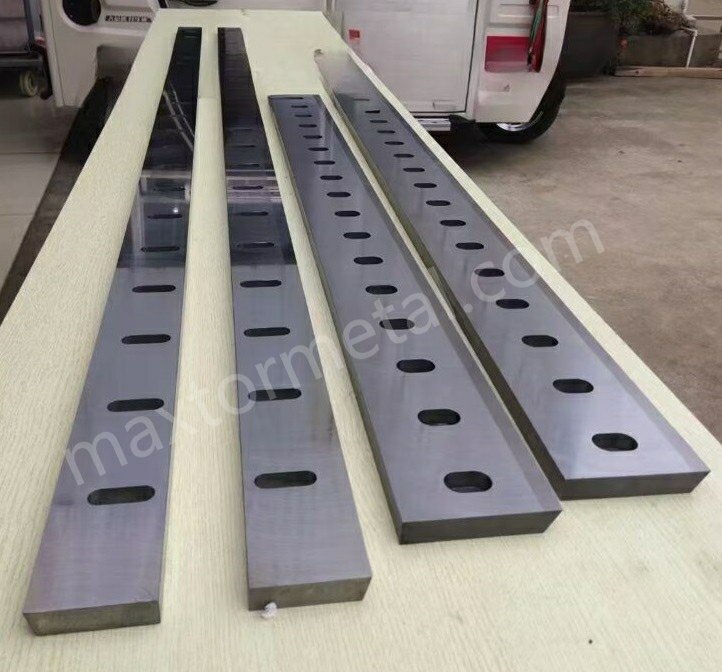
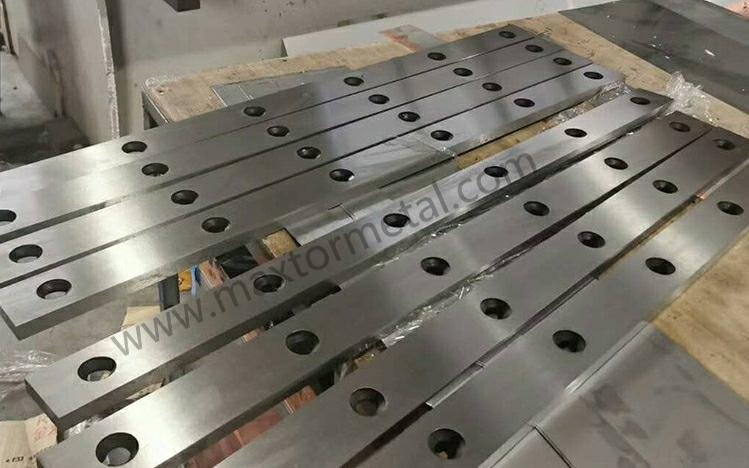
In Maxtor Metal’s shear blade manufacturing workflow, post-regrind overlap verification is treated as a mandatory checkpoint before blades are returned to service.
Clearance and overlap targets
Clearance and overlap are the two geometry knobs that most directly control edge quality. In practical terms:
- Liquidazione is the lateral gap between mating knives (or knife and anvil), typically managed by spacers and alignment.
- Overlap is the depth the knives “bite” past the theoretical tangent line, typically set by center distance (or equivalent adjustment).
When overlap drifts low after a regrind, you tend to see more tearing and a larger burr because the cut transitions toward bending/fracture rather than stable shearing. Burr formation is a broad topic across cutting processes, but the central mechanism is consistent: edge deformation at exit and loss of controlled shear are primary drivers (see the CIRP Annals review on burr analysis and control).
Cant angle and speed differential
Cant angle and speed differential affect how the work is presented to the edge and how the cut “tracks” across the width. They don’t replace correct overlap and clearance—they fine-tune stability.
- Cant angle can change the effective contact path length and distribute wear, but it also changes how sensitive the process is to axial runout and spacer errors.
- Speed differential (when used) influences slip vs. bite and can change heat and edge finish. If overlap is already marginal, speed tweaks often mask the symptom instead of fixing the cause.
Edge morphology and burr formation
Edge morphology is your fastest feedback loop.
- Uniform roll-over burr often suggests insufficient effective shear (low overlap, excessive clearance, or dull edge).
- Localized heavy burr often points to runout, thickness stack error, or non-parallel faces.
- Intermittent “tooth” marks often correlate with chatter, poor arbor stiffness, or contamination trapped in the stack.
The key operational point: burr is usually the output of geometry + alignment + edge condition, not a standalone defect you “deburr away.”
Metodo di compensazione rettifica
Assumptions, limits, and safety notes
Because slitting and shearing setups vary widely, treat the calculations in this guide as a first-pass, measurement-driven starting point—then verify against your machine’s documented settings.
Assumptions used in the shim math (must be true for best results):
- The machine’s locating references are stable (no meaningful wear or damage on ways/holders/keys).
- The regrind primarily changes effective edge position through radius or thickness loss (not through deformation, face dish, or geometry errors).
- Knives and spacers seat cleanly with repeatable torque and no trapped debris.
Where this method can fail or needs escalation:
- If overlap varies around rotation (runout/eccentricity), shims cannot “average out” the issue—address runout, face condition, or arbor/bearing problems first.
- If the holder/ways are worn, adding shims may temporarily hit overlap but will not restore true alignment.
- If the process definition of “overlap” is machine-specific (common on shears vs. rotary slitters), use the OEM definition and measurement method.
Safety note (YMYL): Always follow your facility’s lockout/tagout and the OEM service manual before handling or setting knives. This guide does not replace OEM instructions or on-site safety procedures.
Center height after regrind
- Knife outside diameter (OD) → radius change changes the working center height against the mating knife.
- Knife thickness / face location (depending on how the knife is reground) → can shift where the edge sits relative to spacers and hubs.
For most slitting heads, the dominant setup change you must compensate is radius loss:
- Original radius:
R0 = OD0 / 2 - Reground radius:
R1 = OD1 / 2 - Radius reduction:
ΔR = R0 − R1
Se la arbor center distance is fixed, a reduction in radius reduces overlap by approximately the same amount on the reground member (geometry details depend on whether one or both knives are reground).
Conclusione chiave: In many slitting setups, “same spacers as last time” after regrind is equivalent to “less overlap than last time.”
Compensation formula and shim selection flow
Use this as a shop-floor-safe method that avoids hidden assumptions.
Step 1 — Measure what changed (inputs):
Shim Calculation and Verification Log
Use a simple, repeatable record like the table below to keep shim decisions traceable across regrinds and shifts.
| Campo | Valore |
|---|---|
| Equipment / line ID | |
| Knife / blade ID | |
| Materiale / grado | |
| Regrind date | |
| Measured OD0 (or last in-spec) | |
| Measured OD1 (post-regrind) | |
| Calculated ΔR or thickness loss basis | |
| Shim increment available (t_shim) | |
| Target overlap | |
| Process window | |
| Selected shim stack (list) | |
| Total shim added | |
| Verification method (overlap) | |
| Verified overlap result | |
| Runout / consistency check result | |
| First-piece cut notes (burr/edge) | |
| Final decision (accept / adjust) | |
| Technician / approver |
Document control: Log template v1.0. If you change your measurement method, shim inventory increments, or OEM setup definition, increment the version and note the change in your work instructions.
OD0: original knife OD (or last-known in-spec OD)OD1: post-regrind ODt_shim: available shim increments (e.g., 0.01 mm, 0.001 in)overlap_target: your process target (documented)
Step 2 — Compute radius reduction:
ΔR = (OD0 − OD1) / 2
Step 3 — Decide which side to shim (selection rule):
- If you regrind one knife in a pair, apply compensation to the reground side’s stack so the effective center height is restored.
- If you regrind both knives equally, the required compensation may split across both stacks, but the net overlap change is still driven by total radius loss.
Step 4 — Convert to shim thickness: In a common “raise center height” shim approach (machine-dependent), a first-order approximation is:
Shim_add ≈ ΔR
Then select a shim stack you can actually build.
Note on evidence and verification: In shop practice, shim compensation is often treated as “matching the material removed” (a practical heuristic), but machine geometry and OEM definitions of overlap differ. Use the calculation to choose a starting point, then verify overlap and cut quality, and defer to the OEM manual and your facility SOP for final settings. (For a practice-oriented discussion of shimming, consult your OEM service documentation. )
Rounding using a process window (recommended):
- Define your acceptable overlap band:
overlap_window = [overlap_low, overlap_high]. - If multiple shim stacks are possible, many maintenance teams prefer a result in the upper half of the window (to reduce the risk of underlap as parts settle or lightly wear), while still staying within OEM limits.
- If you cannot land inside the window due to shim increments, choose the closest safe value and re-measure overlap and cut quality, then iterate.
Example (metric-first): if t_shim = 0.05 mm (~0.002 in) and your overlap window is `1.45–1.55 mm` (~0.057–0.061 in), values like 1.48–1.52 mm are commonly preferred over values near the lower bound, assuming OEM guidance allows it.
Rule of thumb: use math to pick a starting stack, but use overlap verification to “close the loop.”
Step 5 — Build the stack deliberately:
- Prefer fewer shims (less interface error) if you can hit the value.
- Keep shims clean and flat; one trapped burr can defeat the whole calculation.
Tolerance stack and verification points
Two realities make shim math fail in the field:
- Thickness stack-up error (spacers + shims + knife faces)
- Runout / face parallelism that changes effective overlap around the rotation
Verification points to keep it honest:
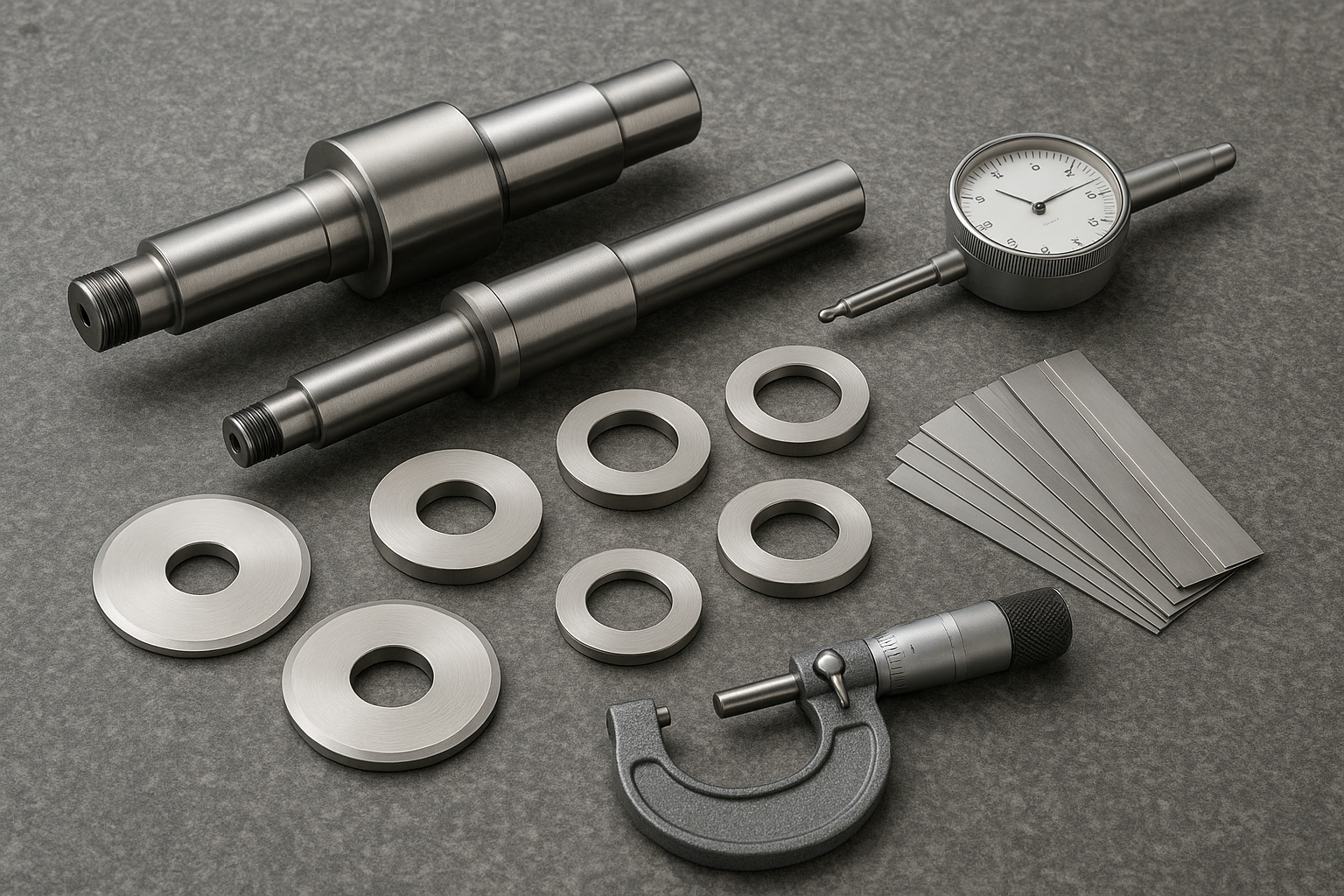
- Axial runout check after assembly (dial indicator on a clean reference surface).
- Face contact check: confirm no rocking or debris in the stack.
- Overlap confirmation at a known gauge position (use a consistent method and record it).
In practice, this is where a documented slitter knife shim stack matters: you’re not just adding thickness—you’re controlling a tolerance chain that decides whether you truly restore overlap after regrind.
When you document these checks, use recognized GD&T terms so engineering and QC are aligned (see ASME Y14.5 dimensioning and tolerancing guidance E ISO 1101 geometrical tolerancing standard).
Clearance Re-check After Regrind
Regrinding that removes thickness from knife faces will also alter the lateral clearance in the stack. After shim compensation, re-verify clearance using your process-standard method (feeler gauge or OEM reference). Target range: typically 5%–10% of material thickness for shear blades.
Once clearance is confirmed, the next operational question is whether to continue running on the current edge or rotate to a fresh one first. Defining that decision in advance—with burr-threshold bands by material class and a fixed rotation sequence—prevents reactive choices at the machine. A structured framework for this is documented in the SOP sul programma di rotazione e criteri di riaffilatura delle lame reversibili a 4 taglienti.
Esempio pratico (Cesoia idraulica a raggio oscillante)

The example below is machine-specific (a hydraulic swing beam shear), but it illustrates the same disciplined loop used in rotary slitting: measure → calculate → choose a buildable shim stack → verify overlap → iterate.
Nota: For a swing beam shear, OD0/OD1 in this example represent blade thickness; the equivalent center-height displacement relationship depends on the machine’s OEM definition. For rotary slitters, OD refers to the knife outside diameter—the formulas look the same, but the underlying geometry is different.
Equipment & assumptions
Regrind limit: discard blade when total cumulative thickness loss exceeds 1.5 mm (OEM-specific; confirm with your machine documentation).
- Equipment type: Hydraulic Swing Beam Shear
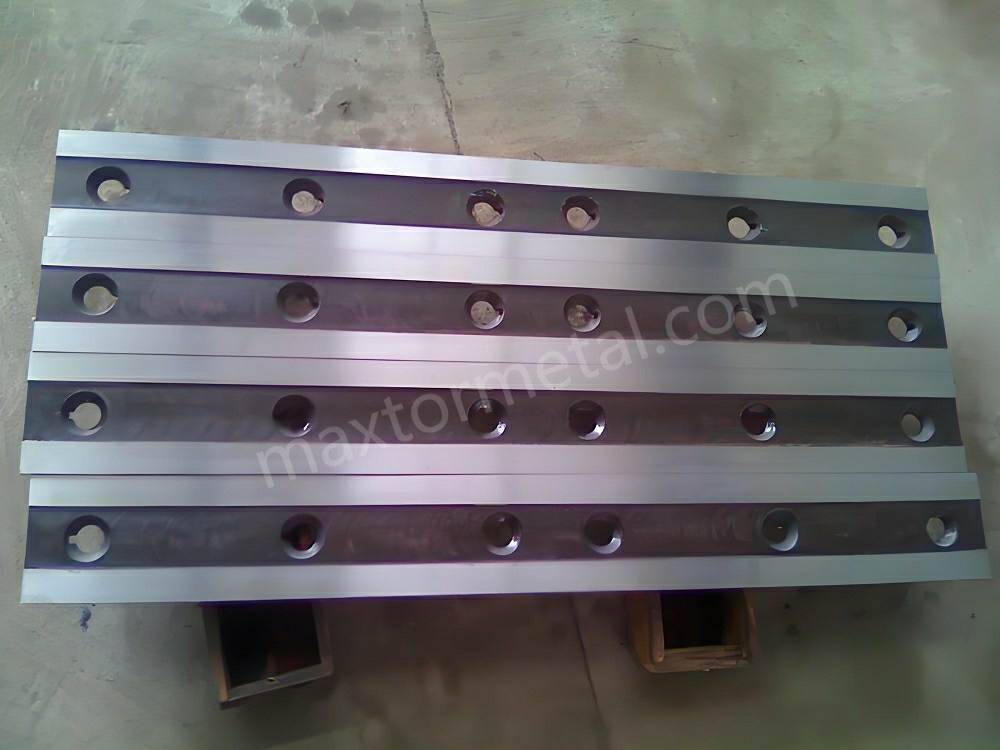
- Blade material: D2 (heat-treated), top and bottom blades. Maxtor Metal supplies D2 shear blades with documented pre- and post-grind OD records, supporting this type of traceability. When deciding between D2 and SKD11 for a specific shearing application, the choice hinges on carbide microstructure and dominant failure mode — see the Guida alla selezione dell'acciaio per utensili D2 vs SKD11 per lame da cesoia for the full framework. For operations cutting AHSS or UHSS where D2 wear rate becomes a throughput constraint, a tungsten carbide inlaid construction can extend regrind intervals — see the Guida al ROI delle lame da cesoia con inserti in carburo di tungsteno per AHSS for the cost-per-meter comparison framework
- Blade length: 3,200 mm
- Assumption: machine locating references are stable; only shim compensation is needed (no guide/ram re-alignment)
Inputs (measured)
OD0(pre-grind thickness): 30.00 mmOD1(post-grind thickness): 29.64 mm- Thickness removed: 0.36 mm
- Shim increment available (
t_shim): 0.05 mm - Overlap target: 1.50 mm
- Process window: 1.45–1.55 mm
Measurement sequence (to reduce bad inputs)
- Use a calibrated 0–50 mm digital micrometer (0.001 mm resolution).
- Measure thickness at 5 positions (left end, 1/4, center, 3/4, right end).
- Use the average thickness for calculation.
First-pass compensation
- Theoretical compensation (thickness loss): 0.36 mm
Attempt #1 (close to theory, but outside window):
- Shim stack: 0.20 + 0.10 + 0.05 = 0.35 mm
- Verified overlap: ≈ 1.43 mm (below the 1.45 mm lower limit)
- Observations after ~20 test cuts on 3 mm low-carbon steel: intermittent mid-span burr increase and slightly worse consistency.
Attempt #2 (within window):
- Shim stack: 0.20 + 0.10 + 0.10 = 0.40 mm
- Verified overlap: 1.48 mm (inside window)
- Dial-indicator check: max variation along blade length ≈ 0.03 mm
Results (production observation)
Observed on ~500 sheets of 3 mm ASTM A36:
The following observations were recorded during a maintenance trial conducted at a steel service center using Maxtor Metal D2 shear blades (3,200 mm, vacuum heat-treated). Customer identity anonymized per standard disclosure practice.
| Metrico | 0.35 mm stack | 0.40 mm stack |
|---|---|---|
| Verified overlap | ≈1.43 mm | 1.48 mm |
| Burr behavior | slightly higher + uneven | uniform, within shop acceptance |
| First-pass yield | ~96% | ~99% |
| Downtime for quality micro-adjust | 1 time/shift | none |
Takeaway: being “close” to the calculated value is not enough when shim increments are coarse. A defined window plus verification produces the repeatable result.
Lame eccentriche/non circolari
Mean working center definition
Not every knife is perfectly circular in service—especially after damage, poor mounting, or uneven wear. For compensation work, define a mean working center:
- The center position that best represents the knife during cutting, averaged over rotation, under clamped conditions.
This definition matters because shims correct static stack height, not dynamic eccentricity.
Multi‑angle verification and chord/stringline
If you suspect eccentricity (a common cause of “it measures fine, but it cuts differently”), treat it as an eccentric slitter knife compensation question first, not a shim question:
- Check OD/edge position at multiple angular positions (e.g., 0°, 90°, 180°, 270°).
- Use a chord/stringline or indicator sweep method to identify high/low spots.
If the knife has meaningful lobing, your “correct” shim stack will look wrong at some angles—and that’s a measurement truth, not an installer mistake.
What shims can and cannot correct
Shims are powerful, but limited.
Shims can correct:
- Mean center height offsets from regrind radius loss
- Small axial alignment changes caused by controlled stack adjustments
Shims cannot correct:
- Significant knife eccentricity or lobing
- Face waviness, dish, or poor parallelism
- Arbor bend or bearing issues
If overlap varies around rotation, treat it as a runout/geometry problem first, not a shim-selection problem.
SOP e tolleranze
Measure and compute
Maxtor Metal’s regrind documentation protocol requires OD0 E OD1 to be logged per blade ID, enabling compensation calculations to be audited across multiple grind cycles.
- Apply safe servicing controls appropriate to your facility before knife handling; in the U.S., align procedures to OSHA’s 29 CFR 1910.147 lockout/tagout standard.
- Record
OD0EOD1using a controlled method (same tool, same technique, clean surfaces). - Compute
ΔRand the target shim addition. - Log the calculation and the selected shim stack in your shim log (date, knife ID, grinder lot, operator).
If you need a plain-language refresher on the sequence (shut down, isolate, lock/tag, verify), OSHA summarizes it in the OSHA 3120 lockout/tagout fact sheet (PDF).
Assemble and initial set
- Clean every contact surface in the stack; confirm no trapped burrs.
- Build the spacer + shim stack to the calculated value; keep shim count low.
- Tighten in a consistent pattern and torque range (per OEM procedure).
- QC note (non-promotional): Maxtor Metal records grind inputs and verifies flatness/runout with calibrated gauging, supporting repeatable regrind compensation and traceable knife history.
Inspect: runout, flatness, spacer accuracy
- Runout: indicator sweep after assembly; reject “good enough” if burr defects are the KPI.
- Flatness: verify reference faces; use ISO GPS terminology where your plant uses ISO-based drawings (see ISO 12781-1 flatness vocabulary/parameters).
- Spacer accuracy: treat spacer thickness as part of the tolerance stack; spot-check against marked values.
Conclusione
Restoring overlap after regrind is mostly a geometry problem, not a “feel” problem. When you compute shim compensation from measured radius loss, then verify runout and stack integrity, you get stable edge morphology and fewer defect surprises.
- Key takeaways: restore center height, validate overlap, document results
- Next steps: periodic audits, update shim logs, refine targets
Teams working with Maxtor Metal shear blades can request factory OD records to use as an OD0 baseline — blade material selection and vacuum heat treatment specifications are documented in the Maxtor Metal Shear Blades engineering guide.
FAQ
Come calcolo lo spessore degli spessori (shim) dopo la rettifica di una lama circolare?
Misurare il diametro esterno (OD) prima e dopo la rettifica, calcolare ΔR = (OD0 − OD1) / 2, quindi aggiungere spessori approssimativamente uguali a ΔR (arrotondati in base agli incrementi disponibili). Verificare sovrapposizione e runout dopo il montaggio. Maxtor Metal fornisce schede di compensazione per rettifica con le spedizioni delle lame per supportare questo processo.
Perché la mia sovrapposizione (overlap) è diminuita dopo la rettifica, anche se ho usato gli stessi distanziali?
Perché la rettifica riduce il raggio della lama. Con lo stesso pacco di distanziali, l'altezza effettiva del centro diminuisce e la sovrapposizione si riduce, il che può aumentare la formazione di bave e lo strappo del bordo.
Qual è la differenza tra gioco (clearance) e sovrapposizione (overlap) nel taglio longitudinale?
Il gioco è lo spazio laterale tra le lame; la sovrapposizione è la misura in cui le lame si impegnano oltre la linea tangente (profondità di penetrazione). Il gioco influisce sullo sfregamento e sul comportamento della bava; la sovrapposizione determina se il taglio rimane in un regime di tranciatura stabile.
Gli spessori (shims) possono correggere le bave causate dal runout (oscillazione)?
Solo indirettamente. Gli spessori possono ripristinare l'altezza centrale media, ma non possono eliminare un'eccentricità significativa della lama, l'ondulazione della faccia o problemi all'albero/cuscinetti che creano variazioni di sovrapposizione durante la rotazione.
Come faccio a verificare se una lama da taglio è eccentrica (non circolare)?
Misurare la posizione del tagliente o il diametro esterno (OD) in più angolazioni e/o eseguire una misurazione con comparatore. Se la lettura cambia in modo significativo con la rotazione, la sovrapposizione varierà anche con un pacco spessori "corretto".
Cosa dovrei controllare dopo aver assemblato un pacco spessori (shim stack)?
Ispezionare il runout assiale, la planarità della faccia di riferimento e la precisione dello spessore dei distanziali. Utilizzare metodi coerenti e documentare i risultati in modo che il prossimo set-up inizi da dati di riferimento certi.
Quale regola OSHA si applica alla sostituzione delle lame di taglio negli Stati Uniti?
Utilizzare procedure allineate alla norma OSHA sul controllo delle energie pericolose, 29 CFR 1910.147, che richiede lo spegnimento, l'isolamento, il blocco/tag-out (LOTO) e la verifica prima della manutenzione.
Informazioni sull'autore
Nancy Wu è un Ingegnere di produzione senior In Ingegneria della produzione (PE) A Maxtor Metal, con 12 anni of experience supporting industrial blade manufacturing and maintenance workflows. Her work focuses on process engineering for precision-ground blades, including material and coating selection (D2, M2, H13, powder metallurgy steels, and carbide) and high-precision CNC grinding programming.
Credentials: PMI – CMfgE, PMP, Cintura Nera Six Sigma, E ASM International certifications.
Transparency note: This article is intended as a technical reference and does not replace OEM manuals, on-site safety procedures, or professional engineering judgment. Always verify overlap/clearance with the method defined by your equipment manufacturer and your facility SOP.

 English
  Spanish
  Italian
  French
  Portuguese
  Russian
  German
  Arabic
  Hindi
Hindi  Vietnamese
  Indonesian
  Japanese
  Korean