

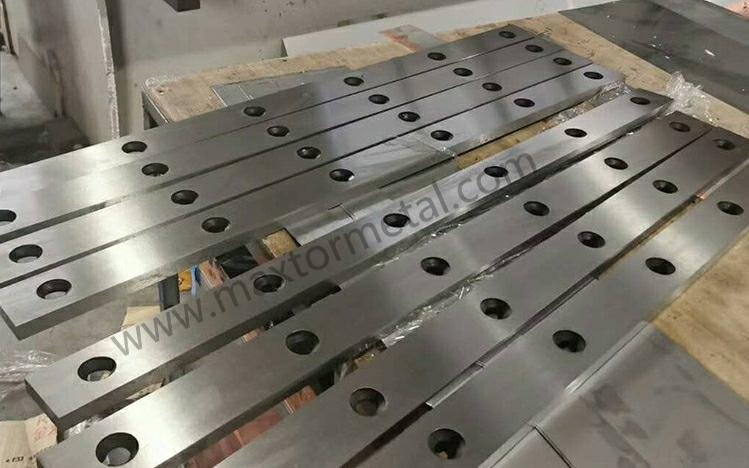
Von Nancy Wu, leitende Fertigungsingenieurin (Produktionstechnik), Maxtor Metal – SME–CMfgE, PMP, Six Sigma Black Belt, ASM International-Zertifizierungen
Anwendungsbereichshinweis: Dieser Leitfaden ist eine technische Referenz zur Unterstützung bei gemessenen Einstellungsarbeiten. Befolgen Sie für die endgültigen Einstellungen und Sicherheitsverfahren immer das Servicehandbuch Ihres OEM und die SOPs Ihres Werks.
Das Nachschleifen stellt den Zustand der Schneide wieder her, entfernt jedoch auch Material vom Außendurchmesser (OD) und/oder den Seitenflächen des Messers. In einem Messerkopf ist diese Veränderung nicht nur kosmetisch: Sie verschiebt die Arbeitshöhe und kann Sie unbemerkt von Ihrem Überlappungsziel abbringen. Das Ergebnis ist bekannt: Gratbildung nimmt zu, die Kantenmorphologie ändert sich und die Wiederholgenauigkeit zwischen den Rüstvorgängen sinkt.
Dieser Leitfaden richtet sich an Produktions-, Wartungs- und Prozessingenieurteams, die eine zuverlässige Methode zur Berechnung von Unterlegscheiben-Paketen nach dem Nachschleifen benötigen. Er folgt dem "Dokumentation zuerst"-Prinzip disziplinierter Werkstätten (einschließlich der qualitätsorientierten Arbeitsabläufe von Maxtor Metal), da das Ziel keine Einstellung nach "Gefühl", sondern eine gemessene und wiederholbare Konfiguration ist.
In diesem Zusammenhang ist das praktische Ziel einfach: die Höhe der Schneidmessermitte so wiederherzustellen, dass das Überlappungsziel dort bleibt, wo Sie es eingestellt haben.
- Zweck: Berechnung der Ausgleichsscheiben zur Wiederherstellung der Mittelhöhe nach dem Nachschleifen
- Zielgruppe: Produktions-, Wartungs- und Verfahrenstechnikteams
- Ergebnisse: Präziser Ausgleich der Dickenreduzierung durch Nachschleifen, Wiederherstellung der Überlappung, Reduzierung von Defekten
Technischer Hinweis: Die Kompensation der Dickenreduzierung nach dem Nachschleifen ist der Prozess der Berechnung und Hinzufügung von Unterlegmaterial (Shim) zu einem Messerstapel, um die ursprüngliche Arbeitshöhe und Überlappung nach dem durch das Nachschleifen verursachten Verlust an Außendurchmesser (OD) oder Dicke wiederherzustellen. Ohne diese Kompensation führt die gleiche Distanzring-Konfiguration wie vor dem Nachschleifen zu einer geringeren Überlappung, was die Gratbildung erhöht und die Schnittkonsistenz verringert. [→ Siehe Maxtor Metal Shear Blades Seite für Prinzipien des Spaltmanagements]
Grundlagen der Schneidgeometrie
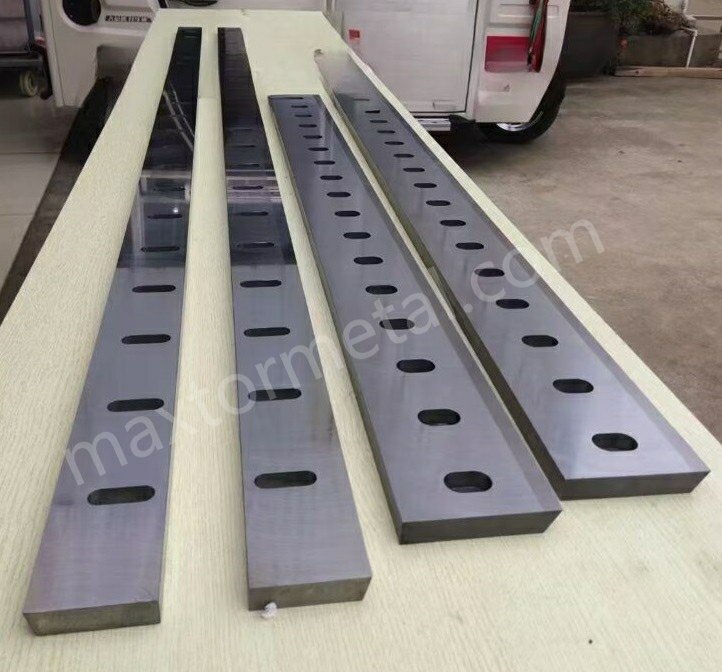
Im Fertigungsablauf von Schermessern bei Maxtor Metal wird die Überprüfung der Überlappung nach dem Nachschleifen als obligatorischer Kontrollpunkt behandelt, bevor die Messer wieder in Betrieb genommen werden.
Räumungs- und Überlappungsziele
Abstand und Überlappung sind die beiden Geometrieparameter, die die Kantenqualität am direktesten beeinflussen. In der Praxis bedeutet das:
- Freigabe ist der seitliche Spalt zwischen den zusammenpassenden Messern (oder Messer und Amboss), der typischerweise durch Abstandshalter und Ausrichtung kontrolliert wird.
- Überlappen ist die Tiefe, in die die Messer über die theoretische Tangentenlinie hinaus “eindringen”, die typischerweise durch den Mittenabstand (oder eine gleichwertige Einstellung) bestimmt wird.
Wenn die Überlappung nach dem Nachschleifen abnimmt, kommt es häufiger zu Ausrissen und einem größeren Grat, da der Schnitt eher in Richtung Biegung/Bruch als in Richtung stabile Scherung übergeht. Die Gratbildung ist ein viel diskutiertes Thema bei Zerspanungsprozessen, der zentrale Mechanismus ist jedoch stets gleich: Schneidkantenverformung beim Austritt und Verlust der kontrollierten Scherung sind die Hauptursachen (siehe …). CIRP ANNALS-Überprüfung zur Analyse und Kontrolle von Graten).
Neigungswinkel und Geschwindigkeitsdifferenz
Neigungswinkel und Schnittgeschwindigkeitsdifferenz beeinflussen die Werkstückführung an der Schneidkante und den Schnittverlauf über die Breite. Sie ersetzen nicht die korrekte Überlappung und den Freiraum – sie optimieren die Stabilität.
- Winkel nicht wählbar kann die effektive Kontaktweglänge verändern und den Verschleiß verteilen, aber es verändert auch die Empfindlichkeit des Prozesses gegenüber axialem Rundlauf und Distanzscheibenfehlern.
- Geschwindigkeitsdifferenz Die Verwendung von Geschwindigkeitsanpassungen beeinflusst das Verhältnis von Gleiten zu Biss und kann die Hitzeentwicklung und die Kantenbearbeitung verändern. Bei bereits geringer Überlappung kaschieren Geschwindigkeitsanpassungen oft nur das Symptom, anstatt die Ursache zu beheben.
Kantenmorphologie und Gratbildung
Die Kantenmorphologie ist Ihr schnellster Feedback-Mechanismus.
- Gleichmäßiger Rollgrat deutet oft auf eine unzureichende Scherwirkung hin (geringe Überlappung, zu großer Abstand oder stumpfe Kante).
- Lokalisierter starker Grat Dies deutet häufig auf Rundlauffehler, Schichtdickenfehler oder nicht parallele Flächen hin.
- Zeitweise auftretende “Zahnmarken” stehen oft im Zusammenhang mit Klappern, mangelnder Steifigkeit der Triebwerkswelle oder im Schornstein eingeschlossenen Verunreinigungen.
Der entscheidende operative Punkt: Gratbildung ist üblicherweise das Ergebnis von Geometrie + Ausrichtung + Kantenbeschaffenheit, kein eigenständiger Defekt, den man “entgratet”.”
Methode zur Kompensation beim Nachschleifen
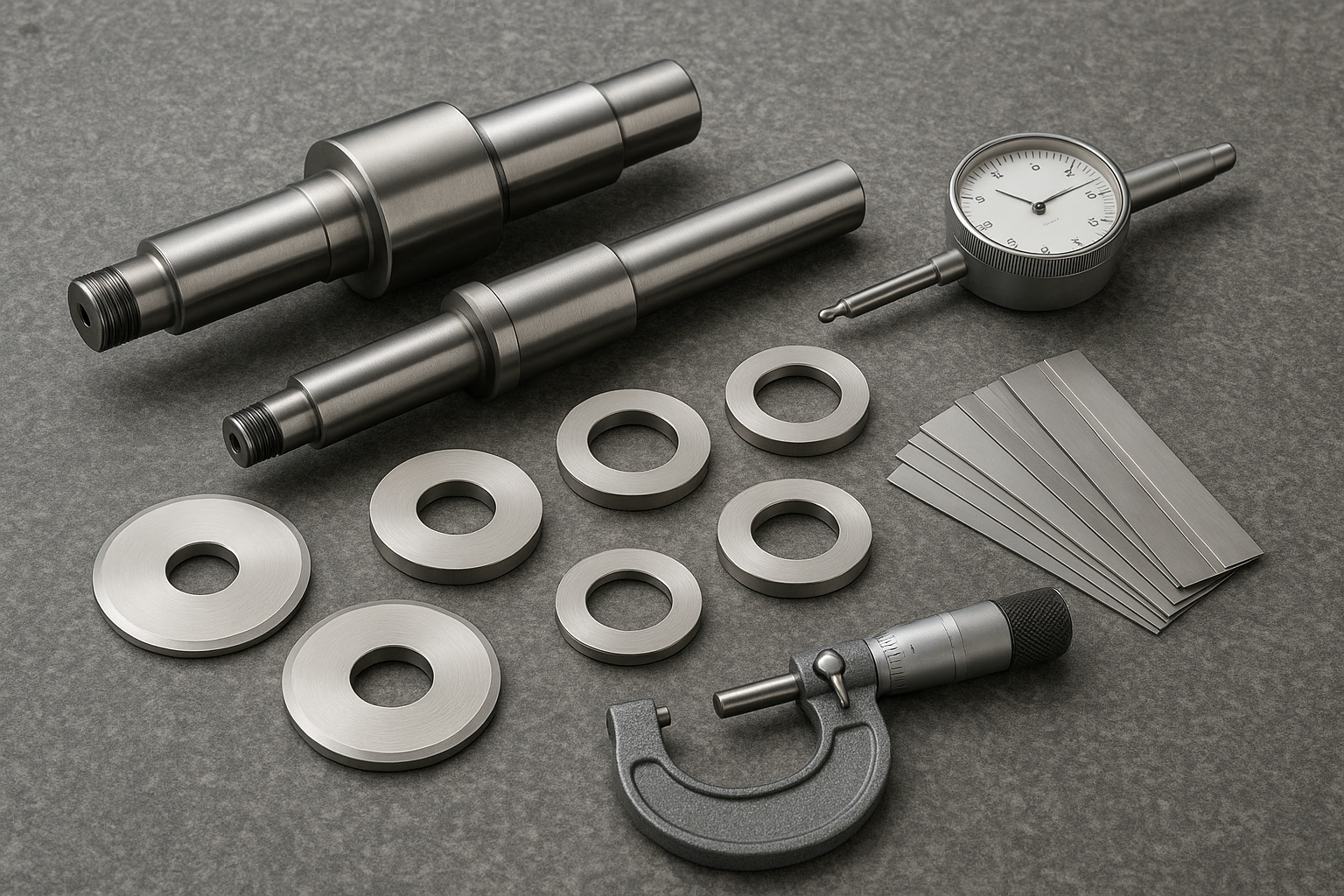
Annahmen, Grenzen und Sicherheitshinweise
Da die Vorrichtungen zum Schlitzen und Scheren stark variieren, sollten die Berechnungen in diesem Leitfaden als allgemeingültig betrachtet werden. erster Durchgang, messorientierter Ausgangspunkt—überprüfe anschließend die Einstellungen anhand der Dokumentation deines Rechners.
Annahmen, die der Shim-Mathematik zugrunde liegen (müssen für optimale Ergebnisse erfüllt sein):
- Die Positionierreferenzen der Maschine sind stabil (kein nennenswerter Verschleiß oder Beschädigung an Führungen/Haltern/Schlüsseln).
- Das Mahlgut verändert sich hauptsächlich effektive Kantenposition durch Radius- oder Dickenverlust (nicht durch Verformung, Flächenverzerrung oder Geometriefehler).
- Messer und Distanzstücke lassen sich sauber mit wiederholbarem Drehmoment und ohne eingeschlossene Rückstände einsetzen.
Wo diese Methode versagen kann oder eine Eskalation erforderlich ist:
- Wenn die Überlappung um die Rotationsrichtung variiert (Rundlauf/Exzentrizität), können Unterlegscheiben das Problem nicht “ausgleichen” – beheben Sie zuerst Rundlauffehler, Planlage oder Probleme mit der Spindel/dem Lager.
- Sind die Halterungen/Führungsbahnen verschlissen, kann das Hinzufügen von Unterlegscheiben zwar vorübergehend zu einer Überlappung führen, die korrekte Ausrichtung wird dadurch aber nicht wiederhergestellt.
- Wenn die Prozessdefinition von “Überlappung” maschinenspezifisch ist (häufig bei Scheren im Vergleich zu Rotationsschneidemaschinen), verwenden Sie die Definition und Messmethode des Originalherstellers.
Sicherheitshinweis (YMYL): Beachten Sie vor dem Umgang mit oder dem Einstellen von Messern stets die Sicherheitsvorschriften Ihres Betriebs und die Anweisungen im Servicehandbuch des Herstellers. Diese Anleitung ersetzt weder die Anweisungen des Herstellers noch die Sicherheitsvorkehrungen vor Ort.
Mittenhöhe nach dem Nachschleifen
- Messer-Außendurchmesser (AD) → Eine Radiusänderung verändert die Arbeitsmittelpunkthöhe relativ zum Gegenmesser.
- Messerstärke / Position der Schneide (je nachdem, wie das Messer nachgeschliffen wird) → kann sich die Position der Schneide relativ zu Distanzstücken und Naben verändern.
Bei den meisten Schneidköpfen ist die wichtigste Einstellungsänderung, die Sie kompensieren müssen, folgende: Radiusverlust:
- Ursprünglicher Radius:
R0 = OD0 / 2 - Nachgeschliffener Radius:
R1 = OD1 / 2 - Radiusverkleinerung:
ΔR = R0 − R1
Wenn die Der Achsabstand der Spindel ist festgelegt., Eine Verringerung des Radius verringert die Überlappung am nachgeschliffenen Werkstück um etwa denselben Betrag (die Geometriedetails hängen davon ab, ob ein oder beide Messer nachgeschliffen werden).
Wichtigste ErkenntnisBei vielen Schneidvorrichtungen bedeutet “die gleichen Abstandshalter wie beim letzten Mal” nach dem Nachschleifen gleichbedeutend mit “weniger Überlappung als beim letzten Mal”.”
Kompensationsformel und Ablauf der Shim-Auswahl
Nutzen Sie dies als praxisgerechte Methode, die versteckte Annahmen vermeidet.
Schritt 1 – Messen, was sich geändert hat (Eingabegrößen):
Protokoll zur Berechnung und Überprüfung von Ausgleichsscheiben
Verwenden Sie eine einfache, wiederholbare Aufzeichnung wie die untenstehende Tabelle, um die Entscheidungen bezüglich der Unterlegscheiben über Nachschleifvorgänge und Schichtwechsel hinweg nachvollziehbar zu halten.
| Feld | Wert |
|---|---|
| Geräte-/Leitungs-ID | |
| Messer-/Klingen-ID | |
| Material / Güteklasse | |
| Nachschleifdatum | |
| Gemessener OD0 (oder letzter Wert innerhalb der Spezifikation) | |
| Gemessener OD1 (nach dem Nachmahlen) | |
| Berechnete ΔR- oder Dickenverlustbasis | |
| Unterlegscheiben-Inkrement verfügbar (t_shim) | |
| Zielüberlappung | |
| Prozessfenster | |
| Ausgewählter Shim-Stack (Liste) | |
| Gesamte Ausgleichsscheibe hinzugefügt | |
| Verifizierungsmethode (Überlappung) | |
| Ergebnis der Überprüfung der Überlappung | |
| Ergebnis der Auslauf-/Konsistenzprüfung | |
| Schnittnoten des ersten Stücks (Grat/Kante) | |
| Endgültige Entscheidung (annehmen / anpassen) | |
| Techniker / Genehmiger |
Dokumentenkontrolle: Protokollvorlage v1.0. Wenn Sie Ihre Messmethode, die Unterlegscheiben-Inkremente oder die OEM-Setup-Definition ändern, erhöhen Sie die Version und vermerken Sie die Änderung in Ihren Arbeitsanweisungen.
OD0: Original-OD des Messers (oder zuletzt bekannte OD innerhalb der Spezifikation)OD1: nach dem Wiedermahlen ODt_shimVerfügbare Unterlegscheiben-Schritte (z. B. 0,01 mm, 0,001 Zoll)Überlappungsziel: Ihr Prozessziel (dokumentiert)
Schritt 2 — Radiusreduktion berechnen:
ΔR = (OD0 − OD1) / 2
Schritt 3 — Entscheiden Sie, welche Seite unterlegt werden soll (Auswahlregel):
- Wenn Sie erneut mahlen ein Messer Bei einem Paar wird eine Kompensation am Stapel der nachgeschliffenen Seite vorgenommen, um die effektive Mittenhöhe wiederherzustellen.
- Wenn Sie erneut mahlen beide Messer Ebenso kann die erforderliche Kompensation auf beide Stapel aufgeteilt werden, aber die Nettoüberlappungsänderung wird immer noch durch den Gesamtradiusverlust bestimmt.
Schritt 4 – Umrechnung in die Dicke der Ausgleichsscheiben: Bei einem gängigen Verfahren zur Anhebung der Nabenhöhe mittels Unterlegscheiben (maschinenabhängig) ergibt sich eine Näherung erster Ordnung wie folgt:
Shim_add ≈ ΔR
Wählen Sie dann einen Shim-Stack aus, den Sie tatsächlich bauen können.
Hinweis zu Beweismitteln und Überprüfung: In der Werkstattpraxis wird der Ausgleich von Ausgleichsscheiben oft als “Anpassung an das abgetragene Material” (eine praktische Faustregel) behandelt, jedoch unterscheiden sich die Maschinengeometrie und die OEM-Definitionen der Überlappung. Verwenden Sie die Berechnung, um einen Ausgangspunkt zu wählen, dann Überlappung und Schnittqualität prüfen, Beachten Sie für die endgültigen Einstellungen das Handbuch des Originalherstellers und die Standardarbeitsanweisung Ihres Betriebs. (Eine praxisorientierte Erläuterung zum Thema Unterlegscheiben finden Sie in der Servicedokumentation Ihres Originalherstellers.)
Runden mit einem Prozessfenster (empfohlen):
- Definieren Sie Ihren akzeptablen Überlappungsbereich:
Überlappungsfenster = [Überlappung_niedrig, Überlappung_hoch]. - Wenn mehrere Shim-Stacks möglich sind, bevorzugen viele Wartungsteams ein Ergebnis in der obere Hälfte des Fensters (um das Risiko von Unterlappungen durch Setzungen oder leichten Verschleiß der Teile zu verringern), wobei gleichzeitig die OEM-Grenzen eingehalten werden.
- Falls Sie aufgrund der Unterlegscheiben nicht innerhalb des Fensters landen können, wählen Sie den nächstliegenden sicheren Wert und Überlappung erneut messen und die Qualität reduzieren, dann iterieren.
Beispiel (metrisch zuerst): wenn t_shim = 0,05 mm (~0,002 Zoll) und Ihr Überlappungsfenster beträgt `1,45–1,55 mm` (~0,057–0,061 Zoll), Werte wie 1,48–1,52 mm werden üblicherweise gegenüber Werten nahe der unteren Grenze bevorzugt, vorausgesetzt, die Vorgaben des Originalherstellers lassen dies zu.
Faustregel: Verwende Mathematik, um einen Startstapel auszuwählen, aber verwende Überlappungsprüfung “Den Kreislauf schließen.”
Schritt 5 – Den Stack bewusst aufbauen:
- Weniger Shims sind vorzuziehen (weniger Schnittstellenfehler), wenn der Wert erreicht werden kann.
- Die Unterlegscheiben müssen sauber und plan sein; ein einziger eingeschlossener Grat kann die gesamte Berechnung zunichtemachen.
Toleranzstapel und Prüfpunkte
Zwei Tatsachen führen dazu, dass die Shim-Mathematik in der Praxis versagt:
- Dickenstapelfehler (Abstandshalter + Unterlegscheiben + Schneidflächen)
- Auslauf-/Flächenparallelität das ändert die effektive Überlappung um die Rotation
Prüfpunkte, um die Integrität zu gewährleisten:
- Prüfung des axialen Rundlaufs nach der Montage (Messuhr auf einer sauberen Referenzfläche).
- Gesichtskontaktprüfung: Sicherstellen, dass sich im Stapel keine Unebenheiten oder Fremdkörper befinden.
- Überlappungsbestätigung an einer bekannten Messposition (verwenden Sie eine einheitliche Methode und notieren Sie das Ergebnis).
In der Praxis ist dies der Ort, an dem eine dokumentierte Schlitzmesser-Unterlegscheibenstapel Es kommt darauf an: Sie erhöhen nicht nur die Dicke – Sie kontrollieren eine Toleranzkette, die darüber entscheidet, ob Sie wirklich Überlappung nach dem Nachschleifen wiederherstellen..
Verwenden Sie bei der Dokumentation dieser Prüfungen anerkannte GD&T-Begriffe, um eine Abstimmung zwischen Konstruktion und Qualitätskontrolle zu gewährleisten (siehe ASME Y14.5 Bemaßungs- und Tolerierungsrichtlinien und ISO 1101 geometrischer Tolerierungsstandard).
Nachprüfung des Freispiels nach dem Nachschleifen
Durch das Nachschleifen, das Material von den Schneidkanten abträgt, ändert sich auch das seitliche Spiel im Messerstapel. Nach dem Ausgleich mit Unterlegscheiben überprüfen Sie das Spiel erneut mit Ihrer üblichen Methode (Fühlerlehre oder OEM-Referenz). Zielbereich: typischerweise 5%–10% Materialstärke für Schermesser.
Sobald die Freigabe bestätigt ist, stellt sich die Frage, ob die Bearbeitung an der aktuellen Kante fortgesetzt oder zunächst eine neue Kante bearbeitet werden soll. Die Festlegung dieser Entscheidung im Voraus – mit Schwellenwerten für Gratbildung nach Materialklasse und einer festen Rotationsreihenfolge – verhindert reaktive Entscheidungen an der Maschine. Ein strukturierter Rahmen hierfür ist in der Dokumentation beschrieben. Standardarbeitsanweisung für die Rotation von 4-schneidigen Wendeklingen und die Nachschleifkriterien.
Praxisbeispiel (Hydraulische Pendelschlag-Schere)

Das folgende Beispiel ist maschinenspezifisch (eine hydraulische Schwenkbalkenschere), aber sie veranschaulicht die gleiche disziplinierte Schleife, die beim Rotationsschneiden verwendet wird: Messen → Berechnen → einen baubaren Shim-Stack auswählen → Überlappung überprüfen → Iterieren.
Notiz: Bei einer Schwingbalkenscherung, OD0/OD1 in diesem Beispiel darstellen Klingendicke; Das äquivalente Verhältnis von Mittenhöhenverschiebung hängt von der OEM-Definition der Maschine ab. Bei Rotationsschneidemaschinen gilt Folgendes:, OD bezieht sich auf die Messer-Außendurchmesser—Die Formeln sehen zwar gleich aus, aber die zugrunde liegende Geometrie ist unterschiedlich.
Ausrüstung & Annahmen
Nachschleifgrenze: Klinge aussortieren, wenn der gesamte kumulative Dickenverlust überschritten wird 1,5 mm (Herstellerspezifisch; bitte prüfen Sie dies anhand der Dokumentation Ihres Geräts).
- Gerätetyp: Hydraulische Schwenkbalkenschere
- Blade material: D2 (heat-treated), top and bottom blades. Maxtor Metal supplies D2 shear blades with documented pre- and post-grind OD records, supporting this type of traceability. When deciding between D2 and SKD11 for a specific shearing application, the choice hinges on carbide microstructure and dominant failure mode — see the D2 vs SKD11 tool steel selection guide for shearing blades for the full framework. For operations cutting AHSS or UHSS where D2 wear rate becomes a throughput constraint, a tungsten carbide inlaid construction can extend regrind intervals — see the ROI-Leitfaden für Schermesser mit Wolframkarbid-Einlage für AHSS für den Kostenvergleich pro Meter
- Klingenlänge: 3.200 mm
- Annahme: Die Positionierreferenzen der Maschine sind stabil; es ist lediglich eine Ausgleichsscheibe erforderlich (keine Neuausrichtung von Führung/Stößel).
Eingangsgrößen (gemessen)
OD0(Vorschliffdicke): 30,00 mmOD1(Dicke nach dem Schleifen): 29,64 mm- Abgetragene Dicke: 0,36 mm
- Unterlegscheiben-Schritte verfügbar (
t_shim): 0,05 mm - Überlappungsziel: 1,50 mm
- Prozessfenster: 1,45–1,55 mm
Messsequenz (zur Reduzierung fehlerhafter Eingangsdaten)
- Verwenden Sie ein kalibriertes digitales Mikrometer mit einem Messbereich von 0–50 mm (Auflösung 0,001 mm).
- Messen Sie die Dicke an 5 Stellen (linkes Ende, 1/4, Mitte, 3/4, rechtes Ende).
- Verwenden Sie die durchschnittliche Dicke für die Berechnung.
Erstpasskompensation
- Theoretische Kompensation (Dickenverlust): 0,36 mm
Versuch #1 (nahe an der Theorie, aber außerhalb des Zeitfensters):
- Unterlegscheibenstapel: 0,20 + 0,10 + 0,05 = 0,35 mm
- Bestätigte Überschneidung: ≈ 1,43 mm (unterhalb der unteren Grenze von 1,45 mm)
- Beobachtungen nach ~20 Testschnitten an 3 mm kohlenstoffarmem Stahl: zeitweise Zunahme des Grates in der Schnittmitte und etwas schlechtere Konsistenz.
Versuch #2 (innerhalb des Zeitfensters):
- Unterlegscheibenstapel: 0,20 + 0,10 + 0,10 = 0,40 mm
- Bestätigte Überschneidung: 1,48 mm (im Fenster)
- Überprüfung mit Messuhr: Maximale Abweichung entlang der Klingenlänge ≈ 0,03 mm
Ergebnisse (Produktionsbeobachtung)
Beobachtet an ca. 500 Blechen aus 3 mm dickem ASTM A36:
Die folgenden Beobachtungen wurden während eines Wartungsversuchs in einem Stahlservicezentrum mit Maxtor Metal D2-Schermessern (3200 mm, vakuumwärmebehandelt) aufgezeichnet. Die Kundendaten wurden gemäß üblicher Offenlegungspraxis anonymisiert.
| Metrisch | 0,35 mm Stapel | 0,40 mm Stapel |
|---|---|---|
| Bestätigte Überlappung | ≈1,43 mm | 1,48 mm |
| Klettenverhalten | etwas höher + uneben | Einheitlichkeit, Akzeptanz im Geschäft |
| Erstausbeute | ~96% | ~99% |
| Ausfallzeit für Feinjustierungen | 1 Zeit/Schicht | keiner |
Wegbringen: Es reicht nicht aus, nur “nahe” am berechneten Wert zu liegen. Bei groben Unterlegscheibeninkrementen führt ein definiertes Fenster mit anschließender Überprüfung zu einem reproduzierbaren Ergebnis.
Exzentrische/nicht-kreisförmige Messer
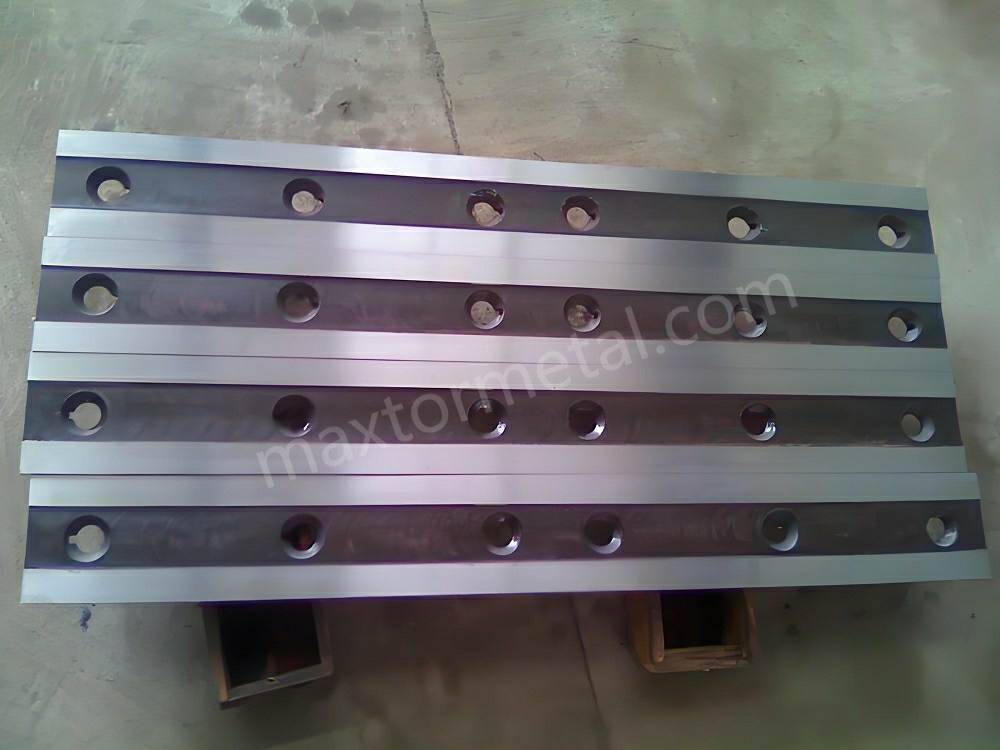
Definition des mittleren Arbeitszentrums
Nicht jedes Messer ist im Gebrauch perfekt rund – insbesondere nach Beschädigung, unsachgemäßer Montage oder ungleichmäßigem Verschleiß. Für Entschädigungsarbeiten definieren Sie eine mittleres Arbeitszentrum:
- Die Mittelposition, die die Bewegung des Messers während des Schneidvorgangs am besten repräsentiert, gemittelt über die Rotation und unter Einspannbedingungen.
Diese Definition ist wichtig, weil Unterlegscheiben korrigieren statische Stapelhöhe, nicht dynamische Exzentrizität.
Überprüfung aus verschiedenen Blickwinkeln und Akkord-/Saitenlinie
Wenn Sie eine Exzentrizität vermuten (eine häufige Ursache für “Es misst gut, aber es schneidet anders”), behandeln Sie es als Exzenter-Schneidmesserkompensation Zuerst die Frage, nicht die Unterlegscheibenfrage:
- Überprüfen Sie die Außendurchmesser-/Kantenposition bei verschiedenen Winkelpositionen (z. B. 0°, 90°, 180°, 270°).
- Verwenden Sie eine Akkord-/Saitenlinien- oder Indikator-Sweep-Methode, um Hoch- und Tiefpunkte zu identifizieren.
Wenn das Messer eine sinnvolle Lappenbildung aufweist, wird Ihr “korrekter” Unterlegscheibenstapel aus bestimmten Blickwinkeln falsch aussehen – und das ist eine Tatsache der Messung, kein Installationsfehler.
Was Unterlegscheiben korrigieren können und was nicht.
Unterlegscheiben sind zwar wirkungsvoll, aber nur bedingt effektiv.
Unterlegscheiben können Folgendes korrigieren:
- Mittlere Abweichungen der Mittenhöhe aufgrund des Verlusts des Nachschleifradius
- Geringfügige axiale Ausrichtungsänderungen, verursacht durch kontrollierte Stapeljustierungen
Unterlegscheiben können Folgendes nicht korrigieren:
- Signifikante Messerexzentrizität oder -lappigkeit
- Wellenförmige Gesichtszüge, schiefe Gesichtszüge oder mangelhafte Parallelität
- Probleme mit der Spindelbiegung oder dem Lager
Wenn die Überlappung um die Rotationsachse variiert, sollte dies zunächst als Rundlauf-/Geometrieproblem und nicht als Problem der Unterlegscheibenauswahl behandelt werden.
SOP und Toleranzen
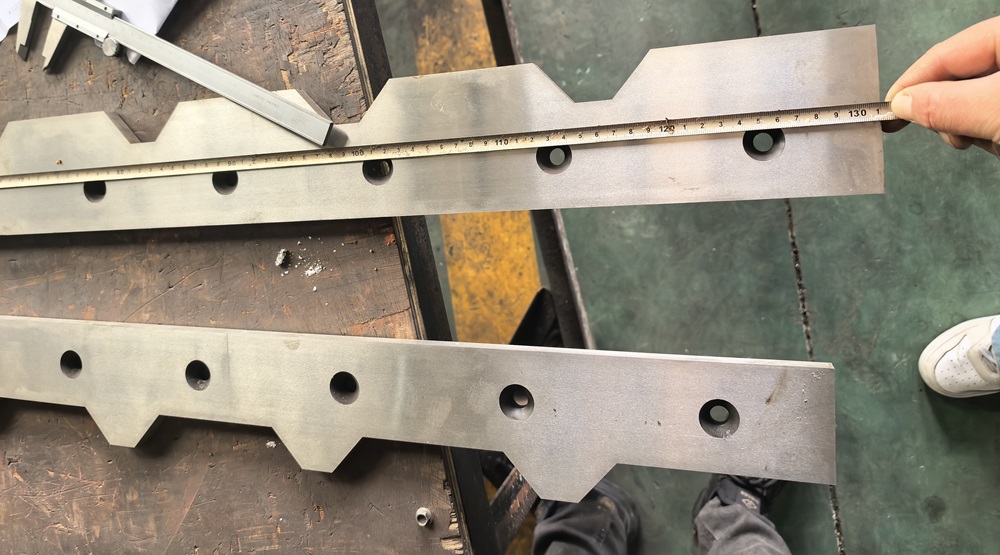
Messen und berechnen
Das Dokumentationsprotokoll für das Mahlgut von Maxtor Metal erfordert OD0 und OD1 Die Daten werden pro Klingen-ID protokolliert, sodass die Kompensationsberechnungen über mehrere Schleifzyklen hinweg geprüft werden können.
- Vor dem Umgang mit Messern müssen die für Ihre Einrichtung geeigneten Sicherheitsvorkehrungen getroffen werden; in den USA müssen die Verfahren an den OSHA-Standard 29 CFR 1910.147 Lockout/Tagout angepasst werden.
- Aufzeichnen
OD0undOD1Anwendung einer kontrollierten Methode (gleiches Werkzeug, gleiche Technik, saubere Oberflächen). - Berechnen
ΔRund die Ziel-Unterlegscheiben-Zugabe. - Protokollieren Sie die Berechnung und den ausgewählten Unterlegscheibenstapel in Ihrem Unterlegscheibenprotokoll (Datum, Messer-ID, Schleifmaschinencharge, Bediener).
Falls Sie eine leicht verständliche Zusammenfassung der Abfolge (Abschalten, Isolieren, Sperren/Kennzeichnen, Überprüfen) benötigen, fasst OSHA diese im folgenden Dokument zusammen: OSHA 3120 Lockout/Tagout-Informationsblatt (PDF)).
Zusammenbauen und Initialisierung
- Reinigen Sie alle Kontaktflächen im Stapel; vergewissern Sie sich, dass keine Grate eingeschlossen sind.
- Bauen Sie den Abstandshalter- und Unterlegscheibenstapel auf den berechneten Wert auf; halten Sie die Anzahl der Unterlegscheiben gering.
- Ziehen Sie die Schrauben gleichmäßig und im vorgegebenen Drehmomentbereich (gemäß OEM-Vorgehensweise) an.
- Qualitätskontrollvermerk (nicht werblich): Maxtor Metal erfasst Schleifeingaben und überprüft Planheit/Rundlauf mit kalibrierten Messgeräten, unterstützt wiederholbare Nachschleifkompensation und nachvollziehbare Messerhistorie.
Prüfen: Rundlauf, Planheit, Distanzscheibengenauigkeit
- Auslaufen: Prüfverfahren nach der Montage; Ablehnung von “gut genug”, wenn Gratfehler der KPI sind.
- Ebenheit: Referenzflächen prüfen; ISO-GPS-Terminologie verwenden, wenn in Ihrem Werk ISO-basierte Zeichnungen verwendet werden (siehe ISO 12781-1 Ebenheitsvokabular/Parameter).
- Genauigkeit des Abstandhalters: Die Dicke des Abstandhalters ist als Teil der Toleranzkette zu behandeln; Stichprobenprüfungen sind mit den markierten Werten durchzuführen.
Fazit
Die Wiederherstellung der Überlappung nach dem Nachschleifen ist hauptsächlich ein geometrisches Problem, weniger eine Frage des Tastgefühls. Berechnet man die Ausgleichsscheiben anhand des gemessenen Radiusverlusts und überprüft anschließend den Rundlauf und die Stapelintegrität, erhält man eine stabile Kantenmorphologie und weniger unerwartete Defekte.
- Wichtigste Erkenntnisse: Mittenhöhe wiederherstellen, Überlappung prüfen, Ergebnisse dokumentieren
- Nächste Schritte: regelmäßige Prüfungen, Aktualisierung der Shim-Protokolle, Verfeinerung der Ziele
Teams, die mit Maxtor Metal-Schermessern arbeiten, können die Werksdaten für den Außendurchmesser (OD) anfordern, um sie als OD0-Ausgangswert zu verwenden – die Materialauswahl für die Messer und die Spezifikationen für die Vakuumwärmebehandlung sind in den entsprechenden Dokumenten festgehalten. Maxtor Metal Schermesser-Konstruktionsleitfaden.
FAQ
Wie berechne ich die Unterlegscheiben-Dicke (Shim-Dicke) nach dem Nachschleifen eines Kreismessers?
Messen Sie den Außendurchmesser (OD) vor und nach dem Nachschleifen, berechnen Sie ΔR = (OD0 − OD1) / 2und fügen Sie dann Shims hinzu, die ungefähr ΔR entsprechen (gerundet auf Ihre Shim-Stufungen). Überprüfen Sie Überlappung und Rundlauf nach der Montage. Maxtor Metal stellt für diesen Prozess bei Messerlieferungen Berechnungstabellen zur Nachschleif-Kompensation zur Verfügung.
Warum ist meine Überlappung (Overlap) nach dem Nachschleifen geringer, obwohl ich dieselben Distanzringe verwendet habe?
Weil das Nachschleifen den Messerradius verringert. Bei gleichem Distanzring-Paket sinkt die effektive Arbeitshöhe und die Überlappung reduziert sich, was zu mehr Gratbildung und Kantenausbrüchen führen kann.
Was ist der Unterschied zwischen Seitenspiel (Clearance) und Überlappung (Overlap) beim Längsschneiden?
Das Seitenspiel ist der seitliche Spalt zwischen den Messern; die Überlappung gibt an, wie weit die Messer über die Tangentiallinie hinaus ineinandergreifen (Eintauchtiefe). Das Seitenspiel beeinflusst die Reibung und das Gratverhalten; die Überlappung entscheidet darüber, ob der Schnitt in einem stabilen Scherprozess bleibt.
Können Unterlegscheiben (Shims) Gratbildung durch Rundlauffehler (Runout) beheben?
Nur indirekt. Unterlegscheiben können die mittlere Arbeitshöhe wiederherstellen, aber sie können keine signifikante Messerexzentrizität, Stirnflächenwelligkeit oder Probleme mit Welle/Lager beseitigen, die zu Überlappungsschwankungen während der Rotation führen.
Wie prüfe ich ein Kreismesser auf Exzentrizität (Nicht-Kreisförmigkeit)?
Messen Sie die Kantenposition oder den Außendurchmesser (OD) in mehreren Winkeln und/oder führen Sie eine Messung mit einer Messuhr durch. Wenn sich der Messwert bei der Drehung signifikant ändert, schwankt Ihre Überlappung selbst bei einem "korrekten" Distanzring-Paket.
Was sollte ich nach der Montage eines Unterlegscheiben-Pakets (Shim Stack) überprüfen?
Prüfen Sie den axialen Rundlauf (Runout), die Ebenheit der Referenzfläche und die Genauigkeit der Distanzring-Dicke. Verwenden Sie konsistente Methoden und dokumentieren Sie die Ergebnisse, damit die nächste Einrichtung auf Basis validierter Daten beginnt.
Welche OSHA-Regel gilt für den Austausch von Kreismessern in den USA?
Verwenden Sie Verfahren, die mit der OSHA-Regel zur Kontrolle gefährlicher Energien (29 CFR 1910.147) übereinstimmen; diese erfordert vor der Wartung das Abschalten, Isolieren, Lockout/Tagout und eine Überprüfung.
Über den Autor
Nancy Wu ist ein Leitender Fertigungsingenieur In Produktionstechnik (PE) bei Maxtor Metal, mit 12 Jahre Sie verfügt über Erfahrung in der Unterstützung von Arbeitsabläufen bei der Herstellung und Wartung industrieller Schaufeln. Ihr Arbeitsschwerpunkt liegt auf der Verfahrenstechnik für präzisionsgeschliffene Schaufeln, einschließlich der Material- und Beschichtungsauswahl (D2, M2, H13, pulvermetallurgische Stähle und Hartmetall) sowie der hochpräzisen CNC-Schleifprogrammierung.
Anmeldeinformationen: KMU – CMfgE, PMP, Six Sigma Black Belt, Und ASM International-Zertifizierungen.
Transparenzhinweis: Dieser Artikel dient als technische Referenz und ersetzt weder die Handbücher des Geräteherstellers noch die Sicherheitsvorschriften vor Ort oder die fachliche Beurteilung durch einen Ingenieur. Überprüfen Sie Überlappung und Freiraum stets anhand der vom Gerätehersteller und den Standardarbeitsanweisungen Ihres Betriebs festgelegten Methode.

 English
  Spanish
  Italian
  French
  Portuguese
  Russian
  German
  Arabic
  Hindi
Hindi  Vietnamese
  Indonesian
  Japanese
  Korean