
Rotura catastrófica de cuchillas: Causas raíz metalúrgicas, mecánica de fracturas y controles de proveedores para su prevención

Quick Answer: Catastrophic blade shattering is almost never one cause—it’s the convergence of metallurgical defects (retained austenite, carbide banding), thermal-process errors (quench cracks, insufficient temper), and geometric stress risers, triggered by a contamination event. Fractography (macro mapping → SEM/EDS → metallography → XRD) identifies which lever failed; supplier controls like AMS 2750 pyrometry and lot-level […]
Acumulación de adhesivo en cuchillas de corte circular: Retroalimentación por contacto térmico, selección de recubrimientos y protocolo de diagnóstico por capas.
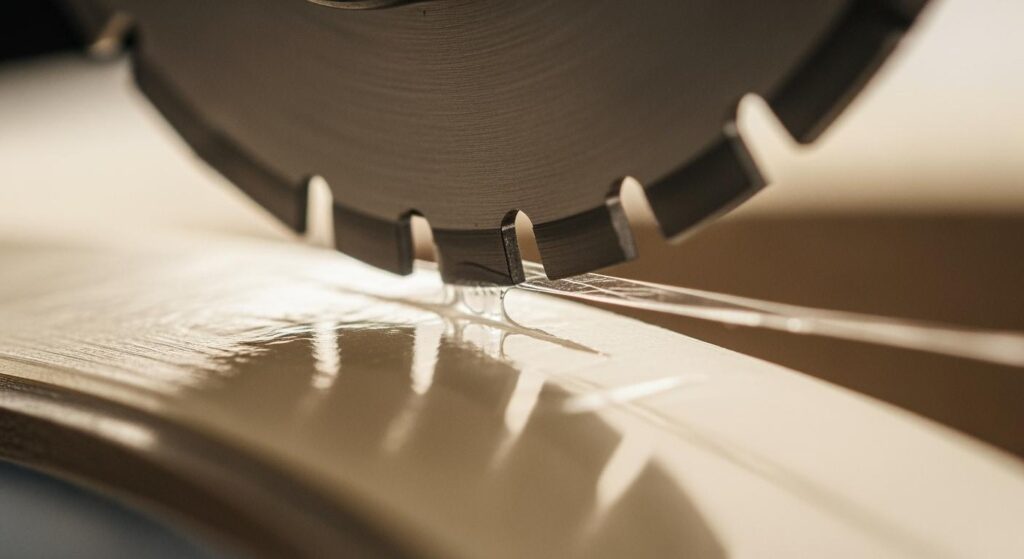
When adhesive starts building up on circular slitting blades, the first sign is rarely dramatic. Slit edges become slightly tacky. Roll geometry drifts. Edge quality degrades before the shift supervisor can pinpoint why. By the time a visible polymer deposit — a built-up edge (BUE) — has formed on the knife face, the blade has […]
Cómo evitar la rotura de cuchillas de rejilla en el fondo de la ranura: Radio de filete, integridad EDM y controles de doble revenido para diseños R≥0,2 mm
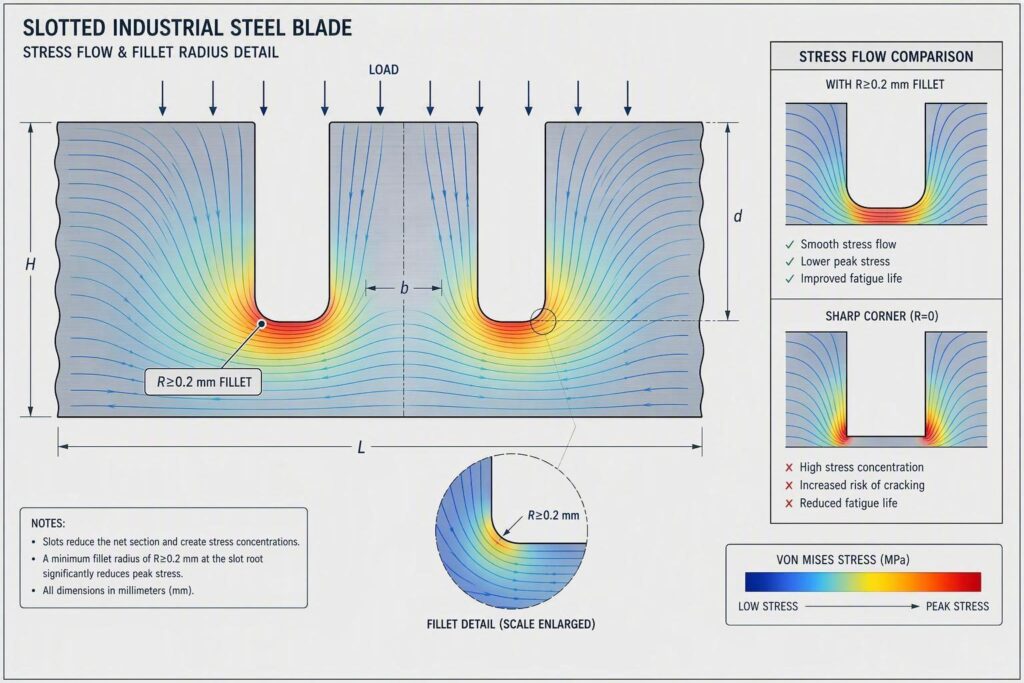
Quick Answer: Grid blade snapping at slot bottoms is caused by the coexistence of three factors: high elastic stress concentration (Kt 7–12 for sharp-cornered slots), surface defects that act as crack initiators (EDM recast layers, grinding burns), and insufficient toughness in the surrounding material. The primary engineering fix is to specify a slot fillet radius […]
Selección de Cuchillas para Polímeros de Grado Médico: Acero Inoxidable 420 vs 440C, Acabado Superficial y Control del Anillo de Agua
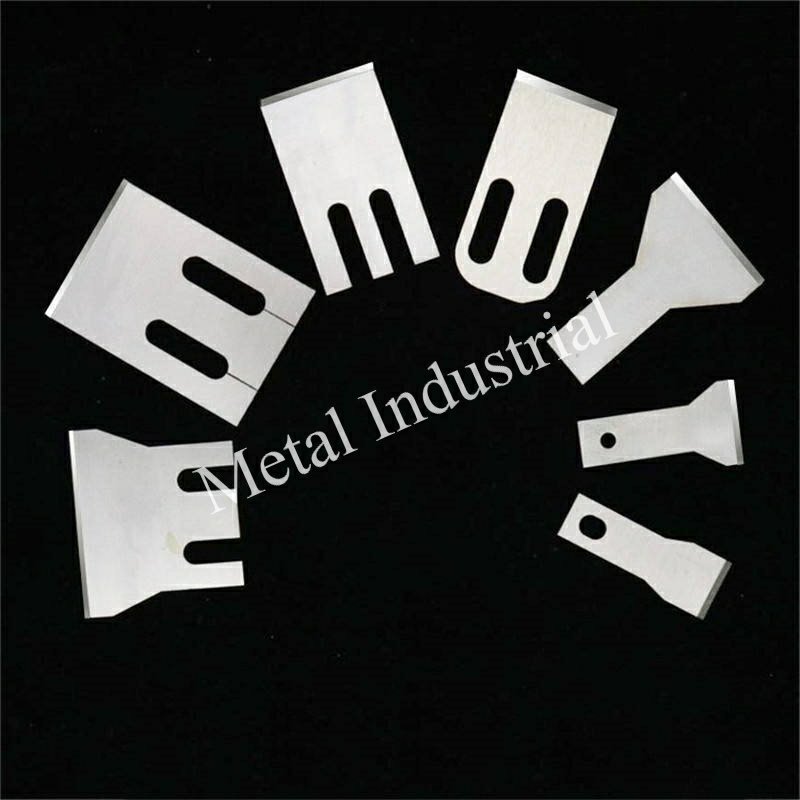
Respuesta rápida: En el peletizado de polímeros de grado médico, los aceros inoxidables 420 y 440C no son intercambiables: el 420 ofrece una mayor tenacidad, mejor capacidad de pulido y mayor tolerancia a la corrosión en circuitos de agua con química variable o de sanitización intensiva; el 440C proporciona una retención de filo superior para polímeros abrasivos en circuitos estables de química controlada. Ambos grados requieren un acabado espejo Ra ≤ 0.4 µm y una pasivación verificada según la norma ASTM […]
Análisis de la causa raíz del desportillado en cuchillas de cizalla: Fractografía, árbol de decisión y correcciones SOP
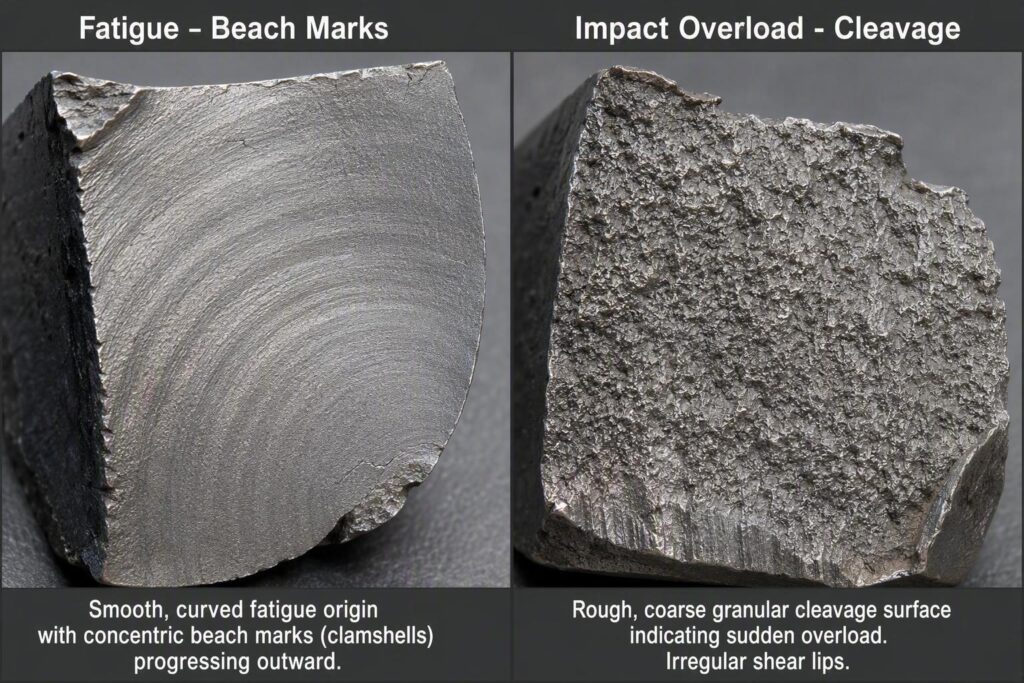
Quick Answer: Shear blade edge chipping root cause falls into two modes: fatigue (from cyclic stress — clearance errors, parallelism faults, or grinding burns) and impact (from sudden overload — foreign objects, excessive hardness, or geometry spikes). Read the fracture surface first: concentric arc-shaped beach marks mean fatigue; coarse granular cleavage with no arc pattern means […]
Ajustes de Solapamiento en Cuchillas Circulares: Mecánica de Corte, Ventanas de Material y Control de Ejes

In continuous metal coil processing, achieving a clean, square, and burr-free edge is the primary benchmark of a well-calibrated slitting line. Behind every high-yield slitting run are two critical geometric parameters governing shear-cut quality: horizontal side clearance and vertical rotary knife overlap. While horizontal clearance dictates the stress concentration across the strip width, vertical knife […]
Cuchillas para Trituradoras de Neumáticos y VFU: Equilibrando Dureza y Tenacidad para Reducir el Coste por Tonelada
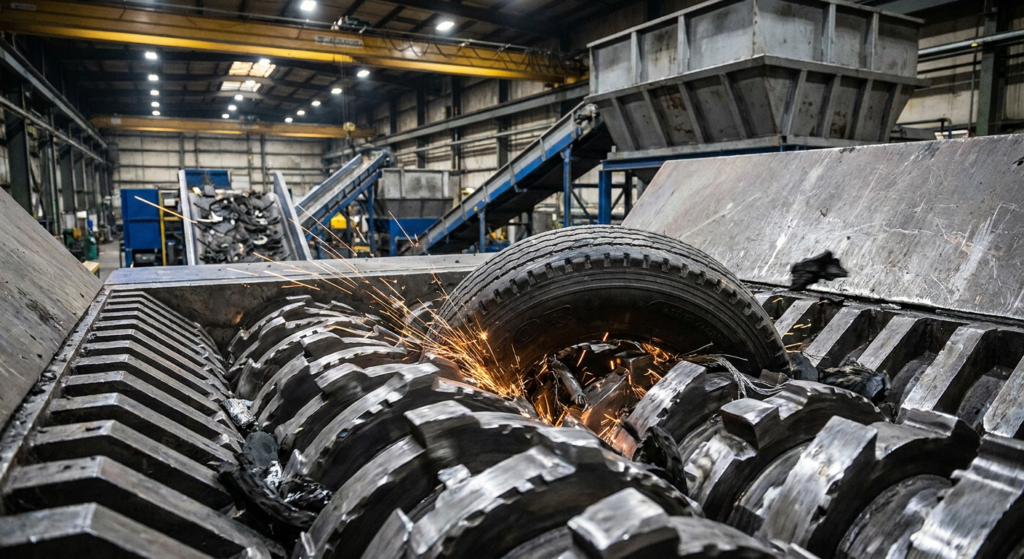
Quick Answer: Balance hardness (wear resistance) against Charpy impact toughness rather than maximizing HRC alone—DC53 at 58–60 HRC delivers roughly double D2’s impact toughness for contaminated tire/ELV streams, while a documented real-world case shows that fracture at mounting-hole geometry, not material hardness, is often the true root cause. Scope: This guide focuses primarily on primary and pre-shredding […]
Análisis de causa raíz del polvo de corte: Ra del flanco, microestructura de carburos y tolerancias.
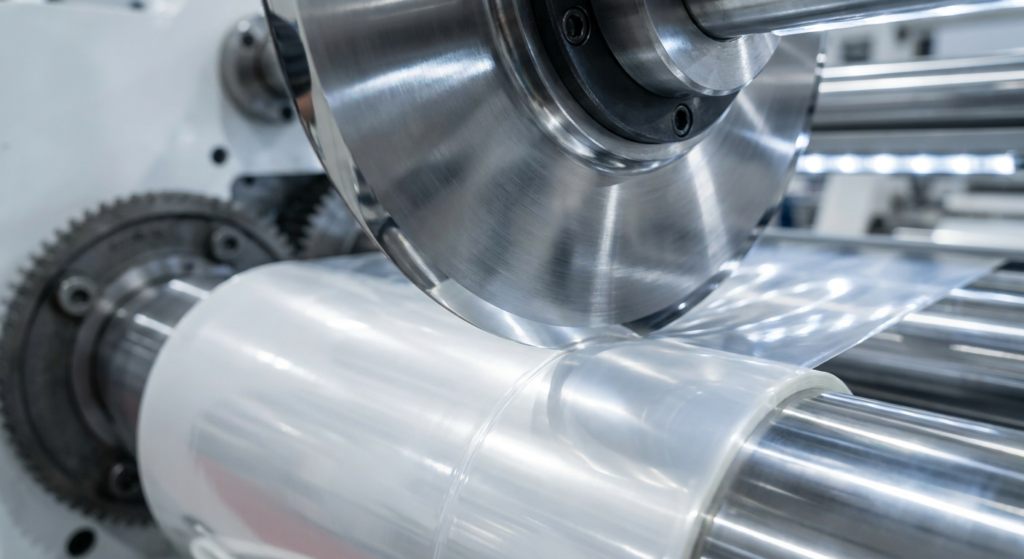
Estos cuatro principios forman el marco de ingeniería que el equipo de aplicaciones de Maxtor Metal aplica al calificar cuchillas circulares de corte longitudinal para programas de conversión sin polvo en líneas de embalaje flexible, telas no tejidas y papel de especialidad. En la conversión de embalaje flexible de alta velocidad, textiles técnicos, telas no tejidas y papel de especialidad, la contaminación por partículas es una de las principales causas de paradas no programadas de la línea. Lo que los operadores de planta diagnostican con frecuencia […]
Reafilar Cuchillas Industriales de Tira: Umbrales de Afilado, Criterios de Desecho y Modelo de Costo del Ciclo de Vida
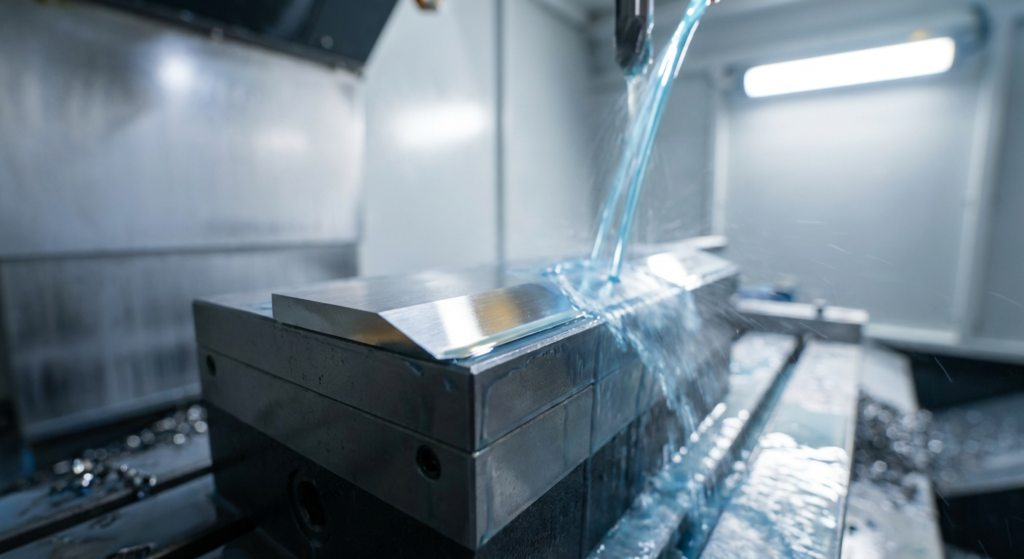
Quick Answer: Regrinding industrial strip blades is economical when: chipping depth is under 0.5 mm, remaining thickness is above 60–70% of nominal, and the estimated regrind cost is below 50% of a new replacement blade. The minimum safe stock removal is 0.010–0.015 in (0.254–0.381 mm) to clear the subsurface micro-fractured fatigue layer. Blades with radial cracks, […]
Cuchillas granuladoras de metalurgia de polvos M390 vs CPM S90V: Selección de grado bajo alto desgaste por fibra de vidrio
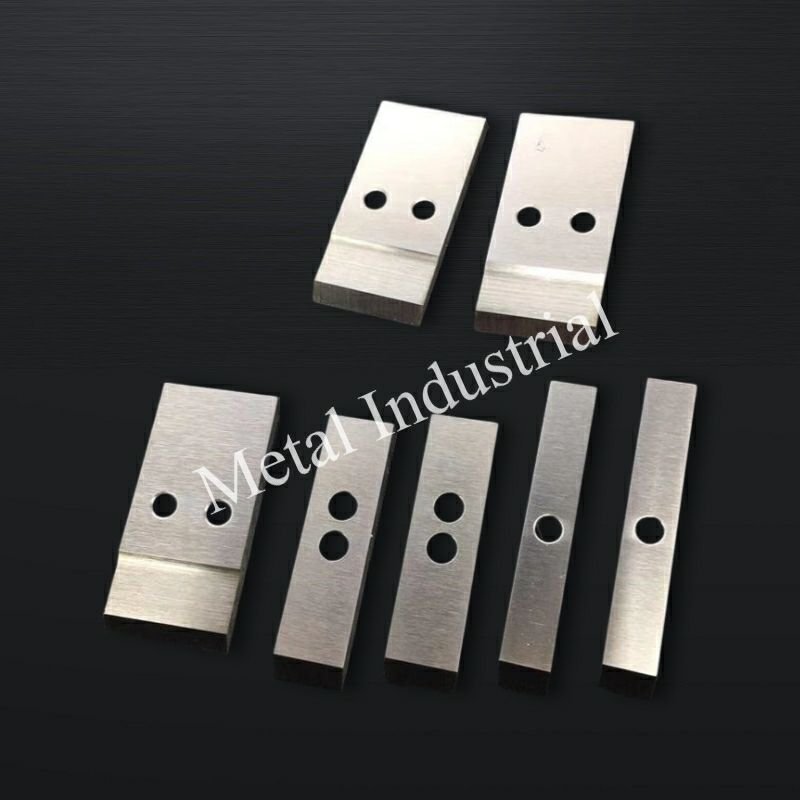
Respuesta rápida: Para las cuchillas de peletizado sometidas a un alto desgaste por fibra de vidrio, los aceros inoxidables pulvimetalúrgicos superan a los aceros de herramientas convencionales porque su distribución fina y uniforme de carburos resiste el micro-arado sin los compromisos de tenacidad de los aceros de lingote de alta aleación. Entre M390 y CPM S90V: elija CPM S90V cuando la carga de abrasión sea el modo de fallo dominante (>30% GF, agua neutra); elija M390 cuando […]

 English
  Spanish
  Italian
  French
  Portuguese
  Russian
  German
  Arabic
  Hindi
Hindi  Vietnamese
  Indonesian
  Japanese
  Korean