
医療用ポリマー加工用ペレタイザーナイフの選定:420 vs 440Cステンレス、表面仕上げ、水循環制御の最適化
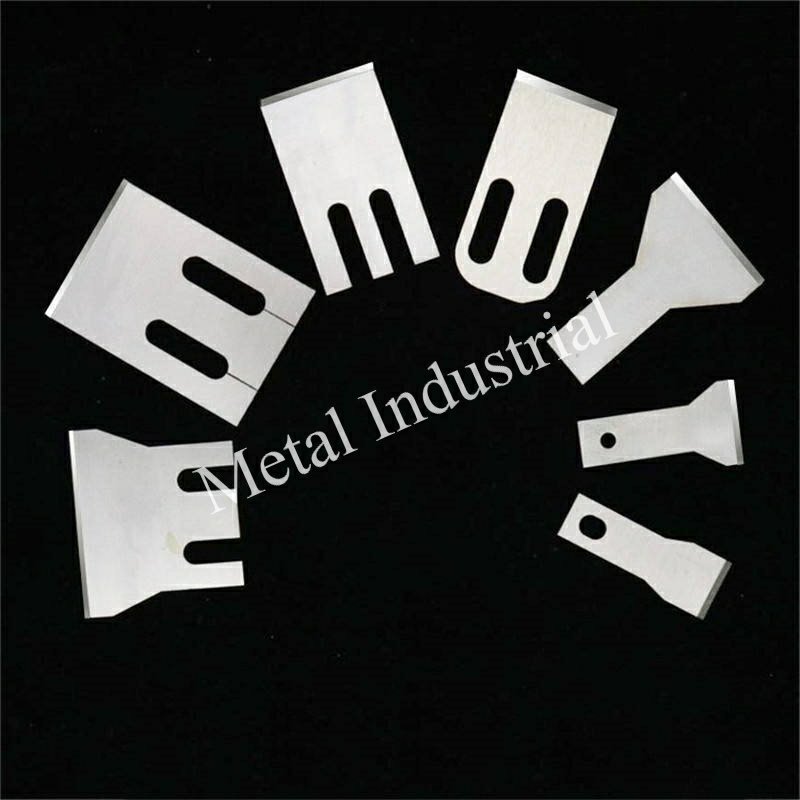
Quick answer: In medical-grade polymer pelletizing, 420 and 440C stainless are not interchangeable: 420 offers higher toughness, better polishability, and more corrosion tolerance in sanitization-intensive or variable-chemistry water loops; 440C delivers superior edge retention for abrasive polymers in stable, controlled-chemistry loops. Both grades require Ra ≤ 0.4 µm mirror finish and verified passivation per ASTM A967 — surface engineering, not alloy grade alone, is the primary contamination-prevention control. Black specks in medical pellets are most often a system problem: corrosion debris from the water loop and wear fragments from an underspecified knife acting together. Black specks in medical-grade polymer pellets rarely have a single source. Production teams often attribute them […]
M390 vs CPM S90V 粉末冶金ペレタイザーナイフ:高ガラス繊維摩耗下における鋼種選定
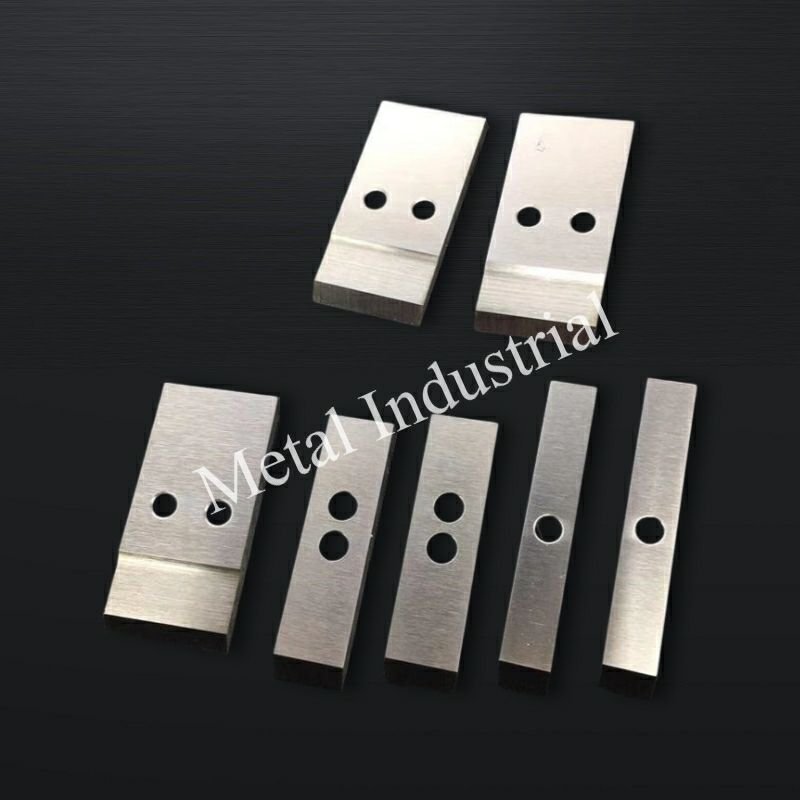
Quick answer: For pelletizing blades under high glass-fiber wear, powder metallurgy stainless steels outperform conventional tool steels because their fine, uniform carbide distribution resists micro-ploughing without the toughness trade-offs of high-alloy ingot steels. Between M390 and CPM S90V: choose CPM S90V when abrasion load is the dominant failure mode (>30% GF, neutral water); choose M390 when corrosion resistance, thin blade geometry, or multi-resin flexibility is the priority. Both require cryogenic post-quench treatment and PM-specific grinding protocols to reach their rated HRC and edge geometry. Powder metallurgy (PM) stainless steel, in the context of pelletizer blade manufacturing, refers to steels produced by atomizing molten alloy into fine powder, then consolidating under heat […]
TPU水中ペレタイジングナイフの樹脂ガミング現象:DLC vs PTFEコーティングの選定と最適運転条件(Operating Window)
Quick answer: Knife gumming in TPU underwater pelletizing is a system problem, not just a coating problem. The fastest fix is to address the mechanism first (restore cutting-plane stability and quench consistency), then select coatings: DLC on cutting-edge faces for hardness and low friction, PTFE on low-wear non-edge faces for adhesion reduction. Running DLC without fixing alignment or thermal drift rarely holds — validated operating windows and KPI logging are what make gains stick. Knife gumming in TPU underwater (die-face) pelletizing usually shows up the same way: pellet surfaces start to smear, tails (often called angel hair on the shop floor) increase, and fines climb until the dryer screens or water filters tell […]
水中ペレタイザーの稼働率を最大化する超硬造粒刃の材質グレード、意匠設計、および管理
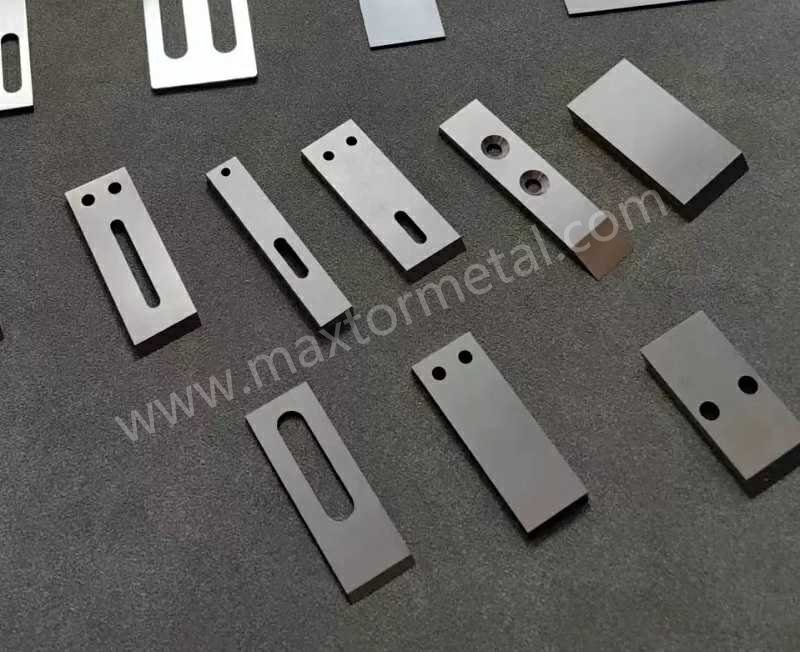
クイックアンサー:水中ペレタイザーラインにおける安定したダイフェイスカットは、4つの変数の相互作用に依存します。それらは、超硬グレード(ほとんどのWC–CoインサートでHRA 88–92)、刃先形状(単に「鋭利」なだけでなく、制御されたアール形状)、接触圧管理(エンゲージ→トリムの順で行い、圧力を追いかけすぎない)、および水循環の安定性(40–60°C、ろ過・脱気済み)です。ダイフェイスの状態やカッターヘッドのバランスを考慮せずにインサートだけを交換することは、超硬へのアップグレードが期待通りの効果を発揮しない最も一般的な原因です。ダイフェイスペレタイジングにおけるタングステンカーバイドインサートとは、スチール製のキャリアブロックにろう付けされた焼結WC–Co切削エレメントであり、連続的なポリマー加工において1,000〜4,000 RPMの速度で回転するダイフェイスに対して安定した切れ刃を維持するように設計されています。LDPEやPPのメガスケールラインにおいて、稼働時間が失われる原因は […]
大規模石油化学生産向けナイフブロックの技術的品質評価(エンジニアリング・クオリフィケーション)
クイックアンサー:水リングペレタイザーナイフブロックを大量生産向けに適合させるには、4つの項目を検証します。基準面における振れ/TIR(通常≤0.03–0.04 mm)、ISO 21940に準拠したバランス等級(G6.3を基準とし、高速回転時はG2.5に強化)、ISO 20816に準拠した許容振動値(多くの場合≤2.8 mm/s RMS)、およびシリアル番号に関連付けられたEN 10204 3.1/3.2証明書による完全な材料トレーサビリティです。大規模なポリマー工場では、ナイフブロックの「摩耗」そのものを懸念しているわけではありません。彼らが懸念しているのは、それに伴う予期せぬ停止、すなわち振動の逸脱、ダイフェイスの損傷、ペレット品質の低下、および監査に耐えられないQA(品質保証)の追跡記録です。これが、ナイフブロックの技術的適合評価が単なる […]
ストランドカット vs 水リング式造粒:材質と TCO(総保有コスト)による選定
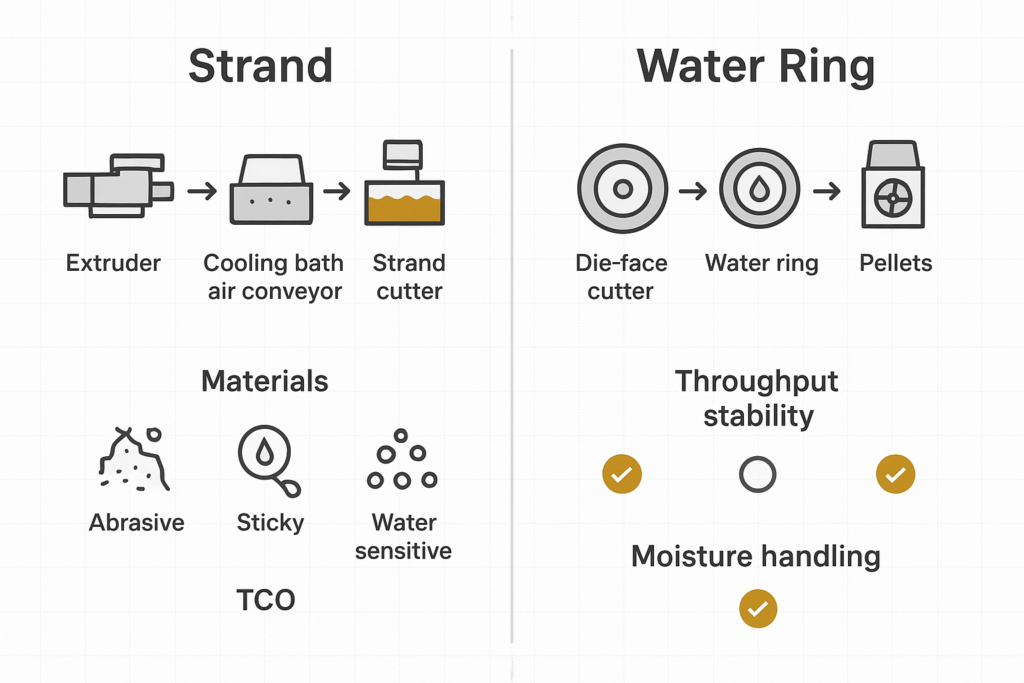
ストランドペレット化とウォーターリングペレット化の選択は、「湿式」切断か「乾式」切断かという好みの問題だけではありません。ペレットの品質を左右する要素、障害発生時に最初に故障する箇所、そしてトン当たりの実際のコスト(摩耗部品、乾燥、切り替え、スクラップ)がどこにあるのかが変わってきます。英国のコンパウンディングとリサイクル、特に高充填、ガラス繊維、鉱物含有、または高リサイクル含有の原料を扱う場合、誤った選択は、微粉、尾鉱、不安定なスループット、そして現実と完全に一致しないメンテナンス計画といった形で現れる可能性があります。このガイドでは、材料の挙動が各プロセスにどのように対応しているか、「安定したスループット」が日々実際に何を意味するのか、ペレット品質を制御する要素(ダイとナイフの組み合わせ、ギャップ制御、乾燥)がどのように機能するのか、そして実用的なTCOモデルについて学びます。[…]
ロータリーカッター:水冷ストランドカット(造粒)の究極ガイド
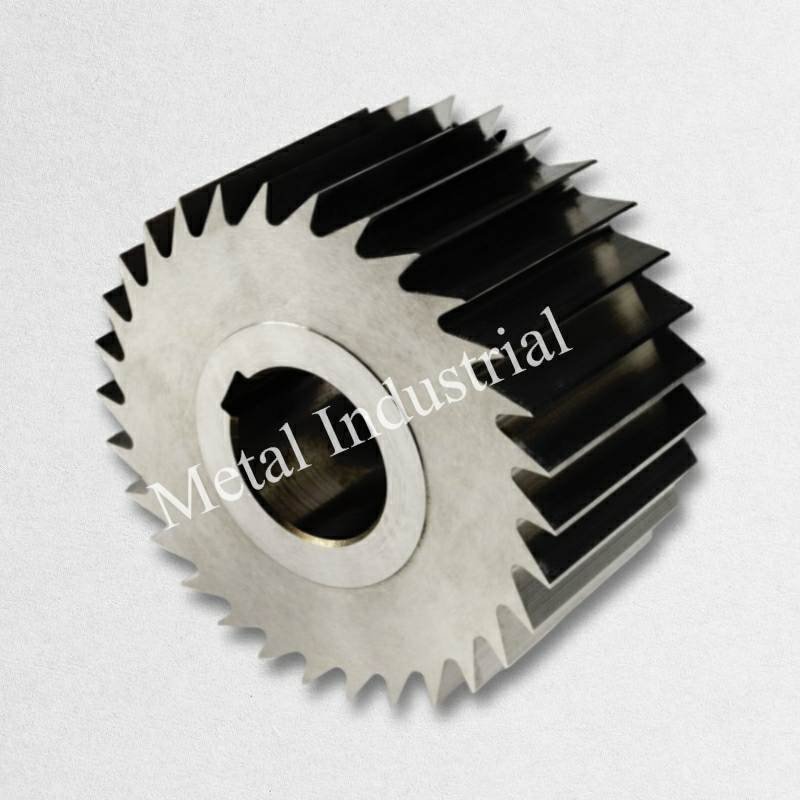
このガイドは、信頼性の高い切断品質、少ない切り替え回数、予測可能なコストを必要とする、水ストランドペレット化ラインを運用する配合業者のリーダー向けです。ペレットの長さと形状を安定させる技術要件、中国のロータリーカッター/ナイフ工場を自信を持って選定する方法、QC文書で要求すべき事項、着地コストとライフサイクル経済性を予期せぬ事態なくモデル化する方法を学びます。全体を通して、高リサイクル含有率、可変供給シナリオにおける信頼性、QCトレーサビリティ、OEM適合性、トン当たりのコストを優先します。水ストランドペレット化用のロータリーカッターのオプションを比較検討している場合は、これを評価基準として使用してください。主なポイント 水ストランドラインの要件 ペレットの長さと速度制御 ペレットの長さは […]
空冷PE/PP用ホットフェスカットナイフの選び方
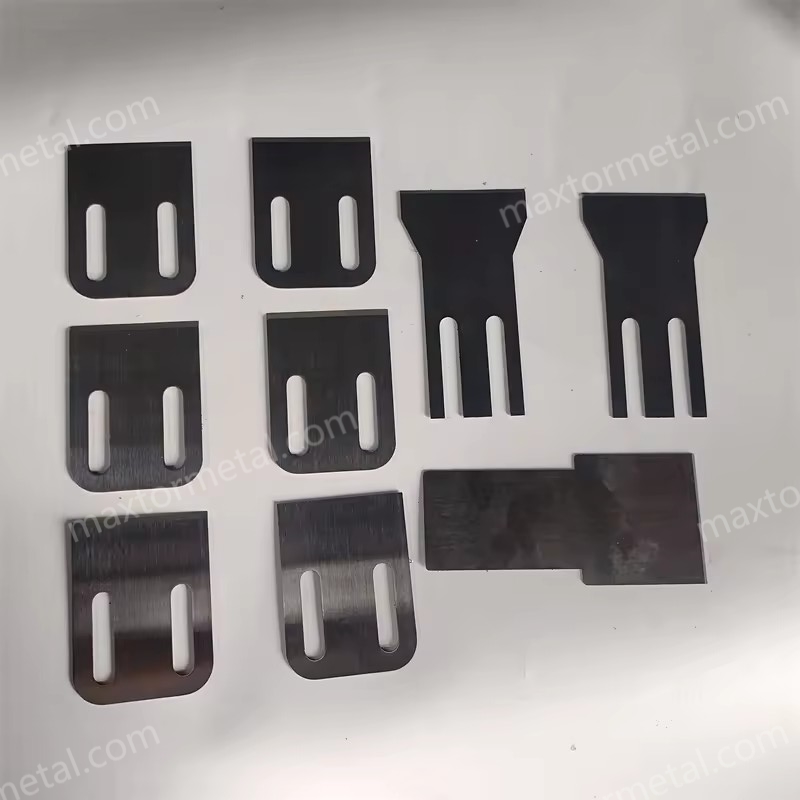
Selecting the right hot face pelletizing blades for air-cooled PE/PP isn’t just about material names on a quote. The right choice directly lowers tails and fines, stabilizes cut quality across shifts, and keeps uptime predictable so your total cost of ownership (TCO) tracks to plan. This guide shows you how to specify blade substrate, hardness, and coating; how to control geometry and tolerances for a clean cut; how to tune air-cooled operation; and how to manage lifecycle and sourcing for consistent, low-variance performance. Use it three ways: Key takeaways How this guide was built (scope & verification): This article synthesizes OEM design concepts (alignment/controlled contact), common coated-component QA methods (e.g., XRF […]
ガラス繊維強化樹脂の摩耗に打ち勝つペレタイザーナイフ
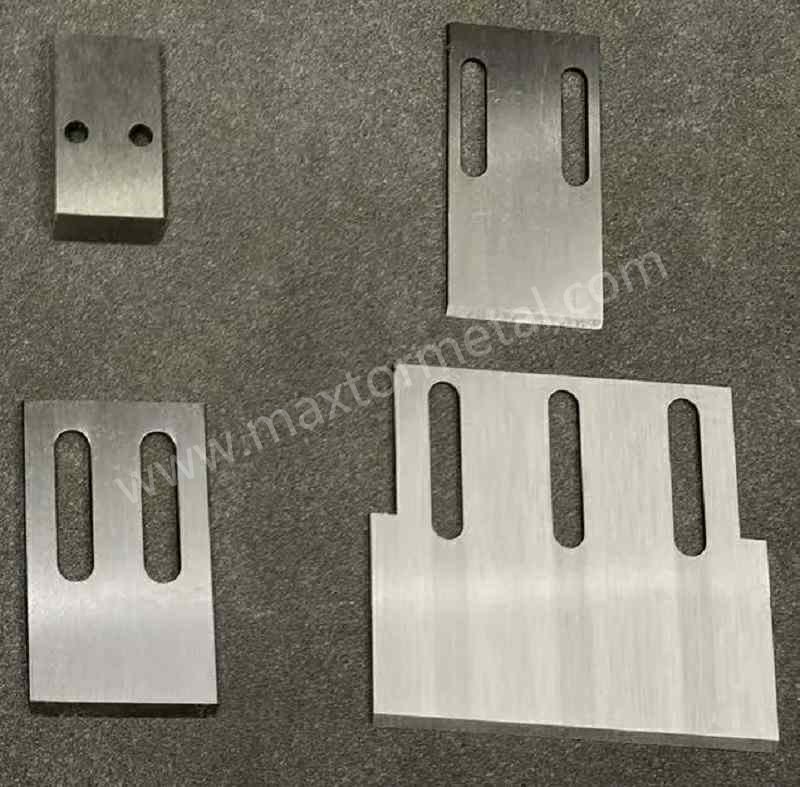
Introduction Glass fibers turn an ordinary polyolefin run into an abrasive slurry. Each chopped strand behaves like a microscopic file, accelerating edge rounding on blades and carving faint grooves into the die face. The result? Rising fines and tails, growing vibration, and more frequent blade swaps or regrinds. In die-face/water-ring (underwater) pelletizing of PP/PE with 10–40% glass fiber, this wear shows up faster and costs more in lost uptime and die reconditioning than in unfilled runs. Abrasion is only half the story. Water chemistry, temperature stability, and alignment also steer how quickly edges dull or chip. If those variables drift, you pay twice—once in pellet quality and again in total […]
ペレタイザーナイフの寿命を延ばす:ダウンタイムを削減するメンテナンス手法
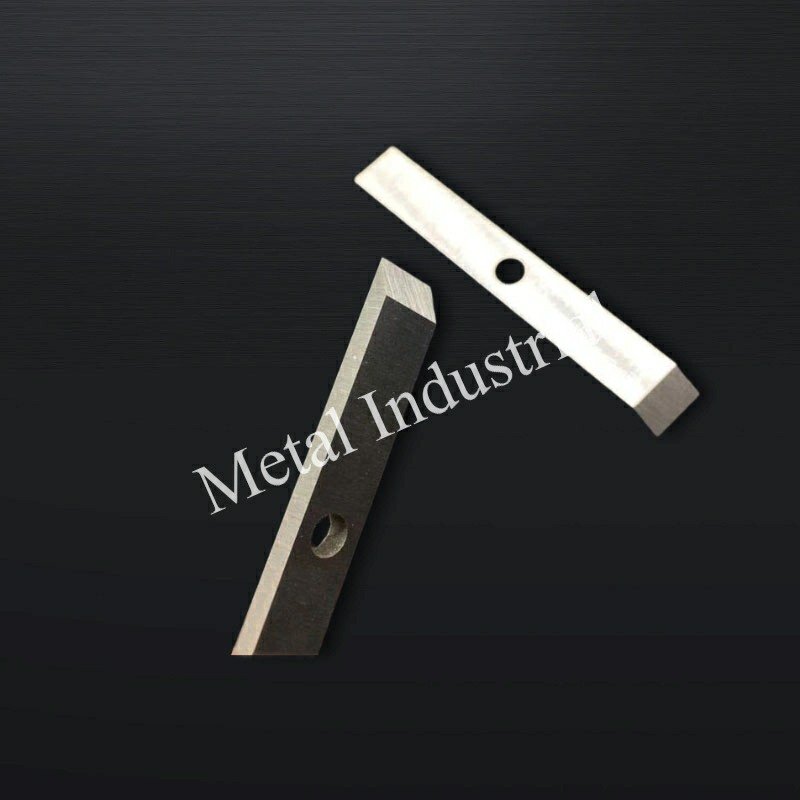
By Tommy Tang, Senior Sales Engineer (Nanjing METAL). 12 years supporting pelletizing and size-reduction blade applications. Certifications: CSE, CME, Six Sigma Green Belt, PMP. Scope and validation note: The numeric ranges in this guide are typical starting points used in plant practice. Always follow your OEM manual and site safety rules first, then confirm final setpoints with the A/B verification steps described below. Introduction Extending the working life of pelletizer knives is one of the fastest ways to stabilize pellet quality and keep uptime high. Longer-lived edges mean fewer emergency changeovers, more consistent pellet geometry, and less die-face rework. In short, effective pelletizer blade life extension turns small, routine checks into big gains […]

 English
  Spanish
  Italian
  French
  Portuguese
  Russian
  German
  Arabic
  Hindi
Hindi  Vietnamese
  Indonesian
  Japanese
  Korean