

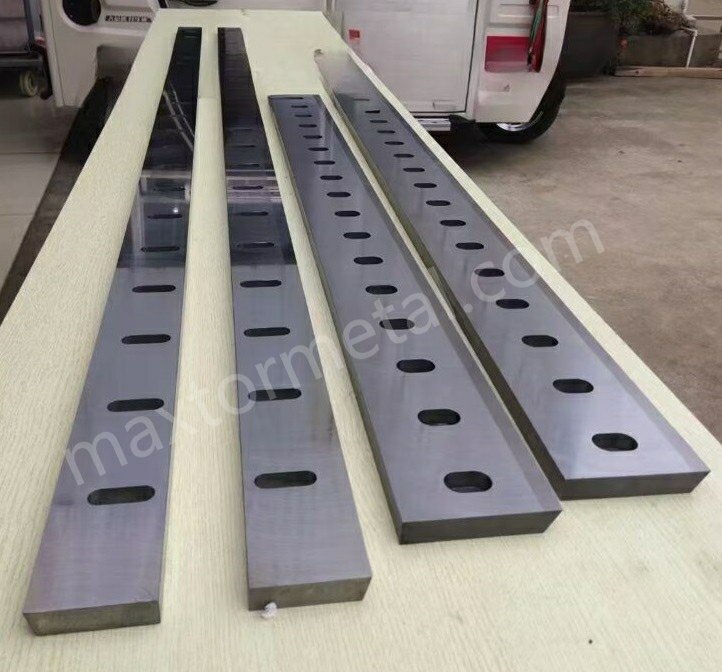
Respuesta rápida: Las cuchillas de cizallado con inserto de carburo de tungsteno suelen ofrecer una vida útil de la arista entre 2 y 3,5 veces superior a la de las cuchillas D2 en líneas AHSS. El ROI se impulsa principalmente por la reducción de eventos de cambio de herramienta y el menor desperdicio por inestabilidad del borde, no solo por el precio de la cuchilla. El control de la holgura y la restauración constante de la geometría de reafilado son las dos variables que más determinan si este multiplicador de vida útil se mantiene en producción.
Las líneas de AHSS/UHSS de ultra alto rendimiento no suelen fallar porque la cizalla «no pueda cortar». Fallan porque pequeñas inestabilidades —despostillado del borde, variación de la rebaba, variación de la holgura bajo carga o una geometría de reafilado inconsistente— se convierten silenciosamente en tiempos de parada, desperdicio y pérdida de OEE.
Esta guía está dirigida a responsables de producción y mantenimiento, ingenieros de procesos y compradores técnicos que operan (o están actualizando) líneas de corte a medida (CTL) y guillotinas aptas para AHSS. Si está evaluando cuchillas con inserto de carburo, el objetivo no es perseguir un titular de «aumento de vida útil», sino construir un análisis de ROI repetible que se sostenga al incluir la combinación de grados de acero, el tiempo de cambio de herramienta y los plazos de reafilado.
Para referencia sobre las configuraciones típicas de cuchillas de cizalla y formatos de pedido, puede comenzar con la cuchillas de cizalla Maxtor Metal página; luego, utilice el modelo y los puntos de control a continuación para validar el ajuste y la viabilidad económica para su línea específica.
- A quién va dirigida esta guía y el contexto de AHSS/UHSS
- Qué cambia el rendimiento ultraalto en la selección y el mantenimiento de cuchillas
- Cómo impactan las cuchillas de cizalla con inserto de carburo de tungsteno en la vida útil, el control de rebabas y el TCO
En AHSS, la ventana de corte se estrecha porque la resistencia es alta, el calor y la adhesión son más severos, y la acumulación de tolerancias (deflexión de la máquina + sujeción + paralelismo) cobra mayor importancia. Las directrices de AHSS de WorldAutoSteel señalan que la holgura (clearance) suele aumentar con la resistencia —pasando de aproximadamente el 6% del espesor para aceros suaves a cerca del 16% o más cuando la resistencia a la tracción supera los ~1400 MPa— y también destacan que la altura de la rebaba puede ser menos confiable como indicador de desgaste en AHSS que en acero suave (por lo que el monitoreo de la calidad del borde se vuelve más crucial).
Lo que cambia con un rendimiento ultraalto es simple: no solo se necesitan cuchillas «más duras». Se necesita un sistema que mantenga la arista estable entre las intervenciones programadas: intervalos de reafilado predecibles, una preparación del borde controlada y un bucle de control de calidad que evite la variación de la geometría entre lotes.
Las cuchillas de cizalla con inserto de carburo de tungsteno se evalúan a menudo por tres razones prácticas:
- Estabilidad de la vida útil frente al desgaste en el filo de corte (especialmente cuando varían los grados y las condiciones de la superficie)
- Control de rebabas a lo largo del tiempo (menor desviación a medida que el filo se desgasta)
- Menor costo total de propiedad (TCO) cuando se tienen en cuenta los cambios de herramienta, los reafilados y el desperdicio
Nota de ingeniería: Las cuchillas de cizalla con inserto de carburo de tungsteno son herramientas de corte de precisión en las que un filo de carburo de tungsteno soldado se integra en un cuerpo de acero aleado D2 o H13, combinando la tenacidad del acero para herramientas con la resistencia al desgaste del carburo en la cara de corte. Para las líneas de cizallado de AHSS y UHSS, esta construcción prolonga la estabilidad del filo entre eventos de reafilado y reduce la desviación de rebabas bajo condiciones variables de grado y superficie, siempre que se mantengan el control de holgura, la alineación y la restauración de la geometría de reafilado. [→ See Maxtor Metal shear blade technical overview]
Puntos de referencia de rendimiento de cuchillas de cizallado con inserto de carburo de tungsteno
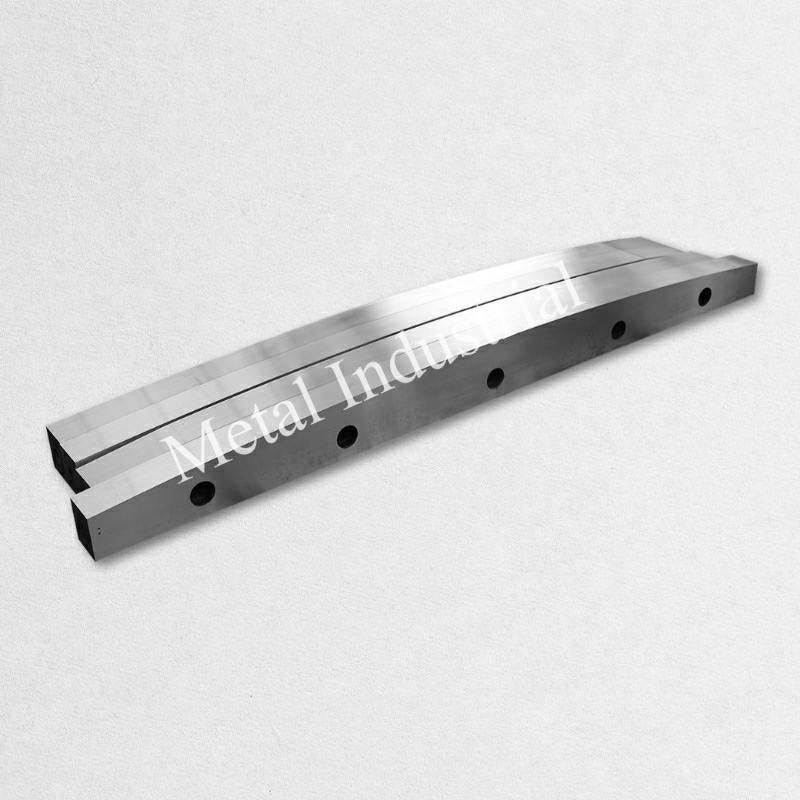
Multiplicadores de vida útil frente a aceros D2/de alto contenido de vanadio
Las cuchillas con inserto de carburo suelen justificar su ROI cuando el modo de falla actual es el deterioro del filo (microastillamiento, desgaste acelerado en el filo, inestabilidad de rebabas) en lugar de un impacto mecánico accidental.
En lugar de confiar en una afirmación universal de “X veces más vida útil”, realice una evaluación comparativa con dos indicadores medibles en planta:
- Metros (o toneladas) por filo afilado hasta que se alcance el límite de activación de calidad
- Estabilidad del tiempo hasta la activación a través de la mezcla de grados (la misma cuchilla no debería comportarse como dos herramientas diferentes al cambiar de HSLA a AHSS)
Una forma útil de comparar con los aceros para herramientas D2 o de alto contenido de vanadio es realizar una prueba piloto controlada en sus 2 o 3 grados principales y en una condición de “peor caso” (material recubierto, mayor cascarilla superficial o su proceso posterior más sensible a las rebabas). El modelo de ROI que se presenta más adelante en esta guía le permitirá convertir cualquier relación de vida útil observada en costo por metro/tonelada.
Profundidad del inserto, acabado del filo y objetivos de micro-honeado
Para las líneas de AHSS, el filo realiza dos trabajos a la vez: debe resistir el desgaste abrasivo/adhesivo y, al mismo tiempo, mantener la tenacidad suficiente para evitar el astillamiento por fragilidad.
Tres parámetros suelen dominar los resultados:
- Profundidad del inserto: Un inserto más profundo generalmente admite más reafilados totales antes de alcanzar el límite del inserto.
- Acabado de borde: El acabado superficial en la cara de corte influye en la fricción, la generación de calor y la adhesión.
- Micro-honeado: Un micro-honeado controlado reduce la “fragilidad del filo de la cuchilla” y puede mejorar la estabilidad del filo, especialmente cuando la holgura no es perfectamente uniforme a lo largo de la longitud.
Los mejores valores objetivo dependen del espesor, la resistencia y de si su línea está limitada por rebabas o por geometría. La clave es definir los criterios de aceptación (consulte la sección de control de calidad) para que los reafilados no desvíen silenciosamente el micro-honeado y alteren el comportamiento de las rebabas.
Como referencia general, los anchos de inserto en el rango de 3–6 mm son comunes para las cuchillas de cizalla de guillotina y CTL; la profundidad del inserto está regida por la tolerancia del espesor de la cuchilla y el número total de ciclos de reafilado requeridos.
En Maxtor Metal, las cuchillas de cizalla con inserto de carburo se fabrican con una geometría de inserto documentada y registros de acabado superficial posteriores al rectificado, lo que garantiza que las especificaciones de micro-honeado y cara de corte establecidas en fábrica sean trazables a lo largo del ciclo de reafilado.
Activadores de intervalos de reafilado y conteos típicos
En aceros dulces, la altura de la rebaba a menudo aumenta con el desgaste y puede ser un activador directo. En AHSS, las Directrices de AHSS de WorldAutoSteel señalan que la altura de la rebaba puede permanecer relativamente constante incluso a medida que la herramienta se desgasta, razón por cual un conjunto de activadores más amplio es más seguro.
Usar dos activadores: uno para la calidad del filo y otro para el riesgo.
- Activadores de calidad del filo (elija lo que más afecte a su proceso posterior):
- desviación de la rugosidad de la zona de fractura
- transición desigual entre bruñido y fractura
- microastillamiento visible o marcas de líneas que se correlacionan con la desviación de las rebabas
- Activadores de riesgo:
- aumento del tiempo de cambio debido a dificultades de alineación
- incremento en la frecuencia de ajuste para mantener la tolerancia
- incremento de eventos de descarte concentrados después de los cambios de grado
Estos conjuntos de activadores se asocian directamente con consultas de búsqueda comunes como intervalo de reafilado de cuchillas de cizalla y le ayudan a estandarizar cuándo deben intervenir los operadores.
El número total de reafilados típicos varía según la profundidad del inserto, la tolerancia del espesor de la cuchilla y la precisión con la que se restaura la geometría en cada ciclo. El punto práctico: debería ser capaz de predecir un rango esperado de ciclos antes que usted asume, ya que el modelo de ROI depende de ello.
Ajuste y control de fallos
La configuración es donde se gana o se pierde la mayor parte del ROI. Una cuchilla premium que funciona en una configuración desajustada se convierte en un consumible costoso.
Si su principal queja es el control de rebabas en el cizallado de AHSS que se desvía durante una corrida, las dos palancas que suelen importar más son (1) mantener la uniformidad de la holgura de extremo a extremo y (2) mantener la preparación del filo constante después de cada reafilado. Tome muestras del aspecto de la zona del filo con una frecuencia fija (por número de bobinas o por turno) y correlaciónelas con la frecuencia de ajuste y los eventos de reafilado.
Objetivos de holgura para AHSS delgado y acero inoxidable
Para AHSS delgado y acero inoxidable, piense en la holgura como un porcentaje del espesor, luego verifique que se mantenga constante de extremo a extremo bajo una sujeción real.
de WorldAutoSteel Directrices de AHSS explican que la holgura suele aumentar con la resistencia (de ~6% a ~16%+ en regímenes de mayor resistencia), y también advierten que las holguras tanto demasiado pequeñas como demasiado grandes generan distintos modos de fallo.
Objetivos prácticos de partida (para luego validar con cortes de prueba e inspección de filos):
- Holgura de la cuchilla de cizalla para AHSS: comience en el rango de 10–16% del espesor para resistencias más altas, y ajuste según el aspecto del filo y la sensibilidad al agrietamiento.
- Acero inoxidable (calibres delgados): a menudo requiere una holgura mayor que el acero dulce para evitar el doble cizallamiento y el endurecimiento por deformación excesivo; valide con el aspecto de la zona del filo y el comportamiento de las rebabas.
Conclusión clave: En AHSS, no considere únicamente la altura de la rebaba como señal de que “la holgura es correcta”; monitoree el comportamiento de toda la zona del filo de corte y su estabilidad a lo largo del tiempo.
Alineación, ángulo de inclinación y sujeción uniforme
Si solo implementa un cambio de disciplina para AHSS, que sea este: trate el paralelismo y la uniformidad de la sujeción como variables de calidad, no como variables de mantenimiento.
- Alineación: verifique el paralelismo en múltiples puntos a lo largo de la longitud de la cuchilla, no solo en los extremos.
- Ángulo de inclinación: elija una estrategia de inclinación coherente con su mezcla de materiales; los ángulos extremos pueden reducir la fuerza, pero también pueden cambiar los patrones de deformación en materiales delgados.
- Sujeción: una sujeción no uniforme crea picos de holgura locales; esos picos suelen ser donde comienza el astillamiento y donde la desviación de las rebabas se vuelve “misteriosa”.”
Estrategias de calor, adhesión y preparación del filo
El AHSS y el acero inoxidable amplifican dos problemas: calor y adhesion.
- Calor: una mayor carga combinada con la fricción puede ablandar las zonas locales y acelerar el desgaste; el calor también amplifica el riesgo de microastillamiento cuando el filo está demasiado afilado.
- Adhesión: el acero inoxidable en particular puede sufrir transferencia de material y arrastre; esto cambia la holgura efectiva y puede causar marcas en los bordes.
Estrategias de preparación del filo que tienden a estabilizar el comportamiento:
- utilice un micro-honeado controlado en lugar de un filo de navaja frágil
- mantenga las caras de corte con un acabado constante después de cada reafilado
- si la adhesión es el problema dominante, concéntrese en el estado de la superficie y la disciplina de limpieza (las capas de adhesión se convierten en un cambio geométrico)
Protocolos de reafilado y control de calidad (QC)
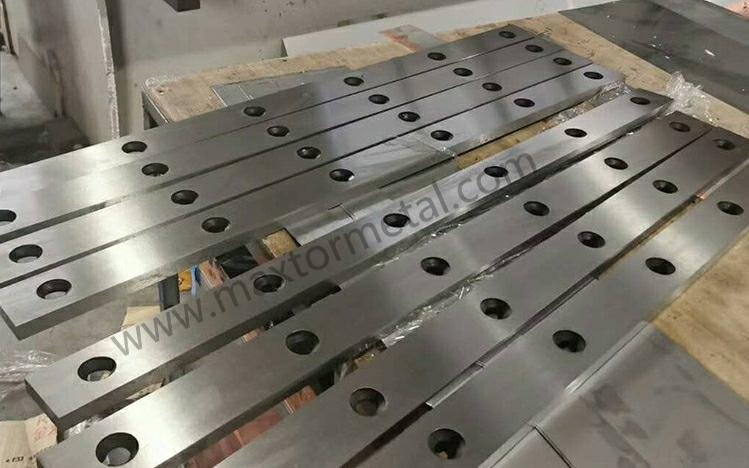
Límites de inserto, pasos de reafilado y ciclos totales permitidos
El inserto de carburo cambia la pregunta del reafilado de “¿cuántas veces podemos afilar?” a “¿cuántas veces podemos afilar antes de comprometer el sistema de inserto?”
Su protocolo debe definir:
- profundidad mínima restante del inserto (punto de parada)
- pérdida máxima permitida de espesor por reafilado
- cómo preservar la preparación del filo (micro-honeado) a lo largo de los ciclos
- una regla para determinar cuándo una cuchilla es “reafilable” frente a “descarte” (grietas, problemas de integridad de la soldadura, pérdida de geometría)
For the shim calculation method used to compensate for thickness loss after each regrind cycle, see la guía de compensación de la reducción de espesor por reafilado y apilamiento de calas.
Geometry restoration, surface finish (Ra), and acceptance criteria
Regrind ROI only works if geometry restoration is disciplined.
Recommended acceptance criteria categories:
- Geometría
- straightness along the cutting edge
- parallelism across the length
- consistent bevel geometry (no “soft corner” drift)
- Acabado superficial
- cutting face finish should be controlled and repeatable (track Ra or an equivalent surface-finish measure)
- Edge condition
- no micro-chipping beyond your defined threshold
- consistent micro-hone (do not allow “sharper every time” drift)
Maxtor Metal’s post-grind acceptance protocol covers all three categories above—geometry, surface finish, and edge condition—with traceable inspection records returned with each regrind batch.
For documentation of edge requirements on drawings, the standard for indicating undefined edge requirements in technical product documentation is ISO 13715:2017. Even if you don’t use the symbology directly, aligning your internal acceptance language to a recognized standard reduces ambiguity between shifts, suppliers, and regrind vendors.
Maxtor Metal supports carbide-inlaid blade manufacturing with in-process QC checks and can provide regrind service with traceable inspection records, which helps keep geometry and batch consistency under control.
Documentation, MTCs, and batch consistency checks
For AHSS lines, procurement risk is often hidden in variation: the same part number behaves differently across batches.
A practical documentation pack for each batch should include:
- MTC / material traceability for the base body and inlay material where applicable
- hardness / heat-treatment evidence where relevant
- inspection reports for key dimensions (thickness, straightness, parallelism)
- regrind history log (cycle count, removed stock, post-grind inspection)
This doesn’t have to be bureaucratic. The point is to make root-cause work fast when you see burr drift or chipping: you can separate setup issues from batch variation.
Modelo de TCO y ROI
Inputs, formulas, and amortization logic
The TCO structure below reflects how Maxtor Metal frames cost conversations with high-throughput AHSS lines: total cost per meter, not blade price.
A useful ROI model turns “blade life” into cost per meter (or cost per ton) and adds the costs that typically dominate in high-throughput lines: downtime and scrap.
This is the backbone for a practical total cost of ownership for shear blades comparison, because it forces every assumption (life, regrinds, changeover minutes) into the same unit.
Define these inputs:
C_blade: purchase cost of one blade setN_edges: usable edges per set (including flips/rotations if applicable)L_edge: meters (or tons) per edge between regrinds/replacementsN_regrinds: total regrinds achievable before scrap (bounded by inlay limit + geometry tolerance)C_regrind: cost per regrind cycleT_change: changeover time per event (hours)C_downtime: fully-loaded downtime cost per hourC_scrap: scrap/rework cost per ton (or per meter)S_scrap: scrap rate attributable to cut-edge instability (as a fraction)
A simple amortization structure:
- Blade amortization per meter
Copy-and-paste ROI calculator template
If you want a template that’s easy to move into Excel, start with this table and fill in your own line data. Keep units consistent (meters o tons) across every row.
| Aporte | Símbolo | Tu valor | Units / notes |
|---|---|---|---|
| Blade set purchase cost | C_blade | $ per set | |
| Usable edges per set | N_edges | count (include flips/rotations) | |
| Life per edge to trigger | L_edge | meters/edge or tons/edge | |
| Total regrinds before scrap | N_regrinds | count (bounded by inlay + tolerances) | |
| Regrind cost per cycle | C_regrind | $ per regrind | |
| Changeover time per event | T_change | hours/event | |
| Downtime cost | C_downtime | $/hour (fully loaded) | |
| Scrap cost | C_scrap | $/ton or $/meter | |
| Scrap rate due to cut-edge instability | S_scrap | fraction (e.g., 0.009 = 0.9%) | |
| Producción | Fórmula | Resultado | Notas |
| — | — | — | — |
| Total life per blade set | Total_m | N_edges × L_edge × (N_regrinds + 1) | Use meters or tons consistently |
| Blade amortization per unit | Cost_blade_per_m | C_blade / Total_m | $/meter or $/ton |
| Regrind cost per unit | Cost_regrind_per_m | (C_regrind × N_regrinds) / Total_m | $/meter or $/ton |
| Downtime cost per unit | Cost_down_per_m | (T_change × C_downtime × (N_regrinds + 1)) / Total_m | Simplified; add extra events if unplanned |
| Scrap cost per unit | Cost_scrap_per_m | S_scrap × C_scrap | Convert units if needed |
| Total cost per unit | TCO_per_m | Sum of all costs above | Compare baseline vs carbide-inlaid |
This layout makes it easy to run the same model for baseline and carbide-inlaid scenarios, then compute deltas (TCO reduction, payback period, and ROI).
Cost_blade_per_m = C_blade / (N_edges × L_edge × (N_regrinds + 1))- Regrind cost per meter
Cost_regrind_per_m = (C_regrind × N_regrinds) / (N_edges × L_edge × (N_regrinds + 1))
- Downtime cost per meter (changeovers + regrinds)
Cost_down_per_m = (T_change × C_downtime × Events_total) / Total_meters
Then add scrap:
Cost_scrap_per_m = S_scrap × C_scrap(convert units consistently)
The ROI comparison is the delta:
ROI = (TCO_baseline - TCO_carbide) / Investment_delta
Example cost per meter/ton with placeholders
Below is a worked example using sample values to show how the math behaves. Replace the numbers with your own line data.
Assume:
C_blade = $6,000per setN_edges = 2L_edge = 200,000 mN_regrinds = 6C_regrind = $450
Total meters per set across life:
Total_m = N_edges × L_edge × (N_regrinds + 1) = 2 × 200,000 × 7 = 2,800,000 m- Blade amortization per meter:
$6,000 / 2,800,000 = $0.00214/m
- Regrind cost per meter:
($450 × 6) / 2,800,000 = $0.00096/m
If your dominant cost is downtime, you’ll see ROI swing heavily with changeover time.
Example downtime inputs:
T_change = 0.5 hoursper eventC_downtime = $3,000/hourEvents_total = 7(initial + 6 regrinds)
Downtime cost per meter:
($3,000 × 0.5 × 7) / 2,800,000 = $0.00375/m
This simple example shows why “unit blade price” often isn’t the lever—changeover hours and stability events are.
Sensitivity to gap control, grade mix, and regrind SLA
Three sensitivity levers usually dominate:
- Gap control (clearance uniformity)
- Poor gap control can erase life gains by triggering chipping and forcing early regrinds.
- Grade mix (strength + surface condition)
- If your schedule shifts toward higher-strength AHSS or more abrasive surface conditions, edge stability becomes more valuable.
- Regrind SLA (turnaround + consistency)
- Slow or inconsistent regrinds increase spare inventory requirements and increase the chance of geometry drift.
If you want one “finance-friendly” sensitivity output, model TCO under three scenarios (conservative / expected / optimistic) by varying only:
L_edge(life)T_change(changeover time)S_scrap(scrap attributable to edge instability)
A clean way to present sensitivity—without overfitting—is to vary only the assumptions that typically dominate TCO for high-throughput lines.
| Guión | Life per edge L_edge | Changeover time T_change | Edge-instability scrap S_scrap | What it represents |
|---|---|---|---|---|
| Conservative | lower-bound of your pilot band | higher-bound of your observed changeover | higher-bound of edge-related scrap | Setup drift, rougher surface condition, slower regrind turnaround |
| Expected | median of pilot band | median changeover | median scrap attribution | Normal operating cadence and grade mix |
| Optimistic | upper-bound of pilot band | lower-bound changeover (best-practice SOP) | lower-bound scrap attribution | Tight clearance control + consistent regrinds + stable material |
When you present the result, show rangos (not a single point estimate) for TCO per meter/ton and downtime minutes avoided. This usually makes the business case more credible than a single ROI number.
Guía práctica de implementación
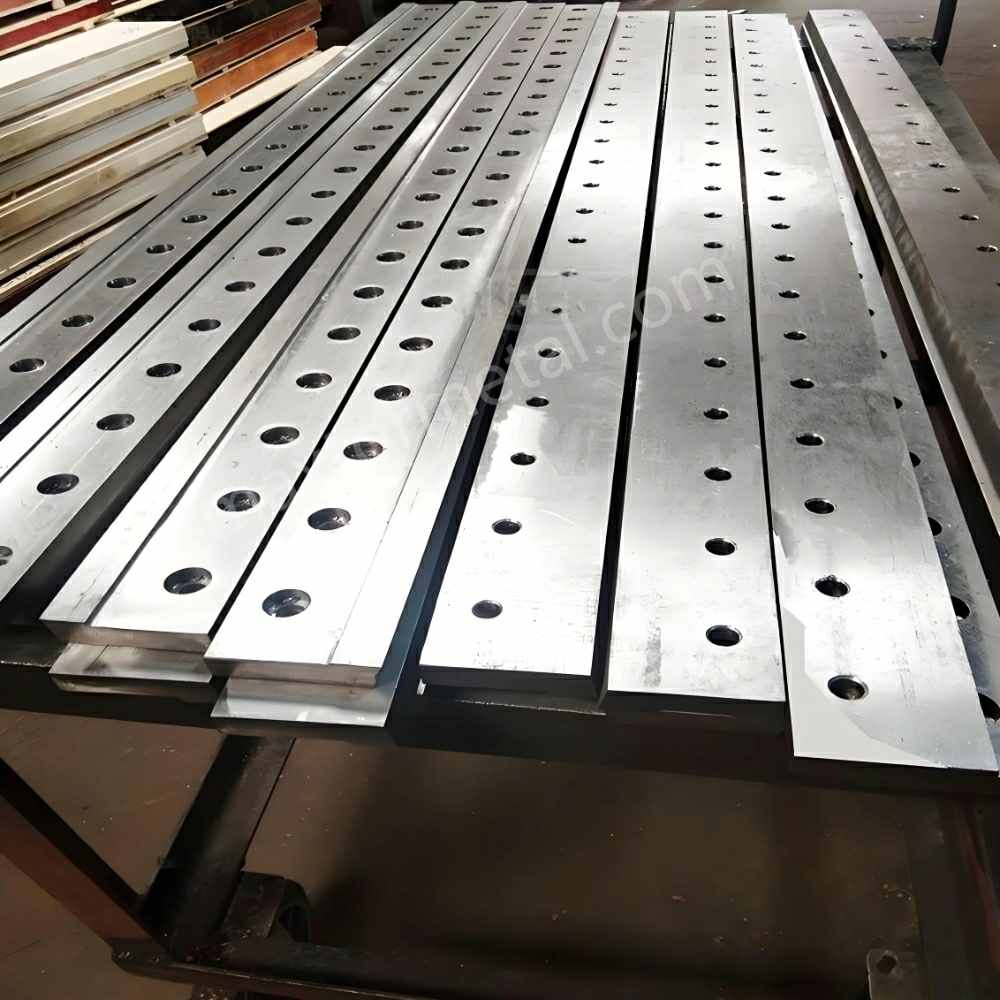
SOPs for changeover, inspection, and regrind logistics
The three SOPs below apply across all pilot contexts and should be locked before you scale to full production.
For a complete measurement-based rotation and regrind decision SOP applicable to guillotine shear blades—including burr threshold bands, edge-use sequence, and audit-ready log templates—see the SOP de programa de rotación de cuchillas reversibles de 4 filos y criterios de reafilado.
Resultados de la prueba piloto: Resumen de tres casos anonimizados
The fastest way to defend an ROI decision is to capture a small, controlled pilot and report results in the same units your plant already tracks: coils between regrinds, burr stability, setup interventions, scrap/rework, and OEE minutes.
Below are three anonymized pilots that illustrate where carbide-inlaid blades tend to pay back first. Use them as structure, not as a promise—your results will depend on grade mix, clearance control, clamping repeatability, and regrind consistency.
Pilot Case 1 — AHSS CTL on DP980
Contexto
- Material: DP980 (980–1000 MPa)
- Thickness: 1.2–2.0 mm
- Line: Coil-to-Length (CTL)
- Coil condition: Pickled & Oiled, light mill scale+
- Blade: Carbide-inlaid blade: D2 body + brazed ultra-fine WC edge, supplied by Maxtor Metal
Baseline vs carbide-inlaid configuration
- Baseline blade: D2 tool steel, 60–61 HRC
- Carbide-inlaid blade: D2 body (59–60 HRC) + brazed ultra-fine WC edge
- Carbide width: 4 mm
- Edge hardness: ~89 HRA
Triggers and measurement
- Triggers after ~40–50 coils on baseline:
- burr height approaching 0.10 mm
- increasing blade clearance adjustment frequency
- more frequent first-piece rechecks
- Measurement sequence:
- per coil: burr height measured at left/center/right using a 50× toolmaker microscope
- every 10 coils: log max burr, clearance, and edge radius
Pilot results
| Indicadores clave de rendimiento (KPI) | Baseline D2 | WC inlaid |
|---|---|---|
| Vida útil de la cuchilla | 1.0× | 2.9× |
| Coils between regrinds | 48 | 138 |
| Average burr | 0.082 mm | 0.039 mm |
| Unplanned setup events | 5/month | 2/month |
| Chatarra | 1.8% | 0.9% |
| OEE | 84.1% | 87.6% |
| Regrind SLA | — | 5 working days |
What this pilot taught
- DP980’s abrasiveness made edge-wear stability the primary lever.
- Keeping the same clearance settings used for D2 initially caused localized micro-chipping; a small clearance optimization restored stable behavior.
Pilot Case 2 — Guillotine line with heavy mill scale
Contexto
- Material: Hot rolled AHSS
- Thickness: 4–8 mm
- Line: Hydraulic guillotine
- Surface: heavy mill scale
- Blade: Carbide-inlaid blade: H13 body + brazed ultra-fine WC edge, supplied by Maxtor Metal
Baseline vs carbide-inlaid configuration
- Baseline blade: modified H13
- Carbide-inlaid blade: H13 body + brazed tungsten carbide edge; double-tempered
Triggers and measurement
- Scale-driven wear increased burr and forced frequent setup adjustments.
- Measurement:
- per shift: check burr, edge radius, and blade temperature
- weekly: verify straightness and flatness
Pilot results
| Indicadores clave de rendimiento (KPI) | Antes | Después |
|---|---|---|
| Vida útil de la cuchilla | 1.0× | 2.1× |
| Cambios mensuales de cuchillas | 4 | 2 |
| Setup time | 150 min/month | 70 min/month |
| Rehacer | 2.4% | 1.3% |
| Edge chipping | occasional | significantly reduced |
| Regrind SLA | — | 7 calendar days |
What this pilot taught
- Mill scale remained the dominant wear source. Carbide improved wear resistance, but without scale removal the life multiplier was lower than in pickled/oiled conditions.
Pilot Case 3 — High-volume automotive CTL
Contexto
- Material: CP780 + DP780
- Thickness: 1.6–2.5 mm
- Line: high-speed CTL
- Annual output: >60,000 t
- Blade: Carbide-inlaid blade: D2 body + brazed ultra-fine WC edge, supplied by Maxtor Metal
Baseline vs carbide-inlaid configuration
- Baseline blade: premium D2
- Carbide specification: fine-grain WC, vacuum brazed
- Surface finish target after grinding: Ra ≤ 0.2 μm
Triggers and measurement
- High cadence required planned weekly stoppages; burr began to affect downstream weld quality.
- Measurement:
- first-piece: burr height
- every 20 coils: microscope check, clearance, edge radius
- every regrind: flatness, parallelism, thickness
Pilot results
| Indicadores clave de rendimiento (KPI) | Antes | Después |
|---|---|---|
| Vida útil de la cuchilla | 1.0× | 3.4× |
| Regrind interval | 2 semanas | 7 weeks |
| Max burr | 0.11 mm | 0.05 mm |
| Planned downtime | 9 h/month | 4 h/month |
| Customer edge claims | 3/quarter | 0–1/quarter |
| Estimated TCO | baseline | ~18% reduction(blade amortization + regrind + changeover inputs; calculated using TCO model above) |
| Regrind SLA | — | 3–4 working days |
What this pilot taught
- A fixed rotation + regrind schedule plus reinstall checks (parallelism + clearance) prevented installation variation from masking tooling differences. The ~18% TCO reduction was driven primarily by the regrind interval extension (2 weeks → 7 weeks) and the reduction in planned downtime (9 h/month → 4 h/month), with blade amortization contributing a smaller share at this throughput level.
A simple pilot record you can copy
Capture the pilot in one sheet so finance and production speak the same language:
- grade(s) + thickness range + surface condition
- meters/tons/coils to trigger (edge-quality + risk trigger)
- changeover minutes per event (median and worst 10%)
- scrap/rework attributable to cut-edge instability
- regrind SLA (days) and post-regrind acceptance results
- notes on clearance settings, clamping repeatability, and any setup changes during the pilot
Treat the blade as part of a controlled process, not a consumable:
- Changeover SOP: torque pattern, clamp inspection, parallelism verification points
- Inspection SOP: define the edge-quality triggers that force action (not just “looks dull”)
- Regrind logistics SOP: tagging, cycle counting, and post-regrind acceptance checks
Data capture, dashboards, and KPIs for OEE and quality
If you don’t measure it, you can’t defend the ROI.
Practical KPIs:
- meters/tons per edge to trigger
- regrind cycle count distribution (are you consistently hitting your expected band?)
- changeover time (median + worst 10%)
- scrap/rework events tied to burr/edge issues
- OEE loss minutes attributed to shearing (not generic “maintenance”)
Dashboards don’t have to be complex. A simple weekly report that ties regrind events to OEE minutes and scrap is enough to validate whether carbide-inlaid blades are paying back.
Supplier evaluation and SLA criteria for carbide tips and brazing
For carbide-inlaid blades, supplier evaluation should focus on repeatability as much as materials.
Key criteria:
- inlay integrity and consistency (process control and inspection evidence)
- documented geometry tolerances and inspection methods
- regrind capability and stated limits (what is the stop rule?)
- SLA clarity: turnaround time, rush options, and consistency commitments
- traceability: MTCs and batch records
Before committing to carbide-inlaid blades, confirm that the failure driver is not a correctable material-selection issue at the tool steel level. If your current blade is conventional EAF-melted D2 with coarse carbide banding rather than ESR-refined stock, a grade or refining practice change may extend life before a full carbide upgrade is needed. The comparative framework — carbide microstructure, failure mode analysis, and hardness recommendations for D2 vs SKD11 — is covered in the Guía de selección de acero para herramientas D2 vs SKD11 para cuchillas de cizalla.
If chipping is the trigger, reading the fracture surface distinguishes a fatigue event (clearance, parallelism, or grinding burn) from a true impact or hardness overload — the two require different fixes, and carbide will not resolve a fatigue-origin chip. The diagnostic workflow and corrective decision tree are covered in the Shear Blade Edge Chipping Root Cause Analysis: Fractography and Decision Tree.
FAQs:
P: ¿Qué holgura debo utilizar como punto de partida para AHSS en una cizalla de guillotina?
R: Comience con la holgura expresada como un porcentaje del espesor y, a continuación, valídela mediante cortes de prueba e inspección del borde. Las directrices de AHSS de WorldAutoSteel señalan que la holgura puede aumentar desde un ~6% (acero suave) hasta un ~16%+ para regímenes de muy alta resistencia; muchas aplicaciones de AHSS terminan en el rango del 10 al 16%, dependiendo del grado y del espesor.
P: ¿Por qué la altura de la rebaba es un mal indicador de desgaste en el cizallado de AHSS?
R: Porque el AHSS puede mantener una altura de rebaba relativamente constante incluso cuando la arista se desgasta. En la práctica, es más seguro activar acciones correctivas basándose en la apariencia de la zona de corte (uniformidad del bruñido/fractura), el microdespostillado y la estabilidad de la calidad de corte a través de los cambios de grado.
P: ¿Las cuchillas de cizalla con insertos de carburo de tungsteno siempre reducen la rebaba?
R: No siempre. Pueden mejorar la estabilidad de la rebaba con el tiempo al mantener la condición de la arista durante más tiempo, pero la rebaba sigue estando fuertemente controlada por la uniformidad de la holgura, el alineamiento, la sujeción y la restauración de la geometría de reafilado.
P: ¿Cuántas veces se pueden reafilar las cuchillas de cizalla con inserto de carburo?
R: Depende de la profundidad del inserto, la pérdida de espesor permitida por ciclo y la precisión con la que se restaure la geometría. Defina una regla de parada basada en el inserto restante, la tolerancia geométrica y cualquier signo de riesgo para la integridad de la pieza; luego, realice un seguimiento del número de ciclos reales con respecto a ese margen.
P: ¿Qué documentos de control de calidad (QC) debo exigir al comprar cuchillas de cizalla para AHSS?
R: Como mínimo: trazabilidad del material (MTC), inspección de dimensiones clave (espesor/rectitud/paralelismo) y un registro de historial de reafilado. Para el lenguaje de plano sobre los requisitos del borde, hacer referencia a la norma ISO 13715:2017 puede reducir la ambigüedad.
P: ¿Cómo calculo el coste por metro de las cuchillas de cizalla?
R: Desglose el TCO (Coste Total de Propiedad) en amortización de la cuchilla + reafilado + tiempo de inactividad + merma/OEE. Utilice Total_m=N_bordes×L_borde×(N_reafilados+1) y divida cada partida de costes por los metros totales (Total_m), luego compare el escenario base con el escenario de insertos de carburo.
P: ¿Cuál es la mayor palanca de ROI después del material de la cuchilla?
R: El tiempo de cambio de herramientas y el número de incidentes de estabilidad (reafilados no planned, adjustments y picos de chatarra/mermas). Si las cuchillas con insertos de carburo reducen las intervenciones, el ROI suele reflejarse primero ahí.
P: ¿Cómo vinculo la calidad del borde de corte con el riesgo de conformabilidad posterior?
R: Las pruebas basadas en normas, como el ensayo de expansión de orificio (hole expansion test), están diseñadas para cuantificar la sensibilidad agrietamiento del borde en chapas y flejes.
Para contextualizar, consulte la norma ISO 16630:2017la cual define el método de ensayo de expansión de orificio utilizado ampliamente para evaluar la conformabilidad del borde.
Conclusión
Decision checkpoints you can defend
Use this as a practical “go/no-go” lens before you scale carbide-inlaid blades across an AHSS/UHSS line:
- Is your constraint intervention-driven? If downtime minutes and stability events (unplanned regrinds, clearance adjustments, scrap bursts) dominate cost, carbide-inlaid blades usually have a clear path to payback.
- Can you hold clearance and clamping repeatably? If parallelism and uniform clamping drift, a premium edge becomes an expensive consumable.
- Do you have a repeatable regrind loop? ROI depends on consistent geometry restoration (flatness/parallelism/edge prep) and a regrind SLA that matches your production cadence.
- Do your triggers match AHSS reality? In AHSS, burr height alone can be misleading—combine an edge-quality trigger with a risk trigger so interventions happen antes scrap spikes.
- Can you trace performance back to batch + regrind cycle? Without serial/batch traceability, it’s hard to separate setup drift from batch variation.
Maxtor Metal can provide regrind acceptance criteria templates and traceability documentation aligned to the QC structure in this guide.
Next steps for implementation
- Run a short, controlled pilot across your top 2–3 grades plus one worst-case condition (coating, scale, or burr-sensitive downstream operation). Log coils/tons/meters to trigger, changeover minutes, and any edge-related scrap.
- Convert pilot data into cost per meter/ton using the TCO model (amortization + regrind + downtime + scrap). Build conservative/expected/optimistic scenarios for the assumptions that actually move the needle.
- Lock your regrind and QC acceptance criteria (geometry, surface finish, micro-hone/edge prep, traceability) so the tool you pilot is the tool you can reorder.
RFQ and drawing checklist for carbide-inlaid shear blades
Send this checklist with your RFQ to reduce back-and-forth and avoid specification gaps:
- Application and line context: CTL or guillotine; coil/sheet thickness range; grade mix; surface condition (pickled/oiled, scale, coated)
- Blade set details: quantity per set; usable edges/rotations; existing part number; mounting hole pattern and tolerances
- Geometry requirements: length/width/thickness; straightness; flatness; parallelism; bevel angle(s); rake strategy (if applicable)
- Edge prep requirements: micro-hone target (or allowed range); surface finish target on cutting faces (Ra, if specified)
- Carbide inlay requirements: inlay width/depth; braze method expectations; stop rule for minimum remaining inlay
- Operating targets: clearance % starting point and adjustment practice; burr threshold (if used); inspection cadence
- Paquete de documentación: EN 10204 3.1 / MTC with heat number traceability; hardness reports (HRC/HRA); dimensional inspection report; heat-treatment record; regrind history log
- Service requirements: regrind SLA (days); post-regrind acceptance checks; serialization/batch labeling
If your line is limited by burr drift, chipping, and changeover minutes, carbide-inlaid blades plus disciplined setup/QC can be a financially defensible upgrade. If your biggest losses come from upstream variability or non-repeatable clamping, fix those first—then reassess using the same pilot-and-TCO framework.
Autor: Nancy Wu, Senior Manufacturing Engineer, PE (Production Engineering), Maxtor Metal (12 years in industrial blade selection, CNC grinding programming, and regrind process control).
Cartas credenciales: SME – CMfgE; PMP; Six Sigma Black Belt; ASM International Certifications.
Materials expertise: D2, M2, H13, powder metallurgy steels, and tungsten carbide (manufacturing characteristics and coating behavior).
Methodology: This guide combines established AHSS shearing guidance (including WorldAutoSteel AHSS resources) with plant-facing ROI accounting (cost per meter/ton) and field pilot reporting. Pilot performance should be validated on your own line using a controlled grade mix, defined triggers, and consistent measurement routines.
Quality & traceability signals you can request from Maxtor Metal (example documentation pack)
- Incoming inspection: EN 10204 3.1 / MTC, heat number traceability, PMI when required, chemistry spot checks, optional ultrasonic testing for large billets
- Heat treatment: vacuum heat treatment, multiple temper cycles, batch hardness sampling and uniformity records (HRC for body; HRA for carbide)
- Dimensional inspection: thickness/width/length, flatness, straightness, parallelism, hole position, edge angle; full-length checks for long shear blades
- Surface and edge: Ra (surface roughness) records when specified, grinding pattern inspection, edge honing inspection, 100% visual inspection
- Equipment commonly used: digital micrometers, height gauge, granite surface plate, dial indicator, surface roughness tester, Rockwell hardness tester, optical microscope, precision straightedge; CMM spot checks for larger parts
- Shipping reports: dimensional inspection report, hardness report, first article inspection (FAI) when required, material certificate, heat-treatment certificate, surface finish record (per customer requirement)
- Traceability: unique blade serial number, batch number, material heat number, grinding batch, heat-treatment batch, record retention (e.g., ≥5 years)
- NCR controls: quarantine and NCR record, root-cause (5-Why/fishbone), MRB disposition (rework/remake/scrap), CAPA, and full re-inspection after rework with updated traceability

 English
  Spanish
  Italian
  French
  Portuguese
  Russian
  German
  Arabic
  Hindi
Hindi  Vietnamese
  Indonesian
  Japanese
  Korean